
Physiotherapy courses:
hand, elbow and shoulder
From assessment to custom splinting: five upper-limb courses, eligible for DPC and FIFPL funding, on-site and by e-learning.
In brief
The upper limb concentrates technical caseloads in which splinting and clinical reasoning carry real weight. Physio Learning offers five courses: hand rehabilitation levels 1 and 2, the plateau français hand and wrist board, elbow rehabilitation by e-learning, and the painful shoulder with Adam Meakins. All are eligible for the DPC, the French three-yearly continuing professional development obligation (provider no. 99GX), and for the FIFPL, the training fund for self-employed practitioners.
What this covers,
in practice
The upper limb is a Physio Learning teaching grouping, a subdivision of the musculoskeletal field, and not an area of practice recognised by the Ordre des masseurs-kinésithérapeutes, the French professional regulator.
What this field covers
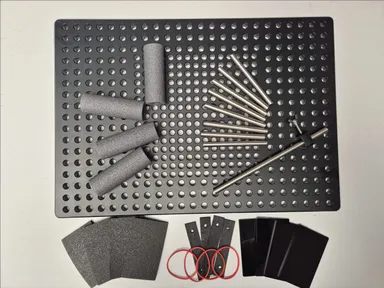
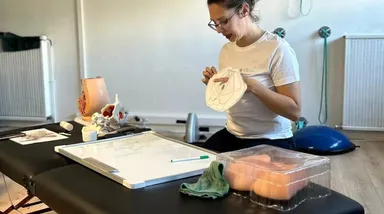
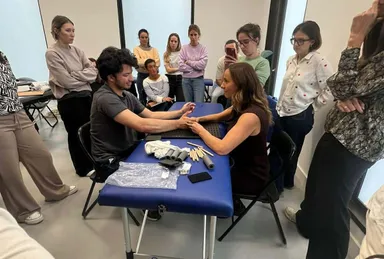
- The hand and wrist, from assessment to custom splinting, across two course levels.
- The rehabilitation equipment: how to genuinely use it, and not merely own it.
- The elbow, by e-learning, with lateral and medial tendinopathies and their differential diagnoses.
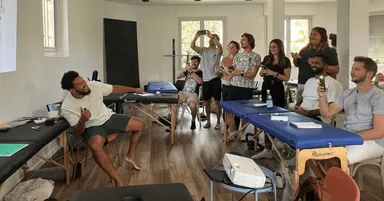
- The painful shoulder with Adam Meakins: moving beyond the subacromial impingement model.
Who it is for
Physiotherapists who see hand and wrist cases and come unstuck on splinting, and those whom the shoulder leaves struggling for want of a clear reasoning framework.
What changes in your practice
You will make custom splints instead of improvising, progress patients without overloading them, and know at what point surgery becomes the right answer.
Hand, elbow, shoulder: one building block of musculoskeletal practice
The upper limb is one of the Physio Learning course strands: it is not an area of practice in its own right: the hours you build up here count towards the recognised area of practice “Musculoskeletal rehabilitation” (Rééducation du système musculo-squelettique) (opinion of the Conseil national de l’Ordre of 30 March 2021).
Training regularly in this field means moving forward: one course after another. The Physio Learning app records those hours in your skills map, strand by strand, as you complete each course.
The conditions under which an area of practice is recognised are a matter for the Ordre des masseurs-kinésithérapeutes.
Select courses and project your hours towards the speciality. 80 h is the milestone we set ourselves, so that a speciality is genuinely within reach with our catalogue.
0 h/ 80 h
Our catalogue currently covers 72 h on this pathway, and we are working on it.
New courses are in preparation to reach 80 h. Tell us which ones would help you most: your feedback shapes what opens next.
Email usYour questions
Do you have to complete level 1 before level 2 in hand rehabilitation?
Level 2 goes deeper into custom splinting and complex conditions: it assumes the fundamentals covered in level 1, or established experience in hand rehabilitation.
Is the shoulder course taught in English?
Adam Meakins teaches in English, with live interpreting into French. The full timetable is set out on the course page.
Do these courses carry a compensation allowance?
On-site courses and virtual classrooms are compensated by the ANDPC for self-employed physiotherapists working under the French health insurance agreement. E-learning is not, unless it is an EPP activity (evaluation of professional practice). See the 2026 DPC guide.