










The subjective IKDC rates the knee out of 100, and the threshold everyone quotes, 11.5, is smaller than the smallest detectable change measured on this instrument, 12.3 to 16.7 points. In an individual patient, a gain of eleven points is therefore indistinguishable from noise. The scorer below reproduces the nineteen items of the form, calculates the score, and compares it to the age and sex norm.
No French version of the adult IKDC has ever been validated: every threshold on this page comes from non-French-speaking cohorts. The detail is below.
Figures taken from the studies listed at the end of this page, every value carrying its source where it is written. The nineteen items are reproduced from the official AOSSM forms, without changing a word; only item 10a (function prior to the injury) never enters the score.
What the IKDC measures, and the debate about its single score
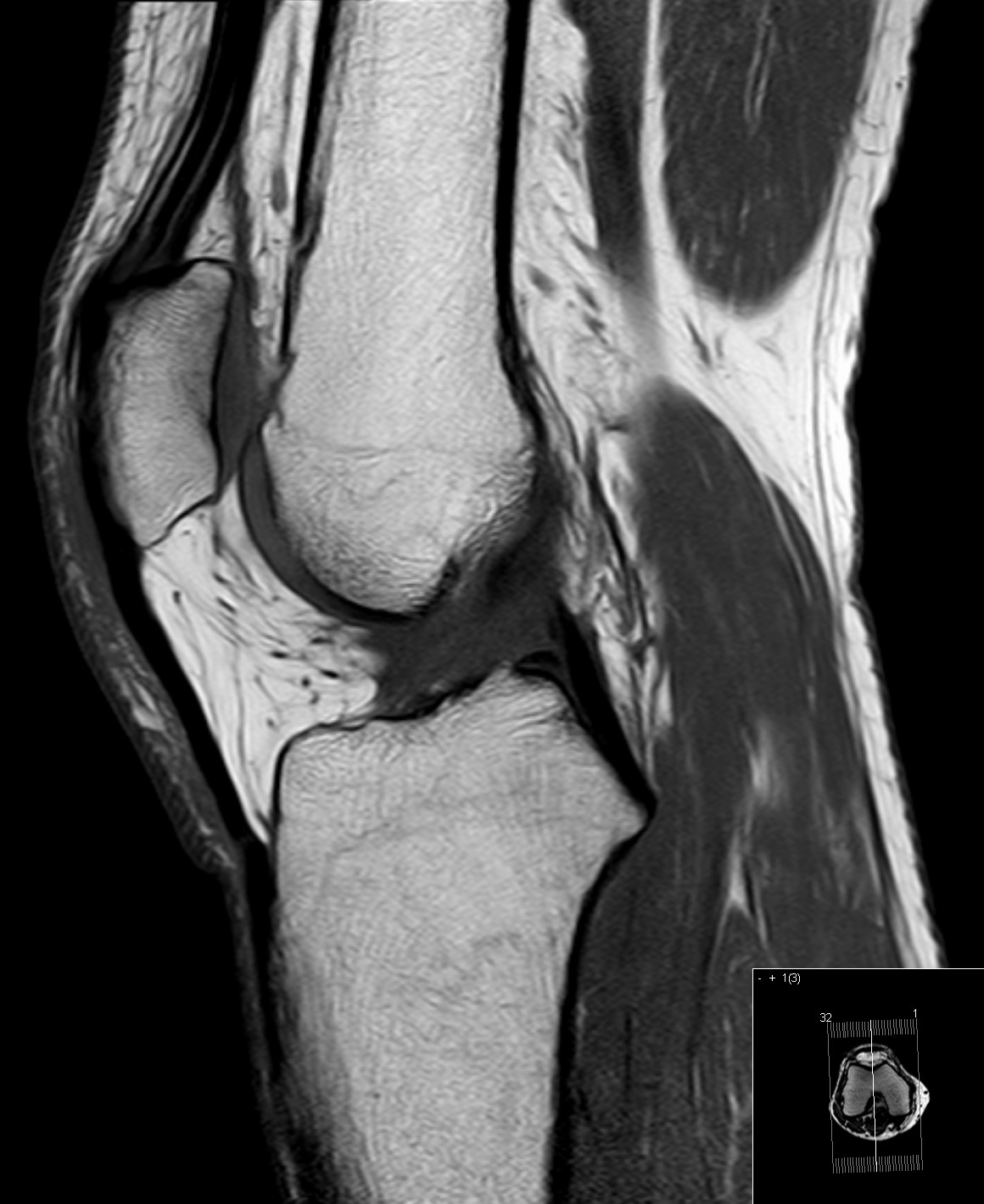
MRISagittal knee MRI, T1 sequence: rupture of the anterior cruciate ligament, ligament course interrupted in the intercondylar notch.
Source : Hellerhoff, Wikimedia Commons · CC BY-SA
The subjective IKDC is a self-report questionnaire specific to the knee rather than to a condition: it serves equally after an anterior cruciate ligament tear, a meniscal lesion, osteoarthritis or patellofemoral dysfunction. It covers symptoms, function and sporting activity, and returns a single score from 0 to 100, where 100 is a knee free of complaints.
That single score is not self-evident, it is a choice, justified in 2001 by a factor analysis revealing only one dominant component in 533 patients. That choice is now debated, and the debate remains open: the confirmatory factor analysis of the German-language validation does not show adequate fit, and a Welsh Bayesian modelling in 319 surgical patients retains two factors, symptoms and activity level.
But the largest study published on the question, 606 patients from the randomised Stability 1 trial, also rejects the two-factor structure, retains a bifactor model and concludes that the instrument should continue to be scored as a single score. The defensible state of the art is therefore this: neither simple structure fits properly, the total remains usable, and the detail of the activity items before surgery carries prognostic information the total alone does not.
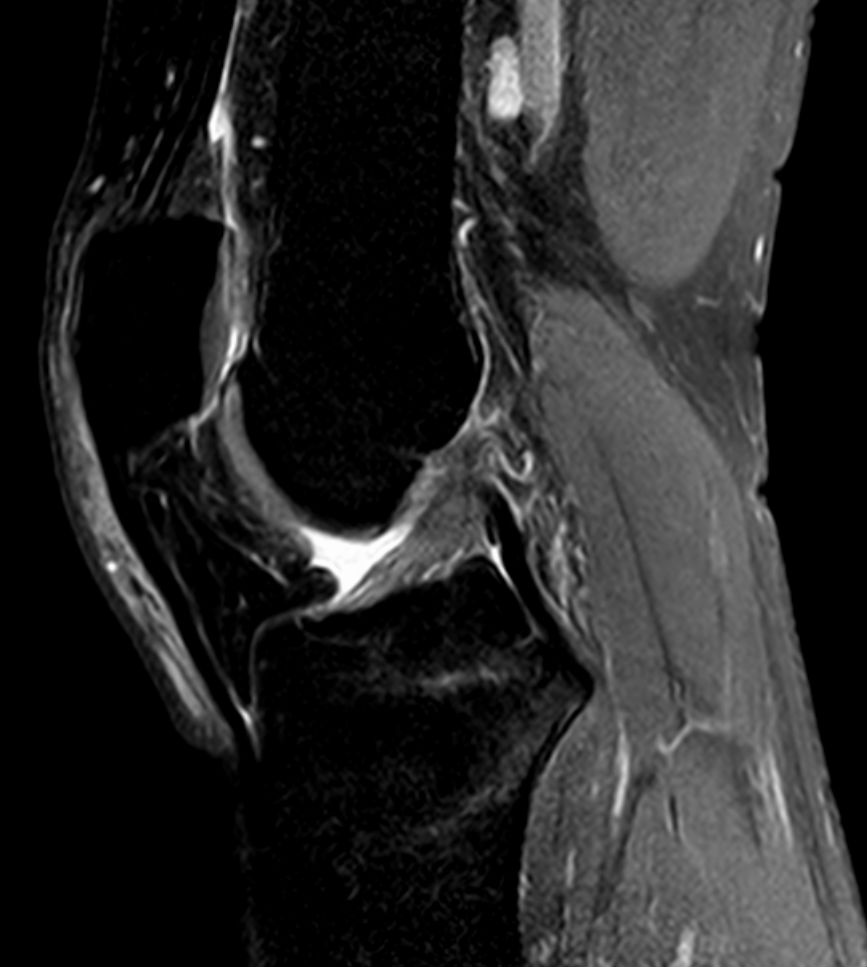
MRISagittal knee MRI, proton density-weighted sequence: high signal intensity in place of the anterior cruciate ligament, indicating its rupture.
Source : Hellerhoff, Wikimedia Commons · CC BY-SA
Eleven and a half points, below the measurement noise
This is the point that decides what can be concluded from a follow-up, and it is rarely written down.
The figure quoted everywhere, 11.5 points, comes from a ROC curve: it is the threshold of maximum sensitivity. The same article gives 20.5 points for maximum specificity. Eleven and a half is therefore not 'the' IKDC threshold, it is one end of a trade-off, and publishing the first without the second amounts to choosing for the reader.
More awkward: the only cohort in this file to have measured the smallest detectable change puts it between 12.3 and 16.7 points. Eleven and a half falls below. Its authors write as much for their own version: the minimal important difference there was smaller than the smallest detectable change. In other words, in one patient, a gain of eleven points cannot be told apart from measurement noise; it may still suffice to show an effect at group level, which is not the same question.
One confusion to avoid in passing, because it circulates: 11.5 is smaller than the smallest detectable change, not than the standard error of measurement. The latter is 4.4 to 6.0 points in the same cohort, and eleven and a half exceeds it comfortably. Lastly, this noise bound comes from a single study, in 312 knee surgery patients in Zurich, with the German-language version: it is the best available, it is not universal.
Aiming at 100 is a misreading
A patient at 80 out of 100 does not have 'twenty points to catch up'. Two sets of benchmarks say so, and neither leads to 100.
The normative data, collected in 5,246 knees from a panel representative of the United States population, show that the general population score falls sharply with age and is lower in women. A man aged 18 to 24 averages 89, a woman aged 51 to 65 71, with standard deviations of 16 to 26 points. A score of 75 in a 55-year-old woman is above her age and sex norm. Worth knowing: 28% of the respondents in that panel already reported a knee problem, so these are general-population values and not those of selected healthy subjects.
The second benchmark answers another question, not 'has this patient changed?' but 'does this patient feel well?'. In 251 patients reviewed one to five years after anterior cruciate ligament reconstruction, the acceptable symptom state starts at 75.9 points, and 89.2% of them declared themselves in it. A patient at 80 is therefore in a state they themselves judge satisfactory, twenty points below the theoretical maximum.
One typo to know in order to read the table below correctly: the abstract of the normative article prints '51 to 55 years' for men, when its methods describe eight age and sex categories including 51 to 65 years for both sexes. The latter is the one that stands.
| Category | Mean out of 100 | Standard deviation |
|---|---|---|
| Men, 18 to 24 years | 89 | 18 |
| Men, 25 to 34 years | 89 | 16 |
| Men, 35 to 50 years | 85 | 19 |
| Men, 51 to 65 years | 77 | 23 |
| Women, 18 to 24 years | 86 | 19 |
| Women, 25 to 34 years | 86 | 19 |
| Women, 35 to 50 years | 80 | 23 |
| Women, 51 to 65 years | 71 | 26 |
What a French physiotherapist actually administers
Here is the point that changes everything for a French practice, and it is almost never said.
No French version of the adult IKDC has ever been validated. This is not an assumption: six distinct search formulations were run against PubMed, then four more built specifically to defeat the claim, without success. Eighteen languages do have a validated and published adult version, from Italian in 2004 to Persian in 2026, across twenty indexed validation studies, Chinese and Arabic counting two each. French is not among them.
A validated French cross-cultural adaptation does exist, but it covers the Pedi-IKDC, the paediatric version, produced in French-speaking Canada in 203 children. It does not transfer to adults. A detail not without irony: Philippe Neyret, a Lyon surgeon, is one of the authors of the original instrument, and the French-language literature uses the English acronym without ever having published the validation of its translation.
The practical consequence is easy to state. A French physiotherapist administering the IKDC does so with a translation whose measurement properties have not been published, and applies to it thresholds imported from American and Swiss cohorts. That does not forbid it; it goes in the report.
What this scorer reproduces, and what it fixes from a printing defect
The nineteen items above reproduce, word for word, the AOSSM's (American Orthopaedic Society for Sports Medicine) 2000 Subjective Knee Evaluation Form, read on its official PDFs, the French version and the original English version: no item added, none removed. The scale applied here is that of the current English version, 0 to 4 for multiple-choice items and 0 to 10 for the scales; the French PDF still prints the older scale, 1 to 5 (1 to 11): the French values in this scorer have been brought back to the current scale, so that the AOSSM formula (sum out of 87, as a percentage) applies the same way to both languages.
The official French PDF also carries a printing defect, confirmed by a high-resolution capture of the page: several labels lose their last letter right before the checkbox. This scorer completes them by cross-checking another verbatim occurrence of the same label elsewhere in the same official document: 'Pas du tout', 'Un peu', 'Beaucoup', 'Énormément' (item 4) and 'La pire douleur imaginable' (item 3), the French labels themselves, since no such defect affects the English PDF.
This page claims no permission beyond the one read on the AOSSM site: the copyright holder is the AOSSM, use is free and without a fee for academic research, a licence must be requested from the AOSSM for corporate and health-system use, and modifying the form is not allowed. For any other use, contact the AOSSM.
Three administration pitfalls
Treating the 11.5 points as a cut-off
It is the maximum-sensitivity threshold of a ROC curve whose anchor behaved non-monotonically, and the same article gives 20.5 points for maximum specificity. It also falls below the published smallest detectable change. The report must say which threshold is used and where it comes from.
Confusing the smallest detectable change with the standard error of measurement
These are two different quantities, and the gap is a factor of two to three: 12.3 to 16.7 points for the first, 4.4 to 6.0 for the second. Eleven and a half falls below the first and comfortably exceeds the second.
Aiming at 100 at discharge
The general population mean falls to 71 out of 100 in women aged 51 to 65, and the state judged acceptable after ACL reconstruction starts at 75.9. The theoretical maximum is nobody's target.
Frequently asked questions
What does IKDC stand for?
IKDC stands for International Knee Documentation Committee, the international committee that produced the instrument. More precisely this is the subjective IKDC, or IKDC-SKF, published in 2001 by Irrgang et al. It has no French name: the French-language literature keeps the English acronym.
How is the IKDC scored?
Nineteen items are scored: fourteen as 0 to 4 options, three as 0 to 10 scales, and one as Yes/No worth 0 or 1. Item 10a, function prior to the injury, never enters the score. The other eighteen are added up, 87 points at most, and the score = sum / 87 × 100. It is calculated once at least sixteen of those eighteen items are answered, each missing item being replaced by the mean of the answered items; below sixteen answers, no score is shown.
How much change counts?
The quoted figure is 11.5, but it falls below the published smallest detectable change, 12.3 to 16.7 points. In an individual patient, a difference of less than a dozen points supports no conclusion.
What score should be aimed for at discharge?
Not 100. The acceptable symptom state after anterior cruciate ligament reconstruction starts at 75.9 points, and the general population mean varies from 89 to 71 depending on age and sex.
Is there a French version?
Not for adults: no French validation of the adult IKDC is indexed. Only the paediatric version, the Pedi-IKDC, has a validated French adaptation, produced in French-speaking Canada.
References
8 sources, PMIDs included
- Irrgang JJ, Anderson AF, Boland AL, Harner CD, Kurosaka M, Neyret P, Richmond JC, Shelborne KD. Development and validation of the international knee documentation committee subjective knee form. Am J Sports Med 2001;29(5):600-13. PMID 11573919. The original publication, in 533 patients with a variety of knee problems. It justifies the single score by a factor analysis revealing only one dominant component, gives an internal consistency of 0.92 and a test-retest reliability of 0.95, and derives from them that a true change is worth 9.0 points. It also establishes discriminant validity: the score is related to physical function (r = 0.47 to 0.66) but not to emotional function (r = 0.16 to 0.26). Philippe Neyret, of Lyon, is one of the authors.
- Irrgang JJ, Anderson AF, Boland AL, Harner CD, Neyret P, Richmond JC, Shelbourne KD. Responsiveness of the International Knee Documentation Committee Subjective Knee Form. Am J Sports Med 2006;34(10):1567-73. PMID 16870824. The study the figure of 11.5 points comes from, quoted everywhere as 'the' IKDC threshold. Read in full, it says two more things. The same curve gives 20.5 points for maximum specificity: 11.5 is only one end of a trade-off. And its anchor behaved non-monotonically in the middle, patients rating themselves 'slightly worse' having gained 20.6 points and the 'unchanged' 10.7, when the 'slightly better' gained only 5.9. The authors flag the exception themselves.
- Kümmel D, Preiss S, Harder LP, Leunig M, Impellizzeri FM. Measurement properties of the German version of the IKDC subjective knee form (IKDC-SKF). J Patient Rep Outcomes 2018;2:31. PMID 30294711. The only study in this base to have computed a smallest detectable change: it runs from 12.3 to 16.7 points, for a standard error of measurement of 4.4 to 6.0. Its authors write that the minimal important difference there was smaller than that smallest detectable change. Two reading points matter: it is the German-language version, but the cohort of 312 surgical patients was recruited in Switzerland, in Zurich; and its confirmatory factor analysis does not show adequate fitting indices.
- Williams T, Burley D, Evans L, Robertson A, Hardy L, Roy S, Lewis D. The structural validity of the IKDC and its relationship with quality of life following ACL reconstruction. Scand J Med Sci Sports 2020;30(9):1748-57. PMID 32492229. A Welsh Bayesian modelling, in 319 patients before anterior cruciate ligament surgery, retaining two factors: symptoms and knee articulation on one side, activity level on the other. Its contribution is not only structural: the two do not predict the same thing. Before surgery it is activity that is most associated with quality of life two to nine years later; afterwards, it is symptoms.
- Marmura H, Tremblay PF, Getgood AMJ, Bryant DM. A bifactor model supports unidimensionality of the International Knee Documentation Committee Subjective Knee Form in young active patients with anterior cruciate ligament tears: a retrospective analysis of a randomized controlled trial. Health Qual Life Outcomes 2023;21(1):104. PMID 37697331. The contradiction, and it is the largest published sample on the question: 606 patients from the randomised Stability 1 trial. It rejects the one-factor structure and the two-factor one, both of inadequate fit, retains a bifactor model, and concludes that the instrument should continue to be scored as a single score, a finer reading being free to consider sport and activity level in second place. Without it, this page would have presented as settled a debate that remains open.
- Muller B, Yabroudi MA, Lynch A, Lai CL, van Dijk CN, Fu FH, Irrgang JJ. Defining Thresholds for the Patient Acceptable Symptom State for the IKDC Subjective Knee Form and KOOS for Patients Who Underwent ACL Reconstruction. Am J Sports Med 2016;44(11):2820-6. PMID 27474383. The question the change threshold does not ask: not 'has this patient changed?' but 'does this patient feel well?'. In 251 patients reviewed on average 3.4 years after anterior cruciate ligament reconstruction, the state judged acceptable starts at 75.9 points, with a sensitivity of 0.83 and a specificity of 0.96. And 89.2% of them declared themselves in that state, twenty-four points below the theoretical maximum.
- Anderson AF, Irrgang JJ, Kocher MS, Mann BJ, Harrast JJ. The International Knee Documentation Committee Subjective Knee Evaluation Form: normative data. Am J Sports Med 2006;34(1):128-35. PMID 16219941. The normative data, in 5,246 knees from a panel representative of the non-institutionalised population of the United States, 28% of whom already reported a knee problem. They forbid aiming at 100: the mean runs from 89 in men aged 18 to 24 to 71 in women aged 51 to 65, with standard deviations of 16 to 26 points. A typo worth knowing: the abstract prints '51 to 55 years' for men when the methods describe eight categories including 51 to 65.
- Lee D, Rao S, Campbell RE, Plummer OR, Tjoumakaris FP, Cohen SB, Freedman KB. The Application of Computerized Adaptive Testing to the International Knee Documentation Committee Subjective Knee Evaluation Form. Am J Sports Med 2021;49(9):2426-31. PMID 34161155. The reference that carries the 0 to 100 range in its abstract. It incidentally establishes that computerised adaptive testing reproduces the total while asking 9.33 fewer questions on average, that is 45.1%, with a correlation of 0.99 and a mean difference of 0.48 point. Two caveats: this shows an algorithm can choose which questions to ask this patient, not that half the items would be useless; and 0.48 is a mean, not a maximum.
 Page written by Anthony Baillon, physiotherapist, co-founder of Physio Learning. The questionnaire itself is the work of an international committee published by Irrgang et al. in 2001: this page reproduces its nineteen items, documents and interprets them.
Behind this article
An author who explains, a reviewer who checks.
How we write and check our content

Physiotherapist · co-founder of Physio Learning
Marked for life by his first four-hour lecture without a single image, he took a master’s in instructional design so that it would never happen to anyone again. He hunts down publication bias and unreadable slides with the same intransigence.

Head of scientific content
Physiotherapist specialising in neuro-musculoskeletal practice and holder of a master’s in public health. He checks the methodological rigour of every article: primary sources, levels of evidence, no exceptions.