

Skip to content

Enrolment is open

Chronic pain & psychological disorders

With Antoine Couly and Catherine La Psy

OnlineDPCFIFPL100% online course9h estimatedE-learning
  • 200+ formés sur cette formation

Why this course?

A complete, EBP approach to understanding, assessing and treating chronic pain by bringing in the psychological factors that go with it.

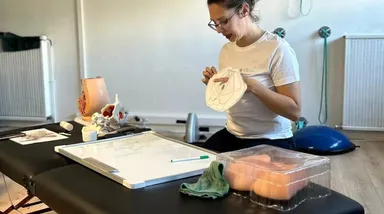
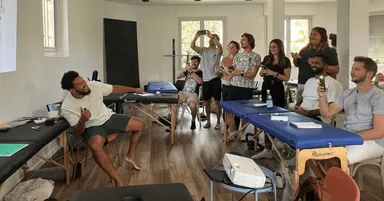
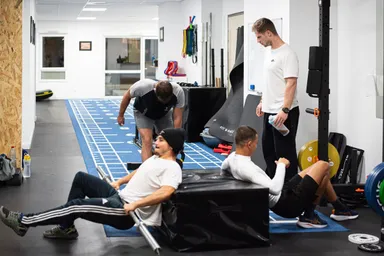
La formation en situation

Bring psychological factors into your management of pain.

Did you know that chronic pain affects nearly 1 adult in 3, and that whether it becomes chronic depends largely on psychological factors that initial training too often leaves aside?

This course will teach you to understand the emotions — cognitions — behaviours paradigm , to spot at-risk profiles (catastrophising, kinesiophobia, fear-avoidance) and to adapt your manual therapy or your exercises accordingly.

The aim: to move past the frustration of treatment failures, to know how to communicate, to know when to refer to a psychologist — and above all, to learn to look after yourself as a clinician .

A 100% EBP course co-built by a physiotherapist holding a Master's in Psychology and a clinical psychologist.

Your practice today

  • Discomfort when faced with chronic pain and psychological factors
  • Difficulty spotting catastrophising, kinesiophobia, fear-avoidance
  • Frustration in the face of repeated treatment failures
  • Uncertainty about when and how to refer to a psychologist

After the course

  • Command of the emotions — cognitions — behaviours paradigm
  • The ability to detect psychological profiles and tailor management to them
  • Sharper therapeutic communication (verbal & non-verbal)
  • Practical tools to prevent your own burnout

Learning outcomes

Chronification

Understand why and how acute pain becomes chronic.

The E-C-B model

Apply the emotions — cognitions — behaviours paradigm day to day.

Manual therapy & exercise

Get more out of your usual tools by matching them to the psychological issues at play.

Therapeutic alliance

Strengthen your relationship with patients through the biopsychosocial model and tailored communication.

Psychological profiles

Spot fear-avoidance, kinesiophobia, catastrophising, depression — and much more.

Looking after yourself

Accept and handle treatment failure, and prevent clinician burnout.

Ready to bring psychology into your management of pain?

Your instructors

The teaching team

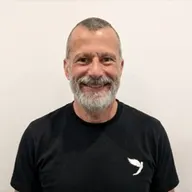
Antoine Couly (kinésithérapeute M2 Psychologie) et Catherine La Psy (psychologue clinicienne)

Antoine Couly is a physiotherapist, holds a Master's in Psychology and is published by Flammarion. He specialises in the management of persistent pain and is committed to teaching physios, from physiotherapy school to continuing education. Catherine La Psy is a clinical psychologist and psychotherapist in private practice, specialising in the management of psychological trauma and post-traumatic stress. Deeply committed to scientific research, she is the author of "Bienvenue chez le psy". Their shared aim: to give you the clinical and human keys to support patients with chronic pain effectively — in a 100% evidence-based practice approach .

Find out more about Antoine Couly.

Course content

Focused modules to bring psychological factors into your clinical practice and get out of therapeutic dead ends. A 9h e-learning course to follow at your own pace.

01Introduction and pre-course assessment
  • Assessment of knowledge before the course (pre-test).
  • Presentation of the teaching framework and the learning outcomes.
  • Why combine physiotherapy and psychology?
02The mechanisms of pain and of psychology
  • Pathophysiology of acute, sub-acute and chronic pain.
  • Central and peripheral sensitisation, and nociplastic pain.
  • Fundamentals of health psychology applied to pain.
  • The role of emotions, cognitions and behaviours.
03The major psychological factors: spotting them, sorting them, treating them
  • Fear-avoidance and kinesiophobia: screening tools.
  • Catastrophising and automatic thoughts.
  • Depression, anxiety, post-traumatic stress.
  • Criteria for referral to a psychologist or a psychiatrist.
04The major psychological tools
  • Principles of the cognitive behavioural model applied to physiotherapy.
  • Verbal and non-verbal therapeutic communication.
  • Patient education and the neuroscience of pain.
  • Graded exposure and desensitisation to movement.
05Looking after yourself as a clinician
  • Recognising burnout and its warning signs.
  • Accepting and handling treatment failure.
  • Setting your professional boundaries, and supervision.
  • Practical tools for emotional regulation.
06Conclusion and validation of what you have learnt
  • Summary and clinical integration of what you have learnt.
  • Final clinical cases and reasoning exercises.
  • Validation MCQ to obtain the certificate.
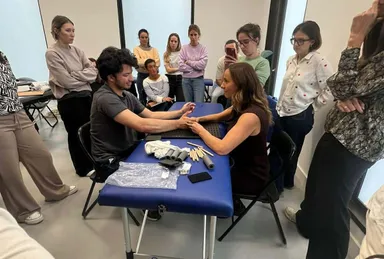
Aperçu des supports de cours sur la douleur chronique et la psychologie

Start the course today

100% Online · Immediate Access. The course is open all year round. Once enrolled, you get instant access to the platform from your computer, tablet or smartphone.

Learn at your own pace

Learn at your own pace 9h estimated of videos, texts, clinical cases and infographics.

Unlimited access

24/7 access to the platform, to the updates and to the community.

Support 7 days a week

Support 7 days a week Instructors and a chat to answer all your questions.

Final validation

Final validation MCQ and practical cases to validate what you have learnt, with a certificate.

They trained with us

See where the healthcare professionals trained on this topic practise.

+180 professionals trained online

⭐ 4,6/5 Average rating across a sample of 99 reviews

Funding available

Two French schemes can fund it, for practitioners working in France. What sets them apart: what you pay upfront, and when.

DPC

Nothing to pay upfront*

The Agence nationale du DPC, the French agency for continuing professional development, pays the training provider directly. Open to healthcare professionals practising in France.

You pay upfront
Nothing
The Agence pays
Physio Learning, directly
* Un reste à charge peut exister, selon le prix de la formation et le montant pris en charge.
  1. You register on agencedpc.fr and choose your session.
  2. Your application is approved: the Agence pays Physio Learning, you pay nothing upfront.

Action DPC n° 99GX2425025

DPC allowance for masseurs-kinésithérapeutes, 2026: not every profession comes under the DPC, and those that do are not on the same allowance. Subject to your application being approved and to your annual allowance still being available. A French scheme, for professionals practising in France.1

FIFPL

Up to 150 € per 6 h of e-learning

You pay for the course, then claim reimbursement from the FIFPL, the French training fund for self-employed professionals. Open to practitioners registered in France.

You pay upfront
The course fee
The FIFPL reimburses
Up to 150 €
per 6 h of e-learning, up to 450 € a year
Cette formation est estimée à 9 heures.
For the exact amount in your own situation, put the request to the FIFPL.
  1. You book your place and pay for the course.
  2. You file your claim with the FIFPL, enclosing the programme and the quote.Programme PDF
  3. The FIFPL reimburses you after the course.

Registered with the FIFPL: kinésithérapeutes S0620260400044

FIFPL 2026 caps and how to claim

Amounts from the masseur-kinésithérapeute scale, 2026: each profession has its own. Reimbursement is decided by the FIFPL, based on your remaining annual allowance and on the budget allocated to your profession. A French fund, for self-employed practitioners registered in France.2

Invest in your expertise

300€

incl. VAT · Direct purchase or funding (FIFPL / DPC) DPC with a live online class: 350€

Included in the course

  • 100% online access (9h estimated)
  • Teaching videos, text, infographics
  • Clinical cases and reasoning exercises
  • MCQ to validate what you have learnt
  • Technical and teaching support 7/7
  • FIFPL or DPC funding possible

🎁 Bonus included

  • Lifetime access to the dedicated community (exchanges with the instructors and fellow physios)
  • Listing on PhysioMaps once you complete the course
  • Unlimited access to future updates

Accès immédiat après inscription : commencez dès aujourd'hui sur l'application Physio Learning, à votre rythme.

Qualiopi-certified training providerNo prerequisites

  • ✓ Certificate and paperwork kept for you
  • ✓ Instructor support after the course
  • ✓ Dedicated app, lifetime access

What fellow physios say.

  • The explanations are simple, which makes putting things into practice easier. I finally understood some tools and content already covered in other courses, but which I had not really managed to apply in the clinic. I find your course clear and relevant!
    Oriane L.Physiotherapist
  • A lot of excellent content. I liked the neurophysiology of pain, and the bonus material on looking after yourself as a clinician. Plenty to take away and think about, all of it explained clearly. Thank you for this course.
    Sophia F.Physiotherapist
  • Really useful, really practical — this is my first course since qualifying (physio + Master's in adapted physical activity). The communication keys are not always easy to put in place in the clinic, but you leave with good tips, and the role-play videos are great!
    Charlie H.Physiotherapist
  • The bonus section on better understanding the reactions we can have depending on what our patients say or do: +++. It is not always easy to do that work on our own inner resources, but I really like the reading suggestions provided. A real treasure trove.
    Fanny M.Physiotherapist
  • The physio — psychologist pairing. It also helps us understand psychology better and, above all, refer our patients more appropriately. The team replies very quickly, which is really pleasant. You feel genuinely supported from start to finish.
    Nicolas M.Physiotherapist
  • Everything was fascinating. The only « downside » — and it is a detail — would be that Catherine speaks really very fast and I sometimes found it a bit hard to keep up. But the course was excellent. Well done and thank you to the whole team!
    Gwenaelle F.Physiotherapist
  • Great course, which lends itself very well to the e-learning format. The videos are very well made, and the clinical cases are particularly interesting for seeing how to apply the theory in the clinic. I come away far more confident.
    Laurène B.Physiotherapist
  • Teaching and content both very good. I did the course over 2 days; on the longest videos there were moments where I switched off, but everything is there to come back to afterwards. A real wealth of information to bring into your practice bit by bit.
    Yoann G.Physiotherapist
  • The course is very thorough on psychological factors, and draws on plenty of resources that let you build your own patient questionnaires. It is exactly what I was missing to structure my management of chronic pain.
    Mathieu B.Physiotherapist
  • Both speakers are clear, approachable and deeply keen to pass on their knowledge — it is very pleasant to follow. A very good course to take straight out of school in my view, and great tools to use with patients for all healthcare professionals.
    Jean-Paul D.Physiotherapist

Find out more

Course format

9H estimated of asynchronous distance learning. The teaching materials are many and varied: teaching videos, text, infographics, demonstration videos and clinical cases.

Who it is for: physiotherapists in private practice or salaried; osteopaths; doctors; psychologists; nurses (DPC); healthcare assistants (DPC); podiatrists. No prerequisites for this course.

Price: 300€ incl. VAT for a direct purchase (350€ through the DPC, with a live online class). FIFPL and DPC funding possible.

An online learning platform, accessible from computer, tablet and phone. Unlimited 24/7 access , including to future updates.

Final award: a course completion certificate after the validation MCQ.

Upcoming course sessions

This e-learning course is open for direct purchase all year round!

Buy the course and train from wherever you want, whenever you want, on the platform accessible from phone, tablet and computer!

Note: if you use FIFPL or DPC funding, you must respect the dates and the session year of your application. Once you have finished the course, it stays accessible to you without limit!

Download the programme or a PDF quote

Would you like to apply for funding before committing?

👉 Download the detailed programme as a PDF

👉 Download the quote as a PDF

DPC funding

For 2026, the DPC, the French continuing professional development scheme, is accepted for physiotherapists, nurses and healthcare assistants .

Action no.: 99GX2425025 — e-learning + compulsory live online class. Funding capped at 347,50€ + 76€ of allowances .

2026 sessions open: • Summer session: from 04/08 to 24/09 · live online class on Thursday 24 September 2026 at 19h. • Autumn session: from 01/09 to 29/10 · live online class on Thursday 29 October 2026 at 19h.

Enrol directly on the DPC website right now!

Go to the help centre for the process.

FIFPL funding

For 2026, if your application is approved and depending on your remaining allowance, the course may be funded by the FIFPL, the French funding body for self-employed professionals. Funding is capped at 900€ a year, with a limit of 250€ a day and of 50% of the price of an e-learning course.

The course is accepted in the catalogue under the name « Troubles psychologiques et douleur : évaluer et trier pour savoir comment et quand traiter – e-learning » .

NACPRO number 2026 (physiotherapists only): S0620260400044 .

Read our full article on the process by clicking here.

Employer funding

We are a Qualiopi-certified training provider and you can contact us directly about employer funding.

Contact the team on WhatsApp by clicking here or by email!

Contact us

Contact the team on WhatsApp by clicking here

Please check first whether your answer is already in our help centre by clicking here .

Bring psychology into your management of chronic pain.

Join the healthcare professionals trained online by Physio Learning.

Qualiopi-certified training providerFIFPL / DPC

Email · WhatsApp · Instagram

The practical details, at a glance

Getting onto the learning platform

Log in to the Physio-Learning platform, then complete the two-factor authentication (code received by SMS or email).

I have a specific need

If you have a disability or need any particular adjustment, contact the team on WhatsApp by clicking here or by email at hello@physio-learning.com!

All our courses are subtitled and the player lets you adjust the playback speed.

  1. DPC: the Agence nationale du DPC pays the training provider directly, subject to your application being approved and to your annual allowance still being available. Some of the cost may remain payable by you, depending on the course price and the amount funded. The DPC only covers healthcare professions bound by the French three-yearly requirement, and the allowance depends on the profession: the amounts shown are those for masseurs-kinésithérapeutes in 2026. A French scheme, open to healthcare professionals practising in France.
  2. FIFPL: you pay for the course, then claim reimbursement. It is full or partial depending on the course, and decided by the FIFPL independently of Physio Learning, within your remaining annual allowance and the budget allocated to your profession. The caps shown are those of the masseur-kinésithérapeute scale for 2026; other professions come under their own section's scale. An online course is capped at half these amounts. A French fund, open to self-employed practitioners registered in France.
  3. Number of professionals trained, rounded down to the nearest fifty, across all sessions of this course: 200+

Psychological disorders and pain: assess and screen to know how and when to treat

DPC : rien à avancer