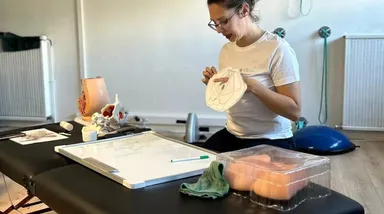
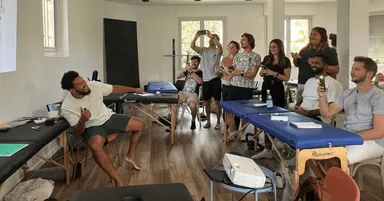
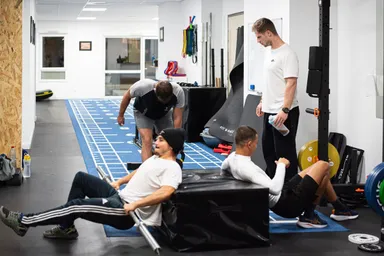
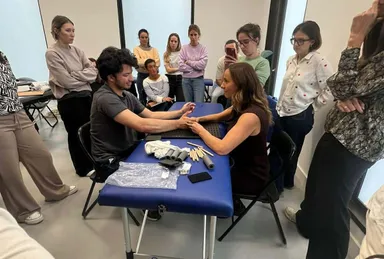
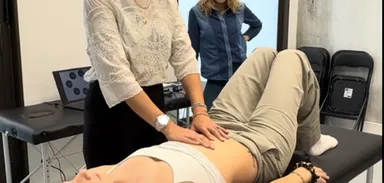
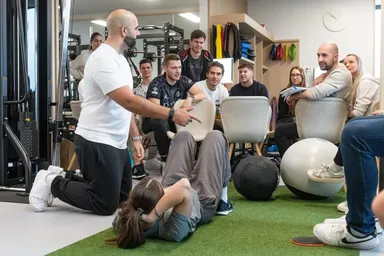
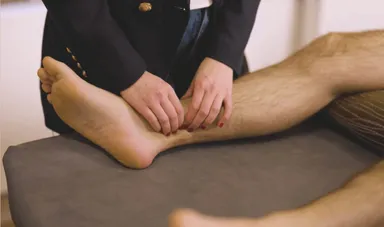
Practising the specific therapeutic techniques (release work, strength work).
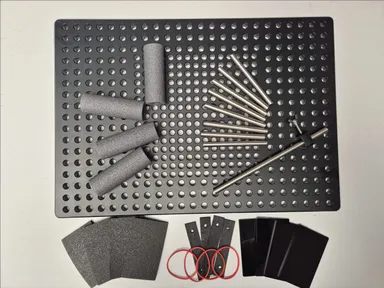
Instrumental tools
Command of biofeedback and electrical stimulation.
Patient education
Lifestyle and dietary advice and self-management exercises.
Ready to master anorectal pelvic floor physiotherapy?
Your instructors
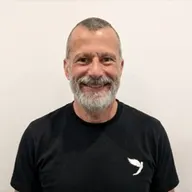
Hi, we are Delphine and Isabelle
They embody a pelvic floor physiotherapy that is expert, committed and firmly focused on passing knowledge on: with complementary career paths, they combine solid clinical practice in the private sector with a major commitment to teaching, research and professional associations.
Delphine Girard , part of a new generation of instructors and the current president of the AFRePP, enriches this vision with a whole-person biopsychosocial approach, firmly grounded in clinical research, patient education and professional networks. Together they offer demanding, humane and up-to-date teaching, in the service of pelvic floor management that is modern, cross-disciplinary and grounded in the scientific evidence.
Isabelle Gien , a pioneer of the field with more than 25 years of experience, brings deep expertise in urogynaecological and proctological rehabilitation, built on her long-standing involvement with the AFRePP, her work as a university instructor and her active part in conferences and prevention campaigns.
The course gives you everything you need for high-quality anorectal rehabilitation, ready to use as soon as you are back in the clinic .
1 / 9
01
Anorectal anatomy, physiology and biomechanics
Refresh the anatomical and physiological knowledge needed for reasoned rehabilitation.
Understand the interactions between pelvic, abdominal and postural structures in continence and defecation.
Identify the biomechanical levers that let the patient take an active part in their anorectal function (breathing, posture, muscle synergies).
02
Pathophysiology and classification of anorectal disorders
Identify the main anorectal conditions seen in rehabilitation and their pathophysiological mechanisms.
Link clinical signs to muscular, neurological or behavioural dysfunction.
Develop a simplified clinical reading to involve the patient in understanding their symptoms and their treatment.
03
Anorectal physiotherapy assessment and diagnosis
Structure a complete, reasoned assessment, shared with the patient.
Identify the relevant assessment tools for building a personalised treatment strategy.
Involve the patient from the assessment onwards in understanding their problem and setting their rehabilitation goals.
04
Treatment principles and strategies in anorectal rehabilitation
Identify the treatment goals according to patient profiles and the diagnoses made.
Understand the physiological basis of the rehabilitation techniques.
Select and adapt the techniques according to the assessments and the patient's capacities.
05
Practical anorectal rehabilitation techniques
Put into practice the manual, instrumental and whole-person techniques of anorectal rehabilitation.
Adapt the protocols to the condition, the sensitivity and the progress of the patient.
Identify the criteria for success and the indicators of clinical progress.
06
Self-rehabilitation and patient self-management
Teach the patient to reproduce and keep up the exercises between sessions.
Set up a structured and safe self-rehabilitation programme.
Pass on the tools that support day-to-day self-management of anorectal disorders.
07
Whole-person management, coordination and follow-up after rehabilitation
Know the surgical indications and what they mean for the rehabilitation pathway.
Adapt management to the patient's progress and to working with other healthcare professionals.
Set up follow-up after rehabilitation to maintain the gains and prevent relapse.
08
Clinical synthesis, assessment and course close
Consolidate what you have learnt and connect it to everyday clinical practice.
Assess participants' progress on the clinical, teaching and educational levels.
Identify the levers for carrying on with rehabilitation centred on patient self-management.
They trained with us
See where the healthcare professionals trained by Physio Learning practise.
8,450+professionals registered with Physio Learning
⭐ 4.8/5Average rating of our training provider on a sample of 675 reviews
Funding available
Two French schemes can fund it, for practitioners working in France. What sets them apart: what you pay upfront, and when.
DPC
Fully funded*
The Agence nationale du DPC, the French agency for continuing professional development, pays the training provider directly, and your attendance is compensated. Open to healthcare professionals practising in France.
You pay upfront
Nothing
The Agence covers
The full cost of the course
and pays you 266 € to 532 € for attending
* Some of the cost may remain payable by you, depending on the course price and the amount funded.
1You register on agencedpc.fr and choose your session.
2Your application is approved: the Agence pays Physio Learning, you pay nothing upfront.
3You receive your allowance in the months following the course.
DPC action no. 99GX2525055
DPC allowance for masseurs-kinésithérapeutes, 2026: not every profession comes under the DPC, and those that do are not on the same allowance. Subject to your application being approved and to your annual allowance still being available. A French scheme, for professionals practising in France.1
FIFPL
Up to 600 € reimbursed
You pay for the course, then claim reimbursement from the FIFPL, the French training fund for self-employed professionals. Open to practitioners registered in France.
You pay upfront
The course fee
The FIFPL reimburses
Up to 600 €
300 € per day over 2 days, up to 900 € a year
For the exact amount in your own situation, put the request to the FIFPL.
1You book your place and pay for the course.
2You file your claim with the FIFPL, enclosing the programme and the quote.Programme PDF
3The FIFPL reimburses you after the course.
Registered with the FIFPL: kinésithérapeutes S0620260350138
Amounts from the masseur-kinésithérapeute scale, 2026: each profession has its own. Reimbursement is decided by the FIFPL, based on your remaining annual allowance and on the budget allocated to your profession. A French fund, for self-employed practitioners registered in France.2
Invest in your expertise
Value 798€590€
TTC
↳ that is 295€ / day of training
Meals not included
Included in the course
2 on-site days (14h)
PowerPoint, videos, clinical cases
Practice in pairs
WhatsApp support 7 days a week
DPC / FIFPL funding possible
🎁 Bonus included
Access to the Physio Learning community for this course
Listing on PhysioMaps once you complete the course
Leave your email: we will let you know as soon as a session opens.
✓ Qualiopi-certified training provider✓ No specific prerequisites
✓ Certificate and paperwork kept for you
✓ Instructor support after the course
✓ Dedicated app, lifetime access
Find out more
How the course runs
2 days of on-site teaching at the course venue (14h). The teaching materials are many and varied: PowerPoint, clinical cases and hands-on practice.
Who it is for: healthcare professionals in private practice or salaried; physiotherapists in private practice or salaried. No prerequisites for this course.
*DPC/FIFPL funding possible
1 technical and teaching support service available 7 days a week on WhatsApp.
DPC: enrol directly on the DPC website, the French continuing professional development scheme, via Rechercher une action > S'inscrire with activity number 99GX2525055 .
FIFPL: funding by the FIFPL, the French funding body for self-employed professionals, has been approved. NACPRO number: S0620260350138 .
The course may be funded depending on your annual allowance. Go to our help centre for all the steps to follow.
Join the 8,450+ professionals registered with Physio Learning.
✓ Qualiopi-certified training provider✓ DPC / FIFPL
The practical details, at a glance
I have a specific need (disability)
If you have a disability, or if you need any particular adjustment for the course, contact the team on WhatsApp by clicking here! Course venues are always accessible to people with reduced mobility.
1.DPC: the Agence nationale du DPC pays the training provider directly, subject to your application being approved and to your annual allowance still being available. Some of the cost may remain payable by you, depending on the course price and the amount funded. The attendance allowance is paid by the Agence, at its own rates and for on-site courses only. The DPC only covers healthcare professions bound by the French three-yearly requirement, and the allowance depends on the profession: the amounts shown are those for masseurs-kinésithérapeutes in 2026. A French scheme, open to healthcare professionals practising in France.
2.FIFPL: you pay for the course, then claim reimbursement. It is full or partial depending on the course, and decided by the FIFPL independently of Physio Learning, within your remaining annual allowance and the budget allocated to your profession. The caps shown are those of the masseur-kinésithérapeute scale for 2026; other professions come under their own section's scale. An online course is capped at half these amounts. A French fund, open to self-employed practitioners registered in France.