







The ACL-RSI measures psychological readiness to return to sport after ACL reconstruction, across twelve items brought back to a score of 0 to 100. In young athletes, it is not the level reached that announces reinjury, it is the progression of the score. The interpreter is right below.
In under-twenties, those who reinjured had gained 9.2 points in twelve months against 24.9 in the others, at comparable levels. The detail is below.
Figures taken from the studies listed at the end of this page, every value carrying its source where it is written. The questionnaire itself is not reproduced.
What the ACL-RSI measures
The ACL-RSI measures neither strength, nor stability, nor function: it measures what the athlete feels about returning. Published in 2008 by Webster et al., it has twelve items across three domains: five of emotions, five of confidence in performance, two of risk appraisal.
The total score is the mean of the items brought back to 0 to 100, a high score signalling better psychological readiness. Three versions coexist, of twelve, six and three items, and all read on the same range. The full French version has been validated since 2015, co-signed by the author of the original scale, with an internal consistency of 0.96.
It is quick to administer, measured at under two minutes for the full French version. It is a consultation instrument, not a long assessment, and that matters for what the rest of this page recommends doing with it.
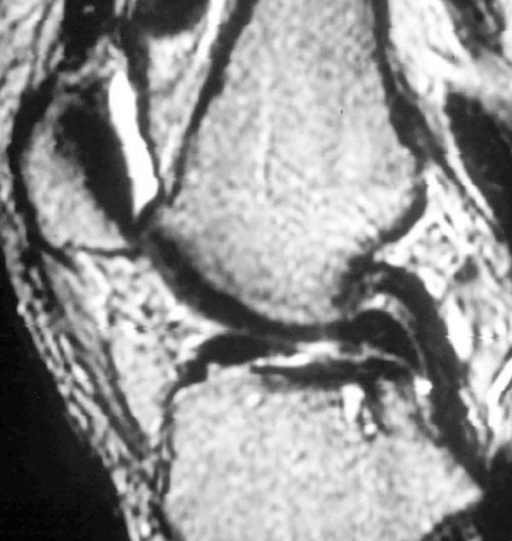
MRISagittal MRI of the knee: poor visualisation of the ACL substance, indicating rupture, in a 25-year-old woman.
Source : Tsai et al., BMC Musculoskeletal Disorders, 2004, figure 1 · Libre accès BioMed Central
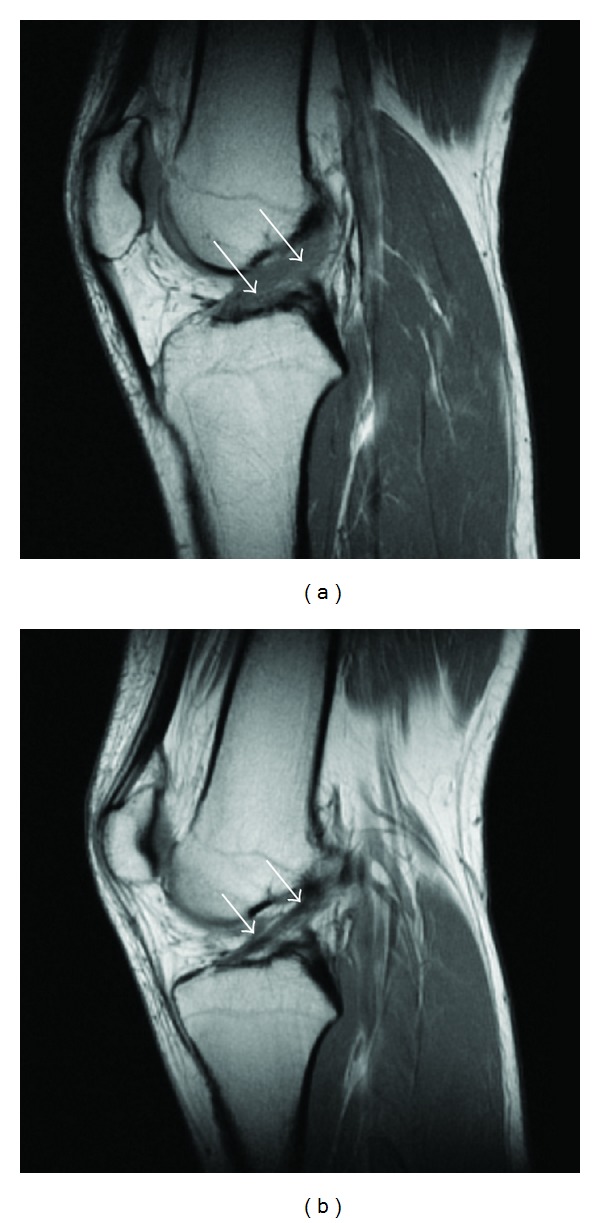
MRISagittal MRI of the knee: complete rupture of the anterior cruciate ligament, arrows pointing to where the ligament should be, before and after treatment.
Source : Ofner et al., Evidence-Based Complementary and Alternative Medicine, 2014, figure 2 · CC BY
Two response formats under one name
Here is the most discreet scoring trap of this instrument: two response formats circulate under the same name.
The original form scores each item from 0 to 100 in steps of ten, on an eleven-box slider, then takes the mean. The form used by the Swedish registry scores each item from 1 to 10, sums to a maximum of 120, then converts back to 0 to 100. That second form cannot score an item zero.
The total comes out bounded 0-100 either way, which makes the confusion painless as long as you read the total. It stops being painless as soon as you compare item-level scores, or take a value from a paper without checking which format it used.
The slope rather than the level
This is the most useful fact on this page, and it inverts the way the scale is almost always presented.
A study of under-twenties compared those who reinjured with those who did not. Their level of score at twelve months did not separate them. What separated them was the progression from baseline: 9.2 points gained in those who reinjured against 24.9 in the others.
The practical consequence is sharp: the ACL-RSI is administered from before surgery, and not only at the return-to-sport visit. Without a baseline there is no slope, and the only figure available is the one that did not discriminate. Its authors point the same way when measuring its responsiveness: the minimal important change is 13.4 points for the full version, but they note it exceeds measurement noise only at group level, not in a given patient. A Rasch analysis in 1,065 Swedish patients, also co-signed by the scale's author, goes further: as things stand, the conditions for aggregating the twelve items into a single score are not met.
| What is measured | Value | Sample |
|---|---|---|
| Items, and domains | 12 in 3 | 5 emotions, 5 confidence, 2 risk |
| Score range, all versions | 0 to 100 | 12, 6 or 3 items |
| Benchmark for return to same sport at 2 years | ≥ 65 | 681 patients, FAST cohort |
| Predictive benchmark from 6 months | ≥ 60 | same patients |
| Progression, young non-reinjured | 24.9 | under 20s |
| Progression, young reinjured | 9.2 | same patients |
| Minimal important change, 12 items | 13.4 | at group level only |
| The same, 6 items | 15.1 | at group level only |
| Internal consistency, French version | 0.96 | 91 operated, 98 controls |
The French benchmarks, and their cohort
For this instrument, the French-speaking world is among the best equipped anywhere, and that yields benchmarks no other language provides as well.
The French prospective FAST cohort, in 681 patients followed for two years, establishes two working values: a score of 65 or above is associated with return to the same sport at two years, and a score of 60 or above as early as six months is an independent predictive factor. The 65 benchmark was found independently in a thousand French patients.
Those same thousand patients served to develop the French short version, of six items, and minimal version, of three. They correlate at 0.98 and 0.94 with the full version and read on the same range. One detail of their construction is worth knowing: the French selection differs from the English by a single item, replaced for a better relevance score.
Why this page does not display the questionnaire
No free licence is established for the ACL-RSI: its items are not reproduced here. Three French versions exist, full, short and minimal, and obtaining the right one matters: they all read on 0 to 100 but their minimal important changes differ, 13.4 points for the full and 15.1 for the short. The response format matters too, two coexisting under the same name.
Three administration pitfalls
Administering it only at the moment of return
Without a baseline there is no slope to read, and it is the slope that discriminated those who reinjured among under-twenties. A preoperative administration costs under two minutes.
Concluding in a patient on a thirteen-point gain
The minimal important change of 13.4 points was established at group level. Its own authors write that it does not exceed the smallest detectable change at individual level: in the athlete sitting in front of you, it is not distinguishable from noise.
Comparing item-level scores across two sources
Two response formats coexist, 0 to 100 in steps of ten or 1 to 10. Totals compare, item scores do not.
Frequently asked questions
What does ACL-RSI stand for?
ACL-RSI stands for Anterior Cruciate Ligament - Return to Sport after Injury. The scale was published in 2008 by Webster et al. to measure psychological readiness to return to sport.
How is the ACL-RSI scored?
Twelve items across three domains, emotions, confidence and risk appraisal, brought back to a score of 0 to 100. The six- and three-item versions read on the same range.
What score allows return to sport?
The French FAST cohort gives 65 out of 100 for return to the same sport at two years, and 60 as early as six months as an independent predictive factor. These are cohort benchmarks, not green lights.
Should it be administered before surgery?
Yes, and that is the most useful advice on this page. In under-twenties, it was the progression of the score, not its level, that separated those who reinjured: 9.2 points gained against 24.9.
Is there a French version?
Yes, validated in 2015 for the full version, with an internal consistency of 0.96, along with short and minimal versions developed in 2024 in a thousand French patients.
References
8 sources, PMIDs included
- Webster KE, Feller JA, Lambros C. Development and preliminary validation of a scale to measure the psychological impact of returning to sport following anterior cruciate ligament reconstruction surgery. Phys Ther Sport 2008;9(1):9-15. PMID 19083699. The original publication. It sets the twelve items and their three domains: five of emotions, five of confidence in performance, two of risk appraisal. A later Rasch analysis will note that it never defined what it called 'readiness'.
- Bohu Y, Klouche S, Lefevre N, Webster K, Herman S. Translation, cross-cultural adaptation and validation of the French version of the Anterior Cruciate Ligament-Return to Sport after Injury (ACL-RSI) scale. Knee Surg Sports Traumatol Arthrosc 2015;23(4):1192-6. PMID 24676789. The validated French version, co-signed by the author of the original scale, in 91 operated patients against 98 controls at six months. Internal consistency 0.96, reproducibility rho 0.90. It clearly separates operated from controls, 62.8 against 89.6, and those returning to the same sport from those who do not, 72.1 against 60.3.
- Sadeqi M, Klouche S, Bohu Y, Herman S, Lefevre N, Gerometta A. Progression of the Psychological ACL-RSI Score and Return to Sport After Anterior Cruciate Ligament Reconstruction: A Prospective 2-Year Follow-up Study From the French Prospective Anterior Cruciate Ligament Reconstruction Cohort Study (FAST). Orthop J Sports Med 2018;6(12):2325967118812819. PMID 30574516. The French prospective FAST cohort, in 681 patients followed for two years. It gives the two best-established French benchmarks: a score of 65 or above for return to the same sport at two years, and 60 or above as early as six months as an independent predictive factor.
- McPherson AL, Feller JA, Hewett TE, Webster KE. Smaller Change in Psychological Readiness to Return to Sport Is Associated With Second Anterior Cruciate Ligament Injury Among Younger Patients. Am J Sports Med 2019;47(5):1209-15. PMID 30786247. The study that inverts the reading. In under-twenties, it is not the level of the score at twelve months that separates those who reinjure, but its progression: 9.2 points gained in reinjured patients against 24.9 in the others. The score reads as a slope, not as a threshold crossed once.
- Webster KE, Feller JA. Evaluation of the Responsiveness of the Anterior Cruciate Ligament Return to Sport After Injury (ACL-RSI) Scale. Orthop J Sports Med 2021;9(8):23259671211031240. PMID 34423062. The authors measure the responsiveness of their own scale: minimal important change of 13.4 points for the twelve-item version and 15.1 for the six-item one. Then they raise the decisive caveat: these values exceed the smallest detectable change at group level, not at individual patient level.
- Webster KE, Feller JA. Development and Validation of a Short Version of the Anterior Cruciate Ligament Return to Sport After Injury (ACL-RSI) Scale. Orthop J Sports Med 2018;6(4):2325967118763763. PMID 29662909. The English six-item short version, read on the same 0 to 100 range. Its full text carries the split of the original twelve items into five emotions, five confidence and two risk appraisal.
- Abid H, Rougereau G, Bohu Y, Meyer A, Gerometta A, Grimaud O, Lefevre N, Hardy A. French Version of the Short Anterior Cruciate Ligament-Return to Sport After Injury Scale: Development and Validation. Orthop J Sports Med 2024;12(2):23259671231220959. PMID 38322979. The French short and minimal versions, developed in 1,000 patients. Internal consistency 0.92 and correlation of 0.98 with the full version for the six-item form, 0.94 for the three-item one. The benchmark of 65 out of 100 is found there independently.
- Piussi R, Alenius S, Webster KE, Thomeé R, Westergren A, Hagell P, Hamrin Senorski E. Measurement properties of the Swedish version of the anterior cruciate ligament return to sport after injury scale (ACL-RSI): A Rasch analysis. J Exp Orthop 2024;11(3):e12059. PMID 38868127. The Rasch analysis in 1,065 Swedish patients, co-signed by the scale's author. It concludes that as things stand, the conditions for aggregating the twelve items into a single score are not met, and sees them satisfied only by correcting local dependency in the computation, which no clinical form does.
 Page written by Anthony Baillon, physiotherapist, co-founder of Physio Learning. The scale itself is by Webster et al., 2008: this page documents and interprets it, it reproduces none of its items.
Behind this article
An author who explains, a reviewer who checks.
How we write and check our content

Physiotherapist · co-founder of Physio Learning
Marked for life by his first four-hour lecture without a single image, he took a master’s in instructional design so that it would never happen to anyone again. He hunts down publication bias and unreadable slides with the same intransigence.

Head of scientific content
Physiotherapist specialising in neuro-musculoskeletal practice and holder of a master’s in public health. He checks the methodological rigour of every article: primary sources, levels of evidence, no exceptions.