





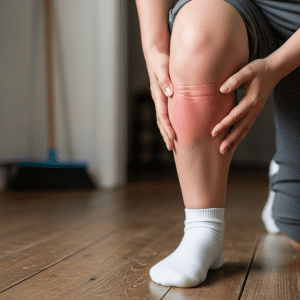
A soft, painful lump on the front of the knee, often after kneeling work: prepatellar bursitis (« housemaid’s knee ») worries people mainly because of the question of a procedure, should it be aspirated, operated on, or simply protected? The answer depends first on one crucial point: is it infected or not? Here is what the evidence says, the decision tree, and why surgery is rarely needed.
📝 In brief
- Aspiration is not the first step in knee bursitis. In prepatellar bursitis of microtraumatic origin (not infected), aspiration is not recommended routinely because the needle can turn mechanical bursitis into iatrogenic septic bursitis; management rests first on conservative measures (protection/padding, ice, elevation, painkillers) 3.
- Aspiration becomes useful as soon as infection is suspected : it is the analysis of the fluid obtained by aspiration, helped by ultrasound for diagnosis and guidance, that distinguishes aseptic from septic bursitis 1. It is this distinction that guides the whole of treatment.
- Even without aspiration, non-septic bursitis largely heals. The only randomised trial available concerned elbow bursitis (olecranon, with different biomechanics from the weight-bearing knee, so to be transferred with caution): resolution at 4 weeks in 83% of patients under compression + NSAIDs, against 65% after aspiration alone and 85% after aspiration + corticosteroid; the authors recommend compression + NSAIDs as the best safety/effectiveness trade-off 5.
- Conservative treatment is the first line. Aspiration to drain if needed, NSAIDs and the PRICE protocol first; surgery (incision, drainage or bursectomy) is reserved for severe, refractory or chronic/recurrent forms 43.
- Superficial septic bursitis does not automatically mean an operation. In a multicentre study of 272 septic bursitis cases (elbow and knee), only 26% were operated on, the great majority being managed medically, with a low overall failure rate of 5.9% 7 ; Staphylococcus aureus is responsible in 80% of superficial septic bursitis cases 1.
- Surgery remains a last resort. When a bursectomy is needed for a stubborn form, the endoscopic route is not inferior to the open route (shorter hospital stay, 80% of those operated on pain-free at 1 year), with no difference in recurrence at 1 year, but on low-level evidence (review of 10 studies, 702 patients; OR 0.41; 95% CI 0.05-3.53) 8.
🔬 What the studies really say
Faced with knee bursitis, the real question is not « aspiration, surgery or rest? » but first: is this bursitis infected or not? That distinction governs everything else, including urgency. To understand the mechanism and the causes of this swollen « bursa » in front of the kneecap, you can read the full article Prepatellar bursitis (housemaid’s knee). Here we focus on one thing only: what aspiration, surgery and conservative treatment are really worth, with the figures.
First step: aseptic or septic?
We separate aseptic bursitis (mechanical, linked to the microtrauma of kneeling) from septic bursitis (infected). Telling them apart usually rests on analysing the fluid taken by aspiration, with ultrasound helping diagnosis and guiding the procedure 1. It is this difference that decides what to do next: infected bursitis needs antibiotics promptly, mechanical bursitis needs protection first. In superficial infected forms, the organism responsible is Staphylococcus aureus in 80 % of cases 1, which guides antibiotic choice.
Non-infected bursitis: protect and wait, do not needle
When bursitis is mechanical or traumatic, first-line treatment is conservative : protecting and padding the knee, ice, elevation, relative rest and painkillers 34. Aspiration is not recommended routinely in this case, because the needle can turn mechanical bursitis into infected bursitis 3.
The only randomised trial to have compared the options concerns bursitis of the elbow (olecranon), not the knee, so caution is needed in transferring it, the knee being a weight-bearing joint. Its results remain instructive about the logic of treatment:
| Approach | Healing at 4 wks | Mean time | Evidence |
|---|---|---|---|
| Compression + NSAIDs | 83 % (25/30) | 3.1 wks | Randomised trial |
| Aspiration alone | 65 % (17/26) | 3.2 wks | Randomised trial |
| Aspiration + corticosteroid | 85 % (23/27) | 2.3 wks | Randomised trial |
To read honestly: aspiration combined with an injection heals fastest and as well (85 %) as simple compression (83 %): the gap between the two is not significant. If the authors nonetheless recommend compression + NSAIDs as the best compromise, it is on grounds of safety (avoiding the complications of aspiration and injection), not because it is more effective. In other words: needling is neither essential nor forbidden, but you gain little more from it than from protecting the knee.
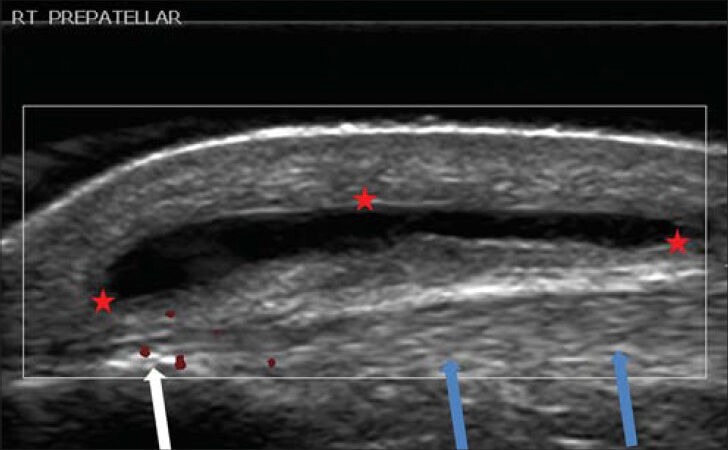
UltrasoundUltrasound of the anterior aspect of the knee: distension of the prepatellar bursa (prepatellar bursitis, so-called housemaid's knee), marked by cursors.
Source : Artul et al., Journal of clinical imaging science, 2014, figure 9 · CC BY-NC-SA
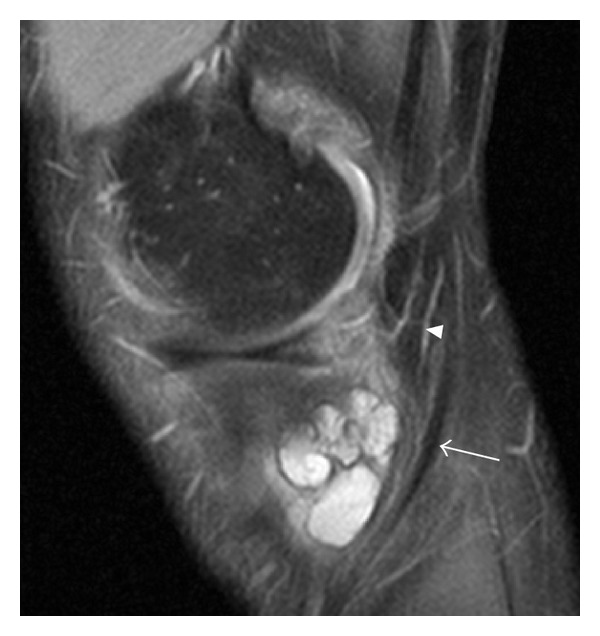
MRISagittal knee MRI: distension of the pes anserine bursa (anserine bursitis) in a 47-year-old floor layer, exposed to repeated kneeling.
Source : Rytter et al., International journal of rheumatology, 2012, figure 2 · CC BY
Key points
- Non-infected bursitis = protection, ice, rest, painkillers first; aspiration is not routine.
- Any knee bursitis that is hot, red, very painful or feverish raises the suspicion of infection : prompt medical advice.
- Aspiration is justified above all to analyse the fluid when infection is suspected 3.
- Surgery concerns only stubborn, recurrent or over-large forms.
Infected bursitis: antibiotics first, surgery rarely
Septic bursitis does not automatically mean the operating theatre. In a cohort of 147 emergency patients with infected elbow bursitis, antibiotic treatment without aspiration achieved uncomplicated healing in 88.1 % of the 134 patients followed up (118/134); only 6 % needed a later aspiration and 6.7 % admission for intravenous antibiotics 6. An important caveat: this study concerns the elbow, not the knee, and compares « antibiotics alone » with « antibiotics + aspiration », not surgery.
A multicentre study of 272 septic bursitis cases (elbow and knee) confirms it: only 26 % (71/272) were operated on, with a low overall failure rate of 5.9 % (16/272). Failures were more frequent when antibiotics lasted less than 14 days (p = 0.02), arguing for a sufficient duration in infected forms 7.
Infected or not, knee bursitis is first treated without a scalpel.
When surgery becomes necessary
Surgery (incision, drainage or bursectomy, removal of the bursa) is reserved for severe, refractory, chronic or recurrent forms, or for a volume that interferes with function 43. It is a last-line choice: the available studies do not compare « operating straight away » with « waiting », but they confirm that most patients get through without an operation.
When a bursectomy is indicated, the endoscopic (minimally invasive) route appears non-inferior to open surgery, with a shorter hospital stay, and 80 % of patients operated on endoscopically are pain-free at one year 8. A word on how to read this: the absence of a difference in recurrence at 1 year rests on a very wide confidence interval (OR 0.41; 95 % CI 0.05–3.53; p = 0.67): this means absence of evidence of a difference on low-level data, not evidence of equivalence.
On infected forms that were operated on, the only surgical randomised trial including prepatellar bursitis (164 patients, 34 of them at the knee) tested one-stage bursectomy against a two-stage strategy: 10 % failures (8/79) against 16 % (14/85), a gap that is not statistically significant 2. The demonstrated advantages of the one-stage procedure are mainly a shorter hospital stay (4.5 vs 6 days) and less wound breakdown. In that trial, 7 days of antibiotics after the operation were enough and proved safe, without that short course being compared with a longer one. An exploratory finding points the same way (beyond 7 days, neither recurrence nor length of stay improved), but on tiny numbers: to be confirmed, not an established rule 8.
Going back to kneeling work
Prepatellar bursitis is a condition of kneeling : it arises from repeated pressure and friction between the skin and the kneecap (hence the nicknames « housemaid’s knee » or « carpet layer’s knee »), from repetition of the movement rather than from a single accident 3. The consequence follows logically: rather than stacking up aspirations or contemplating an operation, the most lasting lever is to treat the cause: protective knee pads, mats, adapting kneeling tasks and taking breaks. Realistic healing times are counted in weeks (often 3 to 4 for an uncomplicated mechanical form, based on elbow data), provided the knee really is unloaded: going back to kneeling work too soon risks recurrence.
Physiotherapy support keeps its full value here, not to « put anything back in place », but to assess the problem, spot the signs of infection that must not be missed, adapt the load, lift the fear of bearing weight again and make you independent in protecting the working movement.
🧭 When a procedure is up for discussion (and when it is not)
Aspiration, injection, operation: faced with knee bursitis, the real question is not « which procedure? » but « is a procedure needed at all? ». The answer depends first on one thing, which governs all the rest: is your bursitis infected or not?
The question that decides everything: infected or not
Distinguishing aseptic bursitis (mechanical, not infected) from septic bursitis (infected) usually rests on analysing the fluid taken by aspiration, with ultrasound helping diagnosis and guiding the procedure 1. This distinction completely changes what should be done: in one case a procedure is often pointless; in the other it is part of the work-up. To understand why this bursitis sits just in front of the kneecap, see the full article on prepatellar bursitis.
Non-infected bursitis: a procedure rarely adds anything
When bursitis comes from repeated microtrauma (kneeling), aspiration is not recommended routinely : the needle can turn mechanical bursitis into infected bursitis (so-called iatrogenic infection). First-line management rests on simple measures: protection and padding, ice, elevation, painkillers 34.
What are aspiration and injection really worth here? The only randomised trial available concerns bursitis of the elbow (olecranon), not the knee: its figures should therefore be read with caution, the knee being a weight-bearing joint with different biomechanics. In that trial 5, at 4 weeks:
| Approach (elbow bursitis, aseptic) | Healing at 4 wks | Level of evidence |
|---|---|---|
| Compression + NSAIDs (no procedure) | 83 % | Favoured (safety) |
| Aspiration + corticosteroid | 85 % | The fastest |
| Aspiration alone | 65 % | Less effective |
Aspiration with injection heals fastest (2.3 weeks against ~3.1-3.2), but the difference in effectiveness against compression alone (83 % vs 85 %) is not significant. The authors nonetheless recommend compression + NSAIDs as the best compromise, not because it is more effective, but because it is safer : it avoids the possible complications of an aspiration or an injection.
If the bursitis is not infected, not piercing it is often the most prudent decision.
And surgery? It only makes sense for a form that persists, recurs, or whose volume clearly interferes with function 34. The most useful thing often remains treating the cause: protecting the knee and adapting kneeling work, rather than multiplying procedures. This is also where a health professional helps: assessing, dosing the return to activity, lifting the fear of movement and making you independent in day-to-day protection.
Infected bursitis: antibiotics first, surgery as a fallback
Infected bursitis does not mean the operating theatre. In a multicentre study of 272 septic bursitis cases (elbow and knee), only 26 % were operated on, the vast majority being managed medically, with a low overall failure rate of 5.9 % 7.
The organism responsible is Staphylococcus aureus in 80 % of superficial infected bursitis cases, which guides the first-line antibiotic 1. A cohort of infected elbow bursitis cases even achieved uncomplicated healing in 88.1 % of assessable patients on antibiotics without aspiration of the bursa (6 % needed an aspiration afterwards): elbow data, to be transferred to the knee with reservations 6.
When surgery is needed for a stubborn form, the endoscopic route is not inferior to the open route, with a shorter hospital stay and 80 % of patients pain-free at one year, on low-level evidence 8. It is a clinical last resort, not a first line.
Key points: your decision tree
- 1. Signs of infection? (hot redness, fever, intense pain) → prompt medical advice; aspirating the fluid then serves the diagnosis.
- 2. No infection? → rest, ice, elevation and knee protection first. Aspiration is not needed straight away and carries a risk.
- 3. Infected? → antibiotics first line; most heal without an operation.
- 4. Surgery? → reserved for forms that persist, recur or interfere with function.
- The real lever: correcting the cause (repeated kneeling), not stacking up procedures.
🔧 The procedures in practice: benefits, risks, recovery
Faced with knee bursitis, three routes exist: conservative measures (rest), aspirating the bursa, or operating. What settles it is first knowing whether the bursa is infected (septic) or simply irritated (aseptic): a distinction that usually rests on analysing the fluid taken by aspiration, with ultrasound helping diagnosis and guidance 1. For the mechanism and the diagnosis, see the full article on prepatellar bursitis.
Rest and conservative measures: the first line
In the great majority of prepatellar bursitis cases, especially those linked to repeated pressure on the knee, the starting point is not a procedure, but common sense: protection and padding, ice, elevation, painkillers. Faced with traumatic or haemorrhagic bursitis that is not infected, this conservative treatment is the first recommended, with no invasive procedure at the outset 3. Treating the cause, often kneeling at work, counts for more than multiplying procedures.
A realistic timescale: mechanical forms generally settle within a few weeks if the triggering pressure is removed: patience here is a genuine treatment strategy, not an absence of treatment.
Key points
- Bursa infected or not: this distinction governs all the rest.
- Mechanical, non-infected bursitis: conservative first (protection, ice, rest, painkillers).
- Aspiration is not routine: on a mechanical bursa, it can turn inflammation into infection.
- Surgery remains reserved for stubborn, recurrent or over-large forms.
Aspiration: useful for diagnosis, not always for cure
Aspiration (needle aspiration) has two faces. As an investigation, it is valuable: as soon as infection is suspected, taking and analysing the fluid is essential 3. As a treatment for mechanical, non-infected bursitis, it is not recommended routinely: the needle can infect a bursa that was until then merely irritated (iatrogenic septic bursitis) 3.
Is aspiration essential to make non-infected bursitis disappear? The only randomised trial available concerns not the knee but the elbow (aseptic olecranon bursitis, 83 patients): resolution at 4 weeks was 83 % with compression + anti-inflammatories, 65 % after aspiration alone and 85 % after aspiration + corticosteroid 5. Aspiration with injection healed fastest (2.3 weeks against 3.1 and 3.2), but the authors still recommend compression + NSAIDs, not because it treats better (the gap of 83 % against 85 % is not significant), but because it avoids the complications of the procedure. These figures come from the elbow; the knee is a weight-bearing joint with different biomechanics: take them as a trend, not as established proof.
Even in superficial infected forms, aspiration is not always necessary: in 134 patients followed up for septic elbow bursitis, antibiotics from the outset without aspiration were enough in 88.1 % of cases, only 6 % subsequently needing an aspiration 6. A caveat: this study sets « antibiotics without aspiration » against « antibiotics with aspiration », not medical against surgical treatment, and concerns only the elbow: transferring it to the knee remains hypothetical.
Surgery: a fallback, not a reflex
The surgical procedure (incision, drainage or removal of the bursa, the bursectomy) is reserved for severe, refractory, or chronic and recurrent forms 4. The figures confirm this is a minority of cases: in a multicentre study of 272 septic bursitis cases of the elbow and knee, only 26 % were operated on, the vast majority being managed medically, with an overall failure rate of 5.9 % 7. Reserving surgery for stubborn forms is a coherent clinical choice, even if none of these studies was designed to « prove » that last-line position.
| Approach | What to expect from it | Level of evidence |
|---|---|---|
| Conservative (protection, ice, rest) | Resolution of mechanical forms within a few weeks | solid (recommended first line) |
| Aspiration | Mainly diagnostic; modest therapeutic effect, risk of infection | moderate, data from the elbow |
| Surgery (bursectomy) | Stubborn/recurrent forms only | weak, few trials |
When a bursectomy is needed, the endoscopic (minimally invasive) route is not inferior to open surgery: a systematic review (10 studies, 702 patients) finds no difference in recurrence at 1 year, with a shorter hospital stay, and 80 % of those operated on endoscopically are pain-free at 1 year 8. An honest qualification: this result rests on low-level evidence (a very wide confidence interval): it is an absence of evidence of a difference, not evidence of equivalence.
After the operation: in the only surgical randomised trial including septic prepatellar bursitis (164 patients, 34 of them at the knee), one-stage removal gave 10 % failures against 16 % for the two-stage approach: a gap that is not significant 2. Its demonstrated advantage is not a better cure rate, but a shorter hospital stay (4.5 against 6 days) and less wound breakdown. In that trial, 7 days of antibiotics were enough, without comparison to a longer course.
Septic bursitis is therefore not an emergency to be operated on as a matter of principle, but a situation to be treated methodically.
The right decision does not depend on fear of the procedure, but on knowing whether the bursa is infected and whether simple measures have been given their chance.
💪 The conservative option first
Faced with knee bursitis, the image that often comes to mind is the needle that « drains the fluid » or the surgical procedure. In practice, for the great majority of prepatellar bursitis cases (that is, the microtraumatic, non-infected forms linked to repeated kneeling), the first line is precisely the opposite: conservative management, with no invasive procedure at the outset 34. Aspiration is not recommended routinely in this setting, precisely because it risks turning mechanical bursitis into septic bursitis by way of the needle 3.
On a swollen but uninfected knee, the first useful reflex is not to needle it, it is to relieve the pressure that created the problem.
What the first line actually consists of
The foundation is simple and well established. These are general measures, often summarised by the PRICE protocol: protection, relative rest, ice, compression and elevation, together with painkillers and, if needed, anti-inflammatories 43. The immediate aim is to bring the inflammation down and leave the bursa « in peace » long enough for it to drain on its own.
But the decisive point lies elsewhere. Prepatellar bursitis is a condition of repeated movement: it arises from repeated compression and shear forces between the skin and the kneecap during frequent kneeling 3. As long as the cause, repeated pressure on the knee, persists, rest alone is not enough. The logic of the first line is therefore to treat the cause rather than multiply procedures: protecting the knee (knee pads, padding), adapting kneeling work or activity, adapting positions in daily life 3.
Where physiotherapy support fits in
This is where support takes on its full meaning, well beyond simply resting. The physiotherapist assesses the knee, rules out the signs that would suggest infection (redness, heat, fever, which completely change what should be done), doses the return to weight-bearing and loading, and above all helps prevent a fear of movement taking hold. They build a gradual return to kneeling and to the triggering movements, with concrete adaptations, so that the knee regains its function without keeping the irritation going. The point is not to « spare » the knee indefinitely, but to reorganise how it is loaded and to make the person independent in preventing recurrence.
Key points
- Non-infected knee bursitis: start with conservative care (protect, relieve the pressure, adapt kneeling), not with aspiration.
- Aspiration is not recommended routinely for microtraumatic bursitis: risk of infection caused by the needle 3.
- Treating the cause (repeated kneeling) counts for more than repeating local procedures.
- Surgery is a fallback reserved for persistent, recurrent or over-large forms, not a first step 34.
How long should you try before reconsidering?
A fair question: how long do you wait? The guidelines do not set a single figure for knee bursitis: an uncertainty that has to be owned honestly. What we mostly have is data on the elbow bursa, whose pathophysiology is close but not identical (the knee is a weight-bearing joint). In the only randomised trial on aseptic elbow bursitis, treatment with compression and anti-inflammatories brought around 83 % resolution at four weeks, the authors keeping it as the best compromise between safety and effectiveness 5. To be transferred to the knee with caution, but the order of magnitude is useful.
In practice, a well-conducted conservative trial of a few weeks, with the cause corrected, is reasonable before reconsidering the strategy. Reconsidering does not mean « operating »: depending on how things go, it may mean a medical reassessment, a possible diagnostic aspiration if infection is suspected (which is indicated) or if the volume interferes with function, and only as a last resort surgery for stubborn forms 34. The signs that should prompt a consultation without waiting for that period (a red, hot, painful knee, fever), fall outside the conservative framework and call for management specific to the infected form.
To understand the mechanisms in detail, the markers for telling a simple form from an infected one and the whole care pathway, the full article covers the ground: Prepatellar bursitis (« housemaid’s knee »).
Bibliography
Every reference checked individually on PubMed (clickable PMID). 8 sources. Click a superscript note marker in the text: the bibliography opens and highlights the source.
- Lormeau C, Cormier G, Sigaux J, Arvieux C, Semerano L (2019). Joint Bone Spine. PMID 31615686. doi:10.1016/j.jbspin.2018.10.006.
- Uçkay et al. (2017). Mayo Clinic Proceedings. PMID 28602435.
- Khodaee M (2017). American Family Physician. PMID 28290630.
- Baumbach SF, Lobo CM, Badyine I, Mutschler W, Kanz KG (2014). Archives of Orthopaedic and Trauma Surgery. PMID 24305696.
- Kim et al. (2016). Clinical Orthopaedics and Related Research. PMID 26463567.
- Beyde et al. (2022). Academic Emergency Medicine. PMID 34698411.
- Charret et al. (2021). Journal of Antimicrobial Chemotherapy. PMID 34293150.
- Brown et al. (2022). Archives of Orthopaedic and Trauma Surgery. PMID 33721054.
❓ Frequently asked questions
Should knee bursitis be aspirated?
Not routinely. In prepatellar bursitis of microtraumatic origin (not infected), aspiration is not recommended routinely because it carries a risk of iatrogenic septic bursitis caused by the needle. Initial management rests on conservative measures: protecting/padding the knee, ice, elevation, rest and painkillers. Aspiration with fluid analysis is, on the other hand, indicated as soon as septic bursitis is suspected 3.
Is aspirating knee bursitis dangerous?
It carries a risk worth knowing about: in non-infected microtraumatic bursitis, the needle can turn mechanical bursitis into septic bursitis (iatrogenic infection). That is why it is not advised routinely in these forms 3. When infection is suspected, however, aspiration becomes a key investigation: analysing the fluid, helped by ultrasound for diagnosis and guidance, distinguishes aseptic from septic bursitis 1.
Knee bursitis: aspiration, surgery or rest?
Rest and conservative measures come first: aspiration to drain only if needed, NSAIDs and the PRICE protocol (protection, rest, ice, compression, elevation). Surgery (incision, drainage or bursectomy) is reserved for severe, refractory or chronic/recurrent forms 4. The only randomised trial available, conducted on elbow bursitis (so to be transferred to the knee with caution), shows moreover that non-septic bursitis largely heals without aspiration: 83% resolution at 4 weeks under compression + NSAIDs 5.
When should knee bursitis be operated on?
Surgery is reserved only for persistent or recurrent forms, or for a volume interfering with function 3. Even in infected forms, an operation is not the rule: of 272 superficial septic bursitis cases, only 26% were operated on, the majority being managed medically, with an overall failure rate of 5.9% 7. When a bursectomy is needed, the endoscopic route is not inferior to the open route, on low-level evidence 8.
Can septic knee bursitis be treated without aspiration or surgery?
Often, yes, with antibiotics. In a cohort of 147 patients treated in the emergency department for superficial septic bursitis (elbow, with close pathophysiology but data not demonstrated for the knee), empirical antibiotics without aspiration achieved uncomplicated resolution in 88.1% of the 134 assessable patients; only 6% subsequently needed an aspiration 6. A sufficient duration of antibiotics counts: failures are more frequent when antibiotics last less than 14 days 7. Staphylococcus aureus being responsible in 80% of cases, it guides empirical treatment 1.
Behind this article
An author who explains, a reviewer who checks.
How we write and check our content

Physiotherapist · co-founder of Physio Learning
Marked for life by his first four-hour lecture without a single image, he took a master’s in instructional design so that it would never happen to anyone again. He hunts down publication bias and unreadable slides with the same intransigence.

Head of scientific content
Physiotherapist specialising in neuro-musculoskeletal practice and holder of a master’s in public health. He checks the methodological rigour of every article: primary sources, levels of evidence, no exceptions.