















The CAIT rates the perceived instability of one ankle out of 30. Its published thresholds run from 27.5 to 11.5, more than half the scale, and it is not the instrument that changes: it is the control group. The threshold to use in French is 23, not the 27 still circulating. The tool below therefore asks what you are comparing against.
The score runs against intuition: a high score signals a stable ankle. A report announcing 'CAIT improved, score down' describes a worsening.
Figures taken from the studies listed at the end of this page, every value carrying its source where it is written. The nine items are reproduced from the University of Liège teaching document and the Creative Commons licensed English version, without changing a word.
What the CAIT measures, and why it is scored ankle by ankle
The CAIT is a self-report questionnaire of nine items, completed by the patient alone, with no equipment. It returns a single score from 0 to 30 per ankle, and its direction runs against intuition: a high score signals a stable ankle, a low score severe perceived instability. The orders of magnitude say it: 18.2 on average in the unstable against 27.4 in the uninjured.
This is the most banal error of direction, and it translates directly into a report: writing 'CAIT improved, score down' describes a worsening.
A second scoring rule, just as simple and just as forgotten: the score is computed ankle by ankle. The form has two columns, left and right, and the two are never added together. The maximum stays 30, never 60. That is in fact this instrument's argument against those requiring comparison with the other side: it remains interpretable in a bilateral patient.
Third point, verifiable in the scoring key and rarely said: the nine items do not carry the same weight, and the heaviest is not an instability item. Item 1, pain, is worth up to 5 points, when single-leg stance is worth only 2. In item order, the maxima are 5, 4, 3, 3, 2, 3, 4, 3 and 3, which indeed makes 30. A patient whose ankle is stable but painful therefore loses up to a sixth of an instability score without being unstable.
Finally, what the score does not license. The original work correlates it strongly with a visual scale of perceived instability, 0.76, and far more weakly with a functional scale, 0.50. A low CAIT says what the patient feels; it says nothing about an anterior drawer, and it excuses no examination of ligamentous stability.
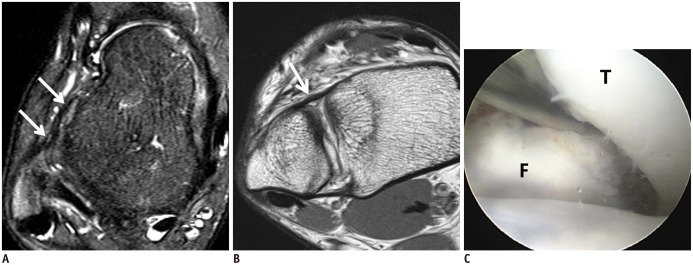
MRIAxial ankle MRI: loose and irregular anterior talofibular ligament (arrows, A), anterior tibiofibular ligament also injured (B), confirmed by arthroscopy showing joint widening (C).
Source : Chun et al., Korean Journal of Radiology, 2015, figure 2 · CC BY-NC
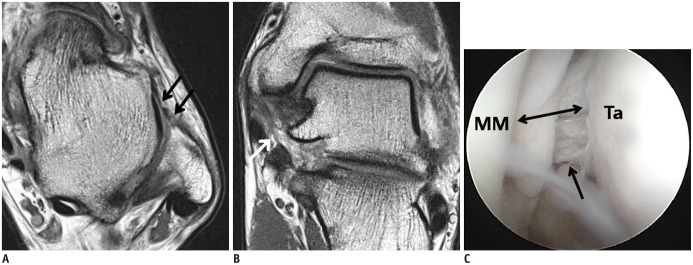
MRIAxial and coronal ankle MRI: rupture of the anterior talofibular ligament (arrows, A) and loose superficial deltoid ligament (B), confirmed by arthroscopy showing widening of the mortise (C).
Source : Chun et al., Korean Journal of Radiology, 2015, figure 1 · CC BY-NC
Three points in English, four point two in French
This is the point that decides what can be concluded from a follow-up, and it sets two literatures against each other.
On the English side, a study in 50 subjects sets the minimal clinically important difference at 3 points or more, for a minimal detectable change of 3.08. The two hold together, and the importance threshold just exceeds the noise.
On the French side, the Liège validation measures a smallest detectable change of 4.21 points, for a standard error of measurement of 1.52. These two values are not in the PubMed abstract of the article: they were read in the full text deposited by its authors, section 3.4. The English and French quantities are computed the same way, which makes the comparison legitimate.
And that comparison is awkward. The 3-point gain the English-language literature calls clinically important falls inside the measurement noise of the French version. In French, at least 5 points are needed to claim an ankle has changed. Announcing progress at 3 points on the CAIT-F is commenting on one's own instrument's error.
Five thresholds for a thirty-point scale
The CAIT does not have one threshold, it has five, and the gap between the highest and the lowest covers more than half the scale: from 27.5 to 11.5 out of 30 points.
It is not the instrument that changes from one study to another. It is the comparison group. The original work compares general-community volunteers and finds 27.5. The laboratory recalibration compares chronically unstable subjects with selected healthy ones and finds 25. The International Ankle Consortium retains a score below 24 as a research criterion. The French validation, in Liège students, finds 23. And a Dutch foot and ankle outpatient clinic, where the controls are themselves patients, finds 11.5.
The rule that emerges is easy to state: the more the control resembles a patient, the more the threshold collapses. A CAIT threshold without its reference population means nothing, which is why the tool at the top of this page asks what you are comparing against before returning a verdict.
One last point on what the CAIT cannot do, and it concerns a very common patient in practice. The instrument does not reliably separate chronic instability from the coper, the patient who had a single sprain and recovered without residual instability. At the recalibrated threshold, the validation set counts seven false positives for a single false negative, and its authors explicitly conclude to caution with these subjects.
| Origin of the threshold | Threshold | Comparison group |
|---|---|---|
| Original publication | 27.5 | 236 volunteers, general community population |
| Laboratory recalibration | ≤ 25 | 200 subjects, two independent sets |
| International Ankle Consortium criterion | < 24 | participant selection criterion, not diagnostic |
| Validated French version | ≤ 23 | 102 subjects from Liège, median age 22 |
| Foot and ankle outpatient clinic | 11.5 | 98 consecutive patients, controls themselves patients |
| Important change, English literature | ≥ 3 | 50 subjects, minimal detectable change 3.08 |
| Smallest detectable change, French version | 4.21 | the same 102 subjects, standard error of measurement 1.52 |
The French threshold, and who it applies to
A validated French version exists, which is not so common in this family, and its threshold is 23 points or less. That is the one a French-speaking physiotherapist should use, and not the 27 of the original work still circulating in French resources.
Its properties are solid: test-retest reliability of 0.960, internal consistency of 0.885, no floor or ceiling effect in unstable subjects. At the chosen cut-point, sensitivity is 0.922 and specificity 1.000, for a maximum Youden index of 0.922.
But one must say who that threshold comes from, because that is precisely the variable moving the other four. The sample has 102 subjects of median age 22, recruited in Liège, 68.6% female, split evenly between unstable and uninjured. The 'French version' is therefore Belgian, and young. Nothing guarantees that 23 holds in a fifty-year-old patient consulting for an ankle that gives way: that is exactly the population shift making the Dutch threshold fall to 11.5.
One administration detail, finally, and it comes from the team that validated this version: the form version that displays the points next to each answer must not be handed to the patient. A patient who sees the scoring key steers their answers.
Where the nine items reproduced here come from
The French items come from the teaching document deposited by the University of Liège's LAM Motion Lab on ORBi, which presents them as the translation of the version validated by Geerinck et al. in 2020. That document prints no figures: the scoring values of the French options above were inferred by rank correspondence with the scoring key printed in the English version, item by item. The English items come from the appendix of Vuurberg et al., 2018, published under a Creative Commons Attribution 4.0 International licence, which permits reproduction with attribution. No licence is published for the French teaching document; for any use beyond these terms, contact the authors of each source.
Three administration pitfalls
Using the threshold of 27 in French
It comes from 236 general-community volunteers and overdiagnoses in practice. The threshold of the French version is 23 points or less, and the International Ankle Consortium retains a score below 24 for research.
Concluding from a three-point gain
That is the English minimal clinically important difference, but the smallest detectable change of the French version is 4.21 points. In French, at least 5 points are needed to claim a real change.
Adding the two ankles together
The score is computed ankle by ankle and the maximum stays 30. A total of 45 or 52 on this questionnaire means nothing.
Frequently asked questions
What does the CAIT measure, and how is it scored?
It rates the perceived instability of one ankle across nine items, each with its own point value, for a score that is the sum of the nine answers, from 0 to 30, where 30 is an ankle perceived as stable. All nine answers are required: no source says what to do with a missing item. It measures a perception, not mechanical laxity.
Which CAIT threshold should be used in France?
23 points or less, the threshold of the French version validated in 102 subjects. The circulating threshold of 27 comes from the original work, in a general community population, and overdiagnoses in practice.
How much change counts?
The English-language literature says 3 points, but the smallest detectable change of the French version is 4.21 points. In French, at least 5 points are needed to conclude.
Is the CAIT computed across both ankles?
No. It is scored ankle by ankle, the form having two columns, and the maximum stays 30. That is what makes it interpretable in a bilateral patient.
Is a low score enough to diagnose chronic instability?
No. The instrument does not reliably separate chronic instability from the patient who had a single sprain and recovered: at the recalibrated threshold, there are seven false positives for one false negative.
References
7 sources, PMIDs included
- Hiller CE, Refshauge KM, Bundy AC, Herbert RD, Kilbreath SL. The Cumberland ankle instability tool: a report of validity and reliability testing. Arch Phys Med Rehabil 2006;87(9):1235-41. PMID 16935061. The original publication, describing the instrument as a 9-item 30-point scale and setting the first threshold, 27.5, in 236 volunteers recruited from the general community, with a sensitivity of 82.9% and a specificity of 74.7%. It also establishes what the score really measures: it correlates strongly with a visual scale of perceived instability, 0.76, and far more weakly with a functional scale, 0.50. It is a perception, not a laxity.
- Geerinck A, Beaudart C, Salvan Q, Van Beveren J, D’Hooghe P, Bruyère O, Kaux JF. French translation and validation of the Cumberland Ankle Instability Tool, an instrument for measuring functional ankle instability. Foot Ankle Surg 2020;26(4):391-7. PMID 31118138. The validated French version, the CAIT-F, produced by a Liège team in 102 subjects of median age 22, 51 with functional ankle instability and 51 without. Test-retest reliability of 0.960, internal consistency of 0.885, no floor or ceiling effect. Three decisive values are not in the PubMed abstract and were read in the full text: the maximum Youden index, 0.922, places the cut-point at 23.5, with a sensitivity of 0.922 and a specificity of 1.000; the standard error of measurement is 1.52 point and the smallest detectable change 4.21 points.
- Wright CJ, Linens SW, Cain MS. Establishing the Minimal Clinical Important Difference and Minimal Detectable Change for the Cumberland Ankle Instability Tool. Arch Phys Med Rehabil 2017;98(9):1806-11. PMID 28137476. The two bounds of the English version, in 50 subjects with chronic instability, reviewed after four weeks: the minimal clinically important difference is 3 points or more, for an area under the curve of 0.797, and the minimal detectable change 3.08 points. These values must be set against the 4.21 points of the French version, computed the same way: the gain English calls important falls inside the noise of the CAIT-F.
- Wright CJ, Arnold BL, Ross SE, Linens SW. Recalibration and validation of the Cumberland Ankle Instability Tool cutoff score for individuals with chronic ankle instability. Arch Phys Med Rehabil 2014;95(10):1853-9. PMID 24814563. The laboratory recalibration, in two independent sets totalling 200 subjects, lowering the threshold to 25 or less, with a sensitivity of 96.6% and a specificity of 86.8%. Above all it carries a warning practice ignores: the instrument does not reliably separate chronic instability from the coper, the patient who had a single sprain and recovered. The validation set counts 7 false positives for a single false negative, and the authors explicitly conclude to caution with these subjects.
- Gribble PA, Delahunt E, Bleakley C, Caulfield B, Docherty CL, Fourchet F, Fong D, Hertel J, Hiller C, Kaminski TW, McKeon PO, Refshauge KM, van der Wees P, Vicenzino B, Wikstrom EA. Selection criteria for patients with chronic ankle instability in controlled research: a position statement of the International Ankle Consortium. J Orthop Sports Phys Ther 2013;43(8):585-91. PMID 23902805. The position statement of the International Ankle Consortium, setting the inclusion criterion used by research: a score below 24. This is not a clinical diagnostic threshold but a criterion for selecting participants, and the distinction is not cosmetic: it explains why this figure coexists with four others without contradicting them.
- Li Y, Tsang RC, Liu D, Ruan B, Yu Y, Gao Q. Applicability of cutoff scores of Chinese Cumberland Ankle Instability Tool and Foot and Ankle Ability Measure as inclusion criteria for study of chronic ankle instability in Chinese individuals. Phys Ther Sport 2021;48:116-20. PMID 33421739. The empirical test of the previous criterion, in 145 participants with chronic instability and 66 uninjured: the below-24 threshold reaches 80.7% sensitivity and 84.9% specificity there. This study also gives the order of magnitude that allows an isolated score to be read, and it must be read the right way round: 18.2 on average in the unstable against 27.4 in the uninjured. A high score signals a stable ankle.
- Vuurberg G, Kluit L, van Dijk CN. The Cumberland Ankle Instability Tool (CAIT) in the Dutch population with and without complaints of ankle instability. Knee Surg Sports Traumatol Arthrosc 2018;26(3):882-91. PMID 27714439. The threshold that collapses, and it is worth knowing because it comes from a real clinic. In 98 consecutive patients of a Dutch foot and ankle outpatient clinic, the cut-off falls to 11.5: unstable below 12. It is not the instrument that changed, it is the control group, itself now a patient population. This article, open access under a Creative Commons licence, also reproduces in appendix the full scoring key of the English version.
 Page written by Anthony Baillon, physiotherapist, co-founder of Physio Learning. The questionnaire itself is by Hiller et al., 2006, in its French version by Geerinck et al., 2020: this page reproduces, documents and interprets it.
Behind this article
An author who explains, a reviewer who checks.
How we write and check our content

Physiotherapist · co-founder of Physio Learning
Marked for life by his first four-hour lecture without a single image, he took a master’s in instructional design so that it would never happen to anyone again. He hunts down publication bias and unreadable slides with the same intransigence.

Head of scientific content
Physiotherapist specialising in neuro-musculoskeletal practice and holder of a master’s in public health. He checks the methodological rigour of every article: primary sources, levels of evidence, no exceptions.