





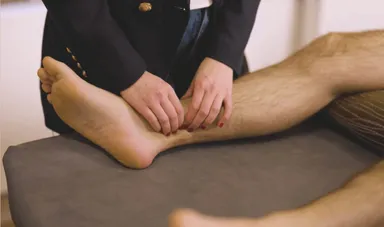



The Ottawa rules decide whether radiography is needed after an acute injury of the ankle, the foot or the knee. They are calibrated for a sensitivity close to 100 % and a specificity of about 50 %: a negative result solidly rules out a fracture, a positive one does not announce it. The full rule is right below.
The knee rule has a sensitivity of 0.99 and a specificity of 0.49: it is built to rule out a fracture, not to announce one. The detail is below.
Figures taken from the studies listed at the end of this page. The statement of the criteria was read again in three independent full texts for each region, since the abstracts do not give it.
What the Ottawa rules decide
The Ottawa rules answer a single question: is radiography needed after this injury? They do not say whether there is a fracture, they say whether to go looking for one.
They were built by Stiell et al. between 1992 and 1996, in the emergency departments of two Ottawa university hospitals, by recursive partitioning across some twenty clinical variables. Three rules came out of it: one for the ankle series, one for the foot series, one for the knee.
Their implementation was measured, not merely assumed. In 2,342 adults, with a control hospital, ankle radiography fell by 28 % in the hospital applying the rule and rose by 2 % in the control. Patients sent home without a film spent 80 minutes in the emergency department against 116, at a cost of 62 dollars against 173, with no difference in satisfaction or in later recourse to radiography.
The statement of the three rules
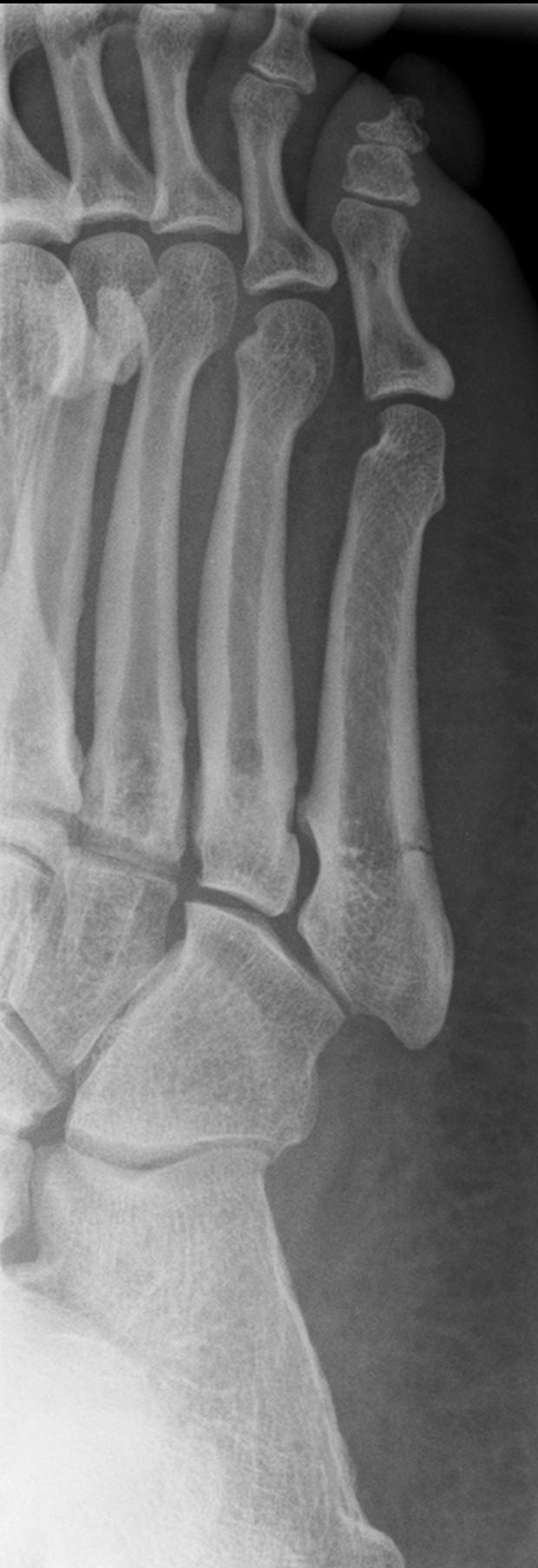
X-rayFrontal foot X-ray: transverse fracture line visible at the base of the 5th metatarsal (Jones fracture), without displacement.
Source : Monfils, Wikimedia Commons · CC BY-SA
The three rules fit in a few lines, and the tool at the top of this page applies them in order. They all read the same way: an entry condition, then a list of criteria of which a single one suffices.
For the ankle series, the entry condition is pain in the malleolar zone, defined as the distal six centimetres of the tibia and fibula plus the talus. A single one of the three following criteria then suffices: bone tenderness over the distal six centimetres of the posterior edge of the fibula or over the tip of the lateral malleolus; the same on the tibial side and the medial malleolus; or inability to bear weight.
For the foot series, the entry condition is midfoot pain, which covers the navicular, the cuboid, the cuneiforms, the anterior process of the calcaneus and the base of the fifth metatarsal. The criteria are bone tenderness at the base of the fifth metatarsal, that of the navicular, or the same inability to bear weight. For the knee, there is no entry condition: five criteria, of which one suffices, namely 55 years or older, isolated tenderness of the patella, tenderness of the head of the fibula, inability to flex to 90 degrees, or inability to bear weight. In all three, bearing weight means taking four steps, two on each foot, with or without a limp, immediately after the injury and on examination.
Ruling out is not ruling in
This is the point everyday use distorts most, and it comes down to two figures.
The rules were calibrated toward 100 % sensitivity, and they reach it: 1.0 in the prospective validations, 98.5 % to 99 % in the meta-analyses. The price of that setting is a specificity of about 50 %: 48.6 % in the 2004 review, 0.49 in the 2020 meta-analysis across 7,385 patients.
The consequence reads in the likelihood ratios. The negative ratio is 0.05 to 0.08 depending on the region: a negative rule solidly rules out a fracture, and at a prevalence of 15 % less than 1.4 % probability remains. The positive ratio for the knee, though, is only 1.86. In other words, a positive rule barely shifts the probability of a fracture: it indicates radiography, it announces nothing. Telling a patient that 'the test is positive' amounts to announcing a fracture that one examination in two will not find.
| What is measured | Ankle and foot | Knee |
|---|---|---|
| Sensitivity, prospective validation | 1.0 | 1.0 |
| Pooled sensitivity, meta-analysis | ≈ 100 % | 98.5 to 99 % |
| Pooled specificity | modest | 48.6 to 49 % |
| Negative likelihood ratio | 0.08 | 0.05 to 0.07 |
| Positive likelihood ratio | not pooled | 1.86 |
| Meta-analysis sample | 15,581 | 4,249 and 7,385 |
| Reduction in radiographs | 30 to 40 % | 28 % |
| Sensitivity in children over 5 | 98.5 % | not established here |
In children
The question comes up often, and it has a measured answer.
A meta-analysis of 12 studies, across 3,130 children of whom 671 had a fracture, finds a pooled sensitivity of 98.5 % and a 24.8 % reduction in radiographs. Of ten missed fractures, four could be characterised: one Salter-Harris type I, one type IV and two judged insignificant.
The boundary is sharp and worth remembering: the authors conclude the rules are reliable in children over five years old. Below that, they have not been established, and the 2003 review had already reported a negative likelihood ratio of 0.07 in the paediatric subgroups.
Why this page states the rule in full
It is the only one of our instrument pages to do so, and the difference is one of kind. Clinical questionnaires are works, often under licence: we give their scoring without reproducing their items. The Ottawa rules are decision rules published in JAMA, taken up in guidelines and in hundreds of articles: stating them is legitimate, and stating them by halves would be useless. One point of method though: PubMed abstracts give the performance of the rules, never the list of their criteria, and their authors' historical website has changed hands and now serves unrelated content. The statement above was therefore read again in three independent full texts per region, which agree.
Three pitfalls in applying them
Announcing a fracture on a positive rule
The positive likelihood ratio for the knee is 1.86, and specificity hovers around 50 %. A positive rule means 'radiography is needed', nothing more, and phrasing it otherwise to the patient is a source of groundless worry.
Forgetting the double condition on weight-bearing
Inability to bear weight counts only if it existed immediately after the injury and persists on examination. A patient who walked at the time and can no longer, or the reverse, does not meet that criterion as it was validated.
Applying the rule outside its frame
It was established on acute injuries, in adults and then in children over five. It has not been validated on chronic pain, on an old injury, nor in younger children.
Frequently asked questions
What are the Ottawa rules for?
They decide whether radiography is needed after an acute injury of the ankle, the foot or the knee. They do not diagnose the fracture, they point toward the examination that will look for it.
What are the criteria for the ankle?
Pain in the malleolar zone, plus at least one of three signs: bone tenderness over the distal six centimetres of the posterior edge or the tip of the lateral malleolus, the same on the medial malleolus side, or inability to take four steps immediately after the injury and on examination.
What are the criteria for the knee?
A single one of five suffices: 55 years or older, isolated tenderness of the patella, tenderness of the head of the fibula, inability to flex to 90 degrees, or inability to take four steps immediately and on examination.
What is a negative result worth?
A great deal. The negative likelihood ratio is 0.08 at the ankle and 0.05 at the knee, which leaves less than 1.4 % probability of fracture at a prevalence of 15 %.
Do the criteria apply to children?
Yes, in children over five years old, with a pooled sensitivity of 98.5 % across 3,130 children. Below that age, they have not been established.
References
7 sources, PMIDs included
- Stiell IG, Greenberg GH, McKnight RD, Nair RC, McDowell I, Reardon M, Stewart JP, Maloney J. Decision rules for the use of radiography in acute ankle injuries. Refinement and prospective validation. JAMA 1993;269(9):1127-32. PMID 8433468. The prospective validation of the ankle and foot rules, in 1,032 then 453 patients. The refined rules reach a sensitivity of 1.0 for the 50 malleolar fractures and of 1.0 for the 19 midfoot fractures. The probability of fracture when the rule is negative is estimated at 0 %, with an interval not exceeding 0.8 %.
- Stiell IG, McKnight RD, Greenberg GH, McDowell I, Nair RC, Wells GA, Johns C, Worthington JR. Implementation of the Ottawa ankle rules. JAMA 1994;271(11):827-32. PMID 8114236. The implementation trial, in 2,342 adults, with a control hospital. Ankle radiography falls by 28 % in the hospital applying the rule and rises by 2 % in the control. Patients sent home without radiography spend 80 minutes in the emergency department against 116, at a cost of 62 dollars against 173, with no difference in satisfaction or in later radiography.
- Stiell IG, Greenberg GH, Wells GA, McDowell I, Cwinn AA, Smith NA, Cacciotti TF, Sivilotti ML. Prospective validation of a decision rule for the use of radiography in acute knee injuries. JAMA 1996;275(8):611-5. PMID 8594242. The prospective validation of the knee rule, in 1,096 adults. Sensitivity of 1.0 for the 63 clinically important fractures, correct interpretation by physicians in 96 % of cases, potential reduction in radiography of 28 %. Probability of fracture if the rule is negative: 0 %, interval up to 0.4 %.
- Bachmann LM, Kolb E, Koller MT, Steurer J, ter Riet G. Accuracy of Ottawa ankle rules to exclude fractures of the ankle and mid-foot: systematic review. BMJ 2003;326(7386):417. PMID 12595378. The reference review, across 27 studies and 15,581 patients. Pooled negative likelihood ratio of 0.08 for the ankle as for the midfoot. Applied to a fracture prevalence of 15 %, it leaves less than 1.4 % probability of fracture. Sensitivity close to 100 %, modest specificity, and 30 to 40 % of radiographs avoided.
- Bachmann LM, Haberzeth S, Steurer J, ter Riet G. The accuracy of the Ottawa knee rule to rule out knee fractures: a systematic review. Ann Intern Med 2004;140(2):121-4. PMID 14734335. The equivalent review for the knee, across 6 studies and 4,249 adults. Pooled negative likelihood ratio of 0.05, pooled sensitivity of 98.5 % and specificity of 48.6 %. The authors stress that the rule is calibrated toward 100 % sensitivity, which explains that low specificity.
- Sims JI, Chau MT, Davies JR. Diagnostic accuracy of the Ottawa Knee Rule in adult acute knee injuries: a systematic review and meta-analysis. Eur Radiol 2020;30(8):4438-46. PMID 32222797. The recent knee meta-analysis, across 8 studies and 7,385 patients. Sensitivity of 0.99, specificity of 0.49, negative likelihood ratio of 0.07 and positive ratio of only 1.86. That last figure says it all: a positive result barely shifts the probability of fracture.
- Dowling S, Spooner CH, Liang Y, Dryden DM, Friesen C, Klassen TP, Wright RB. Accuracy of Ottawa Ankle Rules to exclude fractures of the ankle and midfoot in children: a meta-analysis. Acad Emerg Med 2009;16(4):277-87. PMID 19187397. The paediatric meta-analysis, across 12 studies and 3,130 children, 671 of them with a fracture. Pooled sensitivity of 98.5 % and a 24.8 % reduction in radiographs. The authors conclude the rules are reliable in children over five years old.
 Page written by Anthony Baillon, physiotherapist, co-founder of Physio Learning. The rules themselves are by Stiell et al., published between 1992 and 1996: they are decision rules from the literature, and this page states them in full.
Behind this article
An author who explains, a reviewer who checks.
How we write and check our content

Physiotherapist · co-founder of Physio Learning
Marked for life by his first four-hour lecture without a single image, he took a master’s in instructional design so that it would never happen to anyone again. He hunts down publication bias and unreadable slides with the same intransigence.

Head of scientific content
Physiotherapist specialising in neuro-musculoskeletal practice and holder of a master’s in public health. He checks the methodological rigour of every article: primary sources, levels of evidence, no exceptions.