








The FAAM, short for Foot and Ankle Ability Measure, yields two subscales scored separately, never added. The sport one, on which return to play is decided, declares a threshold of 9 points while its own measurement noise is 12.3, and 18 in French. The full questionnaire, with its calculation, is right below.
The Sport subscale declares a clinically important difference of 9 points and a minimal detectable change of 12.3, in the same study. In French, the second rises to 18. The detail is below.
Figures taken from the studies listed at the end of this page, every value carrying its source where it is written. The twenty-nine items are reproduced above, without changing a word.
What the FAAM measures
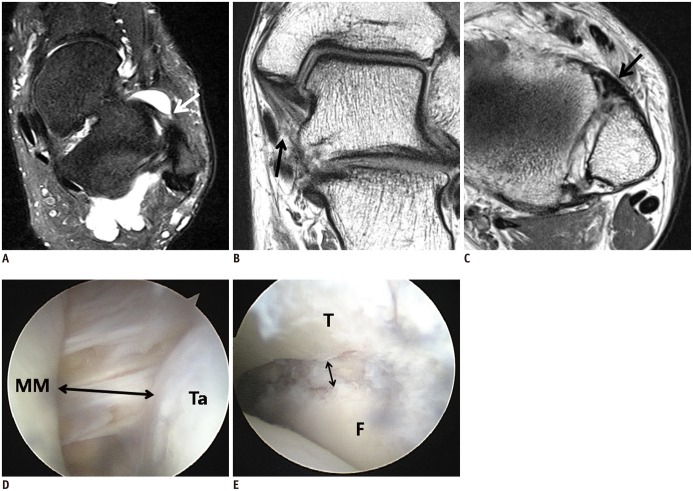
MRIAnkle MRI: high signal with partial discontinuity of the anterior talofibular ligament (A) and superficial deltoid ligament (B), thickened anterior inferior tibiofibular ligament (C); arthroscopy: widened medial mortise and syndesmosis (D, E).
Source : Chun et al., Korean Journal of Radiology, 2015, figure 3 · CC BY-NC
The FAAM measures what the foot and ankle prevent, across twenty-nine items in two subscales: twenty-one for activities of daily living, eight for sport. Each subscale is scored out of 100 and a high score signals better function.
The point to take away first is that they never add up. The original publication gives them distinct thresholds, never a common one, and this page follows the same rule: the tool at the top yields two figures and refuses to make a third.
The instrument was built in 2005 by item reduction across 1,027 subjects, and it is today the most used measure of that region. Its full French version exists, validated in 2011 in 105 French-speaking patients, and a twelve-item French short form was validated in 2026 in 275 surgical patients.
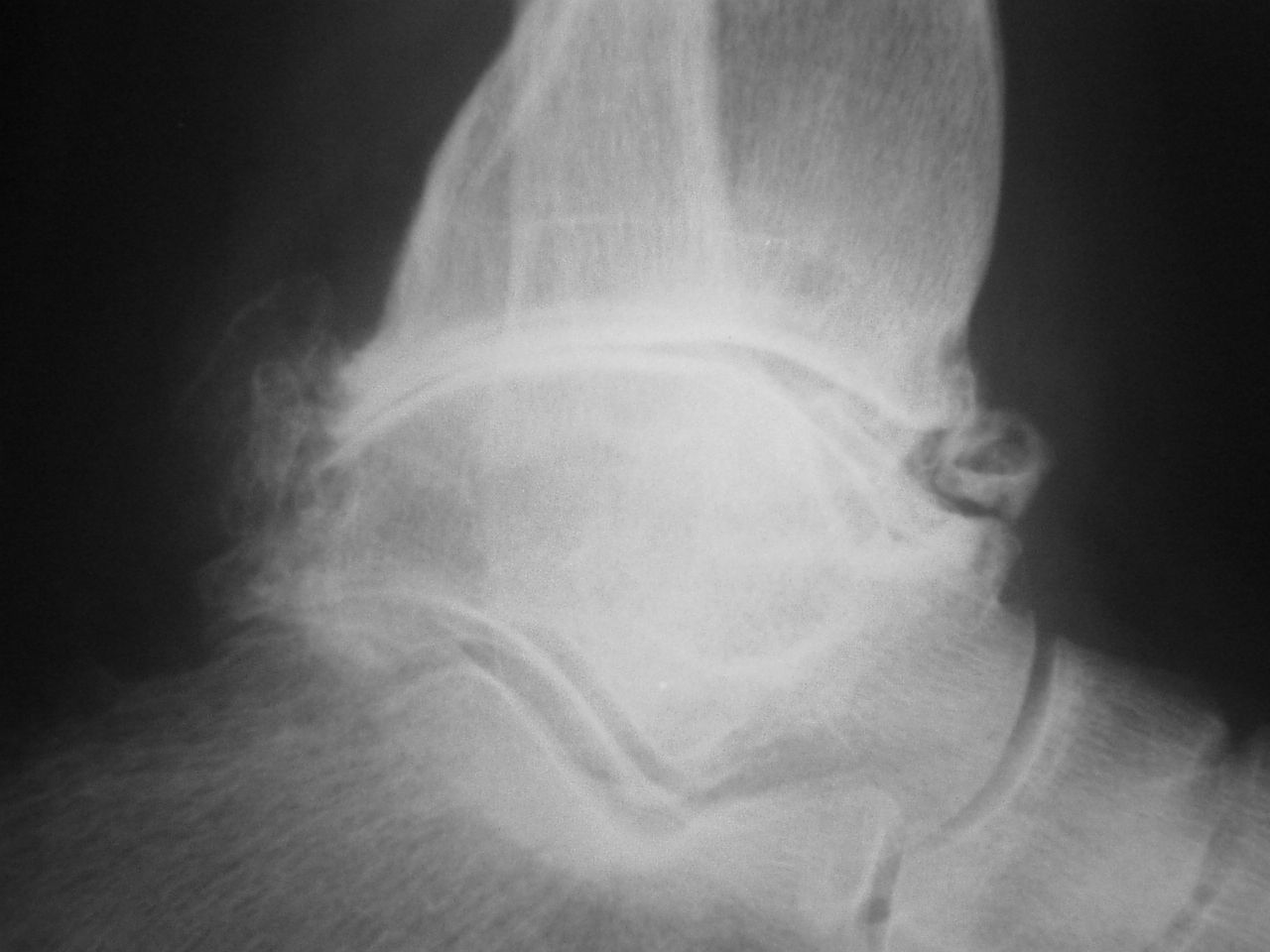
X-rayFrontal ankle X-ray showing tibiotalar osteoarthritis: marginal osteophytes and bone remodelling on both edges of the joint.
Source : Gouvas, Wikimedia Commons · CC BY-SA
A denominator that changes from patient to patient
This is the scoring rule most often misapplied, and it is simple once stated.
Each item is scored from 4, no difficulty, to 0, unable to do. But an item can also be marked 'not applicable', and it then leaves the calculation on both sides: it counts neither in the numerator nor in the denominator. The maximum possible is therefore four times the number of items actually scored, and not 84 or 32 by default.
The consequence is that a patient who leaves three sport items not applicable is scored out of 20 and not out of 32. Counting those items as zeros, which a spreadsheet does spontaneously, artificially lowers the score and makes the comparison with the next administration wrong. The scorer at the top of this page counts the items marked 'not applicable' apart by itself, and computes the percentage on the number of items actually scored, never on 21 or 8 by default.
The sport threshold sits under the noise
Here is the point that should decide the use of the FAAM in athletes, and it comes from its own original publication.
That publication sets for the Sport subscale a minimal clinically important difference of 9 points, and a minimal detectable change at 95 % of 12.3 points. The threshold declared clinically important is therefore buried under the measurement noise of the same instrument, in the same study, on the same sample.
This is no accident. The French version measures 18 points of noise on that subscale, the Japanese 13.7, while the daily-activities subscale stays tight everywhere, at 5.7 then 7 then 6.8. Falling back on the latter to follow an athlete solves nothing: in healthy university athletes it is 100 out of 100 with no dispersion at all. The honest way out fits in one sentence: on the sport side of a French-speaking patient, more than 18 points of change are needed before speaking of progress.
| What is measured | Daily activities | Sport |
|---|---|---|
| Number of items | 21 | 8 |
| Score range | 0 to 100 | 0 to 100 |
| So-called clinically important difference | 8 | 9 |
| Minimal detectable change, English version | ± 5.7 | ± 12.3 |
| The same, French version | 7 | 18 |
| The same, Japanese version | ± 6.8 | ± 13.7 |
| Error of a single measurement, French version | 8 | 10 |
| Score in healthy university athletes | 100 ± 0.0 | still discriminates |
The French version, and the short form
French speakers have two tools, and they do not serve the same moment.
The full French version was validated in 2011 in 105 patients of mean age 50.5 with varied chronic foot and ankle disorders, twenty-two of them retested two days apart. It is the one that gives the two noise figures to remember in French, 7 points and 18 points, along with the error of a single measurement, 8 and 10 points.
The twelve-item short form, validated in France in 2026 in 275 patients operated on for lateral ligament reconstruction, brings what the long version never gave: decision thresholds. A score of 78.1 out of 100 identifies chronic instability status with 81.3 % sensitivity and 85.4 % specificity, and 80.2 marks return to the sport played before the injury at six months. Both values belong to the short form and to that population: carrying them over to the long version would have no basis.
The questionnaire reproduced here, and its two French-language versions
The twenty-nine items above reproduce, without changing a word, the long form of the FAAM: the French form edited online by François Luthi from Borloz et al., 2011, deposited on ORBi, and the original English form by Martin et al., 2005, hosted by the Shirley Ryan AbilityLab, completed for one item by a supplement published under a CC BY 4.0 licence. Neither main source publishes a formal reuse licence; for any use beyond that of this page, contact the authors named in the credit line under the items. For French-language use, two instruments exist: the long version reproduced here, validated in 2011, and the twelve-item short form validated in 2026, which share neither thresholds nor reference population.
Three administration pitfalls
Adding the two subscales together
They share neither the number of items, nor the noise, nor the responsiveness. No study quoted here works on a total, and manufacturing one drowns the sport subscale, the only one still discriminating in athletes, in the one that hits a ceiling.
Counting a not-applicable item as a zero
A not-applicable item leaves the denominator. Counting it zero drags down the score of a patient who simply has no view on an activity they do not do, and the comparison from one session to the next becomes uninterpretable.
Concluding on ten sport points
Ten points exceed the so-called clinically important difference, 9, but stay below the minimal detectable change, 12.3 in English and 18 in French. That is the zone where the instrument allows no conclusion, and it is wide.
Frequently asked questions
What does FAAM stand for?
FAAM stands for Foot and Ankle Ability Measure. The questionnaire was published in 2005 by Martin et al. for musculoskeletal disorders of the foot and ankle.
How is the FAAM scored?
Twenty-nine items, reproduced above, in two subscales, twenty-one for daily activities and eight for sport, scored from 0 to 4 or marked 'not applicable'. Each subscale adds the scored items and divides by four times their number, not-applicable items counting neither in the numerator nor in the denominator. The calculation needs a minimum of items actually scored: twenty out of twenty-one for daily activities, seven out of eight for sport.
How much change counts?
Seven points for daily activities and eighteen for sport in the French version. The so-called clinically important difference, 8 and 9 points, is smaller than the noise on the sport side.
Is there a French version?
Yes, validated in 2011 in 105 French-speaking patients and reproduced above, along with a twelve-item short form validated in France in 2026 in 275 ankle surgery patients, not reproduced on this page.
What score allows return to sport?
The French short form gives 80.2 out of 100 for return to the sport played before the injury at six months, with 75.4 % sensitivity and 87.9 % specificity, in patients operated on for ligament reconstruction.
Is the FAAM free to use?
No formal reuse licence is published for the two main sources, the French teaching document and the original English form. The eighth item of the Sport subscale, absent from the main English form, comes from a supplement published under a CC BY 4.0 licence. The original questionnaire remains the property of Martin et al., 2005; for any use beyond that of this page, contact the authors named in the credit line under the items.
References
7 sources, PMIDs included
- Martin RL, Irrgang JJ, Burdett RG, Conti SF, Van Swearingen JM. Evidence of validity for the Foot and Ankle Ability Measure (FAAM). Foot Ankle Int 2005;26(11):968-83. PMID 16309613. The original publication, which builds the instrument by item reduction across 1,027 subjects and sets its two subscales. It gives each its own thresholds, never a total: minimal detectable change of ±5.7 points for daily activities and ±12.3 for sport, clinically important differences of 8 and 9 points. That is where the sport side's problem is born.
- Borloz S, Crevoisier X, Deriaz O, Ballabeni P, Martin RL, Luthi F. Evidence for validity and reliability of a French version of the FAAM. BMC Musculoskelet Disord 2011;12:40. PMID 21303520. The only published validation of the full French version, in 105 French-speaking patients of mean age 50.5, 22 of them retested. It confirms and widens the gap: minimal detectable change of 7 points for daily activities and 18 for sport. Its full text, open access, also details the variable-denominator scoring rule.
- Uematsu D, Suzuki H, Sasaki S, Nagano Y, Shinozuka N, Sunagawa N, Fukubayashi T. Evidence of validity for the Japanese version of the foot and ankle ability measure. J Athl Train 2015;50(1):65-70. PMID 25310247. The third independent measurement of the noise, in 83 Japanese university athletes. It gives the same profile as the other two: ±6.8 points for daily activities against ±13.7 for sport. The gap between the two subscales is therefore not a translation accident.
- Carcia CR, Martin RL, Drouin JM. Validity of the Foot and Ankle Ability Measure in athletes with chronic ankle instability. J Athl Train 2008;43(2):179-83. PMID 18345343. The study that closes the escape route. In healthy university athletes, the daily-activities subscale is 100 out of 100, with no dispersion at all: it no longer discriminates anything at that level of function. Falling back on it to follow an athlete leads nowhere.
- Matheny LM, Clanton TO. Rasch Analysis of Reliability and Validity of Scores From the Foot and Ankle Ability Measure (FAAM). Foot Ankle Int 2020;41(2):229-36. PMID 31665926. The only Rasch analysis published on the original English version, in 456 patients operated on for the ankle. It examines the structure of the instrument where other studies settle for its coefficients.
- Saliba I, Grimaud O, Fontanier V, Picot B, Khiami F, Rougereau G, Bohu Y, Lefevre N, Hardy A. Validity and reliability of the French version of the quick-FAAM (Q-FAAM-F) among patients undergoing anatomic ankle ligament reconstruction. J Exp Orthop 2026;13(1):e70644. PMID 41560968. The French validation of the twelve-item short form, in 275 patients operated on for lateral ligament reconstruction. It brings two thresholds no other reference gives: 78.1 out of 100 to identify chronic instability, and 80.2 for return to the sport played before the injury, at six months.
- Sangeorzan BJ, Ledoux WR, Shofer JB, Davitt J, Anderson JG, Bohay D, Coetzee JC, Maskill J, Brage M, Norvell DC. Comparing 4-Year Changes in Patient-Reported Outcomes Following Ankle Arthroplasty and Arthrodesis. J Bone Joint Surg Am 2021;103(10):869-78. PMID 33983146. Retained for a precise reason: its abstract is the only one in this base to carry explicitly the 0 to 100 range of each subscale, across 517 participants. The bounds on this page come from it, and not from a third-party source.
 Page written by Anthony Baillon, physiotherapist, co-founder of Physio Learning. The questionnaire itself is by Martin et al., 2005, and its French version by Luthi after Borloz et al., 2011: this page reproduces, documents and computes them.
Behind this article
An author who explains, a reviewer who checks.
How we write and check our content

Physiotherapist · co-founder of Physio Learning
Marked for life by his first four-hour lecture without a single image, he took a master’s in instructional design so that it would never happen to anyone again. He hunts down publication bias and unreadable slides with the same intransigence.

Head of scientific content
Physiotherapist specialising in neuro-musculoskeletal practice and holder of a master’s in public health. He checks the methodological rigour of every article: primary sources, levels of evidence, no exceptions.