






The HAGOS is one of the two instruments recommended by the international Zurich consensus for hip-related pain, and it is a poor tool for individual follow-up. Its smallest detectable change reaches 33.8 points out of 100 in a patient, against 2.7 to 5.2 at group level. The tool below reads one subscale at a time, and refuses to make a total of them.
Eight languages have a validated version of the HAGOS, and French is not one of them. The detail is below.
Figures taken from the studies listed at the end of this page, every value carrying its source where it is written. The questionnaire itself is not reproduced.
What the HAGOS measures, and why it has no global score
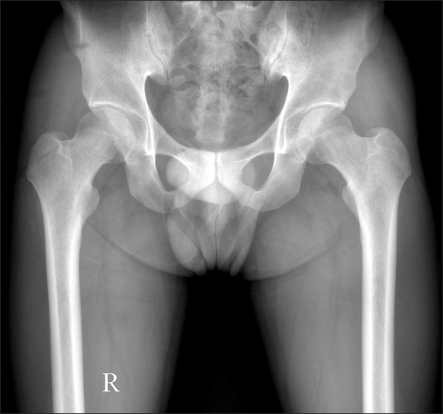
X-rayFrontal pelvic X-ray: positive crossover sign at both hips, suggestive of pincer-type femoroacetabular impingement, in a 25-year-old man with left hip pain.
Source : Yun et al., Clinics in Orthopedic Surgery, 2009, figure 1 · CC BY
The HAGOS is a self-report questionnaire of 37 items split into six subscales: pain (10 items), symptoms (7), function in daily living (5), function in sport and recreation (8), participation in physical activities (2) and hip and/or groin-related quality of life (5). Each produces its own score from 0 to 100, and a high score signals a better state, which is the reverse of most disability scales.
The point to hold before all else: the six subscales are independent and never added together. There is no global HAGOS score. Neither the original publication, nor the modern test theory validation, nor the international Zurich consensus defines one. Any sum or average of the six is a construction of the reader, with no known measurement property, which is why the tool at the top of this page reads one subscale at a time.
A second thing to know before comparing two scores. The modern test theory validation, in 452 athletes, had to remove seven items out of thirty-seven for the six subscales to reach acceptable properties. The revised version is therefore not scored on the same items as the original.
The same study revealed differential item functioning between the Danish, English and Norwegian versions, on the symptoms, pain and sport subscales, to the point of requiring conversion tables to compare scores across languages. Three close European languages, validated by the same team, therefore do not give directly comparable scores. Hold on to that fact: it governs the section on French.
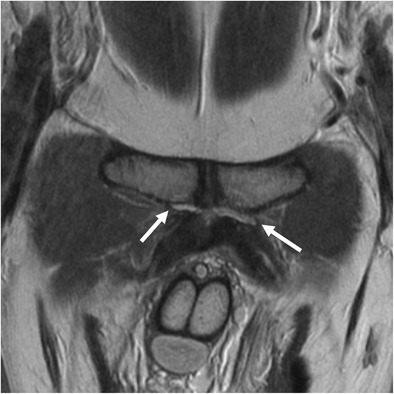
MRICoronal pelvic MRI, PD weighting: bilateral hyperintense clefts at the origin of the adductor tendons on the pubic symphysis, more marked on the left, indicating adductor tendinopathy (arrows).
Source : Li et al., Insights into Imaging, 2016, figure 13 · CC BY
Seventeen points in a patient, three in a group
This is the point that decides what can be concluded from a follow-up, and it is striking.
In the 101 patients of the original cohort, the smallest detectable change is 17.7 to 33.8 points depending on the subscale at the individual level, and 2.7 to 5.2 points at group level. The ratio between the two exceeds six. A gain of ten or fifteen points in your patient proves nothing; the same gain measured across a group of patients is a solid signal.
This is not a contradiction, it is arithmetic: the error of a mean shrinks with sample size, that of a single measurement does not. One clarification is nonetheless needed, because it is often skipped: the group smallest detectable change was computed on those 101 patients, and it varies with the square root of sample size. It therefore does not transfer as it stands to a smaller group, and this page proposes no substitute sample size.
Now set that noise against the reference values. In injury-free male footballers, the reference interval starts at 64.3 for symptoms and at 80.1 for pain. On several subscales, the whole window separating the pathological from the normal is barely wider than a single individual measurement error. The HAGOS is a research instrument that practice has promoted to the bedside.
That does not disqualify it: the Zurich consensus recommends it, alongside the iHOT instruments, as the most appropriate in young to middle-aged active adults. But the same text raises two caveats rarely quoted with the recommendation: the value of the HAGOS outside a surgical context remains poorly documented, and none of the instruments examined has acceptable quality across all psychometric properties. A later COSMIN evaluation in fact judges the development of the HAGOS inadequate, while calling its shortcomings minor, which is not the case for the three other instruments failing in the same work.
Getting better and getting back to normal are not the same threshold
Here are two questions the consultation conflates, and which the same instrument separates very well when asked.
In 97 patients followed a year after hip arthroscopy and compared with 158 controls matched for age and sex, up to 70% cross the minimal important change, but only up to 38% return within the reference interval of healthy subjects. Both values are maxima, reached on the most favourable subscale, and not average proportions.
Getting better and getting back to normal therefore do not read on the same threshold, and a report gains from saying which of the two was reached. At one year, on the sport and recreation, participation and quality of life subscales, patients only reach 54 to 70 points. Only two of them, sport and recreation and participation, keep improving between three and twelve months: quality of life there joins pain, symptoms and daily activities, which no longer move.
A third question exists still, that of the state the patient judges acceptable. In 137 operated patients from the Danish registry, the corresponding thresholds range from 42.5 to 82.5 points depending on the subscale, and only 46.7% of patients report being in it a year and a half after surgery. That is a figure worth knowing before a preoperative consultation.
| Subscale | Items | 95% reference interval |
|---|---|---|
| Pain | 10 | 80.1 to 100 |
| Symptoms | 7 | 64.3 to 100 |
| Function in daily living | 5 | 80.3 to 100 |
| Function in sport and recreation | 8 | 71.9 to 100 |
| Participation in physical activities | 2 | 75 to 100 |
| Hip and/or groin-related quality of life | 5 | 75 to 100 |
No validated French version, and why that matters
No validated French version of the HAGOS is indexed in PubMed. The absence was searched for through six distinct formulations, two of which return strictly no result, then through control queries targeting cross-cultural adaptations. The only French-affiliated works found are clinical studies using the instrument, not validating it.
Eight languages do have one: Danish, English, Norwegian, Swedish, Dutch, Brazilian Portuguese, simplified Chinese, Italian. The count is of languages and not of studies: Dutch was validated three times, in three different populations, which remains a single language.
This is where differential item functioning takes on its full weight. Three versions validated by the same team, Danish, English and Norwegian, required conversion tables to be compared with each other. A working French translation, never tested, can therefore be set neither against the Danish reference values nor against the acceptable-state thresholds of 42.5 to 82.5. It measures something, but what, relative to what the literature publishes, is unknown.
The name itself carries the trace: there is no official French title, for want of a validated version. The translations met in France are authors' renderings, with no status, and international usage, including in French-affiliated articles, is to keep the acronym as it stands.
Why this page does not display the questionnaire
No written permission could be read for the HAGOS. One confusion is worth clearing up in passing, because it circulates: the site distributing Professor Ewa Roos's instruments does carry an explicit licence text, but it names the KOOS, KOOS-12, KOOS-Child, HOOS, HOOS-12 and FAOS, and the acronym HAGOS does not appear there. That licence therefore does not transfer, all the more so as Ewa Roos is only fifth author on the original HAGOS publication. With no established licence, this page describes, scores and interprets, without reproducing any of the 37 items.
Three administration pitfalls
Adding or averaging the six subscales
No global HAGOS score exists, and none of the three authoritative references defines one. The six subscales are reported separately, each out of 100.
Concluding from a ten or fifteen point gain in a patient
The individual smallest detectable change runs from 17.7 to 33.8 points depending on the subscale. The figure of 2.7 to 5.2 points, often quoted, is a group threshold: it does not apply to a patient.
Confusing getting better with getting back to normal
A year after hip arthroscopy, up to 70% of patients cross the minimal important change but only up to 38% return within the interval of healthy subjects. These are two different thresholds, and two different sentences in a report.
Frequently asked questions
What does the HAGOS measure?
It rates hip and groin pain and disability across 37 items split into six independent subscales, each from 0 to 100, where 100 is the best state.
Is there a global HAGOS score?
No. None of the authoritative references defines one, and adding the six subscales is a construction with no known measurement property.
How much change counts?
In a patient, at least 17.7 points are needed, and up to 33.8 depending on the subscale. At group level, 2.7 to 5.2 points suffice, in the cohort where those values were computed.
What score should be aimed for after hip arthroscopy?
The acceptable symptom state starts between 42.5 and 82.5 points depending on the subscale, and only 46.7% of operated patients report being in it a year and a half after surgery.
Is there a French version of the HAGOS?
No. Eight languages have a validated version, and French is not one of them. The translations used in France have not been tested.
References
7 sources, PMIDs included
- Thorborg K, Hölmich P, Christensen R, Petersen J, Roos EM. The Copenhagen Hip and Groin Outcome Score (HAGOS): development and validation according to the COSMIN checklist. Br J Sports Med 2011;45(6):478-91. PMID 21478502. The original publication, in 101 physically active patients of mean age 36, developed and validated against the COSMIN checklist. It fixes the structure in six subscales and carries the figure that governs every clinical use of the tool: the smallest detectable change is 17.7 to 33.8 points at the individual level and 2.7 to 5.2 points at group level. Test-retest reliability there runs from 0.82 to 0.91 depending on the subscale.
- Thorborg K, Branci S, Stensbirk F, Jensen J, Hölmich P. Copenhagen hip and groin outcome score (HAGOS) in male soccer: reference values for hip and groin injury-free players. Br J Sports Med 2014;48(7):557-9. PMID 23850734. The benchmark without which an isolated score means nothing: reference values in injury-free male footballers, in 301 players with no pain either in the current or the previous season, from 40 clubs. The 95% intervals start high, from 64.3 for symptoms to 80.3 for daily activities. The study also shows that the 143 players who had pain the previous season stay below on every subscale, while being declared injury-free.
- Thorborg K, Kraemer O, Madsen AD, Hölmich P. Patient-Reported Outcomes Within the First Year After Hip Arthroscopy and Rehabilitation for Femoroacetabular Impingement and/or Labral Injury: The Difference Between Getting Better and Getting Back to Normal. Am J Sports Med 2018;46(11):2607-14. PMID 30074844. The title poses the question practice conflates, and the figures answer it. In 97 consecutive patients followed a year after hip arthroscopy and compared to 158 matched controls, up to 70% cross the minimal important change, but only up to 38% return within the reference interval of healthy subjects. A reading point: both values are maxima, reached on the most favourable subscale, not average proportions. At one year, on sport, participation and quality of life, patients only reach 54 to 70 points.
- Christensen KB, Clausen MB, King E, Franklyn-Miller A, Harøy J, Andersen TE, Hölmich P, Thorborg K. Validation of the Copenhagen Hip and Groin Outcome Score (HAGOS) using modern test theory across different cultures and languages: a cross-sectional study of 452 male athletes with groin pain. Br J Sports Med 2022;56(6):333-9. PMID 34815222. The validation by modern test theory, in 452 athletes across three language versions. It establishes two facts that change the use. Seven items out of thirty-seven must be removed for the six subscales to reach acceptable properties. And differential item functioning separates the Danish, English and Norwegian versions on the symptoms, pain and sport subscales, which required conversion tables to compare scores from one language to another.
- Ishøi L, Thorborg K, Ørum MG, Kemp JL, Reiman MP, Hölmich P. How Many Patients Achieve an Acceptable Symptom State After Hip Arthroscopy for Femoroacetabular Impingement Syndrome? A Cross-sectional Study Including PASS Cutoff Values for the HAGOS and iHOT-33. Orthop J Sports Med 2021;9(4):2325967121995267. PMID 33889644. The acceptable symptom state thresholds, established in 137 individuals from the Danish hip arthroscopy registry, reviewed on average 18.5 months after surgery. They range from 42.5 to 82.5 points depending on the subscale, with areas under the curve of 0.82 to 0.92. The figure to quote in a preoperative consultation is elsewhere in the same abstract: only 46.7% of those operated on report being in that state.
- Impellizzeri FM, Jones DM, Griffin D, Harris-Hayes M, Thorborg K, Crossley KM, Reiman MP, Scholes MJ, Ageberg E, Agricola R, Bizzini M, Bloom N, Casartelli NC, Diamond LE, Dijkstra HP, Di Stasi S, Drew M, Friedman DJ, Freke M, Gojanovic B, Heerey JJ, Hölmich P, Hunt MA, Ishøi L, Kassarjian A, King M, Lawrenson PR, Leunig M, Lewis CL, Warholm KM, Mayes S, Moksnes H, Mosler AB, Risberg MA, Semciw A, Serner A, van Klij P, Wörner T, Kemp J. Patient-reported outcome measures for hip-related pain: a review of the available evidence and a consensus statement from the International Hip-related Pain Research Network, Zurich 2018. Br J Sports Med 2020;54(14):848-57. PMID 32066573. The international Zurich consensus, 38 researchers and clinicians, recommending the HAGOS and the iHOT instruments as the most appropriate in young to middle-aged active adults with hip-related pain. Two caveats from the same text are rarely quoted alongside the recommendation: the value of the HAGOS outside a surgical context remains poorly documented, and none of the instruments examined shows acceptable quality across all psychometric properties.
- Hansen CF, Jensen J, Odgaard A, Siersma V, Comins JD, Brodersen J, Krogsgaard MR. Four of five frequently used orthopedic PROMs possess inadequate content validity: a COSMIN evaluation of the mHHS, HAGOS, IKDC-SKF, KOOS and KNEES-ACL. Knee Surg Sports Traumatol Arthrosc 2022;30(11):3602-15. PMID 34618175. The indispensable counterpoint to the previous recommendation. This COSMIN evaluation of five reference instruments judges the development of the HAGOS inadequate, its authors nonetheless calling the shortcomings minor, which is not the case for the three other failing instruments. Of the five examined, only one has sufficient content validity, and it is none of the most widely used ones.
 Page written by Anthony Baillon, physiotherapist, co-founder of Physio Learning. The questionnaire itself is by Thorborg et al., 2011: this page documents and interprets it, it reproduces none of its items.
Behind this article
An author who explains, a reviewer who checks.
How we write and check our content

Physiotherapist · co-founder of Physio Learning
Marked for life by his first four-hour lecture without a single image, he took a master’s in instructional design so that it would never happen to anyone again. He hunts down publication bias and unreadable slides with the same intransigence.

Head of scientific content
Physiotherapist specialising in neuro-musculoskeletal practice and holder of a master’s in public health. He checks the methodological rigour of every article: primary sources, levels of evidence, no exceptions.