














The NDI, short for Neck Disability Index, measures what neck pain prevents, across ten items scored from 0 to 5. Its hard part is not administration: it is the threshold above which a change counts, which runs from 5 to 19 points depending on the patient. The interpreter is right below.
The minimal detectable change of the NDI depends on the population: around 5 points out of 50 in uncomplicated neck pain, 10.2 points in cervical radiculopathy. The detail is below.
Figures taken from the studies listed at the end of this page, every value carrying its source where it is written. No item is reproduced: the NDI is under copyright.
What the NDI measures
The NDI measures what neck pain prevents day to day. It was published in 1991 by Vernon and Mior, who adapted the Oswestry low back disability index to the cervical spine: ten items, each scored from 0 to 5, for a total score out of 50.
Its face validity was secured by peer review and patient feedback. In the first 17 patients, all after whiplash injury, test-retest reproducibility reached r = 0.89, and internal consistency alpha = 0.80 across 52 questionnaires.
Thirty years on, the 2024 meta-analysis, across 79 studies of which 70 at low risk of bias, confirms that base: internal consistency above 0.81 and pooled test-retest reliability at ICC 0.91. The instrument holds. It is its interpretation that causes trouble.
Ten items, a score out of 50
Each of the ten items describes an everyday situation and is scored from 0 to 5. The total runs from 0 to 50, and the custom is to double it to express it as a percentage. That conversion explains why thresholds are quoted sometimes in points, sometimes as a percentage, for the same value.
The validated French version exists. Published in 2002 by Wlodyka-Demaille et al. and evaluated in 101 patients with neck pain of mean age 49, it yields a test-retest reliability at 24 hours of ICC 0.93. It is the reference retained by the scale's official distributor.
The authors do raise a caveat that is rarely quoted: the expected convergent and divergent validity was observed only for the NPDS, and their factor analysis extracts three factors, not one. The unidimensionality of the NDI is therefore not settled, and fifteen of the 79 studies in the 2024 meta-analysis find two or three dimensions in it.
The change threshold depends on the patient
This is where the NDI gets complicated, and it is the only place that matters when deciding whether a patient has changed.
In 38 patients with cervical radiculopathy, the minimal detectable change is 10.2 points and the clinically important change 7.0 points. The order of those two is worth pausing on: the threshold that matters clinically is lower than the measurement noise. In that population, a change the patient judges important may not be distinguishable from a measurement error.
In 137 patients with mechanical neck pain, the same team finds two years later a far lower reliability, ICC 0.50, and a threshold of 19 percentage points, twice what had been reported until then, the authors write. The 2009 review sums up the range: minimal detectable change around 5 out of 50 in uncomplicated neck pain, up to 10 out of 50 in radiculopathy, and clinically important difference reported inconsistently from 5 to 19 out of 50.
| What is measured | Value | Population |
|---|---|---|
| Minimal detectable change, uncomplicated neck pain | ≈ 5 / 50 | review of 37 studies |
| Minimal detectable change, cervical radiculopathy | 10.2 / 50 | 38 patients |
| Clinically important change, radiculopathy | 7.0 / 50 | 38 patients |
| Clinically important change, ordinary neck pain | 19 % | 137 patients |
| Pooled estimate of both thresholds | ≈ 15 % | 79 studies, that is 7.5 / 50 |
| Test-retest reliability, French version | ICC 0.93 | 101 patients, at 24 hours |
| Test-retest reliability, ordinary neck pain | ICC 0.50 | 137 patients |
| Test-retest reliability, pooled estimate | ICC 0.91 | 79 studies |
What the score does not tell you
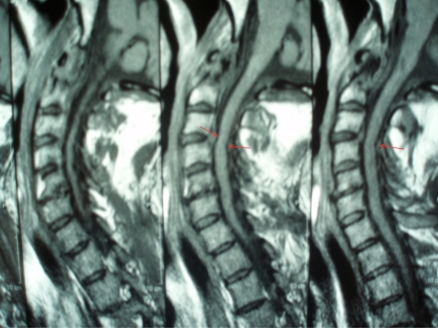
MRIMRI of the cervical spine, series of sagittal slices: spinal cord compression at C3-C4 due to cervical spondylosis, arrows at the point of compression.
Source : Spinos et al., The open orthopaedics journal, 2010, figure 3 · CC BY-NC
It does not say whether a change is real until you know which patient it belongs to. A gain of 6 points is a real change in ordinary neck pain and stays within noise in cervical radiculopathy.
Nor does it say which item moved. The NDI yields a total, and two patients at 20 out of 50 may have unrelated profiles, one limited by sleep and concentration, the other by driving and lifting.
Finally, it is not the most sensitive instrument in every situation. In the 2006 study on cervical radiculopathy, the PSFS proved both more reliable, ICC 0.82 against 0.68, and more responsive than the NDI. Administering them together costs little and gives two readings.
Why this page does not display the questionnaire
The NDI is under copyright, held by its author and distributed under licence. Neither the items, nor the response options, nor the scoring instructions are reproduced here. The questionnaire and its French version are obtained from the distributor, which opens access free of charge to students, physicians and clinical practice after an account is created. A PDF found online does not amount to authorisation, however widespread the habit.
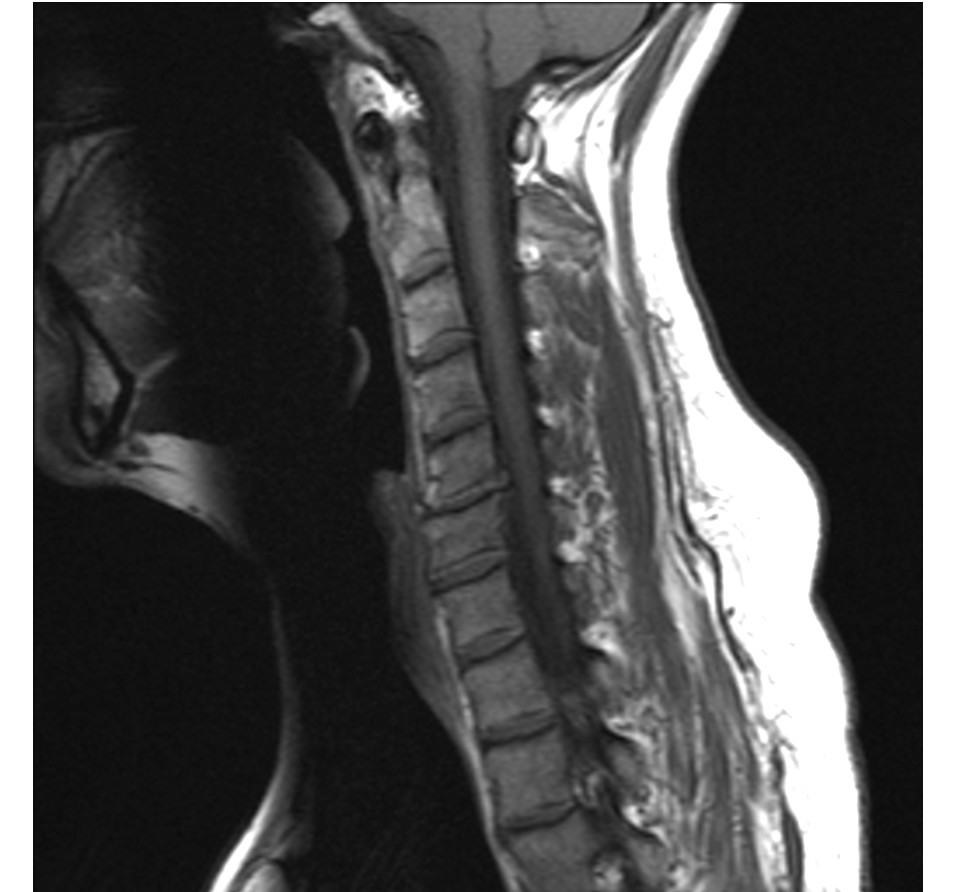
MRIMRI of the cervical spine, sagittal view, T1 sequence: degenerative disc disease with osteophytes and osteoarthritis at C4-C5.
Source : Stillwaterising, Wikimedia Commons · CC BY-SA
Three administration pitfalls
Comparing a score in points with a threshold in percent
20 out of 50 and 20 % are not the same thing: the second is worth 10 out of 50. The conversion is a doubling, it is simple, and that is precisely why it gets skipped before comparing.
Taking a published threshold for a constant
The 2024 meta-analysis records minimal detectable changes from 3 % to 27 % and clinically important differences from 5 % to 33 %. The pooled estimate, around 15 %, that is 7.5 points out of 50, is an order of magnitude, not a decision rule.
Handing it out in the waiting room with no instruction
The items ask about the day, not about the moment. A patient who answers thinking of their most painful moment overscores, and the change between two administrations becomes uninterpretable.
Frequently asked questions
What does NDI stand for?
NDI stands for Neck Disability Index. The questionnaire was published in 1991 by Vernon and Mior, by adapting the Oswestry low back disability index to the cervical spine. It has no official French name.
How is the NDI scored?
It has ten items each scored from 0 to 5, for a total score out of 50, often expressed as a percentage by doubling it. A high score signals greater disability.
How much change counts?
It depends on the population. The minimal detectable change is around 5 points out of 50 in uncomplicated neck pain and 10.2 points in cervical radiculopathy.
Is there a validated French version?
Yes, published in 2002 by Wlodyka-Demaille et al., with a test-retest reliability at 24 hours of ICC 0.93 in 101 patients. It is the reference retained by the scale's distributor.
Is the NDI free to use?
No. The instrument is under copyright, held by its author and distributed under licence. Clinical use is provided for and free of charge, but it goes through an account with the distributor.
References
6 sources, PMIDs included
- Vernon H, Mior S. The Neck Disability Index: a study of reliability and validity. J Manipulative Physiol Ther 1991;14(7):409-15. PMID 1834753. The original publication. The NDI is built by adapting the Oswestry Low Back Pain Index to the cervical spine. Test-retest in 17 patients after whiplash injury: r = 0.89. Internal consistency across 52 questionnaires: alpha = 0.80, every item above 0.75.
- Wlodyka-Demaille S, Poiraudeau S, Catanzariti JF, Rannou F, Fermanian J, Revel M. French translation and validation of 3 functional disability scales for neck pain. Arch Phys Med Rehabil 2002;83(3):376-82. PMID 11887120. The validated French version, by translation and back-translation then evaluation in 101 patients with neck pain, mean age 49. Test-retest reliability at 24 hours: ICC 0.93. The authors' caveat: the expected convergent and divergent validity is observed only for the NPDS, and factor analysis extracts three factors explaining 78 % of the variance.
- Cleland JA, Fritz JM, Whitman JM, Palmer JA. The reliability and construct validity of the Neck Disability Index and patient specific functional scale in patients with cervical radiculopathy. Spine (Phila Pa 1976) 2006;31(5):598-602. PMID 16508559. 38 patients with cervical radiculopathy. NDI: ICC 0.68, minimal detectable change 10.2 points, minimal clinically important change 7.0 points. The PSFS proves more reliable there (ICC 0.82) and more responsive.
- Cleland JA, Childs JD, Whitman JM. Psychometric properties of the Neck Disability Index and Numeric Pain Rating Scale in patients with mechanical neck pain. Arch Phys Med Rehabil 2008;89(1):69-74. PMID 18164333. 137 patients with mechanical neck pain. Reliability much lower, ICC 0.50, area under the curve 0.83, and a change threshold of 19 percentage points, twice what had been reported until then, the authors write.
- MacDermid JC, Walton DM, Avery S, Blanchard A, Etruw E, McAlpine C, Goldsmith CH. Measurement properties of the neck disability index: a systematic review. J Orthop Sports Phys Ther 2009;39(5):400-17. PMID 19521015. The reference review, across 37 primary studies. It gives the range that governs every reading: minimal detectable change around 5 out of 50 in uncomplicated neck pain and up to 10 out of 50 in radiculopathy, clinically important difference reported inconsistently from 5 to 19 out of 50.
- Saltychev M, Pylkäs K, Karklins A, Juhola J. Psychometric properties of neck disability index: a systematic review and meta-analysis. Disabil Rehabil 2024;46(23):5415-31. PMID 38240027. The most recent meta-analysis, across 79 studies of which 70 at low risk of bias. Internal consistency above 0.81, pooled test-retest reliability ICC 0.91. Minimal detectable changes from 3 % to 27 % and clinically important differences from 5 % to 33 %, which the authors summarise around 15 %, that is 7.5 points out of 50.
 Page written by Anthony Baillon, physiotherapist, co-founder of Physio Learning. The questionnaire itself is by Vernon and Mior, 1991, and it is under copyright: this page documents and interprets it, it reproduces none of its items.
Behind this article
An author who explains, a reviewer who checks.
How we write and check our content

Physiotherapist · co-founder of Physio Learning
Marked for life by his first four-hour lecture without a single image, he took a master’s in instructional design so that it would never happen to anyone again. He hunts down publication bias and unreadable slides with the same intransigence.

Head of scientific content
Physiotherapist specialising in neuro-musculoskeletal practice and holder of a master’s in public health. He checks the methodological rigour of every article: primary sources, levels of evidence, no exceptions.