







How long does occipital neuralgia (Arnold's neuralgia) last? Is it dangerous? Here is what the studies actually say about the course of greater occipital neuralgia: typical durations, the factors that make it drag on, the signs to watch for and the levers that speed up recovery.
📝 In brief
- How long does it last, and is it dangerous? Duration depends on treatment: after an injection around the greater occipital nerve, improvement lasts a median of only 26.3 ± 18.5 days (3 to 77 days), even though every patient with occipital neuralgia responds (100 %), with a mean fall in pain of 94 % 4 ; with an occipital nerve block combining a local anaesthetic and a corticosteroid, 95.45 % of patients (42/44) keep a satisfactory result for at least 6 months, the VAS falling from 7.23 to 1.95 within 24 h and 83.33 % taking no painkiller at all at 6 months 3. As for danger, the short-term outlook is rather favourable: short-term relief is common with the basic interventional treatments, and the more advanced treatments bring improvements lasting from a few weeks to several years 1.
- The course can be recurrent over several months. In the same cohort of 44 patients, 9 patients (20.45 %) needed a second block, on average 270 days after the first (range 32 to 465 days): an effective first treatment therefore does not rule out a relapse 3.
- The real warning sign is not the neuralgia itself, but what can mimic it. Posterior neck pain or a unilateral occipital headache, acute and spontaneous, can be the sole manifestation of a vertebral artery dissection ; severe neck pain and/or occipital headache frequently accompanies the ischaemic symptoms in such cases 7. Unusual pain, or pain accompanied by neurological signs, warrants seeking urgent medical advice again.
- It is a rare condition, often recognised late. Incidence is estimated at 3.2 per 100,000 people, with a mean age at diagnosis of 54.1 years 1. The mean time between symptom onset and diagnosis reaches 29 months (95 % CI = 16–41), and migraine coexists in 46 % of patients (95 % CI = 27–66) 2.
- Before talking about occipital neuralgia, the other headaches must be ruled out. The conditions most easily confused with it are migraine, cluster headache, tension-type headache and hemicrania continua; the diagnosis is confirmed by anaesthetic blockade of the suspected nerve 1.
- Conservative management remains first-line, but on weak evidence. Exercise, manual therapy, postural and biomechanical work, education and desensitisation all have a mechanistic rationale, and physiotherapy is consistently recommended as first-line care, even though the specific research is limited to very low-quality evidence for TENS 6. Conversely, immobilisation in a cervical collar, physical modalities and cryotherapy have done no better than placebo, whereas NSAIDs, tricyclic antidepressants, SNRIs and anticonvulsants may relieve symptoms 1. In refractory pain, pulsed radiofrequency of the greater occipital nerve gives significant relief for six to ten months, with mild adverse effects in 3.1 % of patients: weak level of evidence 5.

⏱️ How long it really lasts
It is the first question that comes to mind when the pain burns at the base of the skull: how long is this going to last? Let us answer honestly straight away: no study has followed untreated people for long enough to describe the natural course of occipital neuralgia. It is a rare condition: incidence is estimated at 3.2 per 100,000 people, with a mean age at diagnosis of 54.1 years 1, and that rarity explains how little data there is. What research does put figures on is the duration of relief after treatment and the recurrence rate. That is where the reasoning has to start.
The time markers the studies give
The best-documented landmark is the occipital nerve block (local anaesthetic + corticosteroid), which serves both as a diagnostic test and as a treatment. Here is what the available work observes, from the shortest to the longest term.
| Marker | What the studies observe | Level of evidence |
|---|---|---|
| First 24 h after a block | Pain falls from 7.23 to 1.95 on the VAS 3 | Moderate: prospective cohort of 44 patients |
| First month | Median duration of improvement after injection: 26.3 ± 18.5 days (3 to 77 days) 4 | Weak: small series, results at odds with those below |
| 6 months | 42 patients out of 44 (95.45 %) keep a satisfactory result; 83.33 % take no painkiller at all 3 | Moderate: prospective cohort, with no control group |
| Around 9 months | 9 patients out of 44 (20.45 %) need a second block, on average 270 days after the first (32 to 465 days) 3 | Moderate |
| 6 to 10 months | In refractory pain, pulsed radiofrequency of the greater occipital nerve relieves significantly, with mild adverse effects in 3.1 % 5 | Weak: low-quality evidence |
These figures partly contradict one another, and that has to be said. On one side, a cohort reports relief holding for at least six months in 95 % of patients; on the other, a series with prospective follow-up finds improvement that is certainly massive (mean fall in pain of 94 %, every patient a responder) but lasting only a median of 26 days. Populations, injected products and definitions of « success » differ. The honest translation: we cannot yet predict, for any one person, whether relief will hold for three weeks or six months.
The expected course: waves, not a straight line
The underlying message is rather reassuring. The short-term outlook is favourable: short-term relief is common with the basic interventional treatments, and the more advanced treatments bring improvements lasting from a few weeks to several years 1.
But the course is rarely linear. The fact that one patient in five needed a second block, on average nine months later, describes the reality well: occipital neuralgia can recur and become chronic despite an effective first treatment. So you have to think in months, sometimes in years, not of continuous pain, but of a journey that comes in waves.
Pain that comes back is not a failure of treatment: it is the usual pattern of this neuralgia.
Why does it last in some people?
- Delay in diagnosis. The mean time between symptom onset and diagnosis reaches 29 months 2. A large part of the « duration » patients experience is in fact time spent without the right diagnosis.
- Overlap with migraine. Migraine coexists in 46 % of patients 2 : two pain mechanisms are superimposed, and treating one is not enough.
- Confusion with other headaches. Migraine, cluster headache, tension-type headache and hemicrania continua are the conditions most easily confused with it; the diagnosis is confirmed by anaesthetic blockade of the suspected nerve 1.
- Conservative treatments resting on fragile evidence. Immobilisation in a cervical collar, physical modalities and cryotherapy have done no better than placebo 1. That said, conservative management (exercise, manual therapy, postural work, education, desensitisation) remains consistently recommended as first-line care, with a mechanistic rationale, even though the specific level of evidence is weak 6.
Key points
- No data describe the spontaneous course without treatment: the durations we know are those of relief after treatment.
- After an occipital block: relief within 24 h, holding for at least 6 months in 95 % of patients in one cohort, but only 26 days in median in another series. Discordant evidence.
- About 1 patient in 5 needs a second block, on average 9 months later: recurrence is common and expected.
- The short-term outlook is rather good; the advanced treatments give improvements lasting from a few weeks to several years.
- What makes it last: delay in diagnosis (29 months on average) and associated migraine (46 %), not some hidden seriousness.
To understand the mechanism, the causes and the full range of management options, see the full guide to occipital neuralgia.
📈 What lengthens (or shortens) recovery
No case of occipital neuralgia follows a guaranteed timetable. Research has, however, identified factors that pull the duration up or down. Some are beyond your control; others play out in the coming weeks, and over those you have a say. To understand the mechanism and the causes of this pain, the full guide to occipital neuralgia takes it all from the beginning.
The best-documented factor: the time lost before the right diagnosis
This is the most striking point in the recent literature. The mean time between the first symptoms and diagnosis reaches 29 months: nearly two and a half years 2. This is not negligence: occipital neuralgia is easily confused with migraine, cluster headache, tension-type headache or hemicrania continua 1. The blurring works both ways, since migraine coexists in 46 % of patients 2 : having one does not rule out the other.
Pain labelled « migraine » for two years is pain that has gone two years without treatment for the neuralgia. The diagnosis is confirmed by anaesthetic blockade of the suspected nerve 1. Conversely, posterior neck pain or a one-sided occipital headache that is sudden and unusual should prompt urgent medical review: it can be the sole manifestation of a vertebral artery dissection 7.
What works in your favour
The short-term outlook is rather encouraging: relief is common with the basic interventional treatments, and the more advanced treatments give improvements lasting from a few weeks to several years 1.
The occipital nerve block (local anaesthetic + corticosteroid) is the best-documented procedure. In a prospective cohort of 44 patients, 42 (95.45 %) obtained a satisfactory result for at least six months, pain going from 7.23 to 1.95 on the VAS within 24 hours; at six months, 83.33 % were taking no painkiller at all 3.
What lengthens it: relapse is part of the picture
Let us say it honestly: an effective first treatment is not always the last word. In the same cohort, 9 patients out of 44 (20.45 %) needed a second block, on average 270 days after the first, over a very wide range of 32 to 465 days 3.
The duration of the effect also varies from one series to another. In a more recent prospective follow-up, every patient with occipital neuralgia responded to the greater occipital nerve injection (100 %), with a mean fall in pain of 94 %, but the median duration of improvement was only 26.3 ± 18.5 days, between 3 and 77 days 4. Between « six months of respite » and « three weeks », the gap is real and unexplained: we cannot predict which group you will be in.
If the pain becomes refractory, pulsed radiofrequency of the greater occipital nerve relieves for six to ten months, with mild adverse effects in 3.1 % of patients, on low-quality evidence 5.
| Factor | Effect on duration | Strength of evidence |
|---|---|---|
| Time to diagnosis | Lengthens the journey (29 months on average) | Moderate |
| Associated migraine | Blurs the diagnosis (46 % of patients) | Moderate |
| Occipital nerve block | Shortens the painful phase | Good |
| Pulsed radiofrequency (if refractory) | 6 to 10 months of relief | Weak |
| Conservative management (physiotherapy) | 1st -line, effect not quantified | Weak |
What you can influence
Getting the diagnosis made, and quickly. This is the most tangible lever: asking whether occipital neuralgia is being considered, and whether a diagnostic block is indicated 1.
Starting conservative management: knowing its limits. It is consistently recommended as first-line care: exercise, manual therapy, postural and biomechanical work, education and desensitisation all have a mechanistic rationale 6. But the sources diverge on the evidence. Deuel et al. 6 note that the research specific to occipital neuralgia is limited to very low-quality evidence (only TENS has been studied). StatPearls 1 reports, for its part, that immobilisation in a cervical collar, physical modalities and cryotherapy have done no better than placebo. That disagreement is not settled today.
Discussing the medicines that help. NSAIDs, tricyclic antidepressants, SNRIs and anticonvulsants may relieve symptoms 1.
What does not depend on you
Rarity, first of all: incidence is estimated at 3.2 per 100,000 people, mean age at diagnosis 54.1 years 1. A rare condition is a condition clinicians see rarely, that explains part of the delay, and it is not your fault. Then there is the variability in response to injections: nothing allows us to know in advance who will hold out for six months and who will relapse in three weeks. Finally, the quality of the evidence: here, many recommendations rest on small or low-level studies.
Key points
- The best-documented factor is the time to diagnosis: 29 months on average 2.
- The occipital nerve block is the best-supported procedure: 95.45 % satisfactory results over at least six months 3.
- Relapse is part of the picture: 20.45 % needed a second block 3.
- The duration of relief varies widely across studies: real uncertainty, not settled.
- A sudden and unusual occipital headache calls for urgent medical review 7.
🚦 Is it dangerous? What to watch for
It is often the first question when the pain electrifies the back of the skull: is it serious? The available data describe a condition that is rare and very painful, but whose short-term outlook is rather favourable : short-term relief is common with the basic interventional treatments, and the more advanced treatments bring improvements lasting from a few weeks to several years 1. The real issue is therefore not the neuralgia itself: it is making sure your occipital pain really does come from it, and not from something else.
What is reassuring: impressive pain, an often clear-cut response
The intensity of the pain is not an indicator of seriousness. In a prospective cohort of 44 patients, the occipital nerve block (local anaesthetic + corticosteroid) gave a satisfactory result for at least six months in 42 patients (95.45 %), the VAS going from 7.23 before treatment to 1.95 at 24 hours; at six months, 83.33 % were taking no painkiller at all 3. Pain that responds that clearly to a procedure targeted at the nerve is consistent with involvement of the greater occipital nerve, not with a lesion that is getting worse.
Pain can be unbearable without being dangerous, and that is precisely the case here.
What is annoying but not serious: relapses
One point deserves honesty: relief is often temporary, and that does not mean the condition is « getting worse ». In a series with prospective follow-up, every patient with occipital neuralgia responded to the greater occipital nerve injection (100 %), with a mean fall in pain of 94 %, but the median duration of improvement was only 26.3 ± 18.5 days, with enormous variability from one patient to the next (3 to 77 days) 4. In the cohort of Juškys and Šustickas 3, 9 patients out of 44 (20.45 %) needed a second block, on average 270 days after the first (32 to 465 days). A recurrence several months later is therefore part of the known course.
The signs that should prompt a consultation
One serious differential diagnosis deserves to be named clearly: vertebral artery dissection. Posterior neck pain or a unilateral occipital headache, acute and spontaneous, can be its sole manifestation, and severe neck pain and/or occipital headache frequently accompanies the ischaemic symptoms in such cases 7. In practical terms: if the pain is unusual compared with your usual attacks, sudden, or if it comes with neurological signs, you must seek urgent medical advice, without waiting for the scheduled appointment.
The second reason to consult is less dramatic but just as important: the wrong label. The conditions most easily confused with occipital neuralgia are migraine, cluster headache, tension-type headache and hemicrania continua; after a targeted history and examination, the diagnosis is confirmed by anaesthetic blockade of the suspected nerve 1. This is not theoretical: the mean time between symptom onset and diagnosis reaches 29 months, and migraine coexists in 46 % of patients 2. In other words, you can have both, and treat one without relieving the other.
| Situation | What it may mean | Evidence |
|---|---|---|
| Occipital or posterior neck pain that is acute, spontaneous, one-sided, unusual, or with neurological signs alongside it | May be the sole manifestation of a vertebral artery dissection → urgent advice | Case series 7 |
| Diagnosis made but no relief after anaesthetic block of the nerve | Question the diagnosis: migraine, cluster headache, tension-type headache, hemicrania continua | Landmark review 1 |
| Attacks returning after several weeks or several months | Expected recurrent course, not a sign of worsening | Prospective cohorts 34 |
| Headaches present for years, never labelled | Frequent under-diagnosis and overlap with migraine | Meta-analysis 2 |
And treatments? What the evidence allows us to say
Conservative management, physiotherapy in particular, is consistently recommended as first-line care: exercise, manual therapy, postural work, education and desensitisation all have a mechanistic rationale. But let us be frank: the specific level of evidence remains weak, the published research on conservative interventions specific to occipital neuralgia being limited to very low-quality evidence for TENS 6. Conversely, immobilisation in a cervical collar, physical modalities and cryotherapy have done no better than placebo; NSAIDs, tricyclic antidepressants, SNRIs and anticonvulsants may nonetheless relieve symptoms 1. In refractory pain, pulsed radiofrequency of the greater occipital nerve gives relief for six to ten months, with mild adverse effects in 3.1 % of patients: again on low-quality evidence 5. This uncertainty is real: we cannot yet choose between these options on solid grounds.
Key points
- Occipital neuralgia is rare and its short-term outlook is rather favourable: the pain is violent, and that is not an indicator of seriousness.
- Relapses are part of the normal course: relief after an injection often lasts a few weeks to a few months, and 1 patient in 5 needed a second block about 9 months later.
- One signal alone calls for urgency: occipital or neck pain that is acute, unusual, or accompanied by neurological signs: vertebral artery dissection may have that symptom and no other.
- Pain that does not yield to the anaesthetic block should prompt a rethink of the diagnosis (migraine, cluster headache, tension-type headache, hemicrania continua).
- The evidence on conservative treatments remains weak: be wary of over-confident promises, wherever they come from.
For the detail of the mechanisms, the clinical examination and the treatment options, see the full guide: Occipital neuralgia (greater occipital neuralgia).
💪 Speeding up recovery: what works
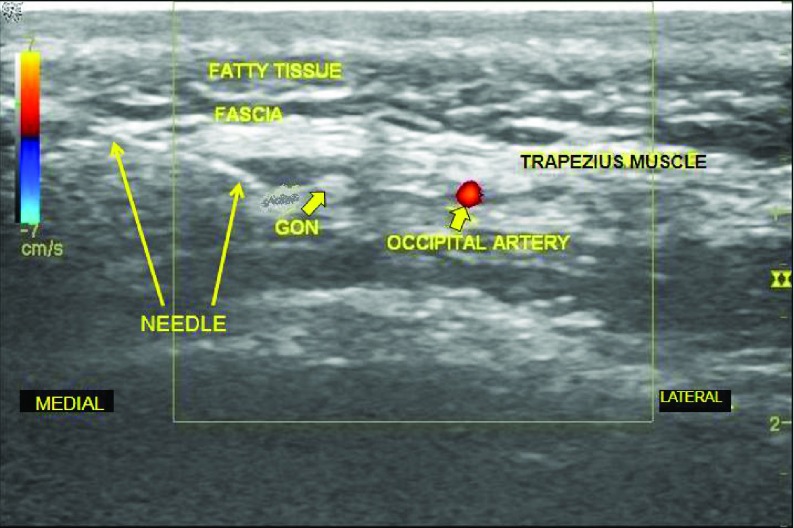
UltrasoundUltrasound showing the needle placed against the greater occipital nerve immediately before injection of anaesthetic and corticosteroid, during an ultrasound-guided nerve block.
Source : VanderHoek et al., Anesthesiology and Pain Medicine, 2013, figure 2 · CC BY
The question that matters: what actually moves things forward? Occipital neuralgia is rare, about 3.2 cases per 100,000 people, mean age at diagnosis 54 years 1. The consequence: few large trials, and recommendations often based on patient series rather than on solid evidence.
Step zero: check that it really is occipital neuralgia
The mean time between the first symptoms and diagnosis reaches 29 months, and migraine coexists in 46 % of patients 2. The conditions most easily confused with it are migraine, cluster headache, tension-type headache and hemicrania continua; the diagnosis is confirmed by anaesthetic blockade of the suspected nerve 1. A treatment that « does not work » is sometimes simply aimed at the wrong target.
The occipital nerve block: the best-documented intervention
In a prospective cohort of 44 patients, 42 (95.45 %) obtained a satisfactory result for at least six months after an injection of local anaesthetic combined with a corticosteroid. Pain went from 7.23 out of 10 before the procedure to 1.95 at 24 hours, and at six months 83.33 % were taking no painkiller at all 3.
The other half of the picture has to be heard. In a series with prospective follow-up, every patient with occipital neuralgia responded to the greater occipital nerve injection (100 %), with a mean fall in pain of 94 %, and yet the median duration of improvement among responders was only 26.3 days, from 3 to 77 days 4. The two studies do not give the same duration of effect and we do not know why: technique, patient profile, definition of a response. Take away the direction of travel: the block relieves quickly and strongly, but it does not immunise against relapse. In the cohort of Juškys and Šustickas, 9 patients out of 44 (20.45 %) needed a second block, on average 270 days after the first (from 32 to 465 days).
The block buys time without pain; what you do with that time counts as much as the injection.
Physiotherapy and exercise: first-line, on fragile evidence
Conservative management, with physiotherapy at the front, is consistently recommended as first-line care. Exercise, manual therapy, postural and biomechanical work, education and desensitisation all have a mechanistic rationale for treating the symptoms and their causes 6.
The level of evidence, though, is contradictory. The research specific to this condition is limited to very low-quality evidence for TENS 6, and a landmark synthesis states that physical modalities, like the cervical collar and cryotherapy, have done no better than placebo 1. Those two readings coexist: physiotherapy remains the recommended first step, but nobody can promise you today that it shortens the course. We do not yet know.
The picture, without embellishment
| Intervention | What we know | Level of evidence |
|---|---|---|
| Occipital nerve block | Rapid, substantial fall in pain; duration varies across series, relapse possible | Moderate |
| Physiotherapy: exercise, manual therapy, education, desensitisation | First-line, mechanistic rationale; superiority not demonstrated | Weak |
| Medicines (NSAIDs, tricyclics, SNRIs, anticonvulsants) | May help relieve symptoms | Weak |
| TENS | Very limited specific data | Very weak |
| Cervical collar, cryotherapy | No better than placebo | Unfavourable |
| Pulsed radiofrequency (refractory pain) | Relief for six to ten months; mild adverse effects in 3.1 % of patients | Weak |
The outlook leans the right way: short-term relief is common with the basic interventional treatments, and the more advanced treatments bring improvements lasting from a few weeks to several years 1.
A simple action plan
- Have the diagnosis confirmed before piling up treatments: the anaesthetic block doubles as a test.
- Relieve the pain : suitable drug treatment, and an occipital block if the pain is marked or resistant.
- Use the pain-free window for active work in physiotherapy (mobility, exercise, desensitisation): a benefit expected by reasoning, not by strong evidence.
- Reassess if the pain comes back: a recurrence does not mean the treatment has failed. In refractory pain, pulsed radiofrequency is an option to discuss 5.
- Drop without regret the cervical collar and cryotherapy as a mainstay treatment.
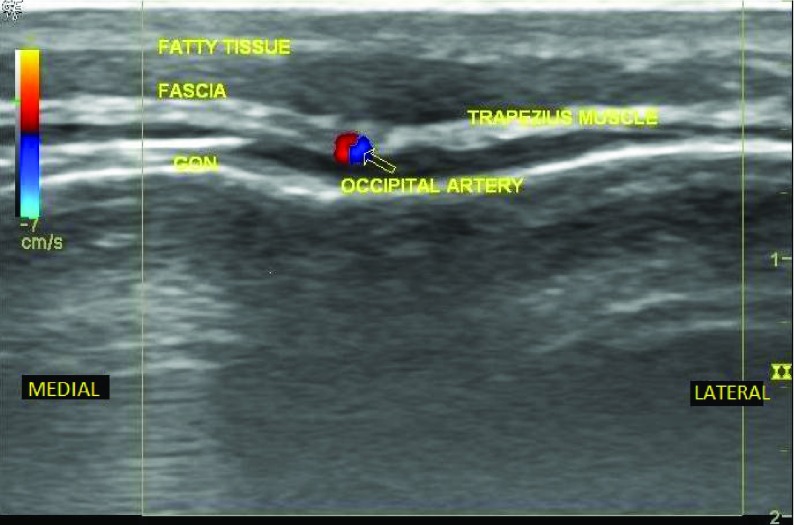
UltrasoundUltrasound of the greater occipital nerve identified in relation to the occipital artery, fatty tissue, fascia and trapezius muscle.
Source : VanderHoek et al., Anesthesiology and Pain Medicine, 2013, figure 1 · CC BY
Key points
- The occipital nerve block is the best-supported intervention; its effect is sometimes lasting, sometimes only a few weeks.
- A relapse is ordinary: about one patient in five needed a second block 3.
- Physiotherapy is recommended as first-line care, but its level of evidence remains weak.
- Cervical collar and cryotherapy: no better than placebo.
- Urgent: posterior neck pain or a unilateral occipital headache, acute and spontaneous, can be the sole manifestation of a vertebral artery dissection 7. Unusual pain or neurological signs = seek medical advice immediately.
For the mechanisms, the origin of the pain and the full range of management options, see our full guide: Occipital neuralgia (greater occipital neuralgia).
Bibliography
6 of the 7 sources are indexed on PubMed and checked individually; the others are official guidelines. Click a superscript note marker in the text: the bibliography opens and highlights the source.
- Djavaherian DM, Guthmiller KB (StatPearls) (2023). StatPearls (NCBI Bookshelf). View the source.
- Melchior AG, Al-Khazali S, Christensen RH, Al-Khazali HM, Ashina H (2025). Cephalalgia. PMID 40017062. doi:10.1177/03331024251317595.
- Juškys R, Šustickas G (2018). Acta Medica Lituanica. PMID 30210238.
- Poyraz Turan B, Özge A (2025). Journal of Clinical Medicine. PMID 40725724.
- De Oliveira K, Dhondt N, Englesakis M, Goel A, Hoydonckx Y (2024). Canadian Journal of Pain. PMID 38915302. doi:10.1080/24740527.2024.2355571.
- Deuel D, Sandgren A, Nelson EO, Cropes M, Deacon A, Houdek T, Abd-Elsayed A (2024). Current Pain and Headache Reports. PMID 38958920. doi:10.1007/s11916-024-01288-6.
- Krespi Y, Gurol ME, Coban O, Tuncay R, Bahar S (2002). Journal of Neuroimaging. PMID 11977915. doi:10.1111/j.1552-6569.2002.tb00117.x.
❓ Frequently asked questions
How long does occipital neuralgia last?
The duration depends above all on the treatment received. After an injection around the greater occipital nerve, the median duration of improvement is only 26.3 ± 18.5 days (range 3 to 77 days) in patients who respond, while every patient in the occipital neuralgia group did respond (100 %), with a mean fall in pain of 94 % 4. With an occipital nerve block combining a local anaesthetic and a corticosteroid, the result holds longer: 42 patients out of 44 (95.45 %) obtained a satisfactory result for at least 6 months, with the VAS going from 7.23 before treatment to 1.95 at 24 hours and 2.21 at 6 months 3. More broadly, short-term relief is common with the basic interventional treatments, and the more advanced treatments bring improvements lasting from a few weeks to several years 1.
Is occipital neuralgia dangerous?
The short-term outlook is rather favourable: short-term relief is common with the basic interventional treatments, and the more advanced treatments bring improvements lasting from a few weeks to several years 1. The point to watch does not come from the neuralgia itself but from what can resemble it: posterior neck pain or a unilateral occipital headache, acute and spontaneous, can be the sole manifestation of a vertebral artery dissection, and severe neck pain and/or occipital headache frequently accompanies the ischaemic symptoms in such cases 7. That is why the diagnosis must rule out the other headaches (migraine, cluster headache, tension-type headache, hemicrania continua), before being confirmed by anaesthetic blockade of the suspected nerve 1.
Can occipital neuralgia recur or become chronic?
Yes, an effective first treatment does not rule out a relapse. In a prospective cohort of 44 patients treated by occipital nerve block, 9 patients (20.45 %) needed a second block, on average 270.1 ± 150.9 days after the first, over a range running from 32 to 465 days 3. The effect of injections is, moreover, often temporary: the median duration of improvement is only 26.3 ± 18.5 days (3 to 77 days) among responders 4. The condition can also become chronic for want of recognition: the mean time between symptom onset and diagnosis reaches 29 months (95 % CI = 16–41 months), and migraine coexists in 46 % of patients (95 % CI = 27–66 %) 2.
When should occipital pain be a worry, and warrant urgent medical advice?
Posterior neck pain or a unilateral occipital headache, acute and spontaneous, can be the sole manifestation of a vertebral artery dissection, and severe neck pain and/or occipital headache frequently accompanies the ischaemic symptoms in such cases 7. Pain that is unusual in the way it comes on, or that is associated with neurological signs, therefore warrants urgent medical review rather than an immediate conclusion of occipital neuralgia. Remember that diagnosing occipital neuralgia means ruling out the conditions most easily confused with it (migraine, cluster headache, tension-type headache and hemicrania continua) and that it is confirmed by anaesthetic blockade of the suspected nerve 1.
Which treatments work for occipital neuralgia, and is physiotherapy useful?
Conservative management, physiotherapy in particular, is consistently recommended as first-line care: exercise, manual therapy, postural and biomechanical work, TENS, patient education and desensitisation all have a mechanistic rationale for treating the symptoms and the causes of occipital neuralgia, even though the published research specific to this condition is limited to very low-quality evidence for TENS 6. Conversely, the most conservative treatments such as immobilising the neck in a cervical collar, physical modalities and cryotherapy have done no better than placebo, whereas NSAIDs, tricyclic antidepressants, SNRIs and anticonvulsants may relieve symptoms 1. The occipital nerve block (local anaesthetic + corticosteroid) gave a satisfactory result for at least 6 months in 95.45 % of patients, of whom 83.33 % were taking no painkiller at all at 6 months 3. In refractory pain, pulsed radiofrequency of the greater occipital nerve gives significant relief for six to ten months, with mild adverse effects in 3.1 % of patients, on a weak level of evidence 5.
Behind this article
An author who explains, a reviewer who checks.
How we write and check our content

Physiotherapist · co-founder of Physio Learning
Marked for life by his first four-hour lecture without a single image, he took a master’s in instructional design so that it would never happen to anyone again. He hunts down publication bias and unreadable slides with the same intransigence.

Head of scientific content
Physiotherapist specialising in neuro-musculoskeletal practice and holder of a master’s in public health. He checks the methodological rigour of every article: primary sources, levels of evidence, no exceptions.