












The ODI, short for Oswestry Disability Index, measures how low back pain affects ten areas of daily life. The score runs from 0 to 100, a high score signalling high disability. The questionnaire and its calculation are right below.
The international consensus proposes 10 points of minimal important change, while the smallest detectable change measured in older adults is 19.1 points. The two do not say the same thing: the detail is below.
Figures taken from the studies listed at the end of this page, every value carrying its source where it is written. The ten sections of the questionnaire are reproduced from the sources named under the items and detailed in the box below.
What the ODI measures
The ODI does not measure pain. It measures what low back pain prevents, across ten areas of ordinary life: washing, dressing, lifting, walking, sitting, sleeping, travelling, social life and sex life. It is a disability questionnaire, which is why a patient in a great deal of pain can score modestly on it.
It was born in 1980 in Oswestry, in a British physiotherapy journal. Its original publication describes the questionnaire; it carries no psychometric value, and citing it for a reliability coefficient is an attribution error one sees regularly.
The score runs from 0 to 100 in the direction of disability: the higher it is, the more impaired the patient. As with the DASH, that is the opposite of functional scales where high is good.
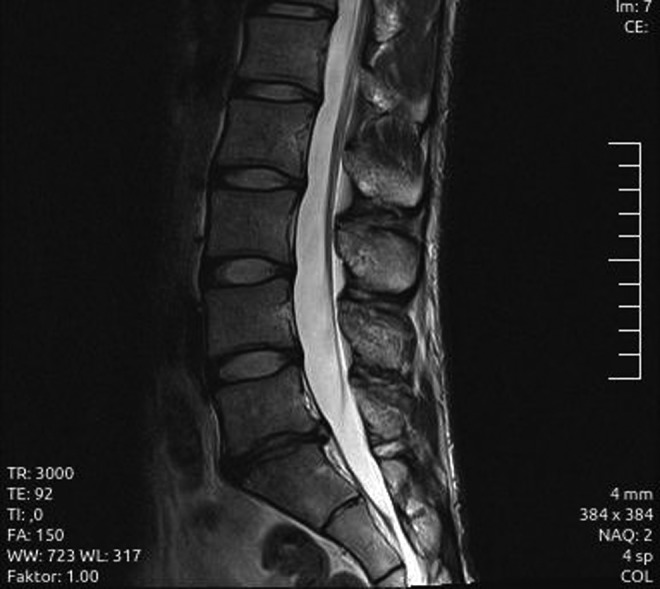
MRIMRI of the lumbar spine, sagittal T2 sequence: severe degenerative disc disease (Pfirrmann grade 4) at L5-S1 with disc protrusion, without nerve root compression.
Source : Külling et al., Orthopaedic Journal of Sports Medicine, 2014, figure 1 · CC BY-NC-ND
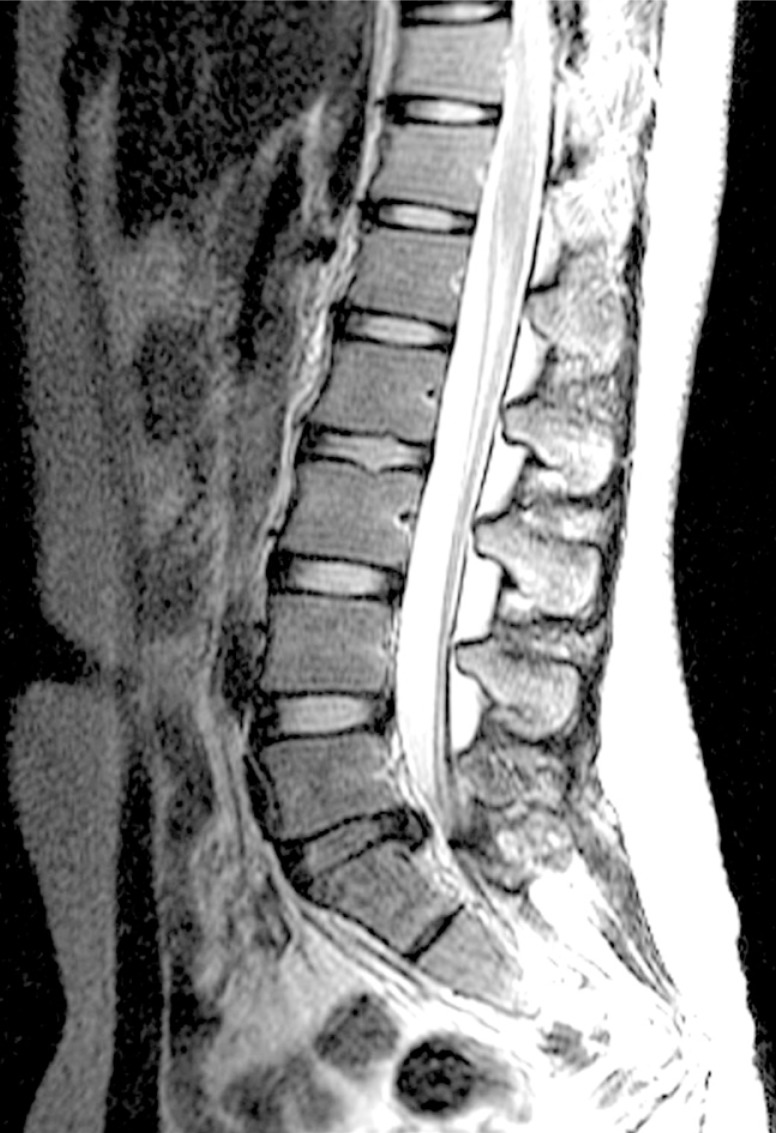
MRIMRI of the lumbar spine, sagittal T2 sequence: L5-S1 disc herniation with protrusion compressing the thecal sac, against a background of degenerative disc disease.
Source : Song et al., Korean Journal of Spine, 2011, figure 2 · CC BY-NC
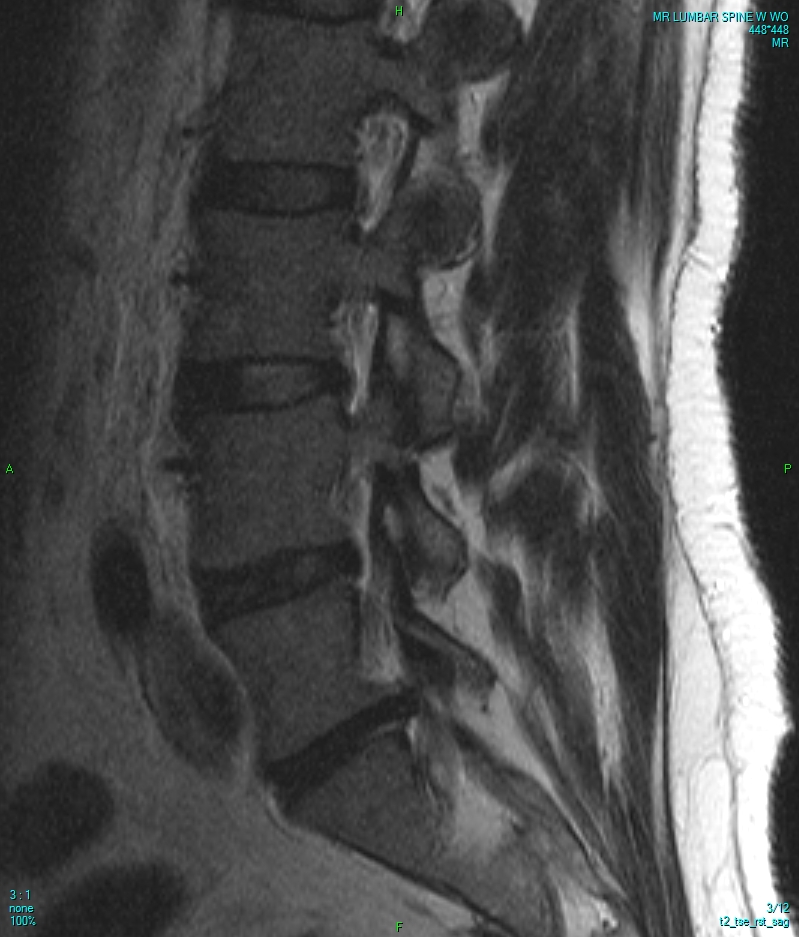
MRISagittal T2 lumbar MRI: signal loss and narrowing of the lower lumbar discs, an appearance of multilevel degenerative disc disease.
Source : Stillwaterising, Wikimedia Commons · CC0
Which ODI, exactly
The question is not rhetorical. The twenty-year review, written by the authors themselves, catalogues four English versions and nine in other languages, backed by at least 114 usable studies. There is therefore no single ODI but a family, and the versions are not interchangeable.
On the French side, the reference validated adaptation is French-Canadian, derived from version 2.0. In 72 chronic low back pain patients it gives an internal consistency of 0.88, a 48-hour test-retest reliability of ICC 0.92 (95% CI 0.87 to 0.95) and a correlation of 0.90 with the Quebec disability scale.
The practical consequence is the same as for every multi-version scale: the version goes in the notes next to the score, from the first administration.
The scorer above reproduces two versions from this family, each sourced under its items: the English section follows the ODI 2.1a of Fairbank & Pynsent 2000, from the appendix of an open-access article; the French section comes from the appendix of two doctoral theses deposited on DUMAS, a translation distinct from the validated French-Canadian adaptation cited above. The detail of both sources is below.
Ten points or nineteen
Two numbers circulate for saying a patient has changed, and they do not measure the same thing.
The first is an international consensus from 2008, proposing 10 points of minimal important change for the ODI scored 0 to 100. It is the most quoted figure, and it comes from a consensus process, not from a single measurement.
The second is a measurement. In 214 low back pain patients with a mean age of 66.2, 193 of them seen again at two weeks, the smallest detectable change of the ODI reaches 19.1 points. In other words, in that population, the consensus threshold is barely more than half the measurement error of the instrument.
The point is not to pick one over the other, but to know which one you are invoking. A gain of 12 points reaches the consensus threshold and stays within the measurement noise of older adults: that is an uncertain zone, and naming it is better than hiding it.
| What is measured | Value | Population and sample |
|---|---|---|
| Minimal important change, consensus | 10 points | international consensus, low back pain |
| Smallest detectable change | 19.1 points | 214 patients, mean age 66.2 |
| Test-retest reliability, French version | ICC 0.92 | 72 chronic patients, 48 h |
| Test-retest reliability, older adults | ICC 0.89 | 214 patients, 2 weeks |
| Internal consistency | 0.86 to 0.88 | depending on version and population |
| Versions catalogued | 4 + 9 | English and other languages, 20-year review |
What the score does not tell you
It does not say which area improved. Ten sections summarised into one number means a patient sleeping better but still lifting as poorly can show the same score as a patient in the opposite situation.
Nor does it say whether the disability is severe. The severity categories seen in circulation appear in none of the sources retained here, and asserting them would lend them a validation we have not verified.
Finally, the comparison with the Roland-Morris is unsettled. A systematic review conducted to COSMIN methodology, restricted to head-to-head studies, retains 9 articles and 11 studies, all of poor or fair methodological quality, and concludes that the evidence on the responsiveness of the two questionnaires is contradictory. Preferring one over the other is departmental habit, not evidence.
Where the ten reproduced sections above come from
The ODI is a copyrighted instrument, owned by Jeremy Fairbank since 1980, distributed under licence by the Mapi Research Trust on its ePROVIDE platform (verified in a browser on 15/09/2026): registering there is free, and access to the questionnaire is too for the student, the clinician in clinical practice and the non-funded academic researcher; funded, institutional or commercial use goes through a specific request to them, with a possible fee.
The two sections reproduced by the scorer above do not come directly from ePROVIDE. The English version is that of the appendix of an open-access article under a CC BY licence published in Cureus (2022), which itself cites Fairbank & Pynsent 2000 (the version known as ODI 2.1a). The French version is that of the appendix of two French medical doctoral theses deposited on the DUMAS academic repository (Petit, 2018, retained as the reference; corroborated by Troussier, 2020), neither of which names its translator, and which is not the validated French-Canadian adaptation cited above. No permission to reproduce beyond these open sources is claimed here; for any other use, contact the Mapi Research Trust.
Three administration pitfalls
Not recording the version
Four English versions and nine translations are in circulation. A score of 34 only compares with a score obtained on the same version, and that information vanishes from the notes if it is not written there from the start.
Reading the score backwards
Zero means no disability, one hundred means maximal disability. A patient going from 52 to 28 is markedly better, and the habit of scales where high is good regularly drives the opposite conclusion.
Announcing a 10-point improvement without saying in whom
The consensus threshold applies to low back pain in general. In older adults it sits well below the measured smallest detectable change. The same gap therefore does not carry the same weight depending on the patient in front of you.
Frequently asked questions
What does ODI stand for?
ODI stands for Oswestry Disability Index. It was published in 1980 by Fairbank, Couper, Davies and O'Brien, under the original title of low back pain disability questionnaire.
How is the ODI scored?
Each section is scored from 0 to 5 according to the statement chosen among six. The score is the sum of the scored sections, divided by five times their number, times one hundred: with ten sections scored, the denominator is 50; the publisher tolerates one missing or not-applicable section, and the denominator then becomes 45. Beyond one missing section, the score is not calculated.
How much change counts?
The international consensus proposes 10 points. But the smallest detectable change measured in older low back pain patients reaches 19.1 points: between the two, the gap exists without it being possible to assert that it exceeds measurement error.
Is there a validated French version?
Yes, a French-Canadian adaptation derived from version 2.0, validated in 72 chronic low back pain patients, with a 48-hour test-retest reliability of ICC 0.92. That is not the translation reproduced by the scorer above, which comes from two doctoral theses deposited on DUMAS.
Is the ODI free to use?
Not freely, but access to the questionnaire is free for the student, the clinician in clinical practice and the non-funded academic researcher, after registering on the ePROVIDE platform of the Mapi Research Trust, which distributes the instrument; funded, institutional or commercial use goes through a specific request. The two sections reproduced here come from an open-access publication for the English and from two doctoral theses deposited on DUMAS for the French, not directly from ePROVIDE.
References
6 sources, PMIDs included
- Fairbank JC, Couper J, Davies JB, O'Brien JP. The Oswestry low back pain disability questionnaire. Physiotherapy 1980;66(8):271-3. PMID 6450426. The original publication, ancestor of every current version. The indexed abstract carries no psychometric value: citing it for a reliability figure would be an attribution error.
- Fairbank JC, Pynsent PB. The Oswestry Disability Index. Spine (Phila Pa 1976) 2000;25(22):2940-52. PMID 11074683. The twenty-year review by the authors themselves: 4 English versions and 9 in other languages, at least 114 usable studies, more than 200 citations. It is what establishes that there is no single ODI. It is also the version, known as 2.1a, reproduced here by the retained English text.
- Ostelo RW, Deyo RA, Stratford P, Waddell G, Croft P, Von Korff M, Bouter LM, de Vet HC. Interpreting change scores for pain and functional status in low back pain: towards international consensus regarding minimal important change. Spine 2008;33(1):90-4. PMID 18165753. The international consensus proposing 10 points of minimal important change for the ODI scored 0 to 100, against 5 points for the Roland-Morris and 20 for the Quebec questionnaire.
- Denis I, Fortin L. Development of a French-Canadian version of the Oswestry Disability Index: cross-cultural adaptation and validation. Spine (Phila Pa 1976) 2012;37(7):E439-44. PMID 22037523. The validated French adaptation, in 72 chronic low back pain patients: internal consistency 0.88, 48-hour test-retest reliability ICC 0.92 (95% CI 0.87 to 0.95), correlation 0.90 with the Quebec scale. It is a version distinct from the one reproduced here by the scorer.
- Chiarotto A, Maxwell LJ, Terwee CB, Wells GA, Tugwell P, Ostelo RW. Roland-Morris Disability Questionnaire and Oswestry Disability Index: which has better measurement properties? A systematic review and meta-analysis. PMID 27081203. A COSMIN systematic review restricted to head-to-head comparisons: 9 articles, 11 studies, all of poor or fair methodological quality, and contradictory evidence on the responsiveness of both instruments.
- Jenks A, Hoekstra T, van Tulder M, Ostelo RW, Rubinstein SM, Chiarotto A. Roland-Morris Disability Questionnaire, Oswestry Disability Index and Quebec Back Pain Disability Scale: which has better measurement properties in older adults with low back pain? PMID 35584027. 214 patients with a mean age of 66.2, 193 seen again at two weeks. Internal consistency 0.86, reliability ICC(2,1) 0.89, and above all a smallest detectable change of 19.1 points.
 Page written by Anthony Baillon, physiotherapist, co-founder of Physio Learning. The questionnaire itself is by Fairbank et al., 1980: this page reproduces it from the sources named under the items, and interprets it.
Behind this article
An author who explains, a reviewer who checks.
How we write and check our content

Physiotherapist · co-founder of Physio Learning
Marked for life by his first four-hour lecture without a single image, he took a master’s in instructional design so that it would never happen to anyone again. He hunts down publication bias and unreadable slides with the same intransigence.

Head of scientific content
Physiotherapist specialising in neuro-musculoskeletal practice and holder of a master’s in public health. He checks the methodological rigour of every article: primary sources, levels of evidence, no exceptions.