









The Roland-Morris measures the disability of the low back pain patient across 24 items. Its validated French version carries another name, EIFEL, which is why people often believe there are two different scales. The full questionnaire, with its score calculated automatically, is right below.
The Roland-Morris threshold is not expressed in points but as a 15 to 40 % reduction, and its smallest detectable change, 6.9 out of 24, is larger than that threshold. The detail is below.
Figures taken from the studies listed at the end of this page, every value carrying its source where it is written. The questionnaire itself is reproduced in the scorer, from the version distributed by rmdq.org.
What the Roland-Morris measures
The Roland-Morris measures what low back pain prevents, across 24 statements the patient ticks or not depending on whether they describe their day. The total runs from 0 to 24, and a high score signals greater disability.
It was published in 1983 by Roland and Morris, inside a study on the natural history of low back pain. Its abstract is not indexed in PubMed: this page therefore has it carry no figure, and looks elsewhere for the measurement properties.
Those properties are good. In 214 patients with a mean age of 66, internal consistency reaches 0.89 and test-retest reliability 0.85. Compared with the Oswestry in a head-to-head review, it has the better construct validity, the Oswestry having the better reliability and the smaller measurement error.
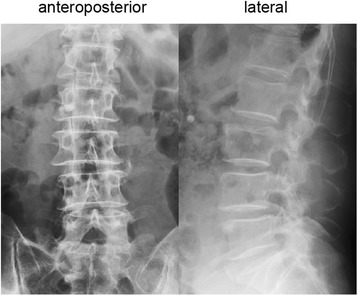
X-rayAnteroposterior and lateral radiographs of the lumbar spine: slight wedging deformity and degenerative disc disease.
Source : Takano et al., BMC Musculoskeletal Disorders, 2017, figure 1 · CC BY
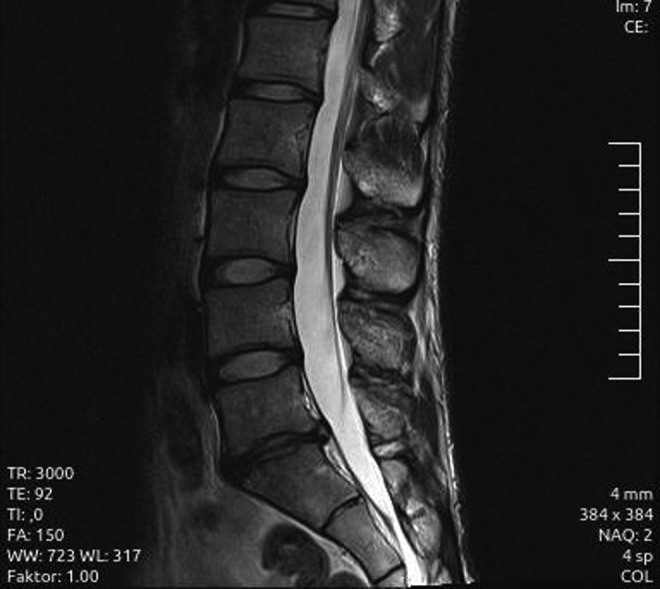
MRIMRI of the lumbar spine, sagittal T2 sequence: severe degenerative disc disease (Pfirrmann grade 4) at L5-S1 with disc protrusion, without nerve root compression.
Source : Külling et al., Orthopaedic Journal of Sports Medicine, 2014, figure 1 · CC BY-NC-ND
EIFEL, the French name
This is the most useful point on this page for a French-speaking reader, and the least known.
The validated French version of the Roland-Morris was published in 1993 by Coste et al. under the name EIFEL. It is not another scale: it is the French adaptation of the same questionnaire, described by its authors as rapid, simple, reliable, valid and sensitive to clinical change.
The practical consequence is direct. A report that speaks of EIFEL and an article that speaks of Roland-Morris speak of the same measure, and their scores compare. Believing in two distinct instruments leads to hunting for thresholds that do not exist on one side while they are published on the other.
Four versions, none unidimensional
The scale has been shortened, and the shortenings are a problem.
A Rasch analysis in 243 patients with chronic low back pain put four versions through the same examination: the original 24-item, two 18-item versions and one 11-item. None of the four proved to be a unidimensional measure of low-back-related disability.
The detail is instructive: items 3 and 23 are redundant, items 13 and 18 do not fit the model, and several items behave differently across patient subgroups. Its authors recommend caution in developing as well as applying alternative versions. In practice that means: use the 24-item version, the one its designers recommend, and do not compare a score obtained on a short version with a threshold published for the long one.
| What is measured | Value | Sample |
|---|---|---|
| Score range | 0 to 24 | original version |
| Internal consistency | 0.89 | 214 patients, mean age 66 |
| Test-retest reliability | 0.85 | same patients |
| Smallest detectable change | 6.9 | same patients |
| Minimal important change | 15 to 40 % | chronic low back pain |
| Versions put through Rasch analysis | 4 | 243 chronic low back pain patients |
| Unidimensional versions among them | 0 | same patients |
| Studies in the comparison with the Oswestry | 11 | all of poor or fair quality |
A threshold expressed as a percentage
This is where the Roland-Morris parts company with most scales in this family, and where the reading habit has to change.
The 2022 study in chronic low back pain establishes not a number of points but a proportion: the minimal important change sits between a 15 % and a 40 % reduction in the score, depending on whether patients who report themselves only 'slightly improved' are counted. The same 4-point change therefore does not mean the same thing starting from 20 as from 8.
A second value complicates the reading, and it must be known. In the 214 older patients already cited, the smallest detectable change is 6.9 out of 24, and the authors explicitly note that this value is larger than the minimal important change. In other words, for a patient starting from a low score, the threshold that matters clinically sits inside the measurement noise.
Where to find the official questionnaire
The site rmdq.org hosts the Roland and Morris questionnaire and declares it, and all of its translations, in the public domain. The scorer above reproduces without changing a word the French translation produced by MAPI Research Institute in 2004/2005 and the original English questionnaire of Roland and Morris, 1983, both distributed by rmdq.org.
That MAPI translation is not the wording of the EIFEL published by Coste et al. in 1993 in the Revue du rhumatisme: these are two distinct French translations of the same original questionnaire, and only the rmdq.org one is reproduced here. For the exact text of the Coste et al. publication, the original article must be obtained.
Three administration pitfalls
Treating an EIFEL and a Roland-Morris as two scales
It is the same measure under two names. The thresholds published for the Roland-Morris apply to the EIFEL, and notes that mix the two labels describe a single series of measurements.
Reading the change in points rather than as a percentage
The published threshold is a 15 to 40 % reduction. Three points gained from a baseline of 6 are a 50 % reduction; the same three points from a score of 20 make only 15 %. The starting point changes the conclusion.
Using a short version with the thresholds of the long one
The 18-item and 11-item versions exist, and none passed the unidimensionality examination, no more than the original did. The thresholds quoted here were established on the 24-item version: carrying them elsewhere has no basis.
Frequently asked questions
What is the Roland-Morris, and what is the EIFEL?
The Roland-Morris is the low-back disability questionnaire published in 1983 by Roland and Morris. The EIFEL is its validated French version, published in 1993 by Coste et al.: it is the same instrument. The scorer above reproduces a different French translation, the one distributed by rmdq.org (MAPI Research Institute, 2004/2005), which is not the exact wording of the EIFEL by Coste et al.
How is the Roland-Morris scored?
It has 24 statements the patient ticks or leaves blank to describe their day. The scorer above adds up the ticked boxes: each is worth one point, each statement left blank is worth zero. The total runs from 0 to 24, and a high score signals greater disability.
How much change allows a conclusion?
The threshold is expressed as a proportion: a 15 to 40 % reduction in the score depending on the definition used. The smallest detectable change, for its part, is 6.9 points out of 24 in older patients.
Should the Roland-Morris or the Oswestry be preferred?
The head-to-head comparison does not settle it: the Oswestry has the better reliability and the smaller measurement error, the Roland-Morris the better construct validity, and the authors conclude there is no strong reason to prefer one over the other.
Can a short version be used?
With reservation. The 18-item and 11-item versions were examined by Rasch analysis, and none is unidimensional, the original no more so. The published thresholds concern the 24-item version.
References
7 sources, PMIDs included
- Roland M, Morris R. A study of the natural history of back pain. Part I: development of a reliable and sensitive measure of disability in low-back pain. Spine (Phila Pa 1976) 1983;8(2):141-4. PMID 6222486. The original publication, which builds the scale inside a natural-history study of low back pain. Its abstract is not indexed: this page has it carry no figure, and cites the other sources for the measurement properties.
- Coste J, Le Parc JM, Berge E, Delecoeuillerie G, Paolaggi JB. Validation française d’une échelle d’incapacité fonctionnelle pour l’évaluation des lombalgies (questionnaire EIFEL). Rev Rhum Ed Fr 1993;60(5):335-41. PMID 8167640. The French adaptation of the Roland and Morris questionnaire, published under the name EIFEL. The authors describe it as rapid, simple, reliable, valid and sensitive to clinical change, from epidemiological research to evaluating the patient in practice.
- Roland M, Fairbank J. The Roland-Morris Disability Questionnaire and the Oswestry Disability Questionnaire. Spine (Phila Pa 1976) 2000;25(24):3115-24. PMID 11124727. The joint review by both authors, each on their own scale, twenty years on. Its abstract is not indexed either: it is cited here as a framing reference, with no value attributed to it.
- Grotle M, Wilkens P, Garratt AM, Scheel I, Storheim K. Which Roland-Morris Disability Questionnaire? Rasch analysis of four different versions tested in a Norwegian population. J Rehabil Med 2013;45(7):670-7. PMID 23828073. 243 patients with chronic low back pain, four versions run through a Rasch model: the original 24-item, two 18-item versions and one 11-item. None of the four is a unidimensional measure of disability. Items 3 and 23 are redundant, items 13 and 18 do not fit, and several behave differently across subgroups.
- Chiarotto A, Maxwell LJ, Terwee CB, Wells GA, Tugwell P, Ostelo RW. Roland-Morris Disability Questionnaire and Oswestry Disability Index: Which Has Better Measurement Properties for Measuring Physical Functioning in Nonspecific Low Back Pain? Systematic Review and Meta-Analysis. Phys Ther 2016;96(10):1620-37. PMID 27081203. The head-to-head comparison, across 9 articles and 11 studies, all of poor or fair methodological quality. The Oswestry has the better test-retest reliability and the smaller measurement error; the Roland-Morris the better construct validity. The authors' conclusion: no strong reason to prefer one over the other.
- Jenks A, Hoekstra T, van Tulder M, Ostelo RW, Rubinstein SM, Chiarotto A. Roland-Morris Disability Questionnaire, Oswestry Disability Index, and Quebec Back Pain Disability Scale: Which Has Superior Measurement Properties in Older Adults With Low Back Pain? J Orthop Sports Phys Ther 2022;52(7):457-69. PMID 35584027. 214 patients with a mean age of 66.2. Internal consistency 0.89 and test-retest reliability 0.85 for the Roland-Morris. Above all, its smallest detectable change is 6.9 out of 24, and the authors note that this value, like those of the other two scales, is larger than the minimal important change.
- Bråten LCH, Grøvle L, Wigemyr M, Wilhelmsen M, Gjefsen E, Espeland A, Haugen AJ, Skouen JS, Brox JI, Zwart JA, Storheim K, Ostelo RW, Grotle M. Minimal important change was on the lower spectrum of previous estimates and responsiveness was sufficient for core outcomes in chronic low back pain. J Clin Epidemiol 2022;151:75-87. PMID 35926821. The study that expresses the threshold differently. In patients with chronic low back pain, the minimal important change of the Roland-Morris, the Oswestry and the numeric pain scale sits between a 15 % and a 40 % reduction, depending on whether patients who are 'slightly improved' are counted. The credibility of the estimates is judged moderate.
 Page written by Anthony Baillon, physiotherapist, co-founder of Physio Learning. The questionnaire itself is by Roland and Morris, 1983; the French translation reproduced here is the one by MAPI Research Institute, 2004/2005, distributed by rmdq.org, which declares it in the public domain: it is not the wording of the EIFEL by Coste et al. 1993. This page reproduces, documents and interprets the questionnaire.
Behind this article
An author who explains, a reviewer who checks.
How we write and check our content

Physiotherapist · co-founder of Physio Learning
Marked for life by his first four-hour lecture without a single image, he took a master’s in instructional design so that it would never happen to anyone again. He hunts down publication bias and unreadable slides with the same intransigence.

Head of scientific content
Physiotherapist specialising in neuro-musculoskeletal practice and holder of a master’s in public health. He checks the methodological rigour of every article: primary sources, levels of evidence, no exceptions.