















The Constant score is the European reference for the shoulder, and it is not a questionnaire: 65 of its 100 points are measured by the examiner, 25 of them with a dynamometer. That is where its problem comes from, and the calculator below displays the band of uncertainty this imposes.
The 95 % confidence limits of a single assessment are 16 to 20 points, while the minimal important difference is 10 points: a gain of eight points proves nothing. The detail is below.
Figures taken from the studies listed at the end of this page, every value carrying its source where it is written. The questionnaire itself is not reproduced.
What the Constant score measures
The Constant score rates shoulder function out of 100 points, a high score signalling better function. Published in 1987 by Constant and Murley, it became the European reference, to the point of being required by most shoulder surgery journals.
It is made of four subscores: pain out of 15, activities of daily living out of 20, range of motion out of 40 and strength out of 25. The original publication called it reproducible between observers and sensitive to small changes; the following thirty years qualified both claims, and that is the subject of this page.
A point of method first, often ignored: it is not the 1987 article to follow when scoring, but the 2008 update, signed by the authors themselves, whose title announces modifications and guidelines for its use. The original description was judged insufficient to standardise administration between centres, and that insufficiency explains a good part of what follows.
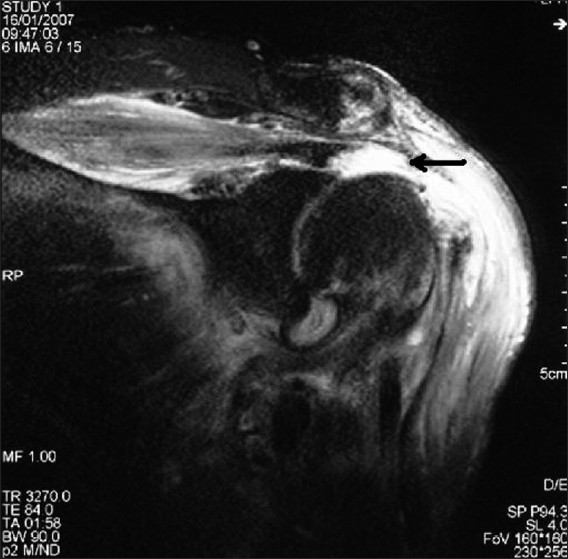
MRIMRI of the shoulder, coronal view: full-thickness tear of the supraspinatus tendon, with high-signal fluid at the tendon insertion, arrow shown.
Source : Naqvi et al., International Journal of Shoulder Surgery, 2009, figure 3 · CC BY
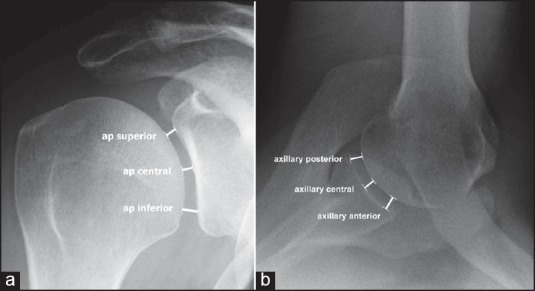
X-rayAnteroposterior and axillary shoulder radiographs: landmarks for measuring the glenohumeral joint space, a technique used to assess shoulder osteoarthritis.
Source : Kircher et al., International Journal of Shoulder Surgery, 2014, figure 1 · CC BY-NC-SA
Two thirds of the points do not come from the patient
This is the first thing to know, and it changes the nature of the instrument.
Pain and daily activities, that is 35 points, are reported by the patient. Range of motion and strength, that is 65 points, are measured by the examiner, and strength requires a dynamometer. A record without a dynamometer is therefore not a Constant score: it is a partial sum, and the tool at the top of this page says so.
That measured half is also the fragile half. In 63 patients assessed twice on the same day, 2 items out of 14 prove unreliable within one examiner, against 12 out of 14 between two different examiners. When a Nice team asked 100 patients to score their own shoulder, correlation with the surgeon's examination stayed excellent overall, 0.87, and good for range of motion and pain, but fell to 0.57 for strength.
Measurement error exceeds the useful threshold
This is the point that should govern every reading of a Constant score, and it is rarely stated.
As early as 1996, a study of 25 patients calculated the 95 % confidence limits of a single assessment: they lie between 16 and 20 points in most cases. Yet the minimal important difference, established in the 193 patients of a randomised trial in subacromial pain syndrome, is 10 points. The uncertainty of a single measurement is therefore larger than the change the score claims to detect: a gain of eight points proves nothing.
The mechanical cause is identified, and it lies in strength. In 33 healthy volunteers, abduction strength measured at 90 degrees is on average 15 % lower than at 60 degrees and 45 % lower than at 30 degrees, on the same shoulder. In other words, a patient unable to adopt the prescribed position swings a quarter of the score. The practical consequence is narrow: the Constant score is interpretable only within a patient, with the same examiner, the same dynamometer, the same position. Comparing it with a score taken by a colleague or read in a report has no metrological meaning.
| What is measured | Value | Sample |
|---|---|---|
| Pain, reported by the patient | 15 points | out of 100 |
| Daily activities, reported | 20 points | out of 100 |
| Range of motion, measured | 40 points | out of 100 |
| Strength, measured with a dynamometer | 25 points | out of 100 |
| Uncertainty of a single assessment | 16 to 20 | 25 patients |
| Minimal important difference | 10 | 193 patients |
| Patient acceptable symptom state | 80 | same patients |
| Unreliable items, same examiner | 2 of 14 | 63 patients |
| Unreliable items, two examiners | 12 of 14 | same patients |
| Strength at 90 degrees against 30 degrees | -45 % | 33 healthy volunteers |
The French version, and the Auto-Constant
French speakers did not translate the name: they use the eponym, and a French validation does exist.
Published in 2007 by a Grenoble team, it covers 53 patients rehabilitating an operated cuff, between one and twelve months, that is exactly the physiotherapist's ground. Correlations are satisfactory, 0.96 within observer and 0.91 and 0.89 between observers, with an internal consistency of 0.75.
Its authors nonetheless raise a caveat worth reading: reproducibility of the total score does not guarantee that of its components, the face validity of the score is open to criticism for assessing operated cuffs, and a precise consensus protocol is still needed. A second French avenue exists, the Auto-Constant: a French questionnaire, all checkboxes and pictures, whose total correlates at 0.87 with the surgeon's examination, for a mean score three points lower. It does not replace the measurement, but it makes remote follow-up possible.
What this page reproduces, and what it does not
No free licence is established for the Constant score: its form is therefore not reproduced here. The four denominators, by contrast, belong to the method and not to the content, and giving them is necessary to understand the instrument. To score for real, it is the 2008 update signed by the authors that must be obtained, and not the 1987 description, judged insufficient to standardise administration between centres and assessors.
Three administration pitfalls
Comparing your score with a colleague's
Between two examiners, 12 of the 14 items are unreliable. The Constant score is followed within a patient and with the same examiner; reading it in a report from elsewhere says almost nothing about the course.
Scoring without a dynamometer
Strength weighs 25 points out of 100 and is measured. Estimating that subscore by eye, or omitting it, does not produce a Constant score but a partial sum that compares with no published value.
Following instability with this score
As early as 1996, every patient whose main problem was instability scored within five points of the maximum. The systematic review confirms the hierarchy: the standardised evaluation falls from 58.6 in subacromial disease to 30.6 in instability.
Frequently asked questions
How is the Constant score scored?
Out of 100 points across four subscores: pain out of 15 and daily activities out of 20, reported by the patient; range of motion out of 40 and strength out of 25, measured by the examiner. A high score signals better function.
Is a dynamometer needed?
Yes. The 25 strength points are measured, and position matters: at 90 degrees of abduction, the strength recorded is on average 45 % lower than at 30 degrees on the same shoulder.
How much change counts?
The minimal important difference is 10 points, and the patient acceptable symptom state sits at 80. But the confidence limits of a single assessment are 16 to 20 points: the useful threshold is smaller than the uncertainty.
Is there a French version?
Yes, validated in 2007 in 53 patients rehabilitating an operated cuff, with a within-observer reproducibility of 0.96. Its authors do note, however, that the face validity of the score is open to criticism in that population.
Does the Constant score suit every shoulder?
No. The standardised EMPRO evaluation places it at 58.6 in subacromial disease and at 30.6 in instability, where it also shows a marked ceiling effect.
References
9 sources, PMIDs included
- Constant CR, Murley AH. A clinical method of functional assessment of the shoulder. Clin Orthop Relat Res 1987;(214):160-4. PMID 3791738. The original publication. It describes a method applicable whatever the diagnosis and claims the score is reproducible between observers and sensitive to small changes. The following thirty years have substantially qualified both claims, and its description of administration is now judged insufficient to standardise between centres.
- Constant CR, Gerber C, Emery RJ, Søjbjerg JO, Gohlke F, Boileau P. A review of the Constant score: modifications and guidelines for its use. J Shoulder Elbow Surg 2008;17(2):355-61. PMID 18218327. The update signed by the authors themselves, twenty-one years on. It is this document, not the 1987 article, that must be read before scoring. Its abstract is not indexed by PubMed: this page has it carry no figure, only its title is citable.
- Conboy VB, Morris RW, Kiss J, Carr AJ. An evaluation of the Constant-Murley shoulder assessment. J Bone Joint Surg Br 1996;78(2):229-32. PMID 8666631. The first serious metrological challenge, in 25 patients. The 95 % confidence limits of a single assessment lie between 16 and 20 points in most cases. The authors also record that every patient with instability scored within five points of the maximum.
- Rocourt MH, Radlinger L, Kalberer F, Sanavi S, Schmid NS, Leunig M, Hertel R. Evaluation of intratester and intertester reliability of the Constant-Murley shoulder assessment. J Shoulder Elbow Surg 2008;17(2):364-9. PMID 18329560. 63 patients assessed twice on the same day by two examiners. The total score holds, but at item level agreement collapses: 2 items out of 14 are unreliable within one examiner, against 12 out of 14 between two different examiners. The authors attribute it to the brevity of the original description.
- Hirschmann MT, Wind B, Amsler F, Gross T. Reliability of shoulder abduction strength measure for the Constant-Murley score. Clin Orthop Relat Res 2010;468(6):1565-71. PMID 19639370. The mechanical explanation of the weak link, in 33 healthy volunteers with a handheld dynamometer. Strength measured at 90 degrees of abduction is on average 15 % lower than at 60 degrees and 45 % lower than at 30 degrees, on the same shoulder. Intraobserver reliability depends on arm and torso position.
- Kanto K, Lähdeoja T, Paavola M, Aronen P, Järvinen TLN, Jokihaara J, Ardern CL, Karjalainen TV, Taimela S. Minimal important difference and patient acceptable symptom state for pain, Constant-Murley score and Simple Shoulder Test in patients with subacromial pain syndrome. BMC Med Res Methodol 2021;21(1):45. PMID 33676417. The two usable thresholds, in the 193 patients of the randomised FIMPACT trial. Minimal important difference of 10 points by the ROC curve, and patient acceptable symptom state at 80 points.
- Livain T, Pichon H, Vermeulen J, Vaillant J, Saragaglia D, Poisson MF, Monnet S. Étude de reproductibilité intra et inter-observateur de la version française du score de Constant au cours de la rééducation des coiffes opérées. Rev Chir Orthop Reparatrice Appar Mot 2007;93(2):142-9. PMID 17401287. The French version, tested by a Grenoble team in 53 patients rehabilitating an operated cuff, between one and twelve months. Satisfactory correlations, 0.96 within observer, 0.91 and 0.89 between observers, internal consistency 0.75. The authors' own caveat: the face validity of the score is open to criticism in this population, and a precise consensus protocol is needed.
- Chelli M, Levy Y, Lavoué V, Clowez G, Gonzalez JF, Boileau P. The « Auto-Constant »: Can we estimate the Constant-Murley score with a self-administered questionnaire? A pilot study. Orthop Traumatol Surg Res 2019;105(2):251-6. PMID 30876713. A Nice team puts the score in the patient's hands, in French, across 100 consecutive patients. Correlation with the surgeon's examination is excellent overall, 0.87, good for mobility and pain, and only fair for strength, 0.57. It is this abstract that carries the denominators of the four subscores.
- Vrotsou K, Ávila M, Machón M, Mateo-Abad M, Pardo Y, Garin O, Zaror C, González N, Escobar A, Cuéllar R. Constant-Murley Score: systematic review and standardized evaluation in different shoulder pathologies. Qual Life Res 2018;27(9):2217-26. PMID 29748823. The systematic review that evaluates the score pathology by pathology with the EMPRO tool. The overall score falls from 58.6 in subacromial disease to 30.6 in instability: the same instrument does not have the same worth depending on what it is asked to follow.
 Page written by Anthony Baillon, physiotherapist, co-founder of Physio Learning. The score itself is by Constant and Murley, 1987: this page documents and computes it, it does not reproduce its form.
Behind this article
An author who explains, a reviewer who checks.
How we write and check our content

Physiotherapist · co-founder of Physio Learning
Marked for life by his first four-hour lecture without a single image, he took a master’s in instructional design so that it would never happen to anyone again. He hunts down publication bias and unreadable slides with the same intransigence.

Head of scientific content
Physiotherapist specialising in neuro-musculoskeletal practice and holder of a master’s in public health. He checks the methodological rigour of every article: primary sources, levels of evidence, no exceptions.