















The Lysholm score rates the knee out of 100. The gain the patient judges important is worth 5.5 points; the smallest change the scale can detect is worth 8.9. Between the two opens a zone where something real happens to the patient without the instrument being able to prove it. The scorer below names it.
Published in 1982 as a physician-administered score, the Lysholm was only validated as a self-report questionnaire in 2009. The detail is below.
Figures taken from the studies listed at the end of this page, every value carrying its source where it is written. The eight items of the questionnaire are reproduced from the two sources named below the scorer, with no copyright holder identified for this instrument.
What the Lysholm measures, and who used to fill it in
The Lysholm score rates the knee across eight items with unequal weights: limping, support, locking, instability, pain, swelling, stair-climbing and squatting. The total runs from 0 to 100, and a high score signals better function. There is no usable subscore: only the total can be read.
Here is the least known fact about this instrument, and it changes how it is handed over. The score was published in 1982 as a physician-administered score. This is not commentators saying so, it is its own authors, in the abstract of their 2009 revalidation: they write there that the Lysholm had been published as a physician-administered score. Its validation as a patient-reported questionnaire dates from that study, twenty-seven years later.
A direct consequence for a bibliography: a page citing the 1982 original to justify a self-report questionnaire cites the wrong reference. It is the 2009 revalidation that authorises this use, and it is also the source of the figures used afterwards.
Finally, the Lysholm does not measure activity level, and its authors published a separate scale for that in 1985. Their conclusion there is explicit: stability test, functional score, performance test and activity rating have a relative weight that changes over the course of treatment, and they should not all be included in one and the same score.
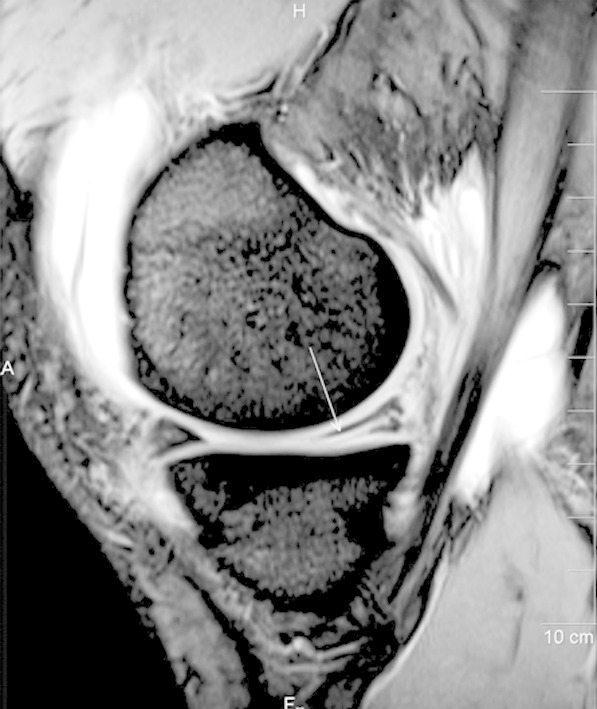
MRIMRI of the knee, sagittal view: grade 3 tear of the posterior horn of the medial meniscus, linear hyperintense signal reaching the inferior articular surface, with joint effusion (arrow).
Source : Yaqoob et al., Pakistan Journal of Medical Sciences, 2015, figure 1 · CC BY
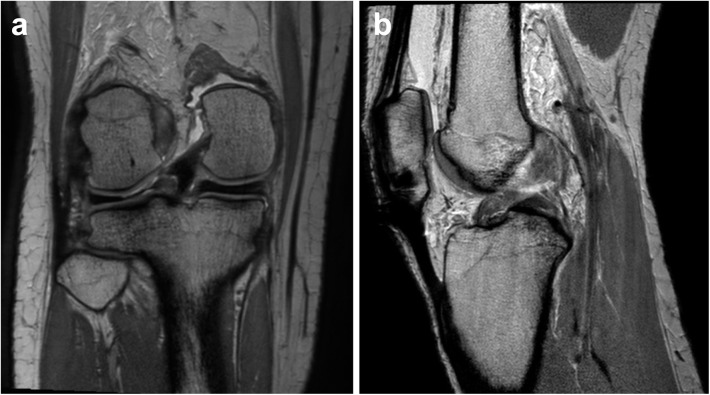
MRIKnee MRI, two views: lateral meniscus root tear on the coronal image (a) and anterior cruciate ligament tear with discontinuity and swelling on the sagittal image (b).
Source : Koo et al., PLoS ONE, 2015, figure 3 · CC BY
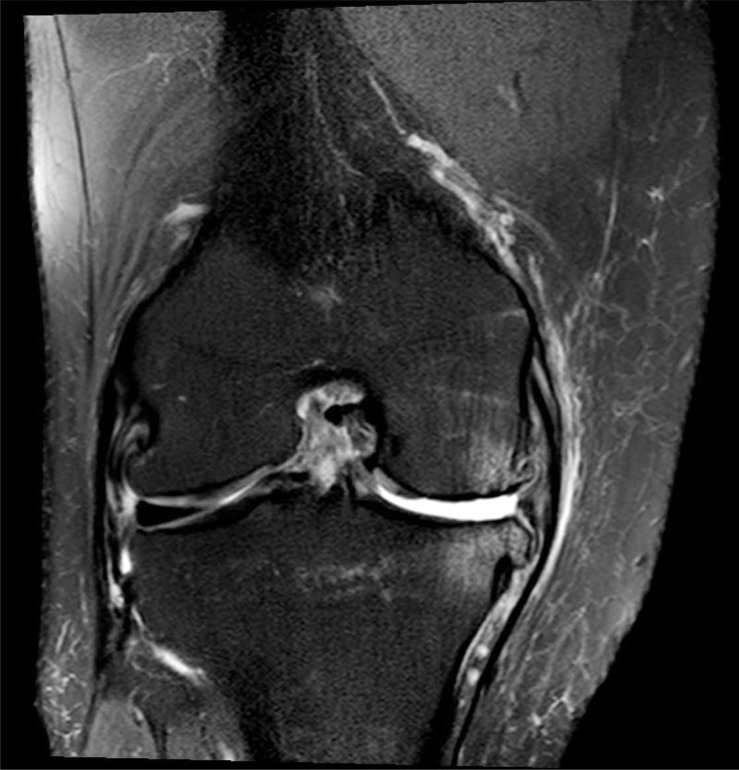
MRIMRI of the knee, coronal view, T2-weighted: chronic anterior cruciate ligament tear with deficient medial meniscus and medial femorotibial compartment osteoarthritis.
Source : Wong et al., The open orthopaedics journal, 2012, figure 2 · CC BY-NC
Five and a half points against eight point nine
This is the most useful point on this page, and it fits in a subtraction.
The minimum detectable change of the Lysholm is 8.9 points. It is measured test-retest in 50 patients reviewed two years after anterior cruciate ligament surgery, with a second administration within four weeks. That is the instrument's noise floor: below it, one cannot tell whether the score moved or the measurement did.
The minimal important clinical difference, meanwhile, is 5.5 points. It is computed by anchor method in 59 patients operated on for the anterior cruciate ligament by a single surgeon, at six months. That is the gain from which the patient reports that something has changed for them.
Five and a half is smaller than eight point nine. In other words: a gain that genuinely matters to the patient remains, in that individual, indistinguishable from measurement error. This is not an arithmetic oddity, it is a property of the scale, and it has a simple operational translation: on individual follow-up, conclude nothing from a difference below about nine points, and do not declare it null either. Between 5.5 and 8.9, the right sentence for the report is 'the patient reports a gain the scale cannot confirm'.
The published thresholds, and the populations they come from
The thresholds published on the Lysholm do not form a coherent set, because they do not come from the same thing. The table below puts each one back in front of its population.
Two of them call for a particular warning. The important difference of 25.4 points and the acceptable state above 52.5 points were established in 99 patients who underwent inlay patellofemoral arthroplasty. They are then taken up as they stand in other knee conditions, which has no basis. And the Persian version finds an individual minimum detectable change of 2.88 points, three times less than the 8.9 of the original version: from one population and method to another, these estimates vary by a factor of three.
Two structural properties complete the picture. First, four domains out of eight hit the ceiling in more than 30% of patients, and the squatting domain collapses to the floor in more than 30%: taken alone, the domains measure nothing, only the 0 to 100 total is usable. The most ironic part is that the instability domain, the scale's historical reason for being, is the only one of the five reported domains whose effect size stays small, when pain, limping, swelling and squatting reach large effect sizes.
Second, the ceiling is not fixed: it doubles over time. In 134 patients operated on for the anterior cruciate ligament and all assessed twice, it rises from 14.9% at six months to 30.6% at twelve months. The scale therefore goes blind at the very moment return-to-sport decisions are made.
| What is measured | Value | Population |
|---|---|---|
| Minimum detectable change, original version | 8.9 | 50 patients, test-retest 2 years after anterior cruciate ligament surgery |
| Minimal important clinical difference | 5.5 | 59 anterior cruciate ligament patients, anchor method at 6 months |
| Individual minimum detectable change, Persian version | 2.88 | 100 patients with a complete anterior cruciate ligament tear |
| Important difference, one particular surgical population | 25.4 | 99 inlay patellofemoral arthroplasties |
| Patient acceptable symptom state, same population | > 52.5 | the same 99 patients |
| Ceiling effect six months after ligament reconstruction | 14.9% | 134 anterior cruciate ligament patients |
| Ceiling effect at twelve months, same patients | 30.6% | the same 134 patients |
No validated French version
No validated French version of the Lysholm score is indexed in PubMed. The absence was searched for, not assumed: seven distinct formulations were run against the database, two of which return strictly no result, and the only French works found are clinical series using the instrument in English.
Twelve other languages have one: German, Turkish, Polish, Chinese, Dutch, Italian, Arabic, Spanish, Greek, Indonesian, Thai, Persian. Several were published after 2020, and Tegner or Lysholm themselves co-sign some of them. French is missing from that list.
There is a historical explanation, and an honourable one: the French-speaking rehabilitation community validated its own tool in French for follow-up after anterior cruciate ligament reconstruction, the PPLP scale, rather than translating this one. The practical consequence remains: any French scoring of the Lysholm rests on an in-house translation whose measurement properties are unknown, to which thresholds from elsewhere are then applied.
Where the scorer's items come from
The Lysholm score circulates very widely reproduced, including as an appendix to open-access articles under a Creative Commons licence, but no text explicitly authorises its reproduction: the original publisher's page raises an anti-bot check, and the ePROVIDE database returns a genuine 404 error page for this instrument. No copyright holder is therefore identified, and this page does not claim any permission: it names its two sources and reproduces their items verbatim. The English version comes from appendix I, "Original score" column, of Smith, Richardson and Tennant, 2009 (Osteoarthritis and Cartilage, full text free of charge on the publisher's site). The French version comes from appendix 5 of a medical thesis defended in Caen in 2021, deposited in open access on DUMAS, with a corrected value: the "Blocage aigu à l'examen" option scored 5 there, it scores 0. There is in any case no validated French version from a translation study: the French grid above is an unvalidated translation, like the others found in the literature.
Three administration pitfalls
Following subscores
Four of the eight domains hit the ceiling in more than 30% of patients and a fifth collapses to the floor. Only the 0 to 100 total is usable; a domain taken alone measures nothing.
Reading a gain of five or six points as a proven improvement
It exceeds the minimal important clinical difference, 5.5 points, but stays below the minimum detectable change, 8.9. In an individual, that difference supports no conclusion, and it cannot be denied either.
Comparing a success rate from one scale to another
On the same 90 anterior cruciate ligament reconstructions, the Lysholm-Tegner system returned 92.5% good and excellent results, against 82% for the IKDC and 79% for ARPEGE. Same surgery, read by three instruments that do not weight the same things: here pain weighs most, in the IKDC it is the ligament examination.
Frequently asked questions
What does the Lysholm score measure?
It rates knee function across eight items with unequal weights, for a total of 0 to 100, where 100 is a knee free of complaints. It measures neither activity level nor objective stability.
How is the Lysholm score calculated?
Each item is scored on its own scale of unequal weights, from 0 for the worst answer up to 5, 10, 15 or 25 points for the best, depending on the item. The score is the sum of the eight values, for a total of 0 to 100; all eight answers are required, as no tolerance for missing items is published for this scale.
How much change counts?
Two figures are needed to answer. The patient reports a gain from 5.5 points, but the scale can only detect a change from 8.9 points. Between the two, no conclusion is drawn.
Is the Lysholm a self-report questionnaire?
Today yes, but only since 2009. It had been published in 1982 as a physician-administered score, and it is its own authors who say so.
Can it be used a year after ligament reconstruction?
With caution: its ceiling effect rises from 14.9% at six months to 30.6% at twelve months. It therefore becomes insensitive just as return to sport is being decided.
Is there a French version of the Lysholm score?
No. No validated French version is indexed, while at least twelve others exist. The French-speaking community validated its own tool instead, the PPLP scale.
References
7 sources, PMIDs included
- Lysholm J, Gillquist J. Evaluation of knee ligament surgery results with special emphasis on use of a scoring scale. Am J Sports Med 1982;10(3):150-4. PMID 6896798. The original publication. The authors build the scale to follow knee ligament surgery, centred explicitly on giving way. Compared to a slightly modified Larson scale, it gives equivalent results for meniscal lesions but a significantly lower total for unstable knees. A point almost nobody recalls: it is a physician-administered score.
- Tegner Y, Lysholm J. Rating systems in the evaluation of knee ligament injuries. Clin Orthop Relat Res 1985;(198):43-9. PMID 4028566. The second founding publication, which adds an activity rating as a complement to the functional score. Its conclusion is the reading key for both instruments, and it is regularly ignored: stability test, functional score, performance test and activity rating are all important, but their relative weight varies over the course of treatment and they should not all be included in one and the same score.
- Kocher MS, Steadman JR, Briggs KK, Sterett WI, Hawkins RJ. Reliability, validity, and responsiveness of the Lysholm knee scale for various chondral disorders of the knee. J Bone Joint Surg Am 2004;86(6):1139-45. PMID 15173285. The reference metrological study. The total holds up well: test-retest reliability of 0.91, floor effect of 0% and ceiling effect of 0.7%, effect size of 1.16. The detail does not: four domains out of eight hit the ceiling in more than 30% of patients, and a fifth collapses to the floor. And the instability domain, the scale's historical reason for being, is the only one of the five reported domains whose effect size stays small. The overall population is 1,657 patients, but each analysis runs on a subset whose size the abstract does not give.
- Briggs KK, Lysholm J, Tegner Y, Rodkey WG, Kocher MS, Steadman JR. The reliability, validity, and responsiveness of the Lysholm score and Tegner activity scale for anterior cruciate ligament injuries of the knee: 25 years later. Am J Sports Med 2009;37(5):890-7. PMID 19261899. Twenty-seven years after the original, the founding authors finally validate the score as a patient-reported questionnaire. Their abstract states plainly that in 1982 it had been published as a physician-administered score. This is also where the minimum detectable change of 8.9 points comes from, measured test-retest in 50 patients, to be set against any individual reading of a gain of a few points.
- Nascimento BFD, Lima MBDR, Dias Júnior JM, Antunes Filho J, Campos TVO, Mendes Júnior AF. Calculation of the Minimal Important Clinical Difference of the Lysholm and IKDC Scores After Anterior Cruciate Ligament Reconstruction. Rev Bras Ortop (Sao Paulo) 2023;58(1):79-84. PMID 36969791. The most useful tension in practice, and it fits in a subtraction. By anchor method, in 59 patients operated on for the anterior cruciate ligament by a single surgeon, the minimal important clinical difference is 5.5 points. That is less than the minimum detectable change of 8.9 points published by the scale's own authors: in an individual, a gain that genuinely matters to them cannot be told apart from measurement noise.
- Ra HJ, Kim HS, Choi JY, Ha JK, Kim JY, Kim JG. Comparison of the ceiling effect in the Lysholm score and the IKDC subjective score for assessing functional outcome after ACL reconstruction. Knee 2014;21(5):906-10. PMID 24998912. The ceiling is not a fixed property of the scale, it is a function of time. In 134 patients operated on for the anterior cruciate ligament and all assessed twice, the ceiling effect rises from 14.9% at six months to 30.6% at twelve months. In other words, the scale goes blind at the very moment return-to-sport decisions are made. Its correlation with the single-leg hop is also weaker there than that of the other score compared.
- Christel P, Djian P, Darman Z, Witvoët J. [Results of Marshall-MacIntosh reconstruction according to 3 scoring systems (ARPEGE, Lysholm, IKDC). 90 cases reviewed with at least a one-year follow-up]. Rev Chir Orthop Reparatrice Appar Mot 1993;79(6):473-83. PMID 8066299. A French study applying three rating systems to the same 90 anterior cruciate ligament reconstructions. The rate of good and excellent results depends massively on the scale chosen: 92.5% with the Lysholm-Tegner system, 82% with the IKDC, 79% with ARPEGE. And it says why: in the IKDC the final result depends first on the ligament examination, whereas here pain is the predominant parameter.
 Page written by Anthony Baillon, physiotherapist, co-founder of Physio Learning. The score itself is by Lysholm and Gillquist, 1982: this page reproduces its eight items from the sources named below the scorer, scores and interprets it.
Behind this article
An author who explains, a reviewer who checks.
How we write and check our content

Physiotherapist · co-founder of Physio Learning
Marked for life by his first four-hour lecture without a single image, he took a master’s in instructional design so that it would never happen to anyone again. He hunts down publication bias and unreadable slides with the same intransigence.

Head of scientific content
Physiotherapist specialising in neuro-musculoskeletal practice and holder of a master’s in public health. He checks the methodological rigour of every article: primary sources, levels of evidence, no exceptions.