














The SPADI, short for Shoulder Pain and Disability Index, measures shoulder pain and disability across thirteen items. Since 2024 it has a French version, whose measurement properties have not yet been assessed. The questionnaire and its calculation are right below.
The two SPADI thresholds do not say the same thing: 8 points for the difference that matters to the patient, 18 points for the minimal detectable change. The detail is below.
Figures taken from the studies listed at the end of this page, every value carrying its source where it is written. The thirteen items are reproduced from the validated French version and the version copied by Kim DH, 2023, without changing a word.
What the SPADI measures
The SPADI measures shoulder pain and disability as the patient reports them. It was published in 1991 by Roach et al., in 37 patients, all men, presenting with shoulder pain.
Its internal consistency was high from the start, from 0.86 to 0.95, and its scores strongly correlated, negatively, with range of motion. Its reproducibility, by contrast, was poor: 0.64 to 0.66 in the original publication.
That early weakness was fixed by use, not by a revision of the instrument. The 2009 systematic review, across 71 primary studies, finds for the four major shoulder questionnaires a reliability of ICC greater than or equal to 0.90, and later syntheses place the SPADI beyond 0.89 depending on the population.
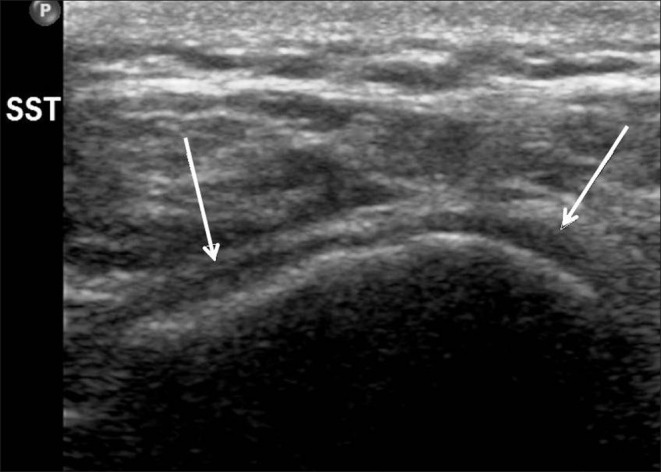
UltrasoundUltrasound of the shoulder, longitudinal view: non-visualisation of the supraspinatus tendon, arrows, indicating a completely retracted full-thickness tear.
Source : Gaitini, Journal of clinical imaging science, 2012, figure 7 · CC BY-NC-SA
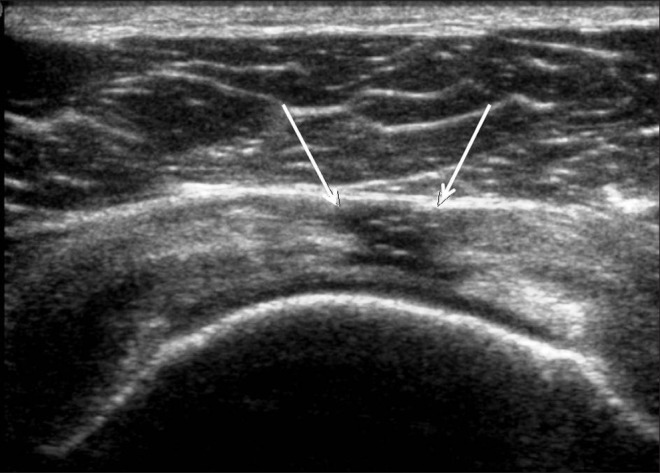
UltrasoundUltrasound of the shoulder, longitudinal view: sonolucent defect, arrows, extending across the entire width of the supraspinatus tendon, non-retracted full-thickness tear.
Source : Gaitini, Journal of clinical imaging science, 2012, figure 8 · CC BY-NC-SA
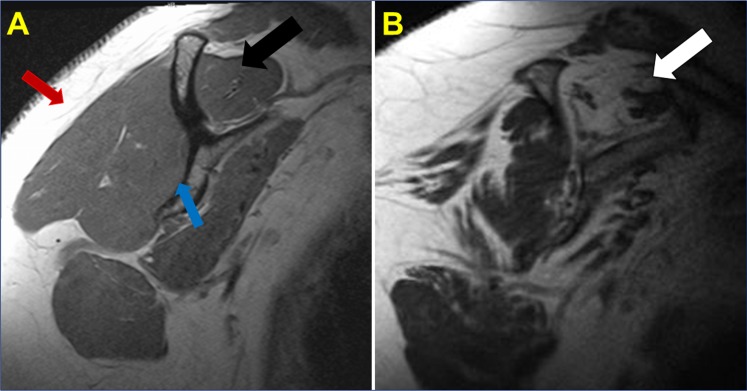
MRIMRI of the shoulder, sagittal T1-weighted view: healthy supraspinatus muscle on the left, compared with atrophy and marked fatty infiltration of the muscle on the right, in the setting of a massive, chronic rotator cuff tear.
Source : Thankam et al., PLoS ONE, 2016, figure 1 · CC BY
Thirteen items, two subscales
The SPADI has thirteen items: five for pain, eight for disability, reproduced on the scorer at the top of this page. The original version scores them on a visual analogue scale; the 1995 one, designed for telephone administration, scores them from 0 to 10, and that is the one the scorer follows. The two agree closely, with an intraclass correlation coefficient of 0.86.
Scoring is not a plain addition, and that is where most users get lost. Each subscale is summed then transformed to a score out of 100, and the total is the mean of the two, not the sum of the thirteen items. A high score signals greater impairment.
One caveat completes the calculation: neither the SPADI-FR nor the version copied by Kim DH offers a not-applicable option. The scorer at the top of this page therefore requires all thirteen answers; short of that, it shows how many items are scored rather than risk a wrong score.
Two thresholds that do not say the same thing
This is the point that decides the reading, and it is uncomfortable.
The minimal clinically important difference of the SPADI is 8 points: the smallest change that matters to the patient. But the minimal detectable change at 95 %, the one that exceeds measurement error, is 18 points. The second is more than double the first.
In other words, a patient can report an improvement that matters to them without the instrument being able to tell it apart from its own noise. The 2009 review places the minimal detectable change of the SPADI at 18 points, against 10.5 for the DASH and 9.4 for the ASES: it is the least precise of the four shoulder questionnaires it compares. The 2011 clinimetric note draws the consequence and explicitly advises caution when the instrument is repeated on the same patient.
| What is measured | Value | Source |
|---|---|---|
| Minimal clinically important difference | 8 | 2011 clinimetric note |
| Minimal detectable change at 95 % | 18 | 2011 clinimetric note |
| Clinically important difference, 2009 review | 8 to 13 | 71 primary studies |
| Minimal detectable change, DASH, for comparison | 10.5 | 71 primary studies |
| Minimal detectable change, ASES, for comparison | 9.4 | 71 primary studies |
| Internal consistency of the subscales | > 0.92 | 129 volunteers |
| Test-retest reliability, original publication | 0.64 to 0.66 | 37 patients |
| Test-retest reliability, 2009 review | ICC ≥ 0.90 | 71 primary studies |
The French version of 2024
Until 2024, no French version of the SPADI was available, for practice or for research in French-speaking countries. One exists since then, published by Lathiere et al. following the international guidelines for transcultural adaptation.
The process is solid: seven steps, fifteen contributors, five native French speakers on the forward translation, five native English speakers blinded on the back translation, a bilingual expert committee, then a pre-test with ten patients. Seven adjustments were retained, and only where at least 20 % of the pre-test participants suggested them.
One caveat, which the authors raise themselves: the psychometric properties of this French version remain to be assessed. Face validity was judged by the expert committee, and nothing more. The thresholds quoted above all come from English-language versions, and nothing yet guarantees that they carry over.
Where the thirteen items reproduced here come from
The French version is the SPADI-FR by Lathière et al., 2024, an article under a CC BY 4.0 licence; its figure 2 is translated with the permission of Kathryn E. Roach, who holds the rights to the original questionnaire by Roach et al., 1991. The English version follows the wording copied by Kim DH, 2023, in a summary table published in Annals of Rehabilitation Medicine, typos included: no reproduction licence is published there. This page does not change a word of either version and refers to their authors for any use beyond its own, clinical and non-commercial.
Three administration pitfalls
Adding up the thirteen items
The raw sum of the thirteen items is not the SPADI score. Each subscale is first transformed to a score out of 100, and the total is the mean of the two, which gives pain, across five items, exactly the same weight as disability, across eight.
Concluding on a ten-point change
Ten points exceed the minimal clinically important difference, 8 points, but stay below the minimal detectable change, 18 points. That is the zone where you can neither conclude to an established improvement nor rule it out.
Answering only some of the items
Neither the French nor the English version reproduced here offers a not-applicable option: the scorer therefore requires all thirteen answers. Without them, it shows how many items are scored rather than compute one on an incomplete basis.
Frequently asked questions
What does SPADI stand for?
SPADI stands for Shoulder Pain and Disability Index. The questionnaire was published in 1991 by Roach et al. to measure shoulder pain and disability as the patient reports them.
How is the SPADI scored?
It has thirteen items, five for pain and eight for disability, each scored from 0 to 10 on the scorer on this page. Each subscale is transformed to a score out of 100 and the total is the mean of the two, not the sum of the thirteen items. A high score signals greater impairment. All thirteen answers are required: neither the French nor the English version reproduced here offers a not-applicable option.
How much change counts?
The minimal clinically important difference is 8 points, but the minimal detectable change at 95 % is 18 points. Between the two, no call can be made.
Is there a French version?
Yes, since 2024, published by Lathiere et al. Its psychometric properties have not been assessed yet, however: it is a translation tested on its form, not yet on its measurements.
Is the SPADI free to use?
The thirteen items of the French version are reproduced on this page under a documented authorisation: the article by Lathière et al., 2024 is under a CC BY 4.0 licence, and its figure 2 is translated with the permission of Kathryn E. Roach, who holds the rights to the original questionnaire. The English items, copied from a table published by Kim DH in 2023, carry no published reproduction licence, however: for any use beyond that of this page, contact their authors.
References
6 sources, PMIDs included
- Roach KE, Budiman-Mak E, Songsiridej N, Lertratanakul Y. Development of a shoulder pain and disability index. Arthritis Care Res 1991;4(4):143-9. PMID 11188601. The original publication, in 37 patients, all men. Thirteen items across two subscales, pain and disability. Internal consistency from 0.86 to 0.95, but test-retest reliability of 0.64 to 0.66 only.
- Williams JW, Holleman DR, Simel DL. Measuring shoulder function with the Shoulder Pain and Disability Index. J Rheumatol 1995;22(4):727-32. PMID 7791172. The 0 to 10 version, designed for telephone administration, in 102 primary-care patients followed for three months. Both versions agree closely, intraclass correlation coefficient 0.86. Area under the curve of 0.91 for telling improved patients from the rest.
- MacDermid JC, Solomon P, Prkachin K. The Shoulder Pain and Disability Index demonstrates factor, construct and longitudinal validity. BMC Musculoskelet Disord 2006;7:12. PMID 16472394. 129 volunteers followed at three and six months. Internal consistency of the subscales above 0.92. Factor analysis recovers the two expected dimensions, but two demanding functional items line up with the pain items.
- Roy JS, MacDermid JC, Woodhouse LJ. Measuring shoulder function: a systematic review of four questionnaires. Arthritis Rheum 2009;61(5):623-32. PMID 19405008. The reference review, across 71 primary studies, comparing four shoulder questionnaires. Minimal detectable change of about 18 points for the SPADI, against 10.5 for the DASH and 9.4 for the ASES; clinically important difference placed between 8 and 13 points.
- Breckenridge JD, McAuley JH. Shoulder Pain and Disability Index (SPADI). J Physiother 2011;57(3):197. PMID 21843839. The clinimetric note that settles the scoring: each subscale transformed to a score out of 100, the total being the mean of the two. Minimal clinically important difference of 8 points, minimal detectable change at 95 % of 18 points, hence the caution advised when the instrument is repeated on the same patient.
- Lathiere T, Chantriaux N, Beard D, Pinsault N, Druart L. French translation and transcultural adaptation of the shoulder pain and disability index (SPADI). Musculoskelet Sci Pract 2024;74:103209. PMID 39500021. The French version, published in 2024: seven steps, fifteen contributors, blinded forward and back translation, a bilingual expert committee and a pre-test with ten patients. The authors state that its psychometric properties remain to be assessed.
 Page written by Anthony Baillon, physiotherapist, co-founder of Physio Learning. The questionnaire itself is by Roach et al., 1991, and its French version by Lathière et al., 2024: this page reproduces, documents and computes them.
Behind this article
An author who explains, a reviewer who checks.
How we write and check our content

Physiotherapist · co-founder of Physio Learning
Marked for life by his first four-hour lecture without a single image, he took a master’s in instructional design so that it would never happen to anyone again. He hunts down publication bias and unreadable slides with the same intransigence.

Head of scientific content
Physiotherapist specialising in neuro-musculoskeletal practice and holder of a master’s in public health. He checks the methodological rigour of every article: primary sources, levels of evidence, no exceptions.