





Deep pain in the buttock, sometimes running down the leg like sciatica: « piriformis syndrome » is a diagnosis that gets made a great deal and proved badly. Before you start stretching in every direction, two useful clarifications: the clinical tests are imperfect, and hip strengthening is better supported than passive stretching alone. Here are cautious self-tests, concrete exercises, and the signals of genuine sciatica not to be missed.
📝 In brief
- There is no « natural treatment » of the piriformis muscle whose superiority has been demonstrated. The most recent systematic review covering conservative and surgical treatment of deep gluteal syndrome, which includes piriformis syndrome, screened 909 references and kept only 13 (508 patients, including 8 randomised trials totalling 336 patients): only three trials reached a minimal clinically important difference on pain, only one on disability, « the overall quality of the evidence was low » and « no conservative treatment can be recommended over another » 4. Two decisive points for reading that verdict: the conservative treatments assessed were all injections (corticosteroids, botulinum toxin, thiocolchicoside, colchicine), of the 7 randomised conservative trials, not one tested physiotherapy or exercise; and the authors' recommendation to follow the general low back pain/sciatica guidelines, with physiotherapy first-line, is an extrapolation, not a result from their data. Their literature search, moreover, stops on 24 July 2019.
- No single clinical test either makes or rules out the diagnosis. In the study that set the manual tests against endoscopic confirmation (33 subjects: 23 with sciatic nerve entrapment, 10 controls), the straight leg raise tops out at 0.15 sensitivity for 0.95 specificity, the seated piriformis stretch test at 0.52 / 0.90 and the active piriformis test at 0.78 / 0.80. The active + seated combination climbs to 0.91 sensitivity for 0.80 specificity (negative likelihood ratio 0.11), but its positive likelihood ratio is only 4.57: lower than that of the seated test alone (5.22): it improves exclusion, not confirmation. The authors conclude that these tests « may help identify » patients, not that they settle the matter. To be weighed: only 23 cases (very wide confidence intervals), a retrospective, non-blinded case-control study, carried out in a tertiary hip surgery centre by the team that promotes these tests: performance is very likely overestimated in community practice 9.
- The « FAIR test, 88 % sensitive » is not the manoeuvre your physiotherapist does by hand. Those figures (sensitivity 0.881, specificity 0.832 at a threshold of 3 standard deviations) come from a series of 918 patients / 1,014 legs and measure the prolongation of the H-reflex on electromyography when the hip is placed in flexion-adduction-internal rotation: an instrumented test, not the manual reproduction of pain in the FAIR position, which has never carried those figures. And the instrumented version is not validated for all that: the cohorts were built by the operational definition being tested itself, with no symptomatic control, so that the reported specificity is uninterpretable and the study does not meet the STARD criteria 10.
- Four signs come up consistently, but their diagnostic value remains unknown. Hopayian's systematic review (55 studies included, 51 of them with individual data, mostly case series and narrative reviews) and its update identify a quartet: buttock pain (50–95 % of cases), pain worse in sitting (39–97 %), external tenderness near the greater sciatic notch (59–92 %) and pain on any manoeuvre that increases tension in the piriformis. But the authors explicitly conclude that the accuracy of these tests and of these symptoms cannot be established from the published studies, and that a negative straight leg raise does not rule the diagnosis out. It is still unknown whether these signs distinguish the piriformis from a disc herniation: nobody has measured it 12.
- Stretching, compression, a ball: the only randomised trial available crowns nobody, with one exception. In 45 patients with chronic low back pain and deep gluteal syndrome (3 groups: compression, stretching, control; 3 sets of 2 min with 2 min of rest, 3 sessions a week, 10 sessions in total), all three groups (all on 15 min of heat + 15 min of TENS, the control receiving that base with no added exercise), improved significantly on pain, with no difference between groups (p = 0.264), and neither compression nor stretching changed the electromyographic activity measured. The only significant between-group difference favours stretching over compression on disability (mean difference −12.62; 95 % CI −20.41 to −4.38; p = 0.009). The primary outcome (flexion-relaxation ratio) concerned the back muscles, never the glutes: with 15 patients per group, a non-significant result signals an underpowered trial, not proof of ineffectiveness 7.
- Strengthen rather than stretch: a serious lead, not proof. A randomised trial of 48 participants (24 per group, 32.8 ± 3.3 years) compared PRT alone (light pressure 2 min + stretching) with INIT, which contains PRT and adds a trigger-point compression of 20 to 60 s and 20 micro-contractions in 10 s against resistance (Ruddy's facilitation): 2 sessions a week for 8 weeks, 3 repetitions per session over 10 minutes. The enriched arm does significantly better on every outcome, immediately and at 4 months, but only p < 0.05 values are reported, with no effect size or threshold of clinical relevance, and the authors note that both arms received stretching, which may have contributed to the gains 8. On pure strengthening, a case report (a 30-year-old man, 2 years of buttock pain) treated solely by hip strengthening and movement retraining, with no stretching or massage, saw his pain fall to 0/10, his LEFS go from 65/80 to 80/80, his hip adduction from 15.9° to 5.8° and his internal rotation from 12.8° to 5.9°: the authors see in this an alternative reading of the pathomechanics (a piriformis over-lengthened rather than shortened), and stress that the strengthening was indicated by a functional movement analysis that objectified weakness of the abductors and external rotators: a single patient, with no control group 5.
🎯 Understanding it in two minutes
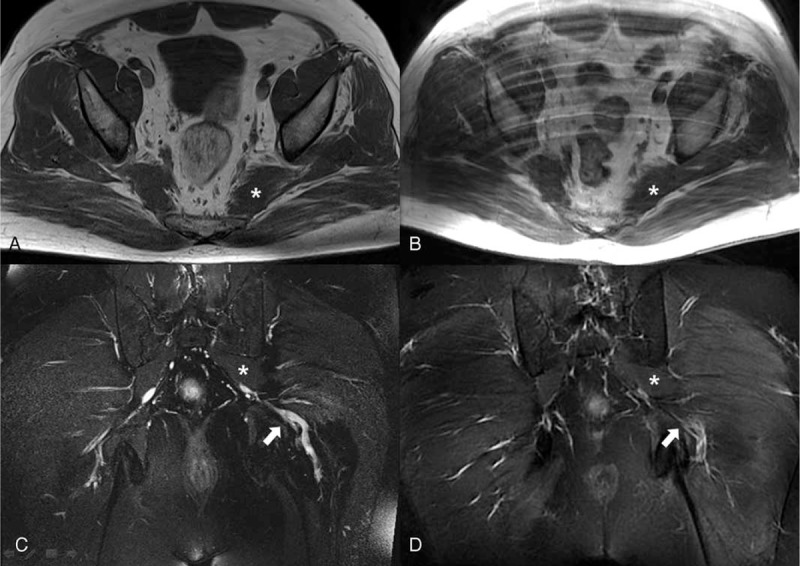
MRIPelvic MR neurography, axial (A, B) and coronal (C, D) views, before treatment (A, C) and one month after (B, D): hypertrophied left piriformis muscle (asterisk) and sciatic nerve in contact with it (arrow).
Source : Yang et al., Medicine (Baltimore), 2015, figure 1 · CC BY-NC-ND
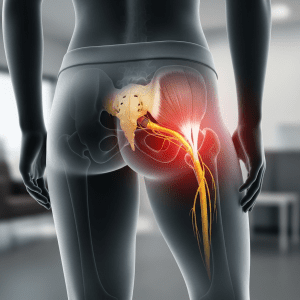
The piriformis is a small deep muscle of the buttock; the sciatic nerve runs right alongside it. The « piriformis syndrome » hypothesis fits in one sentence: this muscle irritates or compresses the nerve, hence buttock pain that can run down the thigh: the nickname « pseudo-sciatica ». Described for more than seventy years, this picture is still debated.
Debated does not mean invented. The landmark systematic review 1 included 55 studies, 51 of them with individual data, mostly case series and narrative reviews: the lowest level of evidence. The authors consider that the consistency of the clinical signs « adds weight to the arguments in favour of the syndrome's existence », while acknowledging that their work « will not settle the debate ». An honest position: weak evidence, an unsettled question, not a refuted entity.
These studies most often describe a quartet: buttock pain, pain worse in sitting, tenderness to pressure near the greater sciatic notch (high in the buttock, towards the bone), and pain reproduced by the manoeuvres that put the piriformis under tension 2. The authors do, however, make clear that the diagnostic accuracy of these tests and of these symptoms cannot be concluded from the published studies: these frequencies describe what is seen in patients who already carry the label, without saying whether these signs distinguish a piriformis from a disc herniation. Nobody has measured it. A useful corollary: a negative straight leg raise test does not rule the diagnosis out.
Who this programme is for
For you if buttock pain, radiating or not, has already been assessed by a health professional and the lumbar possibility has been looked at. That is no small point: according to the synthesis by Kizaki et al. 3, the literature suggests defining deep gluteal syndrome, which includes the piriformis among other causes, by three components, the first of which is « non-discogenic », that is, not related to the lumbar disc. The pathway described combines that exclusion with positive findings (seated piriformis test, Pace's sign, response to injection, EMG) and with imaging (pelvic radiographs, MRI of the spine and pelvis). The authors stress that this definition remains ambiguous: all the more reason not to award it to yourself in three minutes.
An exercise programme does not replace a diagnosis: it starts where the diagnosis leaves off.
If you have not yet had an opinion, or if your pain changes in character, this is not where it gets decided. And if your question is « is it really the piriformis? », the diagnostic triage, the tests, their limits and the competing diagnoses are dealt with in the full guide: Piriformis syndrome: the pseudo-sciatica. This page serves one purpose only: what to do with your body once that step has been taken.
The guiding principle: putting the buttock back under load, progressively
Let us say it straight away: no protocol is proven. The most recent systematic review covering conservative and surgical treatment of deep gluteal syndrome 4 concludes that the overall quality of the evidence is low and that « no conservative treatment can be recommended over another ». Two points change the reading: the conservative treatments assessed were all injections (corticosteroids, botulinum toxin, thiocolchicoside, colchicine), not a single exercise trial, and the literature search stopped on 24 July 2019, seven years ago today. The authors nonetheless recommend physiotherapy first-line, but by extrapolation from the low back pain/sciatica guidelines, not on the strength of their data.
Our guiding principle follows from that gap: rather than looking for the magic technique, give the buttock and the hip back load, movement and tolerance, in stages. Two weak but converging elements point that way. First a case report published in JOSPT 5 : a 30-year-old man in pain for 2 years, treated solely by hip strengthening and movement retraining, with no stretching or massage, went to 0/10 pain, with correction of adduction (15.9° → 5.8°) and internal rotation (12.8° → 5.9°) on the step-down. They propose an alternative reading of the mechanics, a piriformis over-lengthened rather than shortened, without claiming to refute the classic hypothesis. It is a single patient, with no control group, and the strengthening there was guided by an examination that objectified specific weakness of the abductors and external rotators: the authors indeed conclude on the need to analyse functional movement.
Second, the ball and the foam roller do not deserve their reputation. In a randomised trial (45 patients, deep gluteal syndrome, 10 sessions at 3 a week), compression did not improve the primary outcome, and stretching did better than it on disability (F = 5.53; p = 0.009); all three groups, all on heat and TENS, improved on pain, with no difference between them 7. This is not proof that self-massage is useless, the trial is small and did not measure gluteal relaxation, but nothing justifies building your programme on it.
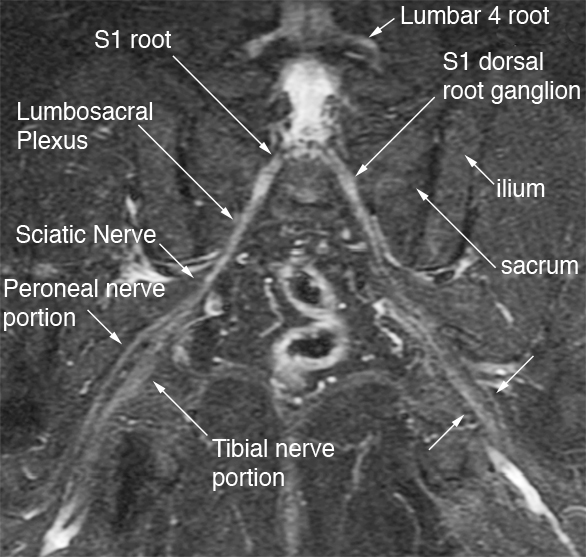
MRIPelvic MR neurography, coronal view: S1 nerve roots, lumbosacral plexus and proximal sciatic nerve dividing into peroneal and tibial portions at the level of the piriformis muscle.
Source : Filler, Wikimedia Commons · CC BY-SA
Key points
- The data « add weight » to the syndrome's existence, but the evidence is weak and the debate is not settled 1.
- The quartet of signs is common, with no established diagnostic value; a negative straight leg raise rules nothing out 2.
- The diagnosis assumes the lumbar spine has been looked at: see the full guide before starting.
- No conservative treatment is superior to another, and exercise has not been tested among them 4.
- The principle adopted here, for want of better: progressive loading of the hip rather than passive massage.
💪 The exercise programme, step by step
Let us say it at once: no exercise programme is proven for the piriformis. The broadest synthesis on treating deep gluteal syndrome, of which the piriformis is only one cause among several, included 13 studies and 508 patients (8 randomised trials) and concludes that the quality of evidence is low 4. A decisive detail: the conservative treatments assessed were all injections (corticosteroids, botulinum toxin, thiocolchicoside, colchicine); no trial concerned exercise. If those authors recommend physiotherapy first-line, it is by extrapolation from the low back pain/sciatica guidelines, not from their data. Their search, moreover, stops on 24 July 2019, despite publication in 2023.
What follows are the doses that have been tested in the published trials, not the ones that have proved themselves.
Two safeguards before you start
The spine first. The piriformis is only accepted once the lumbar spine has been looked at; the diagnostic reasoning is in our guide Piriformis syndrome, that pseudo-sciatica. Pain running down the leg with loss of strength, a numb area, a foot that catches: seek advice, do not self-treat.
The pain rule. No trial defines an acceptable pain threshold: that marker does not exist in the data. Failing that, a cautious framework: discomfort you can bear, that does not build over the repetitions and fades within 24 hours. Pain that radiates further down the leg is a signal to stop, not to push on.
Phase 1: floor work (10 sessions, 3 a week, ≈ 3 and a half weeks)
The most precisely published dose comes from a randomised trial in 45 people with chronic low back pain and deep gluteal syndrome 7. Two exercises, same dose: 3 sets of 2 minutes, 2 minutes of rest between sets, 3 sessions a week, 10 sessions in total.
- Stretch : lying on your back, the ankle on the painful side resting on the opposite knee, just above the kneecap. You are the judge of the stretch sensation.
- Compression : the ankle on the tested side on the opposite bent knee, a foam roller under the buttock, rolling gently over the painful point on the outer side.
All three groups, all on heat (15 min) and TENS (15 min), the control receiving that base with no exercise on top, saw their pain fall significantly, with no difference at all between groups (p = 0.264). One gap only: stretching did better than compression on disability (−12.62 points; 95 % CI −20.41 to −4.38; p = 0.009).
On the ball and the roller: not dangerous, they can relieve in the moment, but here compression produced nothing on the primary outcome and was beaten by a simple stretch. To be qualified: 15 people per group is underpowered: absence of evidence is not evidence of absence. The ball can be part of the programme; it is not its core.
Phase 2: strengthen rather than stretch
The received idea that « the piriformis is shortened, so it needs stretching » has a serious alternative. A published case describes a 30-year-old man with buttock and posterior thigh pain for 2 years, reproduced on palpation and on stretching the piriformis. Movement analysis on a single-leg step-down showed excessive hip adduction and internal rotation, with weakness of the abductors and external rotators. Treatment: hip strengthening and movement retraining, with no stretching or massage at all. Result: pain 0/10, LEFS score from 65/80 to 80/80, adduction brought down from 15.9° to 5.8° 5. The authors see in this a reversed reading of the mechanics, the piriformis being over-lengthened rather than shortened, without refuting the classic hypothesis.
Two cautions: this is a single patient, with no control group: enough to try strengthening before passive stretching, not to prove it; and he was responding to a dysfunction objectified by movement analysis, the real lesson of the case according to the authors.
The dose, for its part, is not published for this indication. Failing that, a cautious framework: a transposition, not proof: 2 to 3 sessions a week, 3 sets of 8 to 12 repetitions, slow tempo (3 s up, 3 s down), on the hip abductors and external rotators (side-lying abduction, « clam », single-leg bridge, lateral steps with a band). You increase the load when it has become easy and the pain rule holds.
Phase 3: relearning the movement
Combined with strengthening in Tonley's case 5 : controlling hip adduction and internal rotation in real movements, stepping down, getting up from a chair, stairs. No trial publishes a criterion for moving from one phase to the next; pragmatic markers: prolonged sitting no longer hurts, stepping down no longer reproduces the symptoms.
| Option | Dose tested | What the data show | Evidence |
|---|---|---|---|
| Piriformis stretch on the floor | 3 × 2 min, 2 min rest, 3 times/week, 10 sessions 7 | No better than heat + TENS for pain; better than compression for disability | Weak |
| Roller or ball under the buttock | Same as the stretch 7 | Nothing on the primary outcome; beaten by the stretch | Weak |
| Enriched manual technique (INIT), in clinic | 2 sessions/week, 8 weeks 8 | Better than the passive technique alone up to 4 months; small numbers | Weak |
Key points
- No piriformis protocol is validated: anyone selling you « THE » proven programme is going beyond what the science says 4.
- The only precise dose published for floor work: 3 sets of 2 minutes, 3 times a week, 10 sessions.
- Stretching beat compression on disability: the ball is not the core of the programme.
- Strengthening before stretching is defensible, but the argument rests on a single case.
- Pain radiating further down, weakness or loss of sensation: stop and seek advice.
⚠️ The mistakes that keep the problem going
Most people who self-treat the piriformis are not doing « too little » or « too much »: they are doing something that has never been measured, on a diagnosis that has never been confirmed. Here are the most common traps, and what the studies really allow us to say about them. For the full clinical picture, the mechanism and the role of the sciatic nerve, see the guide Piriformis syndrome (pseudo-sciatica).
Mistake 1: giving yourself the « piriformis » label without having looked at the back
The synthesis by Kizaki et al. 3 proposes a definition of deep gluteal syndrome, of which the piriformis is only one cause among others, in three components, the first being « non-discogenic ». The diagnostic pathway described explicitly includes pelvic radiographs and MRI of the spine and of the pelvis, combined with positive findings (deep gluteal tenderness, seated piriformis test, Pace's sign, response to injection, EMG). Read with caution: this is a definition proposed by a level IV synthesis, whose stated point is precisely that the definition remains ambiguous, not an official criterion. The practical message holds all the same: until the spine has been explored, the word « piriformis » remains a working hypothesis.
A piriformis diagnosed in three minutes, without ever looking at the lumbar spine, is a hypothesis, not a diagnosis.
Mistake 2: believing a test has settled it
In the study by Martin et al. 9, 33 subjects (23 with endoscopically confirmed sciatic nerve entrapment, 10 controls) underwent the manual tests: straight leg raise sensitivity 0.15 / specificity 0.95; seated piriformis stretch test 0.52 / 0.90; active piriformis test 0.78 / 0.80. Combined, active + seated climb to 0.91 / 0.80 with a negative likelihood ratio of 0.11.
What to take from this without distorting it. A negative straight leg raise rules nothing out 2 ; the active piriformis test alone, on the other hand, does genuinely shift the probability when it is negative. And the reverse is true too: two positive tests do not confirm the diagnosis: the combination's positive likelihood ratio is only 4.57, poorer than that of the seated test alone (5.22). The authors indeed conclude that these tests « may help identify » patients, not settle the matter. Major reservations: only 23 cases (very wide confidence intervals), a retrospective, non-blinded case-control study, carried out in a tertiary hip surgery centre by the team that goes on to operate, and whose lead author promotes these tests. Real-world performance in community practice is very likely lower.
Mistake 3: stretching harder when it does not work
The idea that « the piriformis is shortened, so it needs stretching » is not established. Tonley et al. 5 describe a 30-year-old man, in pain for 2 years, whose symptoms were reproduced by stretching the piriformis. Movement analysis on a single-leg step-down showed excessive hip adduction (15.9°) and internal rotation (12.8°), with weakness of the abductors and external rotators. Treated solely by hip strengthening and movement retraining, with no stretching or massage, he goes to 0/10, LEFS from 65/80 to 80/80, adduction to 5.8° and internal rotation to 5.9°. The authors propose an alternative reading (a piriformis over-lengthened rather than shortened): a hypothesis, not a refutation. And it is a single patient, with no control group. A crucial point often forgotten: the strengthening was chosen because an examination had objectified a specific dysfunction: the authors conclude on the need for functional movement analysis, not on a generic rule of « strengthen rather than stretch ».
Mistake 4: building your whole programme around the ball
In a randomised trial of 45 patients with deep gluteal syndrome 7, three groups (compression, stretching, control), received 10 sessions at 3 a week. All of them, control included, received 15 min of heat + 15 min of TENS; the control was that base with no additional exercise. All three groups improved on pain, with no difference between them (p = 0.264). The only between-group difference concerned disability, in favour of stretching over compression (−12.62 points; 95 % CI −20.41 to −4.38; p = 0.009). The primary outcome (flexion-relaxation ratio of the back muscles) did not move in any group, but with 15 patients per group that is an absence of evidence, not evidence of absence, and gluteal relaxation was quite simply never measured. Note also: the « compression » in the trial was a supervised protocol, not an improvised tennis ball.
Neither obsession nor token effort: the dose actually tested
- Shamsi 2024 : 3 sets of 2 minutes, 2 minutes of rest between sets, 3 sessions a week, 10 sessions in total (~3 and a half weeks). Roller under the buttock, ankle of the tested side on the opposite bent knee; stretch lying on the back, ankle above the opposite kneecap, the sensation judged by the patient themselves.
- Danazumi et al. 2021 : 48 participants, 2 sessions a week for 8 weeks, 3 repetitions per session over 10 minutes. Adding to positional release a compression (20-60 s) and 20 micro-contractions in 10 s did better than positional release alone, immediately and at 4 months (p < 0.05). Reservations: both groups also received stretching, which may have contributed; no effect size or threshold of clinical relevance is reported: « significant » does not mean « noticeable ».
These are the doses that have been tested, not doses shown to be superior. Three sessions a week for a few weeks: below that, you have done nothing; far above it, you leave the ground science has looked at.
The signals that should make you ease off
Let us be honest: none of the available studies sets a stopping threshold or a warning list for self-treatment. What is documented are the most frequently reported signs 12 : buttock pain (50-95 % of cases), pain worse in sitting (39-97 %), external tenderness near the greater sciatic notch (59-92 %), pain on the manoeuvres that put the piriformis under tension. But those authors make clear that the accuracy of the tests as of the symptoms cannot be established from the published studies: these are descriptive frequencies, and their diagnostic value remains unknown. In practice, if your picture shifts, worsens or stops resembling this, the coherent response is not to force the protocol: it is to have things reassessed, particularly on the spinal side.
Three received ideas to discard
| What you read everywhere | What the source actually says | Level of evidence |
|---|---|---|
| « The FAIR test is 88 % reliable » | Those figures 10 measure the prolongation of the H-reflex on EMG in the flexion-adduction-internal rotation position, not the manual manoeuvre done in clinic. Worse: the cohorts were built by the operational definition being tested itself, with no control patients with sciatica: the reported specificity is uninterpretable, and these figures validate neither the manual test nor the instrumented version. | Very weak |
| « There is a score that diagnoses the piriformis for certain » | The 12-point score by Michel et al. 11 reports 96.4 % sensitivity and 100 % specificity, but across 250 cases compared with 30 disc-related radicular problems and 30 healthy subjects: measuring specificity against healthy people inflates it mechanically (spectrum bias). The score was derived and tested on the same cohort, and the study reports no external validation. Hopayian & Danielyan 2 judge, moreover, that the two largest of the three recent cross-sectional studies are at high risk of bias. | Weak |
| « There is a proven protocol for the piriformis » | The review by Hopayian & Mirzaei 4 on deep gluteal syndrome, which includes the piriformis: only three trials reach a clinically important difference on pain, only one on disability, « the overall quality of the evidence was low », and no conservative treatment can be recommended over another. To read closely: the conservative treatments assessed were all injections (corticosteroids, botulinum toxin, thiocolchicoside, colchicine), not one exercise trial. The first-line physiotherapy the authors recommend is an extrapolation from the general low back pain/sciatica guidelines, not a result of their review. And the literature search stopped on 24 July 2019. | Weak |
Key points
- The debate is not settled, and it is normal to say so. After more than 70 years, the literature is still made up essentially of case series and narrative reviews 1. The authors themselves consider that the consistency of the clinical signs adds weight to the arguments in favour of the syndrome's existence, while acknowledging that their work will not settle the debate. Weak evidence does not mean an imaginary entity.
- No single test either makes or rules out the diagnosis. A negative straight leg raise, in particular, rules nothing out.
- Nobody has yet compared the frequency of these signs in people with sciatica with and without a disc herniation 1 : so we do not know whether these signs distinguish the piriformis from a lumbar problem ; it is not measured, not « refuted ».
- A reasonable programme looks like 2-3 sessions a week over 3 to 8 weeks, with active work, not ten minutes of ball a day with gritted teeth.
- The full context (anatomy, differential diagnosis, management) is set out in the guide to piriformis syndrome.
🩺 How long it takes, and where the physiotherapist fits in
It is the question everyone asks first: how long does it last? The honest answer is uncomfortable, no study today allows a time to recovery to be announced. What we can do, on the other hand, is give you the only durations actually tested in published trials, and tell you from what point carrying on alone no longer makes sense. For the mechanism and the diagnosis as a whole, see the full guide: Piriformis syndrome, that pseudo-sciatica.
The durations actually tested (and what they are worth)
Two trials give concrete dosing markers, not promises of results.
| Programme tested | What was observed | Evidence |
|---|---|---|
| 10 sessions, 3 a week (~3 and a half weeks): foam-roller self-massage or stretching 7 | All three groups improve, all of them receiving heat + TENS ; no difference between groups on pain (p = 0.264). One gap only: stretching beats compression on disability (−12.62 points; p = 0.009). | Randomised trial, 45 patients |
| 2 sessions a week for 8 weeks: positional release alone vs the same + compression 20-60 s + micro-contractions 8 | Adding compression and contractions does better than positional release alone, at the end of treatment and 4 months later. Both groups also received stretching, which may have contributed. | Randomised trial, 48 participants |
Take away the order of magnitude: you think in weeks of regular work, not in miracle sessions. And take care with the second trial: the authors report only « p < 0.05 », with no effect size or threshold of clinical relevance: we know the difference exists, not that it is actually felt.
Science has never promised a timescale: it has only measured one, in small groups, a handful of times.
The only long-term « outcome » figure available comes from a very large series 10 : 79 % of patients who tested positive improved by at least 50 %, with a mean follow-up of 10.2 months. Three major reservations: the treatment combined injection and physiotherapy (impossible to know which one worked), there was no control group, and patients were selected by the test itself. This is not a cure rate, at best a reminder that the timescale is counted in months.
What the physiotherapist really adds
1. They triage. Kizaki's synthesis 3 proposes a three-component definition, the first of which is « non-discogenic »: this line cannot be pursued without having looked at the spine. The pathway described combines exclusion of the disc with positive criteria (seated piriformis test, Pace's sign, response to injection, EMG) and with imaging of the pelvis and of the spine. An « it's the piriformis » thrown out in three minutes is not a diagnosis.
2. They combine the tests instead of trusting one. In Martin's study 9, the straight leg raise alone is close to useless (sensitivity 0.15): negative, it reassures about nothing. The active piriformis test alone already does better (0.78 / 0.80), and it is the combination of active + seated that helps most in ruling the hypothesis out (sensitivity 0.91; negative likelihood ratio 0.11). Careful: that combination does not help confirm it (LR+ 4.57, poorer than the seated test alone). A retrospective, case-control, non-blinded study, conducted by the team developing these tests: real-world performance in community practice is very likely lower.
3. They look at how you move. In a case report in JOSPT 5, a man in pain for 2 years was treated solely by hip strengthening and movement retraining, with no stretching or massage, with pain falling to 0/10 and his functional score going from 65/80 to 80/80. The strengthening was not chosen at random: the examination had objectified excessive adduction and internal rotation (15.9° and 12.8°) with weakness of the abductors. The authors propose an alternative reading, a piriformis over-lengthened rather than shortened, and conclude on the need for functional movement analysis. That is one patient, with no control group: enough to justify trying, not enough to prove.
When to stop waiting
Although no study sets a threshold, a few situations clearly fall outside the scope of self-treatment and warrant professional advice rather than a ball under the buttock: loss of strength in the leg or foot, a change in sensation, any disturbance of bladder or bowel control, pain that clearly worsens or wakes you, a deficit that sets in, and, more simply, several weeks of serious work with not the slightest change. Remember that the pathway runs along a nerve, and that no manual test settles it on its own.
Key points
- The durations tested range from 10 sessions (3 a week) to 8 weeks at 2 sessions a week: none of them is a guaranteed time to recovery.
- The broadest review on conservative treatment 4 judges the quality of evidence low: no conservative treatment can be recommended over another. Almost all those trials concerned injections : first-line physiotherapy there is extrapolated from the low back pain/sciatica guidelines, not demonstrated.
- The physiotherapist brings three things the programme alone does not: excluding the spine, combining the tests, analysing the movement.
- Nobody has « the » proven protocol. Anyone who tells you otherwise is going beyond what the science says.
Bibliography
Every reference checked individually on PubMed (clickable PMID). 11 sources. Click a superscript note marker in the text: the bibliography opens and highlights the source.
- Hopayian K, Song F, Riera R, Sambandan S (2010). European Spine Journal. PMID 20596735.
- Hopayian K, Danielyan A (2018). European Journal of Orthopaedic Surgery & Traumatology. PMID 28836092.
- Kizaki K, Uchida S, Shanmugaraj A, Aquino CC, Duong A, Simunovic N, Martin HD, Ayeni OR (2020). Knee Surgery, Sports Traumatology, Arthroscopy. PMID 32246173. doi:10.1007/s00167-020-05966-x.
- Hopayian K, Mirzaei M (2023). Journal of Bodywork and Movement Therapies. PMID 37949567.
- Tonley JC, Yun SM, Kochevar RJ, Dye JA, Farrokhi S, Powers CM (2010). Journal of Orthopaedic & Sports Physical Therapy. PMID 20118521. doi:10.2519/jospt.2010.3108.
- Shamsi M, Akbari M, Mirzaei M, Minobes Molina E (2024). Journal of Bodywork and Movement Therapies. PMID 39593660.
- Shamsi M, Mirzaei M, Hopayian K (2024). BMC Sports Science, Medicine and Rehabilitation. PMID 38200475. doi:10.1186/s13102-023-00802-4.
- Danazumi MS, Yakasai AM, Ibrahim AA, Shehu UT, Ibrahim SU (2021). Journal of Osteopathic Medicine. PMID 34049428.
- Martin HD, Kivlan BR, Palmer IJ, Martin RL (2014). Knee Surgery, Sports Traumatology, Arthroscopy. PMID 24217716. doi:10.1007/s00167-013-2758-7.
- Fishman LM, Dombi GW, Michaelsen C, Ringel S, Rozbruch J, Rosner B, Weber C (2002). Archives of Physical Medicine and Rehabilitation. PMID 11887107.
- Michel F, Decavel P, Toussirot E, Tatu L, Aleton E, Monnier G, Garbuio P, Parratte B (2013). Annals of Physical and Rehabilitation Medicine. PMID 23684470.
❓ Frequently asked questions
Which test diagnoses piriformis syndrome?
No single test is enough. In the study that set the manual tests against endoscopic confirmation in 33 subjects (23 with sciatic nerve entrapment, 10 controls), the seated piriformis stretch test shows a sensitivity of 0.52 for a specificity of 0.90, the active piriformis test 0.78 / 0.80, and the straight leg raise only 0.15 sensitivity for 0.95 specificity. It is the combination of the active piriformis test and the seated piriformis stretch test that becomes usable: sensitivity 0.91, specificity 0.80, negative likelihood ratio 0.11. Note, however, that its positive likelihood ratio is only 4.57, lower than that of the seated test alone (5.22): the combination helps rule out, not confirm. The authors conclude that these two tests « may help identify » patients, without settling the matter. These figures rest on 23 cases (very wide confidence intervals), in a retrospective, non-blinded case-control study carried out in a tertiary hip surgery centre by the team that promotes these tests: they are very likely overestimated in community practice 9. And the diagnosis cannot be made without having looked at the spine: the definition proposed by a level IV synthesis (14 studies, 853 patients) describes deep gluteal syndrome as a non-discogenic disorder of the sciatic nerve entrapped in the deep gluteal space, with a pathway combining exclusion of the discogenic with positive criteria: seated piriformis test, Pace's sign, pelvic radiographs, MRI of the spine and pelvis, response to injection, EMG 3.
Does a negative straight leg raise rule out piriformis syndrome?
No, and this is one of the few points on which the literature is explicit: the systematic review concludes in black and white that the straight leg raise does not rule the diagnosis out: its limitation is indeed among the most frequently reported signs, so it is common, but its absence excludes nothing 2. The figures confirm it: sensitivity 0.15 and a negative likelihood ratio of 0.90, that is, a negative result that barely changes the probability and lets through about 85 % of endoscopically confirmed cases 9. Not all tests are equal for all that: the active piriformis test alone reaches a negative likelihood ratio of 0.27, which is a real shift in probability, and the active + seated combination goes down to 0.11 9.
Is the FAIR test reliable for piriformis syndrome?
This is the most widespread error on the subject. The figures quoted everywhere: sensitivity 0.881 and specificity 0.832 at a threshold of 3 standard deviations: come from a series of 918 patients (1,014 legs, follow-up available for 733) and measure the prolongation of the H-reflex on electromyography when the hip is placed in flexion-adduction-internal rotation. It is therefore an instrumented test, carried out in 2 hospitals and 4 medical practices, and not the manual manoeuvre that seeks to reproduce pain in the FAIR position: the latter has never carried those figures. A second, heavier reservation: the reference against which the test was compared was not an independent gold standard but an operational definition built by the authors, and the cohorts were identified by that very definition, with no symptomatic control (no patient with sciatica but without piriformis syndrome). The specificity of 0.832 thereby becomes uninterpretable, not merely inflated, and the study does not meet the STARD criteria. These figures therefore validate neither the manual version nor the electrophysiological one 10.
What natural treatment is there for the piriformis muscle?
None can be presented as proven superior to the others, and anyone claiming to hold THE piriformis protocol is going beyond what the science says. The most recent systematic review covering conservative and surgical treatment of deep gluteal syndrome, which includes the piriformis, kept 13 studies out of 909 references (508 patients, 8 randomised trials): only three trials reached a clinically important difference on pain, only one on disability, the overall quality of the evidence was low, and no conservative treatment can be recommended over another 4. Two essential qualifications: that verdict concerns injections (corticosteroids, botulinum toxin, thiocolchicoside, colchicine), which were the only conservative treatments assessed: none of the 7 randomised conservative trials tested physiotherapy or exercise; and the authors' recommendation to start with physiotherapy follows from the general low back pain/sciatica guidelines, not from their data. The literature search stops on 24 July 2019. In other words, on exercise we lack data, which does not mean it does not work. The few doses tested in published trials: 3 sets of 2 minutes with 2 minutes of rest, 3 sessions a week, 10 sessions in total for foam-roller self-massage or the supine stretch 7 ; 2 sessions a week for 8 weeks, 3 repetitions per session over 10 minutes for the integrated neuromuscular inhibition technique 8.
Should you stretch the piriformis, massage it with a ball, or strengthen it?
The available data do not make the case for the ball. In a randomised trial of 45 patients with deep gluteal syndrome (10 sessions at 3 a week, about three and a half weeks), compression (a supervised ischaemic compression protocol, not a run-of-the-mill tennis ball self-massage), did not improve the primary outcome, and stretching did significantly better than it on disability (F = 5.53; p = 0.009; mean difference −12.62). On pain, by contrast, all three groups (all on heat and TENS, the control group receiving that base with no additional exercise), improved with no difference between them, and neither exercise changed the electromyographic activity measured. The primary outcome, the flexion-relaxation ratio, concerned the back muscles and not the glutes or the piriformis: gluteal relaxation was not tested, and with 15 patients per group the absence of a difference mainly signals an underpowered trial 7. On strengthening, a case report describes a 30-year-old man in pain for 2 years, treated solely by hip strengthening and movement retraining, with no stretching or massage: pain at 0/10, LEFS from 65/80 to 80/80, hip adduction from 15.9° to 5.8° and internal rotation from 12.8° to 5.9°. The authors propose an alternative reading there, the piriformis being over-lengthened rather than shortened, without refuting the shortening hypothesis, and stress that the strengthening was indicated by a functional movement analysis that had objectified excessive adduction and internal rotation and weakness of the abductors and external rotators: it is the examination that guides, not a generic rule 5. Finally, adding to positional release a trigger-point compression and micro-contractions against resistance does better than release alone in a trial of 48 participants, at 8 weeks and at 4 months, but with no effect size reported 8.