






This page answers one question only, that of time: how long proximal hamstring tendinopathy lasts, what makes recovery longer and what shortens it. To recognise the injury, tell it apart from sciatica and follow a rehabilitation protocol, the reference is the full article on proximal hamstring tendinopathy.
📝 In brief
- Recovery is counted in months, not days: in chronic proximal hamstring tendinopathy, the VISA-H functional score rises from around 50/100 at baseline to ~65/100 at 12 weeks and then ~74/100 at 52 weeks: a clinically meaningful but gradual improvement, spread over almost a year and without full normalisation at 1 year 2.
- On entering the study, these patients had already had symptoms for a long time: the median duration of symptoms is around 1 year (the higher means being pulled up by a few extreme cases): the tendinopathy is typically long-standing 2.
- There is no passive shortcut : individualised physiotherapy and shockwave therapy give equivalent VISA-H scores at 12 weeks (65.2 vs 65.5) and at 52 weeks (73.9 vs 74.7), with no significant difference on the primary outcomes at any time point 2.
- The progressive loading programme must be kept up for a long time : the authors recommend (weak evidence, Grade C) maintaining it for at least eight weeks, since progress is measured in weeks and months 4.
- In professional athletes, shockwave therapy brought pain (VAS) down from 7 to 2/10 at 3 months, against 7 to 5/10 with conservative treatment; 85 % (17/20) of the shockwave group reduced their pain by at least 50 % at 3 months, against 10 % (2/20) 3.
- A red flag to tell apart: faced with deep buttock pain at the common origin of the hamstrings 1, a complete rupture or avulsion of the tendon is a different problem; in observational data, surgery is associated with a more frequent return to sport at the previous level (65.2 % vs 50.7 %), a decision that remains individual 5.

How long it really lasts
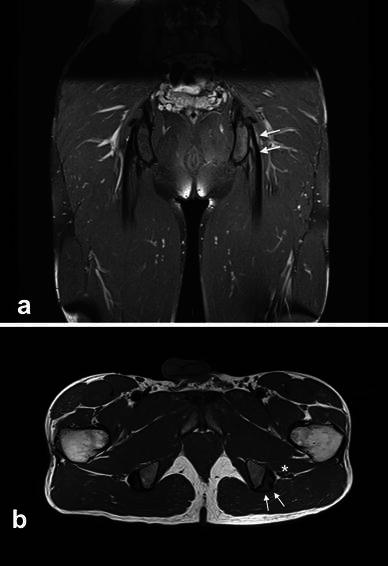
MRIPelvic MRI, coronal and axial views: tendinopathy of the proximal semimembranosus tendon, arrows on the thickened tendon near the ischium.
Source : Benazzo et al., Journal of Orthopaedics and Traumatology, 2013, figure 1 · CC BY
Let us be frank: proximal hamstring tendinopathy is a condition measured in weeks and months, not days. It shows up as deep buttock pain, at the common origin of the hamstrings, often long-standing, which gets in the way of sport as much as of everyday things like sitting down or driving 1. Understanding the real pace of recovery saves you from two traps: giving up too early, or worrying about a slowness that is in fact… normal.
Key points
- Recovery is slow and gradual : it typically spreads over almost a year, without necessarily a full return to « as new » at 12 months.
- A functional score (VISA-H) rises on average from around 50/100 at baseline to ~65 at 12 weeks, then ~74 at 52 weeks 2.
- There is no miracle passive shortcut: progressive strengthening programmes are the foundation, to be kept up over time.
Acute or persistent: two different tempos
Most people who seek help for this pain are already in a persistent (chronic)form. In a recent trial, the duration of symptoms before treatment was long: the median was around one year (roughly 53 to 59 weeks). Some quoted means climb to ~2 years, but they are pulled up by a few extreme cases: the reality for the « typical » patient is more like around a year of symptoms, not two 2. A recent, well-managed case may progress faster; but as soon as the pain settles in, you have to think in months.
The expected course, with the figures
The good news: it improves, measurably and meaningfully. The less good news: it is gradual. Here is the average trajectory observed over a year in a trial of chronic tendinopathy 2 :
In practice, the improvement is already clear at 12 weeks (~65/100), then continues more gently up to a year (~74/100). Remember: at 52 weeks the score remains below the maximum: recovery often continues beyond the year, with no « lightning cure ».
Does treatment change the duration?
That is the question everyone asks. In a randomised trial of 100 patients, two approaches, a programme of individualised physiotherapy and shockwave therapy, gave equivalent scores on the primary outcomes, at every measurement point:
| Approach | VISA-H at 12 wks | VISA-H at 52 wks |
|---|---|---|
| Individualised physiotherapy | 65.2 | 73.9 |
| Shockwave therapy | 65.5 | 74.7 |
No significant difference in measured effectiveness (VISA-H and global impression of change), at any time point 2. An honest qualification: shockwave therapy came out ahead on a few secondary outcomes (satisfaction, general health at one year), so the tie applies to functional effectiveness, not « to everything ».
One uncertainty to own: the appealing idea that « what speeds things up is active treatment kept up over time » is a hypothesis, not a result demonstrated by this trial (there was neither a no-treatment group nor an arm isolating that factor).
And in elite athletes?
In professional athletes with a chronic form, a trial (n=40) showed a marked advantage for shockwave therapy over standard conservative treatment at 3 months: pain went from 7 to 2 out of 10 with shockwave therapy, against 7 to 5 with conservative care; and 85 % (17/20) of the shockwave group reduced their pain by at least half, against 10 % (2/20) with conservative care 3. Take care not to over-read this: these figures concern a very narrow population (professionals, chronic form) and do not transfer as they stand to an everyday patient.
What really speeds things up, and what draws them out
The foundation is progressive loading. The authors recommend (weak evidence, Grade C) keeping a strengthening programme going for at least eight weeks : progress is slow and is not decided in a handful of sessions 4. Factors that weigh on the prognosis: how long the symptoms have been there, going back too hard too soon, and irregularity. What genuinely helps is the support around it: assessing precisely, dosing the load, progressing it, lifting the fear of movement and making you independent: a central role for the physiotherapist.
Red flag: when it is no longer « just » a tendinopathy
One signal to tell apart: a complete rupture or avulsion of the proximal tendon, often sudden (« a snap », abrupt loss of function). This is neither the same problem nor the same timescale. In a meta-analysis, surgery is associated with a more frequent return to sport at the previous level than non-operative treatment (65.2 % against 50.7 %), but the evidence is weak (observational studies, no randomised trial), and the decision is always individual 5. If a rupture is suspected, prompt medical advice is needed.
To understand the mechanisms, the diagnosis and the whole of management, see the full article: Proximal hamstring tendinopathy.
What lengthens (or shortens) recovery
The real question, when you have proximal hamstring tendinopathy 1, is: « why is this dragging on, and what can I do about it? ». The honest answer comes in two parts. Some factors work against you whether you like it or not; others really are in your hands.
Key points
- Recovery is counted in weeks and months, not days: the VISA-H functional score climbs slowly, from around 50 to 74/100 over a year 2.
- What you influence most: the regularity and the duration of progressive loading, kept up over time.
- What does not depend on you: how long-standing the symptoms were at the outset, and individual variability.
- No passive shortcut replaces active work over time.
What weighs on the prognosis (and that you do not choose)
The first factor is the starting point. In a 2025 randomised trial of already chronic tendinopathies, participants arrived with long-standing symptoms: a median of around a year. 2Let us be clear straight away, because the means in that study (often quoted at around two years) are pulled up by a few extreme cases: the « typical » patient does not necessarily have two years of pain behind them, but how long-standing it is remains a real weight. The more a tendinopathy has settled in, the longer the way back.
This slowness is not a failure: it is the very nature of tendon tissue. In that same trial, the VISA-H score (function and pain) started at around 50/100, rose to ~65 at 12 weeks, then ~74 at 52 weeks: a real, clinically meaningful improvement, but gradual over almost a year, without full normalisation at one year 2. In other words, you get better, distinctly better, but you do not close the file in a quarter.
What you can influence
Here is the good news: the most solid lever is also the most accessible. For proximal hamstring tendinopathy, the authors of a review recommend (weak evidence, Grade C) keeping progressive strengthening programmes going for at least eight weeks 4. That figure does not come from a controlled trial, but it is a common-sense marker: below it, you cut short a process which is, precisely, slow.
Consistency over time counts for more than any machine.
This idea is reinforced, indirectly, by what the 2025 trial did not show. Across 100 patients, individualised physiotherapy and shockwave therapy gave equivalent VISA-H scores at 12 weeks (65.2 vs 65.5) and at 52 weeks (73.9 vs 74.7), with no significant difference on the primary outcomes (VISA-H and GROC) at any time point 2. One qualification in the interests of honesty: on secondary outcomes, the shockwave group came out ahead (satisfaction, general health) at certain time points. So the tie applies to the primary scores, not « to everything ».
What this result suggests, as a hypothesis (the trial did not test it directly, having no arm isolating that factor): the engine of recovery would not be the passive modality chosen, but active engagement sustained over several months. Take it as a reasonable line of thought, not as proof.
| Factor | Do you control it? | Weight on the duration |
|---|---|---|
| Regularity of progressive loading | Yes, largely | The main lever 4 |
| Length of the programme (≥ 8 weeks) | Yes, if you keep it up | Recommended, weak evidence (Grade C) |
| How long-standing the symptoms were at the outset | No | Weighs on the starting point 2 |
| Individual variability in response | No | Slow and variable recovery |
And does shockwave therapy speed things up?
In professional athletes with chronic proximal hamstring tendinopathy (n=40), shockwave therapy clearly outperformed standard conservative treatment: pain (VAS) went from 7 to 2/10 at three months with shockwave therapy, against 7 to 5 with conservative care, and 85 % (17/20) of the shockwave group reduced their pain by at least 50 % at three months, against 10 % (2/20) 3. A striking result, but one to frame carefully: this very narrow population (professional athletes) does not transfer as it stands to an everyday patient. And among the more typical patients of the 2025 trial, the advantage of shockwave therapy on the primary scores disappeared. So there is no universal technological shortcut.
A case apart: complete rupture of the tendon
To be distinguished from tendinopathy: complete rupture or avulsion of the proximal tendon, which follows a different logic. In a meta-analysis (7 observational studies, no randomised trial), surgery was associated with a more frequent return to sport at the previous level than non-operative treatment (65.2 % vs 50.7 %), even though final functional scores were comparable 5. Weak evidence: this excess may reflect patient selection (those operated on often being more sporting candidates) rather than a proven effect of surgery. The decision remains individual, to be discussed case by case.
To understand the full mechanism, the stages and the management options, see the full article on proximal hamstring tendinopathy.
Is it dangerous? What to watch for
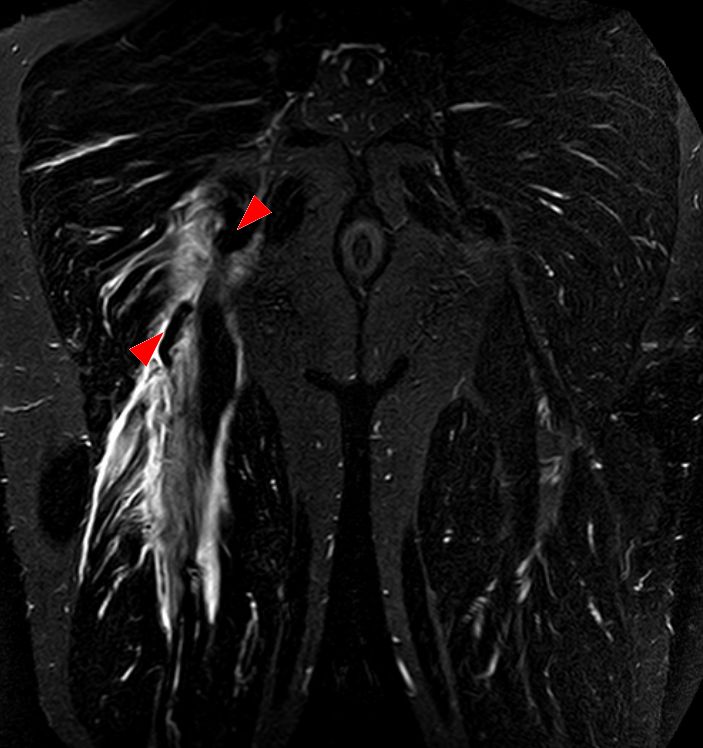
MRIPelvic MRI, coronal STIR sequence: tear of the hamstrings at the ischium, arrowheads on the tuberosity and retracted tendon stump, with bleeding around the muscle.
Source : Hellerhoff, Wikimedia Commons · CC BY-SA
Let us reassure you straight away: proximal hamstring tendinopathy is a benign condition. It shows up as deep buttock pain, at the common origin of the hamstrings, often long-standing, which gets in the way of sport as much as of everyday activities 1. It is unpleasant and sometimes long-lasting, but it does no lasting damage: the tendon is neither « broken » nor bound to tear. The real issue is not danger, it is duration.
Key points
- Proximal hamstring tendinopathy is benign: it does not progress towards destruction of the tendon.
- It improves slowly, over weeks to months, not in a few days.
- A few signals, however, warrant prompt advice (see below).
Long, but benign
What worries people most is the slowness. A 2025 randomised trial, in patients whose symptoms had lasted a long time (a median of about a year at baseline), shows real but gradual improvement: the VISA-H functional score goes from around 50/100 at the start to ~65 at 12 weeks, then ~74 at 52 weeks: clinically meaningful, without full normalisation at one year 2. In other words, patience is part of the treatment. The authors of a review recommend, moreover (weak evidence, Grade C), keeping a progressive strengthening programme going for at least eight weeks 4.
Hamstring tendinopathy takes time to tame, but it does no lasting damage.
The signals that should prompt a consultation
The usual picture, deep buttock pain that comes on gradually and flares when sitting or on exertion, is reassuring. Some scenarios, however, do not look like this tendinopathy and deserve prompt advice:
- Sudden pain after a violent stretch or a fall, especially with a clear loss of strength: this may be a complete rupture or avulsion of the proximal tendon, to be distinguished from tendinopathy. This is a different situation, where surgery may come into question. A meta-analysis (weak evidence: 7 observational studies, no randomised trial) associates surgery with a more frequent return to sport at the previous level than non-operative treatment (65.2 % against 50.7 %), without final functional scores differing markedly; the decision remains individual 5.
- Pain that falls outside the expected picture : an unusual location, rapid worsening, or symptoms that do not fit the picture described above.
If in doubt, a health professional will confirm the diagnosis and rule out other causes. That is the whole point of an assessment: making the right diagnosis, dosing the load, progressing it, picking up the rare warning signs and lifting the fear of movement, without letting a problem drag on which, in fact, responds very well over time.
To understand the mechanisms, the examination and the management options in detail, see the full article: Proximal hamstring tendinopathy.
Speeding up recovery: what works
The good news first: proximal hamstring tendinopathy (that deep buttock pain, at the common origin of the hamstrings, which gets in the way of sport as much as of everyday things 1), responds to treatment. The less good news: there is no « fast forward » button. Recovery plays out over weeks and months, and it is worth seeing through.
Progressive loading, the foundation of treatment
The foundation is progressive strengthening: loading the tendon gradually so that it copes better with effort. It is the best-supported approach, and it is also long-haul work. The authors recommend (weak evidence, Grade C) keeping a strengthening programme going for at least eight weeks: progress is slow and is measured in weeks and months, never in days 4.
In practice, a 2025 randomised trial in patients whose symptoms had already lasted a long time (a median of about a year) followed the VISA-H functional score: starting at around 50/100, it rose to ~65/100 at 12 weeks, then ~74/100 at 52 weeks. The improvement is real and clinically meaningful, but gradual over almost a year, without a full return to normal at 12 months 2.
And shockwave therapy?
Shockwave therapy comes up often in the question « how do I get better faster ». The data are mixed, and deserve careful reading.
On one hand, in professional athletes with a chronic form (n=40), shockwave therapy clearly outpaced standard conservative treatment: at 3 months, pain (VAS) went from 7 to 2 under shockwave therapy, against 7 to 5 only. And 85 % (17/20) of the shockwave group reduced their pain by at least half, against 10 % (2/20) in the other group 3. These figures are impressive, but they concern a very narrow population, elite athletes, and do not transfer mechanically to every patient.
On the other hand, the 2025 trial 2 compared individualised physiotherapy with shockwave therapy in 100 patients. Result: no significant difference on the primary outcomes (VISA-H score and global impression of improvement) at any time point: 65.2 against 65.5 at 12 weeks, 73.9 against 74.7 at 52 weeks. Worth noting all the same: on secondary outcomes, the shockwave group reported better satisfaction and better general health at certain time points. So the tie applies to effectiveness as measured by VISA-H, not « to everything ».
| Approach | What the data say | Level of evidence |
|---|---|---|
| Progressive strengthening | Foundation of treatment; slow improvement over almost a year | Solid |
| Shockwave therapy | Results equivalent to physiotherapy on the primary outcomes; strong in professional athletes | Moderate / variable |
| Passively waiting for it to « pass » | Symptoms often long-standing and persistent without active treatment | Unfavourable |
What these trials do not prove is that a passive modality applied on its own « speeds up » recovery. No study arm isolated that effect. The hypothesis most consistent with the data as a whole (to be taken as a line of thought, not as a demonstrated result) is that the engine of recovery is not the machine, but engagement in active treatment sustained over time.
The real lever is not a machine, it is active work kept up over time.
A simple plan of action
- Get assessed. An assessment by a physiotherapist confirms the diagnosis, doses the load precisely, picks up any red flags and lifts the fear of movement.
- Load progressively. A tailored strengthening programme, increased in steps, kept up for at least eight weeks 4.
- Keep going over time. Aim for progress over several months, without judging failure on a few days 2.
- Consider shockwave therapy as an adjunct if progress stalls, to be discussed case by case.
Key points
- The foundation of treatment is progressive strengthening, kept up for at least 8 weeks (weak evidence, Grade C).
- Recovery is slow: the functional score climbs from around 50 to 74/100 over a year, with no « shortcut ».
- Shockwave therapy and physiotherapy give equivalent results on the primary outcomes; shockwave therapy may help in certain cases (especially athletes).
- One red flag, not to be confused with a tendinopathy: sudden pain after an injury, which may suggest a rupture or avulsion of the tendon, to be assessed without delay.
The special case of complete rupture
To be clearly distinguished from tendinopathy: complete rupture or avulsion of the proximal tendon, often after an accident. A meta-analysis (based on observational studies, therefore weak evidence) associates surgery with a more frequent return to sport at the previous level than non-operative treatment (65.2 % against 50.7 %), with final functional scores remaining comparable 5. This difference may partly reflect patient selection; the decision remains individual and is taken with the care team.
To understand the whole picture (mechanisms, diagnosis, investigations and detailed management), see the full article: Proximal hamstring tendinopathy.
Bibliography
Every reference checked individually on PubMed (clickable PMID). 5 sources. Click a superscript note marker in the text: the bibliography opens and highlights the source.
- Goom TS, Malliaras P, Reiman MP, Purdam CR (2016). The Journal of Orthopaedic and Sports Physical Therapy. PMID 27084841.
- Rich A, Ford J, Cook J, Hahne A (2025). The American Journal of Sports Medicine. PMID 41243328.
- Cacchio A, Rompe JD, Furia JP, Susi P, Santilli V, De Paulis F (2011). The American Journal of Sports Medicine. PMID 20855554.
- Dizon P, Jeanfavre M, Leff G, Norton R (2023). Sports (Basel). PMID 36976939.
- Thamrongskulsiri N, Limskul D, Tanpowpong T, et al. (2025). Journal of Experimental Orthopaedics. PMID 40655246.
❓ Frequently asked questions
How long does hamstring tendinopathy last?
Chronic proximal hamstring tendinopathy recovers slowly, over almost a year. In a 2025 trial, the VISA-H functional score went from around 50/100 at baseline to ~65/100 at 12 weeks then ~74/100 at 52 weeks: the improvement is clinically meaningful but gradual, without full normalisation at 1 year 2.
Why is my hamstring tendinopathy lasting so long?
Because these tendinopathies are typically already long-standing by the time they are treated: the median duration of symptoms is around 1 year at baseline, and progress under treatment is then measured in weeks and months, not days 24.
How long should I keep doing the strengthening exercises?
The authors recommend (a weak-evidence recommendation, Grade C) keeping a progressive strengthening programme going for at least eight weeks. Since progress is slow, regularity over time counts for more than initial intensity 4.
Does shockwave therapy cure hamstring tendinopathy faster?
It depends on the profile. In a 2025 trial, physiotherapy and shockwave therapy gave equivalent VISA-H scores at 12 and 52 weeks, with no significant difference on the primary outcomes. In professional athletes, on the other hand, shockwave therapy outperformed conservative treatment at 3 months (85 % vs 10 % achieving ≥ 50 % pain reduction). So there is no universal shortcut 23.
When should hamstring pain be a cause for concern?
Tendinopathy shows up as deep buttock pain at the common origin of the hamstrings, often long-standing and interfering with sport as much as with everyday activities 1. To be distinguished from a complete rupture or avulsion of the tendon: in observational data, surgery is associated with a more frequent return to sport at the previous level (65.2 % vs 50.7 %), but the decision remains individual 5.
Behind this article
An author who explains, a reviewer who checks.
How we write and check our content

Physiotherapist · co-founder of Physio Learning
Marked for life by his first four-hour lecture without a single image, he took a master’s in instructional design so that it would never happen to anyone again. He hunts down publication bias and unreadable slides with the same intransigence.

Head of scientific content
Physiotherapist specialising in neuro-musculoskeletal practice and holder of a master’s in public health. He checks the methodological rigour of every article: primary sources, levels of evidence, no exceptions.