








The VISA-A rates the clinical severity of Achilles tendinopathy out of 100, 100 being a healthy tendon. The change threshold everyone quotes, fourteen points, falls to seven in the same cohort six months later: it is a property of the study, not of the scale. The scorer below reproduces the eight questions and calculates the score automatically.
The change-based thresholds of this questionnaire do not form a gradation: substantial benefit is 19.5 there when the minimal difference is 23.5. Only the raw-score ones follow each other. The detail is below.
Figures taken from the studies listed at the end of this page, every value carrying its source where it is written. The eight questions are reproduced from the sources named under the questionnaire, without changing a word.
What the VISA-A measures
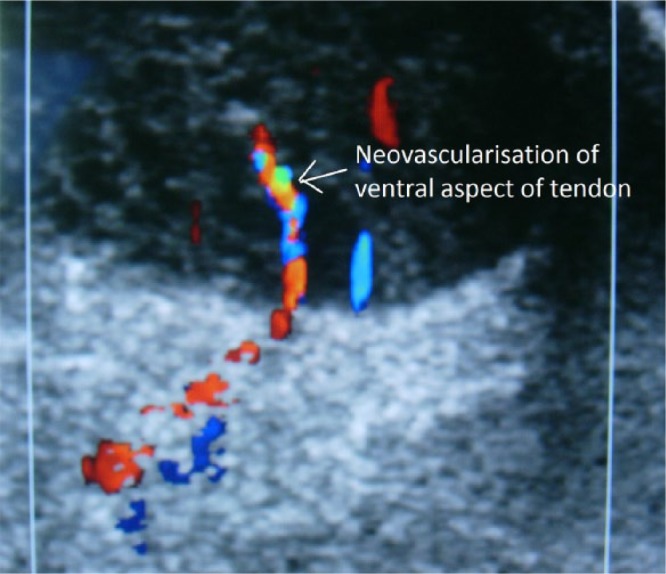
UltrasoundTransverse Doppler ultrasound of the Achilles tendon: neovascularisation on the ventral aspect of the tendon (arrow), a characteristic sign of active tendinopathy.
Source : Pearce et al., EFORT Open Reviews, 2016, figure 2 · CC BY-NC
The VISA-A rates the clinical severity of Achilles tendinopathy across eight questions covering pain, daily function and sporting activity. The total runs from 0 to 100, and the direction is the reverse of most pain scales: 100 is the perfect score, that of a healthy tendon.
The 2001 publication gives severity benchmarks, to be read as means and not as decision thresholds: controls scored above 96, non-surgical patients sat at 64, and pre-surgical ones at 44.
A validated French version exists, published in 2016 by a Liège team in 116 subjects. A reading point worth knowing: its abstract concludes to 'excellent reliability' without publishing any coefficient. This page therefore attributes none to it, and looks for its figures elsewhere.
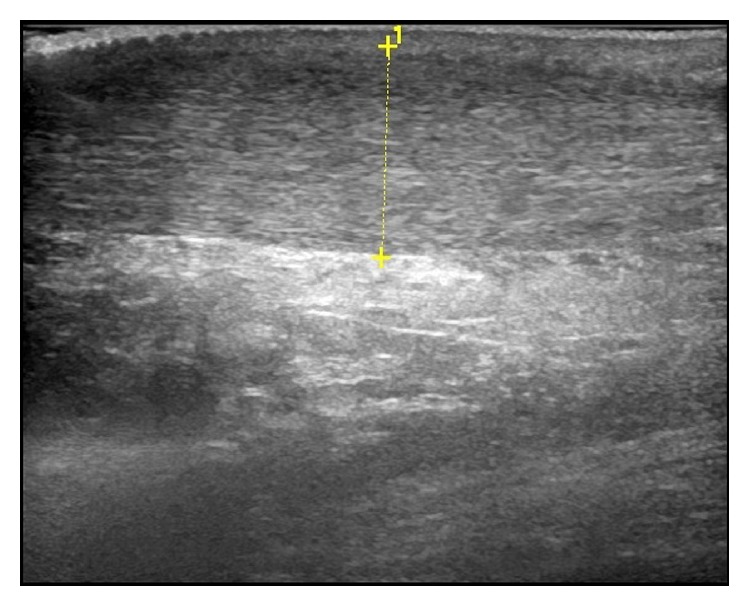
UltrasoundLongitudinal ultrasound of the Achilles tendon: measured thickening of the tendon body (calipers), heterogeneous appearance suggestive of mid-portion tendinopathy.
Source : Crescibene et al., Journal of Blood Transfusion, 2015, figure 1 · CC BY
The thresholds belong to their studies
This is the point that decides what a follow-up can conclude, and it is more awkward than it looks.
The fourteen-point threshold everyone quotes comes from a cohort of 64 active patients, measured at twelve weeks. In the same cohort, at twenty-four weeks, it falls to seven points, with a confidence interval running from -10 to 28, that is containing zero. Another cohort, of 97 participants, finds 23.5 points. The threshold is a property of the study, not of the scale.
Usable thresholds do exist, provided you take the right ones. The same study in 97 participants gives three values in raw score which do follow each other: above 70.5 for the minimal important difference, above 77.5 for substantial benefit, above 89.5 for full recovery. Its change-based values, by contrast, invert, substantial benefit being 19.5 when the minimal difference is 23.5. The inversion is indeed in the source: it forbids treating those three as a gradation, and that is why the tool at the top of this page uses only the raw-score thresholds.
An instrument challenged by its peers
The VISA-A has been the reference instrument of this field for twenty-five years, and it is today challenged by its peers unusually directly.
A Rasch analysis published in 2025 in 217 subjects is bluntly titled 'the VISA-A is fundamentally flawed and unfit for clinical practice or research'. It concludes the questionnaire does not meet the COSMIN criteria for construct validity, places item 8, the sporting question, at the top of its problems, and shows that item responses depend on age and body mass index.
Its authors go as far as an operational recommendation for data already collected: analyse only items 1 to 6, with responses collapsed to four points. The field did not stop at criticism: a replacement instrument, the TENDINS-A, was developed and evaluated according to the COSMIN recommendations and published in 2024. That does not make the VISA-A unusable today, but it shows what to expect, and it argues against resting a decision on it alone.
| What is measured | Value | Sample |
|---|---|---|
| Minimal important difference, raw score | > 70.5 | 97 participants |
| Substantial benefit, raw score | > 77.5 | same participants |
| Full recovery, raw score | > 89.5 | same participants |
| Minimal difference, as change, 12 weeks | 14 | 64 active patients |
| The same, at 24 weeks, same patients | 7 | interval containing zero |
| The same, other cohort | 23.5 | 97 participants |
| Substantial benefit, as change | 19.5 | lower than the previous threshold |
| Healthy control benchmark | > 96 | 87 controls |
| Pre-surgical patient benchmark | 44 | 14 patients |
The sedentary patient, and the French version
Here is where the criticism of the sporting item meets the ordinary practice.
A British team built a VISA-A for the sedentary patient, tested in 51 patients of mean age 64.8. The two versions give significantly different scores, before as after treatment, and the sedentary version tracks patient-perceived change far better: correlation of 0.420 against 0.253, that is nearly three times more shared variance.
That is exactly the profile of the patient who consults for Achilles tendinopathy in community practice. And that is where French speakers are missing something: no French version of the sedentary VISA-A is indexed. The variant most relevant to that clientele exists only in English, while the original version has been translated and validated in French since 2016.
Where the eight questions reproduced above come from
No free licence is published for the VISA-A. The French items are reproduced from the VISA-A-F questionnaire by Oppong-Kyei et al., 2014, deposited in open access on ORBi by a team from the University of Liège. The English items are reproduced from the original version by Robinson et al., 2001, distributed without an account by the Physical Therapy Clinic of the University of Delaware, laboratory of Karin Grävare Silbernagel, co-author of the validated Swedish version. Both versions are reproduced without changing a word; this page does not claim any permission it has not obtained, and refers to both rights holders for any other use. The version intended for the sedentary patient covers the original questionnaire, the one whose sporting item is most challenged, and has no indexed French translation: using it means working in English, and saying so.
Three administration pitfalls
Quoting the fourteen points as a threshold of the scale
It is the threshold of one cohort, at one moment. The same cohort, six months later, gives seven points, with an interval containing zero; another gives 23.5. The report must say where the threshold used comes from.
Treating the three change thresholds as a gradation
In the source, substantial benefit is 19.5 and the minimal difference 23.5: the order is inverted. Only the three raw-score thresholds, 70.5, 77.5 and 89.5, follow each other.
Using it as it stands in a sedentary patient
The sporting item is the most challenged of the scale, and a sedentary version exists that tracks perceived change markedly better in patients of mean age 64.8. It has no French translation: saying so in the report is better than ignoring it.
Frequently asked questions
What does VISA-A stand for?
VISA-A stands for Victorian Institute of Sport Assessment - Achilles. The questionnaire was published in 2001 by Robinson et al. to measure the clinical severity of Achilles tendinopathy.
How is the VISA-A scored?
Eight questions covering pain, daily function and sporting activity: items 1 to 7 are all mandatory, and the patient completes a single branch of question 8 (A, B or C) according to whether pain during sport is absent, tolerated or activity-stopping. The score, from 0 to 100, is the automatic sum of the first seven items and the branch used; 100 is the perfect score. The direction is therefore the reverse of most pain scales: a low score signals severe involvement.
How much change counts?
There is no single answer. Published change thresholds run from 7 to 37.5 points: within a single work, 23.5 for the minimal clinically important difference, 19.5 for substantial benefit and 37.5 for complete recovery. The 7-point one has a confidence interval containing zero. The raw-score thresholds, above 70.5, 77.5 and 89.5, are safer to use.
Is the VISA-A still recommended?
It remains widely used, but a 2025 Rasch analysis concludes that it does not meet the COSMIN criteria for construct validity, and a replacement instrument evaluated according to COSMIN was published in 2024.
Is there a French version?
Yes, validated in 2016 in 116 subjects by a Liège team, and its items, those of the VISA-A-F deposited on ORBi, are what the scorer at the top of the page reproduces. The version intended for the sedentary patient, however, has no indexed French translation.
References
7 sources, PMIDs included
- Robinson JM, Cook JL, Purdam C, Visentini PJ, Ross J, Maffulli N, Taunton JE, Khan KM; Victorian Institute Of Sport Tendon Study Group. The VISA-A questionnaire: a valid and reliable index of the clinical severity of Achilles tendinopathy. Br J Sports Med 2001;35(5):335-41. PMID 11579069. The original publication. Eight questions covering pain, daily function and sporting activity, for a single score from 0 to 100 where 100 is the perfect score. It gives severity benchmarks, mean values and not decision thresholds: above 96 in controls, 64 in non-surgical patients, 44 in pre-surgical ones.
- Kaux JF, Delvaux F, Oppong-Kyei J, Dardenne N, Beaudart C, Buckinx F, Croisier JL, Forthomme B, Crielaard JM, Bruyère O. Validity and reliability of the French translation of the VISA-A questionnaire for Achilles tendinopathy. Disabil Rehabil 2016;38(26):2593-9. PMID 26860592. The validated French version, produced by a Liège team following a six-step methodology, in 116 subjects: 31 patients, 63 at-risk athletes and 22 controls. The authors conclude it is equivalent to the original. A reading caveat: their abstract says 'excellent reliability' without publishing any numeric coefficient, and this page therefore attributes none to it.
- Lagas IF, van der Vlist AC, van Oosterom RF, van Veldhoven PLJ, Reijman M, Verhaar JAN, de Vos RJ. Victorian Institute of Sport Assessment-Achilles (VISA-A) Questionnaire-Minimal Clinically Important Difference for Active People With Midportion Achilles Tendinopathy: A Prospective Cohort Study. J Orthop Sports Phys Ther 2021;51(10):510-6. PMID 34592827. The study the figure of 14 points comes from, in 64 active patients. It gives 14 points at twelve weeks, but 7 points at twenty-four in the same cohort, with a confidence interval of -10 to 28 that contains zero. The threshold therefore does not have the same value depending on when it is measured.
- Sigurðsson HB, Grävare Silbernagel K. Is the VISA-A Still Seaworthy, or Is It in Need of Maintenance? Orthop J Sports Med 2022;10(8):23259671221108950. PMID 35982828. A second cohort, of 97 participants, giving usable and increasing thresholds in raw score: above 70.5 for the minimal difference, above 77.5 for substantial benefit, above 89.5 for full recovery. Its change-based thresholds, however, invert, substantial benefit being 19.5 when the minimal difference is 23.5: they do not form a gradation.
- Travers N, Murphy MC, Wand BM, Kirwan P, Travers M, Debenham J, Gibson W, Hince D. The Victorian Institute of Sport Assessment - Achilles is fundamentally flawed and unfit for clinical practice or research: A Rasch Measurement Theory Analysis using COSMIN recommendations. Phys Ther Sport 2025;73:68-76. PMID 40106921. The most severe Rasch analysis published on this instrument, in 217 subjects, and its title says so bluntly. It concludes the questionnaire does not meet the COSMIN criteria for construct validity, puts item 8, the sporting question, at the top of the list of problems, shows that item responses depend on age and body mass index, and recommends analysing only items 1 to 6 with responses collapsed to four points.
- Norris R, Cook JL, Gaida JE, Maddox T, Raju J, O'Neill S. The VISA-A (sedentary) should be used for sedentary patients with Achilles tendinopathy: a modified version of the VISA-A developed and evaluated in accordance with the COSMIN checklist. Br J Sports Med 2023;57(20):1311-6. PMID 36927742. The answer to the sporting item: a version designed for the sedentary patient, tested in 51 patients of mean age 64.8. The two versions give significantly different scores, and the sedentary version tracks patient-perceived change far better, correlation of 0.420 against 0.253. Its factor analysis also finds two dimensions there, symptoms and activity.
- Murphy MC, McCleary F, Hince D, Chimenti R, Chivers P, Vosseller JT, Nimphius S, Mkumbuzi NS, Malliaras P, Maffulli N, de Vos RJ, Rio EK. TENDINopathy Severity assessment-Achilles (TENDINS-A): evaluation of reliability and validity in accordance with COSMIN recommendations. Br J Sports Med 2024;58(12):665-73. PMID 38575200. The replacement instrument, developed and evaluated according to the COSMIN recommendations. Its mere existence shows where the field is going: the teams challenging the VISA-A do not stop at criticising it, they build something else.
 Page written by Anthony Baillon, physiotherapist, co-founder of Physio Learning. The questionnaire itself is by Robinson et al., 2001, with its French version by Oppong-Kyei et al., 2014: this page reproduces, documents and interprets them.
Behind this article
An author who explains, a reviewer who checks.
How we write and check our content

Physiotherapist · co-founder of Physio Learning
Marked for life by his first four-hour lecture without a single image, he took a master’s in instructional design so that it would never happen to anyone again. He hunts down publication bias and unreadable slides with the same intransigence.

Head of scientific content
Physiotherapist specialising in neuro-musculoskeletal practice and holder of a master’s in public health. He checks the methodological rigour of every article: primary sources, levels of evidence, no exceptions.