






The VISA-P is the primary outcome of nearly every trial on patellar tendinopathy. Its published change thresholds run from 6.6 to more than 13 points, when its measurement error is 12.2: a gain of eight points crosses a published threshold while staying inside the instrument's noise. The tool below shows the three bounds together.
Healthy-subject values run from 83 in the Swedish version to 99 in the French one: two versions of the same questionnaire do not compare. The detail is below.
Figures taken from the studies listed at the end of this page, every value carrying its source where it is written. The questionnaire itself is not reproduced.
What the VISA-P measures, and what it does not diagnose
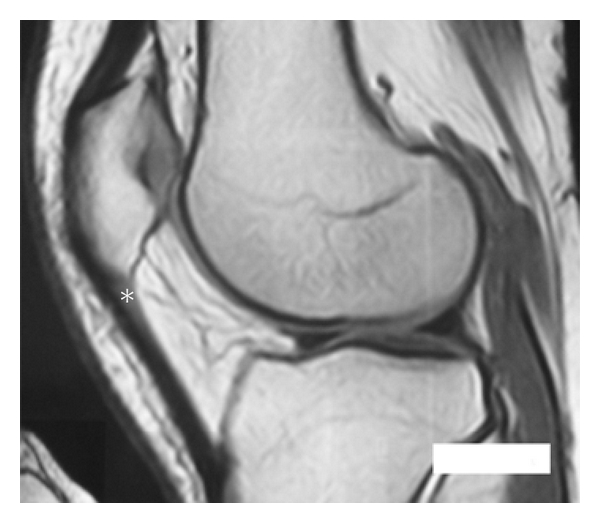
MRIMRI of the knee, sagittal view, preoperative: low-signal area in the proximal portion of the patellar tendon, asterisk, chronic patellar tendinopathy.
Source : Pascual-Garrido et al., Stem Cells International, 2012, figure 1 · CC BY
The VISA-P rates the severity of patellar tendinopathy across eight questions. Six of them rate pain during daily activities and simple functional tests, on a reversed visual analogue scale where 10 represents optimal health; the last two cover the ability to play sport. The total runs from 0 to 100, and the direction is the reverse of a pain scale: 100 is the absence of symptoms.
Here is what it does not do, and it is the most useful thing on this page. It diagnoses nothing. The only validation in this file to have included a genuinely relevant comparison group finds 58 points in patients with patellar tendinopathy and 62 in patients with another knee lesion. A low score says this knee is unwell; it never says it is the tendon.
The threshold of 80, so often repeated, holds no better. In the Swedish validation, healthy students score 83 with a standard deviation of 13, and the national basketball team 79 with a standard deviation of 24: the threshold falls inside the healthy interval. A 2025 editorial writes it in full, this instrument has no validated diagnostic threshold; it is an opinion, not a study, but it names a widespread practice.
Two fundamental caveats finally bear on the score itself. The original version documents neither the selection of its items, nor the weighting of each response, nor the ordering of the options in its eighth question. And a Danish Rasch analysis, in 184 patients and 100 controls, concludes that the eight items do not fit a unidimensional measurement model: they decompose at best into three factors, with differential item functioning between healthy and affected subjects.
A version pitfall, finally, and a documented one. The group that produced the instrument modified the time periods of the eighth question after 1998, and it is that modified version circulating in the translations, not the one printed in the original article.
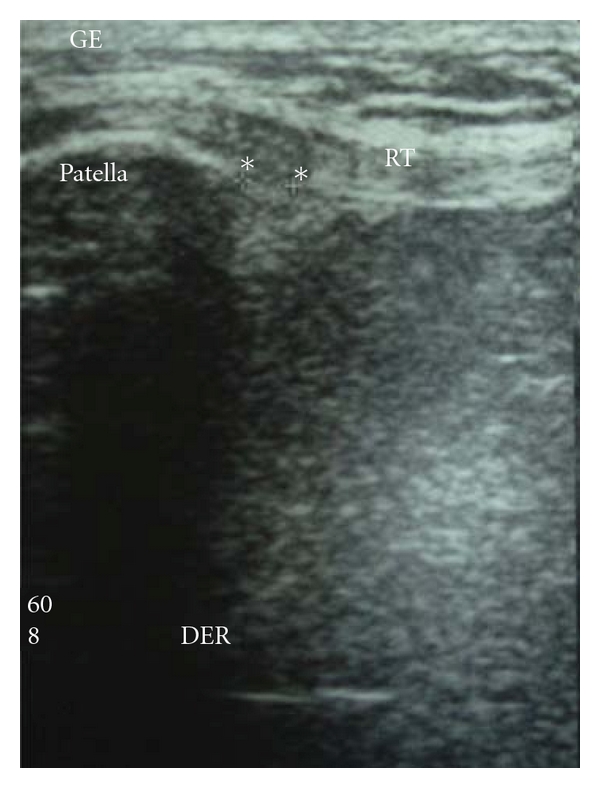
UltrasoundUltrasound of the patellar tendon, preoperative: hypoechoic areas corresponding to tendon oedema, asterisks, below the patella.
Source : Pascual-Garrido et al., Stem Cells International, 2012, figure 2 · CC BY
Eight points cross a threshold and stay in the noise
This is the point that decides what can be concluded from a follow-up, and it comes from a collision between three ways of computing a threshold.
By distribution method, on the patellar subset of a corpus of trials, the minimal important difference is 7.3 points under the half standard deviation rule and 6.6 under the one standard error of measurement rule.
By anchoring on patients' perception, in 98 athletes under conservative treatment, it is more than 13 points. The probability of a real change there is 98% if the threshold is crossed, and 45% otherwise.
And the instrument's measurement error is 12.2 points, with a standard error of measurement of 5.2 and a reliability of 0.91. It is the only bound that says whether a difference is real in a given patient.
Put these three numbers side by side and the consequence is obvious: a gain of eight points crosses a published 'important' threshold while staying inside the instrument's noise. The choice of threshold therefore decides the conclusion, and an honest report says which one it uses. A fourth value, Japanese, even falls to 7 points in 43 participants, which completes the demonstration that these bounds do not overlap from one version and one method to another.
One caveat, finally, carried by the authors of the anchored value themselves: the absolute threshold depends on the initial score. For that reason they propose a relative formulation, 15.4 to 27% change, preferable when the baseline is extreme.
Healthy-subject values, from 83 to 99 depending on the version
There is not one healthy-subject reference value, there are as many as there are versions, and the gap between them forbids comparing two cohorts that did not fill in the same questionnaire.
The French validation gives 99 in asymptomatic subjects, with a standard deviation of 2. The Swedish one gives 83 in healthy students, with a standard deviation of 13. Sixteen points therefore separate two populations both described as healthy, on the same instrument.
The table below gathers the available values. It is worth pausing on the two Dutch lines: they show best what the score cannot do, since patients with another knee problem score higher there than those with patellar tendinopathy, but with widely overlapping intervals.
One last benchmark circulates, and it deserves to be quoted with its limits. In 31 asymptomatic college athletes, a score of 89.5 flagged a hypoechoic area of the tendon with 86.4% sensitivity. But the association was significant only in the right knee, not the left, in a very small sample and a single cross-sectional study. It is a lead, not a threshold.
| Group | Mean | Standard deviation | Version |
|---|---|---|---|
| Asymptomatic subjects | 99 | 2 | French, 22 subjects |
| At-risk athletes | 86 | 14 | French, 42 subjects |
| Healthy students | 83 | 13 | Swedish |
| National basketball team | 79 | 24 | Swedish |
| Other knee lesion | 62 | 24 | Dutch |
| Patellar tendinopathy | 58 | 19 | Dutch |
| Patellar tendinopathy | 53 | 17 | French, 28 subjects |
The French version, and why its items are not here
A validated French version exists, the VISA-PF, produced by a Liège team in six steps and tested in 92 subjects. Its properties are good: excellent test-retest reproducibility, good internal consistency, coherent convergent and divergent validity against the SF-36. It also gives the three French benchmarks: 99 in asymptomatic subjects, 86 in at-risk athletes, 53 in patients.
What it does not give matters just as much for follow-up: it reports neither responsiveness nor a threshold. No French-language threshold exists for this instrument, and all those used in France come from Spanish, Brazilian, Japanese or multinational cohorts.
On rights, the situation is unusual and deserves explaining, because it is not the same by language. The English, Dutch and Swedish items were published in appendix to articles carrying an explicit written reproduction permission, with an obligation to cite the source; that permission was read word for word. The French items appeared in an all-rights-reserved journal, and no equivalent permission could be read.
A third element calls for caution on the instrument itself, independently of the article reproducing it. The Swedish and Dutch teams both write that they informed the Australian group and obtained its consent before translating the questionnaire. That group therefore claims rights over the instrument, distinct from the article's licence. This page, being French-language, reproduces no item.
Why this page does not display the questionnaire
The rights situation is not the same by language, which is rare enough to be worth explaining. The English, Dutch and Swedish items were published in appendix to articles carrying an explicit written reproduction permission, read word for word, with an obligation to cite the source. The French items appeared in an all-rights-reserved journal, and no equivalent permission could be read. To this is added a signal that holds for every language: the Swedish and Dutch teams write that they informed the Australian group behind the instrument and obtained its consent before translating. This page being French-language, it reproduces no item.
Three administration pitfalls
Using it as a diagnostic test
Patients with another knee lesion score close to, and even slightly above, those with patellar tendinopathy. A low score says this knee is unwell, not where the problem comes from.
Concluding from an eight-point gain
It crosses the thresholds computed by distribution methods, 6.6 and 7.3 points, but stays below the 12.2 points of the instrument's measurement error. In a given patient, that difference supports no conclusion.
Comparing two cohorts that did not fill in the same version
Healthy-subject values run from 83 to 99 depending on the version, and the originating group modified the eighth question after 1998. The VISA-P is a within-patient follow-up figure, always measured in the same version.
Frequently asked questions
What does the VISA-P measure?
It rates the severity of patellar tendinopathy across eight questions, for a total of 0 to 100 where 100 is the absence of symptoms and full sporting practice.
Can the VISA-P make a diagnosis?
No. It has no validated diagnostic threshold, and patients with another knee lesion score close to those with patellar tendinopathy.
How much change counts?
Published thresholds run from 6.6 to more than 13 points depending on the method, and the instrument's measurement error is 12.2 points. A gain of eight points crosses a threshold without leaving the noise.
What is a VISA-P in a healthy subject?
It depends on the version: 99 in asymptomatic subjects of the French validation, 83 in healthy students of the Swedish one. The often quoted threshold of 80 therefore falls inside the healthy interval.
Is there a French version of the VISA-P?
Yes, the VISA-PF, validated in 2016 in 92 subjects. But that validation publishes no change threshold: those used in France all come from elsewhere.
References
13 sources, PMIDs included
- Visentini PJ, Khan KM, Cook JL, Kiss ZS, Harcourt PR, Wark JD. The VISA score: an index of severity of symptoms in patients with jumper's knee (patellar tendinosis). Victorian Institute of Sport Tendon Study Group. J Sci Med Sport 1998;1(1):22-8. PMID 9732118. The original publication, which does not yet call the instrument VISA-P but simply the VISA score: the suffix only appears after the Achilles version was created, in 2001. It fixes the form: eight questions, six rating pain during daily activities and simple functional tests and two the ability to play sport, for a total of 0 to 100 where 100 is the absence of symptoms.
- Zwerver J, Kramer T, van den Akker-Scheek I. Validity and reliability of the Dutch translation of the VISA-P questionnaire for patellar tendinopathy. BMC Musculoskelet Disord 2009;10:102. PMID 19671174. The only validation in this file to have included a genuinely relevant comparison group, and its result deserves to be better known: patients with patellar tendinopathy score 58 (19) points there, and patients with another knee lesion, 62 (24). A low score therefore says this knee is unwell, never that it is the tendon. This open-access article also carries an explicit written reproduction permission, and publishes in appendix the English questionnaire and its Dutch version.
- Frohm A, Saartok T, Edman G, Renström P. Psychometric properties of a Swedish translation of the VISA-P outcome score for patellar tendinopathy. BMC Musculoskelet Disord 2004;5:49. PMID 15606923. The Swedish validation, giving the lowest healthy-subject values in this file: healthy students at 83 (13) and the national basketball team at 79 (24). The so often repeated threshold of 80 therefore falls inside that healthy interval. Its full text also notes that the original version documents neither item selection, nor response weighting, nor the ordering of the options in its eighth question.
- Kaux JF, Delvaux F, Oppong-Kyei J, Beaudart C, Buckinx F, Croisier JL, Forthomme B, Crielaard JM, Bruyère O. Cross-cultural Adaptation and Validation of the Victorian Institute of Sport Assessment-Patella Questionnaire for French-Speaking Patients With Patellar Tendinopathy. J Orthop Sports Phys Ther 2016;46(5):384-90. PMID 26999409. The validated French version, the VISA-PF, produced by a Liège team in six steps then tested in 92 subjects: 28 with the condition at 53 (17), 22 asymptomatic at 99 (2) and 42 at-risk athletes at 86 (14). Excellent test-retest reproducibility, good internal consistency, coherent convergent and divergent validity against the SF-36. A decisive point for follow-up: it reports neither responsiveness nor a threshold. No French-language threshold exists.
- Wageck BB, de Noronha M, Lopes AD, da Cunha RA, Takahashi RH, Costa LO. Cross-cultural adaptation and measurement properties of the Brazilian Portuguese Version of the Victorian Institute of Sport Assessment-Patella (VISA-P) scale. J Orthop Sports Phys Ther 2013;43(3):163-71. PMID 23321783. The source of this instrument's measurement error, and therefore of the only bound allowing a conclusion in a patient: the minimal detectable change at 90% is 12.2 points, for a standard error of measurement of 5.2 and a reliability of 0.91. Its responsiveness rests on 32 patients who received a month of physiotherapy. No floor or ceiling effect is detected there.
- Hernandez-Sanchez S, Hidalgo MD, Gomez A. Responsiveness of the VISA-P scale for patellar tendinopathy in athletes. Br J Sports Med 2014;48(6):453-7. PMID 23012320. The only value anchored on patients' perception, in 98 athletes under conservative treatment: an important change is worth more than 13 points, or 15.4 to 27% relative change. Its authors specify that the absolute threshold depends on the initial score, which makes the relative formulation preferable in a patient whose baseline is extreme. The probability of a real change is 98% if the threshold is crossed, 45% otherwise.
- Challoumas D, Zouvani A, Creavin K, Murray E, Crosbie G, Ng N, Millar NL. Determining minimal important differences for patient-reported outcome measures in shoulder, lateral elbow, patellar and Achilles tendinopathies using distribution-based methods. BMC Musculoskelet Disord 2023;24(1):158. PMID 36864412. The distribution-based values, 7.3 points by the half standard deviation rule and 6.6 by the one standard error of measurement rule. A reading point applies: these figures come from the patellar subset alone of a corpus of 119 trials covering four tendinopathies, not from the 119. The same work notes that 58 of the 119 trials defined a minimal important difference, with inconsistencies between trials using the very same outcome.
- Agergaard AS, Comins JD, Siersma V, Malmgaard-Clausen NM, Couppe C, Hjortshoej MH, Olesen JL, Magnusson SP. Assessment of the Psychometric Properties of the Danish VISA-P. Transl Sports Med 2023;2023:5291949. PMID 38654908. The most radical analysis in this file, in 184 patients and 100 controls: the eight items do not fit a unidimensional measurement model, the instrument decomposes at best into three factors, and differential item functioning separates healthy from affected subjects. Its authors recommend substituting numerical pain rating scales and functional tests.
- Korakakis V, Kotsifaki A, Stefanakis M, Sotiralis Y, Whiteley R, Thorborg K. Evaluating lower limb tendinopathy with Victorian Institute of Sport Assessment (VISA) questionnaires: a systematic review shows very-low-quality evidence for their content and structural validity-part I. Knee Surg Sports Traumatol Arthrosc 2021;29(9):2749-64. PMID 34019117. The systematic review concluding, for the VISA-P as for its cousins, to very-low-quality evidence for content and structural validity, with comprehensiveness judged insufficient. It is the indispensable counterpoint to this instrument's omnipresence as the primary outcome of trials in the field.
- Togashi I, Nagao M, Nishio H, Nozu S, Shiota Y, Takazawa Y. Cross-cultural adaptation, validity, reliability and responsiveness of the Japanese version of the Victorian Institute of sports assessment for patellar tendinopathy (VISA-P-J). BMC Sports Sci Med Rehabil 2023;15(1):5. PMID 36631888. A fourth change value, in 43 participants followed at one week and at twelve: 7 points. It is half the anchored Spanish value and smaller than the Brazilian measurement error, which illustrates the heart of the problem: from one version and one method to another, these thresholds do not overlap.
- Fazekas ML, Sugimoto D, Cianci A, Minor JL, Corrado GD, d’Hemecourt PA. Ultrasound examination and patellar tendinopathy scores in asymptomatic college jumpers. Phys Sportsmed 2018;46(4):477-84. PMID 30122090. A lead, and it is presented here as such. In 31 asymptomatic college athletes, a score of 89.5 flagged a hypoechoic area of the tendon with 86.4% sensitivity and 77.7% specificity. But the association was significant only in the right knee, not the left, in a very small sample and a single cross-sectional study: to be handled as a hypothesis, not an established threshold.
- Ledingham CJ, O’Grady P. Expanding role of VISA-P in patellofemoral pain assessment-case for caution and context. World J Orthop 2025;16(10):110077. PMID 41181044. An opinion editorial, not an original study, writing in full that this instrument has no validated diagnostic threshold. Its value here is to name a widespread practice rather than to bring new data, and it appears in this list on that basis.
- Murphy MC, Korakakis V, Scattone Silva R, Perez Armendariz ML, Cowen G, Haydock C, Kadlec D, Maffuli N, Perrot M, Webster D, Zwerver J, Rio EK. TENDINopathy Severity Assessment - Patellar (TENDINS-P): Development and Content Validity Assessment of a New Patient-Reported Outcome Measure for Patellar Tendinopathy. J Orthop Sports Phys Ther 2026;56(5):300-9. PMID 42063302. The announced successor, published in 2026. One clarification matters before expecting it as a replacement: only its content validity is established to date. Neither its reproducibility, nor its responsiveness, nor its change threshold are. It therefore does not yet replace the VISA-P, but its existence shows where the field is going.
 Page written by Anthony Baillon, physiotherapist, co-founder of Physio Learning. The questionnaire itself is by the Victorian Institute of Sport Tendon Study Group, 1998: this page documents and interprets it, it reproduces none of its items.
Behind this article
An author who explains, a reviewer who checks.
How we write and check our content

Physiotherapist · co-founder of Physio Learning
Marked for life by his first four-hour lecture without a single image, he took a master’s in instructional design so that it would never happen to anyone again. He hunts down publication bias and unreadable slides with the same intransigence.

Head of scientific content
Physiotherapist specialising in neuro-musculoskeletal practice and holder of a master’s in public health. He checks the methodological rigour of every article: primary sources, levels of evidence, no exceptions.