





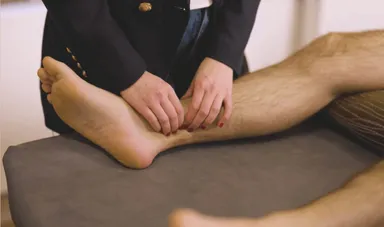



The WOMAC, short for Western Ontario and McMaster Universities Osteoarthritis Index, is the reference instrument for hip and knee osteoarthritis. Two things complicate reading it: it exists in several formats with different ranges, and its construct validity could not be demonstrated in a French population. The normaliser is right below.
In a review of 134 trials, the range of the WOMAC score is reported ambiguously in 38 % of cases and stays completely unclear in a further 10 %. That is why this tool asks for your maximum. The detail is below.
Figures taken from the studies listed at the end of this page, every value carrying its source where it is written. The questionnaire itself is not reproduced.
What the WOMAC measures
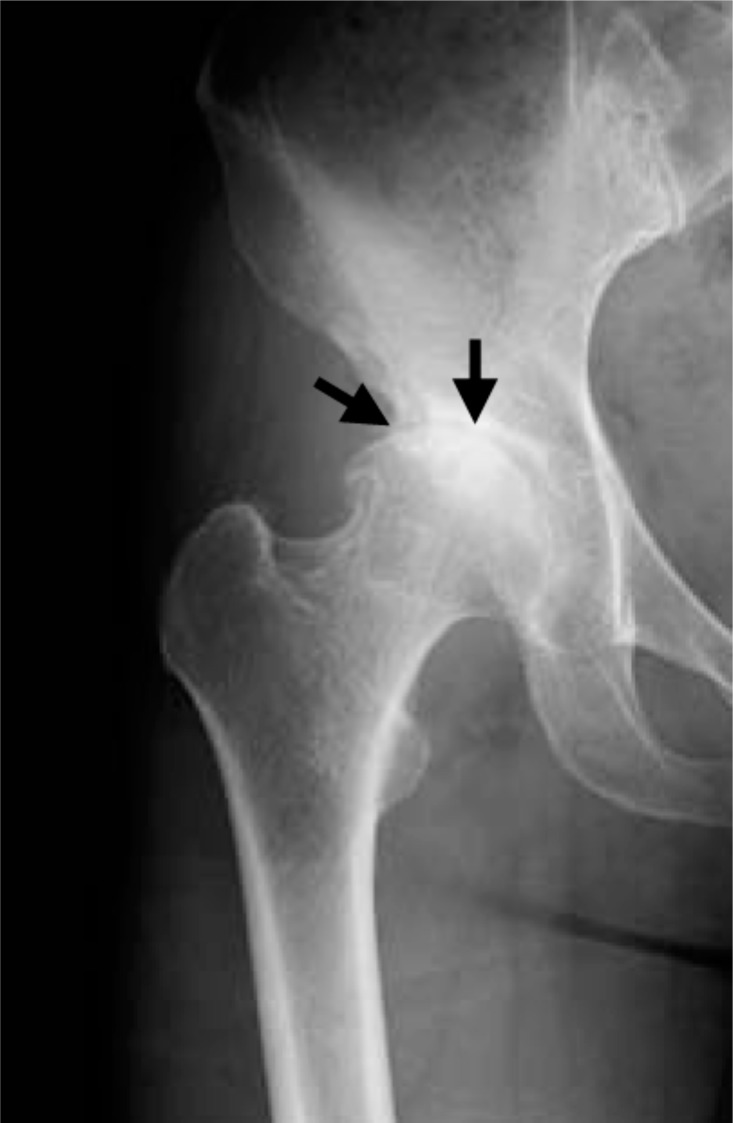
X-rayAnteroposterior pelvic radiograph: severe hip osteoarthritis with near-complete loss of the joint space, osteophytes, subchondral osteosclerosis and femoral head deformity (arrows).
Source : Kamimura et al., The Open Rheumatology Journal, 2014, figure 3d · CC BY-NC
The WOMAC was published in 1988 by Bellamy et al., inside a controlled trial comparing two anti-inflammatory drugs. It measures what hip or knee osteoarthritis costs the patient, across three subscales: pain, stiffness and physical function.
It became the reference instrument of the field, and a consensus meeting recommended it as early as 1994 as a primary efficacy criterion in osteoarthritis. Its responsiveness is good: in 43 patients followed for a year after joint replacement, it proves more responsive than the Lequesne index, with a standardised response mean of 2.4 at the hip against 2.1.
One detail of the original publication is worth noting, because it governs how to cite it: its abstract carries no numeric value. The coefficients sometimes attributed to it come from elsewhere, and this page looks for them in the studies that actually measured them.
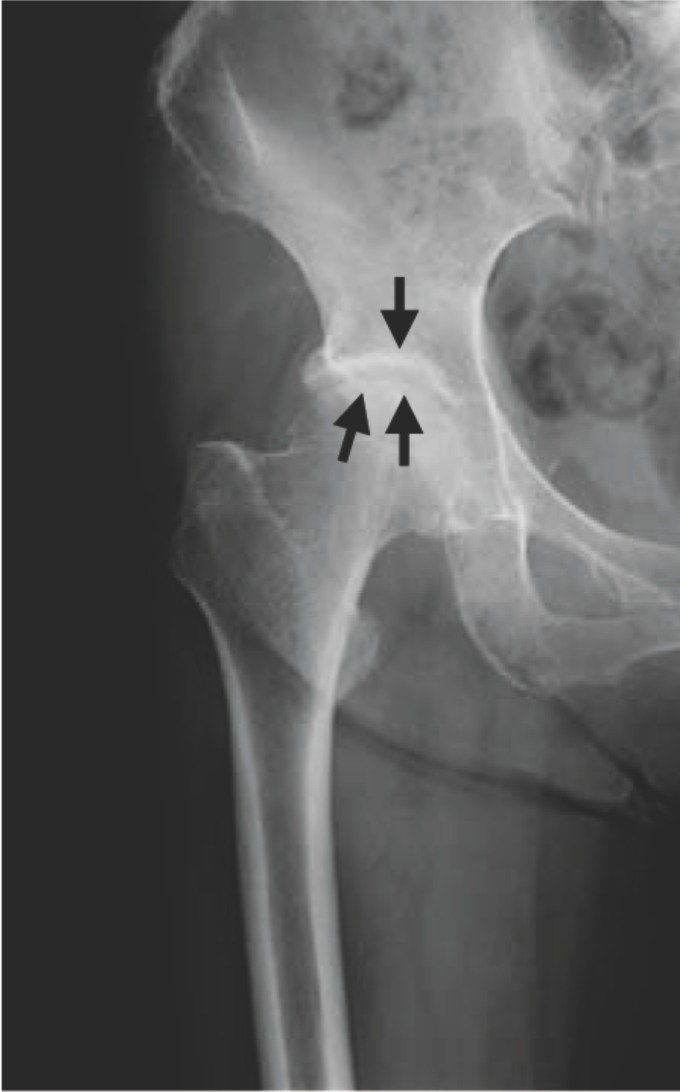
X-rayAnteroposterior pelvic radiograph: early hip osteoarthritis with narrowing of the right hip joint space (arrows), without major deformity of the femoral head.
Source : Kamimura et al., The Open Rheumatology Journal, 2014, figure 1a · CC BY-NC
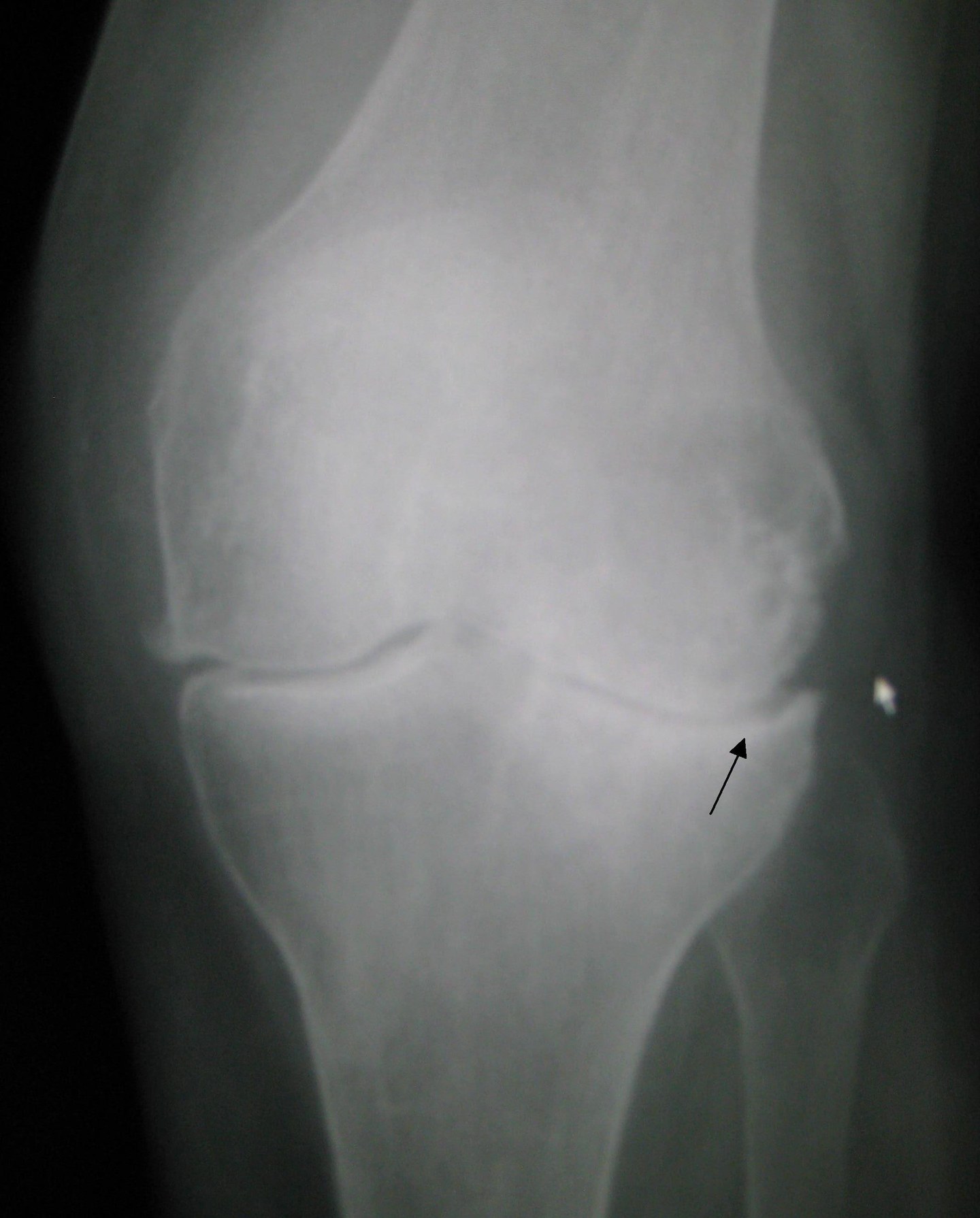
X-rayAnteroposterior knee radiograph: knee osteoarthritis with narrowing of the lateral joint space, arrow, and remodelling of the bone surfaces.
Source : Heilman, Wikimedia Commons · CC BY-SA
Which WOMAC are you reading?
This is the question to ask before reading a WOMAC score, and it rarely has an answer.
The instrument exists in several response formats, and their score ranges differ. A systematic review of 134 trials of physical treatments in knee osteoarthritis measured what that produces: the type of scale used is inadequately reported in 53 % of trials, the score range is ambiguous in 38 %, and completely unclear in a further 10 %.
The consequence is direct. A score of 40 means nothing until you know what it is calculated out of, and two trials both reporting 'WOMAC 40' may describe very different patients. That is why the tool at the top of this page asks for the maximum of your scale before yielding anything: the percentage compares, the raw score does not.
Construct validity, in a French population
This result is rarely quoted in France, and it concerns the French-speaking reader directly.
In 2002, a French team administered the French-Canadian version of the WOMAC and the Lequesne index twice, three hours apart, to 88 patients with knee osteoarthritis. Repeatability is adequate, from 0.68 to 0.82 depending on the section. But construct validity could not be demonstrated.
The detail is sharp: factor analysis extracts five factors, where the announced structure provides for three; the function section extracts two, explaining 71 % of the variance, which the authors cannot characterise clinically; and eight of its questions have insufficient psychometric properties. Their conclusion covers both indices: they are not valid to assess the functional disability of knee osteoarthritis in a French population. A Rasch analysis arriving from another direction points the same way: only a pain dimension cut to three items and a function dimension cut to fourteen fit the model.
| What is measured | Value | Sample |
|---|---|---|
| Subscales | 3 | pain, stiffness, function |
| Repeatability, French version | 0.68 to 0.82 | 88 knee osteoarthritis patients |
| Factors found, French version | 5 | same patients, 3 expected |
| Minimal important improvement | 6 to 9 points | 609 patients, 7 countries |
| The same, in relative terms | 10 to 17 % | same patients |
| Patient acceptable symptomatic state | 39 to 48 | same patients |
| Responsiveness at 12 months, hip | 2.4 | 43 replacements, against 2.1 for Lequesne |
| Trials where the format is unclear | 53 % | 134 trials |
| Trials where the range is ambiguous | 38 % | 134 trials |
The thresholds, and the form in which they travel
The WOMAC thresholds exist, but they do not travel in just any form.
The 2015 multinational study, across 609 patients from seven countries assessed before and four weeks after an anti-inflammatory drug, places the minimal clinically important improvement at an absolute change of 6 to 9 points depending on the subscale. Its authors take care to give the relative equivalent: 10 to 17 %.
It is that second form to hold on to. Absolute change depends on the range of the scale used, which the previous section showed is often unknown; the percentage, for its part, travels. The same study also records between-country variation, which invites treating these values as an order of magnitude rather than a rule.
Why this page does not display the questionnaire
No free licence is established for the WOMAC: neither its items nor its response options are reproduced here. That holds all the more since several formats circulate, with differing ranges: obtaining the form from its rights holders is the only way to know for certain which scale you are scoring on, which is exactly the problem this page describes.
Three administration pitfalls
Comparing two scores without knowing their ranges
This is the error the review of 134 trials makes visible. One WOMAC compares with another only once both are brought back to a percentage of their respective maximum, and the report must carry the format used.
Citing the 1988 publication for a coefficient
Its abstract contains none. The reliability, responsiveness and threshold values in circulation come from later studies, and attributing them to the founding text is an attribution error.
Treating the three subscales as one homogeneous block
The pain section is more responsive than the function section, in the WOMAC as in the Lequesne index, and the Rasch analysis retains only reduced versions of each. A single total hides those differences.
Frequently asked questions
What does WOMAC stand for?
WOMAC stands for Western Ontario and McMaster Universities Osteoarthritis Index. The questionnaire was published in 1988 by Bellamy et al. for hip and knee osteoarthritis.
How is the WOMAC scored?
It yields three subscales: pain, stiffness and physical function. It exists in several response formats whose score ranges differ: it is the format used, and not the figure alone, that must be recorded.
How much change allows a conclusion?
The minimal clinically important improvement is a change of 6 to 9 points, that is 10 to 17 % of the range depending on the subscale. It is the relative form to keep, the absolute form depending on the format used.
Is the WOMAC validated in French?
Its repeatability is, from 0.68 to 0.82. Its construct validity is not: in a study of 88 French patients with knee osteoarthritis, it could not be demonstrated, factor analysis finding five factors instead of three.
Should the WOMAC or the Lequesne index be preferred?
To follow a change, the WOMAC is more responsive, with a standardised response mean of 2.4 against 2.1 at the hip at twelve months. The 2002 French study, for its part, finds both wanting on construct validity.
References
6 sources, PMIDs included
- Bellamy N, Buchanan WW, Goldsmith CH, Campbell J, Stitt LW. Validation study of WOMAC: a health status instrument for measuring clinically important patient relevant outcomes to antirheumatic drug therapy in patients with osteoarthritis of the hip or knee. J Rheumatol 1988;15(12):1833-40. PMID 3068365. The original publication, inside a controlled trial of two anti-inflammatory drugs. It establishes the three subscales, pain, stiffness and physical function, and concludes they meet the criteria for validity, reliability and responsiveness. Its abstract carries no numeric value.
- Faucher M, Poiraudeau S, Lefevre-Colau MM, Rannou F, Fermanian J, Revel M. Algo-functional assessment of knee osteoarthritis: comparison of the test-retest reliability and construct validity of the WOMAC and Lequesne indexes. Osteoarthritis Cartilage 2002;10(8):602-10. PMID 12479381. 88 French patients with knee osteoarthritis, French-Canadian version of the WOMAC. Adequate repeatability, from 0.68 to 0.82 depending on the section. But construct validity could not be demonstrated: factor analysis extracts five factors instead of the three expected, eight questions of the function section have insufficient properties, and the authors conclude the index is not valid to assess the functional disability of knee osteoarthritis in a French population.
- Theiler R, Sangha O, Schaeren S, Michel BA, Tyndall A, Dick W, Stucki G. Superior responsiveness of the pain and function sections of the Western Ontario and McMaster Universities Osteoarthritis Index (WOMAC) as compared to the Lequesne-Algofunctional Index in patients with osteoarthritis of the lower extremities. Osteoarthritis Cartilage 1999;7(6):515-9. PMID 10558848. 43 patients followed up to one year after hip or knee replacement. The WOMAC is more responsive than the Lequesne index there: standardised response mean of 2.4 at the hip and 2.0 at the knee at twelve months, against 2.1 and 1.5. In both instruments, the pain sections are more responsive than the function sections.
- Bellamy N, Hochberg M, Tubach F, Martin-Mola E, Awada H, Bombardier C, Hajjaj-Hassouni N, Logeart I, Matucci-Cerinic M, van de Laar M, van der Heijde D, Dougados M. Development of multinational definitions of minimal clinically important improvement and patient acceptable symptomatic state in osteoarthritis. Arthritis Care Res (Hoboken) 2015;67(7):972-80. PMID 25581339. 609 patients from seven countries, assessed before and four weeks after an anti-inflammatory drug. The minimal clinically important improvement is an absolute change of 6 to 9 points, that is 10 to 17 % depending on the subscale, and the patient acceptable symptomatic state falls between 39 and 48. The authors record between-country variation.
- Davis AM, Badley EM, Beaton DE, Kopec J, Wright JG, Young NL, Williams JI. Rasch analysis of the Western Ontario McMaster (WOMAC) Osteoarthritis Index: results from community and arthroplasty samples. J Clin Epidemiol 2003;56(11):1076-83. PMID 14614998. Rasch analysis on a community sample over 55 and on arthroplasty series, before and one year after. Only two reduced dimensions fit the model: a three-item pain dimension, once night pain and pain on standing are removed, and a fourteen-item physical dimension, once heavy domestic duties, the bath and the toilet are removed.
- Woolacott NF, Corbett MS, Rice SJ. The use and reporting of WOMAC in the assessment of the benefit of physical therapies for the pain of osteoarthritis of the knee: findings from a systematic review of clinical trials. Rheumatology (Oxford) 2012;51(8):1440-6. PMID 22467082. 134 trials of physical treatments put through the sieve. The type of WOMAC scale used is inadequately reported in 53 % of trials; the score range is ambiguous in 38 % and completely unclear in a further 10 %. The authors conclude this imprecision limits the interpretation of results and their pooling.
 Page written by Anthony Baillon, physiotherapist, co-founder of Physio Learning. The questionnaire itself is by Bellamy et al., 1988: this page documents it and normalises its score, it reproduces none of its items.
Behind this article
An author who explains, a reviewer who checks.
How we write and check our content

Physiotherapist · co-founder of Physio Learning
Marked for life by his first four-hour lecture without a single image, he took a master’s in instructional design so that it would never happen to anyone again. He hunts down publication bias and unreadable slides with the same intransigence.

Head of scientific content
Physiotherapist specialising in neuro-musculoskeletal practice and holder of a master’s in public health. He checks the methodological rigour of every article: primary sources, levels of evidence, no exceptions.