





The Western Ontario Rotator Cuff Index circulates under two metrics running in opposite directions. The raw score runs from 0, the best state, to 2100, maximal disability: it falls as the patient improves, and its minimal difference is written -300. The converted score out of 100 is the reverse: 100 is normal quality of life, and it rises as the patient improves. 'A WORC of 40' therefore designates either an almost normal patient or severe disability. The tool below first asks which of the two you are using.
The 21 WORC items are not reproduced: the questionnaire carries named rights holders and no public permission to reproduce it exists. The detail is below.
Figures taken from the studies listed at the end of this page, every value carrying its source where it is written. The questionnaire itself is not reproduced.
Two scales running in opposite directions, and no conversion
The Western Ontario Rotator Cuff Index is a quality-of-life questionnaire specific to rotator cuff disorders, published in 2003 by Kirkley, Alvarez and Griffin. It has 21 items across five domains: six for pain and physical symptoms, four for sports and recreation, four for work, four for lifestyle, three for emotions. Each item is answered on a VAS-type response option.
What follows is where the difficulty lies. Each item scores 0 to 100, and the sum of all twenty-one gives a total of 0 to 2100 in which a high score means poor quality of life. On this raw scale, 0 is the best possible state: the score falls as the patient improves, which is why the minimal important difference of the WORC is written in the literature with a minus sign, -300.
But most publications do not report that total. They convert to a percentage out of 100, and this scale runs the other way: 100 designates normal quality of life, and the score rises as the patient improves. The reference psychometric study accordingly announces a scale of 0 to 100, a mean baseline WORC of 46.8 and a mean gain of 18.8 after treatment.
The practical consequence fits in one sentence: 'a WORC of 40' means nothing. On the raw scale, 40 points out of 2100 describe a roughly asymptomatic patient. On the percentage scale, 40 out of 100 describe marked disability, below the baseline mean of the reference cohort. The same number, two opposite pictures.
Which leaves the question always asked: can one be converted into the other? This page does not offer it, and here is why. A single indexed abstract pairs a value from both scales, writing that 28 points out of 100 equate to 533 points out of 2100. Yet the structure of the instrument, twenty-one items scored 0 to 100 then summated, would lead one to expect 28 × 21, that is 588. The only published conversion therefore falls 55 raw points short of the proportional conversion, with no explanation of the gap in the abstract. Until that point is clarified, converting a patient's score means propagating an approximation whose rule nobody knows.
Three things the WORC does not do
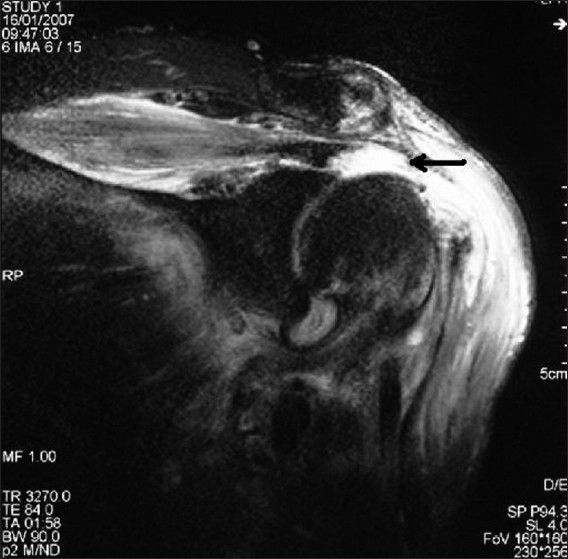
MRIMRI of the shoulder, coronal view: full-thickness supraspinatus tear, arrow on the retracted tendon, with high-signal fluid at its insertion.
Source : Naqvi et al., International journal of shoulder surgery, 2009, figure 3 · CC BY
Three limitations of this instrument are established, and they are more useful to know than its qualities, which are amply documented elsewhere.
The WORC does not grade severity. No band has been published, and the most complete psychometric study explains why none should be invented: applied to 92 patients across three distinct presentations, 35 rotator cuff tears, 35 calcific tendinitis and 22 impingement, it finds significant differences between rotator cuff tears, the most symptomatic, and the other patients for the Constant and for the DASH, but not for the WORC. Its authors conclude that the validity of the instrument in the most symptomatic patients needs further investigation. The tool at the top of this page therefore returns no severity verdict.
The WORC says nothing about the tendon. A prospective cohort of 117 patients undergoing arthroscopic repair of 1 to 5 cm tears, followed for two years, compared the responsiveness of five shoulder questionnaires and of their individual items, those of the WORC included, against structural healing assessed by MRI and CT. No correlation reaches 0.3, neither for total scores nor for high-function items. Better still: at one year, 92 % of patients report an acceptable symptom state, including all those meeting stringent criteria for failed repair. A reading point is needed here, and it is owed to the refuter of this page's source file: the WORC is not one of the five questionnaires whose total score was totalled in that work, it enters only through its individual items.
The WORC has no French name, and no metropolitan version. The only validated French-language adaptation is Canadian French, and it keeps the English acronym: it is called WORC-CF, where the Roland-Morris became the EIFEL in France. It was evaluated in 87 patients, with an intraclass correlation coefficient of 0.96 and a standardized response mean of 1.54. No French, Belgian or Swiss team has published a validation since 2015.
A word finally on cultural adaptations in general, since they are often assumed equivalent. The systematic review that examined them, fourteen studies, finds that none reports all recommended measurement properties. All report reliability; none reports agreement; internal consistency is fully reported by 15 % of them and construct validity by 43 %. Eight of them follow 100 % of the recommended adaptation steps, but only one combines 100 % of those guidelines with 83 % of the quality criteria. Its authors recommend that adapted versions undergo further testing before clinical use.
The minimal important difference is not a number, it is a family
The question asked of a follow-up questionnaire is not 'what is the score' but 'does this change count'. The WORC does not answer with a number. It answers with a family of numbers, and knowing which one applies requires knowing three things: the scale, the population and the treatment.
Let us start with the good news, rare in this kind of file. On the raw scale, the two anchor-based estimates, that is, tied to the patient's own perception of change, converge remarkably: -282.6 points in 222 patients with full-thickness tears, operated or not, and -300 points in 64 adults with partial-thickness tears treated for three months with physiotherapy. Two populations sharing neither lesion nor treatment, and seventeen points apart, less than 1 % of the scale range. This is the most solid ground on this page.
It gives way as soon as the method changes. The same work on the 222 full-thickness tears gives, by distribution-based approach, -392.5 points at a third of a standard deviation and -588.7 at a half. On the same population, with the same data, the threshold doubles depending on the method chosen. A minimal important difference is not a property of the instrument: it is the product of an instrument, a population and a statistical convention.
Then comes what makes the family unusable as it stands. The 2025 meta-analysis, twelve studies and 1,326 observations, establishes that the bar rises with treatment intensity and follow-up duration: 17 for conservative treatment within six months, 26 after surgery, 29 beyond six months. Another team requires more than 35 points after rotator cuff repair. These four values are quoted everywhere, and neither of the two abstracts carrying them declares on which scale they are expressed. Comparing them with the raw thresholds is impossible; assuming they are expressed out of 100 is a hypothesis, not a reading. This page does not make it, and its tool does not apply them.
What the direction does say regardless: applying a surgical threshold to conservative care amounts to declaring the failure of a treatment that worked. Between 17 and 35, the ratio exceeds a factor of two, and that is the only thing these four numbers yield while their scale remains unstated.
Which leaves the reversal, the most interesting result in this file. 56 patients with shoulder pain for at least six months were asked how much improvement they required for a rotator cuff repair to be worth its costs and risks. Their median answer: 40 %, that is 28 points out of 100, that is 533 out of 2100. The authors explicitly note that this value is larger than the published minimal important differences, which they place between 13.5 and 28 out of 100. In other words, the minimal important difference of the WORC is a statistical detection floor, not the bar the patient sets. A physiotherapist invoking a threshold should first say which of the two is meant.
| Published threshold | Value | Declared scale | Population |
|---|---|---|---|
| Minimal important difference, anchor-based | -282.6 | raw, 0 to 2100 | 222 full-thickness tears, operated or not |
| Minimal important difference, anchor-based | -300 | raw, 0 to 2100 | 64 partial-thickness tears, three months of physiotherapy |
| Minimal important difference, one third of a standard deviation | -392.5 | raw, 0 to 2100 | the same 222 full-thickness tears |
| Minimal important difference, half a standard deviation | -588.7 | raw, 0 to 2100 | the same 222 full-thickness tears |
| Standard error of measurement | 6.0 | out of 100, explicitly declared | 57 retested patients, Dutch version |
| Standard error of measurement | 6.9 | out of 100 | 92 patients, three distinct presentations |
| Smallest detectable change | 16.7 | out of 100, explicitly declared | 57 retested patients, Dutch version |
| Smallest worthwhile effect, between groups | 28 | out of 100, paired with 533 out of 2100 | 56 patients asked about benefit and harm |
| Mean minimal difference, conservative < 6 months | 17 | not declared | meta-analysis, 12 studies, 1,326 observations |
| Mean minimal difference, surgery | 26 | not declared | same meta-analysis |
| Mean minimal difference, follow-up > 6 months | 29 | not declared | same meta-analysis |
| Clinically important change after repair | > 35 | not declared | sample size absent from the abstract |
A questionnaire under rights, with no French name and no metropolitan version
This point decides what this page may display, and deserves setting out, because it is often handled by silence.
The WORC has named rights holders. Its public record at the instrument database publisher carries, in full, a copyright line dated 1998 together with a registration number and three names, those of the three authors of the original publication. The same record lists thirteen translations and gives North American English as the original language.
The literature confirms this independently. The title of the Dutch validation carries the copyright symbol next to the acronym; its authors' information section states that one of its signatories, co-author of the original questionnaire, is its copyright holder; and the text specifies that the explanation of several contested questions was adjusted in close consultation with the developer. The same person co-signs the Polish adaptation. Translations therefore go through the developers, which is the behaviour of an instrument under rights, not of a free one.
A methodological note, and it holds beyond this page. The publisher's public record is only readable in a browser: queried from the command line, the same address returns an empty three-thousand-byte shell, and it was that emptiness that led the preparatory file to believe nothing was consultable. Two other pages thought to be blocked are not blocked either: the most consulted physiotherapy encyclopaedia simply has no page on the WORC. As for the detailed conditions of use, they sit behind an account; they were not read, and no account was created to read them.
The verdict is therefore clear and it is limited: an instrument under identified rights, with named holders and precise conditions unread. No public permission to reproduce exists. Describing the questionnaire, explaining its scoring, discussing its thresholds and building a reading tool is perfectly permitted, and that is what this page does. Reproducing its 21 items is not, and this page does not do it.
Why this page does not display the 21 items
The WORC carries a copyright line dated 1998, a registration number and three named holders, read in a browser on the public record of the instrument database publisher. The same person, co-author of the original questionnaire, is declared its copyright holder in the open-access full text of the Dutch validation, whose title carries the copyright symbol next to the acronym. No public permission to reproduce it could be read, and the detailed conditions of use sit behind an account this page did not create. Describing the instrument, explaining its scoring and discussing its thresholds remains permitted; reproducing its items does not. To obtain the questionnaire, one must approach its rights holders.
Four reading pitfalls
Reading a score without saying which scale it is written on
This is the founding pitfall, and it reverses the meaning. 40 on the raw scale describes an almost normal patient; 40 on the percentage scale describes marked disability. A WORC score passed on without its scale is not information.
Applying a surgical threshold to conservative care
The 2025 meta-analysis gives 17 for conservative treatment within six months, 26 after surgery and 29 beyond six months of follow-up; another team requires more than 35 points after repair. Judging twelve rehabilitation sessions by the postoperative threshold means declaring the failure of a treatment that worked.
Taking the minimal important difference for the threshold that counts
Asked directly, 56 patients require 28 points out of 100 of between-group improvement for a repair to be worth its costs and risks, a value the authors describe as larger than the published minimal important differences. The statistical threshold and the patient's bar are not the same object.
Taking the Canadian French version for a metropolitan validation
The WORC-CF was adapted to Quebec French and validated in 87 patients. It is the only French version in existence, and no French, Belgian or Swiss team has published a validation since.
Frequently asked questions
What does the WORC measure?
Quality of life related to rotator cuff disorders, through 21 items across five domains: pain and physical symptoms, sports and recreation, work, lifestyle, emotions.
Does the WORC score rise or fall as the patient improves?
It depends on the scale, and that is the whole problem. On the raw score of 0 to 2100, it falls: 0 is the best state. On the converted score of 0 to 100, it rises: 100 is normal quality of life.
What improvement counts as important?
On the raw scale, the two anchor-based estimates are 282.6 and 300 points. On the percentage scale, the only individual change threshold whose source explicitly declares its scale is a smallest detectable change of 16.7 points; the standard errors of measurement of 6.0 and 6.9 sit alongside it, but they bound the noise, they do not say what counts. The often quoted thresholds of 17, 26, 29 and 35 do not declare theirs.
Is there a French version of the WORC?
Only one, Canadian French, validated in 2015 in 87 patients. It keeps the English acronym, and no French, Belgian or Swiss validation exists.
May the WORC questionnaire be reproduced?
Not without permission. The instrument carries a copyright line dated 1998, a registration number and three named holders, and no public permission to reproduce it could be read.
References
11 sources, PMIDs included
- Kirkley A, Alvarez C, Griffin S. The development and evaluation of a disease-specific quality-of-life questionnaire for disorders of the rotator cuff: The Western Ontario Rotator Cuff Index. Clin J Sport Med 2003;13(2):84-92. PMID 12629425. The original publication, and the source of the structure: 21 items across five domains, each answered on a VAS-type response option. Two-week reliability of 0.96, and construct validity established by 21 of 21 correlations with the DASH, ASES, UCLA, Constant, Rowe, Sickness Impact Profile, SF-36 and range of motion. Its authors report it more responsive than the five other shoulder tools of the time. A reading caveat: the abstract gives no sample size, and this page attributes none to it.
- Furtado R, MacDermid JC, Nazari G, Bryant DM, Faber KJ, Athwal GS. Cross-cultural adaptions and measurement properties of the WORC (Western Ontario rotator cuff index): a systematic review. Health Qual Life Outcomes 2020;18(1):17. PMID 31996226. The systematic review of cultural adaptations, 14 studies retained, and the only text in this file read in full rather than in abstract: it is open access under a CC BY licence, and it is the source of the item distribution by domain, 6 for pain and physical symptoms, 4 for sports and recreation, 4 for work, 4 for lifestyle, 3 for emotions, as well as the sentence fixing the direction of the raw scale, each item scored 0 to 100 and summated to 2100, a higher score meaning poorer quality of life. Its finding is severe: none of the 14 studies reports all recommended measurement properties, none reports agreement, internal consistency is fully reported by 15 % of them and construct validity by 43 %. Only one reaches 100 % of the adaptation guidelines and 83 % of the quality criteria.
- Braun C, Handoll HH. Estimating the Minimal Important Difference for the Western Ontario Rotator Cuff Index (WORC) in adults with shoulder pain associated with partial-thickness rotator cuff tears. Musculoskelet Sci Pract 2018;35:30-33. PMID 29471221. The abstract carrying verbatim the bounds of the raw scale and their direction, score 0 (best) to 2100 (worst disability), and the only anchor-based minimal important difference in patients treated exclusively with physiotherapy. In 64 adults with symptomatic atraumatic partial-thickness tears, three months of exercise-based conservative treatment in German outpatient care, anchored on a seven-point Global Perceived Change scale: -300 points, for improvement in 9 patients out of 10 (95 % CI: 8 out of 10 to everyone).
- Gagnier JJ, Robbins C, Bedi A, Carpenter JE, Miller BS. Establishing minimally important differences for the American Shoulder and Elbow Surgeons score and the Western Ontario Rotator Cuff Index in patients with full-thickness rotator cuff tears. J Shoulder Elbow Surg 2018;27(5):e160-e166. PMID 29307675. The second anchor-based estimate on the raw scale, in 222 subjects with full-thickness tears, operated or not, followed at 4, 8, 16, 32, 48 and 64 weeks: -282.6 points. This is the remarkable convergence in this file, within seventeen points of the previous one, across two populations sharing neither lesion nor treatment. The same work gives the distribution-based estimates, far larger: -588.7 at half a standard deviation and -392.5 at a third. No variable predicted the variation in minimal important differences.
- de Witte PB, Henseler JF, Nagels J, Vliet Vlieland TP, Nelissen RG. The Western Ontario rotator cuff index in rotator cuff disease patients: a comprehensive reliability and responsiveness validation study. Am J Sports Med 2012;40(7):1611-9. PMID 22582227. The most complete psychometric study, and the abstract carrying the other scale, WORC (range, 0-100; 21 items, 5 domains). In 92 patients across three distinct presentations, 35 rotator cuff tears, 35 calcific tendinitis and 22 impingement: Cronbach's alpha 0.95, ICC 0.89, standard error of measurement 6.9, no floor or ceiling effect, mean baseline WORC of 46.8 ± 20.4. Its limitation is the most useful finding on this page: unlike the Constant and the DASH, the WORC did not separate rotator cuff tears, the most symptomatic patients, from the others. A reading caveat: the mean gain of 18.8 (95 % CI: 11.3 to 26.2) is measured six weeks after needling and lavage or injection in the single calcific tendinitis subgroup, not in the 92 patients.
- Wessel RN, Wolterbeek N, Fermont AJ, van Mameren H, Sonneveld H, Griffin S, de Bie RA. The conceptually equivalent Dutch version of the Western Ontario Rotator Cuff Index (WORC)©. BMC Musculoskelet Disord 2013;14:362. PMID 24359231. The Dutch validation, and the only reference in this file that declares its scale while giving an individual change threshold: standard error of measurement of 6.0 points and smallest detectable change of 16.7 points, on a 0-100 scale, in 57 patients enrolled, of whom 50 remained available for the test-retest reliability analysis. It is also the documentary proof that this questionnaire has a rights holder: its title carries the copyright symbol next to the acronym, one of its signatories is Sharon Griffin, co-author of the instrument, and the open-access full text states that she is its copyright holder.
- Wessel RN, Wolterbeek N, Fermont AJM, Lavrijsen L, van Mameren H, de Bie RA. Responsiveness and disease specificity of the Western Ontario Rotator Cuff index. J Orthop 2018;15(2):337-342. PMID 29881148. The source of the highest threshold in the family, 'more than 35 points' for a patient undergoing rotator cuff repair to be considered clinically improved. Two caveats that decide how it may be used. The abstract gives no sample size. And above all it does not declare its scale: the same team worked on 0-100 in its 2013 Dutch validation, but this abstract does not restate it, and this page does not assume it on their behalf.
- Farzad M, Jafari H, MacDermid JC, Ataeian M. Responsiveness and clinically important differences of the Western Ontario Rotator Cuff (WORC) Index in surgical and non-surgical treatment groups with different follow-up periods: A systematic review and meta-analysis. Shoulder Elbow 2025;17(2):219-232. PMID 39574545. The reference meta-analysis, 12 studies and 1,326 observations, appraised with COSMIN and GRADE. It establishes that the minimal difference of the WORC is not a constant: it grows with treatment intensity and follow-up duration, at 17 for conservative treatments within six months, 26 after surgery and 29 beyond six months. Overall effect size of 0.91 (95 % CI: 0.56 to 1.26), heterogeneity I² = 91.2 %, which is considerable. Here again, the abstract does not state on which scale these three values are expressed.
- Hansford HJ, Buchbinder R, Zadro JR, McAuley JH, Ferreira ML, Lewin A, Page RS, Harris IA. The smallest worthwhile effect on pain and function for rotator cuff repair surgery: a benefit-harm trade-off study. Trials 2025;26(1):203. PMID 40500773. The work that turns the question around, and the only source in this file to let patients speak rather than statistics. 56 English-speaking participants aged 45 to 75, shoulder pain of at least 4 out of 10 for at least six months, mean age 58.4 ± 6.7 years, 39 women out of 56: asked about the benefit-harm trade-off, they require a median between-group improvement of 40 % for a repair to be worth its costs and risks, that is 28 points out of 100, or 533 out of 2100 on the raw score. The authors write that this value is larger than the published minimal important differences, which they place between 13.5 and 28 out of 100. A caveat given by the authors themselves: the reliability analysis is underpowered, 25 of 56 subjects having provided follow-up data, for ICCs of 0.60 to 0.77. It is also the only indexed abstract pairing a value from both scales.
- Sahoo S, Li Y, Cogan CJ, Entezari V, Ho JC, Iannotti JP, Ricchetti ET, Lapin B, Derwin KA. Comparative responsiveness of shoulder patient-reported outcome measures (PROMs) to rotator cuff repair surgery and healing. J Shoulder Elbow Surg 2026;35(7):1685-1694. PMID 41720252. The prospective cohort of 117 patients undergoing arthroscopic repair of 1 to 5 cm tears, followed for two years, measuring what no shoulder questionnaire does: neither total scores nor high-function items correlate with structural healing assessed by MRI Sugaya classification and CT-measured tendon retraction, all correlations below 0.3. At one year, 92 % of patients report an acceptable symptom state, including all those meeting stringent criteria for failed repair. An important reading point: the WORC is not one of the five questionnaires whose total score was totalled in this work, it enters only through its individual items.
- St-Pierre C, Dionne CE, Desmeules F, Roy JS. Reliability, validity, and responsiveness of a Canadian French adaptation of the Western Ontario Rotator Cuff (WORC) index. J Hand Ther 2015;28(3):292-8; quiz 299. PMID 25990445. The only French version of the WORC, and it is from Quebec. Translated and cross-culturally adapted following the standard procedure, then evaluated in 87 patients with rotator cuff disorders who completed it three times, at baseline, two days later for reliability and four weeks later for responsiveness: ICC of 0.96, high correlation with the DASH, standardized response mean of 1.54. Its authors note from the outset that few shoulder questionnaires exist in French. No French, Belgian or Swiss validation has been published since, and the instrument carries no French name: the English acronym is kept as is.
 Page written by Anthony Baillon, physiotherapist, co-founder of Physio Learning. The questionnaire itself is by Kirkley, Alvarez and Griffin, in 2003: this page documents, scores and interprets it, it reproduces none of its items.
Behind this article
An author who explains, a reviewer who checks.
How we write and check our content

Physiotherapist · co-founder of Physio Learning
Marked for life by his first four-hour lecture without a single image, he took a master’s in instructional design so that it would never happen to anyone again. He hunts down publication bias and unreadable slides with the same intransigence.

Head of scientific content
Physiotherapist specialising in neuro-musculoskeletal practice and holder of a master’s in public health. He checks the methodological rigour of every article: primary sources, levels of evidence, no exceptions.