





Could your acromioclavicular osteoarthritis be linked to your work? This page reviews, with official sources, recognition as an occupational disease in France: what schedule 57 does (and does not) cover, the CRRMP route, the practical steps and the compensation you may be entitled to.
📝 In brief
- Acromioclavicular osteoarthritis is not a « scheduled » occupational disease. Section A (shoulder) of schedule no. 57 of the general scheme lists only three rotator cuff conditions: acute non-ruptured non-calcific tendinopathy, chronic non-ruptured non-calcific tendinopathy, and partial or full-thickness tear confirmed by MRI. Neither osteoarthritis nor the acromioclavicular joint appears there: it cannot therefore benefit from the presumption of occupational origin 8.
- Recognition remains possible, but through the complementary system. A disease not listed in a schedule can be recognised as occupational in origin if it is essentially and directly caused by the person’s usual work and results in death or permanent disability of at least 25 %: the threshold set by article R. 461-8 of the social security code 73.
- The case must go before a CRRMP. When the CPAM cannot rule because no schedule matches (or because a condition of the schedule is not met), it passes the case to the regional occupational disease recognition committee for a reasoned opinion, which is binding on the fund 27.
- Two time limits not to be confused. The employee has 2 years from the initial medical certificate to send the declaration (form S6100b + the first two parts of the medical certificate); in practice the form is completed within 15 days of the start of sick leave. The fund then has 120 days to rule, and the CRRMP 4 months to give its opinion (+ 2 months if a further investigation is needed) 7.
- Compensation depends on the permanent disability rating. After the condition has stabilised, below 10 % permanent disability compensation takes the form of a lump sum paid once; from 10 %, it is a pension (quarterly between 10 and 50 %, monthly from 50 %), exempt from CSG and CRDS contributions and not subject to income tax 7.
- Other rights exist alongside. The invalidity pension (the « ordinary » illness route) requires working capacity or earnings reduced by at least 66 %, with three categories (30 % of average annual income in category 1, 50 % in category 2, 50 % plus a supplement in category 3). If the shoulder limits your chances of obtaining or keeping a job, disabled worker status (RQTH) is applied for at the MDPH: granted for 1 to 10 years, or for life if the disability cannot improve 7.
📋 What the regulations say
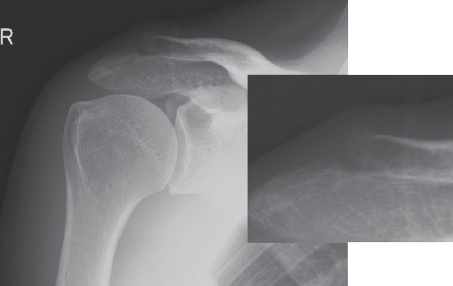
X-rayFrontal shoulder X-ray with close-up of the acromioclavicular joint: osteosclerosis of the distal clavicle and a subchondral cyst, signs of acromioclavicular osteoarthritis.
Source : Koike et al., Upsala journal of medical sciences, 2010, figure 3 · CC BY-NC
Let us say it straight away: acromioclavicular osteoarthritis appears in no occupational disease schedule. That does not close the door to recognition, but it changes the route, and the level of proof required.
Schedule 57 A (shoulder): what it lists, and what it does not
Schedule no. 57 of the general scheme covers « periarticular conditions caused by certain work movements and postures ». Its section A concerns the shoulder and lists only three conditions, all of the rotator cuff : acute non-ruptured non-calcific tendinopathy, chronic non-ruptured non-calcific tendinopathy (with or without enthesopathy) and partial or full-thickness cuff tear confirmed by MRI 8. The words « osteoarthritis » and « acromioclavicular » appear nowhere in it.
The direct consequence: your AC osteoarthritis does not benefit from the presumption of occupational origin, that mechanism, which spares you having to prove the link with work yourself, is reserved for diseases listed in a schedule and contracted under its conditions 2.
| Listed condition | Time limit for cover | Length of exposure |
|---|---|---|
| Acute non-ruptured non-calcific tendinopathy | 30 days | Not required |
| Chronic non-ruptured non-calcific tendinopathy | 6 months | 6 months |
| Partial or full-thickness cuff tear (MRI) | 1 year | 1 year |
| Acromioclavicular osteoarthritis | Not listed | Outside the schedule |
The exhaustive list of work activities covers movements or holding the shoulder unsupported in abduction, for the acute form, an angle of 60° or more for at least 3 h 30 a day in total (INRS 2026). They concern you only if a tendinopathy or a tear is also documented in your case. On the condition itself, see the article acromioclavicular osteoarthritis.
The possible route: the complementary system and the CRRMP
A disease outside the schedules can nonetheless be recognised, through the « complementary system » of article L. 461-1, on two demanding cumulative conditions: it must be essentially and directly caused by the person’s usual work and result in death or permanent disability of at least 25 % 7, the threshold set by article R. 461-8 of the social security code 3.
With no matching schedule, the CPAM informs you, and your employer, that the case is being passed to the regional occupational disease recognition committee (CRRMP). It then recognises the occupational origin after that reasoned opinion, which is binding on it 72.
Let us be honest: 25 % is a high threshold for isolated AC osteoarthritis. And no indicative scale specific to this site appears in the official sources cited here: nobody can tell you what rating to « expect ».
No schedule does not mean no rights: it means the burden of proving the link with your work falls on you.
The steps, one by one
- The initial medical certificate. Your doctor states on it the possible link between the disease and your work. Its date starts the clock.
- The declaration. It is you who declares: form S6100b « Déclaration de maladie professionnelle » sent to your CPAM (or MSA), with the first two parts of the initial certificate 7.
- The time limits. The form is to be completed within 15 days of the start of sick leave (Service-Public.fr 2026), but you retain 2 years from the initial certificate, or from the date you stopped working because of the disease, if later 7.
- The review. The fund has 120 days to rule 7. If the CRRMP is asked, it has 4 months, plus 2 months if a further investigation is needed (Service-Public.fr 2026).
After the condition stabilises: compensation and other rights
If lasting effects remain, the fund’s medical adviser proposes a permanent disability rating (IPP). Below 10 %, it is a lump sum paid once. From 10 %, a pension : quarterly between 10 and 50 %, monthly from 50 %. It is exempt from CSG and CRDS contributions and not subject to income tax 7.
Two schemes exist alongside. The invalidity pension (the « ordinary » illness route) requires working capacity or earnings reduced by at least 66 %, in three categories: category 1st (able to work, 30 % of average annual income), category 2nd (total incapacity, 50 %), category 3rd (needing another person’s help, 50 % plus a supplement) 7. The RQTH, applied for at your department’s MDPH, is granted for 1 to 10 years, or for life if the disability cannot improve, and gives access to workplace adjustments and to dedicated employment support schemes (Service-Public.fr 2026).
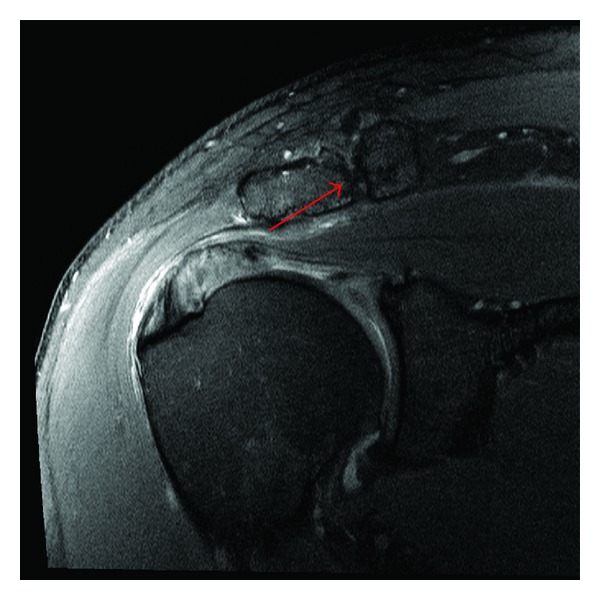
MRICoronal shoulder MRI, fat-saturated PD sequence: moderate to severe osteoarthritis of the acromioclavicular joint, arrow on the joint.
Source : Murray et al., Case reports in orthopedics, 2014, figure 2 · CC BY
Key points
- AC osteoarthritis is in no schedule : no presumption, the link with work must be demonstrated.
- Schedule 57 A covers only the rotator cuff: useful if a tendinopathy or a tear is also documented in your case.
- One route only: the complementary system through the CRRMP, with a disability threshold of at least 25 %.
- Time limits: 2 years to declare, 120 days for the review, 4 months for the CRRMP opinion.
- Disabled worker status and the invalidity pension remain available without recognition as an occupational disease.
🗂️ The steps, one by one
Your condition is listed in no schedule: schedule no. 57 A of the general scheme lists only three shoulder conditions (acute tendinopathy, chronic tendinopathy, cuff tear confirmed by MRI) and mentions neither osteoarthritis nor the acromioclavicular joint 8. You therefore do not benefit from the presumption of occupational origin reserved for the schedules 2 : your case will go through the so-called « complementary » route. More demanding, but very real. On the condition itself, see the full article: Acromioclavicular osteoarthritis.
Key points
- Everything starts with the initial medical certificate (CMI) written by a doctor.
- It is you, the employee, who declares, not the employer, not the doctor.
- Form S6100b + the first two parts of the CMI, sent to your CPAM.
- Time limit to declare: 2 years from the date of the CMI 7.
- Outside the schedules: opinion of the CRRMP and permanent disability of at least 25 % 73.
Step 1: The initial medical certificate
It all starts at the doctor’s, most often your GP. They write the CMI, which names the disease and the possible link with your work. This document starts your rights running: the 2-year limit runs from the CMI informing you of that possible link, or from the date you stopped working because of the disease, if later 7.
Two pieces of advice: ask that the certificate name the lesion precisely (acromioclavicular osteoarthritis, which side) and rest on the imaging; and bring a written description of your work movements, because your GP knows your shoulder but rarely your job.
Step 2: The declaration to the CPAM
It is you who declares, to your CPAM, using form S6100b « Déclaration de maladie professionnelle » and the first two parts of the CMI 7. If sick leave is prescribed, the form is to be completed within 15 days of the start of that leave (Service-Public.fr 2026), without this depriving you of the overall 2-year limit.
Step 3: The review, then the CRRMP
The fund has 120 days to rule 7. As no schedule matches, it cannot decide alone: it informs you, and your employer, that the case is being passed to the regional occupational disease recognition committee (CRRMP). That committee has 4 months to give its opinion, plus 2 months if a further investigation is needed (Service-Public.fr 2026). That reasoned opinion is binding on the fund 2.
The committee looks at two things: that the disease is essentially and directly caused by your usual work, and that it results in permanent disability of at least 25 % 7: the threshold set by article R. 461-8 of the social security code 3.
| Situation | Proof required | Route |
|---|---|---|
| Condition in schedule 57 A, all requirements met | None: presumption of occupational origin 2 | Direct route |
| Condition in schedule 57 A, one requirement missing (time limit, list of work activities) | Direct link with usual work (CRRMP) | Complementary route |
| Acromioclavicular osteoarthritis (outside the schedules) | Essential and direct link and permanent disability ≥ 25 % 7 | Demanding route |
The occupational health doctor’s role
They do not declare on your behalf and do not write the CMI. Their value lies elsewhere: they know your job, your hours, your movements, which is what the CRRMP seeks to establish. The markers in schedule 57 A give an idea of what counts as significant shoulder exposure: movements or holding the shoulder unsupported in abduction, an angle of at least 60°, for at least 3 h 30 a day in total for the acute form (INRS 2026). Those thresholds do not apply legally to your osteoarthritis, which is outside the schedules, but they show the level of precision expected.
A case outside the schedules is won less on the diagnosis than on a precise description of the work.
Five steps for a solid case
- Date it early : the CMI starts the countdown.
- Document the exposure : job descriptions, rotas, contracts, statements from colleagues. The committee decides on the documents.
- Gather the imaging and the history: X-rays, MRI, reports.
- Ask the occupational health doctor for a description of the job, before filing.
- Keep a copy of everything and send it by recorded delivery.
And afterwards? Stabilisation and rights
Disease recognised and lasting effects remaining after stabilisation: a permanent disability rating is set. Below 10 %, a lump sum paid once; from 10 %, a pension: quarterly between 10 and 50 %, monthly from 50 %. That pension is exempt from CSG and CRDS contributions and is not subject to income tax 7.
Two distinct schemes exist alongside. The invalidity pension falls under « ordinary » illness and requires working capacity or earnings reduced by at least 66 %, in three categories (30 % of average annual income; 50 %; 50 % plus a supplement for another person’s help) 7. The RQTH is applied for at the MDPH if the osteoarthritis reduces your chances of obtaining or keeping a job: granted for 1 to 10 years, or for life if the disability cannot improve, it gives access to workplace adjustments (Service-Public.fr 2026).
One honest caveat: the official sources cited here do not publish the proportion of acromioclavicular osteoarthritis cases recognised by the CRRMPs. The 25 % threshold is high, and nobody can tell you the outcome in advance. That does not make the process pointless: it justifies preparing it seriously.
💶 Sick leave, disability rating and compensation: what to expect
If your acromioclavicular osteoarthritis seems linked to your job, one question comes up quickly: what are you entitled to, and on what conditions? The answer turns on a decisive point of law: this condition appears in no occupational disease schedule. That does not close the door to recognition, but it changes the rules of the game. For everything about the disease itself (symptoms, investigations, treatments), see our full article on acromioclavicular osteoarthritis : this page focuses on your rights.
Outside the schedules: no presumption, but a complementary route
Schedule no. 57 A of the general scheme (shoulder) lists only three rotator cuff conditions: acute tendinopathy, chronic tendinopathy and partial or full-thickness tear confirmed by MRI. Acromioclavicular osteoarthritis appears nowhere in it 8. It therefore does not benefit from the presumption of occupational origin that spares employees from proving the link with their work when all the requirements of a schedule are met 2.
Your case then falls under the complementary system : the CPAM passes it to the regional occupational disease recognition committee (CRRMP), whose reasoned opinion is binding on the fund. Two cumulative conditions: the disease must be essentially and directly caused by your usual work, and result in permanent disability of at least 25 % 73. That is a high threshold, and it is worth knowing from the outset: not every case of acromioclavicular osteoarthritis that hampers work reaches it.
By way of comparison, the shoulder conditions that are listed in schedule 57 A follow strict requirements: a cover period of 30 days (acute tendinopathy), 6 months (chronic tendinopathy, with 6 months of exposure) or 1 year (cuff tear, with 1 year of exposure), for work involving holding the shoulder unsupported in abduction: an angle ≥ 60° for at least 3 h 30 a day in total for the acute form (INRS 2026).
Length of sick leave: no official benchmark for this condition
Let us be transparent: there is, as far as we know, no official indicative length of sick leave published specifically for acromioclavicular osteoarthritis. The figures you will come across (30 days, 6 months, 1 year) are administrative cover periods under schedule 57 A: they concern neither acromioclavicular osteoarthritis nor the length of your leave. That is decided case by case with your doctor, according to the intensity of the pain, the treatment (with or without surgery) and the demands of your job.
After stabilisation: lump sum or disability pension
If the disease is recognised as occupational in origin and lasting effects remain after stabilisation, the fund’s medical adviser proposes a permanent disability rating (IPP), which determines the form the compensation takes 7 :
| IPP rating | Compensation | Payment |
|---|---|---|
| Below 10 % | Flat-rate lump sum | Once only |
| From 10 to 50 % | Permanent disability pension | Every quarter |
| From 50 % | Permanent disability pension | Every month |
Worth knowing: this pension is exempt from CSG and CRDS contributions and is not subject to income tax 7.
It is the disability rating set after stabilisation that decides the form your compensation takes.
Invalidity pension: a route distinct from the disability pension
If recognition as an occupational disease fails, or alongside an « ordinary » illness, the invalidity pension remains possible. It requires working capacity or earnings reduced by at least 66 % (a loss of at least two thirds) and comes in three categories: category 1st (you can still work: pension of 30 % of average annual income), category 2nd (totally unable to work: 50 %), category 3rd (totally unable to work and needing another person’s help: 50 % plus a supplement) 7.
RQTH: protecting your job day to day
If acromioclavicular osteoarthritis reduces your chances of obtaining or keeping a job, you can apply for disabled worker status (RQTH) at your department’s MDPH, online or by form. It is granted for 1 to 10 years, or for life if the disability cannot improve, and gives access in particular to workplace adjustments and to dedicated employment support schemes (Service-Public.fr 2026). It is often the most useful step day to day, independently of any pension.
The time limits not to let slip
You make the declaration yourself to the CPAM, with form S6100b together with the first two parts of the initial medical certificate. In practice, it must be completed within 15 days of the start of sick leave; you nonetheless retain a maximum of 2 years from the initial medical certificate. The fund then has 120 days to rule and, where the CRRMP is asked, which is the case for acromioclavicular osteoarthritis, the committee has 4 months to give its opinion, plus 2 months if a further investigation is needed 7. So arm yourself with patience: the full review can approach a year.
Key points
- Acromioclavicular osteoarthritis is a disease « outside the schedules »: no presumption of occupational origin.
- Recognition possible through the CRRMP, but with a permanent disability threshold of at least 25 %.
- Disability rating after stabilisation: a lump sum below 10 %, a pension (untaxed) from 10 %.
- The invalidity pension (3 categories) and disabled worker status remain distinct routes, often more accessible.
- Declaration: form S6100b, 15 days in practice, 2 years maximum; 120-day review, plus 4 months of CRRMP.
🏢 Staying in work: adjustments and what comes next
A shoulder that hurts at work does not necessarily mean stopping for good. In most situations, the issue is not choosing between « holding on » and « leaving », but adjusting the job, the pace and the movements while the pain settles. This section describes the administrative levers for staying in work. For the clinical side (understanding the condition, the investigations, the treatments), see the full article Acromioclavicular osteoarthritis.
The starting point: your AC osteoarthritis is « outside the schedules »
That is the legal fact governing all the rest. Schedule no. 57 A of occupational diseases under the general scheme, which covers the shoulder, lists only three conditions: acute non-ruptured non-calcific tendinopathy, chronic non-ruptured non-calcific tendinopathy and partial or full-thickness rotator cuff tear confirmed by MRI. Neither osteoarthritis nor the acromioclavicular joint appears there 8. You therefore do not benefit from the presumption of occupational origin attached to the schedules 2 : recognition goes through the complementary system, with an opinion from the regional committee (CRRMP) and a permanent disability threshold of at least 25 % 73.
In other words: the « occupational disease » route is a narrow one for isolated AC osteoarthritis. It is worth attempting if your usual work is implicated, but it should not be your only plan. The schemes for staying in work, for their part, depend on no schedule.
Staying in work does not depend on recognition as an occupational disease: it is settled with the occupational health doctor.
Adjusting the job: disabled worker status as the key
If your acromioclavicular osteoarthritis reduces your chances of obtaining or keeping a job, you can apply for disabled worker status (RQTH) at your department’s MDPH, online or by form. It is granted for 1 to 10 years, or for life if the disability cannot improve, and gives access in particular to workplace adjustments and to dedicated employment support schemes (Service-Public.fr 2026).
The word « disabled » puts many patients off. Here it is an administrative status, not a judgement on you: it is what unlocks the means to adapt a job.
Phased return, redeployment, unfitness for work: to be discussed, not improvised
These three schemes exist and are frequently used for painful shoulders. We do not set out here the conditions for access, their duration or their consequences for your pay: they vary according to your scheme, your collective agreement and your situation, and we would rather assert nothing we have not checked. The right person to speak to is the occupational health doctor: it is they who propose adjustments, who trigger the workplace assessment and who, only as a last resort, declare unfitness for work, which triggers the duty to seek redeployment. Your CPAM and your HR department complete the picture.
What to avoid above all: waiting for long-term sick leave before raising it. A shoulder spared early in an adjusted job has a better chance of remaining a working shoulder.
If lasting effects set in: pension or invalidity?
Two routes often confused, with very different thresholds.
| Scheme | Condition | What you receive |
|---|---|---|
| Permanent disability after a recognised occupational disease | IPP rating below 10 % after stabilisation | Lump sum, paid once 7 |
| Permanent disability after a recognised occupational disease | IPP rating from 10 % | Pension: quarterly between 10 and 50 %, monthly from 50 %; exempt from CSG and CRDS contributions and from income tax 7 |
| Invalidity pension (the « ordinary » illness route) | Working capacity or earnings reduced by at least 66 % | 1st category: 30 % of average annual income; category 2nd : 50 % ; 3rd : 50 % plus a supplement for another person’s help 7 |
If you do nonetheless make an occupational disease declaration, note that you have 2 years from the initial medical certificate to send it with form S6100b, that the fund has 120 days to rule and that the CRRMP has 4 months to give its opinion, plus 2 months if a further investigation is needed 7.
And where does rehabilitation fit in?
Rehabilitation and workplace adjustment answer two different questions: what your shoulder can do, and what your job asks of it. Acting on one while ignoring the other leaves half the problem untouched, that is common-sense reasoning, which we do not claim here to support with figures on staying in work: we have not checked any. What physiotherapy follow-up involves, what to expect from it and the level of evidence behind it are covered in the article Acromioclavicular osteoarthritis. The occupational health doctor, for their part, does not prescribe rehabilitation: they adjust the job. The two run in parallel, not one after the other.
Key points
- Acromioclavicular osteoarthritis is in no schedule: no presumption, the CRRMP route is compulsory, with a 25 % permanent disability threshold 83.
- Disabled worker status, applied for at the MDPH, is granted for 1 to 10 years (or for life) and opens access to workplace adjustments (Service-Public.fr 2026).
- Phased return, redeployment, unfitness: speak to the occupational health doctor before long-term leave, not after.
- Lasting effects: lump sum below 10 % IPP, pension from 10 %; the invalidity pension, for its part, requires a loss of at least 66 % 7.
- Workplace adjustment and rehabilitation support each other: the treatment side is set out in the main article.
Bibliography
10 official sources (Légifrance, Ameli, INRS, Service-public…), each checked individually: direct clickable link. Click a superscript note marker in the text: the bibliography opens and highlights the source.
- Légifrance (2017). Code de la sécurité sociale — Article Annexe II: Tableau n° 57 (version in force since 8 May 2017). View the source.
- Légifrance (2018). Code de la sécurité sociale — Article L461-1 (version in force since 1 July 2018). View the source.
- Légifrance (2019). Code de la sécurité sociale — Article R461-8 (version in force since 1 December 2019, décret n° 2019-356). View the source.
- INRS (2026). Tableau des maladies professionnelles — Régime général tableau 57: Affections périarticulaires provoquées par certains gestes et postures de travail. View the source.
- Ameli (Assurance Maladie) (2026). Maladie professionnelle: définition et démarches — page assuré. View the source.
- Service-Public.fr (2026). Maladie professionnelle: démarches à effectuer (fiche F176). View the source.
- Ameli (Assurance Maladie) (2026). Incapacité permanente suite à une maladie professionnelle: indemnités et rentes. View the source.
- Légifrance (2017). Code de la sécurité sociale — Annexe II: Tableau n°57 (Affections périarticulaires provoquées par certains gestes et postures de travail), version in force since 08 May 2017. View the source.
- INRS (2026). Tableaux des maladies professionnelles — RG 57: Affections périarticulaires provoquées par certains gestes et postures de travail. View the source.
- Service-Public.fr (2026). Qu'est-ce que la reconnaissance de la qualité de travailleur handicapé (RQTH)?. View the source.
❓ Frequently asked questions
Is acromioclavicular osteoarthritis recognised as an occupational disease?
Not under a schedule. Section A (shoulder) of schedule no. 57 of occupational diseases under the general scheme lists only three rotator cuff conditions: acute non-ruptured non-calcific tendinopathy, chronic non-ruptured non-calcific tendinopathy (with or without enthesopathy) and partial or full-thickness tear confirmed by MRI. The term « acromioclavicular osteoarthritis » appears nowhere in it 8. It is therefore a disease « outside the schedules », which does not benefit from the presumption of occupational origin provided for in article L. 461-1 of the social security code 2. It can, on the other hand, be recognised through the complementary system, under strict conditions.
Which occupational disease schedule applies to the shoulder?
It is schedule no. 57 A, « Affections périarticulaires provoquées par certains gestes et postures de travail ». It sets strict cover periods: 30 days for acute tendinopathy, 6 months for chronic tendinopathy (subject to 6 months of exposure) and 1 year for rotator cuff tear (subject to one year of exposure). The exhaustive list of work activities covers movements or holding the shoulder unsupported in abduction, with an angle of 60° or more for at least 3 h 30 a day in total for the acute form 8. None of those three entries covers acromioclavicular osteoarthritis.
How can acromioclavicular osteoarthritis be recognised as occupational in origin without a schedule?
Through the complementary recognition system. Where the CPAM cannot rule because no schedule matches the condition, or because a requirement of the schedule is not met, it informs the insured person and their employer that the case is being passed for an opinion to the regional occupational disease recognition committee (CRRMP). The primary fund then recognises the occupational origin after that committee’s reasoned opinion, which is binding on it 27. For a disease not listed in a schedule, two cumulative conditions are required: that the disease be essentially and directly caused by the person’s usual work, and that it result in their death or permanent disability of at least 25 % 73.
What is the time limit for declaring an occupational shoulder disease to the CPAM?
The declaration is made by the employee themselves to their CPAM (or MSA) using form S6100b « Déclaration de maladie professionnelle », together with the first two parts of the initial medical certificate written by the doctor. The limit is 2 years from the date of the initial medical certificate stating the possible link between the disease and the work, or from the date of stopping work because of the disease, if later 7. In practice, the form must be completed within 15 days of the start of sick leave. The fund then has 120 days to rule, and the CRRMP, if asked, 4 months to give its opinion, plus a further 2 months if an additional investigation is needed 7.
What compensation or disability rating for occupational acromioclavicular osteoarthritis?
After stabilisation, if lasting effects remain, the fund’s medical adviser proposes a permanent disability rating (IPP) awarded by the CPAM. Below 10 %, compensation takes the form of a flat-rate lump sum paid once; from 10 %, a permanent disability pension is paid: quarterly between 10 and 50 %, monthly from 50 %. That pension is exempt from CSG and CRDS contributions and is not subject to income tax 7. To be distinguished from the invalidity pension, which falls under « ordinary » illness and requires working capacity or earnings reduced by at least 66 %: category 1, 30 % of average annual income; category 2, 50 %; category 3, 50 % plus a supplement for another person’s help 7. Finally, if the shoulder reduces your chances of obtaining or keeping a job, disabled worker status can be applied for at the MDPH: it is granted for 1 to 10 years, or for life if the disability cannot improve, and gives access to workplace adjustments (Service-Public.fr 2026).
Behind this article
An author who explains, a reviewer who checks.
How we write and check our content

Physiotherapist · co-founder of Physio Learning
Marked for life by his first four-hour lecture without a single image, he took a master’s in instructional design so that it would never happen to anyone again. He hunts down publication bias and unreadable slides with the same intransigence.

Head of scientific content
Physiotherapist specialising in neuro-musculoskeletal practice and holder of a master’s in public health. He checks the methodological rigour of every article: primary sources, levels of evidence, no exceptions.