





You have been told you have osteoarthritis of the facet (« zygapophysial ») joints in your lower back, and the question keeps coming up: injection, radiofrequency, or surgery? Let us be clear: surgery is not a treatment for isolated facet joint osteoarthritis, injections have a modest and short-lived effect, and exercise remains the foundation. Here is what the trials actually show, and how each option is decided.
📝 In brief
- Surgery has no place in isolated lumbar facet joint osteoarthritis: there is no convincing evidence justifying a surgical procedure for degenerative facet joint pain, except traumatic dislocation: management is conservative first 89.
- Intra-articular corticosteroid injection disappoints: in the only double-blind randomised trial against placebo, 42 % of patients on methylprednisolone against 33 % on saline reported marked improvement at one month, with no clinically or statistically significant difference on the primary outcome 1 ; the European guidelines do not recommend intra-articular corticosteroids 8.
- The effect of injections appears largely non-specific: in a meta-analysis of 3 trials (247 patients), corticosteroids, anaesthetics and saline produced comparable pain relief at 1 hour, at 1–1.5 months and at 3–6 months, no difference demonstrated between active substance and saline placebo 3.
- Facet joint radiofrequency does not improve low back pain once exercise is in place: in the MINT facet trial, radiofrequency added to a standardised exercise programme produced a difference of only −0.18 points out of 10 at 3 months (95 % CI −0.76 to 0.40) against exercise alone, non-significant and clinically negligible 4.
- Exercise remains the foundation of treatment: with moderate certainty, it reduces pain by 15 points out of 100 against no treatment, usual care or placebo, with physiotherapy (postural education, stretching, trunk strengthening) as a cornerstone 109.
- Imaging is not pain: facet joint osteoarthritis is part of spinal ageing (found on imaging in 36 % of adults under 45, 67 % of those aged 45–64 and 89 % of those aged 65 and over) and correlates poorly with symptoms 98.
🔬 What the studies really say
When facet joint pain settles in, the question keeps coming back: should you have an injection, « burn » the nerve, have surgery? To answer honestly, you have to look at what the clinical trials actually show, not at what we hope they show. If you first want to understand the condition itself, the full article on lumbar facet joint osteoarthritis sets out its mechanism. Here we focus on one thing only: invasive procedure or conservative treatment, what does the evidence say?
Key points
- No invasive procedure has demonstrated a clear, lasting benefit in isolated facet joint osteoarthritis.
- Corticosteroid injections give a modest, short-lived effect.
- Radiofrequency has mixed results across trials.
- Surgery is not a treatment for facet joint osteoarthritis as such.
- Exercise remains the foundation of treatment, with the best level of evidence.
Injections and blocks: a modest and short-lived effect
The only double-blind randomised trial against placebo, in patients who had actually been selected because a facet joint anaesthetic block had relieved them, is instructive. At one month, 42 % of patients who had received corticosteroid (methylprednisolone) against 33 % of those who had received saline reported marked or very marked improvement: a difference neither clinically nor statistically significant on that primary outcome 1.
At six months, only 22 % of patients on corticosteroid (11 of 49) and 10 % on placebo (5 of 48) still had sustained improvement. The effect is therefore modest and brief. To be precise: that six-month figure numerically favours the corticosteroid, and the authors did observe a statistical difference after adjustment, but they judged it of little clinical importance and probably related to the other care received. Their conclusion is clear: injecting corticosteroid into the facet joints is « of little use » in chronic low back pain.
The systematic reviews confirm this uncertain picture. One review found only six trials, all small (18 to 109 participants), heterogeneous and mostly inconclusive, with only two showing a significant difference: it was not even possible to pool them in a meta-analysis 2. Another analysis (3 trials, 247 patients) finds comparable pain relief between active substances and saline; but it is too small, with enormous margins of uncertainty, to conclude that they are genuinely equivalent: let us say that no difference was demonstrated there, which is not the same thing as proof of a non-specific effect 3.
Radiofrequency thermocoagulation: mixed evidence
Radiofrequency involves « heating » the small nerves that supply the facet joint. Here the evidence is frankly divided. In the large MINT randomised trials, adding radiofrequency of the facet joint nerves to a standardised exercise programme brought no clinically relevant improvement: the difference in pain at 3 months in the facet trial was −0.18 points out of 10 (95 % CI −0.76 to 0.40) compared with exercise alone 4.
Conversely, a meta-analysis of 7 trials (454 patients) finds a significant reduction in low back pain at one year against a placebo (« sham ») or an epidural block, with, in a subgroup, a benefit in those who responded to a diagnostic block, but the lower bound of the confidence interval crosses the threshold of clinical relevance, which weakens the real reach of the effect 5. Finally, in a small trial (32 patients), 45 % of patients on cooled radiofrequency against 17 % on injection achieved at least 50 % relief at 12 months: a gap that looks favourable, but whose intervals overlap: superiority is not established at that time point on so few patients 6. And when corticosteroid and pulsed radiofrequency are compared on the lumbar facet joints, the corticosteroid relieves faster (at 2 weeks and 1 month) but the advantage fades: no difference at all at 3 and 6 months, with around half of each group relieved 7.
Surgery is not a treatment for isolated facet joint osteoarthritis
This is an essential and reassuring point: there is no convincing evidence justifying a surgical procedure for degenerative facet joint pain alone 8. Fusion has precise indications (instability, deformity, certain associated conditions), but not « facet joint osteoarthritis » in itself. The low back pain guidelines confirm it: pain of facet joint origin is almost never, on its own, an indication for surgery, and management is conservative first 9.
Why this caution? Because facet joint osteoarthritis is part of the normal ageing of the spine. Moderate to severe osteoarthritis is found on imaging in 36 % of adults under 45, 67 % of those aged 45–64 and 89 % of those aged 65 and over 9 ; signs of it are found in more than half of adults under 30, and in 100 % after the age of 60 8. Yet these images correlate poorly with symptoms: the facet joint is implicated in only a minority of chronic low back pain.
Osteoarthritis visible on imaging is not, on its own, the cause of your pain.
The European guidelines do not, moreover, recommend intra-articular corticosteroids in chronic low back pain 8. That does not mean no targeted procedure has a place: the same source supports radiofrequency neurotomy after positive diagnostic blocks. The message is therefore precise, no surgery and no corticosteroid injection as a mainstay treatment, but certain targeted procedures may help selected profiles.
Exercise remains the foundation
Across all treatments for chronic low back pain, it is exercise that has the best level of evidence. The large Cochrane review by Hayden (249 trials, 24,486 participants) concludes, with moderate certainty, that it reduces pain by 15 points out of 100 (95 % CI −18.3 to −12.2) against no treatment, usual care or placebo 10.
We must stay honest about the limits: this advantage holds mainly against no treatment (against other active conservative care, the gap narrows to around 9 points), the effect on function is smaller (−6.8 points, below the threshold of clinical relevance), and the 15 points only just reach that threshold. « Foundation » therefore does not mean « better than everything else »: it means an active, safe approach, with no notable adverse effects, and the best supported for taking back control of your pain. This is where physiotherapy support takes on its full meaning: assessing precisely, dosing the effort, progressing it, picking up any warning signs, lifting the fear of movement and making you independent.
| Approach | What the studies say | Level of evidence |
|---|---|---|
| Facet joint corticosteroid injection | Modest and short-lived effect; no superiority over placebo on the primary outcome 1 | Weak |
| Radiofrequency (thermocoagulation) | Mixed results; no better than exercise alone in MINT 4 | Moderate / mixed |
| Surgery for isolated facet joint disease | No convincing evidence; limited indications 8 | Weak |
| Exercise | Reduces pain, moderate certainty 10 | Moderate (the most solid) |
In short: invasive procedures may relieve some people, but their average benefit is modest, often short-lived, and sometimes indistinguishable from that of a placebo. Surgery does not treat isolated facet joint osteoarthritis. The best-supported starting point remains an active one: moving, strengthening, and being supported to do so with confidence.
🧭 When a procedure is up for discussion (and when it is not)
When facet joint pain settles in, a question comes up quickly: should something be « done » to the joint itself: an injection, an aspiration, radiofrequency, even an operation? The honest answer is that a procedure is never decided on an image, but on what you feel, what you have already tried, and the benefit genuinely expected. And in facet joint osteoarthritis, that benefit is often more modest than people imagine.
On a facet joint, the wear visible on imaging says almost nothing about the pain you feel.
That is the first marker: facet joint osteoarthritis is part of the normal ageing of the back. Signs of it are found in more than half of adults under 30, and in everyone after the age of 60, with no reliable correlation with symptoms 8. A « worn » image is therefore not, on its own, a reason to intervene.
Injection: a real but short effect, and hard to tell apart from a placebo
Corticosteroid injection into the facet joint is the most commonly offered procedure. The only double-blind trial against placebo, conducted in patients who had actually been selected by a positive anaesthetic test, is instructive: at one month, 42 % of patients on corticosteroid said they were markedly better, against 33 % on saline: a difference neither clinically nor statistically significant 1. At six months, only 22 % of the corticosteroid group (against 10 % of the placebo group) still had sustained improvement: a modest effect, of doubtful clinical significance, which the authors themselves played down.
The more recent reviews do not overturn this. One systematic review found only six small, heterogeneous trials, most of them inconclusive 2. And when the injected products are compared, corticosteroids, anaesthetics and plain saline give comparable effects, without any difference having been demonstrated, in studies too small to settle it 3. In other words: when an injection relieves, part of the effect does not necessarily come from the drug.
Radiofrequency: mixed evidence
Radiofrequency (thermocoagulation of the small nerves of the facet joint) is sometimes considered after diagnostic blocks. Here the data contradict each other. In the large MINT trials, adding facet joint radiofrequency to an exercise programme brought no clinically relevant improvement: a difference of −0.18 points out of 10 at three months (95 % CI −0.76 to 0.40) against exercise alone 4. Conversely, a meta-analysis of seven trials in selected patients finds a significant reduction in pain at one year against placebo, but the confidence interval crossed the threshold of clinical relevance, with a real benefit mainly in the subgroup of good responders to the diagnostic block 5. Compared directly with injection, cooled radiofrequency relieved 45 % of patients against 17 % at twelve months, but in a very small sample where that difference was not statistically established at that time point 6.
The message: radiofrequency may help certain well-selected profiles, but it is neither automatic nor guaranteed.
Surgery: almost never for the facet joint alone
This is the clearest point. There is no convincing evidence justifying surgery for degenerative facet joint pain alone 8. Pain of facet joint origin is almost never, in itself, an indication for surgery, except after trauma such as a dislocation 9. Surgery is discussed for other associated problems (instability, nerve compression), not to « repair » the facet joint osteoarthritis itself.
| Procedure | What the evidence says | Level |
|---|---|---|
| Exercise and active rehabilitation | Reduces pain (−15 pts/100 vs no treatment); the foundation of management | Moderate certainty |
| Corticosteroid injection | Modest and short-lived effect, barely distinguishable from placebo | Weak |
| Radiofrequency | Contradictory evidence; possible benefit in selected responders | Uncertain |
| Surgery for the facet joint alone | No convincing evidence | Not recommended |
A simple decision tree
To find your bearings, in order:
- Movement first. Exercise remains the mainstay treatment for chronic low back pain, with moderate certainty that it reduces pain 10. Being assessed lets you dose the effort, lift the fear of moving and progress safely: it is the first step, and often the most rewarding.
- If pain persists despite well-conducted active management, an injection can be discussed, bearing in mind that its effect is modest and temporary, and that it mainly serves to get through a difficult patch, not to cure the joint.
- If relief from a diagnostic block is clear and reproducible, radiofrequency may be considered in selected profiles, with no guarantee of result.
- Surgery is not for isolated facet joint osteoarthritis : it only arises if another spinal problem requires it.
Key points
- Facet joint osteoarthritis visible on imaging is commonplace with age and correlates poorly with pain: on its own it does not justify a procedure.
- Injection gives little relief and not for long, and is hard to tell apart from placebo.
- Radiofrequency gives contradictory results: useful, perhaps, in well-selected patients.
- Surgery is not indicated for facet joint pain alone.
- Active rehabilitation remains the foundation: that is where you start.
To understand where this pain comes from and how facet joint osteoarthritis progresses, return to the full article on lumbar facet joint osteoarthritis.
🔧 The procedures in practice: benefits, risks, recovery
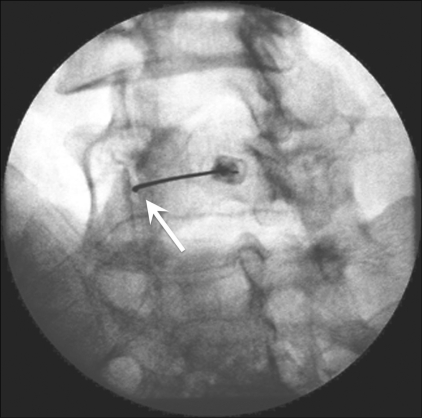
X-rayOblique fluoroscopy during a lumbar L4-L5 facet joint injection: the needle is in intra-articular position, arrow on its tip.
Source : Chaturvedi et al., The Indian journal of radiology & imaging, 2009, figure 3 · CC BY
When facet joint osteoarthritis pain persists, talk quickly turns to injection, radiofrequency or surgery. What can you really expect from them? This page compares those procedures; to understand the condition itself, see the full article « Lumbar facet joint osteoarthritis ».
Corticosteroid injection into the joint
The principle: injecting a corticosteroid, under imaging guidance, directly into the painful facet joint. It is a common procedure, but its effectiveness is far more uncertain than people imagine.
The only double-blind randomised trial against placebo (in patients who had, moreover, been selected by a prior anaesthetic test) showed no advantage for the corticosteroid: at one month, 42 % of patients injected with corticosteroid reported marked improvement, against 33 % on saline: a gap with neither clinical nor statistical significance 1. Over the months, the effect wears off: only 22 % of the « corticosteroid » patients still had sustained improvement between month 1st and month 6th , against 10 % on placebo. That gap exists, but the authors themselves judged its clinical reach doubtful. In plain terms: a possible benefit, modest and short-lived.
Other work points the same way. A meta-analysis (3 trials, 247 patients) finds no demonstrated difference between corticosteroid, anaesthetic and plain saline, but in samples so small that the absence of a difference does not prove equivalence 3. A systematic review found only six trials, small and heterogeneous, most of them inconclusive 2. The European guidelines do not recommend intra-articular corticosteroids in chronic low back pain 8.
Recovery: an outpatient procedure, with a quick return to activity. Relief, when it comes, is often clearest in the very first weeks and then fades 7.
Radiofrequency (thermocoagulation of the facet joint nerves)
Here it is not the joint that is treated but the small nerve carrying its pain (the medial branch), heated by a needle after test blocks. The evidence is frankly mixed.
In the multicentre MINT trial (facet joint arm), radiofrequency added to an exercise programme brought nothing beyond exercise alone: a difference in pain at 3 months of −0.18 out of 10 (95 % CI −0.76 to 0.40), negligible 4. Conversely, a meta-analysis of 7 trials (454 patients) observes a significant reduction in low back pain at one year, but the lower bound of the confidence interval crosses the threshold of clinical relevance, with, in a subgroup, a benefit in those responding to the diagnostic block 5. Finally, compared with injection, radiofrequency offers only modest response rates: in a small trial (32 patients), 45 % of « radiofrequency » patients achieved ≥ 50 % relief at 12 months against 17 % with injection, but in so few patients that this advantage is not statistically established at that time point 6.
Recovery: a percutaneous outpatient procedure; local soreness is possible for a few days. The effect, where it exists, is judged over several months and is not permanent.
Surgery
This is the clearest message, and the most reassuring: there is no convincing evidence justifying a surgical procedure for facet joint osteoarthritis pain alone 8. This pain almost never calls for surgery as such 9. One underlying reason: facet joint osteoarthritis is part of the normal ageing of the spine and correlates poorly with symptoms. On imaging, moderate to severe osteoarthritis is found in 36 % of adults under 45, 67 % of those aged 45–64 and 89 % of those aged 65 and over 9. Seeing osteoarthritis on a scan therefore does not mean it should be operated on.
Exercise: the foundation of treatment
Before any procedure, management is active first. Exercise remains the best-supported treatment: the large Cochrane review (249 trials, 24,486 participants) concludes, with moderate certainty, that it reduces pain by 15 points out of 100 against no treatment, usual care or placebo 10. The effect on function is more modest and its superiority is solid only against no treatment, but exercise is safe, lasting and makes you independent. Working with a physiotherapist lets you assess, dose and progress that work, lift the fear of movement and pick up any warning signs 9.
| Procedure | What you can expect from it | Evidence |
|---|---|---|
| Exercise / active rehabilitation | Pain reduction, independence, no risk | Moderate |
| Corticosteroid injection | Possible but modest and brief benefit | Weak |
| Radiofrequency | Mixed results across trials | Mixed |
| Surgery (facet joint alone) | Not justified by the current data | Absent |
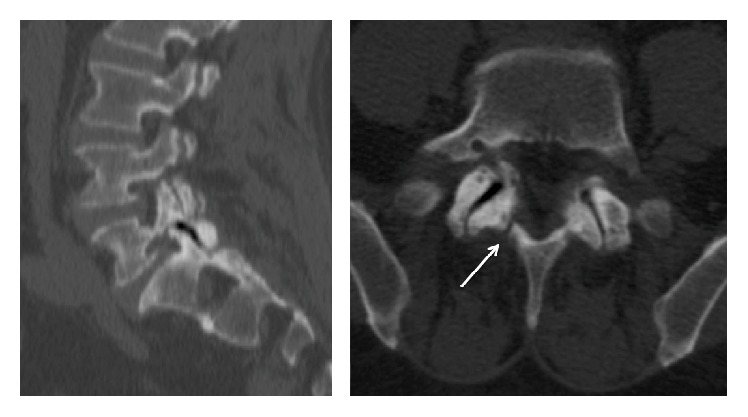
CT scanSagittal and axial lumbar CT scan: severe facet joint osteoarthritis with a vacuum sign, the arrow marking an associated L5 pars interarticularis lysis.
Source : Ruiz Picazo et al., Case reports in orthopedics, 2016, figure 3 · CC BY
Key points
- No solid evidence justifies operating on isolated facet joint osteoarthritis.
- The corticosteroid injection brings at best modest, short-lived relief, no better than placebo at one month.
- And radiofrequency gives mixed results: sometimes a benefit, often at the edge of clinical relevance.
- And exercise remains the starting point: safe, lasting and the best supported.
💪 The conservative option first
If you are trying to find out whether osteoarthritis of the facet (or zygapophysial) joints should be « operated on », the honest answer starts with good news: this diagnosis almost never calls for surgery as such. There is no convincing evidence justifying a surgical procedure for isolated degenerative facet joint pain 8, and the studies have shown no surgical benefit outside very particular situations such as a traumatic dislocation 9. Management is therefore conservative first, and physiotherapy is a cornerstone of it.
This is also explained by the nature of this osteoarthritis: it is part of the normal ageing of the spine. Moderate to severe facet joint osteoarthritis is found on imaging in 36 % of adults under 45, 67 % of those aged 45–64 and 89 % of those aged 65 and over 9. In other words, what an MRI or a CT shows is very common, and correlates poorly with symptoms: there is no reliable correspondence between degenerative images and the pain felt 8. A « worn » image therefore does not require a procedure.
What first-line care involves
The foundation is movement. The largest Cochrane review on the subject (249 trials, more than 24,000 participants) concludes, with moderate certainty, that exercise reduces chronic low back pain by around 15 points out of 100 compared with no treatment, usual care or a placebo 10. Let us be transparent about the limits: this advantage is solid mainly against no treatment; compared with other active approaches, the gap is smaller, and the effect on function (your ability to do your activities) remains more modest, below the threshold considered clinically important. Exercise is therefore not magic, but it is the best-supported option, with no risk comparable to that of an invasive procedure.
In practice, a first-line programme typically combines postural education, stretching and appropriate strengthening of the trunk muscles 9. But reducing this work to a list of exercises would be to miss the essential. The physiotherapist’s role is to assess your situation, to dose the effort at the right level, to progress the load over time, to pick up the warning signs that would fall outside facet joint osteoarthritis, and above all to help you lift the fear of movement so as to make you independent. It is that individualised progression, more than any one exercise, that gives the pathway its value.
How long should you try it before reconsidering?
This approach deserves a fair trial. There is no « official » duration set by the studies: an area of uncertainty it is more honest to acknowledge than to hide. In practice, one thinks in terms of several weeks to a few months of a genuinely followed, progressive programme, with regular points of reassessment, before concluding that something else should be considered. A « failed » trial of a few passive sessions does not count as a real conservative trial.
Why not skip straight to an injection or a procedure? Because the evidence for the interventional alternatives is, at best, mixed. The European guidelines do not recommend intra-articular corticosteroids in chronic low back pain 8 ; in the only trial against placebo, corticosteroid injection into the facet joint did no better than saline on the primary outcome at one month 1. These options are open to discussion, but after a genuine active pathway, not in its place.
Key points
- Isolated facet joint pain almost never calls for surgery: management starts with conservative care 9.
- Exercise is the best-supported option, with a pain reduction of around 15 points out of 100 against no treatment 10, without the risk of a procedure.
- The physiotherapist assesses, doses, progresses and makes you independent; it is that progression, more than any particular exercise, that counts.
- Give it a fair trial (several weeks to a few months, reassessed) before considering an injection or a procedure, for which the evidence is limited.
A degenerative image, very commonplace with age, does not on its own make an indication for surgery.
To understand in detail what this condition is, why imaging correlates poorly with pain and how a suitable programme is built, see the full article « Lumbar facet joint osteoarthritis ».
Bibliography
Every reference checked individually on PubMed (clickable PMID). 10 sources. Click a superscript note marker in the text: the bibliography opens and highlights the source.
- Carette S, Marcoux S, Truchon R, et al. (1991). The New England Journal of Medicine. PMID 1832209. doi:10.1056/NEJM199110033251405.
- Vekaria R, et al. (2016). European Spine Journal. PMID 26906169. doi:10.1007/s00586-016-4455-y.
- Suputtitada A, et al. (2023). Medicina (Kaunas). PMID 37374242. doi:10.3390/medicina59061038.
- Juch JNS, Maas ET, Ostelo RWJG, et al. (2017). JAMA. PMID 28672319. doi:10.1001/jama.2017.7918.
- Lee CH, Chung CK, Kim CH (2017). The Spine Journal. PMID 28576500.
- McCormick ZL, Conger A, Kendall R, et al. (2023). Pain Medicine. PMID 37578437.
- Do KH, et al. (2017). Medicine (Baltimore). PMID 28353611. doi:10.1097/MD.0000000000006524.
- Perolat R, Kastler A, Nicot B, et al. (2018). Insights into Imaging. PMID 30090998.
- Mann SJ, Viswanath O, Singh P (2023). StatPearls. PMID 30855816.
- Hayden JA, et al. (2021). Cochrane Database of Systematic Reviews. PMID 34580864. doi:10.1002/14651858.CD009790.pub2.
❓ Frequently asked questions
Should lumbar facet joint osteoarthritis be operated on?
No, in the great majority of cases. There is no convincing evidence justifying a surgical procedure for isolated degenerative facet joint pain; surgery is almost never indicated as such, outside a traumatic dislocation 89. Management starts with conservative measures, with physiotherapy as a cornerstone.
Is a facet joint injection effective against lumbar osteoarthritis?
Its benefit is limited and short-lived. In the only double-blind randomised trial against placebo, corticosteroid injection did no better than saline on the primary outcome at one month (42 % against 33 % reporting marked improvement, with no significant difference); a modest effect persisted in a minority at six months, but of doubtful clinical significance and played down by the authors 1. The systematic reviews remain inconclusive 2 and the European guidelines do not recommend intra-articular corticosteroids 8.
Radiofrequency or injection: which to choose for facet joint osteoarthritis?
The evidence is mixed and does not allow a firm choice. A small randomised trial (32 patients) of cooled radiofrequency versus corticosteroid injection found 45 % achieving at least 50 % relief at 12 months against 17 %, but with overlapping confidence intervals: superiority is not statistically established at that time point 6. Compared with intra-articular pulsed radiofrequency on the lumbar facet joints, the corticosteroid relieved faster (at 2 weeks and 1 month) but the advantage faded at 3 and 6 months, with around half the patients in each group relieved 7. Added to an exercise programme, facet joint radiofrequency brought nothing clinically relevant 4.
Does facet joint osteoarthritis seen on imaging always explain the pain?
No. Facet joint osteoarthritis is part of the normal ageing of the spine: it is found on imaging in 36 % of adults under 45, 67 % of those aged 45–64 and 89 % of those aged 65 and over 9, and is present in more than half of adults under 30, and in 100 % after the age of 60 8. It correlates poorly with symptoms: the presence of degenerative signs on imaging does not mean the facet joint is the source of the pain.
What treatment for lumbar facet joint osteoarthritis without surgery?
Conservative management centred on exercise. Physiotherapy (postural education, stretching, trunk strengthening) is a cornerstone 9, and exercise reduces pain by around 15 points out of 100 against no treatment, usual care or placebo, with moderate certainty 10. Where that fails, radiofrequency neurotomy after diagnostic blocks remains an option supported by the literature, unlike surgery and intra-articular corticosteroids 8.