










The Tegner activity scale rates a participation level across eleven levels, from 0 to 10. The minimum detectable change everyone copies, one point, is not a constant: measured phase by phase, it is 0.43 in healthy subjects and 2.12 just before anterior cruciate ligament reconstruction. The same point gained is therefore proof at one moment and noise at another.
In adolescents, the ceiling effect of this scale reaches 32.8%, beyond the 30% threshold its own revalidators judged unacceptable. The detail is below.
Figures taken from the studies listed at the end of this page, every value carrying its source where it is written. The eleven levels are reproduced from an unvalidated French thesis and an open-access publication for the English, without changing a word.
What the Tegner rates, and what it does not
The Tegner activity scale is a single item, self-administered, with no subscale and no composite score. It grades across eleven levels sporting activity, competitive and recreational, and work activity, in one and the same graduation. A high level signals high participation.
A word about its bounds, because they required a detour. The reference carrying the scoring only speaks of eleven levels and never writes the range. Two independent abstracts give it in full, 0 to 10, one in vascular surgery and the other on Achilles tendon rupture. That is where the bounds displayed by the tool on this page come from, and not from a deduction based on the number of levels.
What the scale does not rate deserves saying just as plainly. It does not measure knee function, and its original publication is categorical on this point: stability testing, functional score, performance test and activity grading have a relative weight that changes over the course of treatment, and they should not all be included in one and the same score. The Tegner is reported alongside a functional score, never added to it, never averaged with it.
Nor does it measure activity actually performed. In 31 anterior cruciate ligament patients wearing an accelerometer for seven days, there is no significant relationship between the declared level and time spent in moderate to vigorous activity. The scale rates a claimed level of practice; to measure a dose of activity, something else is needed.
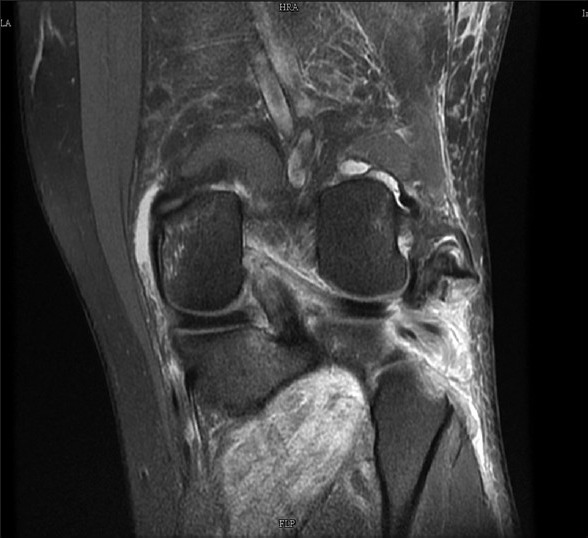
MRICoronal knee MRI: high signal intensity within the anterior cruciate ligament with fibre disruption, suggestive of a left anterior cruciate ligament tear.
Source : Tewari et al., Indian Journal of Nuclear Medicine, 2012, figure 3 · CC BY-NC-SA
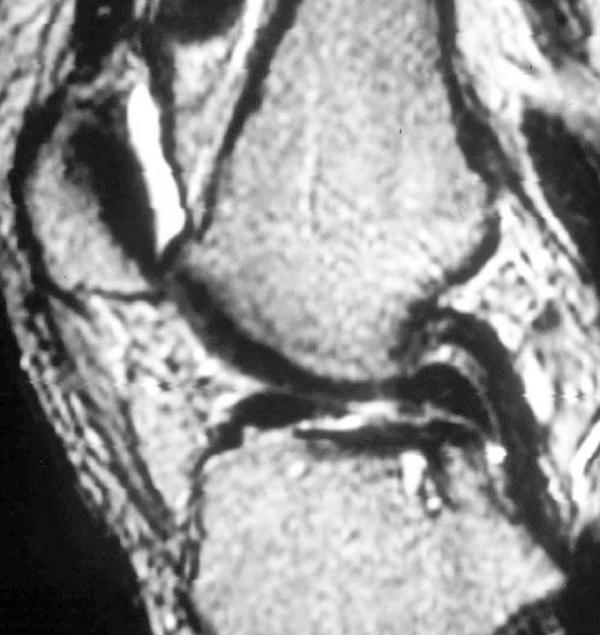
MRISagittal knee MRI: poor visualisation of the anterior cruciate ligament substance, a sign suggestive of rupture in a patient presenting with internal derangement of the knee.
Source : Tsai et al., BMC Musculoskeletal Disorders, 2004, figure 1 · Libre accès BioMed Central
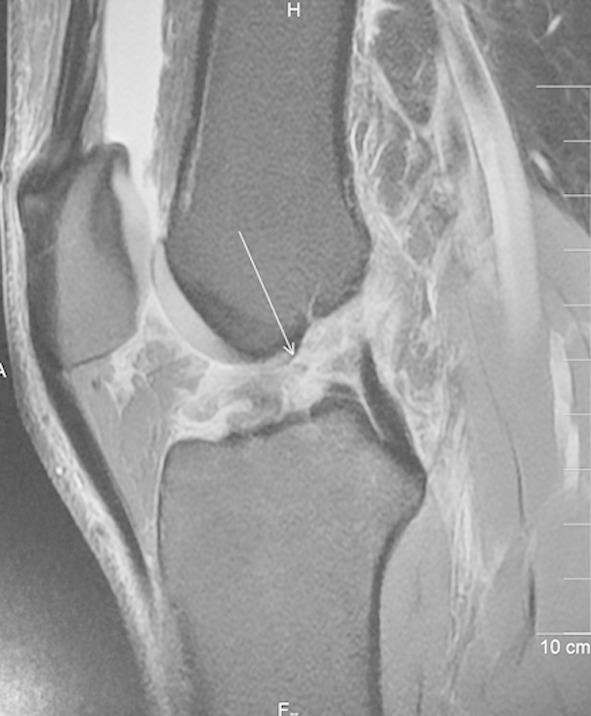
MRISagittal knee MRI, arrow on the anterior cruciate ligament: partial rupture involving approximately 75 percent of the ligamentous body, confirmed at arthroscopy.
Source : Yaqoob et al., Pakistan Journal of Medical Sciences, 2015, figure 3 · CC BY
A low Tegner is not a failure of the knee
This is the least known clinical consequence of everything above, and it changes a conversation in the rehabilitation room.
An excellent functional score with a low Tegner is not an inconsistency to be corrected. It is information to be read. The two instruments do not measure the same thing, and the figures show it: in the criterion validity subgroup of the reference revalidation, 170 patients, the Tegner correlates with the SF-12 at only 0.2, when the functional score correlates at 0.8 with another knee score. A clarification that matters for anyone copying that figure: it comes from those 170 patients, not from the 505 of the responsiveness analysis.
The same dissociation appears over time. The German-language version shows that the link between activity and function is strong in the acute phase, rho of 0.77, and looser in the chronic phase, rho of 0.60. In other words, the further from surgery, the less the activity level can be deduced from knee function.
What that means in practice: a patient whose knee works and whose participation has not returned may have a reason that is not orthopaedic. The season, age, work, fear. The Tegner does not say which, but it signals that there is one, and that is already a lot for a single item.
One point is proof or noise depending on when
The figure everyone copies is a minimum detectable change of one point. It comes from the 2009 revalidation, measured test-retest in 50 patients. The German-language version, in another cohort, finds 1.4.
But only one validation had the idea of measuring it phase by phase, and its result forbids treating that point as a constant. In 78 participants split into four groups, the smallest detectable change is 0.43 in healthy subjects, 2.12 just before anterior cruciate ligament reconstruction, 0.89 between two and three months after and 0.44 between three and twelve months. Measurement noise is almost five times larger preoperatively than in the late phase.
Reliability collapses in exactly the same place: the intraclass correlation coefficient exceeds 0.90 in all groups except the preoperative one, where it falls to 0.71. This is not surprising, it is almost mechanical: that is the moment when the patient is least certain about what they still do and what they used to do.
The consequence is direct and easy to remember: a gain of two points announced in the preoperative period sits within measurement noise, while a single point gained between three and twelve months after surgery is real. That is why the tool at the top of this page asks for the phase before qualifying a difference, and refuses to rule while it is not given.
| Phase | Smallest detectable change | Source |
|---|---|---|
| Subject with no knee injury | 0.43 | simplified Chinese version, 78 participants |
| Before anterior cruciate ligament reconstruction | 2.12 | same study, reliability 0.71 in that group |
| Two to three months after reconstruction | 0.89 | same study |
| Three to twelve months after reconstruction | 0.44 | same study |
| All phases, original version | 1 | 50 patients, test-retest at 2 years |
| All phases, German version | 1.4 | 46 surgical patients and 20 healthy subjects |
No French version, and case-by-case permission
No validated French version of the Tegner scale is indexed in PubMed. The absence was searched for: seven distinct formulations, one of them covering plausible French titles, which returns strictly no result. The only French works found are surgical series and registries using the instrument in English.
Nine languages do have one: German, Dutch, simplified Chinese, Arabic, Indonesian, Greek, Thai, Persian, Spanish. Several are later than 2020.
Translating the list of sports oneself is not a neutral operation, and not only in terms of rights. The German-language version notes that the Swedish original contains sports unknown in German-speaking countries, and that other German-speaking countries will require further adaptations still. The Thai version had to modify the sports to the point that its authors rename it Thai adjusted Tegner scale. An in-house translation therefore produces an unvalidated version, and probably a different scale.
The French menu shown at the top of this page nonetheless reproduces a translation: the appendix of a medical thesis, defended in Grenoble in 2021 and deposited on DUMAS. This is not a validated version, and it bears repeating: it is a default choice, for lack of a better accessible reproduction. Another French thesis, a meniscectomy thesis deposited under identifier dumas-01252606, carries a slightly different appendix at several levels: proof that the French translations in circulation are not identical to one another.
Where the eleven displayed levels come from, and why the two languages differ
No source from the publisher or the rights holder could be read to reproduce this scale: the original publication (Tegner Y, Lysholm J, Clin Orthop Relat Res 1985;198:43-9) is paywalled, and the instrument's record on ePROVIDE, the Mapi Research Trust catalogue, itself reads 'Copyright: No information' and only delivers the questionnaire on free registration. The eleven levels displayed in the tool above therefore come from two reproductions found in open-access publications, not from the publisher or the authors: in French, the appendix of a medical thesis deposited on DUMAS, an unvalidated in-house translation; in English, the English column of a table in an open-access Arabic validation (CC BY licence), whose authors write that they obtained permission to translate from the original author. The two grids do not correspond word for word, notably at levels 0, 4 and 7: at level 0 for instance, the French 'Handicap professionnel - Invalidité' omits the mention of the knee that the English carries, 'Sick leave or disability pension because of knee problems'. Describing, scoring and interpreting the scale remains free; for any other reproduction, Mapi Research Trust remains the contact point identified on ePROVIDE.
Three administration pitfalls
Merging it into a functional score
This is the founding misreading, and it is refuted by the original publication itself: the four dimensions of knee evaluation have a relative weight that changes over the course of treatment, and should not be brought together in one and the same score. The Tegner is reported alongside, never added.
Treating the change point as a constant
It is 1 point in the English revalidation, 1.4 in German, and 0.43 to 2.12 depending on phase in the Chinese validation. Two points gained before surgery sit within noise; a single point gained between three and twelve months after does not.
Using it in adolescents
Ceiling effect of 32.8% in 398 athletes aged 10 to 18.8, beyond the 30% threshold the very team that revalidated the scale judged unacceptable. The Tegner there correlates only with days per week and does not separate club athletes from school athletes. A paediatric scale does better on all three criteria.
Frequently asked questions
What does the Tegner scale measure?
It rates a participation level, sport and work together, across eleven levels graded from 0 to 10. It measures neither knee function nor activity actually performed.
How is the Tegner scale scored?
It is a single item, chosen from a menu: the patient picks the level matching their activity. Established practice is to record two, the pre-injury level and today's, and to read the gap.
Does one point gained count?
It depends when. The smallest detectable change is 0.43 points in healthy subjects but 2.12 just before anterior cruciate ligament reconstruction. A point gained in the late phase is real; two points gained preoperatively are not necessarily.
Can it be used in an adolescent?
Better avoided: its ceiling effect there reaches 32.8%, beyond the 30% threshold set by its own revalidators, and it does not separate club athletes from school athletes.
Is there a French version of the Tegner scale?
No. No validated French version is indexed, while nine other languages have one. The levels displayed above reproduce the unvalidated translation from a French medical thesis; the French works published use the instrument in English.
References
11 sources, PMIDs included
- Tegner Y, Lysholm J. Rating systems in the evaluation of knee ligament injuries. Clin Orthop Relat Res 1985;(198):43-9. PMID 4028566. The original publication. The authors build an activity grading where work and sport are graded numerically, explicitly designed as a complement to the functional score. Their conclusion is the reading key for the instrument, and it is very widely ignored: stability testing, functional score, performance test and activity grading are all important, but their relative weight varies over the course of treatment and they should not all be included in one and the same score.
- Wirth B, Meier N, Koch PP, Swanenburg J. [Development and evaluation of a German version of the Tegner activity scale for measuring outcome after anterior cruciate ligament injury]. Sportverletz Sportschaden 2013;27(1):21-7. PMID 23413019. The structural reference: it is its abstract that carries the scoring itself, the scale assesses on 11 levels the activity in sports, competitive and recreational, and work. It gives an independent minimal detectable change, 1.4 points, in 46 anterior cruciate ligament patients and 20 healthy subjects. Above all it shows that the link between activity and function is not stable over time, rho of 0.77 in the acute phase against 0.60 in the chronic phase, hence the need to score both separately. It also documents the translation obstacle: the Swedish original contains sports unknown elsewhere.
- Deveze E, Bruneau A, Raimondeau D, Henni S, Abraham P, Picquet J. Long-Term Functional Outcomes After Surgery of Functional Popliteal Artery Entrapment Syndrome. Ann Vasc Surg 2023;97:405-9. PMID 37244483. An unexpected reference, and its presence here deserves an explanation. The structural validation writes 'eleven levels' without ever giving the scale's bounds, and none of the major metrological references writes them either. This vascular surgery work does state them verbatim: a numerical scale with each value (0 to 10) representing specific activity. It is the source of the bounds displayed on this page.
- Sukanen M, Khair RM, Reito A, Ponkilainen V, Paloneva J, Cronin N, Hautala AJ, Finni T. Early Predictors of Recovery From Nonoperatively Treated Achilles Tendon Rupture: 1 Year Follow-Up Study. Scand J Med Sci Sports 2024;34(7):e14700. PMID 39010659. The independent confirmation of the same bounds, in an entirely different field, non-operatively treated Achilles tendon rupture: scale 0-10, 10 = best possible score. Two abstracts from unrelated teams writing the same range are worth more than a deduction from the number of levels.
- Briggs KK, Lysholm J, Tegner Y, Rodkey WG, Kocher MS, Steadman JR. The reliability, validity, and responsiveness of the Lysholm score and Tegner activity scale for anterior cruciate ligament injuries of the knee: 25 years later. Am J Sports Med 2009;37(5):890-7. PMID 19261899. The reference revalidation, in self-administered form. It is the source of the most quoted figure on this instrument, a minimum detectable change of 1 point, measured test-retest in 50 patients. It also establishes that the Tegner measures something other than perceived health: in the criterion validity subgroup, 170 patients, its correlation with the SF-12 is only 0.2. Mind which figure belongs to which sample: the n = 505 in that abstract is the responsiveness sample, not the correlation one.
- Huang H, Zhang D, Jiang Y, Yang J, Feng T, Gong X, Wang J, Ao Y. Translation, Validation and Cross-Cultural Adaptation of a Simplified-Chinese Version of the Tegner Activity Score in Chinese Patients with Anterior Cruciate Ligament Injury. PLoS One 2016;11(5):e0155463. PMID 27186880. The only validation measuring the smallest detectable change separately at each phase of the pathway, instead of giving a single value. The result contradicts the common use of the 1-point figure: in 78 participants split into four groups, it is 0.43 in healthy subjects, 2.12 just before anterior cruciate ligament reconstruction, 0.89 between two and three months after and 0.44 between three and twelve months. Reliability collapses in the same place, the coefficient falling to 0.71 preoperatively when it exceeds 0.90 everywhere else.
- Briggs KK, Kocher MS, Rodkey WG, Steadman JR. Reliability, validity, and responsiveness of the Lysholm knee score and Tegner activity scale for patients with meniscal injury of the knee. J Bone Joint Surg Am 2006;88(4):698-705. PMID 16595458. The extension of the validation beyond the anterior cruciate ligament, to meniscal lesions, in 122 patients for test-retest then 191 and 477 for the rest. It sets in passing the methodological threshold later used to judge the instrument elsewhere: a ceiling effect is unacceptable above 30%. A nuance often lost in citations: the responsiveness of the Tegner there is only of moderate effect size.
- Wagner KJ 3rd, Sabatino MJ, Zynda AJ, Gans CV, Chung JS, Miller SM, Wilson PL, Ellis HB Jr. Activity Measures in Pediatric Athletes: A Comparison of the Hospital for Special Surgery Pediatric Functional Activity Brief Scale and Tegner Activity Level Scale. Am J Sports Med 2020;48(4):985-90. PMID 32167838. The reason not to reach for this tool in adolescents. In 398 young athletes aged 10 to 18.8, the ceiling effect of the Tegner reaches 32.8%, beyond the 30% threshold set by the very team that revalidated the scale. It correlates only with days per week, 0.211, and does not separate club athletes from school athletes, where a paediatric scale does so on all three criteria.
- Kuenze C, Cadmus-Bertram L, Pfieffer K, Trigsted S, Cook D, Lisee C, Bell D. Relationship Between Physical Activity and Clinical Outcomes After ACL Reconstruction. J Sport Rehabil 2019;28(2):180-7. PMID 29140161. What happens when the declared level is set against activity actually measured. In 31 anterior cruciate ligament patients wearing an accelerometer for seven days, at least ten hours a day, no significant relationship between the Tegner and time spent in moderate to vigorous activity. The scale rates a claimed level of practice, not a dose of activity.
- Hambly K. The use of the Tegner Activity Scale for articular cartilage repair of the knee: a systematic review. Knee Surg Sports Traumatol Arthrosc 2011;19(4):604-14. PMID 21076815. The systematic review of its actual use in cartilage repair: 442 citations, 34 articles retained, samples of 5 to 137, ages of 12 to 76 and follow-ups of 3 to 120 months. Its authors call for caution in interpreting the scores, and ground the ban on averaging a single-item ordinal score from one study to another. One typo not to propagate: its abstract dates the scale's creation to 1984, when the original publication is from 1985.
- Alayane A, Moussa MK, Ghandour M, Ayari M, Meyer A, Grimaud O, Khiami F, Lefèvre N, Bohu Y, Hardy A. Similar graft failure rates in low-activity patients (Tegner activity scale ≤ 4) undergoing anterior cruciate ligament reconstruction with or without lateral extra-articular augmentation. Knee Surg Sports Traumatol Arthrosc 2026;34(7):2433-44. PMID 40923405. The French use of the scale, and the source of the low-activity benchmark used by the tool above. This Paris team defines low activity as a pre-injury Tegner of 4 or below, and builds on that criterion a comparison of 282 matched anterior cruciate ligament reconstructions. Two clarifications: that threshold is defined by the study and not psychometrically validated, and the values it reports are means, 2.8 then 5.2 in one group and 3.0 then 4.4 in the other.
 Page written by Anthony Baillon, physiotherapist, co-founder of Physio Learning. The scale itself is by Tegner and Lysholm, 1985: this page reproduces its eleven levels, from an unvalidated French thesis and an open-access publication, and documents and interprets them.
Behind this article
An author who explains, a reviewer who checks.
How we write and check our content

Physiotherapist · co-founder of Physio Learning
Marked for life by his first four-hour lecture without a single image, he took a master’s in instructional design so that it would never happen to anyone again. He hunts down publication bias and unreadable slides with the same intransigence.

Head of scientific content
Physiotherapist specialising in neuro-musculoskeletal practice and holder of a master’s in public health. He checks the methodological rigour of every article: primary sources, levels of evidence, no exceptions.