





Do you have pain on the side of the hip, and has someone mentioned gluteus medius tendinopathy, trochanteric bursitis or « greater trochanteric pain syndrome »? This page brings together the exercise programme validated by research, step by step, with the doses and the mistakes to avoid.
📝 In brief
- The exercises that work target the hip abductors, under slow, controlled load, not stretching. The self-rehabilitation protocol tested in the GTPS pilot trial starts with isometrics: lying on the unaffected side, a pillow between the knees, the affected hip abducted to about 30° in line with the body and the knee straight, hold 30 s, 6 repetitions with 60 s of rest between each: supplemented by a weight-bearing gluteal contraction, 3 sets of 10 counting 6 s. All of it is done daily. The isotonic progression keeps the same volume (3 sets of 10) with slow 6 s repetitions: 3 s concentric, 3 s eccentric 6.
- Isometric or isotonic: at 12 weeks, the two are equivalent. In that randomised trial, the VISA-G score improves by about 10 points in each group, with a between-group difference of −0.1 points (95 % CI −13.8 to 13.5); 55 % of the isometric group and 58 % of the isotonic group achieve a fall of at least 2 points in pain. In other words, the modality to choose is the one the patient tolerates 6.
- Pain of up to 5/10 is acceptable during exercise. The load-monitoring rule is simple: up to 5/10 on the numerical scale, provided the pain then settles and increases neither at night nor the next day 6. That framing, combined with instructions on positions, goes with very high adherence to the sessions: 96 % 9.
- Managing compression counts as much as the exercises. Education means minimising or adapting compressive activities and positions: single-leg stance (walking, running, climbing stairs), adduction activities such as sitting with the legs crossed, certain hip stretches and certain sleeping positions (Doyle 2024). In practical terms: avoid hip adduction beyond the midline, prolonged single-leg stance and lying on the affected side; put a pillow between the knees at night and rest on the unaffected side 9 ; do not cross the legs when sitting or standing, sleep on your back with a pillow under the knees or on your side with a pillow between the legs 1. This is also why aggressive stretches, which put the tendon into adduction and compress it against the greater trochanter, are counterproductive.
- Reckon on 8 to 12 weeks of supervised work, not a miracle session. The winning arm of the LEAP trial is a structured programme of load-management education and exercise delivered in 14 physiotherapy sessions over 8 weeks 2. Over 12 weeks, a supervised heavy slow resistance (HSR) programme with education, at about 2.5 sessions a week, proves safe and feasible: median adherence of 100 %, a single dropout (5 %), no serious adverse events, tolerable pain in 100 % of cases before, during and 24 h after the sessions, with significant gains in hip strength 7.
- Exercise is the first-line treatment, ahead of injection. In LEAP (n = 204), the education + exercise programme achieves 51/66 successes at 8 weeks against 38/65 for corticosteroid injection and 20/68 for wait-and-see, a superiority of 19.9 % over injection (NNT 5.0); the advantage holds at 52 weeks (51/65 against 36/63, a difference of 20.4 %, NNT 4.9), even though the pain scores converge at 1 year 2. At 15 months, home-based self-rehabilitation reaches 80 % success and shockwave therapy 74 %, while injection falls back to 48 % 5. Kjeldsen's meta-analysis (6 trials, 733 patients) makes a strong recommendation for exercise as first-line treatment 3, Wang's network meta-analysis ranks it first for pain (SUCRA 95.9 %) and for VISA-G function (SUCRA 96.9 %) 4, and Grimaldi's masterclass records the abandonment of rest and anti-inflammatory injections as first-line care in favour of an active approach in which the patient manages the condition themselves 8.

🎯 Understanding it in two minutes
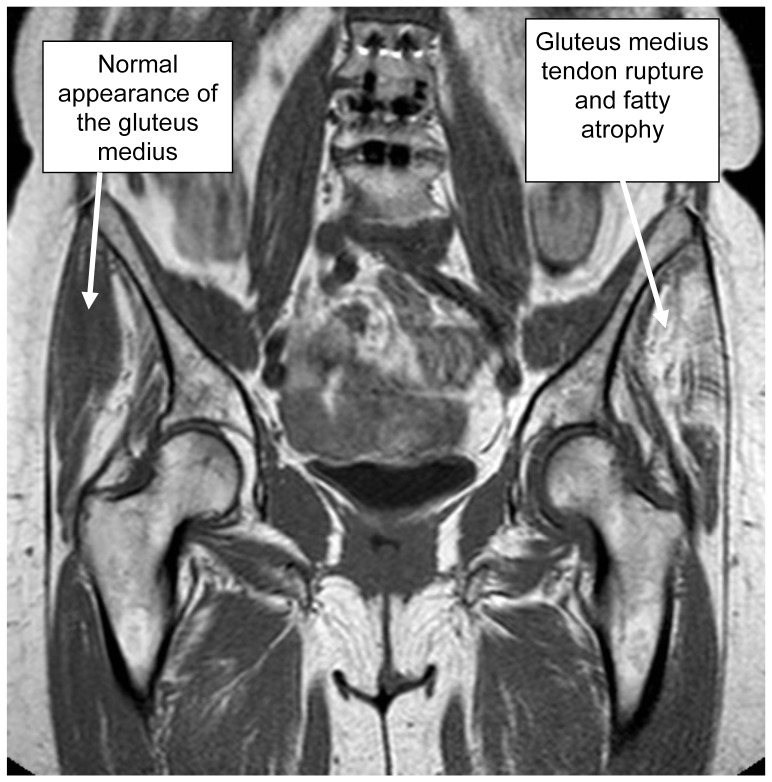
MRICoronal pelvic MRI comparing a normal gluteus medius and a gluteus medius tendon tear with fatty atrophy on the affected side.
Source : Kaltenborn et al., PloS one, 2014, figure 3 · CC BY
That pain on the side of the hip, which bites when you climb stairs, when you stand on one leg or when you lie on the affected side, has a name: greater trochanteric pain syndrome. The good news is that the first-line treatment is neither an injection nor rest: it is an exercise programme that you run yourself, together with a few very concrete changes of habit.
The mechanism, in one sentence
The tendons on the outer side of the hip suffer when they are compressed against the bony prominence of the greater trochanter. That compression rises as soon as the hip moves into adduction, that is, as soon as the knee comes towards or crosses the midline of the body: legs crossed sitting or standing, prolonged weight-bearing on one leg, sleeping on the painful side, and certain hip stretches 1. That is the paradox of this condition: the stretches that seem to relieve it at the time often keep the problem going, because they put the tendon back under compression.
Here, the aim is not to stretch what hurts: it is to decompress, then reload progressively.
Why progressive loading is the guiding principle
The LEAP trial 2, conducted in 204 people, compared three strategies: education + exercise, corticosteroid injection, or simple wait-and-see. At eight weeks, exercise does better than injection by close to 20 percentage points (NNT 5.0), and the advantage still holds at one year (NNT 4.9). The pain scores, for their part, end up converging at 52 weeks: exercise is not magic, it is simply the option that works most often and most durably.
| Approach | At 8 weeks | At 52 weeks |
|---|---|---|
| Education + exercise | 51/66 | 51/65 |
| Corticosteroid injection | 38/65 | 36/63 |
| Wait-and-see | 20/68 | 31/60 |
This result is not an isolated one. A meta-analysis of 6 randomised trials (733 patients) makes a strong recommendation for exercise as first-line treatment and reports no serious adverse effects 3. A more recent network meta-analysis ranks exercise as the most effective conservative intervention, for both pain and function, ahead of physical modalities, injections and placebo 4. And Rompe's trial 5 shows that the initial superiority of injection reverses with time: at 15 months, home-based self-rehabilitation reaches 80 % success against 48 % for injection. In other words, the shortcut of the injection is paid for later.
Be careful, though, not to over-read the dose. In LEAP, the winning arm was supervised : 14 physiotherapy sessions over 8 weeks 2. A programme done alone at home does not reproduce that framework exactly. The protocol you will find below rests on smaller trials 67 : the direction of travel is solid, the precision of the optimal dose less so.
Who this programme is for
For you if your diagnosis has already been made, by a doctor or a physiotherapist, and you are looking for what to do, concretely, week after week. If you are not yet at that point, if the pain came on suddenly after a fall, or if you have doubts about where your symptoms come from, start with the full guide to greater trochanteric pain syndrome : tests, differential diagnoses and imaging are set out there. What you are reading here is the logical next step, not the starting point.
The approach argued for in the recent literature is explicitly active: setting aside the traditional beliefs centred on rest and anti-inflammatories, in order to make the person able to manage their own condition through education, load management and progressive exercise 8.
Key points
- The culprit is compression, not « stiffness »: anything that puts the hip into adduction (crossed legs, standing on one leg, sleeping on the painful side) makes the mechanics worse 1.
- Aggressive hip stretches are counterproductive : they compress the tendon against the bone instead of relieving it (Doyle 2024).
- Progressive exercise is the first-line treatment, with a strong recommendation and no serious adverse effects reported 3.
- Pain of up to 5/10 during exercise is acceptable, provided it then settles and increases neither at night nor the next day 6.
- It takes time : think in weeks and months, not days. The benefit of exercise over injection is judged at 8 weeks and confirmed at 1 year 2.
- The diagnosis is not made here : go through the main guide if yours has not been made.
💪 The exercise programme, step by step
The good news first: exercise is not a fallback, it is the first-line treatment. Kjeldsen's meta-analysis 3, across 6 randomised trials and 733 patients, makes it a strong recommendation, with no serious adverse effects; Wang's 4 ranks it first among the conservative approaches. That leaves the real question: which exercises, at what dose, and when do you move on?
Key points
- You start by removing the compression (everyday positions), not by adding exercises.
- Typical progression: isometric → slow controlled load → heavy slow load.
- Pain of up to 5/10 is acceptable if it settles afterwards 6.
- And Aggressive hip stretches crush the tendon: they are part of the problem.
- The winning arm of LEAP is education + exercise, not exercise alone.
Step 0: Decompress before you strengthen
This is the step everyone skips, and it shapes everything else. The gluteal tendons suffer when the hip moves into adduction (the knee crossing the midline): the tendon is then pressed against the bone of the greater trochanter. The education delivered in LEAP-Ireland (Doyle 2024) aims to minimise or adapt these compressive positions: standing on one leg (walking, stairs), sitting with the legs crossed, certain stretches, sleeping positions. In practical terms 91 :
- do not cross the legs, sitting or standing ;
- avoid prolonged single-leg stance;
- do not sleep on the painful side: lie on the unaffected side with a pillow between the knees, or on your back with a pillow under the knees.
This framing is no small matter: in Høgsholt's study 9, adherence reached 96 %. The mechanisms are set out in the main guide.
Phase 1: Isometrics: reloading without provoking
Clifford's protocol 6 can be reproduced exactly as it stands. Lying on the unaffected side, a pillow between the knees, you lift the painful leg to about 30° of abduction, in line with the body (definitely not forwards), knee straight, and you hold for 30 seconds : six repetitions, 60 seconds of rest between each. Then a weight-bearing gluteal contraction, 3 sets of 10, each contraction counted for 6 seconds. All of it every day.
Phase 2: Slow controlled load
Same trial, different modality: the movement becomes dynamic, but slow. 3 sets of 10 repetitions, each repetition lasting 6 seconds (3 s up, 3 s down), 60 seconds of rest between sets. The slowness is not a detail: it is what controls the load.
An honest point: at 12 weeks, Clifford 6 finds no difference between isometric and isotonic (VISA-G improved by about 10 points in both groups; between-group difference −0.1 points, 95 % CI −13.8 to 13.5). No evidence that either modality is superior: the right exercise is the one you tolerate. A caveat: this was a pilot trial, with small numbers.
Phase 3: Heavy slow load
With the pain settled, you go after strength. A supervised heavy slow resistance programme, with education, at about 2.5 sessions a week for 12 weeks, proved safe and feasible 7 : median adherence of 100 %, no serious adverse events, tolerable pain before, during and 24 h after the sessions, significant gains in hip strength. To be qualified: this was a feasibility study, with small numbers, not proof of superiority.
The dosing at a glance
| Phase | Exercise | Dose | Evidence |
|---|---|---|---|
| 0: Decompression | Everyday positions | Ongoing, from day 1 | Moderate |
| 1: Isometric | Abduction lying on the unaffected side, 30° | 6 × 30 s, 60 s rest, daily | Moderate |
| 1b | Standing gluteal contraction | 3 × 10, counting 6 s, daily | Moderate |
| 2: Slow load | Controlled isotonic movement | 3 × 10, 6 s/rep (3 s + 3 s), 60 s rest | Moderate |
| 3: Heavy load | Supervised heavy resistance | ~2.5 sessions/week, 12 weeks | Weak |
The pain rule, your only dashboard
This is the criterion that drives everything 69, on three conditions: that the pain settles afterwards, that it does not increase at night, nor the next day. If any one of the three turns red, you do not stop: you drop back a level (less load, or back to isometrics).
When do you move to the next phase? Frankly: the published trials set no numerical threshold. They give the pain rule above and a programme duration (8 to 12 weeks). In practice, you progress once the current dose is being held while meeting the three conditions, not on a date decided in advance.
The mistakes that keep the pain going
- Stretching « because it feels tight » : some hip stretches put the tendon into precisely that compression (Doyle 2024). Chasing the stretch means reproducing the mechanism.
- Waiting for it to pass : in LEAP 2, wait-and-see is the weakest arm, 20/68 successes at 8 weeks against 51/66 for education + exercise. Grimaldi 8 rules out rest from the outset.
- Relying on injection alone : it relieves quickly, then falls away. At 15 months, Rompe 5 : 80 % success for home-based self-rehabilitation against 48 % for injection.
- Under-dosing the support : the winning arm of LEAP is 14 physiotherapy sessions over 8 weeks 2, not three exercises on a sheet of paper.
⚠️ The mistakes that keep the problem going
Many people do « everything right » and still see their lateral hip pain settle in over months. Most often it is not exercises that are missing: it is a few reflexes, logical on the face of it, that put compression back on the gluteal tendons every day. Correcting those is often worth more than adding one more exercise.
Mistake 1: stretching the hip to « loosen it off »
This is the most widespread reflex, and probably the most counterproductive. The classic gluteal stretches (knee pulled across the body, leg crossed, the « figure 4 » position), place the hip in adduction, which is to say they press the tendons against the greater trochanter. Yet the education delivered in the landmark programmes consists precisely in minimising or adapting these compressive positions: single-leg stance, adduction activities such as sitting with the legs crossed, certain hip stretches and certain sleeping positions (Doyle 2024). Disantis 2022 points the same way and puts it very concretely: do not cross the legs, sitting or standing, and sleep on your back with a pillow under the knees, or on your side with a pillow between the legs.
What relieves in the moment is not always what repairs: a stretch that crushes the tendon buys a few minutes of comfort at the cost of several days of irritation.
Mistake 2: waiting for it to pass, or relying on injection
Rest and anti-inflammatories as first-line care belong to the traditional beliefs that the recent literature sets aside: the reference today is an active approach, in which the person manages their own condition through education, load management and progressive exercise 8. The LEAP trial is very clear: at 8 weeks, the education + exercise programme achieves 51 successes out of 66, against 38/65 for corticosteroid injection and only 20/68 for simple wait-and-see 2. And the advantage holds over time: at 52 weeks, 51/65 for exercise against 36/63 for injection.
Injection can relieve quickly, that is what makes it attractive, but Rompe's 2009 trial shows that this advantage reverses: at 15 months, home-based self-rehabilitation reached 80 % success, shockwave therapy 74 %, injection only 48 %. Two syntheses point the same way: a strong recommendation for exercise as first-line treatment 3 and a ranking of exercise at the top of the conservative treatments, for pain as well as for function 4. The detail of the diagnostic reasoning and of the alternatives is dealt with in the full guide to greater trochanteric pain syndrome.
Mistake 3: aiming for « zero pain », or gritting your teeth
Both extremes waste time. The rule used in the protocols sits in between: pain of up to 5/10 is acceptable during exercise, provided it then settles and increases neither at night nor the next day 6. The same threshold framed Høgsholt's 2022 programme, in which adherence reached 96 %.
The signals that should make you ease off (reduce the load, not stop everything):
- pain that goes beyond 5/10 during exercise;
- pain that does not come back down within the following minutes;
- more waking at night, or a new inability to find a comfortable position;
- more pain the next day than before the session.
Mistake 4: too little, too irregular, or all at once
The programmes that have proved themselves are dense and spread out. The winning arm of LEAP is 14 physiotherapy sessions over 8 weeks 2. Clifford's 2019 isometric protocol is daily: 6 holds of 30 s with 60 s of rest, supplemented by 3 sets of 10 weight-bearing gluteal contractions. The move to slow controlled load is done in 3 sets of 10 repetitions of 6 s (3 s up, 3 s down). And heavy slow resistance, over 12 weeks at about 2.5 sessions a week, proved safe and feasible, with median adherence of 100 %, no serious adverse events and gains in hip strength 7.
Three received ideas to drop
| Received idea | What the evidence says | Level |
|---|---|---|
| « You have to stretch the glutes every morning. » | Hip stretches into adduction are among the compressive positions to be adapted 1. | Moderate |
| « One injection and that is the end of it. » | Better in the short term, but overtaken by exercise at 8 and 52 weeks 2 and at 15 months 5. | High |
| « There is a miracle exercise. » | At 12 weeks, isometric and isotonic give the same result (difference −0.1 VISA-G points): the right modality is the one you tolerate 6. | Weak (pilot trial) |
A word of honesty about that last line: Clifford 2019 is a pilot trial, and its confidence interval is very wide (−13.8 to 13.5 points). It does not prove the two modalities are equivalent: it only indicates that neither pulled ahead, which makes it legitimate to choose the better-tolerated one. We do not yet know which progression suits whom best.
Key points
- Stretching the glutes by crossing the leg compresses the tendon: this is not a neutral stretch.
- Rest and injection alone are the strategies that age worst; progressive exercise is the first-line treatment.
- Pain of up to 5/10 is acceptable if it settles and increases neither at night nor the next day.
- The precise choice of exercise matters less than consistency held over 8 to 12 weeks.
- Everyday life is part of the treatment: do not cross the legs, a pillow between the knees at night, sleep on the non-painful side.
🩺 How long it takes, and where the physiotherapist fits in
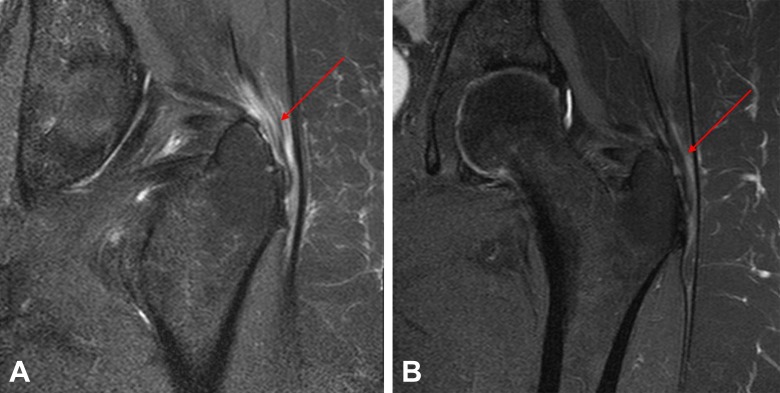
MRICoronal hip MRI in the same patient before and six months after treatment: regression of the thickening and high signal intensity of the gluteus medius tendon.
Source : Bucher et al., Orthopaedic Journal of Sports Medicine, 2017, figure 4 · CC BY-NC-ND
It is the question that always comes back: how long? The honest answer is not « a few days ». The trials that have tested exercise in greater trochanteric pain syndrome think in weeks and months, never in isolated sessions. Knowing that in advance avoids the third-week discouragement, which is the real risk of failure in self-rehabilitation.
Realistic timescales, according to the trials
In the LEAP trial 2, the load-management education programme combined with exercise was delivered in 14 physiotherapy sessions over 8 weeks: a dense, supervised pace. It is at 8 weeks that the first real milestone is measured. The home exercise protocols studied by Clifford 2019, for their part, are assessed over 12 weeks of daily practice, and Grigat's 2025 heavy slow resistance programme also runs over 12 weeks at about 2.5 sessions a week.
The useful horizon is therefore of the order of two to three months for solid change, and Rompe's 2009 trial is a reminder that the benefit of self-rehabilitation keeps building well beyond that: the home training group reached 80 % success at 15 months, while corticosteroid injection stalled at 48 %.
It is not rest that puts a lateral hip back in order, it is load progressively restored and held over time.
Exercise, injection, waiting: what does time change?
| Approach 2 | Success at 8 weeks | Success at 52 weeks | Evidence |
|---|---|---|---|
| Education + exercise | 51/66 | 51/65 | High |
| Corticosteroid injection | 38/65 | 36/63 | Moderate |
| Wait-and-see | 20/68 | 31/60 | Moderate |
At 8 weeks, exercise beats injection by 19.9 % (5 people need to be treated with exercise rather than injection for one extra success). At one year, the advantage still holds (a 20.4 % difference). One nuance for honesty, however: at 52 weeks, the pain scores themselves converge between the groups (2.1 for exercise, 2.3 for injection, 3.2 for waiting). What exercise changes most durably is the sense of overall improvement and function, not just the pain figure.
Two syntheses converge: Kjeldsen's 2024 meta-analysis (6 trials, 733 patients) makes a strong recommendation for exercise as first-line treatment, and Wang's 2025 network meta-analysis ranks exercise first for pain (SUCRA 95.9 %) as well as for function (VISA-G, SUCRA 96.9 %), ahead of physical modalities, injections and placebo. No serious adverse effect was reported in this work.
What the physiotherapist actually adds
Many of the exercises described above can be done on your own. So why see anyone?
- The dose and its progression. Moving from isometrics (30 s holds, 6 repetitions) to slow controlled load (3 × 10, 6 s per repetition: 3 s concentric, 3 s eccentric), then to heavy slow resistance, means knowing when to step up. Clifford 2019 shows that at 12 weeks isometric and isotonic give the same result, so the choice comes down to what you tolerate, and that calls for an outside eye.
- Education about compression. This is the pillar most often missed on your own: minimising or adapting compressive activities and positions: single-leg stance (walking, running, stairs), adduction when sitting with the legs crossed, certain hip stretches, sleeping positions (Doyle 2024). Disantis 2022 stresses the same point for sitting, standing and lying. It is also what explains why aggressive stretches are counterproductive, as set out in the full guide to greater trochanteric pain syndrome.
- Adherence. This is not a footnote: it is the limiting factor. When supervised, the reported adherence rates are very high 9.
- The safety framework. The pain rule (up to 5/10 acceptable during exercise, provided it then settles and increases neither at night nor the next day 6) is only of value if someone helps you interpret it in the first few weeks.
Grimaldi 2025 sums up the spirit of this management: abandoning the beliefs centred on rest and anti-inflammatories as first-line care, in favour of an active approach in which the person manages their own condition through education, load management and progressive exercise. The physiotherapist is not there to do it for you; they are there to make the programme sustainable.
When to seek advice without delay
A point of honesty: the trials cited above do not define a list of warning signals. They recruit patients who already have a diagnosis. The markers below are therefore ordinary caution, not quantified evidence: all the more reason not to decide on them alone:
- pain that stays above 5/10 during exercise, or that increases at night or the next day : this is the only criterion explicitly drawn from the protocols 6, and it means the load needs revising, not gritting your teeth;
- lateral hip pain that came on after trauma or a fall, or with an inability to bear weight;
- fever, feeling generally unwell, constant night pain unrelated to lying on that side;
- neurological signs (frank loss of strength, numbness, pain running down the leg);
- no change after regular practice over the horizon documented in the trials (8 to 12 weeks): the diagnosis then deserves to be revisited.
Key points
- Count in weeks : 8 weeks for the first milestone, 12 weeks for a completed programme, and a benefit that keeps going beyond a year.
- Exercise + education beats injection at 8 weeks and at one year 2, and two meta-analyses place it first-line 3.
- At one year, the pain scores converge between approaches: the main gain from exercise is in overall improvement and function.
- What the physiotherapist brings above all is the dose, the education about compression and adherence, not some magic technique.
- Pain > 5/10 that persists at night or the next day: adjust the load, do not push through.
Bibliography
Every reference checked individually on PubMed (clickable PMID). 9 sources. Click a superscript note marker in the text: the bibliography opens and highlights the source.
- Disantis AE, Martin RL (2022). International Journal of Sports Physical Therapy. PMID 35391855. doi:10.26603/001c.32981.
- Mellor R, Bennell K, Grimaldi A, Nicolson P, Kasza J, Hodges P, Wajswelner H, Vicenzino B (2018). BMJ. PMID 29720374. doi:10.1136/bmj.k1662.
- Kjeldsen T, Hvidt KJ, Bohn MB, Mygind-Klavsen B, Lind M, Semciw AI, Mechlenburg I (2024). Physiotherapy. PMID 38295551. doi:10.1016/j.physio.2024.01.001.
- Wang SQ, Guo NY, Liu W, Huang HJ, Xu BB, Wang JQ (2025). Journal of Orthopaedic Surgery and Research. PMID 39891188. doi:10.1186/s13018-025-05477-w.
- Rompe JD, Segal NA, Cacchio A, Furia JP, Morral A, Maffulli N (2009). The American Journal of Sports Medicine. PMID 19439758. doi:10.1177/0363546509334374.
- Clifford C, Paul L, Syme G, Millar NL (2019). BMJ Open Sport & Exercise Medicine. PMID 31673402. doi:10.1136/bmjsem-2019-000558.
- Grigat JM, Kjeldsen T, Jørgensen SL, Mechlenburg I, Dalgas U (2025). Musculoskeletal Science and Practice. PMID 41138648. doi:10.1016/j.msksp.2025.103425.
- Grimaldi A, Ganderton C, Nasser A (2025). Musculoskeletal Science and Practice. PMID 39854929. doi:10.1016/j.msksp.2025.103253.
- Høgsholt M, Jørgensen SL, Rolving N, et al. (2022). Frontiers in Sports and Active Living. PMID 35498515. doi:10.3389/fspor.2022.881054.
❓ Frequently asked questions
Which exercises should you do for greater trochanteric pain syndrome?
Hip abduction exercises under slow, controlled load, not stretches. The self-rehabilitation protocol tested in Clifford's GTPS pilot trial starts with isometrics: lying on the unaffected side with a pillow between the knees, the affected hip is abducted to about 30° in line with the body, knee straight, and held for 30 s: 6 repetitions with 60 s of rest between each. To this is added a weight-bearing gluteal contraction, 3 sets of 10 repetitions counted for 6 s, with 60 s of rest between sets. All of it is done daily. The isotonic progression keeps the same volume (3 sets of 10) with 6 s repetitions: 3 s concentric phase and 3 s eccentric phase 6. At 12 weeks, no difference is found between isometric and isotonic: both reduce pain and improve function, which makes it legitimate to choose the modality the patient tolerates 6. These exercises are not conceived in isolation: in the LEAP trial they are part of a structured programme of load-management education and exercise 2.
Which exercises and stretches should be avoided in greater trochanteric pain syndrome?
Those that compress the tendon against the greater trochanter. Education about managing compression means minimising or adapting compressive activities and positions: single-leg stance (walking, running, climbing stairs), adduction activities such as sitting with the legs crossed, certain hip stretches and certain sleeping positions (Doyle 2024). That is the reasoning that makes aggressive stretches counterproductive: they place the hip in adduction and crush the tendon against the bony prominence. In a feasibility study with education, patients were encouraged to avoid hip adduction beyond the midline, prolonged single-leg stance and lying on the affected side 9. Disantis stresses the same point: avoid hip adduction sitting, standing and lying so as to limit excessive compression on the lateral aspect of the hip, and in concrete terms do not cross the legs, sitting or standing 1. Grimaldi's masterclass goes further and also sets aside rest and anti-inflammatory injections as first-line management, in favour of an active approach based on education, load management and progressive exercise 8.
How should you sleep with greater trochanteric pain syndrome?
Not on the painful side, and never with the upper hip dropping into adduction. The instructions in Høgsholt's feasibility study are explicit: avoid lying on the affected side, place a pillow between the knees during sleep and rest on the unaffected side 9. Disantis recommends sleeping on your back with a pillow under the knees, or on your side with a pillow between the legs, stressing that avoiding hip adduction must be hammered home for sitting, standing and lying positions in order to limit excessive compression on the lateral aspect of the hip 1. Sleeping positions are, moreover, among the compressive positions to be minimised or adapted in the education part of the programme (Doyle 2024). This is no comfort detail: in the study that combined these positional instructions with a pain rule (≤ 5/10 acceptable), mean adherence to the exercise sessions reached 96 % 9.
Injection or exercise: which to choose for greater trochanteric pain syndrome?
Exercise, first-line. In the LEAP trial (n = 204), the education + exercise programme beats corticosteroid injection and wait-and-see at 8 weeks on the success rate measured by global perceived improvement: 51/66 against 38/65 and 20/68, a superiority of 19.9 % for exercise over injection (NNT 5.0). That advantage persists at 52 weeks (51/65 against 36/63 and 31/60; a difference of 20.4 %, NNT 4.9), even though the pain scores end up converging at 1 year (EDX 2.1; CSI 2.3; WS 3.2) 2. Rompe's trial shows that the short-term superiority of injection reverses over time: at 15 months, home-based self-rehabilitation reaches 80 % success and shockwave therapy 74 %, against only 48 % for injection, which has become significantly less effective than the other two approaches 5. Kjeldsen's meta-analysis (6 randomised trials, 733 patients) concludes with a strong recommendation for exercise as first-line treatment and finds it superior to injection for achieving significant global improvement, with no serious adverse effect reported 3. Wang's network meta-analysis ranks exercise first for pain (SUCRA 95.9 %) as well as for VISA-G function (SUCRA 96.9 %), ahead of physical modalities, injections and placebo 4.
How long does it take for exercises to relieve greater trochanteric pain syndrome?
You have to think in weeks, not in isolated sessions. The winning arm of the LEAP trial is a structured programme of load-management education and exercise delivered in 14 physiotherapy sessions over 8 weeks: it is at that point that the success rate already exceeds injection and wait-and-see, and the advantage is maintained at 52 weeks 2. Clifford's pilot trial assesses its two daily exercise programmes at 12 weeks, with a gain of about 10 points on the VISA-G and a fall of at least 2 points in pain in 55 to 58 % of participants 6. A supervised heavy slow resistance programme over 12 weeks, at about 2.5 sessions a week, proved safe and feasible, median adherence of 100 %, a single dropout (5 %), no serious adverse events, tolerable pain in 100 % of cases before, during and 24 h after the sessions, with significant improvements in hip muscle strength 7. Over the long term, the gap keeps widening in favour of self-rehabilitation: 80 % success at 15 months against 48 % for injection 5. In practice, pain of up to 5/10 is acceptable during exercise as long as it settles afterwards and increases neither at night nor the next day 6.