




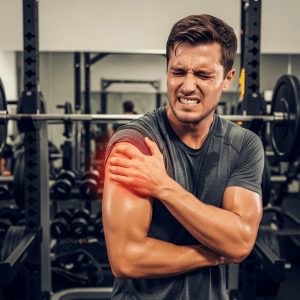
Pain at the front of the shoulder, stirred up when you raise your arm or carry something, put down to « the biceps tendon »: it is common, and often long. Let us say it at once: the evidence specific to this tendon is thin, and nobody has validated THE miracle programme. But the principle that works for shoulder tendinopathies is clear: load progressively, without chasing zero pain. Here is how, with concrete doses.
📝 In brief
- There is no landmark randomised trial of « the » exercise programme for the long head of biceps: what you will be offered rests either on expert consensus or on extrapolation from the rotator cuff. The only scoping review dedicated to physiotherapy interventions for the proximal long head of biceps, injections and NSAIDs are excluded from it, screened 4,059 references and kept only 14: 5 randomised trials with small numbers, 1 cohort, 1 case series, 4 reviews, 2 commentaries and 1 Delphi study, « heterogeneous in design and content », which « precludes any summative conclusion »; the authors conclude that evidence is scarce 3. Exercise is not absent from it (general exercise, eccentric training and stretching do feature among the quantitative studies), but it is in the minority alongside physical agents (shockwave, laser, ultrasound, iontophoresis). Careful about what this finding does not say : a scoping review maps the literature without assessing effectiveness or quality. Little evidence, of low volume, is not proof that nothing works.
- The compass available is an expert consensus, and it endorses all five ways of loading the tendon. An international Delphi study (29 expert physiotherapists, 3 rounds, threshold set a priori at 75 % agreement, response rate 24.6 %) designated 61 interventions out of 86 as effective, around a multimodal core (exercise, manual therapy and patient education), that goes beyond local work on the tendon alone. All 5 loading techniques proposed reached consensus: isometric, concentric in shoulder flexion, concentric in elbow flexion, eccentric in shoulder flexion, eccentric in elbow flexion. Read it for what it is: the PubMed record classes this work as level of evidence 5, the lowest on the scale, and the authors write themselves that evidence for the effectiveness of the recommended interventions is still lacking in this population: a guide to be tested in clinical trials, not a demonstration 4.
- A programme centred on the biceps curl alone runs against the available consensus. The experts agree on progressive strengthening for 9 muscle groups out of 11: biceps brachii (100 %), serratus anterior (100 %), internal and external rotators of the cuff (96.55 % each), deltoid (96.55 %), middle and lower trapezius (93.10 %), rhomboids (79.31 %) and latissimus dorsi (75.86 %: the weakest of the nine, one vote from non-consensus). Only upper trapezius (51.72 %) and pectoralis major (65.52 %) fall short of the threshold. The consensus also covers the 6 open and closed chain modalities tested and the functional tasks (reaching, carrying, overhead activity, occupational and sporting movements), all between 96 and 100 %. Here again: this is agreement between experts, never « it has been shown that » 4.
- On dosing (sets, repetitions, frequency), no figure is validated for the long head of biceps; the markers below come from the cuff and the extrapolation is ours. A scoping review of 46 programmes from 22 randomised trials finds 2 to 7 sessions a week, 1 to 3 sets, 4 to 30 repetitions and 4 to 16 weeks, with no universal approach: the 3 × 15 three times a week you read everywhere is indeed within the trials' ranges, what is missing is that no set of parameters commands consensus or has shown itself superior 10. A narrative synthesis of 14 trials (search closed in June 2014, with no meta-analysis or effect size) gives markers its authors describe as preliminary: some resistance seems to matter, with the optimal level unknown; 3 sets preferable to 1 or 2; optimal frequency unknown; and most programmes should show a clinically significant benefit at 12 weeks: useful for setting a reassessment date 8. Load heavy? We do not know: 3 trials (283 patients), none at low risk of bias across all domains, contradictory results, low to very low certainty, and what little signal there is concerns volume more than load alone, with high load in isolation bringing no functional benefit at 6 weeks 9.
- « Acceptable pain » is neither a green light to stop everything, nor an instruction to go looking for pain. On the Achilles tendon, an extrapolation we own, the only trial to have asked the question never tested complete rest: both arms (38 patients) followed the same daily loaded strengthening from week 1, one continuing running and jumping under pain monitoring, the other stopping them for 6 weeks (swimming, cycling and deep-water running remaining allowed). No significant difference, both groups improving (VISA-A-S from 57 to 85 in the group that continued, from 57 to 91 in the active rest group at 12 months, the numerical advantage goes to active rest, across 19 patients per arm and with no power calculation). The supported conclusion is one-directional: continuing under pain monitoring does no harm. The rule there is ≤ 5/10 during exercise, ≤ 5/10 afterwards but settled by the next morning, with no increase from one week to the next 5. Conversely, provoking pain does not seem necessary: in 43 patients with chronic cuff-related shoulder pain, 12 weeks of exercise including one at 4-7/10 did no better than a programme capped at 2/10 (SPADI, time × group interaction p = 0.25; difference at 12 weeks = 0.93; 95 % CI: −7.20 to 9.05), no difference detected, the interval remaining wider than the threshold of clinically important change 6.
- What goes with a good outcome is not the anatomical label put on the shoulder. The first cohort of more than 1,000 patients to test a broad range of biopsychosocial factors in physiotherapy (1,030 included, 840 seen again at 6 weeks, 811 at 6 months, 71 factors tested) finds four factors associated with a better outcome on both scales and at both time points: lower baseline disability, expecting « complete recovery » rather than « slight improvement », higher pain self-efficacy and less intense rest pain, that is, two measures of severity and two psychological factors. Examination findings pointing towards a structural diagnosis (restricted passive external rotation, external rotation lag) are not associated with the patient-reported outcome, which does not make the examination useless: other findings are (symptom change on scapular facilitation, a reduced gap between active and passive abduction). To be read with caution: a cohort with no control group, models explaining only 0.30 to 0.43 of the variance at 6 months: associations, not demonstrated treatment levers 12.
🎯 Understanding it in two minutes
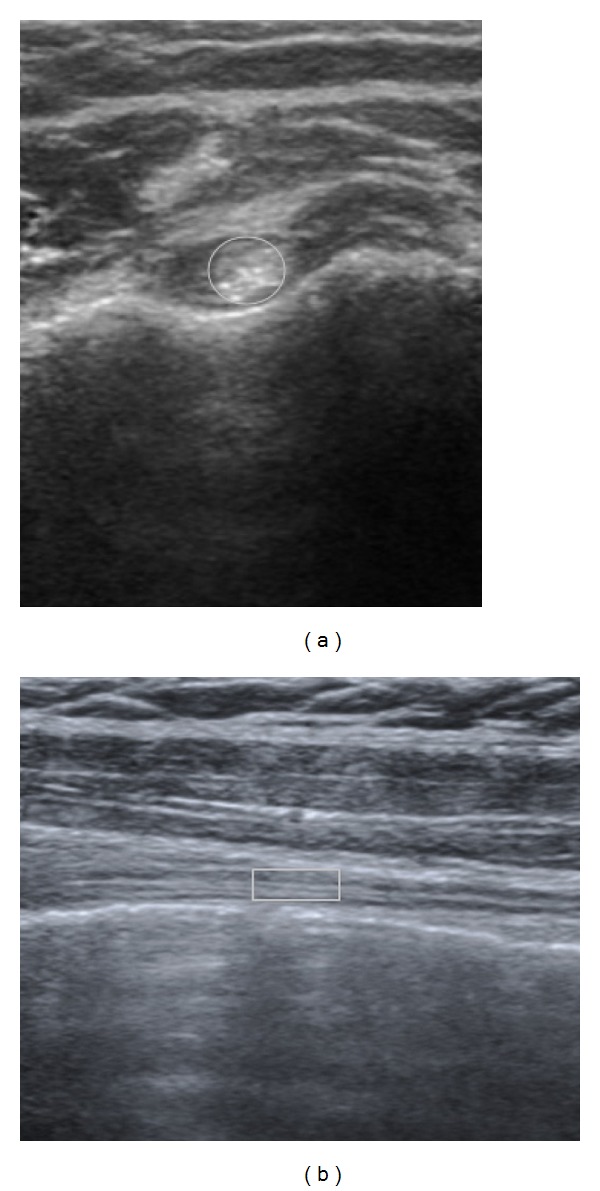
UltrasoundUltrasound of the long head of biceps tendon in transverse and longitudinal views showing peritendinous hypoechogenicity suggestive of tendinitis with effusion.
Source : Huang et al., TheScientificWorldJournal, 2013, figure 1 · CC BY
The long head of biceps tendon runs down the front of the shoulder, in a bony groove, before joining the biceps muscle. When that area becomes painful, people commonly speak of « biceps tendinitis ». This page deals with one question only: which exercises to do, and how to dose them. The mechanism, the diagnostic process and the red flags are set out in our full guide Long head of biceps tendinopathy: we are not repeating it here.
One point of honesty at the outset: the « long head of biceps » label is more fragile than it looks. A systematic review with meta-analysis of 30 studies concludes that there is not enough evidence to recommend any single clinical test; Yergason's manoeuvre, the least bad of the set, brings only weak information (positive likelihood ratio 2.56; negative 0.70) 1. So no examination test allows anyone, on its own, to state that your pain does come from that tendon.
Imaging does not settle it either. A systematic review devoted to shoulder imaging abnormalities in adults with no shoulder symptoms finds 30 % of long head of biceps tendon abnormalities. A figure to handle with care: a single study of 20 shoulders, very low certainty evidence, with the true prevalence acknowledged as uncertain 2. Finding an « abnormality » therefore does not prove it explains the pain. Ultrasound keeps a precise role: it is useful for confirming the large lesions: dislocation of the tendon (pooled positive likelihood ratio 38.00) and complete rupture (35.50), but the authors explicitly rule out using it to exclude a lesion: it confirms, it does not rule out 1.
Who this programme is for
For you if you have shoulder pain attributed to the long head of biceps, with no suspicion of complete rupture or dislocation of the tendon: those two situations call for medical advice and a confirmatory ultrasound, not a programme found online 1. The prerequisite applies to everyone: have the framework set by a professional, drawing on the full guide to long head of biceps tendinopathy for the diagnosis.
What the science says, and does not say
Let us be frank: the evidence specific to the long head of biceps is scant. A scoping review sifted 4,059 references and kept only 14 dealing with physiotherapy interventions for the proximal long head of biceps (including 5 randomised trials with small numbers and 1 Delphi study). The quantitative studies mainly concerned physical agents (shockwave, laser, ultrasound, iontophoresis) rather than structured exercise programmes: general exercise, eccentrics and stretching do feature, but remain in the minority. Too heterogeneous in design and content to allow the slightest summative conclusion, they leave the authors concluding that evidence is scarce 3. Two clarifications: this review covers only physiotherapist interventions (neither injections nor anti-inflammatories), and a scoping review maps the literature without judging effectiveness. Little evidence does not mean nothing works.
For want of landmark trials, it is an international expert consensus that serves as the compass: a 3-round Delphi study, 29 specialist physiotherapists, agreement threshold set at 75 %. The result: 61 interventions out of 86 reached « effective » consensus, and the core of the agreement concerns multimodal management (exercise, manual therapy and education), that goes beyond local work on the tendon alone. The authors are explicit about the status of their work: a guide to be tested in clinical trials, not proof (level of evidence 5, the lowest rung; response rate 24.6 %), and « evidence of effectiveness is still lacking in this particular population » 4.
What you will read below is not a demonstrated protocol: it is the best available consensus, to be adjusted with your physiotherapist.
The guiding principle: loading the tendon, progressively
In that same consensus, the 5 tendon-loading techniques proposed (isometric, concentric and eccentric, in shoulder and elbow flexion) all won the experts' agreement: agreement of opinion, never demonstrated effectiveness. The most useful message lies elsewhere: the experts do not treat the biceps in isolation. Progressive strengthening commands consensus for 9 muscle groups out of 11, biceps brachii included 4. A programme reduced to the biceps curl alone therefore runs against the little we have.
That leaves the question everyone asks: should you stop moving? The best available trial concerns the Achilles tendon: the extrapolation to the biceps is one we own. In 38 patients, one group continued running and jumping using a pain-monitoring model, the other stopped those two activities for 6 weeks; both groups followed the same daily progressive strengthening programme. No significant difference between them, and both improved markedly 5. Do not over-read that result: neither arm stopped loading the tendon, so complete rest was never tested, and the trial is too small to prove equivalence. The supported conclusion goes one way only: continuing under pain monitoring does neither better nor worse than stopping running and jumping, with no demonstrated negative effect.
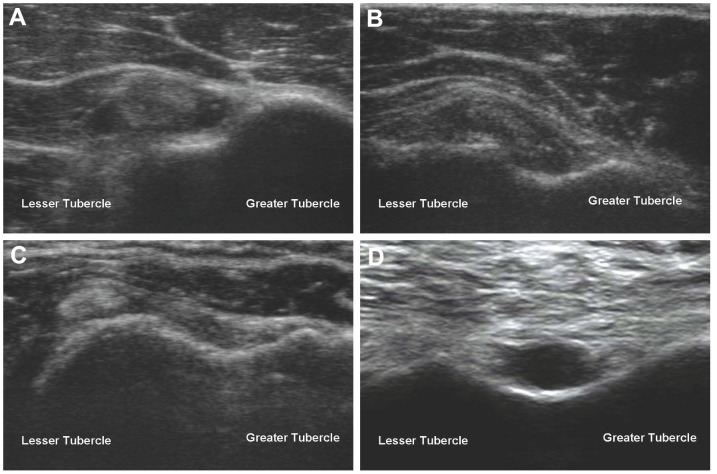
UltrasoundComparative ultrasound of the long head of biceps tendon showing four possible presentations: tendinopathy, medial subluxation, dislocation and tear with an empty bicipital groove.
Source : Chang et al., PloS one, 2014, figure 1 · CC BY
Key points
- No single clinical test proves the pain comes from the long head of biceps; 30 % of adults with no shoulder symptoms have an abnormality of that tendon on imaging: a fragile figure: 1 study, 20 shoulders 12.
- Specific evidence is scant: 14 articles kept out of 4,059 references, too heterogeneous to conclude 3.
- Management rests on an expert consensus (29 physiotherapists, threshold 75 %, level of evidence 5): multimodal, not centred on the biceps alone 4.
- On the Achilles tendon, continuing to load under pain monitoring showed no negative effect, to be transposed with caution 5.
💪 The exercise programme, step by step
Let us say it at once: as of 2026, there is no exercise programme validated specifically for long head of biceps tendinopathy. A scoping review kept only 14 articles devoted to physiotherapy for this tendon, too heterogeneous to conclude; the quantitative studies mainly concerned passive modalities (shockwave, laser, ultrasound), with exercise in the minority 3. The markers below therefore rest either on an expert consensus specific to the long head of biceps, or on an extrapolation we own from rotator cuff tendinopathy.
The principle: load the whole shoulder complex, not the biceps alone
The most useful message fits in one sentence: the long head of biceps rarely works alone. An international expert consensus (Delphi method, 29 physiotherapists, agreement threshold set at 75 %) recommends progressive strengthening of 9 muscle groups out of 11: the internal and external rotators of the cuff (96.55 % agreement each), the scapular stabilisers (serratus anterior 100 %, middle and lower trapezius 93.10 %, rhomboids 79.31 %), the deltoid (96.55 %) and the biceps itself (100 %). Only upper trapezius and pectoralis major failed to reach consensus. The work is recommended in open as in closed chain, with functional tasks (catching, carrying, overhead movements). A programme reduced to the biceps « curl » alone therefore runs against this consensus 4.
Careful: this is expert opinion, the lowest level of evidence, not a trial. The authors say it in black and white: evidence for the effectiveness of these interventions is still lacking in this particular condition. The consensus indeed describes multimodal management combining exercise, manual techniques and education, with exercise and building independence forming the backbone.
Progressively loading the whole shoulder complex, not the biceps alone: that is the thread running through it.
The « acceptable pain » rule
Should all pain be avoided? The most precise marker comes from a trial on the Achilles tendon, not on the biceps, so the transposition is one to own. This « pain-monitoring model » allows: pain of up to 5/10 during exercise; up to 5/10 after exercise, provided it has settled by the next morning; and pain that does not increase from one week to the next 5. In that trial, continuing running and jumping under this rule did neither better nor worse than stopping those activities for six weeks: both groups improved, with no demonstrated negative effect from continuing to load the tendon.
That range is a tolerance, not a target. A Belgian trial in chronic shoulder pain (an extrapolation, here again) compared twelve weeks of exercise carried out in moderate pain with exercise kept to a maximum of 2/10: no difference detected on shoulder function or on the other outcomes measured 6. Provoking pain is therefore not necessary in order to progress.
The exercises, phase by phase
The expert consensus retained five ways of loading the tendon, all of which reached agreement: isometric work (contraction without movement), concentric work in shoulder then elbow flexion, and eccentric work in those two directions 4. A classic progression, not validated as such for this tendon, is to start with isometrics when the pain is sharp, then add concentrics, and finally eccentrics and functional tasks. It is the pain rule above that serves as the criterion for moving from one stage to the next, far more than a fixed calendar.
On precise dosing (sets, repetitions, frequency), let us be frank: no figure is validated for the long head of biceps, and no set of parameters commands consensus or has shown itself superior, even for the cuff. A mapping of 46 programmes from 22 shoulder trials shows considerable variability instead 10 ; the markers below are drawn from it, for guidance only.
| Parameter | Range observed (cuff trials) | What we know about it |
|---|---|---|
| Sets | 1 to 3 | 3 sets seem preferable to 1 or 2 |
| Repetitions | 4 to 30 per set | a high number might do slightly better |
| Frequency | 2 to 7 times/week | optimal frequency unknown |
| Duration | 4 to 16 weeks | reassess the benefit around 12 weeks |
| Resistance | — | essential: movement without load is not enough |
Markers extrapolated from the rotator cuff: ranges drawn from a mapping of 46 programmes 10, interpretation from a review of 14 trials that stresses real resistance is needed 8. None of them is validated for the long head of biceps.
Should you load heavy?
The honest answer is: we do not know. A review with GRADE analysis found only three trials (283 patients) on the cuff, contradictory and of low to very low certainty; what little signal there is concerns exercise volume , not high load alone, which brought no functional benefit at six weeks in one trial 9. As for the choice of « method », a meta-analysis of 22 trials finds a slight advantage for motor control exercises on disability (a small but real effect, moderate certainty), with no clear difference in short-term pain 10. So we do not yet know what really produces the effect: better a programme you can keep up over time.
What place for imaging?
Imaging does not make the diagnosis of « tendinitis ». A meta-analysis shows that ultrasound mainly serves to confirm the large lesions, dislocation or complete rupture of the tendon, but that it cannot exclude them, and that no single clinical test is enough to state that the pain comes from the long head of biceps 1. Its performance falls further for partial tears, where a normal ultrasound rules nothing out 11. Above all, a long head of biceps abnormality is found in about 30 % of adults with no shoulder symptoms, on a single small study, of very low certainty 2 : an « abnormal » image is therefore not necessarily the cause of the pain, and does not on its own decide the exercise programme.
Key points
- You load the whole shoulder complex (cuff, scapula, deltoid, biceps), not the biceps alone: the isolated curl runs against the expert consensus.
- Pain of up to about 5/10 during effort is tolerated if it settles by the next morning and does not increase from one week to the next; going looking for it brings nothing.
- No dose is validated for the long head of biceps: progress in stages (isometric → concentric → eccentric) and take stock around 12 weeks.
- Imaging confirms a rupture or a dislocation but does not diagnose « tendinitis »: an abnormality of the tendon is common even without pain.
⚠️ The mistakes that keep the problem going
First a point of honesty: the evidence specific to the long head of biceps is rare. The only scoping review of physiotherapy interventions for this tendon kept just 14 articles out of 4,059 references, including 5 small randomised trials, too heterogeneous in design and content for any summative conclusion 3. Exercise, eccentrics and stretching feature there, but remain in the minority alongside physical agents (shockwave, laser, ultrasound…). What follows therefore rests on an expert consensus and on extrapolations we own, our editorial choice, from the cuff or the Achilles tendon. The full picture is in the guide Long head of biceps tendinopathy.
Mistake 1: putting the arm on complete rest
This is the most common reflex… and nobody has ever tested it. The trial always cited concerns the Achilles 5 : 38 patients (mid-portion tendinopathy, recreational athletes aged 44-48), both groups following the same daily progressive loading programme from the first week. The only difference: one continued running and jumping with a pain rule, the other stopped them for 6 weeks. At 12 months, both had improved markedly (VISA-A-S from 57 to 85 for the group that continued, from 57 to 91 on active rest), with no significant difference (19 patients per arm).
The conclusion goes one way only: continuing to load under pain monitoring does no harm. Neither that complete rest would be harmful, no arm stopped loading, nor that continuing would be superior: the figure in fact favoured the other group.
Mistake 2: going looking for the pain
The mirror error. A Belgian trial compared, in 43 people with chronic cuff-related shoulder pain (another extrapolation), 12 weeks of exercise in pain (one exercise at 4-7/10, the others at 0-2/10), against a programme kept to 2/10 at most. No difference detected on disability (SPADI) up to 6 months: a gap of 0.93 points at 12 weeks (95 % CI: −7.20 to 9.05). But « no difference detected » is not « equivalence demonstrated »: the interval exceeds the SPADI's threshold of clinically relevant change, and the secondary outcomes are exploratory 6. The « pain-free » arm was not at zero: it tolerated 2/10.
Mistake 3: strengthening only the biceps
This is the clearest departure from specialist opinion. An international consensus (Delphi, 3 rounds, 29 expert physiotherapists, threshold at 75 % agreement) settles on progressive strengthening of 9 muscle groups out of 11 : biceps brachii and serratus anterior (100 %), internal rotators, external rotators and deltoid (96.55 %), middle and lower trapezius (93.10 %), rhomboids (79.31 %), latissimus dorsi (75.86 %, one vote from non-consensus). Only upper trapezius (51.72 %) and pectoralis major (65.52 %) failed to reach consensus. To this are added functional tasks, from carrying loads to overhead work (96 to 100 %) 4. A programme reduced to the curl therefore runs against it. An indispensable clarification: expert opinion (the lowest level of evidence), not a trial: evidence of effectiveness is lacking, as the authors themselves say.
Mistake 4: stretching forcefully… or banning stretching
Contrary to a widespread narrative, the experts did not reject stretching: 7 muscle groups out of 7 reached consensus in the 3rd round, from pectoralis major (96.55 %) to the biceps itself (79.31 %) 4. Note: pectoralis major and upper trapezius reach consensus for being stretched while they do not for being strengthened. Here again: structured opinion, not demonstration. And no source compares gentle stretching with forced stretching: nobody can promise you that wrenching range out of a painful tendon serves any purpose.
The signals that should make you ease off
The most operational published rule comes from the pain-monitoring model 5, transposed by analogy:
- pain allowed up to 5/10 during exercise;
- up to 5/10 afterwards, but settled by the next morning ;
- pain and stiffness must not increase from one week to the next.
If any one of these signals turns red, it is the dose you adjust, not the arm you put under a bell jar.
Three received ideas that cost dear
| Received idea | What the literature says | Certainty |
|---|---|---|
| « My scan shows an abnormality, so that is what is causing the pain » | These abnormalities exist in people with no shoulder pain (above). Ultrasound confirms a dislocation or a complete rupture (positive likelihood ratios 38.00 and 35.50), but does not exclude them; a normal scan does not rule out a partial tear (sensitivity 0.27-0.71) 111 | weak |
| « You have to load heavy » | 3 trials (283 patients), none at low risk of bias, contradictory results. What little signal there is concerns volume, not high load alone, with no functional benefit at 6 weeks in the largest trial 9 | weak to very weak |
| « There is an optimal protocol » | Across 46 programmes from 22 trials: 2 to 7 sessions/week, 1 to 3 sets, 4 to 30 repetitions, over 4 to 16 weeks, no set of parameters commands consensus or has shown itself superior 10. The only clear signal: motor control is probably slightly superior on disability (SMD −0.29), a small but real gap; these figures come from the cuff, and we do not know what produces a programme's effect 10 | moderate |
Key points
- Complete rest has never been tested; on the Achilles, loading under pain monitoring does no harm.
- 5/10 is a tolerance, not a target: nothing indicates you should go looking for pain.
- The expert consensus covers 9 muscle groups, not the biceps alone.
- Stretching is not banned, but nothing validates forced stretching.
🩺 How long it takes, and where the physiotherapist fits in
How long? The answer starts with an admission: the evidence specific to long head of biceps tendinopathy is scant and of low volume. The only scoping review devoted to physiotherapy interventions for this tendon kept 14 articles out of 4,059 references (5 small randomised trials, 1 cohort, 1 case series, 4 reviews, 2 commentaries, 1 Delphi), too heterogeneous for any summative conclusion; the quantitative studies mainly concerned mostly physical agents (shockwave, laser, ultrasound) rather than structured exercise programmes: exercise, eccentrics and stretching feature there, but in the minority 3. For the full clinical picture: see the guide to long head of biceps tendinopathy.
Duration markers, not promises
No timescale has been established for the long head of biceps : what follows comes from cuff-related shoulder pain, and the extrapolation is one we own. A narrative synthesis of 14 heterogeneous trials (with no meta-analysis or effect size, search closed in June 2014), puts forward preliminary markers : most programmes should show a clinically significant benefit at 12 weeks 8. The mapping of the programmes actually tested gives the scale: 46 programmes from 22 trials run over 4 to 16 weeks, 2 to 7 sessions a week, 1 to 3 sets, 4 to 30 repetitions; no set of parameters commands consensus or has shown itself superior 10.
Rest or movement?
Complete rest has never been tested head-on. In the landmark Achilles trial (38 patients, recreational athletes), both groups followed the same daily loading programme; only running and jumping were stopped for 6 weeks in one arm, with no significant difference at the end (VISA-A-S 57 at inclusion, 85 on continuing and 91 on active rest at 12 months, the point estimate numerically favours stopping, on numbers too small to settle it). The supported conclusion goes one way only: continuing to load under pain monitoring does no harm: up to 5/10 during exercise, 5/10 afterwards but settled by the next morning, with no increase from one week to the next 5. But tolerating pain does not mean seeking it out. A Belgian trial (43 people, chronic cuff-related shoulder pain) comparing 12 weeks of exercise including one carried out at 4-7/10 against exercise kept to 2/10 at most detected no difference on the SPADI up to 6 months (p = 0.25), without demonstrating equivalence: the confidence interval remains wider than the threshold of clinically relevant change 6.
What the physiotherapist adds to the programme done alone
For want of trials, an international expert consensus serves as the compass: 29 specialist physiotherapists, 3 rounds, a 75 % agreement threshold, 61 interventions out of 86 accepted as effective. The core of the agreement is multimodal management (exercise, manual therapy, education), that goes beyond local work on the tendon alone. To be taken for what it is: expert opinion (level of evidence 5, response rate 24.6 %), presented as a guide to be tested in trials 4.
| Muscles | Agreement | Status |
|---|---|---|
| Serratus anterior and biceps (100 %); cuff (internal and external rotators) and deltoid (96.55 % each); middle and lower trapezius (93.10 %) | 93–100 % | Expert consensus |
| Rhomboids (79.31 %); latissimus dorsi (75.86 %) | 76–79 % | Fragile, one vote from the threshold |
| Pectoralis major (65.52 %); upper trapezius (51.72 %) | 52–66 % | No consensus |
Nine muscle groups out of eleven therefore reach consensus, as do open and closed chain work (6 techniques out of 6) and functional tasks (reaching, carrying, working overhead, occupational and sporting movements; 96 to 100 %). All 5 tendon-loading techniques (isometric, concentric and eccentric, shoulder and elbow) reached consensus, as did stretching (7 groups out of 7, including the biceps at 79.31 %): for pectoralis major and upper trapezius, the experts even approve stretching without approving resistance strengthening. A programme reduced to the biceps curl therefore runs against the only consensus available.
When to seek advice, and what imaging can really do
No single clinical test allows anyone to state that your pain comes from the long head of biceps: their accuracy varies enormously from one study to another, the evidence is insufficient to recommend any one of them, and Yergason's manoeuvre brings little (LR+ 2.56; LR− 0.70) 1 : the first reason to seek advice. Ultrasound, for its part, serves to confirm a suspected dislocation of the tendon (pooled LR+ 38.00) or complete rupture (35.50): two situations that warrant an opinion. But it cannot rule out a lesion: its sensitivity collapses for partial tears (0.27 to 0.71); a normal ultrasound excludes nothing, and it complements the clinical examination without replacing it 11. Before worrying about a report: 30 % of long head of biceps abnormalities have been found in adults with no shoulder symptoms (a single study of 20 shoulders, very low certainty) 2.
Key points
- 12 weeks : a reassessment marker extrapolated from the cuff, not a date of recovery (programmes tested: 4 to 16 weeks).
- No dose (sets, repetitions, frequency) commands consensus or has shown itself superior.
- Loading under pain monitoring does no harm; provoking pain is not necessary.
- The expert consensus targets 9 muscle groups out of 11: the biceps curl alone misses the point.
- Seek advice if the diagnosis is not clear: no single test establishes it, and ultrasound confirms a dislocation or a complete rupture without being able to rule them out.
Bibliography
Every reference checked individually on PubMed (clickable PMID). 12 sources. Click a superscript note marker in the text: the bibliography opens and highlights the source.
- Bélanger V, Dupuis F, Leblond J, Roy JS (2019). Journal of Rehabilitation Medicine. PMID 31243466. doi:10.2340/16501977-2563.
- Ibounig T, Sanders S, Haas R, Jones M, Järvinen TLN, Taimela S, Docking S, Rämö L, Buchbinder R (2024). Osteoarthritis and Cartilage. PMID 38876437. doi:10.1016/j.joca.2024.06.001.
- McDevitt AW, Young JL, Cleland JA, Hiefield P, Snodgrass SJ (2024). Brazilian Journal of Physical Therapy. PMID 38219522. doi:10.1016/j.bjpt.2023.100586.
- McDevitt AW, Cleland JA, Addison S, Calderon L, Snodgrass S (2022). International Journal of Sports Physical Therapy. PMID 35693861. doi:10.26603/001c.35256.
- Silbernagel KG, Thomeé R, Eriksson BI, Karlsson J (2007). American Journal of Sports Medicine. PMID 17307888. doi:10.1177/0363546506298279.
- Cavaggion C, Luque-Suarez A, Voogt L, Juul-Kristensen B, Wollants G, Beke L, Fransen E, Struyf F (2024). Open Access Journal of Sports Medicine. PMID 39635498. doi:10.2147/OAJSM.S483272.
- Dubé MO, Lafrance S, Charron M, Mekouar M, Desmeules F, McCreesh K, Michener LA, Grimes J, Shanley E, Roy JS (2024). Journal of Orthopaedic & Sports Physical Therapy. PMID 38832666. doi:10.2519/jospt.2024.12452.
- Littlewood C, Malliaras P, Chance-Larsen K (2015). International Journal of Rehabilitation Research. PMID 25715230. doi:10.1097/MRR.0000000000000113.
- Malliaras P, Johnston R, Street G, Littlewood C, Bennell K, Haines T, Buchbinder R (2020). Archives of Physical Medicine and Rehabilitation. PMID 32682937. doi:10.1016/j.apmr.2020.06.013.
- Lafrance S, Charron M, Dubé MO, Desmeules F, Roy JS, Juul-Kristensen B, Kennedy L, McCreesh K (2024). Journal of Orthopaedic & Sports Physical Therapy. PMID 38848304. doi:10.2519/jospt.2024.12453.
- Courage O, van Rooij F, Saffarini M (2023). Knee Surgery, Sports Traumatology, Arthroscopy. PMID 36114842. doi:10.1007/s00167-022-07154-5.
- Chester R, Jerosch-Herold C, Lewis J, Shepstone L (2018). British Journal of Sports Medicine. PMID 27445360. doi:10.1136/bjsports-2016-096084.
❓ Frequently asked questions
Which exercises should you do for biceps tendinitis?
There is no landmark randomised trial of « the » exercise programme for the long head of biceps: the only scoping review devoted to physiotherapy interventions for this tendon screened 4,059 references and kept only 14, judged « heterogeneous in design and content », which « precludes any summative conclusion », the authors conclude that evidence is scarce 3. What structures practice today is therefore an international expert consensus (Delphi method, 29 physiotherapists, 3 rounds, threshold set a priori at 75 % agreement): 61 interventions out of 86 are designated as effective, around multimodal management (exercise, manual therapy and patient education), that goes beyond local work on the tendon alone. All 5 tendon-loading techniques proposed reached consensus: isometric, concentric in shoulder flexion, concentric in elbow flexion, eccentric in shoulder flexion and eccentric in elbow flexion. To this are added progressive strengthening of 9 muscle groups out of 11, the 6 open and closed chain modalities tested, and functional tasks (reaching, carrying, overhead activity, occupational and sporting movements), all between 96 and 100 % agreement. Read it for what it is: expert opinion classed as level of evidence 5 (the lowest on the scale), with a response rate of 24.6 %, and the authors themselves write that evidence for the effectiveness of the recommended interventions is still lacking in this population; they present their work as a guide to be tested in clinical trials, not as a demonstration 4. On the choice of method, the only robust signal comes from cuff-related shoulder pain: an extrapolation we own as such: a systematic review with meta-analyses (22 trials, 1,281 participants) shows that motor control programmes are probably slightly superior to non-specific exercise on disability (SMD −0.29; 95 % CI: −0.51 to −0.07; n = 323; 7 trials in the short term, and −0.33; 95 % CI: −0.57 to −0.09; n = 286; 5 trials in the medium term; moderate certainty), with no significant difference in short-term pain (SMD −0.19; 95 % CI: −0.41 to 0.03). A small gap, but a real one, and for the rest, we do not yet know what produces the effect: the review classes intensity as low to very low certainty and cites progression and individualisation only as hypotheses explaining the residual uncertainty 10.
Should you strengthen only the biceps or the whole shoulder?
A programme centred on the biceps curl alone runs against the available consensus. The 29 experts in the international Delphi on long head of biceps tendinopathy agree on progressive strengthening for 9 muscle groups out of 11: biceps brachii (100 % agreement), serratus anterior (100 %), internal and external rotators of the cuff (96.55 % each), deltoid (96.55 %), middle and lower trapezius (93.10 %), rhomboids (79.31 %) and latissimus dorsi (75.86 %): the last being the most fragile of the nine, one vote from non-consensus, as are the rhomboids. The only two muscles that fail to reach the 75 % threshold are upper trapezius (51.72 %) and pectoralis major (65.52 %). The consensus also covers open and closed chain work (6 modalities out of 6) for the cuff, the scapular stabilisers and the biceps, as well as functional tasks (96 to 100 %). A clarification that changes the reading: this is a consensus of opinion, not a trial: those percentages express agreement between experts, never demonstrated effectiveness, and the authors remind us that evidence of effectiveness is still lacking in this population 4.
How many sets, repetitions and sessions a week for biceps tendinitis?
No figure is validated for the long head of biceps. The markers that follow are borrowed from cuff-related shoulder pain: this is an extrapolation, and we own it as such: the sources cited here say nothing about the long head of biceps. A scoping review of 46 exercise programmes from 22 randomised trials finds considerable variability: 2 to 7 sessions a week, 1 to 3 sets, 4 to 30 repetitions per set, over 4 to 16 weeks, with no universal approach 10. In other words, the 3 sets of 15 repetitions three times a week you read everywhere are indeed within the trials' ranges, what is missing is not their presence in the literature, it is that no set of parameters commands consensus or has shown itself superior; and since that review is descriptive, it synthesises no effectiveness at all. An older narrative synthesis (14 heterogeneous randomised trials, search closed in June 2014, with no meta-analysis, no effect size or confidence interval) draws from it markers its own authors describe as preliminary: some resistance seems to matter, movement without load not being enough, even if the optimal level remains unknown; 3 sets are preferable to 1 or 2; a high number of repetitions might give better results; the optimal frequency is unknown; the setting (home or clinic), the physiotherapist's experience, and whether the exercise provokes or avoids pain do not seem to change the result; and most programmes should show a clinically significant benefit at 12 weeks: a useful marker for setting a reassessment date with the patient 8. Should you load heavy? We do not know: a systematic review with GRADE assessment found only 3 trials (283 patients), none at low risk of bias across all domains, with contradictory results and low to very low certainty. What little signal there is concerns volume more than load alone: high load and high volume improve function by 20 points out of 100 (95 % CI: 12 to 28) at 3 months in one trial (n = 102, low certainty, with no clinically important difference in activity or night pain, and overall pain not reported); high volume brings a clinically important functional benefit beyond 3 months in another (n = 61, very low certainty); while high load alone brings no functional benefit at 6 weeks (n = 120, very low certainty). The risk of adverse effects remains uncertain 9. Finally, no trial has compared different frequencies or different programme durations 10.
Can you do the exercises if it hurts, or should you rest?
Two pieces of data frame the answer, both from outside the long head of biceps: an extrapolation to own. On « should you stop »: the only trial to have asked the question did so on the Achilles tendon, and it never tested complete rest. In 38 patients (mid-portion tendinopathy only, insertional cases excluded, mean age 44 and 48, recreational athletes), both arms followed the same daily progressive loading programme from the first week; one group (n = 19) additionally continued running and jumping using a pain-monitoring model, the other (n = 19) had to stop those two activities for 6 weeks: swimming, cycling and deep-water running remaining allowed. No significant difference between the groups, with both improving markedly (VISA-A-S score of 57 at inclusion, 85 in the group that continued and 91 in the active rest group at 12 months). The only supported conclusion is one-directional: continuing to load the tendon under pain monitoring does no harm. This is not proof of superiority, at 12 months the numerical advantage in fact goes to active rest, across 19 patients per arm and with no power calculation reported, so absence of evidence rather than evidence of equivalence. The pain rule used there is described precisely: pain allowed up to 5/10 on the VAS during exercise, up to 5/10 after exercise but having to be settled by the next morning, with pain and stiffness not increasing from one week to the next 5. On « should you go looking for pain »: no. A Belgian randomised trial in 43 participants with chronic cuff-related shoulder pain compared 12 weeks of exercise with and without provoking pain, followed to 6 months. The actual protocol deserves reading: the « in pain » group did only one exercise at 4-7/10 on the numerical scale (the other 3 remaining at 0-2/10), and only until week 9; the « pain-free » group was capped at 2/10, so it was not zero pain. No difference detected on the SPADI (time × group interaction, p = 0.25; mean difference at 12 weeks = 0.93; 95 % CI: −7.20 to 9.05), nor on the other outcomes, which the authors declare exploratory for want of power. « No difference detected » and not « no difference »: the confidence interval remains wider than the SPADI's threshold of clinically important change, and equivalence is not demonstrated. The trial also has no control group, included only 13 % of the patients screened and rests on 2 physiotherapists in a single clinic. The authors conclude that provoking pain does not seem necessary in order to get a result 6.
Should you stretch the biceps in biceps tendinitis?
Contrary to a narrative widespread in the field, the experts did not reject stretching. In the international Delphi on long head of biceps tendinopathy, « agree » consensus went from 5 muscle groups out of 7 in round II to 7 out of 7 in round III, with four participants changing their view to include upper trapezius: pectoralis major and pectoralis minor (96.55 %), posterior rotators of the cuff (93.10 %), latissimus dorsi (89.66 %), upper trapezius (86.20 %), glenohumeral internal rotators (86.20 %) and biceps brachii itself (79.31 %). An illuminating detail: for pectoralis major and upper trapezius, the logic reverses: the experts approve stretching them (96.55 % and 86.20 %) without approving progressive resistance loading (65.52 % and 51.72 %). Two reservations, and they are heavy ones. First, this is a consensus of opinion from 29 experts, not data: the paper writes in black and white that evidence for the effectiveness of the recommended interventions is still lacking in this population, and positions expert opinion as a useful tool where evidence is missing. Second, the distinction often made between gentle stretching and forced stretching of the painful tendon is never addressed by this study: neither is supported by data specific to the long head of biceps 4.