



In brief
Long head of biceps (LHB) tendinopathy is an essentially degenerative disorder of the tendon, with disorganisation of the collagen fibres and neovascularisation, which is why the term “tendinitis” should be abandoned. It is rarely isolated: more than 90 % of cases are associated with rotator cuff pathology, and its prevalence on MRI rises by about 4 % per year of age. Clinical diagnosis rests on a battery of tests (the Upper Cut plus palpation cluster being the most accurate), not on any single test. Conservative treatment is first line, maintained for at least 12 weeks, with global shoulder exercise under progressive loading.
Clinical synthesis based on the international Delphi McDevitt 2022, the BMC 2023 scoping review, the prospective Clin Orthop 2025 data and the meta-analyses of Cook & Purdam, Hegedus and Coombes.
Clinical summary
- Long head of biceps (LHB) tendinopathy is primarily degenerative and rarely isolated: more than 90 % of cases are associated with rotator cuff pathology (BMC 2023 scoping review).
- Prevalence rises by about 4 % per year of age on MRI of the symptomatic shoulder (Clin Orthop Relat Res 2025, n=500 shoulders).
- The dominant risk factors are ageing, overhead sports (throwing, swimming, tennis, volleyball), subacromial impingement and glenohumeral instability.
- The pathophysiology follows the Cook & Purdam continuum (BJSM 2009): a reversible reactive phase, then tendon dysrepair, then degeneration with a risk of rupture.
- Clinical diagnosis rests on a battery of tests and not on a single test (Hegedus BJSM 2012): Upper Cut plus groove palpation, in parallel, give the best accuracy.
- The differential diagnosis targets subscapularis (Belly-press, Lift-off), SLAP lesions (Biceps Load II, sens 89.7 % / spec 96.9 %) and suprascapular nerve entrapment.
- First-line imaging is dynamic ultrasound (tendon stability); MR arthrography remains the gold standard for the full work-up.
- Classifying lesions as zone A (extra-articular), zone B (pulley/junction) or zone C (intra-articular / SLAP) guides the treatment strategy.
- In practice, Conservative treatment is first line and must be maintained for at least 12 weeks (McDevitt 2022 consensus).
- The exercise programme must be global : rotator cuff, scapular control, biceps under progressive loading (isometric → HSR → plyometric).
- Corticosteroid injections (Coombes 2010, Lancet) improve pain in the short term but can be harmful in the long term. Shockwave is promising for associated cuff pathology (Brindisino 2024).
- Patient education, load management and self-efficacy are major determinants of the clinical outcome (Chester BJSM 2018, n=1030).
- LHB tendinopathy is very often a warning sign of global shoulder dysfunction: treating the biceps alone is bound to fail.
- Return to sport is guided by functional criteria (strength > 90 % of the contralateral side, full range, sport-specific tests) and not by a fixed delay.
- Complex cases (Boileau's 2004 hourglass biceps, an irreparable pulley lesion) respond poorly to conservative care and call for tenotomy or tenodesis.
- Anterior shoulder pain can mimic other conditions: always look for SLAP lesions, subscapularis involvement, suprascapular nerve entrapment and C5-C6 radiculopathy.
- Bringing evidence-based practice back into the clinic runs into lack of time and clinician beliefs: active implementation strategies are required (audit, feedback, interactive training).
Contents
- What are the fundamentals to know about long head of biceps tendinopathy?
- How do you assess and diagnose long head of biceps tendinopathy with certainty?
- Which treatment strategies are the most effective for long head of biceps tendinopathy?
- The biceps, victim or culprit? Understanding the coupling with the rotator cuff.
- How do you secure lasting recovery and prevent recurrence?
- What do real clinical cases teach us about long head of biceps tendinopathy?
- How do you apply these recommendations concretely in your practice?
What are the fundamentals to know about long head of biceps tendinopathy?
How is this condition defined, who does it affect and what are the risk factors?
Long head of biceps tendinopathy, abbreviated LHB or LHBT in the literature, is an essentially degenerative disorder of the tendon in its intra-articular and bicipital portion, with disorganisation of the collagen fibres, an increase in ground substance and neovascularisation. Histopathology shows little or no acute inflammation, which is why the historical term “tendinitis” should be abandoned.¹ ²
The condition is rarely isolated. A scoping review published in 2023 in BMC Musculoskeletal Disorders concludes that the great majority of long head of biceps disorders coexist with rotator cuff pathology, and surgical series report comorbidity in up to 93 % of cases.² ³ A classic distinction is drawn between primary tendinopathy (direct mechanical impingement in the bicipital groove) and the far more frequent secondary tendinopathy, which follows from instability or from lesions of the adjacent structures.
A prospective study published in Clinical Orthopaedics and Related Research in 2025 (n = 500 symptomatic adult shoulders, mean age 55, 49 % men) quantified the effect of age for the first time: the prevalence of long head of biceps abnormalities on MRI rises by about 4 % per year of age and remains strongly linked to concomitant cuff tendinopathy.⁴ This finding recentres the clinical reading: LHB tendinopathy is above all a marker of global degeneration of the subacromial complex. 🧓
📊 Linear rise in MRI prevalence per decade of age
LHB tendinopathy on MRI of the symptomatic shoulder: modelled at +4 %/yr (Clin Orthop Relat Res 2025)
Linearised estimates from the data reported in Long Head of Biceps Tendinopathy Is Associated With Age and Cuff Tendinopathy on MRI. Clin Orthop Relat Res. 2025;483(5). PMID 39679662.
The risk factors can be grouped into two categories:
- Extrinsic : repetitive overhead sports (throwing, swimming, tennis, volleyball, weightlifting), an abrupt increase in training load, subacromial impingement, anterior glenohumeral instability and repetitive overhead manual work.⁵ ⁶
- Intrinsic : a zone of relative hypovascularity in the intra-articular portion (the critical zone described by Refior & Sowa in 1995), the morphology of the bicipital groove (shallow, with a prominent medial wall), subscapularis weakness, scapular dyskinesis, ageing and hormonal status (post-menopause).⁵ ⁷ ⁸
What happens in the body, and how does long head of biceps tendinopathy evolve?
The pathophysiology follows the continuum model proposed by Cook & Purdam in 2009 in the British Journal of Sports Medicine, a model that still structures how tendinopathy is read clinically at every site.⁹ Three stages:
- Reactive tendinopathy : a non-inflammatory proliferative response to acute overload. The tendon thickens transiently to reduce stress. A reversible stage if load is managed.⁹ 📈
- Tendon dysrepair : a disorganised attempt at healing, with increased proteoglycans, fibre separation, neovascularisation and increased innervation contributing to chronicity.²
- Degenerative tendinopathy : irreversible structural change, cell apoptosis, marked collagen disorganisation. Increased risk of partial or complete rupture.⁹ ¹⁰ 📉
Left untreated, the natural course tends towards chronicity in a substantial fraction of cases, with worsening of the associated cuff lesions, tendon weakening and a risk of spontaneous rupture (classically presenting as the “Popeye sign”). Conversely, when complete rupture occurs on an advanced tendinopathy, the functional consequences are often modest (a loss of 8-20 % of strength in supination and elbow flexion depending on the series), because the short head and the supinator partly compensate.¹¹
Not to be missed at the initial assessment
- Non-mechanical night pain, fever, unexplained weight loss → tumour or infection (Finucane 2020).
- Distal neurological deficit, upper-limb paraesthesia → C5-C6 radiculopathy, thoracic outlet syndrome.
- Spontaneous rupture in a patient < 40 with no loading context → systemic work-up (athlete with REDs, hypothyroidism, prolonged corticosteroid use).
- History of glenohumeral dislocation → suspect a combined pulley plus subscapularis lesion.
Key points
- LHB tendinopathy is degenerative, rarely isolated and strongly associated (> 90 %) with cuff pathology.
- Prevalence on MRI rises by about 4 % per year of age (Clin Orthop 2025).
- The Cook & Purdam continuum (BJSM 2009) remains the reference framework for understanding the trajectory.
- Without appropriate management, the course leads to chronicity, loss of function, and even spontaneous rupture.
Chapter 1 bibliography
- Cook JL, Purdam CR. Is tendon pathology a continuum? A pathology model to explain the clinical presentation of load-induced tendinopathy. Br J Sports Med. 2009;43(6):409-416. PMID 18812414.
- Diplock B, Hing W, Marks D. The long head of biceps at the shoulder: a scoping review. BMC Musculoskelet Disord. 2023;24(1):232. PMID 36978047.
- Krupp RJ, Kevern MA, Gaines MD, Kotara S, Singleton SB. Long head of the biceps tendon pain: differential diagnosis and treatment. J Orthop Sports Phys Ther. 2009;39(2):55-70. doi:10.2519/jospt.2009.2802.
- Canavan K, Zai Q, Bruni D, et al. Long Head of Biceps Tendinopathy Is Associated With Age and Cuff Tendinopathy on MRI Obtained for Evaluation of Shoulder Pain. Clin Orthop Relat Res. 2025;483(5):869-877. PMID 39679662.
- Varacallo M, Seaman TJ, Mair SD. Biceps Tendon Dislocation and Instability. In: StatPearls. Treasure Island (FL): StatPearls Publishing; 2023. NBK534850.
- Nho SJ, Strauss EJ, Lenart BA, et al. Long head of the biceps tendinopathy: diagnosis and management. J Am Acad Orthop Surg. 2010;18(11):645-656. PMID 21041799.
- Refior HJ, Sowa D. Long tendon of the biceps brachii: sites of predilection for degenerative lesions. J Shoulder Elbow Surg. 1995;4(6):436-440. PMID 8665288.
- Boileau P, Ahrens P, Hatzidakis A. Entrapment of the long head of the biceps tendon: the hourglass biceps — a cause of pain and locking of the shoulder. J Shoulder Elbow Surg. 2004;13(3):249-257. PMID 15111893.
- Andres BM, Murrell GA. Treatment of tendinopathy: what works, what does not, and what is on the horizon. Clin Orthop Relat Res. 2008;466(7):1539-1554. PMID 18446422.
- Cardoso TB, Pizzari T, Kinsella R, Hope D, Cook JL. Current trends in tendinopathy management. Best Pract Res Clin Rheumatol. 2019;33(1):122-140. PMID 31431267.
- Hsu AR, Ghodadra NS, Provencher MT, et al. Biceps tenotomy versus tenodesis: a review of clinical outcomes and biomechanical results. J Shoulder Elbow Surg. 2011;20(2):326-332. PMID 21051241.
How do you assess and diagnose long head of biceps tendinopathy with certainty?
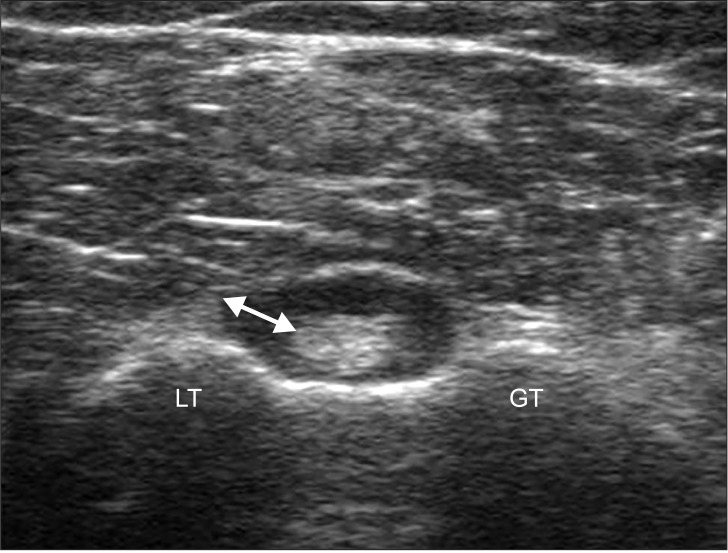
UltrasoundTransverse ultrasound of the long head of biceps tendon at the bicipital groove: effusion within the tendon sheath, arrow on the measured distance.
Source : Park et al., Clinics in orthopedic surgery, 2015, figure 1 · CC BY-NC
Diagnosing LHB tendinopathy is above all a diagnosis of correlation : anterior shoulder pain is non-specific, and the reliability of clinical tests taken in isolation is limited.¹ ² The best strategy combines a careful history, a battery of at least two or three tests that provoke pain in the bicipital groove, differential diagnosis manoeuvres and, where needed, targeted imaging.
Which questions should you ask to understand the patient and their history?
History-taking should explore several lines 🤔 :
- Location : anterior pre-deltoid pain, classically in the bicipital groove, sometimes radiating towards the biceps brachii.³
- Mechanism : gradual onset (overuse, overhead sport) vs acute trigger (resisted supination effort, trauma).
- Joint noises : popping or snapping during glenohumeral rotation → suspect tendon instability, a pulley lesion or a subscapularis tear.⁴
- Aggravating factors : overhead movements, carrying loads, resisted supination, sleeping on the affected side.
- Past history : glenohumeral dislocations, trauma, previous injections, chronic overhead sport, manual occupation.
- Yellow flags : kinesiophobia, low self-efficacy, negative expectation. Chester 2018 (BJSM, n = 1030) showed that these psychological variables predict the outcome of physiotherapy more strongly than the structural clinical examination.⁵
Which clinical tests should you perform, and which other conditions should you rule out?
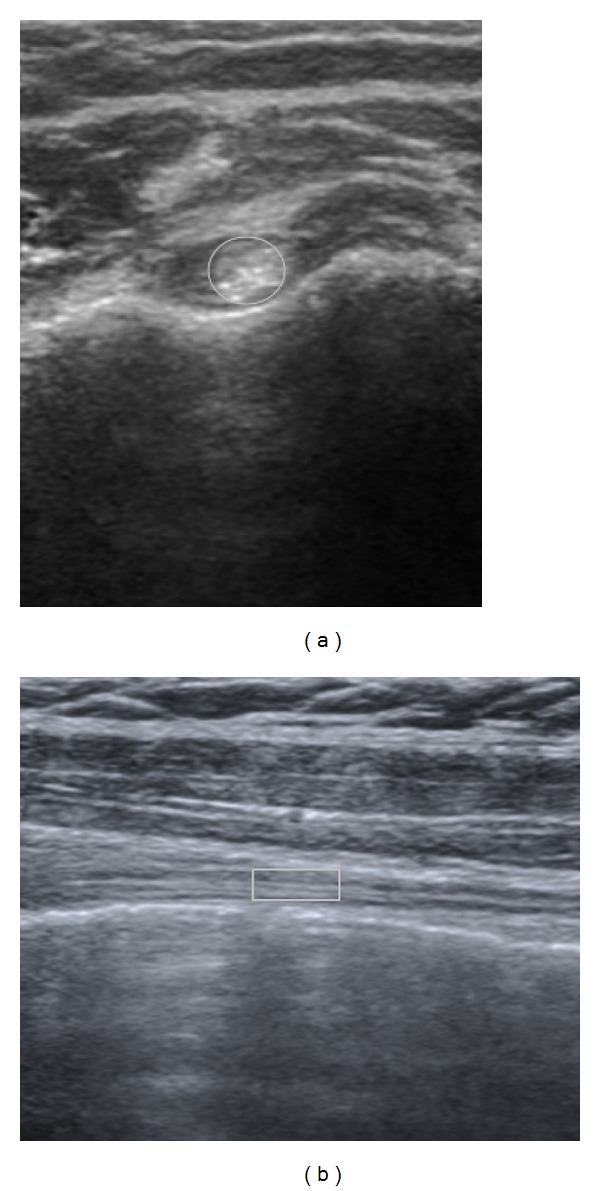
UltrasoundUltrasound of the long head of biceps tendon in transverse and longitudinal views: hypoechogenicity around the tendon, measurement area outlined, tendinopathy.
Source : Huang et al., TheScientificWorldJournal, 2013, figure 1 · CC BY
The landmark meta-analysis by Hegedus (BJSM 2012, updated 2017) concluded that no single test has sufficient diagnostic value to confirm or rule out LHB involvement.¹ ² The sensible strategy is to combine several tests with palpation. A recent diagnostic study in a surgical population (Erickson 2019) confirmed that,as a cluster, the Upper Cut plus palpation give the best characteristics (sensitivity 88 % in parallel, specificity 93 % in series).⁶ ⁷
| Test | Description | Sensitivity | Specificity | Level of evidence |
|---|---|---|---|---|
| Bicipital groove palpation | Local tenderness in 10° of external rotation plus supination | ~ 53 % | ~ 54 % | CEBM 2b |
| Speed | Resisted forward flexion, elbow extended, forearm supinated | ~ 32-50 % | ~ 75 % | CEBM 2b |
| Yergason | Resisted supination, elbow at 90° | ~ 32-43 % | ~ 79-83 % | CEBM 2b |
| Upper Cut | Explosive upward movement against resistance, fist to the chin | ~ 73 % | ~ 78 % | CEBM 2b |
| Upper Cut + palpation cluster | Parallel / series | ~ 88 % | ~ 93 % | CEBM 2a (cluster) |
| Biceps Load II | Test for type II SLAP (Kim 2001) | 89.7 % | 96.9 % | CEBM 1b |
| Belly-press / Lift-off (subscapularis) | Looking for an associated subscapularis tear | ~ 40-87 % | ~ 92-98 % | CEBM 2b |
Differential diagnosis: a non-negotiable step 🎯
The high prevalence of concomitant conditions calls for a structured approach:
- Subscapularis tear : the tendon forms the roof of the biceps pulley; its rupture is the major mechanical cause of LHB instability. The Belly-press and the Lift-off should be performed systematically.⁸
- SLAP lesion (biceps anchor): the Biceps Load II (Kim 2001, n = 127) remains the best-performing single test (sens 89.7 %, spec 96.9 %).⁹
- Subacromial impingement : Neer and Hawkins-Kennedy can provoke referred pain in the groove without any primary LHB involvement.
- Suprascapular nerve entrapment at the spinoglenoid notch: posterolateral pain that may be felt anteriorly, weak external rotation, infraspinatus atrophy. To be considered where conservative treatment fails unexpectedly.¹⁰
- C5-C6 radiculopathy : cervicobrachial pain, motor or sensory deficit, positive Spurling.
🔀 Simplified diagnostic decision tree
Anterior shoulder pain in the non-traumatic adult
Adapted from Diplock 2023 (scoping review), McDevitt 2022 (Delphi) and van Deurzen 2020 (SR/MA on tenodesis).
Imaging
- Dynamic ultrasound : the first-line investigation. It assesses thickening, tenosynovitis and subluxation on rotation. Operator-dependent.¹¹ ¹²
- MRI : sensitivity 67-94 %, specificity 75-100 % depending on the lesion; it remains the gold standard for the global work-up (LHB + cuff + labrum + bone).¹³
- MR arthrography : useful where a SLAP lesion or a refractory pulley lesion is suspected.
Should patients with long head of biceps tendinopathy be classified?
Yes. Classification improves interprofessional communication, guides treatment and refines the prognosis. A scoping review published in 2025 (PMID 40606699) surveyed every existing system (Walch, Habermeyer, Lafosse, Boileau, Itoi, Bennett) and proposed a new 4-stage arthroscopic classification (A: normal, B: erythema, C: fraying, D: labral involvement).¹⁴
For clinical physiotherapy practice, the functional classification by anatomical zone is the most workable:
- Zone A, extra-articular (bicipital groove) : tendinopathy, tenosynovitis. Responds well to conservative treatment (exercise, MT, education).
- Zone B, junction / pulley : a lesion of the reflection pulley (Habermeyer / Bennett), often associated with a partial tear of subscapularis and supraspinatus. A cause of instability (subluxation, dislocation). Treatment is often surgical.¹⁵
- Zone C, intra-articular : SLAP lesion, involvement of the biceps anchor. The strategy depends on age, activity and severity.
Key points
- Clinical diagnosis rests on a battery of tests and not on a single test (Hegedus 2012).
- The Upper Cut plus palpation cluster offers the best accuracy (sens ≈ 88 %, spec ≈ 93 % in series).
- Always look for a tear of subscapularis (Belly-press, Lift-off) and for a SLAP lesion (Biceps Load II: sens 89.7 %, spec 96.9 %).
- Dynamic ultrasound assesses stability; MRI and MR arthrography remain the gold standard for the full work-up.
- Classifying by anatomical zone (A / B / C) guides the treatment strategy.
Chapter 2 bibliography
- Hegedus EJ, Goode AP, Cook CE, et al. Which physical examination tests provide clinicians with the most value when examining the shoulder? Update of a systematic review with meta-analysis of individual tests. Br J Sports Med. 2012;46(14):964-978. PMID 22773322.
- Hegedus EJ, Cook C, Lewis J, et al. Combining orthopedic special tests to improve diagnosis of shoulder pathology. Phys Ther Sport. 2015;16(2):87-92. PMID 25178255.
- Nho SJ, Strauss EJ, Lenart BA, et al. Long head of the biceps tendinopathy: diagnosis and management. J Am Acad Orthop Surg. 2010;18(11):645-656. PMID 21041799.
- Habermeyer P, Magosch P, Pritsch M, et al. Anterosuperior impingement of the shoulder as a result of pulley lesions: a prospective arthroscopic study. J Shoulder Elbow Surg. 2004;13(1):5-12. PMID 14735066.
- Chester R, Jerosch-Herold C, Lewis J, Shepstone L. Psychological factors are associated with the outcome of physiotherapy for people with shoulder pain: a multicentre longitudinal cohort study. Br J Sports Med. 2018;52(4):269-275. PMID 27445360.
- Kibler WB, Sciascia A. The role of the scapula in preventing and treating shoulder instability. Knee Surg Sports Traumatol Arthrosc. 2016;24(2):390-397. PMID 26231154.
- Gill HS, El Rassi G, Bahk MS, et al. Physical examination for partial tears of the biceps tendon. Am J Sports Med. 2007;35(8):1334-1340. PMID 17369556.
- Hanchard NC, Cummins J, Jeffries C. Evidence-based clinical guidelines for the diagnosis, assessment and physiotherapy management of contracted (frozen) shoulder. Chartered Society of Physiotherapy. 2011 (review). csp.org.uk.
- Kim SH, Ha KI, Ahn JH, Choi HJ. Biceps load test II: a clinical test for SLAP lesions of the shoulder. Arthroscopy. 2001;17(2):160-164. PMID 11172245.
- Memon AB, Dymm B, Ahmad BK, et al. Suprascapular neuropathy: A review of 87 cases. Muscle Nerve. 2019;60(3):250-253. PMID 31294855.
- Skendzel JG, Jacobson JA, Carpenter JE, Miller BS. Long head of biceps brachii tendon evaluation: accuracy of preoperative ultrasound. AJR Am J Roentgenol. 2011;197(4):942-948. PMID 21940583.
- Armstrong A, Teefey SA, Wu T, et al. The efficacy of ultrasound in the diagnosis of long head of the biceps tendon pathology. J Shoulder Elbow Surg. 2006;15(1):7-11. PMID 16414462.
- de Jesus JO, Parker L, Frangos AJ, Nazarian LN. Accuracy of MRI, MR arthrography, and ultrasound in the diagnosis of rotator cuff tears: a meta-analysis. AJR Am J Roentgenol. 2009;192(6):1701-1707. PMID 19457838.
- Curtis A, Price M, Kruger T, et al. Long Head of Biceps Tendinopathy: A Scoping Review of Classifications and Proposed Novel Classification System. Cureus. 2025;17(6):e85614. PMID 40606699.
- Braun S, Horan MP, Elser F, et al. Lesions of the biceps pulley. Am J Sports Med. 2011;39(4):790-795. PMID 21335355.
Which treatment strategies are the most effective for long head of biceps tendinopathy?
Where do you start? What is the recommended hierarchy of interventions?
Conservative treatment is the undisputed first line. The international Delphi by McDevitt (Int J Sports Phys Ther 2022, 29 experts) established consensus on 61 interventions recommended for LHB tendinopathy, organised around four pillars: education, therapeutic exercise, adjunctive manual therapy and load management.¹ The consensus recommends maintaining the conservative approach for at least 12 weeks before any escalation to surgery (tenotomy or tenodesis).¹ ²
| Intervention | Mechanism | Expected effect | Level of evidence |
|---|---|---|---|
| Education + load management | Understanding of pain, self-efficacy | Less pain, return to activity | GRADE moderate-high (Delphi 2022) |
| Progressive exercise (HSR + isometric) | Tendon adaptation, load capacity | Less pain, better function | GRADE moderate (extrapolated from Achilles/patellar) |
| Cuff + scapular strengthening | Humeral centring, biomechanics | Mechanical offloading of the LHB | GRADE high (Cools 2015) |
| Manual therapy (mobilisations, soft tissue) | Pain modulation, increased mobility | Short-term benefit alongside exercise | GRADE moderate |
| Corticosteroid injection (ultrasound-guided) | Local anti-inflammatory | Relief for 4-8 weeks, possibly harmful long term | Lancet 2010 (Coombes) |
| Shockwave therapy (ESWT) | Neovascularisation, new collagen | Positive effect on associated cuff pathology (Brindisino 2024) | GRADE moderate (cuff), low (isolated LHB) |
| Oral NSAIDs | Anti-inflammatory, analgesic | Short-term relief only | GRADE low |
| Tenodesis / tenotomy | Removal of the tendon conflict | Indicated after ≥ 12 weeks of PT have failed | SR/MA 2020-2021 (van Deurzen, Hsu) |
What is the place of exercise, and is there a superior approach?
Exercise is the central pillar and the intervention with the strongest consensus (strong recommendation, McDevitt 2022). No single modality has shown absolute superiority, but effective programmes share:
- Progressive loading : isometric (analgesia, Rio 2015) → heavy slow isotonic resistance (HSR, Kongsgaard / Beyer) → ballistic and plyometric work for overhead athletes.³ ⁴ ⁵
- Rotator cuff strengthening : essential, because humeral centring determines the mechanical load on the LHB.⁶
- Scapular control : lower trapezius, serratus anterior. Scapular dyskinesis is a major contributing factor in the painful shoulder.⁶ ⁷
- Pain tolerance : a simple rule validated by Smith 2017. Pain ≤ 4/10 during exercise, stable or decreasing within 24 h, allows load to progress.⁸
📊 Typical progression of an exercise programme for LHB tendinopathy
After Cools 2015 (Braz J Phys Ther), Cook & Purdam 2009 (BJSM), McDevitt 2022 (Delphi)
Reproduced and adapted from the tendon rehabilitation continuum (Cook & Purdam 2009; Cools 2015; Delphi McDevitt 2022).
Manual therapies, technologies: how effective are they really?
- Corticosteroid injections : the landmark meta-analysis by Coombes (Lancet 2010, 41 RCTs) remains the reference. Benefit in the short term (4-8 weeks), but results equal to or worse than placebo in the medium and long term, and a cumulative risk of tendon weakening. To be reserved for very painful cases alongside an exercise programme, ideally ultrasound-guided.⁹
- Extracorporeal shockwave therapy (ESWT) : the Brindisino meta-analysis (Physiotherapy Research International 2024, 21 RCTs) shows a significant effect on pain and function in calcific cuff tendinopathy at 24 weeks. The data on isolated LHB tendinopathy are insufficient, but extrapolation is reasonable where cuff comorbidity is established.¹⁰
- Manual therapy : glenohumeral, scapulothoracic and thoracic mobilisations, soft-tissue release of subscapularis. A modest but consistent benefit alongside exercise (it never replaces exercise).¹¹
- Physical modalities (TENS, laser, ultrasound): low to very low level evidence, symptomatic value only.
Beyond the physical: how do you educate the patient and address psychological factors?
Education is a treatment in its own right, not an add-on. Three priority lines:
- Explaining the condition : tendinopathy is a problem of load capacity, not a “tear” or “irreversible damage”. This reframing reduces kinesiophobia.¹² ¹³
- Active load management : pacing, planning, alternating phases of stress and recovery. Tools: an activity diary, a smartphone app.
- Adherence to the exercise programme : the patient must understand that this is the principal intervention and that the benefits are gradual (4 to 12 weeks before the peak effect).
Chester 2018 (BJSM, n = 1030) showed that psychological factors (self-efficacy, expectation of recovery, severity of pain at rest) are more strongly associated with the outcome than structural clinical signs.¹³ Assessing kinesiophobia (TSK-11), catastrophising (PCS) and depression (PHQ-9) should be part of the initial work-up.
Key points
- Conservative treatment is first line and must be maintained for at least 12 weeks before escalating to surgery (McDevitt 2022 consensus).
- Exercise is central: isometric → HSR → plyometric, with global strengthening (LHB + cuff + scapula).
- Corticosteroid injections bring short-term benefit only (Coombes 2010, Lancet).
- Shockwave therapy is promising for associated cuff pathology (Brindisino 2024).
- Education and psychological factors are major determinants of the outcome (Chester 2018, BJSM).
Chapter 3 bibliography
- McDevitt AW, Cleland JA, Strickland CD, et al. Physical Therapy Interventions for the Management of Biceps Tendinopathy: An International Delphi Study. Int J Sports Phys Ther. 2022;17(4):677-694. PMID 35693861.
- van Deurzen DFP, Gurnani N, Alta TDW, et al. Suprapectoral versus subpectoral tenodesis for Long Head Biceps Brachii tendinopathy: A systematic review and meta-analysis. Orthop Traumatol Surg Res. 2020;106(4):693-700. PMID 32461094.
- Rio E, Kidgell D, Purdam C, et al. Isometric exercise induces analgesia and reduces inhibition in patellar tendinopathy. Br J Sports Med. 2015;49(19):1277-1283. PMID 25979840.
- Kongsgaard M, Kovanen V, Aagaard P, et al. Corticosteroid injections, eccentric decline squat training and heavy slow resistance training in patellar tendinopathy. Scand J Med Sci Sports. 2009;19(6):790-802. PMID 19793213.
- Beyer R, Kongsgaard M, Hougs Kjær B, et al. Heavy Slow Resistance Versus Eccentric Training as Treatment for Achilles Tendinopathy: A Randomized Controlled Trial. Am J Sports Med. 2015;43(7):1704-1711. PMID 26018970.
- Cools AM, Johansson FR, Borms D, Maenhout A. Prevention of shoulder injuries in overhead athletes: a science-based approach. Braz J Phys Ther. 2015;19(5):331-339. PMID 26537804.
- Kibler WB, Sciascia A. Current concepts: scapular dyskinesis. Br J Sports Med. 2010;44(5):300-305. PMID 19996329.
- Smith BE, Hendrick P, Smith TO, et al. Should exercises be painful in the management of chronic musculoskeletal pain? A systematic review and meta-analysis. Br J Sports Med. 2017;51(23):1679-1687. PMID 28596288.
- Coombes BK, Bisset L, Vicenzino B. Efficacy and safety of corticosteroid injections and other injections for management of tendinopathy: a systematic review of randomised controlled trials. Lancet. 2010;376(9754):1751-1767. PMID 20970844.
- Brindisino F, Garzonio F, Di Giacomo G, et al. The effectiveness of extracorporeal shock wave therapy for rotator cuff calcific tendinopathy. A systematic review with meta-analysis. Physiother Res Int. 2024;29(3):e2106. PMID 38878302.
- Pieters L, Lewis J, Kuppens K, et al. An Update of Systematic Reviews Examining the Effectiveness of Conservative Physical Therapy Interventions for Subacromial Shoulder Pain. J Orthop Sports Phys Ther. 2020;50(3):131-141. PMID 31726927.
- Lewis J. Rotator cuff related shoulder pain: Assessment, management and uncertainties. Man Ther. 2016;23:57-68. PMID 26970911.
- Chester R, Jerosch-Herold C, Lewis J, Shepstone L. Psychological factors are associated with the outcome of physiotherapy for people with shoulder pain: a multicentre longitudinal cohort study. Br J Sports Med. 2018;52(4):269-275. PMID 27445360.
- Andres BM, Murrell GA. Treatment of tendinopathy: what works, what does not, and what is on the horizon. Clin Orthop Relat Res. 2008;466(7):1539-1554. PMID 18446422.
The biceps, victim or culprit? Understanding the coupling with the rotator cuff.
Why are more than 90 % of LHB tendinopathies associated with the cuff?
The BMC 2023 scoping review and several surgical series converge: between 36 % and 93 % of long head of biceps disorders coexist with rotator cuff involvement, particularly of subscapularis and supraspinatus.¹ ² The prospective Clin Orthop Relat Res 2025 study (n = 500 MRIs) confirms the linear LHB-cuff-age association.³ This near-systematic comorbidity has led several authors to reframe the fundamental question: is pain attributed to the LHB primary (disease of the tendon itself) or secondary (excessive demand compensating for a failing cuff)?
📊 Structural comorbidities of the long head of biceps (surgical series)
Percentage of LHB lesions seen at arthroscopy with concomitant involvement
Aggregated estimates (Diplock 2023 scoping review; Habermeyer 2004; Braun 2011). Values vary with the population (surgical vs symptomatic MRI) and the inclusion criteria.
This finding has major therapeutic implications :
- Treating the biceps in isolation (stretching, self-massage, local injection) without correcting the cuff or scapular deficit is bound to fail.
- The exercise programme must be centred on the cuff and the scapula, the biceps being only a secondary component.
- The initial assessment must systematically include the cuff tests (Belly-press, Lift-off, Jobe, drop arm, external rotation lag sign).
How do you assess the overhead athlete: a stratification strategy?
The overhead athlete (thrower, swimmer, tennis player, volleyball player, baseball player) has a specific risk profile: repetitive overload, micro-traumatic anterior instability, scapular dyskinesis and internal rotation deficit (GIRD) combined. Cools 2015 (Braz J Phys Ther) proposes a structured 4-step approach to prevention and return to play:⁴
- Identify the risk factors : GIRD > 18°, total arc of motion deficit > 5°, visible scapular dyskinesis, weak external rotation.
- Establish normative criteria : ranges of motion, isokinetic strength, strength ratios (internal/external rotation).
- Apply a prevention programme : posterior stretching (sleeper stretch), specific cuff and scapular strengthening, motor control.
- Return-to-sport criteria : strength ≥ 90 % of the contralateral side, IR/ER ratio ≥ 0.66, sport-specific plyometric tests without pain.
Red flags specific to the overhead athlete
- Sudden loss of throwing velocity or serve speed with no initial pain → suspect a partial subscapularis tear or a SLAP lesion.
- A “dead arm” sensation → micro-traumatic anterior instability.
- Onset of paraesthesia in the C5-C6 dermatome → thoracic outlet syndrome.
- Palpable atrophy of the infraspinatus fossa → suprascapular nerve entrapment (paralabral cyst, spinoglenoid notch).
- Non-mechanical night pain in a young athlete → rule out osteoid osteoma and primary bone tumour.
Key points
- LHB tendinopathy is secondary in the great majority of cases (cuff involvement, instability, impingement).
- Treatment must target the primary cause, not just the painful tendon.
- In the overhead athlete, factor in GIRD, scapular dyskinesis and normative strength criteria.
- Specific red flags to know: dead arm, infraspinatus atrophy, C5-C6 paraesthesia.
Chapter 4 bibliography (biceps & cuff)
- Diplock B, Hing W, Marks D. The long head of biceps at the shoulder: a scoping review. BMC Musculoskelet Disord. 2023;24(1):232. PMID 36978047.
- Lafosse L, Reiland Y, Baier GP, Toussaint B, Jost B. Anterior and posterior instability of the long head of the biceps tendon in rotator cuff tears: a new classification based on arthroscopic observations. Arthroscopy. 2007;23(1):73-80. PMID 17210430.
- Canavan K, Zai Q, Bruni D, et al. Long Head of Biceps Tendinopathy Is Associated With Age and Cuff Tendinopathy on MRI Obtained for Evaluation of Shoulder Pain. Clin Orthop Relat Res. 2025;483(5):869-877. PMID 39679662.
- Cools AM, Johansson FR, Borms D, Maenhout A. Prevention of shoulder injuries in overhead athletes: a science-based approach. Braz J Phys Ther. 2015;19(5):331-339. PMID 26537804.
- Wilk KE, Macrina LC, Fleisig GS, et al. Correlation of glenohumeral internal rotation deficit and total rotational motion to shoulder injuries in professional baseball pitchers. Am J Sports Med. 2011;39(2):329-335. PMID 21131681.
- Kibler WB, Sciascia A. Current concepts: scapular dyskinesis. Br J Sports Med. 2010;44(5):300-305. PMID 19996329.
- Burkhart SS, Morgan CD, Kibler WB. The disabled throwing shoulder: spectrum of pathology. Part I: pathoanatomy and biomechanics. Arthroscopy. 2003;19(4):404-420. PMID 12671624.
- Braun S, Horan MP, Elser F, et al. Lesions of the biceps pulley. Am J Sports Med. 2011;39(4):790-795. PMID 21335355.
- Habermeyer P, Magosch P, Pritsch M, et al. Anterosuperior impingement of the shoulder as a result of pulley lesions: a prospective arthroscopic study. J Shoulder Elbow Surg. 2004;13(1):5-12. PMID 14735066.
- Finucane LM, Downie A, Mercer C, et al. International Framework for Red Flags for Potential Serious Spinal Pathologies. J Orthop Sports Phys Ther. 2020;50(7):350-372. PMID 32438853.
How do you secure lasting recovery and prevent recurrence?
How do you make the patient an active participant in their recovery through self-management?
Patient autonomy is a major predictor of therapeutic success. ¹ Three concrete pillars:
- Symptom monitoring : the patient learns to use pain as a signal. A simple validated rule (Smith 2017): pain ≤ 4/10 during exercise, stable or decreasing within 24 h.²
- Load management (pacing) : avoid spikes in activity, use a diary or an app, watch the acute-to-chronic workload ratio (ACWR < 1.3-1.5 in athletes).³
- Autonomy in the exercise programme : the patient understands the “why” of each exercise and knows how to progress or regress according to their response. A simple programme, doable at home, with functional goals.⁴
When and how should a safe return to sport and to activity be planned?
Return to sport (RTS) must be criteria-based and not based on a fixed delay.⁵ ⁶ Progression follows the rehabilitation continuum:
- Pain control : isometrics in non-provocative positions (Rio 2015).⁷
- Restoring load capacity : HSR (Heavy Slow Resistance, Kongsgaard/Beyer) for the cuff and the biceps, up to 3-4 sets of 6-8 repetitions at 80 % of 1-RM, 2-3 times a week for 12 weeks.⁸
- Energy storage and release : progressive plyometrics, with medicine-ball throws, ballistic press-ups and push-press.
- Return to sport : submaximal sport-specific patterns, then controlled progression of volume and intensity.
| Criterion | Recommended threshold | Measurement tool |
|---|---|---|
| Elbow flexor strength | ≥ 90 % of the contralateral side | Hand-held dynamometer |
| Supination strength | ≥ 90 % of the contralateral side | Isokinetic or manual testing |
| Active range of motion | Symmetrical, pain-free | Goniometer |
| Bicipital groove palpation | Pain-free | Clinical examination |
| Sport-specific functional tests | Performed without apprehension or pain | Y-Balance, throwing tests, push-up tests |
| Psychological confidence | I-PRRS ≥ 50/60 (Injury-Psychological Readiness) | Self-report questionnaire |
| Minimum duration | ≥ 12 weeks of a structured programme | Session records |
Key points
- Patient autonomy (education, self-monitoring, pacing) is the key to durability.
- Return to sport is criteria-based and not based on a fixed delay (strength ≥ 90 %, sport-specific tests).
- Rehabilitation follows a logical continuum: isometric → HSR → plyometric.
- Always address the cuff and the scapula, otherwise recurrence is predictable.
Chapter 5 bibliography
- Littlewood C, Malliaras P, Mawson S, et al. Self-managed loaded exercise versus usual physiotherapy treatment for rotator cuff tendinopathy: a pilot randomised controlled trial. Physiotherapy. 2014;100(1):54-60. PMID 23954024.
- Smith BE, Hendrick P, Smith TO, et al. Should exercises be painful in the management of chronic musculoskeletal pain? A systematic review and meta-analysis. Br J Sports Med. 2017;51(23):1679-1687. PMID 28596288.
- Gabbett TJ. The training-injury prevention paradox: should athletes be training smarter and harder? Br J Sports Med. 2016;50(5):273-280. PMID 26758673.
- McDevitt AW, Cleland JA, Strickland CD, et al. Physical Therapy Interventions for the Management of Biceps Tendinopathy: An International Delphi Study. Int J Sports Phys Ther. 2022;17(4):677-694. PMID 35693861.
- Wilk KE, Macrina LC, Cain EL, et al. The recognition and treatment of superior labral (slap) lesions in the overhead athlete. Int J Sports Phys Ther. 2013;8(5):579-600. PMID 24175139.
- Cools AM, Johansson FR, Borms D, Maenhout A. Prevention of shoulder injuries in overhead athletes: a science-based approach. Braz J Phys Ther. 2015;19(5):331-339. PMID 26537804.
- Rio E, Kidgell D, Purdam C, et al. Isometric exercise induces analgesia and reduces inhibition in patellar tendinopathy. Br J Sports Med. 2015;49(19):1277-1283. PMID 25979840.
- Beyer R, Kongsgaard M, Hougs Kjær B, et al. Heavy Slow Resistance Versus Eccentric Training as Treatment for Achilles Tendinopathy: A Randomized Controlled Trial. Am J Sports Med. 2015;43(7):1704-1711. PMID 26018970.
What do real clinical cases teach us about long head of biceps tendinopathy?
Case 1: young volleyball player, isolated tendinopathy (Inglis 2024)
A case report published in 2024 (PMC11262752) documents the rehabilitation of a young volleyball player with proximal biceps tendinopathy. The programme combined education about the condition, load management, eccentric exercise with a kettlebell, kinesiotaping and a structured progression over several weeks.¹ The course was favourable, with a gradual return to play. This case illustrates the value of a targeted conservative programme in an overhead athlete without major structural cuff involvement.
Case 2: the diagnostic challenge of suprascapular nerve entrapment
Reviews of suprascapular neuropathy series (Memon 2019, n = 87) show that these entrapments often present with anterolateral shoulder pain, sometimes with weak external rotation and infraspinatus atrophy. The diagnosis is regularly made late because clinical biceps tests can be positive (referred sensitisation), delaying treatment.² The further work-up includes EMG and nerve conduction studies and an MRI looking for a paralabral cyst at the spinoglenoid notch. Treatment ranges from targeted rehabilitation to surgical decompression.
Case 3: Boileau's hourglass biceps and spontaneous rupture
The landmark series by Boileau (J Shoulder Elbow Surg 2004) described 21 patients with an “hourglass biceps”: a hypertrophic intra-articular tendon, trapped in the groove when the arm is elevated, causing pain and marked restriction.³ A dynamic intraoperative test reproduces the phenomenon. Every case but one was associated with a cuff tear. Treatment consists of tenotomy or tenodesis after resection of the hypertrophic intra-articular portion. The arthroscopic technique for identifying and managing it was specified by Xu 2022 (Arthroscopy Techniques, PMID 35782846).⁴
The spontaneous rupture of the LHB on chronic tendinopathy produces the famous “Popeye sign” (Pawar 2020, J Orthop Case Reports). The deformity is striking, but the functional consequences are modest after rehabilitation: strength loss is estimated at 8-20 % in supination and elbow flexion, often compensated by the short head and the supinator.⁵ Conservative treatment is preferred in older, less active patients; tenodesis is discussed in younger or active patients and in those concerned about appearance.
Key points
- A progressive conservative programme (education, load, eccentric exercise) can resolve an isolated LHB tendinopathy in an athlete (Inglis 2024).
- A Suprascapular nerve entrapment can mimic LHB tendinopathy: think of EMG and MRI where treatment fails unexpectedly.
- The hourglass biceps (Boileau 2004) is a mechanical cause that responds poorly to conservative care and calls for tenotomy or tenodesis.
- A Spontaneous rupture on chronic tendinopathy has a modest functional impact; the decision to operate depends on the patient's profile.
Chapter 6 bibliography (clinical cases)
- Inglis JE. Rehabilitation With Eccentric Training Using Kettlebell and Kinesio Taping in a Young Volleyball Player With Proximal Biceps Tendinopathy: A Case Report. Cureus. 2024;16(6):e63249. PMID 39070346 (PMC11262752).
- Memon AB, Dymm B, Ahmad BK, et al. Suprascapular neuropathy: A review of 87 cases. Muscle Nerve. 2019;60(3):250-253. PMID 31294855.
- Boileau P, Ahrens P, Hatzidakis A. Entrapment of the long head of the biceps tendon: the hourglass biceps — a cause of pain and locking of the shoulder. J Shoulder Elbow Surg. 2004;13(3):249-257. PMID 15111893.
- Xu S, Field LD. Arthroscopic Identification and Management of Hourglass Biceps. Arthrosc Tech. 2022;11(6):e1123-e1126. PMID 35782846.
- Mariani EM, Cofield RH, Askew LJ, et al. Rupture of the tendon of the long head of the biceps brachii. Surgical versus nonsurgical treatment. Clin Orthop Relat Res. 1988:233-239. PMID 3342572.
- van Deurzen DFP, Gurnani N, Alta TDW, et al. Suprapectoral versus subpectoral tenodesis for Long Head Biceps Brachii tendinopathy: A systematic review and meta-analysis. Orthop Traumatol Surg Res. 2020;106(4):693-700. PMID 32461094.
- Friedman JL, FitzPatrick JL, Rylander LS, et al. Biceps Tenotomy Versus Tenodesis in Active Patients Younger Than 55 Years: Is There a Difference in Strength and Outcomes?. Orthop J Sports Med. 2015;3(2):2325967115570848. PMID 26535382.
How do you apply these recommendations concretely in your practice?
When and to which other health professionals should you refer?
Referral is not an admission of failure, it is part of patient-centred care.
- GP / sports physician : the pivot of a coordinated pathway. Systematic referral where red flags are present (non-mechanical night pain, weight loss, fever, progressive neurological deficit, Finucane 2020).¹
- Rheumatologist : suspected rheumatoid arthritis, spondyloarthritis or polymyalgia rheumatica in the older patient.
- Orthopaedic surgeon : failure of conservative treatment at 12 weeks, subscapularis tear, hourglass biceps, irreparable pulley lesion, symptomatic type II SLAP lesion in the young athlete.²
- Psychologist / CBT : predominant yellow flags (marked kinesiophobia, catastrophising, depression). CBT alongside physiotherapy improves outcomes in chronic musculoskeletal pain.³
- Strength and conditioning coach : optimise the return to the sporting movement, plan load, monitor the ACWR.
How do you measure outcomes and overcome barriers to implementation?
The use of PROMs is indispensable. For the shoulder, the validated and recommended tools are:
- DASH (Disabilities of Arm, Shoulder, Hand), 30 items, MCID ≈ 10 points.
- QuickDASH , the short 11-item version, MCID ≈ 8 points.
- ASES (American Shoulder and Elbow Surgeons), 100 points (pain 50 + function 50), MCID ≈ 12-17 points.
- SPADI (Shoulder Pain and Disability Index), 13 items, MCID ≈ 8-13 points.
- VAS / NPRS for pain, MCID ≈ 2 points.
The Goal Attainment Scaling (GAS) makes it possible to individualise the goals (3-5 goals rated -2 to +2) and to quantify attainment; its psychometric validity in rehabilitation was reconfirmed by Krasny-Pacini 2019.⁴
The barriers to implementing recommendations are well documented (Slade 2022, JOSPT): lack of time, low confidence, long-held clinician beliefs, lack of institutional support.⁵ The effective strategies:
- Interactive continuing education : practical workshops beat passive reading.
- Audit + feedback : analysing your actual practice, identifying the gaps.
- Local opinion leaders : “champions” within practices or networks.
- Integrated tools : PROMs and GAS inside the patient record software, to reduce the administrative burden.
Key points
- Identify the red flags and refer without delay (Finucane 2020).
- Actively address the yellow flags (Chester 2018): they are the best predictor of the outcome.
- Systematically use validated PROMs (DASH, ASES, SPADI) and GAS for individualisation.
- Overcome the barriers to implementation through interactive training, audit, opinion leaders and software integration.
Chapter 7 bibliography
- Finucane LM, Downie A, Mercer C, et al. International Framework for Red Flags for Potential Serious Spinal Pathologies. J Orthop Sports Phys Ther. 2020;50(7):350-372. PMID 32438853.
- van Deurzen DFP, Gurnani N, Alta TDW, et al. Suprapectoral versus subpectoral tenodesis for Long Head Biceps Brachii tendinopathy: A systematic review and meta-analysis. Orthop Traumatol Surg Res. 2020;106(4):693-700. PMID 32461094.
- Williams ACC, Fisher E, Hearn L, Eccleston C. Psychological therapies for the management of chronic pain (excluding headache) in adults. Cochrane Database Syst Rev. 2020;8(8):CD007407. PMID 32794606.
- Krasny-Pacini A, Hiebel J, Pauly F, et al. Goal attainment scaling in rehabilitation: a literature-based update. Ann Phys Rehabil Med. 2013;56(3):212-230. PMID 23562111.
- Slade SC, Kent P, Patel S, Bucknall T, Buchbinder R. Barriers to primary care clinician adherence to clinical guidelines for the management of low back pain: a systematic review and metasynthesis of qualitative studies. Clin J Pain. 2016;32(9):800-816. PMID 26710217.
- Chester R, Jerosch-Herold C, Lewis J, Shepstone L. Psychological factors are associated with the outcome of physiotherapy for people with shoulder pain: a multicentre longitudinal cohort study. Br J Sports Med. 2018;52(4):269-275. PMID 27445360.
- McDevitt AW, Cleland JA, Strickland CD, et al. Physical Therapy Interventions for the Management of Biceps Tendinopathy: An International Delphi Study. Int J Sports Phys Ther. 2022;17(4):677-694. PMID 35693861.
- Beaton DE, Wright JG, Katz JN; Upper Extremity Collaborative Group. Development of the QuickDASH: comparison of three item-reduction approaches. J Bone Joint Surg Am. 2005;87(5):1038-1046. PMID 15866967.
And after this article?
This article is part of a collection of evidence-based clinical syntheses. A question, a comment, a correction to suggest? Contact us directly through the WhatsApp button at the bottom right of the screen.