





Pain on the outer edge of the ankle, just behind the malleolus, coming back as soon as you increase your running: the peroneal (fibular) tendons are loaded with every step. The good news is that they respond well to progressive eversion strengthening: provided you dose it and return to running in stages. Here is the programme, from isometric work through to plyometrics, and how to get back to running without a relapse.
📝 In brief
- No quantified exercise protocol has been validated specifically for the peroneal tendons. The ESSKA-AFAS international consensus, the only reference text on these tendons, classes its conservative treatment recommendations at level of evidence V: expert opinion, the lowest on the scale (postoperative rehabilitation, by contrast, is graded level II). It nonetheless gives explicit qualitative safeguards: consider conservative treatment in every patient; in the acute phase, treat the associated pathology, use ice-compression-elevation and avoid immobilisation; start weight-bearing, then mobility and tendon loading exercises as soon as it is pain-free; shockwave only if the initial measures fail (symptoms > 3 months); PRP not supported by the literature. No validated dose, then, but a direction that commands consensus, and any figure you read elsewhere, including below, is extrapolated from other tendons 1.
- For eversion strengthening, the closest experimental data come from chronic ankle instability, not from tendinopathy. In 52 men (no women included), 12 weeks of home resistance band exercises, twice a day (starting at 20 repetitions of 5 s without resistance, then from week 2: 10 sets × 15 repetitions, increasing resistance red → green → blue, RPE 11–13), improve strength, function and balance in both groups. Working eversion in plantarflexion (peroneus longus) gives a greater gain in eversion strength than eversion with the foot neutral (+41.4 % vs +16.5 % at 30°/s, p = 0.002), but that group started lower: after 12 weeks, 42.1 vs 38.1 Nm/kg, a gap of ~10 %, not 25 points. This superiority is confined to eversion: inversion (p = 0.087 at 30°/s; p = 0.520 at 120°/s), FAOS pain and function (p = 0.427) and posterolateral Y-balance (p = 0.800) do not differ. Take away: foot position changes the gain obtained: the study measures no muscle recruitment (no EMG) 5.
- The load dosing is borrowed from the Achilles tendon. Alfredson's eccentric protocol (3 × 15 repetitions, twice a day, knee straight and knee bent, 12 weeks, at slow speed, with a progressive build-up of load during the first week and an increase in load once the exercise becomes pain-free) is the only one whose evidence is strong, across 14 trials in mid-portion Achilles tendinopathy. Strong evidence does not mean superiority: other protocols achieve comparable results, with methodological weaknesses or too poor a description of their parameters, and no definitive conclusion on the optimal parameters could be drawn 3. Heavy slow resistance (HSR) gives clinically equivalent results at 12 and 52 weeks (VISA-A, VAS, tendon thickness, neovascularisation identical; n = 58, a superiority trial not powered for equivalence); its only significant difference is adherence: 92 % vs 78 % (P < 0.005) — for a far lower volume (~3 sessions/week against ~14 in twice-daily Alfredson), with no gain in effectiveness at all. Satisfaction only tends that way (100 % vs 80 %, P = 0.052), and the gap disappears at 52 weeks (96 % vs 76 %, P = 0.10): HSR is more sustainable, not more effective 7.
- Balance work is the best-described part: again in chronic ankle instability. 20 randomised trials, 682 participants: a large effect on self-reported function (SMD = 1.02; 95 % CI 0.61–1.43; 14 studies, 460 participants) and gains on the SEBT (anterior MD = 5.88 [3.37–8.40]; posteromedial 5.47 [3.40–7.54]; posterolateral 6.04 [3.30–8.79]). The indicative dose (3 times a week, 20 to 30 minutes, 4 to 6 weeks), comes from subgroup analyses with no randomised comparison of doses, with I² 55–84 % and methodologically weak trials: it generates hypotheses, it is not established; and 20–30 min sessions are not superior to 6-week programmes (MD = 1.21 in both cases, overlapping CIs) 6. In 43 adolescents, a resistance band (3 × 10 in plantarflexion, dorsiflexion, inversion, eversion), a balance board (5 trials of 40 s, changing direction every 10 s) or both, 3 times a week for 4 weeks, improve balance and a hop test versus control, with no superiority demonstrated, but ~11 subjects per arm, numbers too small to settle it 14.
- Nothing indicates that continuing to run is harmful, provided it is framed by a pain-monitoring model. In the only trial to have tested it (38 patients, Achilles tendinopathy), continuing running and jumping under pain monitoring or stopping them for 6 weeks gives significant improvement in both groups (P < 0.01), with no significant difference in the speed of improvement. Caution nonetheless: n = 19 per group, a trial not designed for non-inferiority, and the VISA-A-S at 12 months leans numerically towards active rest (91 [8.2] against 85 [12.7]). The authors write that no negative effect could be demonstrated, absence of evidence of harm, not evidence of equivalence 4. For the staged return, the « 10 % rule » is not demonstrated: no difference between +10 % and +24 % of weekly distance, and even the > 30 % vs < 10 % contrast does not reach significance (HR = 1.59; 95 % CI 0.96–2.66), with the authors judging the evidence « very limited » 10.
- Two popular options rest on far less than people think: isometrics for pain relief, and insoles. The seminal isometrics data concern 6 volleyball players, patellar tendon, a single session (pain on a single-leg decline squat 7.0 ± 2.04 → 0.17 ± 0.41, analgesia holding at 45 min, maximal voluntary strength +18.7 ± 7.8 %): that is an immediate effect, never a programme effect, and it has never been replicated: including on the patellar tendon itself 8. On the Achilles, a quasi-randomised trial finds no immediate relief after isometrics (2 × 45 s seated then 3 × 45 s standing, 30–60 kg), after isotonics (2 × 15 seated then 3 × 15 standing), nor even after rest: a uniform null, underpowered (~23 patients/arm, CI from −11.2 to 11.5 on a 0–100 VAS), which says nothing about the medium term 9. On insoles, the prevention of soft-tissue injuries is not demonstrated: RR 0.79; 95 % CI 0.55–1.14: an estimate that favours orthoses but on data too imprecise, and that in military recruits, by analogy only; shock-absorbing insoles, for their part, are clearly ineffective (RR 0.92; 0.74–1.15), and there are no treatment data in that source, only prevention in healthy subjects 11.
🎯 Understanding it in two minutes
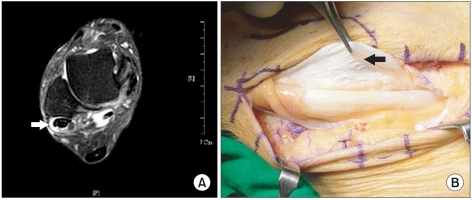
MRIAxial fat-saturated T2 ankle MRI (A): split tear and enlargement of the peroneus brevis tendon, white arrow, with synovial effusion, and an intraoperative view of the same lesion (B).
Source : Park et al., Clinics in Orthopedic Surgery, 2010, figure 4 · CC BY-NC
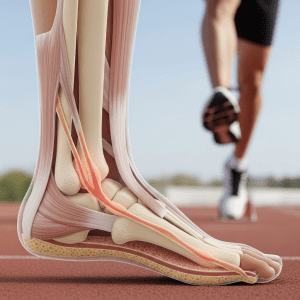
Your peroneal (fibular) tendons run down the outer side of the leg, curve around the lateral malleolus, the bony prominence on the outer edge of the ankle, and attach under the foot. Their main job:eversion, the movement that turns the sole of the foot outwards and steadies you with every step, especially on uneven ground. When they are irritated, the pain typically sits behind or below the lateral malleolus, and it flares with effort.
A tendinopathy is neither a tear nor an inflammation to be put out: it is a tendon overtaken by what is being asked of it. Too much, too fast, or too often, without time to adapt. That is good news for what follows, because an overtaken tendon can be reconditioned: provided it is loaded in the right order.
This page is not for making the diagnosis. Pain on the outer edge of the ankle does not automatically mean peroneal tendinopathy: tendon dislocation or a split tear, the aftermath of a sprain, ankle instability and stress fracture all look very similar from the outside. For everything to do with diagnosis, investigations and clinical presentations, read the full guide: Peroneal tendinopathies. Here, we deal with one question only: which exercises, in what order, and how to get back to running.
Who this programme is for
This programme is for you if a health professional has already settled on a diagnosis of peroneal tendinopathy, if your pain is mechanical (it appears and increases with effort, and settles at rest), and if you are looking to get back to running or a weight-bearing sport.
It is not for you in the event of recent unexplored trauma, marked swelling, an inability to put weight through the foot, a sense of a tendon « snapping » over the outer edge (suggesting tendon dislocation), or after surgery: postoperative rehabilitation of the peroneal tendons follows its own rules and falls outside the scope of this page. If in doubt, go back to the main guide and then to your physiotherapist.
What the science really knows (and what it does not)
This needs saying straight away, because it changes how you read everything that follows. The international reference text on peroneal tendon disorders is the ESSKA-AFAS consensus 1. That expert panel, convened by nominal group technique (agreement validated at a mean score ≥ 7.5/10), acknowledges itself that « current practice rests mainly on level IV and V evidence », and classes its conservative treatment recommendations at level V, that is, expert opinion, the lowest on the scale. (Its recommendations on rehabilitation after surgery are better supported: level II.)
In concrete terms: there is to date no quantified exercise protocol validated specifically for peroneal tendinopathy. The major living review on common lower limb tendinopathies 2 did not even study them: it deliberately covered the Achilles, the patellar tendon and the hip, « the tendons most often affected in the lower limb ». Any precise dose you read here, or elsewhere, is therefore borrowed from neighbouring tendons or from chronic ankle instability, which is better studied. We will flag it at every stage.
Load rather than immobilise: on the direction, the experts agree. It is the exact dose that has never been validated for this particular tendon.
The guiding principle: progressive loading
The ESSKA-AFAS consensus gives no figures, but it does give explicit safeguards: conservative treatment should be considered in every patient with a peroneal tendon disorder; immobilisation is to be avoided (a recommendation stated in the context of treating the acute phase); and as soon as it is pain-free, you start weight-bearing, then mobility, then tendon loading exercises. The panel also notes that data on the outcomes of conservative treatment in the acute phase are limited and heterogeneous.
Where does the progression rule come from? From the Achilles tendon. Alfredson's protocol, the only exercise protocol to carry a strong level of evidence in mid-portion Achilles tendinopathy 3, rests on a gradual build-up of load during the first week, then an increase in load once the exercise becomes pain-free. Careful not to over-read this: what sets Alfredson apart is the methodological quality of the studies that tested it, not clinical superiority; the authors make clear that other protocols achieve similar results and that no definitive conclusion on the optimal parameters could be drawn.
Should you stop running? On the Achilles, Silbernagel's trial 4 compared 38 patients allowed to continue running and jumping under a pain-monitoring model against 6 weeks of active rest. Both groups improved significantly and no difference in the speed of improvement was found. Let us put it honestly: nothing indicates that continuing to run under pain monitoring is harmful: this is not proof that continuing is as good as resting (at 12 months, the score leaned numerically towards active rest, and the trial was not designed to test equivalence). And « continuing » never meant running freely: the running was framed by a pain ceiling.
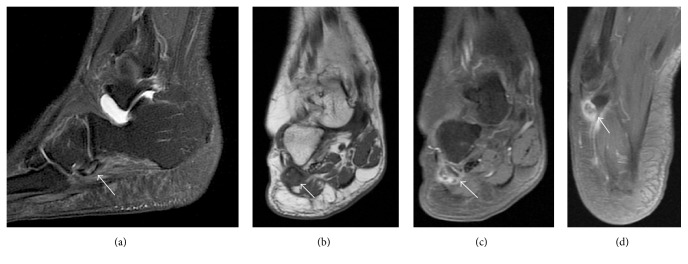
MRIFour-sequence midfoot MRI: irregular os peroneum within the peroneal tendon (arrows) and thickened, heterogeneous peroneus longus tendon, signs of associated tendinopathy.
Source : Chagas-Neto et al., Case Reports in Radiology, 2016, figure 2 · CC BY
Key points
- The diagnosis is not made here : go through the full guide to peroneal tendinopathies and through a professional.
- No exercise protocol is validated for this tendon : the 2018 ESSKA-AFAS consensus is level of evidence V (expert opinion) for conservative treatment.
- But the direction commands consensus : conservative treatment for everyone, no immobilisation, weight-bearing then loading exercises as soon as it is pain-free.
- The figures come from elsewhere : Achilles, patellar tendon, chronic ankle instability. An extrapolation we own and flag at every stage.
- No total stop imposed : nothing shows it is harmful to continue running under pain monitoring 4.
| Building block | Source of the data | Strength |
|---|---|---|
| Load, do not immobilise | Peroneals 1 | Weak: expert opinion, but specific to the right tendon |
| Eversion strengthening, balance | Chronic ankle instability 56 | Moderate: a different condition, a neighbouring ankle |
| Eccentric / heavy slow resistance dosing | Achilles tendon 37 | Moderate: good level of evidence, but a different tendon |
💪 The exercise programme, step by step
Let us say it at once: no quantified protocol is validated for this tendon. The ESSKA-AFAS international consensus, the only text specific to the peroneals, classes its conservative treatment recommendations at level of evidence V: expert opinion, the lowest on the scale (rehabilitation after surgery, by contrast, is graded II). It nonetheless recommends that conservative treatment in every patient and, in the acute phase, that immobilisation be avoided and loading started as soon as it is pain-free 1. All the dosing that follows is therefore extrapolated: the living review of lower limb tendinopathies did not study the peroneals, but the Achilles, the patellar tendon and the greater trochanter, where exercise remains the foundation 2. The rest is in the guide to peroneal tendinopathies.
What commands consensus is the direction: load progressively rather than immobilise; the detail of the dose remains borrowed from other tendons.
Phase 1: Settling an irritable tendon (optional)
Isometrics is the most weakly supported step in the progression: the seminal data concern 6 volleyball players, a single session, a patellar 8 tendon, never replicated since, including on the patellar tendon itself. On the Achilles, a quasi-randomised trial found no immediate relief, either with isometrics or with isotonics, and rest did no better: an underpowered trial: absence of evidence, not evidence of absence 9. Worth trying for a few days if the tendon is very irritable, worth dropping otherwise.
Phase 2: Loading: heavy and slow, or eccentric
The core of the programme. In 58 patients with chronic Achilles tendinopathy, 12 weeks of heavy slow resistance or of eccentrics improve pain and function, with gains held at 52 weeks, and no difference between groups, which is not demonstrated equivalence on n = 58. Adherence differs (92 % against 78 %) with no difference in effectiveness at all: a pragmatic argument, not an effectiveness one: heavy slow resistance calls for ~3 sessions a week against ~14 with twice-daily eccentrics 7.
The only protocol whose evidence is strong is Alfredson's: 3 × 15 repetitions, twice a day, knee straight and bent, 12 weeks, at slow speed, with a progressive build-up of load in the first week, the load increasing once the exercise becomes pain-free, hence the progression rule. « Strong evidence » describes the methodological soundness of the studies, not superiority: other protocols do just as well 3.
Transposed to the peroneals: eversion (the foot pushing outwards) against resistance, slow, at increasing load, and foot position matters. In 52 men with chronic ankle instability (12 weeks, twice a day; 10 sets × 15 repetitions on a band of increasing resistance; RPE 11–13), both groups improve, but eversion worked in plantarflexion gains more strength than with the foot neutral: + 41.4 % against + 16.5 % (p = 0.002). Caution: that group started lower (29.8 against 32.7) and finishes at 42.1 against 38.1: a real gap of about 10 %, not 25 points. And the superiority stops there: nothing differs on inversion, on perceived pain or on posterolateral balance; 52 men, no women 5. Do not settle for neutral-foot eversion.
Phase 3: Balance, then a return to impact
Better documented, but in chronic ankle instability, not in peroneal tendinopathy. A meta-analysis of 20 trials and 682 participants finds a large effect on self-reported function (SMD = 1.02; 95 % CI 0.61–1.43). The dose that emerges is indicative, not established : 3 times a week, 20 to 30 minutes, 4 to 6 weeks, drawn from subgroup analyses, with no randomised comparison of doses, high heterogeneity and low-quality trials 6. The return to jumping closes the progression: no trial doses plyometrics for this tendon, it is a logic of graded return.
Returning to running in stages
Should you stop running? The closest trial randomised 38 patients with Achilles tendinopathy: one group continued running and jumping framed by a pain-monitoring model, the other stopped for 6 weeks. No significant difference in the speed of improvement; at 12 months, the function score goes from 57 to 85 in those who continued, against 57 to 91 on active rest: a numerical advantage to rest, across 19 patients per group. No negative effect could be demonstrated : nothing indicates that continuing under pain monitoring is harmful, which is not proof that continuing is as good as resting 4.
As for the stages, the « 10 % rule » is not demonstrated: beyond + 30 % of weekly distance against less than 10 %, the review on load and running injuries finds only a non-significant trend (HR = 1.59; 95 % CI 0.96–2.66) and « very limited » evidence 10. A marker of caution, not a physiological threshold. Assess, dose, progress: that is what a physiotherapist builds with you.
Key points
- Load, do not immobilise : the only direction that commands consensus, at level of evidence V 1.
- No validated dose for the peroneals : the figures come from the Achilles and from ankle instability.
- Heavy and slow or eccentric : no difference in effectiveness found; choose the one you will keep up 7.
- Eversion in plantarflexion : more strength gain than with the foot neutral, and only in eversion 5.
| Stage | Dose | Origin | Strength |
|---|---|---|---|
| Isometrics | As an adjunct, for a few days | Patellar tendon (n = 6) | Very weak |
| Eccentric or heavy slow resistance | 3 × 15, twice a day, or ~3 sessions/week, 12 weeks | Achilles | Moderate, extrapolated |
| Eversion in plantarflexion | 10 × 15 on a band, RPE 11–13 | Unstable ankle | Weak, extrapolated |
| Balance | 3 times/week, 20–30 min, 4–6 weeks | Unstable ankle | Moderate, extrapolated |
⚠️ The mistakes that keep the problem going
First of all, an honest clarification, because it explains most of the mistakes that follow: there is today no validated, quantified exercise protocol specific to peroneal tendinopathy. The only reference text on these tendons, the ESSKA-AFAS international consensus, classes its conservative treatment recommendations at level of evidence V (expert opinion, the lowest on the scale) and acknowledges that « current practice rests mainly on level IV and V evidence » 1. Anything you read elsewhere as an « official programme » is therefore, at best, a reasoned extrapolation from other tendons.
That does not mean we know nothing. The consensus, reached by Nominal Group Technique with agreement validated at ≥ 7.5/10, is explicit about the direction: conservative treatment should be considered in every patient with a peroneal tendon disorder; immobilisation should be avoided (stated in the context of acute treatment); and as soon as it is pain-free, weight-bearing and then tendon loading exercises can be resumed. No validated dose, but explicit qualitative safeguards. For the full clinical picture, see the guide to peroneal tendinopathies.
Mistake 1: putting the ankle on complete rest « until it passes »
This is the most widespread reflex, and the one the consensus advises against most clearly: in the acute phase, immobilisation is to be avoided 1. On the Achilles tendon (an extrapolation, once again), a randomised trial compared two groups following the same progressive strengthening: one allowed to continue running and jumping using a pain-monitoring model, the other required to stop those activities for 6 weeks. Both improved significantly, with no difference in the speed of improvement, and the authors conclude that no negative effect could be demonstrated from continuing to load 4.
Careful not to over-read this: with 19 patients per group and a trial not designed to prove equivalence, at 12 months the score in fact leaned numerically towards active rest (91 against 85). The fair reading is therefore: nothing indicates that continuing to run under pain monitoring is harmful, not « running is better ». And that continuation is never free: it is framed.
Your tendon does not need to be spared, it needs to be dosed.
Mistake 2: loading too hard too fast, or so cautiously that nothing happens
Both extremes keep the problem going. The best-supported progression rule comes from Alfredson's protocol for the mid-portion Achilles, the only exercise protocol to carry a strong level of evidence: 3 × 15 repetitions, twice a day, knee straight and knee bent, 12 weeks, at slow speed, with the load increased only once the exercise becomes pain-free, and with a progressive build-up of load over the first week, a detail routinely forgotten 3. Starting straight away at full load is not doing Alfredson.
Two useful qualifications. First, « strong evidence » does not mean « superior »: the other protocols achieve similar results, they have simply been tested with less methodological rigour. Second, twice-daily eccentrics are not compulsory: in 58 patients with chronic Achilles tendinopathy, heavy slow resistance (HSR) and eccentrics gave equivalent, durable results at 52 weeks, with markedly better adherence in HSR (92 % vs 78 %, P < 0.005). But that adherence translated into no gain in effectiveness, and satisfaction was not significantly different 7. HSR is not more effective: it calls for fewer sessions, so it holds up better over time. That is a practical argument, not an outcome argument.
Mistake 3: working eversion only with the foot flat
The best trial close to our subject is not about tendinopathy but about chronic ankle instability: 52 men (no women), randomised double-blind to work targeting peroneus brevis (eversion in neutral) or peroneus longus (eversion in plantarflexion), 12 weeks at home. Both groups improve. But eversion in plantarflexion improves eversion strength more (+41.4 % vs +16.5 % at 30°/s, p = 0.002) 5.
Three honest clarifications, because this figure travels badly. The « peroneus longus » group started lower (29.8 vs 32.7) and finishes at 42.1 against 38.1: the final gap is about 10 %, not 25 points. The superiority is confined to eversion, no gap on inversion, nor on perceived pain/function (p = 0.427), nor on posterolateral balance (p = 0.800). And no measurement of muscle recruitment was made: saying that « position changes the muscle recruited » is the protocol's premise; what is measured is that foot position changes the gain obtained.
Mistake 4: expecting an insole to solve the problem
In prevention among military recruits, foot orthoses reduce the risk of injury overall (RR 0.72) and of stress fracture (RR 0.59), but for soft-tissue injuries (the category closest, by analogy, to ours), the effect is not demonstrated : RR 0.79 (95 % CI 0.55–1.14). The estimate favours orthoses, but the interval crosses 1: that is imprecision, not ineffectiveness. Shock-absorbing insoles, for their part, are clearly ineffective across every category 11. Note: these data concern prevention in healthy subjects, never the treatment of an established tendinopathy.
On ankle instability, a systematic review clearly separates the devices: a potential benefit from elastic braces, kinesiotaping and textured insoles on postural stability; inconsistent effects for semi-rigid braces, fibular reposition taping and arch-support insoles, that is, what people commonly mean by an « orthotic insole ». No meta-analysis could be carried out, so heterogeneous are the studies, and the outcome measured is postural stability in the laboratory, with the device worn, in the short term: never pain, function or recurrence 12.
The signals that should make you ease off
For want of a validated protocol, the compass is pain, and it works in both directions:
- You increase the load while the exercise is still painful. The validated rule is the opposite: you increase once it no longer hurts 3, and you only start loading when it is pain-free 1.
- Pain climbs session after session, or does not return to its usual level the next day: the volume is above what the tendon can take today.
- You have increased your mileage abruptly. In runners, an increase of more than 30 % in mean weekly distance is associated with a non-significant trend towards increased risk (HR 1.59; 95 % CI 0.96–2.66), and no difference was found between +10 % and +24 %: the authors judge the evidence « very limited » 10. The 10 % rule is a marker of caution, not a physiological threshold.
- Nothing shifts despite regular work. In the best-studied tendinopathies, it is reasonable to consider an adjunct after at least 3 months of exercise alone, where there is resistance to treatment 2 ; the peroneal consensus mentions shockwave if the initial measures fail beyond 3 months, and does not support PRP 1. That is precisely the moment to have the dose reassessed rather than pushing on alone.
Three received ideas that cost weeks
| What you often read | What the data say | Level |
|---|---|---|
| « Isometrics settles the tendon before you load it » | The seminal data concern 6 volleyball players with patellar tendinopathy, in a single session, with a spectacular analgesic effect at 45 min 8. That result has never been replicated: including on the patellar tendon itself. On the chronic Achilles, neither isometrics nor isotonics relieved anything immediately… but nor did the rest arm: a uniform null, and underpowered 9. A plausible adjunct tool, never a demonstrated step. | Very weak |
| « Strengthening gains X points, that is proven » | The reference thresholds (small 0.34 / medium 0.73 / large 1.21) come from 114 studies, 4,104 participants: cuff, Achilles, epicondyle, patellar tendon; the peroneals are absent from them. Since the thresholds are consistent from one site to another, the extrapolation remains reasonable. The real error lies elsewhere: on a pain outcome, the scale is 0.53 / 0.94 / 1.45. And these are before/after changes (natural history and placebo included), never effects against a control group 13. | Moderate, outside the peroneals |
| « You need THE right exercise » | In 43 adolescents with ankle instability, a resistance band (3 × 10 in plantarflexion, dorsiflexion, inversion, eversion), a balance board (5 trials of 40 s) or both, 3 times/week for 4 weeks: all three improve balance and a hop test versus control, and none is superior, but with ~11 subjects per group, the numbers were too small to settle it 14. | Weak |
For balance, an indicative dose does exist (chronic ankle instability, 20 trials, 682 participants): 3 times a week, 20 to 30 minutes, 4 to 6 weeks, with a large effect on self-reported function (SMD 1.02; 95 % CI 0.61–1.43). To be taken for what it is: that dose comes from subgroup analyses, with no randomised comparison of doses, high heterogeneity and trials of often weak methodological quality 6. A starting marker, not an established prescription.
Key points
- No validated exercise protocol exists for the peroneals: the consensus sits at level of evidence V, and every dose is extrapolated from other tendons 1.
- Complete rest and immobilisation are the best-identified mistake; nothing indicates that continuing to run is harmful under pain monitoring 4.
- You increase the load once the exercise becomes pain-free, and you start gradually, not at full load from the outset 3.
- Eversion with the foot flat is not enough: the plantarflexed position gains more eversion strength 5.
- Insoles: effect not demonstrated and data imprecise for soft tissue in prevention; never evaluated as a treatment here 1112.
- Stuck after 3 months of regular work: have things reassessed and the dose adjusted rather than pushing on alone.
🩺 How long it takes, and where the physiotherapist fits in
The question that always follows the exercises: « how long? ». The honest answer fits in a sentence: nobody has measured it on this tendon. The full picture is in our guide Peroneal tendinopathies ; here, one question only: how long, and with whom.
Count in months, and know where the markers come from
The only reference text specific to these tendons is the ESSKA-AFAS international consensus 1. It acknowledges that « current practice rests mainly on level IV and V evidence » and classes its conservative treatment recommendations at level V : the lowest on the scale, expert opinion. The nuance matters: in that same consensus, rehabilitation after surgery is graded at level II. So it is not « nothing is proven about the peroneals », it is conservative exercise for the tendinopathy, and that alone, that has no validated quantified protocol. The major living review on lower limb tendinopathies 2 did not study them either: it covered the Achilles, the patellar tendon and the greater trochanter.
The durations are therefore borrowed from protocols tested elsewhere: twelve weeks for Alfredson's eccentrics 3 as for heavy slow resistance 7 ; four to six weeks for the balance component 6. And nothing stops at the end of the programme: on the Achilles, function scores are still climbing at one year 4. Beware of spectacular « improvements »: the reference thresholds 13 measure a before/after within a single group: they include natural history and placebo, and prove the superiority of no treatment at all.
What support adds to a programme done alone
- Naming what you are loading. In the consensus, diagnosis is better supported (level III) than conservative treatment (level V): identifying the condition comes before choosing the exercises.
- Dosing what has no validated dose. No figures for this tendon, but explicit safeguards: consider conservative treatment in every patient, avoid immobilisation (stated for the acute phase), start weight-bearing and then loading exercises as soon as it is pain-free. The rest (sets, resistance, pace) is adjusted to you. Even Alfredson provides for a progressive build-up of load in the first week, not 3 × 15 at full load from the outset.
- Choosing the variant that pays. In 52 men (no women) with chronic ankle instability, not a tendinopathy, eversion in plantarflexion gave more strength than eversion with the foot neutral: 42.1 against 38.1 Nm/kg at twelve weeks (p = 0.002; the « +41 % against +17 % » often quoted is inflated by a lower starting point). The advantage stops there: nothing on inversion, on perceived pain (p = 0.427) or on posterolateral balance (p = 0.800) 5.
- Making the programme sustainable. On the Achilles, eccentrics and heavy slow resistance showed no difference in effectiveness 7. What did differ: adherence, 92 % against 78 %, for three weekly sessions instead of two a day. A practical argument, not an effectiveness one: better adherence did not produce better results.
- Framing the running rather than stopping it. In 38 patients with Achilles tendinopathy, continuing running and jumping under a pain-monitoring model showed no harmful effect 4 : absence of evidence of harm, not evidence of equivalence, at twelve months, active rest leans numerically ahead (91 against 85). The running there was not free: it was capped by pain.
| Stage | Where the evidence comes from | Strength |
|---|---|---|
| Do not immobilise, load as soon as it is pain-free | Peroneal consensus 1 | Expert opinion (V) |
| Eversion in plantarflexion | 52 men, ankle instability 5 | Sound, but indirect |
| Eccentrics for 12 weeks | Achilles 3 | Strong… on a different tendon |
What is missing here is not the exercise: it is a validated dose, and a dose is adjusted to a person, not in an article.
What should make you seek advice rather than push on
There is no validated list of warning signals for this tendon: the points below come from the consensus 1, not from a trial.
- A recently injured, painful ankle. In the acute phase, the consensus asks that the associated pathology be looked for and treated (a lateral ligament rupture, for example) and that immobilisation be avoided. That triage is not done in front of an exercise video.
- Instability, or a tendon that « snaps ». Peroneal tendon disorders do not come down to tendinopathy: dislocations call for other decisions, including surgical ones.
- Symptoms that persist despite the initial measures. Beyond three months, the consensus considers shockwave, and Challoumas 2 considers an adjunct after at least three months of exercise alone. PRP, for its part, is not supported by the literature.
- Pain that refuses to be capped despite cautious progression: that is the moment to reassess, not to grit your teeth.
Key points
- Count in months: the programmes tested, on other tendons, last twelve weeks, and progress continues beyond that.
- No dose is validated for the peroneals: the consensus gives a direction (load, do not immobilise), not figures.
- Seek advice without delay in the acute phase, where there is instability or a tendon that snaps, and if nothing shifts after three months.
- Diagnostic triage, dosing, progression, a framed return to running: that is what support adds.
Bibliography
Every reference checked individually on PubMed (clickable PMID). 14 sources. Click a superscript note marker in the text: the bibliography opens and highlights the source.
- van Dijk PA, Miller D, Calder J, et al. (2018). Knee Surgery, Sports Traumatology, Arthroscopy. PMID 29767272. doi:10.1007/s00167-018-4971-x.
- Challoumas D, Crosbie G, O'Neill S, Pedret C, Millar NL (2023). Sports Medicine - Open. PMID 37553459. doi:10.1186/s40798-023-00616-1.
- Habets B, van Cingel REH (2015). Scandinavian Journal of Medicine & Science in Sports. PMID 24650048.
- Silbernagel KG, Thomeé R, Eriksson BI, Karlsson J (2007). The American Journal of Sports Medicine. PMID 17307888. doi:10.1177/0363546506298279.
- Ko D, Choi Y, Lee K (2024). Healthcare (Basel). PMID 38470658. doi:10.3390/healthcare12050547.
- Tang F, Xiang M, Yin S, Li X, Gao P (2024). BMC Musculoskeletal Disorders. PMID 39217316. doi:10.1186/s12891-024-07800-8.
- Beyer R, Kongsgaard M, Hougs Kjær B, Øhlenschlæger T, Kjær M, Magnusson SP (2015). The American Journal of Sports Medicine. PMID 26018970.
- Rio E, Kidgell D, Purdam C, Gaida J, Moseley GL, Pearce AJ, Cook J (2015). British Journal of Sports Medicine. PMID 25979840. doi:10.1136/bjsports-2014-094386.
- van der Vlist AC, van Veldhoven PLJ, van Oosterom RF, Verhaar JAN, de Vos R-J (2020). Scandinavian Journal of Medicine & Science in Sports. PMID 32474979. doi:10.1111/sms.13728.
- Damsted C, Glad S, Nielsen RO, Sørensen H, Malisoux L (2018). International Journal of Sports Physical Therapy. PMID 30534459.
- Bonanno DR, Landorf KB, Munteanu SE, Murley GS, Menz HB (2017). British Journal of Sports Medicine. PMID 27919918. doi:10.1136/bjsports-2016-096671.
- Tang Y, Liang P, Pan J, Zhang C, Ren H, Cheng S, Kong PW (2023). Healthcare (Basel). PMID 37761767. doi:10.3390/healthcare11182570.
- Swinton PA, Shim JSC, Pavlova AV, et al. (last author: Cooper K) (2023). BMJ Open Sport & Exercise Medicine. PMID 36865768. doi:10.1136/bmjsem-2022-001389.
- Cain MS, Ban RJ, Chen Y-P, Geil MD, Goerger BM, Linens SW (2020). Journal of Athletic Training. PMID 32577737.
❓ Frequently asked questions
Which exercises should you do for peroneal tendinopathy?
There is no validated, quantified exercise protocol specific to this tendon: the ESSKA-AFAS international consensus, the only reference dedicated to the peroneal tendons, classes its conservative treatment recommendations at level of evidence V (expert opinion) and acknowledges that data on the outcomes of conservative treatment are limited and heterogeneous in the acute phase 1. What the consensus does say, and what structures practice: consider conservative treatment in every patient, avoid immobilisation in the acute phase, start weight-bearing and then mobility and tendon loading exercises as soon as it is pain-free. The content of the sessions is extrapolated from neighbouring conditions: eversion strengthening on a band while varying foot position: eversion in plantarflexion, which targets peroneus longus, gives a greater gain in eversion strength than eversion with the foot neutral (p = 0.002), but with no difference on inversion, on pain or on perceived function, and in 52 men with chronic ankle instability 5 ; balance work 6 ; progressive loading of the eccentric or heavy slow resistance type, borrowed from the Achilles tendon 37. Exercise remains the foundation: the landmark living systematic review on common lower limb tendinopathies (which did not study the peroneals, having chosen the Achilles, the patellar tendon and the greater trochanter because they are the tendons most often affected), writes that it « will be effective for most patients », that no convincing evidence shows any adjunct to do better than exercise alone, and recommends considering an adjunct after at least 3 months of exercise alone in resistant cases 2.
Should you stop running with peroneal tendinopathy?
No data answer directly for this tendon. The only trial to have asked the question did so on the Achilles: 38 patients randomised between continuing running and jumping using a pain-monitoring model, or stopping those activities for 6 weeks, all following the same progressive strengthening. Both groups improve significantly (P < 0.01) and no significant difference in the speed of improvement appears; the authors conclude that no negative effect could be demonstrated from continuing to load the tendon under pain monitoring 4. Read it for what it is: n = 19 per group, a trial not designed for non-inferiority, and at 12 months the VISA-A-S leans numerically towards active rest (91 [8.2] against 85 [12.7]). So: nothing indicates that continuing is harmful, which is not the same thing as « continuing is just as effective ». And keeping up the running is not free: it is framed by the pain-monitoring model. On volume progression, the « 10 % rule » is not demonstrated: no difference between a 10 % and a 24 % increase in weekly distance, and even the > 30 % vs < 10 % contrast does not reach significance (HR = 1.59; 95 % CI 0.96–2.66), with the evidence linking an abrupt change in load to injury judged « very limited » 10. It is a marker of caution, not a physiological threshold.
Eccentric, isometric or heavy slow resistance: which type of exercise should you choose?
None of these three protocols has been tested on the peroneals; everything that follows comes from the Achilles and the patellar tendon. Alfredson's eccentric protocol (3 × 15 repetitions, twice a day, knee straight and knee bent, 12 weeks, at slow speed, with a progressive build-up of load during the first week and an increase in load once the exercise becomes pain-free) is the only one whose evidence is strong. Careful about what that sentence means: it is the methodological quality of the trials that tested it that sets it apart, not a better clinical result; other protocols achieve similar results, and no definitive conclusion on the optimal parameters could be drawn 3. Heavy slow resistance gives clinically equivalent results to eccentrics up to 52 weeks (VISA-A, VAS, tendon thickness, neovascularisation) in 58 patients; its only significant advantage is adherence (92 % vs 78 %, P < 0.005), for a far lower session volume — satisfaction only tends that way at 12 weeks (100 % vs 80 %, P = 0.052) and the gap disappears at 52 weeks (P = 0.10). It is more sustainable, not more effective 7. Isometrics, finally, is the most weakly supported option: the seminal data concern 6 volleyball players with patellar tendinopathy in a single session (pain 7.0 ± 2.04 → 0.17 ± 0.41, analgesia holding at 45 min) and have never been replicated, including on the patellar tendon itself 8 ; on the Achilles, a quasi-randomised trial finds no immediate relief after isometrics, nor after isotonics, nor even after rest: a uniform, underpowered null (~23 patients/arm), which says nothing about the medium term 9. To be offered as a tolerable entry into loading, not as a guaranteed painkiller.
How long does a programme last, and what improvement can be expected?
No duration has been established for the peroneals. The markers come from elsewhere: 12 weeks for Alfredson's eccentrics as for heavy slow resistance on the Achilles 37 ; an indicative dose of 3 sessions a week, 20 to 30 minutes, over 4 to 6 weeks for balance work in chronic ankle instability: drawn from subgroup analyses, with no randomised comparison of doses, high heterogeneity (I² 55–84 %) and low-quality trials: a working hypothesis, not an established dose 6 ; and a delay of at least 3 months of exercise alone before considering an adjunct in resistant cases 2. To judge improvement, the landmark meta-analysis (114 studies, 171 arms, 4,104 participants) proposes thresholds of pre/post change under exercise: small 0.34 (95 % CrI 0.31–0.37), medium 0.73 (0.70–0.77), large 1.21 (1.17–1.27). The peroneals do not appear in that corpus (cuff 45 %, Achilles 26.3 %, lateral epicondyle 17 %, patellar 11.7 %), but the effect sizes are similar from one tendinopathy to another, with considerable overlap of thresholds between sites: the extrapolation is reasonable. The real error lies elsewhere, what makes the thresholds vary is the domain measured: for a PAIN outcome, the scale is 0.53 / 0.94 / 1.45, and for disability 0.61 / 1.04 / 1.51. One last safeguard: these thresholds describe within-group change (natural history, regression to the mean and placebo included), not an effect against a control: they are never used to judge the superiority of a treatment 13.
Are insoles or orthoses useful for peroneal tendinopathy?
No study tests an external device in peroneal tendinopathy; the answers are indirect and modest. In PREVENTION, among military recruits in basic training, foot orthoses reduce the risk of injury overall (RR 0.72; 95 % CI 0.55–0.94) and above all of stress fracture (RR 0.59; 0.45–0.76), but for soft-tissue injuries (a pool that gathers medial tibial stress syndrome, patellofemoral pain, Achilles tendinopathy and plantar fasciitis, and in which peroneal tendinopathy does not feature as an outcome), the effect is not demonstrated: RR 0.79 (95 % CI 0.55–1.14). The point estimate favours orthoses (−21 %), but the interval crosses 1: the data are too imprecise, and the authors themselves call for better trials to refine the estimate. Shock-absorbing insoles, by contrast, are clearly ineffective across every category, soft tissue included (RR 0.92; 0.74–1.15). And that source says nothing about treatment: its eligibility criteria concern prevention in healthy subjects 11. On postural stability measured in the laboratory, with the device worn, in chronic ankle instability, the devices have to be separated one by one: a potential benefit for elastic braces, kinesiotaping and TEXTURED insoles; inconsistent effects from one study to another for semi-rigid braces, fibular reposition taping and ARCH-SUPPORT insoles, which is precisely what people commonly call an orthotic insole. No meta-analysis could be carried out, so strong was the heterogeneity, and nothing was measured on sprain recurrence, pain, function or beyond the short term 12. None of these reviews compares a device with strengthening.