











« It has been months (will it ever go away? » That is the most common question about piriformis syndrome, and the answer is reassuring: in the great majority of reported cases, things move towards improvement), often within a few weeks of conservative treatment, sometimes more slowly. Here are the real timescales, what speeds things up, and the signals that should prompt another consultation.
📝 In brief
- There is no single timescale. In patients whose imaging (MRI or CT) is normal, the great majority recover quickly: 41 of 42 patients saw their symptoms disappear spontaneously or under conservative treatment within 35 days 1. Conversely, in published cases, often severe or refractory, the median duration of symptoms before treatment reached 365 days (IQR 60–1095), a sign of a readily chronic form and of late treatment 4.
- Conservative treatment often brings relief within a few weeks. In a randomised trial of 44 patients, pain (VAS) went from around 7.6–7.8 at baseline to 2.5–2.6 at 3 months, with no significant difference between ultrasound-guided dry needling and an exercise programme 2.
- It is recommended to wait at least 3 months of conservative treatment before considering surgery 1.
- The longer the symptoms have been there, the poorer the prognosis appears to be. In a matched cohort of 230 patients with a refractory form treated by interventional procedures, each additional year of symptom duration reduced the chances of improvement (OR = 0.87 per year; 95 % CI 0.76–0.99; p = 0.038); age, sex and BMI had no significant effect, but the dominant factor remained the type of procedure, not the duration, and this is a retrospective, non-causal study 3.
- In reported cases, the course is most often favourable: 197 of 212 patients (92.9 %) recovered or improved after treatment, all types combined. This figure comes from published cases (strong publication bias) and 58.9 % of the successes were surgical 4.
- A well-made diagnosis counts for more than time. Where the syndrome is diagnosed without confirmation by imaging or EMG, a case review suggests an increased risk of surgical failure (OR 5.3, with no confidence interval reported), hence the importance of ruling out the other causes of sciatic pain before any invasive procedure 4.
⏱️ How long it really lasts
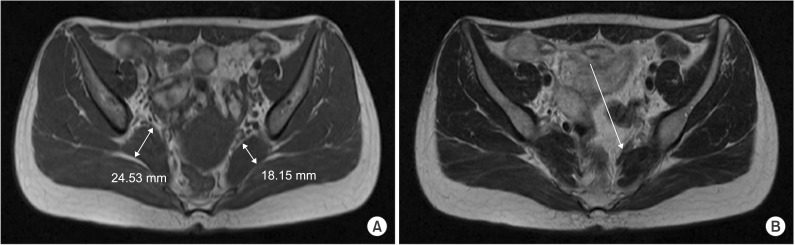
MRIAxial pelvic MRI: asymmetric hypertrophy of the right piriformis muscle (24.5 mm versus 18.2 mm on the left), with a dark signal band anterior to the left piriformis.
Source : Moon et al., Annals of rehabilitation medicine, 2015, figure 2 · CC BY-NC
This is the question that comes up again and again: are we talking weeks, months, a year? The honest answer is that there are two very different realities depending on the form of the syndrome. The good news is that the most common form runs its course fairly quickly and well. To understand what this syndrome is and how it is told apart from true sciatica, see the full article on piriformis syndrome.
Key points
- In one cohort, almost all patients with normal imaging recovered in around 35 days, either spontaneously or with non-surgical treatment 1.
- Under conservative treatment, pain can fall sharply within 3 months 2.
- The longer the pain has been there, the poorer the prognosis: acting early helps 3.
- The « one year » figures you sometimes read come mainly from severe published cases: they are not the rule.
The common form: a few weeks
In a cohort of 42 patients whose MRI or CT was normal, 41 had complete resolution of their symptoms within 35 days, either spontaneously or with conservative treatment 1. In other words, in the great majority of uncomplicated cases, we are talking weeks, not years.
A randomised trial points the same way: in 44 patients, pain measured on a 0-to-10 scale went from around 7.6–7.8 at the start to 2.5–2.6 at three months, with no significant difference between ultrasound-guided dry needling and an exercise programme 2. A caveat: this is a single small trial (n = 44), specifically on piriformis syndrome: it cannot be extended to all pain or all techniques. But it shows that non-surgical treatment can bring clear relief within a few weeks to three months.
Why you sometimes read « a year »
Some sources give a median symptom duration of around 365 days (a year), with a very wide range of 60 to 1095 days 4. That figure is real, but it must be read with care: it comes from a review of 212 published cases (case reports from 1980 to 2024), a population heavily skewed towards severe or resistant forms: 58.9 % of those patients were in fact operated on. So it is not the typical duration of an « ordinary » piriformis syndrome, and it is the delay before treatment (which includes the time taken to decide to treat), not pure diagnostic delay. The main point: when the syndrome drags on in these published cases, it is often because it had not been identified.
How long, by treatment
| Approach | Timescale / observed result | Level of evidence |
|---|---|---|
| Conservative treatment (exercise, dry needling) | Pain ~7.7 → ~2.5 at 3 months 2 | Moderate (small trial) |
| Injection + rehabilitation | 79 % improved by at least 50 %, mean gain 71.1 % at ~10 months 5 | Weak (uncontrolled series) |
| Botulinum toxin (image-guided) | Median 30 days pain-free vs 1 day without toxin, but the difference was not significant 6 | Weak / uncertain |
On injection combined with rehabilitation, an older series of patients with a positive FAIR test reports 79 % improving by at least 50 %, with a mean gain of 71.1 % at a mean follow-up of 10.2 months 5. These figures concern piriformis syndrome only, and as there was no control group they describe the course of treated patients without proving the treatment’s own effect (natural history may contribute). For botulinum toxin, durability remains uncertain: 30 days pain-free against 1 day, but the difference does not reach the significance threshold (p = 0.059); only the response at 48 h was significant 6, and a review concludes the evidence is only « acceptable » and insufficient to quantify the effect 7.
What really speeds up (or slows down) recovery
Two factors stand out. First, not letting it drag on : in a cohort of patients with refractory syndrome treated by interventional procedures, each additional year of symptom duration reduced the chances of improvement 3. This is borderline significance, in a very particular population (the strongest predictor remained the type of procedure, not the duration), but the practical message is consistent: acting early helps. Second, a well-made diagnosis : a case review suggests an increased risk of surgical failure when the diagnosis is made without confirmation by imaging or EMG 4. Hence the importance of ruling out other causes first.
Time does not work against you if you do not let the pain settle in.
Overall, in the cases reported in the literature, the course is rather favourable: 197 of 212 patients (92.9 %) recovered or improved after treatment, all types combined 4. That figure comes exclusively from published cases, where successes are over-represented, and nearly 6 successes in 10 were surgical, so it is not a recovery rate for the general population. It remains reassuring nonetheless: properly managed, piriformis syndrome usually gets better, and rarely in theatre.
📈 What lengthens (or shortens) recovery
Two people with the same diagnosis may take a few weeks or several months to get better. Why? Because the duration depends less on how « serious » it feels than on a few factors identified in the studies. Here is what the literature does allow us to say, and what it does not yet allow us to assert.
Delay before treatment: the factor that comes up most
The most consistent message is also the most encouraging: the earlier you act, the better things seem to go. In a matched cohort of 230 patients, each additional year of symptom duration reduced the chances of improvement (OR = 0.87 per year, 95 % CI 0.76–0.99, p = 0.038), while age, sex and BMI had no significant effect 3.
Time passing with nothing done is never neutral: it is the most accessible lever.
One caution about this figure: it comes from a retrospective study of refractory piriformis syndrome, treated by interventional procedures (pulsed radiofrequency or endoscopic release). The OR measures pain improvement after those procedures, and its confidence interval reaches 0.99 (borderline significance). Moreover, in that same study, the strongest predictor was not symptom duration but the type of procedure (OR = 2.15). So it is not a « law » valid for all pain: it is a signal pointing the same way as clinical common sense.
This delay is common. In a review of 212 published cases (case reports 1980–2024), the median duration of symptoms before treatment reached 365 days, around a year, with a very wide range (60 to 1095 days) 4. Take care not to over-read this: these reported cases are heavily skewed towards severe forms (58.9 % had to be operated on), and « duration before treatment » also takes in the time spent deciding, not just diagnostic delay. This figure describes published cases, not the average person seeing a clinician in the community.
A solid diagnosis changes everything
The second documented factor is the quality of the diagnosis. Piriformis syndrome mimics sciatica: if the label is applied without ruling out the other causes, treatment can miss the mark entirely. A case review suggests that, where the diagnosis is made without instrumental confirmation (imaging, EMG), the risk of surgical treatment failing is markedly higher 4.
Here too, let us stay measured: this OR comes from an aggregation of case reports, with no confidence interval or p value reported. It cannot therefore be treated as a « proven » prognostic factor. But the underlying idea is robust and widely agreed: rule out the differential diagnoses before any invasive procedure. That is precisely the role of the detailed clinical assessment in the main article on piriformis syndrome.
What really counts (and what counts less)
| Element | Effect on duration | Level of evidence |
|---|---|---|
| Long-standing symptoms (years) | Tends to lengthen | Moderate: 1 cohort, refractory forms |
| Diagnosis not confirmed (imaging/EMG) | More surgical failures | Weak: case review, unbounded OR |
| Early conservative treatment | Often rapid resolution | Moderate: cohort + trial |
| Age, sex, BMI | No significant effect | Moderate 3 |
Good news on that last point: your age, your weight or your sex do not appear to weigh on the chances of improvement 3. It is not your profile that decides, but above all how quickly you act and how accurate the diagnosis is: two levers you can do something about.
Finally, when the problem is tackled early, the course is generally favourable: in one cohort, 41 of 42 patients (normal imaging) saw their symptoms resolve spontaneously or with conservative treatment within 35 days, and it is recommended to wait at least 3 months of conservative treatment before considering surgery 1.
Key points
- Acting early is the most accessible lever: long-standing symptoms tend to reduce the chances of improvement 3.
- A well-made diagnosis, which rules out the other causes of « false sciatica », determines whether treatment succeeds 4.
- Age, sex and BMI do not appear to determine the outcome.
- Managed well and early, the problem most often resolves without surgery, often within a few weeks to 3 months 1.
🚦 Is it dangerous? What to watch for
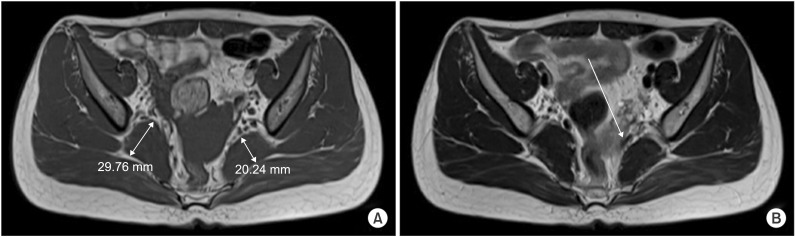
MRIFollow-up axial pelvic MRI: progression of right piriformis hypertrophy (29.8 mm versus 20.2 mm on the left), indicating an unfavourable course at a distance from the initial episode.
Source : Moon et al., Annals of rehabilitation medicine, 2015, figure 3 · CC BY-NC
Good news first: piriformis syndrome is not, in itself, a serious disease. It is an unpleasant pain, sometimes stubborn, but one that most often runs a favourable course. The real issue is therefore less the « dangerousness » of the syndrome than not missing something else, because pain in the buttock and leg can have several origins.
Key points
- Piriformis syndrome is rarely serious in itself and improves in the great majority of cases.
- The main risk is not the pain, but the default diagnosis : calling « piriformis » something that comes from elsewhere.
- A useful marker: if no improvement appears after several weeks to a few months of appropriate treatment, reassess rather than pressing on unchanged.
A syndrome that, most often, improves
In a cohort of patients whose imaging (MRI or CT) was normal, almost all saw their symptoms disappear spontaneously or with conservative treatment in a little over a month 1. That is an encouraging signal: when the picture is simple and well framed, the course is generally quick.
A review of the literature points the same way, with a majority of patients improved after treatment. That figure must nonetheless be read with care: it comes exclusively from reported and published cases (212 patients, cases 1980–2024), a population in which stories that end well, and severe forms that were operated on, are over-represented. In that series, around 93 % of patients recovered or improved, but nearly 59 % of the successes were surgical 4. So it is not a true « recovery rate » for the general population, rather a biased reflection of the best-documented cases.
The most important question is not « is it dangerous? », but « is it really the piriformis? »
The real point to watch: getting the diagnosis wrong
Piriformis syndrome is a diagnosis of exclusion: other causes of buttock pain or « false sciatica » must be ruled out first. This is not a theoretical point. In the same case review, where the diagnosis had been made without instrumental confirmation (imaging, EMG), surgical treatment failed more often (odds ratio of 5.3). To be interpreted with reserve, it is a review of aggregated case reports and this OR is given without a confidence interval, but the message stands: better to confirm before any invasive procedure 4.
In practice, this is where a health professional’s judgement counts most: assessing, putting the pain in context, spotting what does not fit and referring on if needed. To understand in detail how the piriformis can mimic sciatica and what distinguishes it from a true nerve problem, see the full article, « Piriformis syndrome: the false sciatica ».
When should you see someone again?
There is no universal countdown, and that is normal: the duration depends on the form, on how long-standing the symptoms are and on the treatment. Two simple markers nonetheless help you not to get stuck:
- No improvement at all after several weeks to a few months of appropriate treatment: that is a signal to reassess the diagnosis, not necessarily to change treatment at random.
- Before considering surgery, the literature recommends waiting at least three months of well-conducted conservative treatment 1. In other words, the invasive route is not a first line.
What these figures do not say
Let us be honest about the limits: most of the data above come from case series or small cohorts focused on piriformis syndrome, often in its refractory forms. They describe reassuring trends, not individual guarantees, and do not replace personal advice. If your pain changes in nature, worsens markedly or comes with an unusual symptom that worries you, the right reflex is not to look for the answer in a table of statistics: it is to talk to a health professional, who can examine your situation and check that there is nothing else to explore.
💪 Speeding up recovery: what works
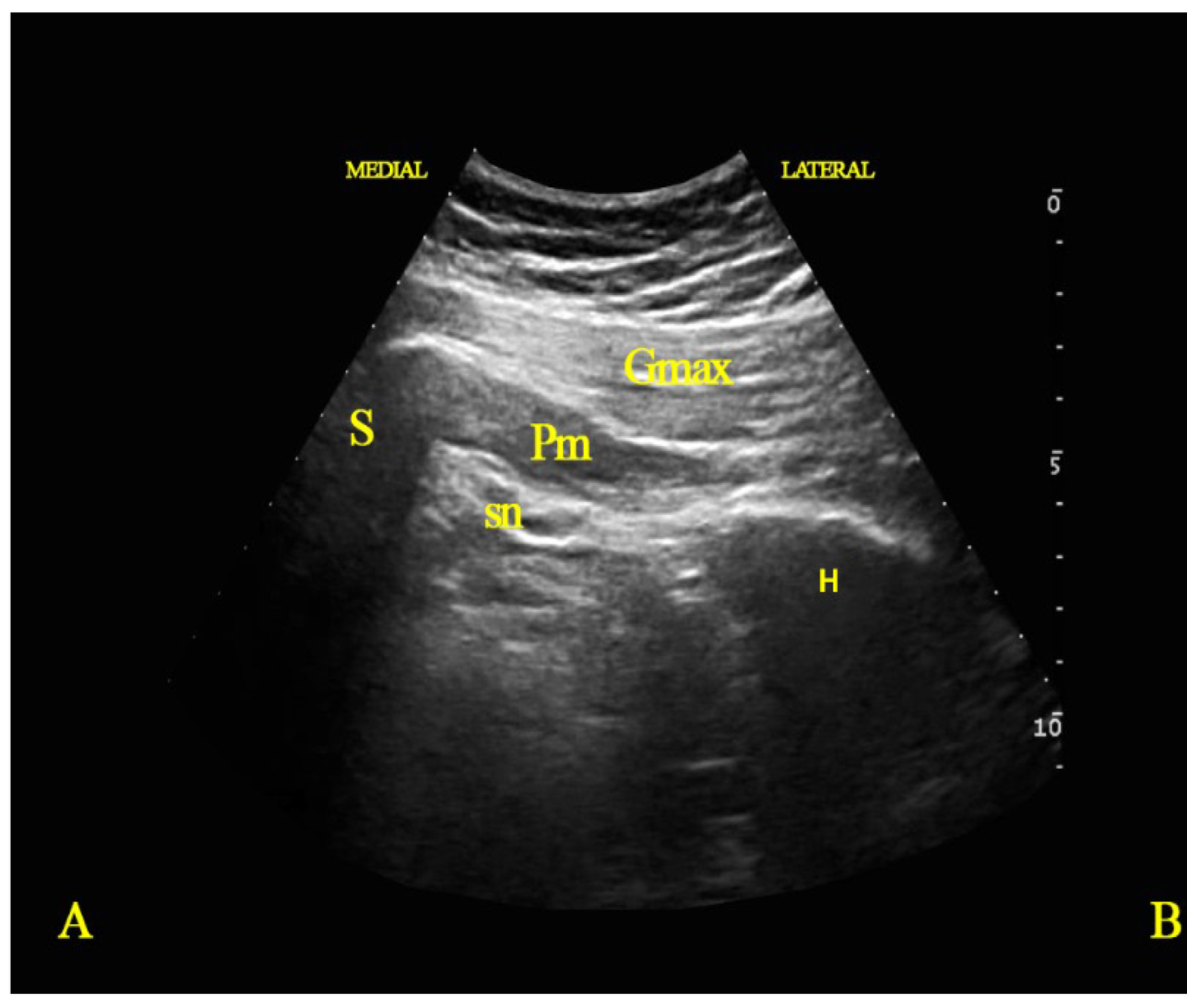
UltrasoundUltrasound of the buttock: piriformis muscle and sciatic nerve identified in contact with the gluteus maximus, sacrum and iliac bone, diagnostic view before an ultrasound-guided procedure.
Source : Elsawy et al., Wikimedia Commons · CC BY
Good news first: in the great majority of cases, piriformis syndrome eventually settles, often without any invasive procedure. So the real question is not « how do I force recovery? » but « what puts the odds on my side? ». Here is what the research says.
Most often, it resolves, and fairly quickly
In a cohort of patients whose imaging (MRI or CT) was normal, 41 of 42 saw their symptoms disappear completely, spontaneously or with conservative treatment, in around 35 days 1. When no structural cause is found, the course therefore leans strongly towards recovery, over a few weeks.
In the great majority of cases, the piriformis settles without a scalpel, often with time and movement.
What is associated with better results
Several conservative approaches are associated with relief, but mind the level of evidence: many studies lack a control group, so they describe the course of treated patients without demonstrating the technique’s own effect.
- Exercise and active rehabilitation. In a randomised trial (44 patients), pain (VAS) went from around 7.6–7.8 at baseline to 2.5–2.6 at three months, with no significant difference between an exercise programme and ultrasound-guided dry needling 2. A single, small trial, specific to piriformis syndrome, but one that shows supervised active work brings clear relief.
- Injection combined with rehabilitation. In patients with a positive FAIR test, 79 % (514/655) improved by at least 50 %, with a mean improvement of 71.1 % at a mean follow-up of 10.2 months 5. These figures concern piriformis syndrome only and come from a series without a control group: they describe favourable results without proving that the combination does better than the natural course.
- Botulinum toxin. An option considered when basic measures are not enough. A review concludes that the evidence is of « acceptable » quality for its safety and for a reduction in pain, but that the data are insufficient to quantify that reduction 7. A study on piriformis syndrome (CT-guided injection) found more responses at 48 h with the toxin (p<0.001); the difference in pain-free duration (30 days against 1 day), on the other hand, did not reach significance (p=0.059), so durability remains unproven 6.
| Approach | What we know | Level of evidence |
|---|---|---|
| Exercise / active rehabilitation | VAS ~7.7 → ~2.6 at 3 months 2 | Moderate (1 trial, n=44) |
| Injection + rehabilitation | 79 % improved ≥50 % 5 | Weak (uncontrolled series) |
| Botulinum toxin | Safe, reduces pain; magnitude not quantified 7 | Acceptable for safety |
| Surgery | To be reserved for after ≥3 months of conservative treatment 1 | Last resort |
Acting early appears to help
One finding supports early treatment: in a matched cohort of 230 patients, each year of symptom duration slightly reduced the chances of improvement (OR = 0.87 per year, 95 % CI 0.76–0.99, p=0.038), with age, sex and BMI having no significant effect 3. To be heavily qualified: these were refractory forms treated by interventional procedures (pulsed radiofrequency or endoscopic release), the study is retrospective (no proof of cause and effect), the upper bound of the interval touches 0.99 (borderline significance), and the most decisive factor was in fact the type of procedure (OR = 2.15), not the duration. Not a general law: just one more argument for not letting things drag on.
A good diagnosis before any procedure
Piriformis syndrome mimics other causes of buttock pain and « false sciatica ». A case review suggests that, where the diagnosis is made without instrumental confirmation (imaging/EMG), the risk of surgery failing is higher (OR 5.3, given without a confidence interval in this review of case reports) 4. In practice: have the origin of the pain confirmed and rule out the differential diagnoses, set out in the full article on piriformis syndrome, before any invasive treatment.
When recovery drags on
Some forms settle in for the long haul. In a review of 212 published cases (case reports, 1980–2024), the median duration of symptoms before treatment reached 365 days (range 60–1095 days), but this population leans heavily towards severe and refractory forms (58.9 % had to be operated on), and that figure does not reflect the usual delay in the general population 4. In that same review, 197 of 212 patients (92.9 %) recovered or improved after treatment; here again, these are cases reported in the literature (successes are over-represented) and a good share of the improvements rested on surgery. Read it as an encouraging signal, not as a true recovery rate. In every case, it is recommended to wait at least 3 months of conservative treatment before considering surgery 1 : time is on your side.
Key points
- A reassuring prognosis: with normal imaging, resolution often within a few weeks 1.
- Supervised exercise brings clear relief 2 ; injection and botulinum toxin are options, on still modest evidence.
- Do not let it drag on: a shorter course is associated with better results, even if the finding is limited to refractory forms 3.
- Have the diagnosis confirmed before any invasive procedure; wait at least 3 months of conservative treatment before surgery.
- If the pain persists, worsens or changes, have the situation reassessed by a health professional.
Bibliography
Every reference checked individually on PubMed (clickable PMID). 7 sources. Click a superscript note marker in the text: the bibliography opens and highlights the source.
- Vij et al. (2021). Anesthesiology and Pain Medicine. PMID 34221947.
- Guner D, et al. (2023). Cureus. PMID 37731410.
- Park E, et al. (2025). Journal of Clinical Medicine. PMID 40869732.
- Monteleone et al. (2025). BMC Surgery. PMID 41068685. doi:10.1186/s12893-025-03202-2.
- Fishman et al. (2002). Archives of Physical Medicine and Rehabilitation. PMID 11887107.
- Yan K, et al. (2021). Diagnostic and Interventional Radiology. PMID 33252337.
- Koh et al. (2022). Journal of Clinical Orthopaedics and Trauma. PMID 35865325.
❓ Frequently asked questions
How long does piriformis syndrome last?
It depends on the form. In patients whose MRI or CT is normal, 41 of 42 recovered spontaneously or with conservative treatment within 35 days 1. In published cases, often more severe, the median duration of symptoms before treatment nonetheless reached 365 days, with a wide interquartile range (60–1095 days) 4.
Can piriformis syndrome last several months, or even years?
Yes, some forms become chronic. In a review of 212 published cases (1980–2024), the median duration of symptoms before treatment was 365 days, with some cases approaching 3 years (IQR 60–1095 days). These reported cases are, however, skewed towards severe or refractory forms and do not reflect the typical duration in the general population 4.
How quickly does conservative treatment bring relief?
Often within a few weeks to 3 months. In a randomised trial of 44 patients, pain (VAS) went from around 7.6–7.8 at baseline to 2.5–2.6 at 3 months, with no significant difference between ultrasound-guided dry needling and exercise 2. This result comes from a single small trial devoted to piriformis syndrome.
When should surgery be considered?
It is recommended to wait at least 3 months of conservative treatment before considering an operation 1. Moreover, making the diagnosis without confirmation by imaging or EMG is associated, in a case review, with an increased risk of surgical failure (OR 5.3, with no confidence interval reported), which argues for confirming the diagnosis before any procedure 4.
Does a long course worsen the prognosis?
That is what the data suggest. In a cohort of 230 patients with a refractory form treated by interventional procedures, each additional year of symptom duration reduced the chances of improvement (OR = 0.87 per year; 95 % CI 0.76–0.99; p = 0.038), with no significant effect of age, sex or BMI 3. This is a retrospective study of refractory forms: it is not a general rule applicable to every situation.
Behind this article
An author who explains, a reviewer who checks.
How we write and check our content

Physiotherapist · co-founder of Physio Learning
Marked for life by his first four-hour lecture without a single image, he took a master’s in instructional design so that it would never happen to anyone again. He hunts down publication bias and unreadable slides with the same intransigence.

Head of scientific content
Physiotherapist specialising in neuro-musculoskeletal practice and holder of a master’s in public health. He checks the methodological rigour of every article: primary sources, levels of evidence, no exceptions.