On-siteDPCFIFPLEnrolment is open2 days · 14hOn-site course
8,450+professionals registered with Physio Learning
50+trained on this course
5/5 · 21 participants
Why this course?
An essential course to master every aspect of rehabilitation in climbing.
An honest, pragmatic and evidence-based approach.
Are you looking for a course that promises neither ready-made recipes nor miracle protocols?
This course will give you a clear, realistic view of the causes, the mechanisms and the management of these common injuries.
You will learn to structure your assessments, to guide your patients and to foster their self-management with tools you can apply in the clinic the very next day.
Tools you can apply immediately — no abstract theory, only what works in the field.
Your practice today
✕Doubts about return-to-sport (RTP) timing
✕Generic and sometimes passive protocols
✕Concern about the high risk of recurrence
✕A clinical assessment lacking objective criteria
After the course
✓Return-to-sport criteria that are 100% objective and validated (EBP)
✓Clear progression algorithms (sprint, eccentric)
✓Full confidence in managing patient risk
✓A structured assessment with precise triage (Red flags)
Learning outcomes
Structured assessment & triage
Red flags and reproducible clinical tests.
Algorithmic progression
Objective criteria for each phase of rehabilitation.
Safe return to sport
Risk management and prevention of recurrence.
Exercise prescription
Warm-up, sprint, progressive loading.
Evidence-based practice
Sport science and clinical studies.
Therapeutic patient education
Patient engagement and empowerment.
Ready to master the management of the climbing patient?
Your instructor
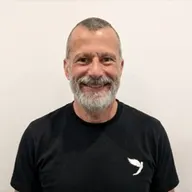
Hi, I'm Julien!
A physiotherapist specialised in the management of climbing injuries. Passionate about analysing the complex movements of climbing and about injury prevention. An expert in climber biomechanics and return-to-sport strategies.
9 practical, progressive modules for the management of climbers. Ready to use in the clinic the very next day.
1 / 10
01
Muscle and tendon injuries of the hand and fingers
Functional anatomy of the climber's fingers
Pulley injuries and flexor tendinopathy
Injury mechanisms specific to climbing
02
Ligament and joint injuries of the hand and fingers
Finger capsulitis and sprains
Dislocations and subluxations
A tailored clinical assessment
03
Practical workshops
Putting the clinical tests into practice
Assessments in pairs
Analysis of the sporting movement
04
Practical protocols for finger stiffness or hypermobility
Specific rehabilitation protocols
Managing stiffness and hypermobility
Exercises tailored to the climber
05
Wrist and elbow injuries: key assessment points and practical exercises
Epicondylalgia in the climber
Wrist tendinopathy
Practical exercises and a specific assessment
06
Posterior shoulder instability: tests and practical exercises
Clinical tests for posterior instability
Rehabilitation protocols
Practical exercises in pairs
07
Spine – lower limb – upper limb coordination in the climber
Analysis of the kinetic chain
Whole-body movement coordination
Clinical implications for rehabilitation
08
History taking and key points of the climber's clinical assessment
A tailored subjective examination
Key points of the clinical examination
Specific clinical reasoning
09
Exercises, return to sport, prevention, taping and strapping
Prescribing appropriate exercises
Criteria for returning to climbing
Specific taping and strapping techniques
Prevention strategies
Multiple-choice test
They trained with us
See where the healthcare professionals trained on this topic practise.
50+trained on this course
⭐ 4.8/5Average rating of our training provider on a sample of 675 reviews
Funding available
Two French schemes can fund it, for practitioners working in France. What sets them apart: what you pay upfront, and when.
DPC
Fully funded*
The Agence nationale du DPC, the French agency for continuing professional development, pays the training provider directly, and your attendance is compensated. Open to healthcare professionals practising in France.
You pay upfront
Nothing
The Agence covers
The full cost of the course
and pays you 266 € to 532 € for attending
* Some of the cost may remain payable by you, depending on the course price and the amount funded.
1You register on agencedpc.fr and choose your session.
2Your application is approved: the Agence pays Physio Learning, you pay nothing upfront.
3You receive your allowance in the months following the course.
DPC action no. 99GX2525037
DPC allowance for masseurs-kinésithérapeutes, 2026: not every profession comes under the DPC, and those that do are not on the same allowance. Subject to your application being approved and to your annual allowance still being available. A French scheme, for professionals practising in France.1
FIFPL
Up to 600 € reimbursed
You pay for the course, then claim reimbursement from the FIFPL, the French training fund for self-employed professionals. Open to practitioners registered in France.
You pay upfront
The course fee
The FIFPL reimburses
Up to 600 €
300 € per day over 2 days, up to 900 € a year
For the exact amount in your own situation, put the request to the FIFPL.
1You book your place and pay for the course.
2You file your claim with the FIFPL, enclosing the programme and the quote.Programme PDF
3The FIFPL reimburses you after the course.
Registered with the FIFPL: kinésithérapeutes S0620260430122
Amounts from the masseur-kinésithérapeute scale, 2026: each profession has its own. Reimbursement is decided by the FIFPL, based on your remaining annual allowance and on the budget allocated to your profession. A French fund, for self-employed practitioners registered in France.2
Invest in your expertise
Value 890€590€
TTC · Pre-Learning included
↳ that is 295€ / day of training
Meals not included
Included in the course
2 on-site days in Paris or Toulouse (14h)
PowerPoint, videos, clinical cases
Practice in pairs
Multiple-choice test + practical cases
WhatsApp support 7 days a week
DPC / FIFPL funding
🎁 Bonus included
Access to the Physio Learning community for this course
Listing on PhysioMaps once you complete the course
Leave your email: we will let you know as soon as a session opens.
✓ Qualiopi-certified training provider✓ 50+ trained on this course✓ No prerequisites
✓ Certificate and paperwork kept for you
✓ Instructor support after the course
✓ Dedicated app, lifetime access
What fellow physios say.
“Excellent course! I see a lot of climbers in the clinic and I lacked precise landmarks for pulley injuries. I am leaving with clear protocols I can apply straight away.”
JDJulie D.Physiotherapist
“Very pragmatic. The biomechanical analysis of the different grips (crimp, open hand) taught me a huge amount about my patients' recurring injuries.”
MLMarc L.Physiotherapist
“The hand/finger specific assessment is really well built. It saves you a huge amount of time in the first session when isolating the injured structure with reproducible tests.”
TRThomas R.Physiotherapist
“I particularly like the global approach: we do not just look at the finger, we analyse the whole kinetic chain (wrist, elbow, shoulder), which is essential in climbing.”
SKSophie K.Physiotherapist
“Working in pairs really helps you master the clinical tests, particularly for the shoulder and elbow instabilities that are so common on bouldering problems.”
APAntoine P.Physiotherapist
“Julien is an enthusiast who shares his expertise without holding back. Thanks to him, return-to-sport (RTP) criteria on the wall are finally objective and reassuring.”
EBElodie B.Physiotherapist
“I was able to apply the progressive loading exercises the very next day with a patient with flexor tendinopathy. The result is great, he has regained confidence.”
NMNicolas M.Physiotherapist
“An essential course if you have a climbing gym near your clinic. The finger-specific strapping techniques have already been very useful to me!”
CVClaire V.Physiotherapist
“The theory/practice mix is perfectly balanced. The climber-specific history taking opened my eyes to the real injury mechanisms we so often miss.”
JSJulien S.Physiotherapist
“The pre-learning means you arrive with solid anatomy foundations, which leaves far more time for pure clinical practice over the two on-site days.”
MTMarine T.Physiotherapist
5/5 · 100 % of the 21 participants recommend this course (post-course survey)
For 2026, if your application is approved (a decision that does not depend on Physio-learning) and depending on your annual allowance, the course may be funded by the DPC, the French continuing professional development scheme.
For 2026, if your application is approved (a decision that does not depend on Physio-learning) and depending on your annual allowance, the course may be reimbursed by the FIFPL, the French training fund for self-employed professionals, in 2026: for a physiotherapist, funding is capped at 900€ per year, with a limit of 300€ per day, half that for an online course, within the budget allocated to their profession.
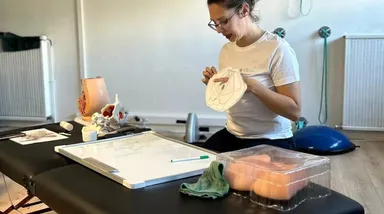
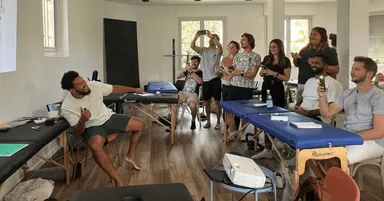
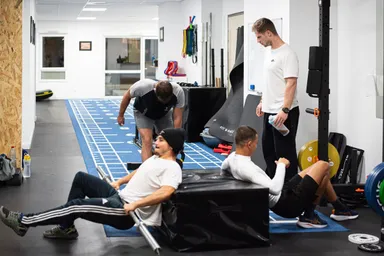
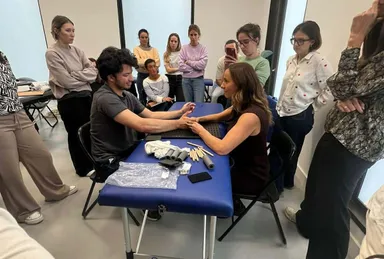
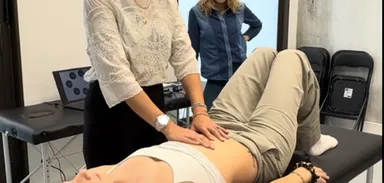
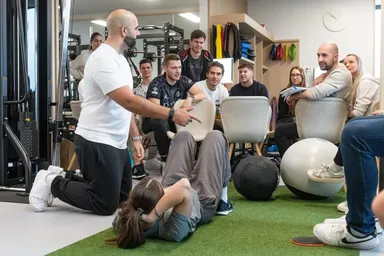
2 days of on-site teaching at the course venue in Paris or Toulouse (14h). The teaching materials are many and varied: PowerPoint, teaching videos, clinical cases. Time for practice in pairs is scheduled throughout the course.
Dates: Paris on 3 and 4 October 2026
Who it is for: self-employed or salaried healthcare professionals; osteopaths; strength and conditioning coaches; doctors No prerequisites for this course.
*Pre-Learning on the site included – *Meals not included – *DPC/FIFPL funding possible
A multiple-choice test to validate what you have learnt, plus practical cases. 1 instructor to answer all your questions on the subject. 1 technical and teaching support service available 7 days a week via WhatsApp.
The course provides what you need to manage the injuries of the climbing patient.
Prerequisites
No prerequisites for this course.
Accessing the learning platform
Log in to the Physio-Learning platform, then complete the two-factor authentication (code received by SMS or email).
Our course venues are always accessible to people with reduced mobility, and we will do our best to adapt to your situation. So do get in touch!
1.DPC: the Agence nationale du DPC pays the training provider directly, subject to your application being approved and to your annual allowance still being available. Some of the cost may remain payable by you, depending on the course price and the amount funded. The attendance allowance is paid by the Agence, at its own rates and for on-site courses only. The DPC only covers healthcare professions bound by the French three-yearly requirement, and the allowance depends on the profession: the amounts shown are those for masseurs-kinésithérapeutes in 2026. A French scheme, open to healthcare professionals practising in France.
2.FIFPL: you pay for the course, then claim reimbursement. It is full or partial depending on the course, and decided by the FIFPL independently of Physio Learning, within your remaining annual allowance and the budget allocated to your profession. The caps shown are those of the masseur-kinésithérapeute scale for 2026; other professions come under their own section's scale. An online course is capped at half these amounts. A French fund, open to self-employed practitioners registered in France.
3.Satisfaction rating from the questionnaire completed by participants at the end of the course: ★★★★★ 5/5 · 100 % of the 21 participants recommend this course (post-course survey)
4.Number of professionals trained, rounded down to the nearest fifty, across all sessions of this course: 50+