



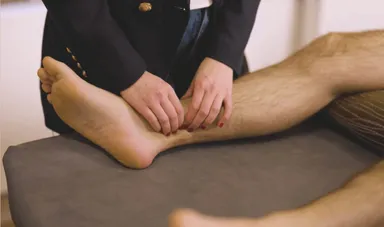



You have pain low in the back, to the side of the sacrum, and one question only: how long is this going to last? The honest answer fits in a sentence: most mechanical episodes improve within a few weeks to a few months, but there is no precise « clock » specific to the sacroiliac joint. Here are the actual durations by situation (including pregnancy and postpartum), what lengthens or shortens them, and the rare signals that should raise the alarm.
📝 In brief
- In the only situation that is genuinely documented, pregnancy-related pelvic girdle pain, 78.0 % of women have recovered 6 months after giving birth, but 22.0 % are still in pain. Of 41,421 Norwegian women who reported pelvic girdle pain at 30 weeks of pregnancy, 18.5 % keep pain in one or two pelvic sites, 3.0 % a pelvic girdle syndrome and 0.5 % a severe form: more than one woman in five. Two limits to bear in mind: recovery rates fall the more intense the pain was during pregnancy (severe cases, the ones who seek care, recover less), and the study measures only one time point, at 6 months: it says nothing about what becomes of that 22 % afterwards 3.
- Outside pregnancy, there are no duration data specific to the sacroiliac joint. There is neither a guideline nor an established treatment protocol for sacroiliac syndrome 1, the reported prevalence varies from 15 to 30 % of mechanical low back pain across series: a figure from a narrative review, not a meta-analysis 2. The same source recalls that the predictive value of the provocation tests, even as a battery, is now questioned, and that the intra-articular anaesthetic block remains controversial (false positives and false negatives): the duration announced therefore depends on a diagnosis that is itself uncertain.
- A minority of women remain in pain over the very long term, and that is the message not to smooth over. Up to 11 years after giving birth, 1 woman in 10 who had pelvic girdle pain during pregnancy (37 out of 371 respondents, 70 % response, all from randomised trials, so pain marked enough to enter a trial) keeps a persistent form with severe impact 4. Twelve years on, 40.3 % of the 295 respondents in a Swedish cohort (response rate 47.3 %) report low back and/or pelvic pain that is continuous or recurrent over 12 months, with no confirmatory clinical examination, against 59 % with no pain or only occasional pain. The authors' conclusion: for a subgroup of women, spontaneous recovery without recurrence is an unlikely scenario 7.
- What genuinely shortens it: exercise, with an effect gained early and then maintained. After giving birth, 20 weeks of specific stabilisation exercises leave, 2 years later, 85 % of women with minimal disability against 47 % in the group receiving individualised physiotherapy without those exercises, and 68 % with minimal evening pain against 23 % (81 randomised, 65 analysed at 2 years). The gap disappears when you adjust for the score at 1 year, which is to be expected: the score at 1 year is itself the effect of treatment: the effect is gained during the first year and then maintained. But the women most disabled at the outset recover the most, whichever group they are in 13. During pregnancy, an 8 to 12 week programme reduces the number of women reporting combined low back and pelvic pain (RR 0.66; 95 % CI 0.45-0.97), evidence of moderate to low quality, with no effect found in the pelvic subgroup (group exercise: RR 0.97; 95 % CI 0.77-1.23) 12.
- No reliable individual prognosis: we give directions, not durations. The landmark systematic review on prognostic factors includes only 3 studies, with a weak to very weak GRADE level of evidence for every factor; the authors write that the limited number of studies and the absence of replication rule out any definitive conclusion (search closed in April 2017, Wuytack 2018). The most frequently reported factors (intense pain during pregnancy, a large number of positive provocation tests, a history of low back pain, high disability, neurotic behaviour, fear-avoidance), come from a purely qualitative synthesis: meta-analysis proved impossible (heterogeneity, raw data unavailable) and 5 of the 10 studies are at moderate risk of bias 11. These factors stack up rather than weighing much on their own: about 3 to 5× per factor, on ORs with wide intervals and 36 cases 6.
- Pain that lasts and wakes you at night deserves a rheumatology opinion, not a conclusion. The 4 Berlin criteria (morning stiffness lasting more than 30 minutes, improvement with exercise but not with rest, painful waking in the second half of the night only, alternating buttock pain) have no value in isolation: together at ≥ 2 out of 4, sensitivity 70.3 % and specificity 81.2 % (positive likelihood ratio 3.7, not enough to settle it); at ≥ 3 out of 4, the LR+ rises to 12.4 and justifies a firm referral. Figures from a case-control study (101 already-established spondyloarthritides vs 112 cases of mechanical low back pain under 50): performance in an early patient is probably overestimated 10.
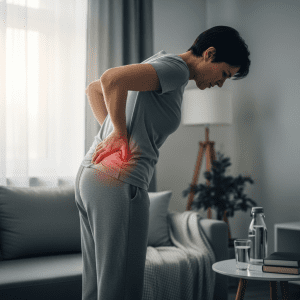
⏱️ How long it really lasts
The short answer: most mechanical sacroiliac pain eases within a few weeks to a few months, not years. The honest answer: there is today neither a guideline nor an established treatment protocol for sacroiliac syndrome, which explains how thin the prognostic data specific to this site are 1. Orders of magnitude can be given; a precise date for any one person cannot be promised.
To place the problem: sacroiliac pain accounts for 15 % to 30 % of mechanical low back pain, and its first-line management is conservative: drug treatment, exercise therapy, rehabilitation, behavioural approaches 2. Injections and more invasive procedures are considered only if that fails.
An acute episode: improvement plays out over a few weeks
The main comparative trial in sacroiliac syndrome (51 patients) compared three techniques: therapeutic exercise, manipulative techniques and their combination. All three significantly improve pain and disability from baseline. Notably, the benefit shifts over time: the manipulative techniques take the lead at 6 weeks, therapeutic exercise at 12 weeks, and at 24 weeks no difference at all appears between the groups 1. In other words, over six months the course goes broadly in the right direction whichever technique is used.
| Situation | What the figures say | Strength of evidence |
|---|---|---|
| Acute mechanical episode | Progressive improvement over a few weeks to about 6 months | weak |
| Pregnancy-related pain | 78 % recovered 6 months after giving birth | moderate |
| Persistent form | About 1 woman in 10 still affected 11 years on | weak |
Orders of magnitude drawn from Nejati 2019, Bjelland 2013 and Elden 2016; none of them replaces individual advice.
Pregnancy and postpartum: the great majority recover within six months
This is the ground on which the figures are firmest. About 45 % of pregnant women and 25 % of postpartum women report pelvic girdle pain and/or pregnancy-related low back pain, of mean intensity 50 mm on a visual analogue scale during pregnancy; after giving birth, the pain decreases 5.
In that very large Norwegian cohort, six months after giving birth, 18.5 % still had pain in one or two pelvic sites, 3.0 % a pelvic girdle syndrome and 0.5 % a severe form 3. Another follow-up finds 16 % of pain still persisting 3 to 6 months after giving birth 6. So the turning point comes mainly in the six months after the birth.
When the pain settles in
In a minority, it lasts. Eleven years after giving birth, about 1 woman in 10 who had pelvic girdle pain during pregnancy keeps a persistent form with severe impact 4. At twelve years, 40.3 % of the respondents in a Swedish cohort still reported pain to varying degrees, against 59 % entirely pain-free 7.
Spontaneous recovery without recurrence remains an unlikely scenario for a subgroup of women.
What increases the risk of persistence is not pain alone, but the stacking of factors: in one cohort, having three of them together (age of 30 or over, moderate to high disability during pregnancy, and pelvic pain combined with low back pain), multiplied the risk of persistent pain by 27 6.
Key points
- Most mechanical episodes improve over a few weeks to a few months.
- After a pregnancy, the great majority recover within six months; a minority keep a lasting problem.
- The prognostic data are weak overall (GRADE weak to very weak): we give orders of magnitude, not a personal date 8.
When an abnormal duration should suggest something else
Pain that does not follow this mechanical pattern (rest does not relieve, activity relieves, the night wakes you) should raise the possibility of an inflammatory rather than a mechanical origin (spondyloarthritis). The ASAS criteria for inflammatory pain list five features: improvement with exercise, night pain, insidious onset, onset before the age of 40 and no improvement with rest; the presence of at least 4 of those 5 reaches a sensitivity of 77.0 % and a specificity of 91.7 % 9. Morning stiffness lasting more than 30 minutes and painful waking in the second half of the night point the same way 10. This is the opposite of the mechanical profile, in which rest relieves and activity aggravates: something to report to a health professional.
⚖️ What lengthens (or shortens) recovery
Honesty first: there is neither a guideline nor an established protocol for sacroiliac syndrome 1, and the prognostic data specific to this site are very thin. Almost all the figures below come from a neighbouring, far better studied population: women with pregnancy-related pelvic girdle pain. And even there, the landmark review on prognostic factors included only three studies, with a weak to very weak level of evidence for every factor; the limited number of studies and the absence of replication rule out any definitive conclusion, its authors write 8. Directions can be named, your prognosis cannot be calculated. For the clinical picture, see the guide Mechanical sacroiliac pain.
The most frequently reported factors
A review of 10 studies looked for what predicts pain still present 3 to 6 months after giving birth, in women with pelvic girdle pain (isolated low back pain is excluded). The most frequent findings: intense pain during pregnancy, numerous positive provocation tests, a history of low back pain and of lumbopelvic pain, high disability during pregnancy, neurotic behaviour and high fear-avoidance. The evidence is weak or contradictory for emotional distress, catastrophising and sleep. None of these associations is quantified: meta-analysis proved impossible and half the studies are at moderate risk of bias 11. Factors that are frequently reported, then, not demonstrated risk factors.
It is not the pain alone, it is the stacking
In a Norwegian cohort, 16 % of women who reported pelvic pain during pregnancy still had pelvic girdle pain 3 to 6 months after giving birth: a fragile figure: of 68 women in pain, only 47 were examined and 36 diagnoses confirmed. Three factors stand out, each multiplying the risk by about 3 to 5: age ≥ 30 (OR 2.9; CI 1.3–6.8), moderate to high Oswestry disability during pregnancy (OR 5.1; 1.7–15.0), pelvic pain + low back pain together (OR 2.8; 1.2–6.4). Combined, their effects add up strongly (the authors model a ×27 risk, with no published confidence interval and on 36 cases: a direction, not a measurement). Reassuring in passing: in these women, the persistent pain had no major impact on daily activities 6.
What you can influence
| Lever | What the evidence says | Level |
|---|---|---|
| Exercise during pregnancy (8 to 12 weeks) | Reduces the number of women reporting low back and pelvic pain (combined outcome: RR 0.66; 95 % CI 0.45–0.97) and sick leave (RR 0.76). But on pelvic pain alone, group exercise does not beat usual antenatal care (RR 0.97; 0.77–1.23): Liddle 2015 | Moderate to weak |
| Specific stabilisation exercises after giving birth | At 2 years: 85 % with minimal disability against 47 %, and 68 % with minimal evening pain against 23 % (81 randomised, 65 analysed): Stuge 2004 | Moderate |
| Non-rigid pelvic belt + information | NICE recommends « considering » it, on a single trial for this comparison (N = 105), of low quality: NICE 2021 | Weak |
| Manipulation, exercise, or both (sacroiliac) | All three groups improve from baseline, but the trial (51 patients) has no control group: natural history is not ruled out. At 24 weeks there is no difference between groups, and the combination does no better: Nejati 2019 | Weak |
Two qualifications on the stabilisation exercises, to be read alongside the figures in the table: the comparison group was not « no treatment » (20 weeks of individualised physiotherapy, without the specific exercises) and it improved too; and it was the women most disabled at the outset who recovered the most, whichever group they were in. The gap disappears if you adjust for the level reached at 1 year, as expected, since the effect is gained during the first year and then maintained to 2 years 13.
First-line management remains conservative; only if that fails come corticosteroid injections, which relieve for more than 3 months in some people, and then radiofrequency 2.
What does not depend on you
Of 41,421 women who reported pelvic girdle pain at 30 weeks of pregnancy, 78.0 % had recovered 6 months after giving birth, but 22.0 % were still in pain (18.5 % in one or two pelvic sites, 3.0 % a pelvic girdle syndrome, 0.5 % a severe form). Two reservations: this is an average across all self-reported severities, and recovery rates fall when the pregnancy pain was severe: the most marked cases, the ones who seek care, recover less. The study measures a single time point, at 6 months: it says nothing about what follows for that 22 %.
Further out, two cohorts give a rough idea, no more. Up to 11 years after giving birth, 1 woman in 10 (37 out of 371 respondents, recruited from trials and so relatively painful) kept pain with severe impact; only two predictors are retained, the number of positive provocation tests (OR 1.79) and a history of low back pain (OR 2.28), with no published confidence interval 4. At 12 years, of 295 respondents (47.3 % response: women still in pain reply more readily), 40.3 % reported continuous or recurrent low back and/or pelvic pain, against 59 % with no pain or only occasional pain, for a subgroup, the authors conclude, spontaneous recovery without recurrence is unlikely 7.
Key points
- The prognostic data are weak 8 : nobody can give you a date.
- A quantified marker, from the postpartum period: about 4 women in 5 recovered at 6 months, but more than one in five still in pain: the more so the more severe the pain was.
- What weighs is not any one factor but their accumulation : intense pain, high disability, a history of low back pain, numerous positive provocation tests.
- Your levers: moving, specific stabilisation exercises, a non-rigid belt as an adjunct: moderate to weak evidence.
- What you do not choose: baseline severity, the extent of the pain, your history. One consolation: those most affected at the outset improve the most.
🚩 Is it dangerous? What to watch for
It is the question that always comes right after « how long? ». Short answer: mechanical sacroiliac pain is pain that lasts, not pain that damages. The reported prevalence of sacroiliac pain varies from 15 to 30 % across series in patients with mechanical low back pain, first-line management there is conservative (medication, cognitive behavioural therapy, manual medicine, exercise, rehabilitation), and imaging is indicated only to rule out red flags 2. In other words: you are not X-rayed to measure how serious your pain is, but to rule something else out. If no imaging has been ordered for you, that is not negligence.
Lasting is not worsening
The best duration data come from pregnancy. Of 41,421 women in the Norwegian mother and child cohort who reported pelvic girdle pain at 30 weeks, 78.0 % had recovered 6 months after giving birth, and 22.0 % were still in pain (18.5 % in one or two sites, 3.0 % a pelvic girdle syndrome, 0.5 % a severe form) 3. That 78 % is an average at a single measurement point, across all severities: the authors make clear that recovery rates fall when the pain was more severe during pregnancy. So it is not your personal prognosis.
Over the very long term, up to 11 years after giving birth, 1 woman in 10 who had pelvic girdle pain during pregnancy keeps a persistent form with severe impact (37 out of 371 respondents, 70 % response), in women recruited from clinical trials, so already painful enough to enter one 4. Persistence does exist, it is a minority, and nothing in these data describes a progressive deterioration.
Pain that settles in is not pain that is destroying something.
The real signal: pain that changes rhythm
What to watch is not the intensity, it is the pattern. A mechanical sacroiliac is relieved by rest and stirred up by activity. The opposite pattern (relieved by movement, not by rest), suggests what is called inflammatory pain, and that is the reason for referral to a rheumatologist.
| Mechanical pattern (reassuring) | Inflammatory pattern (to report) | Evidence |
|---|---|---|
| Rest relieves, activity aggravates | Improvement with exercise, but not with rest | moderate |
| Brief morning stiffness | Morning stiffness lasting more than 30 minutes | moderate |
| Nights broadly settled | Waking with pain in the second half of the night only | moderate |
| Buttock pain on one side, related to positions | Alternating buttock pain (switching right/left) | moderate |
| An identifiable trigger | Insidious onset, before the age of 40 | weak |
These first four items are the Berlin criteria : together at at least 2 out of 4, they give a sensitivity of 70.3 % and a specificity of 81.2 % (positive likelihood ratio 3.7); at at least 3 out of 4, that ratio rises to 12.4 10. No single sign discriminates: morning stiffness alone proves nothing. And these performance figures come from a comparison between already-established spondyloarthritides and mechanical low back pain under the age of 50: the authors themselves called for validation at an early stage, which is precisely the situation you are in. Concretely, a ratio of 3.7 applied to a prevalence of about 5 % of axial spondyloarthritis among people with chronic low back pain takes the probability to only ~16 %: it is a flag for referral, not a diagnosis. Only the threshold of 3 criteria out of 4 justifies a firm referral.
The five ASAS features of inflammatory pain (improvement with exercise, night pain, insidious onset, age at onset < 40, no improvement with rest) point the same way: at at least 4 features out of 5, sensitivity 79.6 % and specificity 72.4 % in the validation cohort (n = 648), that is, about 1 person in 4 without inflammatory pain wrongly labelled (the 77.0 % / 91.7 % often quoted come from an exercise on 20 patients in which the gold standard was the experts' own opinion) 9. The authors are explicit: a diagnosis of axial spondyloarthritis is not made on the presence or absence of isolated parameters. These features classify pain as inflammatory; inflammatory pain is not the disease. The « before 45 » threshold you meet everywhere is, moreover, only an entry criterion of classification criteria intended for research, validated in a rheumatology cohort in which 60.2 % of the patients referred did have axial spondyloarthritis 9: a population with no relation to that of a community practice, where prevalence is around 5 %.
The uncertainty you are owed: the diagnosis itself
It has to be said plainly: there is no guideline or established treatment protocol for sacroiliac syndrome 1. And the reliability of the diagnosis is itself debated: recent work has questioned the predictive value of the provocation tests, alone or even as a battery, and the diagnostic value of the anaesthetic injection remains controversial because of false positives and false negatives 2. This is not a reason to doubt your pain: it is a reason not to chase a label. To understand what exactly this diagnosis covers, see the guide Mechanical sacroiliac pain.
Key points
- A mechanical sacroiliac is not an emergency: imaging there serves only to rule out red flags, not to measure severity 2.
- Watch the rhythm, not the intensity: relieved by movement and not by rest, waking in the second half of the night, stiffness > 30 min, alternating buttock pain → mention it to your doctor.
- These criteria point, they do not diagnose: at 2/4 the probability remains low; only 3/4 justifies a firm rheumatology opinion 10.
- 78 % recovery at 6 months after giving birth, but 22 % persistent pain: lasting is common, worsening is not 3.
- The diagnosis of mechanical sacroiliac pain remains imperfect (provocation tests and blocks both debated): that does not call your pain into question.
🚀 Speeding up recovery: what works
First point of honesty: there is no guideline or established treatment protocol for sacroiliac syndrome 1. What does exist is clear agreement on the starting point: first-line management is conservative: drug treatment, cognitive behavioural therapy, manual medicine, exercise therapy and rehabilitation, with psychological support if needed. Imaging is indicated only to rule out red flags, not to « see » the sacroiliac joint 2. In other words: we are not looking for a miracle treatment, we are putting in place what, in most people, accompanies recovery.
Exercise and physiotherapy: the foundation, but read the qualifications
This is the best-documented line, which does not mean « proven 100 % ». In women with pelvic girdle pain after giving birth, a 20-week programme of specific stabilisation exercises left, two years later, 85 % of women with minimal disability against 47 % in the other group, and 68 % with minimal evening pain against 23 % 13. Three indispensable clarifications: these percentages concern 65 women analysed (81 randomised, 16 excluded, mostly for new pregnancies); the comparison group was not « no treatment » but received 20 weeks of individualised physiotherapy without those specific exercises; and it improved too. The authors note that the women most disabled at the outset recovered the most, whichever group they were in: part of the recovery is spontaneous. The gap between groups is gained during the first year, then maintained to two years.
During pregnancy, the Cochrane review (34 trials, 5,121 women) finds that an 8 to 12 week exercise programme reduces the number of women reporting pain, but the outcome is combined, low back + pelvic (RR 0.66; 95 % CI 0.45–0.97; 1,176 participants, 4 studies), and land-based exercise reduces related sick leave (RR 0.76; 95 % CI 0.62–0.94). Quality of evidence: moderate to low. On pelvic pain taken on its own, group exercise compared with usual antenatal care shows no difference (RR 0.97; 95 % CI 0.77–1.23). And the authors warn: new data will very probably change these estimates 12.
Supervised movement is not a lightning cure: it is simply the only line the studies support repeatedly.
What helps a little, what has not proved itself
| What you can do | What the evidence really says | Level |
|---|---|---|
| Exercise / supervised rehabilitation | First-line 2 ; an effect on the combined low back+pelvic outcome and on sick leave 12 ; benefit maintained at 2 years postpartum 13 | Moderate to weak |
| Non-rigid lumbopelvic belt (pregnancy) | NICE recommends « considering » it alongside exercise advice. A single trial for this comparison (N = 105), of low quality, but a large effect on pain intensity at 6 weeks (NICE 2021) | Weak, but recommended |
| Manual therapy / manipulation alone | NICE concludes that the evidence is insufficient and makes no recommendation (NICE 2021). In the sacroiliac trial (51 patients), manipulation was « notable » at 6 weeks and exercise at 12 weeks, but with no statistical superiority demonstrated between groups 1 | Insufficient |
| Combining manipulation + exercise | The combination brings no significantly better result than either approach alone 1 | Weak |
| Corticosteroid injections, radiofrequency | Considered only if conservative care fails . Injections are documented as relieving for more than 3 months in some people 2 | Second-line |
| Imaging straight away | Indicated only to rule out red flags 2 | Not indicated |
A word on the most frequently cited sacroiliac trial 1 : all three groups improve, but there is no control group at all, a limitation acknowledged by the authors themselves, so natural history and regression to the mean are not ruled out. At 24 weeks, no difference is observed between groups, which, with ~17 patients per arm, mainly reflects a lack of power, not proven equivalence. Add that the same landmark review recalls that the predictive value of the provocation tests, alone or as a battery, is now questioned, and that the value of the anaesthetic block remains controversial 2 : the diagnosis itself is not an exact science.
A simple action plan
- Move, with supervision. Ask for a structured exercise programme rather than rest; postpartum, specific stabilisation exercises have the best case 13.
- Pregnant? Exercise advice and/or a non-rigid lumbopelvic belt are worth considering (NICE 2021).
- Allow time. The benefits play out over weeks to months, not over sessions: the gap seen at 2 years had already been gained at one year 13.
- No reflex imaging, except to rule out a red flag 2.
- Only if that fails, discuss injection or radiofrequency with the doctor 2.
- A signal not to miss: if your pain improves with activity but not with rest, wakes you in the second half of the night, with morning stiffness lasting more than 30 minutes, mention it to your doctor. That pattern points towards a rheumatology opinion: it is a reason for referral, never a diagnosis on its own 109.
Key points
- No established protocol exists for the sacroiliac joint: conservative care (exercise, rehabilitation) is first-line 12.
- Exercise has the best case, but of moderate to weak quality, and its effect on pelvic pain alone is not demonstrated 12.
- Part of the recovery happens whatever treatment is received 13.
- Non-rigid belt: a weak recommendation, but recommended (NICE 2021). Manual therapy alone: insufficient evidence.
- Injections and radiofrequency: after failure, and effective only in some people 2.
To understand where the pain comes from, how it is assessed and what exactly this diagnosis covers, read the full guide: Mechanical sacroiliac pain.
Bibliography
Every reference checked individually on PubMed (clickable PMID). 14 sources. Click a superscript note marker in the text: the bibliography opens and highlights the source.
- Nejati P, Safarcherati A, Karimi F (2019). Pain Physician. PMID 30700068.
- Szadek K, Cohen SP, de Andrès Ares J, Steegers M, Van Zundert J, Kallewaard JW (2024). Pain Practice. PMID 38155419. doi:10.1111/papr.13338.
- Bjelland EK, Stuge B, Engdahl B, Eberhard-Gran M (2013). BJOG: An International Journal of Obstetrics and Gynaecology. PMID 23107369. doi:10.1111/1471-0528.12029.
- Elden H, Gutke A, Kjellby-Wendt G, Fagevik-Olsen M, Ostgaard HC (2016). BMC Musculoskeletal Disorders. PMID 27406174. doi:10.1186/s12891-016-1154-0.
- Wu WH, Meijer OG, Uegaki K, Mens JMA, van Dieën JH, Wuisman PIJM, Ostgaard HC (2004). European Spine Journal. PMID 15338362. doi:10.1007/s00586-003-0615-y.
- Gausel AM, Kjærmann I, Malmqvist S, Dalen I, Larsen JP, Økland I (2016). European Spine Journal. PMID 25900296. doi:10.1007/s00586-015-3959-1.
- Bergström C, Persson M, Nergård KA, Mogren I (2017). BMC Musculoskeletal Disorders. PMID 28915804. doi:10.1186/s12891-017-1760-5.
- Wuytack F, Daly D, Curtis E, Begley C (2018). Midwifery. PMID 30142609. doi:10.1016/j.midw.2018.07.012.
- Sieper J, van der Heijde D, Landewé R, Brandt J, Burgos-Vagas R, Collantes-Estevez E, Dijkmans B, Dougados M, Khan MA, Leirisalo-Repo M, van der Linden S, Maksymowych WP, Mielants H, Olivieri I, Rudwaleit M (2009). Annals of the Rheumatic Diseases. PMID 19147614. doi:10.1136/ard.2008.101501.
- Rudwaleit M, Metter A, Listing J, Sieper J, Braun J (2006). Arthritis & Rheumatism. PMID 16447233. doi:10.1002/art.21619.
- Burani E, Marruganti S, Giglioni G, Bonetti F, Ceron D, Cozzi Lepri A (2023). Medicina (Kaunas). PMID 38138226. doi:10.3390/medicina59122123.
- Liddle SD, Pennick V (2015). Cochrane Database of Systematic Reviews. PMID 26422811. doi:10.1002/14651858.CD001139.pub4.
- Stuge B, Veierød MB, Laerum E, Vøllestad N (2004). Spine (Phila Pa 1976). PMID 15131454. doi:10.1097/00007632-200405150-00021.
- National Guideline Alliance (UK) (2021). NICE Evidence review U (Antenatal care, NICE guideline NG201), National Institute for Health and Care Excellence. PMID 34524753.
❓ Frequently asked questions
How long does sacroiliac pain last?
We have to start with an honest answer: there are no duration data specific to mechanical sacroiliac syndrome, for want of a guideline and an established treatment protocol for this site 1. The only solid figures come from a neighbouring, well-studied situation, pregnancy-related pelvic girdle pain: of 41,421 women in pain at 30 weeks of pregnancy, 78.0 % had recovered 6 months after giving birth, but 22.0 % were still in pain: 18.5 % in one or two pelvic sites, 3.0 % with a pelvic girdle syndrome, 0.5 % with a severe form. The authors make clear that recovery rates fall the more intense the pain was during pregnancy, and the study measures a single time point, at 6 months 3. Outside pregnancy, the main comparative sacroiliac trial (51 patients, about 17 per arm) shows that exercise, manipulation and the combination of the two all improve pain and disability from baseline, with no difference between the groups at 24 weeks, but that trial has no control group at all, a limitation acknowledged by the authors themselves: natural history and regression to the mean are not ruled out, and the absence of a difference at 24 weeks reflects a lack of power, not proven equivalence 1.
How long does sacroiliac pain last after a pregnancy?
Six months after giving birth, 78.0 % of women who reported pelvic girdle pain at 30 weeks of pregnancy have recovered, and 22.0 % are still in pain 3. A Norwegian prospective cohort finds a similar order of magnitude earlier: 16 % of women who reported pelvic pain during pregnancy still had persistent pelvic girdle pain 3 to 6 months after giving birth: a figure resting on an incomplete base, since only 47 of the 68 women in pain were examined and 36 diagnoses confirmed. Worth noting, without dramatising: this persistent pain « had no major impact on activities of daily living », even though subjective health status was worse 6. To put it in context: about 45 % of pregnant women and about 25 % of postpartum women have pelvic girdle pain and/or pregnancy-related low back pain; among affected patients (and not among all pregnant women), the pain is serious in about 25 % and disability severe in about 8 % during pregnancy; after the pregnancy, problems remain serious in about 7 % of affected patients. These values include mild complaints and fall by about 20 % if those are excluded 5.
Can sacroiliac pain last for years or become chronic?
Yes, for a minority of people, and the postpartum data document it. Up to 11 years after giving birth, 1 woman in 10 who had pelvic girdle pain during pregnancy keeps a persistent form with severe impact (37 out of 371 respondents, 70 % response): a population drawn from randomised trials, so with pain marked enough to enter one, and a percentage calculated on respondents, not on the 530 recruited 4. Twelve years on, in a Swedish cohort, 40.3 % of respondents (119 out of 295, response rate 47.3 %) report continuous or recurrent low back and/or pelvic pain over the previous 12 months, against 59 % with no pain or only occasional pain: both groups defined by questionnaire, with no clinical examination confirming pelvic girdle pain. A response rate below 50 % exposes the study to bias: women still in pain reply more readily to a questionnaire about pain, even though non-respondents did not differ significantly on most baseline variables. The authors' conclusion deserves to be given as it stands: for a subgroup of women, spontaneous recovery without recurrence is an unlikely scenario 7.
What can be done to shorten sacroiliac pain?
Move, with support. After giving birth, 20 weeks of specific stabilisation exercises leave, 2 years later, 85 % of women with minimal disability against 47 % in the group receiving individualised physiotherapy without those exercises (and not « without care »), and 68 % with minimal evening pain against 23 %: across 65 women analysed, 81 having been randomised and 16 excluded, mostly for a new pregnancy. The gap between groups disappears when you adjust for the score reached at 1 year, which is to be expected since that score is itself the effect of treatment: the effect is gained during the first year and then maintained. A qualification to keep in the same sentence as the figures: it is the women most disabled at the outset who recover the most, whichever group they are in 13. During pregnancy, a Cochrane review (34 trials, 5,121 women) shows that an 8 to 12 week exercise programme reduces the number of women reporting combined low back and pelvic pain (RR 0.66; 95 % CI 0.45-0.97) and that land-based exercise reduces sick leave (RR 0.76; 95 % CI 0.62-0.94), on evidence of moderate to low quality; on low back pain itself, the evidence is of low quality (SMD -0.64; 95 % CI -1.03 to -0.25) and new data will very probably change these estimates 12. On the pelvic girdle, NICE recommends « considering » referral to physiotherapy for exercise advice and/or a non-rigid lumbopelvic belt: a weak recommendation on low-quality evidence, resting on a single trial for this comparison (N = 105) showing a clinically important difference in pain intensity at 6 weeks; for manual therapy alone, the committee concludes that the evidence is insufficient and makes no recommendation (NICE 2021).
When should sacroiliac pain that lasts be a worry?
When the pattern becomes inflammatory rather than mechanical: morning stiffness lasting more than 30 minutes, improvement with exercise but not with rest, painful waking in the second half of the night only, alternating buttock pain. None of these signs counts on its own: together at at least 2 out of 4 (Berlin criteria), they give a sensitivity of 70.3 % and a specificity of 81.2 %, that is, a positive likelihood ratio of 3.7, against a prevalence of axial spondyloarthritis of about 5 % among people with chronic low back pain in primary care, that takes the probability only to about 16 %: it is a flag for referral, not a diagnosis. Only the threshold of at least 3 out of 4 (LR+ 12.4) justifies a firm rheumatology referral. These performance figures come from a case-control study setting 101 already-established spondyloarthritides against 112 cases of mechanical low back pain under 50, and the authors themselves call for prospective validation at an early stage 10. The ASAS criteria for inflammatory back pain describe five features: improvement with exercise, night pain, insidious onset, age at onset before 40, no improvement with rest: at least 4 out of 5 give a sensitivity of 79.6 % and a specificity of 72.4 % in the validation cohort (n = 648), that is, about 1 patient in 4 without inflammatory pain wrongly labelled (77.0 % and 91.7 % in the initial exercise on 20 patients, where the gold standard was the experts' own judgement). The authors say it plainly: a diagnosis of axial spondyloarthritis cannot be made on the presence or absence of isolated parameters: set against the real question, these criteria have a specificity of only 39.5 % (CI 33.0-46.1) and a likelihood ratio of 1.2 (CI 1.1-1.4) for axial spondyloarthritis (PMID 30713715) 9. The « before 45 » threshold often quoted is not a sign but the entry criterion of the ASAS classification criteria (chronic low back pain of at least 3 months of unknown origin starting before the age of 45), established in a rheumatology cohort of 649 already-referred patients, in which 60.2 % did have axial spondyloarthritis, a figure that does not transfer to community practice 9.