





Someone showed you an X-ray or a CT scan and mentioned lumbar osteoarthritis, and since then you have hardly dared to move. Let us start with the most important point: after the age of 50, close to three people in four have osteoarthritis in their lumbar facet joints, and most of them have no pain at all. What the image shows does not decide what you feel. Here are the exercises that research supports, with their actual doses.
📝 In brief
- The exercises that work for lumbar osteoarthritis are not « anti-osteoarthritis » exercises: they are structured active programmes. The largest network meta-analysis on chronic low back pain (217 randomised trials, 20,969 participants) shows that Pilates, the McKenzie method and functional restoration do better than the other types of exercise, with effects of −15 to −19 points for pain and −10 to −12 for function against minimal treatment 3. And exercise also works when facet joint osteoarthritis is explicitly the accepted cause: a single-blind randomised trial in 45 patients in pain from facet joint osteoarthritis, with a telerehabilitation programme of two sessions a week for six weeks, improves pain at rest (F = 4.276; p = 0.021), pain on activity (F = 12.327; p = 0.0001) and disability measured on the Oswestry (F = 23.122; p = 0.0001) 4.
- The dose can be quantified: about 520 MET-minutes a week to cross the threshold of clinically significant improvement in pain, maximum response around 920, and then the curve comes back down. This dose-response relationship is non-linear, U-shaped: more is not always better 5. The format that comes out on top is short and regular over time: sessions of 15 to 30 minutes (SMD = −1.62; SUCRA = 94.6), three times a week (SMD = −1.44; SUCRA = 87), over a programme of at least 16 weeks (SMD = −2.75; SUCRA = 95.4) 8. An important caveat: both these pieces of work concern non-specific chronic low back pain, not lumbar osteoarthritis in particular: the figures are an order of magnitude, not a dosage validated in facet joint osteoarthritis.
- What exercise changes, measured honestly: pain falls markedly, function much less so. In the landmark Cochrane review (249 randomised trials), exercise reduces pain by 15.2 points out of 100 (95 % CI: −18.3 to −12.2; moderate evidence) compared with no treatment, usual care or placebo. On functional limitation, the effect is −6.8 points out of 100 (95 % CI: −8.3 to −5.3): that gain does not reach the threshold of clinical relevance chosen by the authors, and it has to be put that way 3. Compared with the pool of other conservative treatments taken together, exercise keeps an advantage on pain (−9.1 points; 95 % CI: −12.6 to −5.6; weak evidence) and on function (−4.1; 95 % CI: −6.0 to −2.2), but none of these gaps reaches the threshold of clinical relevance. And in the subgroup comparing exercise with manual therapy, there is no difference at all: MD 1.0 (95 % CI: −3.1 to 5.1). The −9.1 is driven by other comparators, such as education alone (MD −12.2) or non-exercise physical therapy (MD −10.4) 3.
- The scan does not dictate what to do: facet joint osteoarthritis is commonplace and does not explain the pain. In the Framingham Heart Study community cohort (188 subjects scanned), CT found facet joint osteoarthritis in 59.6 % of men and 66.7 % of women, with a prevalence that climbs with age: 24.0 % before 40, 74.2 % between 50 and 59, 89.2 % between 60 and 69, with L4-L5 the most affected level (45.1 %). Yet people with facet joint osteoarthritis, at any spinal level, had no more low back pain than anyone else 1. An image of lumbar osteoarthritis is therefore not a reason to restrict movement.
- Walking is not a fallback: provided it is dosed and supported. The Australian randomised trial WalkBack (701 adults) tested a progressive, individualised walking programme combined with education, with six physiotherapy sessions over six months: the risk of a recurrence of activity-limiting low back pain falls by 28 % (hazard ratio 0.72; 95 % CI: 0.60-0.85; p = 0.0002), and the median time to recurrence goes from 112 to 208 days 9. The intervention tested is indeed the pairing of walking + education, not walking alone.
- Having pain during exercise is not a signal to stop, and there is no need to load heavily. In chronic musculoskeletal pain, protocols that allow pain during exercise do slightly better than pain-free exercise in the short term (SMD −0.27; 95 % CI: −0.54 to −0.05; moderate evidence, 385 participants), with no superiority thereafter in the medium and long term: tolerable pain is not an obstacle 6. On load, a randomised trial in 70 patients with recurrent low back pain (12 sessions over 8 weeks) compared individualised low-load motor control exercises with a heavy-load deadlift: both groups improve, the advantage goes to motor control on the patient-specific functional scale (4.2 vs 2.5 points), with no difference in pain intensity: heavy load is not dangerous, it is simply not superior 7. Finally, fear of movement deserves to be spotted early: fear-avoidance beliefs are a prognostic factor for poor outcome in subacute low back pain (4 weeks to 3 months), with odds ratios of 1.05 to 4.64 across four cohorts of 258 to 1,068 patients, even though their predictive value is poor in very acute low back pain (less than 2 weeks) as in chronic low back pain (more than 3 months) 10.
🎯 Understanding it in two minutes
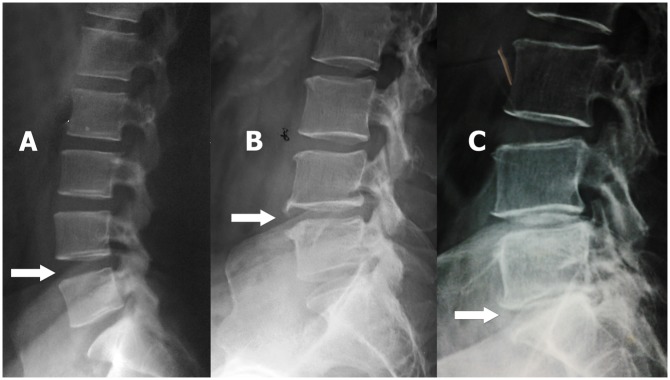
X-rayLateral lumbar spine X-ray: three grades of osteoarthritis, from an intact disc to osteophytes with moderate disc space narrowing, arrows on the signs.
Source : Perera et al., PLoS ONE, 2017, figure 1 · CC BY
Someone has mentioned lumbar osteoarthritis, facet joint osteoarthritis or facet arthropathy, and you are now looking for what to do in practice. What helps most in persistent low back pain is not rest: it is a progressive, dosed exercise programme held over time. The diagnosis itself is dealt with elsewhere: see the full guide to lumbar facet joint osteoarthritis.
The mechanism, and what imaging does not tell you
The facets are the small joints at the back of each spinal level. Over the years they wear, as they do in everyone. And that is where the most costly misunderstanding arises. In the Framingham Heart Study community cohort, CT found facet joint osteoarthritis in 59.6 % of men and 66.7 % of women, with a clear rise with age (24.0 % before 40, 74.2 % between 50 and 59, 89.2 % between 60 and 69), the L4-L5 level being the most affected (45.1 %). Above all: people with facet joint osteoarthritis, at any level, had no more low back pain than anyone else 1.
What your scan shows is not necessarily what is causing your pain.
So the image explains the pain poorly. That does not mean you are not in pain: it means the radiology report is a poor guide to treatment. The programme that follows does not seek to « repair » a worn joint, but to make you more tolerant of load and movement.
What the evidence actually rests on
Let us say it frankly: most of the available research is not about lumbar osteoarthritis, but about non-specific chronic low back pain: persistent back pain with no identified structural cause. The data underpinning this programme are solid, but transposed.
In chronic low back pain, the Cochrane review of 249 randomised trials shows that exercise reduces pain to a clinically important degree against no treatment, usual care or placebo. But, a nuance few pages report, its effect on functional limitation remains below the threshold of clinical relevance chosen by the authors themselves 3. Only one study has tested exercise specifically in patients in pain from facet joint osteoarthritis: 45 patients, six weeks of telerehabilitation at two sessions a week, with significant results on pain at rest, pain on activity and the Oswestry 4. That is little: the direction of travel is reliable, the precision is not yet.
| What was studied | In whom | Result | Confidence |
|---|---|---|---|
| Exercise vs nothing, usual care or placebo 3 | Non-specific chronic low back pain, 249 trials | Pain −15.2 / 100 (95 % CI: −18.3 to −12.2); function −6.8 / 100, below the threshold of clinical relevance | Moderate |
| Exercise, 2 sessions/week, 6 weeks 4 | 45 patients, painful facet joint osteoarthritis | Pain and Oswestry significantly improved | Weak (small numbers) |
Who this programme is for
For you if your situation has already been assessed by a health professional and you are looking for what to do, week after week. If the pain came on suddenly, if it comes with unusual signs or if you still have doubts about where it comes from, the starting point is not this page: it is the full guide.
The guiding principle: load, progressively
It all comes down to one idea: your back is not protected by sparing it, it is strengthened by using it a little more than the day before, regularly, over time. That progression can be quantified: a dose-response network meta-analysis (82 trials, 5,033 participants) puts at about 520 MET-minutes a week the volume needed for a clinically significant improvement in pain, with the maximum response observed around 920 MET-minutes, with a non-linear, U-shaped relationship: beyond that, more is not better 5. Here again, the population studied is non-specific chronic low back pain, not lumbar osteoarthritis in particular.
Two corollaries, finally. Tolerable pain during exercise is not an obstacle : in chronic musculoskeletal pain, protocols that allow it even do slightly better in the short term than pain-free exercise (SMD −0.27; moderate evidence), with no superiority thereafter 6. And heavy loads are not compulsory : between low-load motor control exercises and a heavy deadlift, both groups improve, with a slight advantage to motor control on function (4.2 vs 2.5 points) and no difference in pain 7. Heavy load is not dangerous; it is simply not superior.
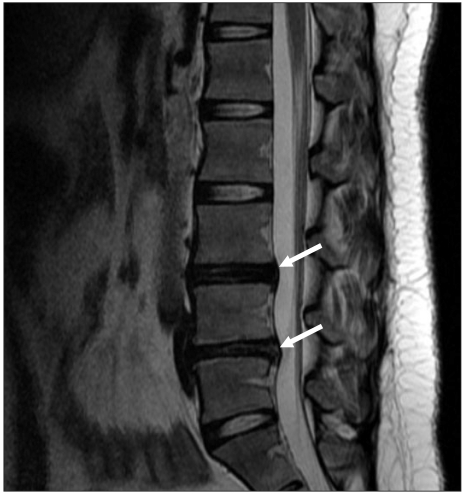
MRISagittal lumbar spine MRI, T2 sequence: degenerative signal loss of the L3-L4 and L4-L5 discs with slight height reduction, arrows on the affected levels.
Source : Kim et al., Annals of rehabilitation medicine, 2012, figure 2 · CC BY-NC
Key points
- Facet joint osteoarthritis on CT is commonplace and correlates poorly with pain: in a community cohort, those who had it had no more low back pain than anyone else 1.
- The solid evidence concerns non-specific chronic low back pain, not lumbar osteoarthritis; only one small trial (45 patients) has tested exercise in this indication 4.
- Exercise reduces pain to a clinically important degree (−15.2 / 100), but its effect on function (−6.8 / 100) remains below the threshold of clinical relevance 3.
- Load progressively, at around 520 MET-minutes a week: a U-shaped relationship, beyond which more is not better 5.
💪 The exercise programme, step by step
One point straight away: most of the evidence concerns non-specific chronic low back pain, not lumbar osteoarthritis. A randomised trial was indeed run in patients in pain from facet joint osteoarthritis: 45 people, two sessions a week for six weeks by telerehabilitation: pain (at rest and on activity) and Oswestry disability significantly improved 4. Encouraging, but small.
That approximation matters less than it seems: on CT, 59.6 % of men and 66.7 % of women in an unselected cohort had facet joint osteoarthritis, with no more low back pain than anyone else, at any level 1. You do not train against an image, but to regain capacity: see the guide to lumbar facet joint osteoarthritis.
The pain rule
Am I allowed to hurt? In chronic musculoskeletal pain, allowing pain during exercise does slightly better in the short term than pain-free exercise (standardised difference −0.27; moderate evidence), with no superiority thereafter 6. The marker: pain that is tolerable during the set, that comes back down within the hour and does not leave you stiffer on waking. If it climbs, spreads into the leg or lasts 24 h, reduce the load, range or repetitions, without stopping.
The quantified dose
| Parameter | Marker | Basis |
|---|---|---|
| Sessions | 15 to 30 min, 3 times a week | Zhao 2025 |
| Programme duration | 16 weeks minimum | Zhao 2025 |
| Volume | ≈ 520 MET-min/week for a clinically significant gain; max. around 920 | Liang 2024 |
Here again: non-specific chronic low back pain, not osteoarthritis. The MET-minute combines intensity and duration (walking included), and the relationship is non-linear, U-shaped : more is not better 5.
Phase 1: weeks 1 to 4: getting moving again
Moving again without chasing the perfect movement. Three sessions of 15 to 20 minutes: pelvic and trunk mobility, very low-load core work, progressive ranges. Slow tempo (≈ 3 s per phase), 2 sets of 8 to 10 repetitions. In honesty: the trials quantify duration, frequency and volume, not repetitions: this scheme is only a practical framework. Moving on: completing the three sessions without a flare at 24 h.
Phase 2: weeks 5 to 12: building capacity
You move up to 20 to 30 minutes, 3 times a week: strengthening and motor control. In 70 people with recurrent low back pain (12 sessions over 8 weeks), low-load motor control and heavy deadlift both improve; the advantage goes to motor control on function (4.2 vs 2.5 points), with no difference in pain 7. Heavy load is not dangerous, it is simply not superior. In practice: 3 sets of 8 to 12 repetitions, at a load that preserves movement quality. Moving on: carrying, getting up and gardening become possible again.
Phase 3, from week 12: making it last
The phase everyone skips, and the only one the data point to: the best results go to programmes of at least 16 weeks 8. You consolidate, vary and bring back the movements you had been avoiding. On the type of exercise, a meta-analysis of 217 trials places Pilates, the McKenzie method and functional restoration ahead of the other modalities (−15 to −19 points of pain against minimal treatment) 3. None is compulsory: the one you will keep up for 16 weeks beats the « best » one dropped after three.
Walking is not a fallback
WalkBack (an Australian trial, 701 adults) tested progressive, individualised walking combined with six physiotherapy sessions over six months: walking and education together, never walking alone: activity-limiting recurrences reduced by 28 % (HR 0.72), median time to relapse extended from 112 to 208 days 9.
Common mistakes
- Waiting until the pain has gone. Fear-avoidance predicts a poorer outcome in subacute low back pain (odds ratios 1.05 to 4.64), but little in the very acute or chronic phase 10.
- Banking on perfect posture. The trials cited tested no ideal everyday position, only regular, dosed movement.
- Too hard, too fast. A U-shaped curve: beyond a certain volume, there is nothing more to gain 5.
What support adds
In people with chronic low back pain, exercise reduces pain to a clinically important degree against no treatment, usual care or placebo: −15.2 points out of 100 (95 % CI −18.3 to −12.2), moderate evidence, 249 trials. On function, it is far thinner: −6.8 points, below the threshold of clinical relevance chosen by the authors themselves 3. Compared with the pool of other conservative treatments, the advantage on pain (−9.1; weak evidence) does not reach that threshold either; and between techniques, exercise and manual therapy do not differ (MD 1.0; 95 % CI −3.1 to 5.1).
These figures compare techniques, not professionals. The physiotherapist delivers exercise: many practise in no other way. Their value lies elsewhere: assessing, dosing, progressing, screening for what needs screening, defusing fear of movement, building independence, which is exactly what WalkBack tested.
Key points
- Evidence drawn from non-specific chronic low back pain; one small trial targets osteoarthritis 4.
- Osteoarthritis seen on imaging is commonplace and correlates poorly with pain 1.
- Dose: 15–30 min, 3 times/week, ≥ 16 weeks; ≈ 520 MET-min/week 85.
- Tolerable pain is not an obstacle 6.
- Progressive walking + support: 28 % fewer recurrences 9.
⚠️ The mistakes that keep the problem going
A programme rarely fails for lack of willpower, but through an error of steering. A point of honesty first: most of the evidence cited here concerns non-specific chronic low back pain, not lumbar osteoarthritis. Only one randomised trial has looked specifically at patients in pain from facet joint osteoarthritis (45 patients, single-blind; exercise by telerehabilitation, 2 sessions/week for 6 weeks): pain at rest (p = 0.021), on activity (p = 0.0001) and Oswestry disability (p = 0.0001) all improved 4. Encouraging, small, not conclusive: we are extrapolating, and we are telling you so.
Mistake 1: steering your life by your imaging report
This is the most costly mistake: it drives all the others. In the Framingham Heart Study community cohort (188 subjects), CT found facet joint osteoarthritis in 59.6 % of men and 66.7 % of women; above all, people with facet joint osteoarthritis, at any level, had no more low back pain than anyone else 1. The frequency climbs with age: 24.0 % before 40, 74.2 % between 50 and 59, 89.2 % between 60 and 69, with L4-L5 the level most involved (45.1 %).
The image does not measure your pain and does not dictate what your back can do. What we really know about this osteoarthritis is set out in our guide to lumbar facet joint osteoarthritis.
Mistake 2: waiting for the pain to go before moving
A logical reflex, and a trap. In chronic musculoskeletal pain, protocols that allow pain during exercise even do slightly better than pain-free exercise in the short term (SMD -0.27; 95 % CI: -0.54 to -0.05; moderate evidence, 385 participants), with no superiority thereafter 6. Tolerable pain is not an obstacle, with no obligation to go looking for it.
Tolerable pain during exercise is not a signal to stop, it is information to dose by.
Fear of movement does count, but at one precise moment: fear-avoidance beliefs predict a poor outcome in subacute low back pain (4 weeks to 3 months; odds ratios of 1.05 to 4.64), with poor predictive value in the very acute phase as in the chronic stage 10. Fear does not explain everything.
Mistake 3: doing too much, too fast, or too little, too rarely
A dose-response network meta-analysis (82 trials, 5,033 participants, non-specific chronic low back pain) puts at about 520 MET-minutes a week the threshold for clinically significant improvement in pain, with the maximum response at 920 MET-minutes, in a non-linear U-shaped relationship: more is not always better 5. The best results go to sessions of 15 to 30 minutes, three times a week, over at least 16 weeks 8 : short and regular over time beats long and intense abandoned after three weeks.
Mistake 4: thinking that walking « does not count »
In the Australian randomised trial WalkBack (701 adults), progressive, individualised walking combined with education, six physiotherapy sessions over six months, reduced by 28 % the risk of a recurrence of activity-limiting low back pain (HR 0.72; 95 % CI: 0.60-0.85; p = 0.0002), with the median time to recurrence going from 112 to 208 days 9. The two were tested together, not walking alone.
Mistake 5: looking for THE right exercise, or believing you need heavy loads
A randomised trial (70 people with recurrent low back pain, 12 sessions over 8 weeks) set individualised low-load motor control against a heavy deadlift: both improve, with a slight advantage to motor control on the patient-specific functional scale (4.2 vs 2.5 points), and no difference in pain 7. Heavy load is not dangerous; it is not superior. Some approaches do stand out (Pilates, McKenzie, functional restoration 3), without any one of them being THE recipe.
Received idea: « exercise is a last resort »
The Cochrane review of 249 trials says the opposite for pain: -15.2 points out of 100 (95 % CI: -18.3 to -12.2; moderate evidence) against no treatment, usual care or placebo 3. In honesty, the effect on functional limitation is -6.8 points out of 100, below the threshold of clinical relevance chosen by the authors. Against the pool of other conservative treatments, the advantage falls to -9.1 points (weak evidence), without reaching that threshold either. And in the subgroup, exercise vs manual therapy: MD 1.0 (95 % CI: -3.1 to 5.1), no difference. That line compares techniques, not professionals: it is the physiotherapist who delivers the exercise, and for many it is the bulk of their practice. Their value lies elsewhere: assessing, individualising, dosing, progressing, screening, lifting fear of movement, building independence.
The signals that should make you ease off
- Pain clearly above your usual level the next day : not a failure, a dosing signal. Reduce the volume, keep the frequency.
- Pain that stops being tolerable during the session: there is margin, but it is not unlimited.
- Anything new and unusual (loss of strength, altered sensation, urinary or bowel problems, fever, unexplained weight loss, night pain, trauma), warrants medical advice before continuing.
Key points
- Facet joint osteoarthritis on CT: commonplace, with no association with low back pain at any level 1. Do not steer by an image.
- Tolerable pain during exercise is not an obstacle 6.
- ≈ 520 MET-minutes/week, 15 to 30 minutes, 3 times a week, over 16 weeks: a U-shaped dose-response 58.
- Progressive walking and education: 28 % fewer recurrences 9.
- Solid evidence on pain, fragile on function (-6.8/100, below the clinical threshold), and drawn from non-specific chronic low back pain.
🩺 How long it takes, and where the physiotherapist fits in
It is the question everyone asks first: how long before it gets better? The honest answer comes in two parts. The first improvements often arrive within a few weeks. The benefit that lasts, on the other hand, is built over several months. And above all: almost all the figures that follow come from studies of non-specific chronic low back pain, not lumbar osteoarthritis in particular. We are giving them to you anyway, because they are the best we have, but you should know what you are relying on.
Realistic timescales, with figures
The only randomised trial run specifically in patients in pain from facet joint osteoarthritis is encouraging: 45 patients, two sessions a week for six weeks, with significant improvement in pain at rest (p = 0.021), pain on activity (p = 0.0001) and disability measured on the Oswestry (p = 0.0001) 4. Six weeks, then, to see something shift. But it is a small trial, in 45 people: take it as a signal, not as solid proof.
For a lasting benefit, you have to look further out. A network meta-analysis of the prescription variables finds the best results in programmes of at least 16 weeks (SMD = -2.75), with three sessions a week (SMD = -1.44) of 15 to 30 minutes (SMD = -1.62) 8. In other words: short and regular over time beats long and occasional. Another trial, in 70 people with recurrent low back pain, improved both groups in 12 sessions spread over 8 weeks 7.
Two caveats, which we would rather state plainly. First, the Cochrane review of 249 trials shows that exercise reduces pain by -15.2 points out of 100 against no treatment, usual care or placebo (moderate evidence), but its effect on functional limitation is only -6.8 points out of 100, a gap that the authors themselves place below their threshold of clinical relevance 3. Second, recall what the full guide to lumbar facet joint osteoarthritis sets out: on CT, this osteoarthritis is found in 59.6 % of men and 66.7 % of women in a community population, and people with facet joint osteoarthritis, at any level, had no more low back pain than anyone else 1. Your imaging report therefore does not fix your prognosis.
What professional support adds
A programme is not a sheet of paper. It gets tuned. The dose can be quantified: about 520 MET-minutes a week are needed to achieve a clinically significant improvement in pain, with the maximum response around 920, in a U-shaped relationship, more is not always better 5. Finding that balance point for you, without overshooting or falling short, is exactly the job.
The physiotherapist brings what no article can: assessing your situation, choosing the dose, progressing it, screening for warning signals, lifting fear of movement and making you independent. That last point is not decorative: fear-avoidance beliefs are a prognostic factor for poor outcome in subacute low back pain (4 weeks to 3 months), with odds ratios of 1.05 to 4.64, even though their predictive value becomes poor in very acute and in chronic low back pain 10. Having someone confirm to you that tolerable pain during exercise is not a signal to stop 6 often changes everything.
The Australian WalkBack trial illustrates this well: 701 adults on a progressive, individualised walking programme combined with education and supported by six physiotherapy sessions over six months saw their risk of a recurrence of activity-limiting low back pain fall by 28 % (HR 0.72; 95 % CI 0.60-0.85). The median time to recurrence went from 112 to 208 days 9. Six sessions over six months: this is not lifelong care, it is a framework.
The physiotherapist is not a technique: they are the person who assesses, doses, progresses and makes you independent.
One point that matters. When the Cochrane review compares exercise with other conservative treatments, it compares techniques, never professionals. And in the subgroup, exercise against manual therapy gives a mean difference of 1.0 point (95 % CI: -3.1 to 5.1): no difference at all 3. None of these comparisons says what a physiotherapist will do: many deliver exercise and education exclusively, and that is a full practice in itself.
The signals that call for medical advice without delay
What follows does not belong to the effectiveness data cited above: these are reasons to consult, not verdicts. Seek advice promptly in the event of:
- difficulty passing urine or opening the bowels, loss of sensation in the perineum or groin;
- worsening loss of strength in a leg;
- fever, chills, or unexplained weight loss;
- a history of cancer, or night pain that no position relieves;
- pain that came on after a fall or a violent impact.
Screening for these signals is part of a first-contact professional's job. It is also a good reason to have a back that has hurt for a long time assessed rather than setting off alone.
Key points
- 6 weeks for the first signs, 16 weeks and more for a benefit that holds 48.
- Three short sessions a week are worth more than one long occasional session.
- The effect of exercise on pain is clinically important; its effect on function remains below the threshold of relevance chosen by the authors 3.
- Most of this evidence concerns non-specific chronic low back pain, not lumbar osteoarthritis.
- The value of a physiotherapist: assessing, dosing, progressing, screening, reassuring, building independence.
- Bowel or bladder problems, progressive motor deficit, fever, a history of cancer, trauma: seek advice without delay.
Bibliography
Every reference checked individually on PubMed (clickable PMID). 10 sources. Click a superscript note marker in the text: the bibliography opens and highlights the source.
- Kalichman L, Li L, Kim DH, Guermazi A, Berkin V, O'Donnell CJ, Hoffmann U, Cole R, Hunter DJ (2008). Spine (Phila Pa 1976). PMID 18923337. doi:10.1097/BRS.0b013e318184ef95.
- Hayden JA, Ellis J, Ogilvie R, Malmivaara A, van Tulder MW (2021). Cochrane Database of Systematic Reviews. PMID 34580864. doi:10.1002/14651858.CD009790.pub2.
- Hayden JA, Ellis J, Ogilvie R, Stewart SA, Bagg MK, Stanojevic S, Yamato TP, Saragiotto BT (2021). Journal of Physiotherapy. PMID 34538747. doi:10.1016/j.jphys.2021.09.004.
- Okudan B, Çelik D, Koban O (2024). European Journal of Pain. PMID 37747343. doi:10.1002/ejp.2187.
- Liang Z, Tian S, Wang C, Zhang M, Guo H, Yu Y, Wang X (2024). Journal of Orthopaedic & Sports Physical Therapy. PMID 38457134. doi:10.2519/jospt.2024.12153.
- Smith BE, Hendrick P, Smith TO, Bateman M, Moffatt F, Rathleff MS, Selfe J, Logan P (2017). British Journal of Sports Medicine. PMID 28596288. doi:10.1136/bjsports-2016-097383.
- Aasa B, Berglund L, Michaelson P, Aasa U (2015). Journal of Orthopaedic and Sports Physical Therapy. PMID 25641309. doi:10.2519/jospt.2015.5021.
- Zhao K, Zhang P, Li H, Li L (2025). Frontiers in Public Health. PMID 40520315. doi:10.3389/fpubh.2025.1512450.
- Pocovi NC, Lin CW, French SD, Graham PL, van Dongen JM, Latimer J, Merom D, Tiedemann A, Maher CG, Clavisi O, Tong SYK, Hancock MJ (2024). The Lancet. PMID 38908392. doi:10.1016/S0140-6736(24)00755-4.
- Wertli MM, Rasmussen-Barr E, Weiser S, Bachmann LM, Brunner F (2014). The Spine Journal. PMID 24412032. doi:10.1016/j.spinee.2013.09.036.
❓ Frequently asked questions
Which exercises should you do if you have lumbar osteoarthritis?
Structured active exercises, not specifically « anti-osteoarthritis » ones. In the largest network meta-analysis on chronic low back pain (217 randomised trials, 20,969 participants), three approaches stand out from the other types of exercise: Pilates, the McKenzie method and functional restoration, with effects of −15 to −19 points for pain and −10 to −12 for function against minimal treatment 3. Exercise has also been tested in patients in pain from facet joint osteoarthritis specifically: a single-blind randomised trial in 45 patients, with a telerehabilitation programme of two sessions a week for six weeks, significantly improves pain at rest (F = 4.276; p = 0.021), pain on activity (F = 12.327; p = 0.0001) and disability measured on the Oswestry (F = 23.122; p = 0.0001) 4. On load, there is no obligation to go heavy: a randomised trial in 70 patients with recurrent low back pain (12 sessions over 8 weeks) comparing individualised low-load motor control exercises with a heavy-load deadlift finds improvement in both groups, with an advantage to motor control on the patient-specific functional scale (4.2 vs 2.5 points) and no difference in pain intensity 7.
How long and how often should you do your exercises for lumbar osteoarthritis?
The dose can be quantified. A Bayesian dose-response network meta-analysis (82 trials, 5,033 participants) puts at about 520 MET-minutes a week the volume of exercise needed to achieve a clinically significant improvement in pain, with the maximum response observed around 920 MET-minutes; beyond that the curve comes back down, the dose-response relationship being non-linear and U-shaped, more is not always better 5. On format, a network meta-analysis of the prescription variables in chronic low back pain finds the best results for sessions of 15 to 30 minutes (SMD = −1.62; SUCRA = 94.6), three sessions a week (SMD = −1.44; SUCRA = 87), over a programme of at least 16 weeks (SMD = −2.75; SUCRA = 95.4): short and regular over time is better than long and occasional 8. One caveat is needed: both these pieces of work concern non-specific chronic low back pain and not lumbar osteoarthritis in particular. They are orders of magnitude for framing a programme, not a dosage validated in facet joint osteoarthritis.
Do exercises really relieve lumbar osteoarthritis, and by how much?
On pain, yes, and to a clinically important degree: in the landmark Cochrane review (249 randomised trials), exercise reduces pain by 15.2 points out of 100 (95 % CI: −18.3 to −12.2) compared with no treatment, usual care or placebo, with a moderate level of evidence 3. On functional limitation, we need to be precise: the effect is −6.8 points out of 100 (95 % CI: −8.3 to −5.3), and that gain does not reach the threshold of clinical relevance chosen by the review's authors. Compared with the pool of other conservative treatments taken together, exercise keeps an advantage on pain (−9.1 points; 95 % CI: −12.6 to −5.6; weak evidence) and on function (−4.1; 95 % CI: −6.0 to −2.2), but none of these gaps reaches the threshold of clinical relevance either. An important point so as not to over-read this: in the subgroup comparing exercise with manual therapy, there is no difference at all (MD 1.0; 95 % CI: −3.1 to 5.1). The −9.1 gap is driven by other comparators: education alone (MD −12.2) or non-exercise physical therapy (MD −10.4), and not by manual therapy 3.
Is walking good for lumbar osteoarthritis?
Walking is not a fallback, but what was tested is a programme, not an improvised stroll. The Australian randomised trial WalkBack (701 adults) evaluated a progressive, individualised walking programme combined with education, supported by six physiotherapy sessions over six months: the risk of a recurrence of activity-limiting low back pain was reduced by 28 % (hazard ratio 0.72; 95 % CI: 0.60-0.85; p = 0.0002), and the median time to recurrence went from 112 days in the control group to 208 days in the intervention group 9. The pairing of walking + education is what matters: that is the intervention studied, and nothing in this trial allows the result to be attributed to walking alone.
Should you stop the exercises if lumbar osteoarthritis hurts during the session?
Tolerable pain during exercise is not an obstacle. In chronic musculoskeletal pain, protocols allowing pain during exercise do slightly better than pain-free exercise in the short term (SMD −0.27; 95 % CI: −0.54 to −0.05; moderate evidence, 385 participants), with no superiority in the medium and long term 6. Two things help to keep that pain from becoming a lasting brake. First, the image does not dictate what to do: in the Framingham Heart Study community cohort (188 subjects scanned), facet joint osteoarthritis was visible in 59.6 % of men and 66.7 % of women: 24.0 % before 40, 74.2 % between 50 and 59, 89.2 % between 60 and 69, with L4-L5 the most affected level (45.1 %), without people who had facet joint osteoarthritis, at any level, having more low back pain than anyone else 1. Second, fear of movement deserves to be spotted: a systematic review of 21 studies shows that fear-avoidance beliefs are a prognostic factor for poor outcome in subacute low back pain (4 weeks to 3 months), with odds ratios of 1.05 to 4.64 across four cohorts of 258 to 1,068 patients, their predictive value remaining poor in very acute low back pain (less than 2 weeks) as in chronic low back pain (more than 3 months) 10.
Behind this article
An author who explains, a reviewer who checks.
How we write and check our content

Physiotherapist · co-founder of Physio Learning
Marked for life by his first four-hour lecture without a single image, he took a master’s in instructional design so that it would never happen to anyone again. He hunts down publication bias and unreadable slides with the same intransigence.

Head of scientific content
Physiotherapist specialising in neuro-musculoskeletal practice and holder of a master’s in public health. He checks the methodological rigour of every article: primary sources, levels of evidence, no exceptions.