






A lump has appeared on your wrist and the first question that comes to mind is: is it serious? The short answer is no: a ganglion cyst is a benign lesion, not a cancer. The real question then becomes: should it be operated on, aspirated, or simply left alone? Here is what the studies that followed patients for six years have to say.
📝 In brief
- No, a ganglion cyst of the wrist is not a cancer : the ganglion is the most common soft-tissue mass of the hand and wrist, a benign lesion whose non-surgical management leads to the cyst disappearing in more than 50 % of patients, with observation among the recognised treatment options alongside aspiration and surgery 1.
- Doing nothing cures more than one ganglion in two. In the landmark prospective cohort on dorsal wrist ganglia (236 patients, mean follow-up of 70 months), 23 of the 55 ganglia left entirely untreated, 58 %, had disappeared spontaneously 4 ; on the palmar side, 20 of the 39 untreated ganglia had likewise disappeared on their own 5.
- Surgery is not compulsory. Symptom resolution was comparable between excision, aspiration and doing nothing (p > 0.3), and the authors conclude that neither excision nor aspiration brought a significant long-term benefit over doing nothing: satisfaction nonetheless remaining higher after surgery (p < 0,0001), même en cas de récidive 4.
- Recurrence depends on the procedure, but none abolishes it : 6 % after arthroscopic excision, 21 % after open excision and 59 % after needle aspiration, across 35 studies and 2,239 ganglia 6. The most recent systematic review gives wide ranges (7 to 72 % after aspiration, 6 to 41 % after open excision, 0 to 16 % with arthroscopy), on low-quality evidence 7.
- Surgery on a benign lesion has a price. Among those operated on for a palmar ganglion: 20 % complications and 14 days off work; and one wrist in four remained weak whatever the treatment, including where the ganglion had gone 5.
- The real risk is not the ganglion, it is a rushed diagnosis. Sarcomas of the wrist have been incompletely resected after being taken for ganglia; the warning signs are a mass on the ulnar side, present for less than 6 months and not fluctuating in size 3, rapid growth over a few weeks to a few months, a firm, fixed mass, one that is deep or larger than 5 cm: the absence of pain being no reassurance 2.

🔬 What the studies really say
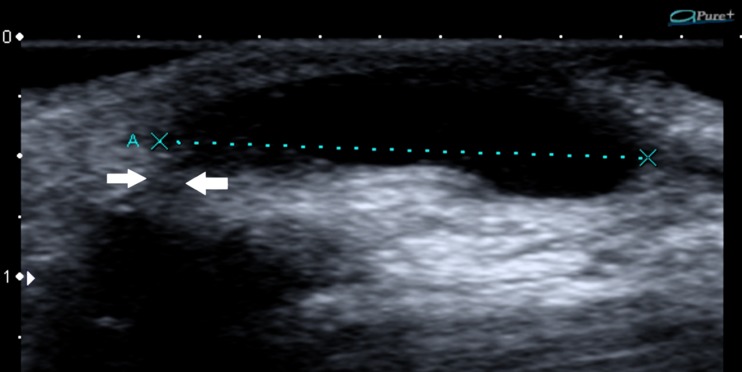
UltrasoundLongitudinal wrist ultrasound: well-defined anechoic structure on the palmar aspect of the carpus, arrows on the stalk connecting the cyst to the radiocarpal joint.
Source : Vanhoenacker et al., Insights into Imaging, 2011, figure 4 · CC BY
Two questions dominate: is it cancer? and should it be operated on? Here are the figures, not empty formulas.
No, it is not a cancer
The ganglion cyst is the most common soft-tissue swelling of the hand and wrist : a benign lesion, filled with a gelatinous fluid. The most telling proof is how it behaves: non-surgical management leads to it disappearing in more than 50 % of patients, and simple observation is a recognised option, alongside aspiration and surgery 1. A cancer does not disappear because it has been left alone. That is also why MRI is not warranted for a typical ganglion: it is reserved for cases where an occult or intraosseous ganglion, or a solid tumour, including a sarcoma, remains a concern.
A ganglion cyst is not a malignant tumour, and doing nothing is a treatment in its own right.
The rare signs that should prompt a consultation
For any soft-tissue mass, slow growth points to a benign lesion, whereas rapid growth over a few weeks to a few months is worrying ; a firm, fixed mass raises the suspicion of a sarcoma; a mass that is deep or larger than 5 cm is more suspicious; a sensory or motor deficit may reflect nerve compression. Counter-intuitively: the absence of pain is no reassurance, as most malignant lesions are asymptomatic at the outset 2. This is not theoretical: a series of 4 patients reports sarcomas of the wrist incompletely resected after being taken for ganglia: the shared atypical features being the ulnar side (3/4), symptoms of less than 6 months (3/4) and above all no fluctuation in size (3/4), a mass that never varies where a typical ganglion swells and subsides 3.
Natural history: more than one ganglion in two disappears on its own
On the palmar side: 20 of 39 untreated ganglia (51 %) had gone, and 85 % of patients were satisfied whatever the treatment: including simple reassurance 5.
Aspiration, surgery or doing nothing: the comparison in figures
| Option | Recurrence | Complications | Evidence |
|---|---|---|---|
| Doing nothing | 58 % spontaneous disappearance (dorsal), 51 % (palmar) | None | Cohorts 4 |
| Aspiration | 59 % on average (7 to 72 %) | 3 % | Meta-analysis 6 |
| Open excision | 21 % on average (6 to 41 %) | 14 % (20 % palmar) | Meta-analysis 6 |
| Arthroscopic excision | 6 % on average (0 to 16 %) | 4 % | Weak evidence 7 |
These averages come from a meta-analysis of 35 studies, 2,239 ganglia 6. Aspiration lets nearly three ganglia in five come back: it empties the sac without treating its joint stalk. In randomised trials, surgery reduced the risk of recurrence by 76 % compared with aspiration; in the cohorts, aspiration did no better than simple reassurance. Let us state the uncertainty plainly: the most recent review (549 patients) judges the quality of the evidence to be low: these are ranges, not guarantees 7.
The « book bash »: to be avoided
Crushing the ganglion with a heavy book is the most widely shared piece of advice, and the least supported. The only publication analyses 214 YouTube videos (more than a million views) and a questionnaire answered by 38 people. Its authors acknowledge that there is no data at all on the rate of recurrence or complications in patients who self-treat a ganglion with external force (Trivedi 2016). Videos posted by those who succeeded, self-selected volunteers: this material cannot rule out complications. The technique is not « validated », it is unevaluated, and it applies blunt trauma to a wrist through which tendons, nerves and vessels run.
When surgery is genuinely justified
It reduces recurrence without abolishing it: at 70 months, 58 % (45/78) after aspiration against 39 % (40/103) after excision. But symptom resolution was comparable between the three groups: surgery, aspiration, doing nothing (p > 0.3): neither excision nor aspiration brought a significant long-term benefit 4. On the palmar side, the same symptoms at 2 and 5 years whatever the treatment 5.
One result stands out: satisfaction remains higher after surgery (p < 0.0001), even where the ganglion recurs 4. What the patient expects therefore counts as much as the anatomical result, hence a shared decision: disabling pain, real functional difficulty, or failure of conservative care. The price enters the balance: 8 of 103 patients operated on had a complication on the dorsal side 4, and on the palmar side those operated on accumulated 20 % complications and 14 days off work. One last finding: one wrist in four remained weak, whatever the treatment, even with the ganglion gone 5.
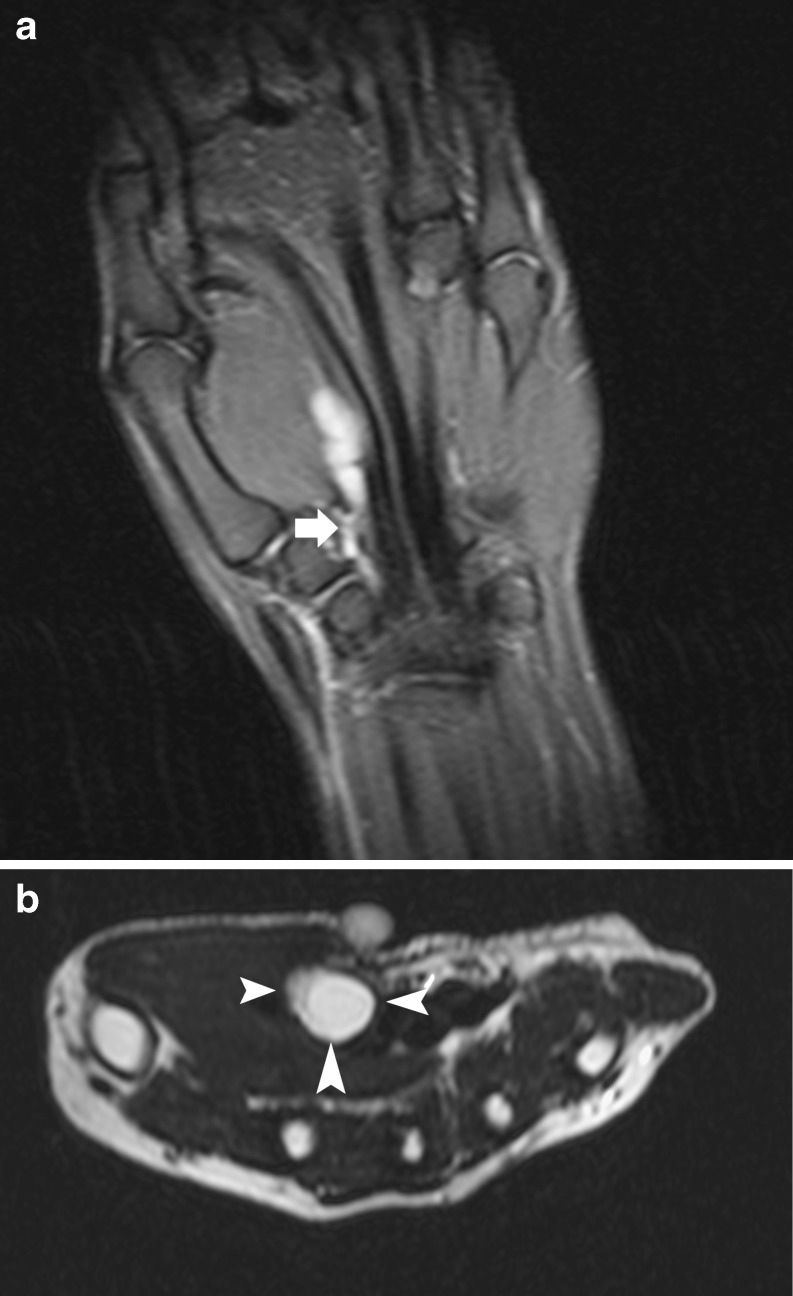
MRICoronal and axial wrist MRI, fat-saturated T2-weighted sequences: polylobulated volar ganglion cyst with high signal intensity, arrows on the stalk connecting the cyst to the scaphotrapezial joint.
Source : Vanhoenacker et al., Insights into Imaging, 2011, figure 3 · CC BY
Key points
- A benign lesion, the most common of the hand and wrist: not a cancer 1.
- Doing nothing cures more than one ganglion in two: 58 % spontaneous disappearance on the dorsal side, 51 % on the palmar side 4.
- Mean recurrence: 59 % after aspiration, 21 % after open surgery, 6 % with arthroscopy: weak evidence 6.
- Seek advice for rapid growth, a firm, fixed, deep mass or one larger than 5 cm, a mass that never varies, or a neurological deficit. The absence of pain is no reassurance 2.
- The « book bash » is unevaluated: no data on recurrence or complications. To be avoided (Trivedi 2016).
- Surgery is up for discussion if pain is disabling or after conservative care has failed, but one wrist in four stays weak whatever happens 5.
Mechanisms and rehabilitation: see the article Ganglion cysts of the wrist and hand.
⚖️ When a procedure is up for discussion (and when it is not)
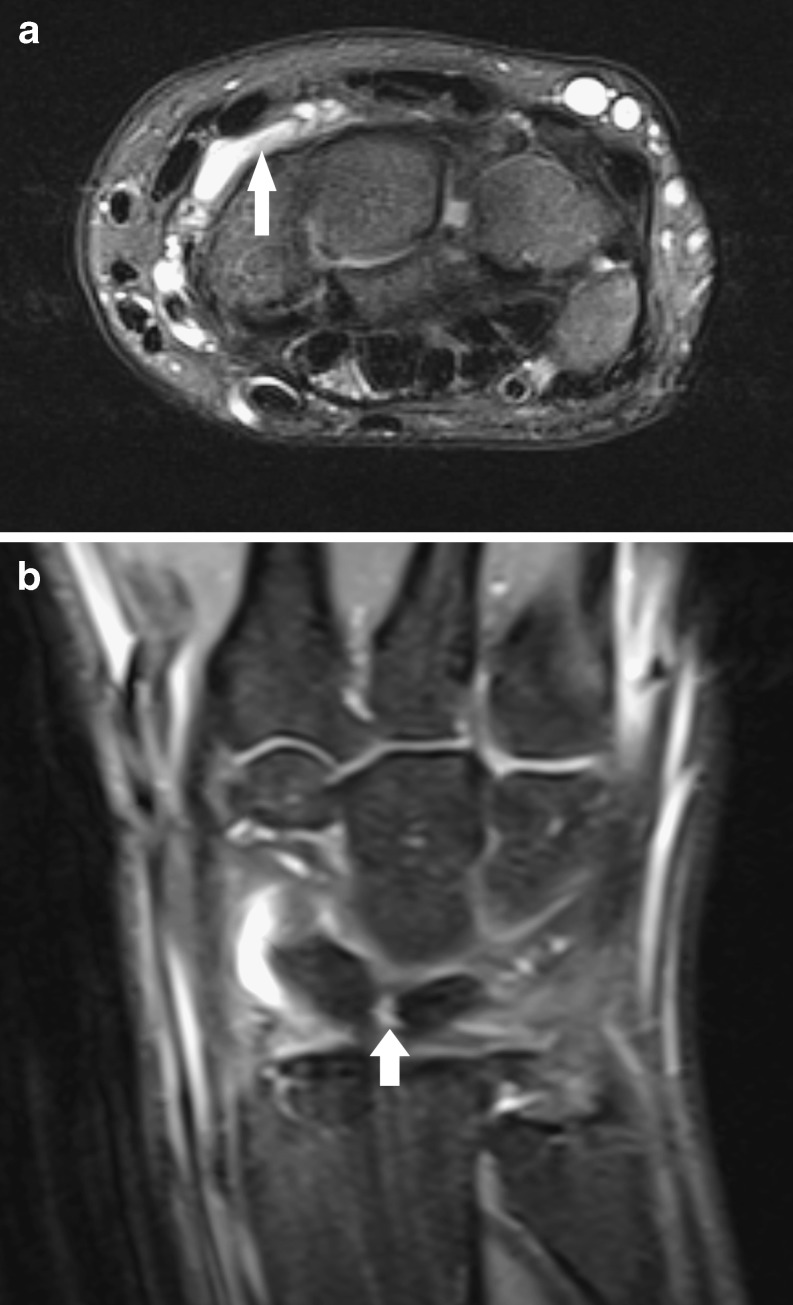
MRIAxial and coronal wrist MRI, fat-saturated T2-weighted sequences: small dorsal ganglion cyst with high signal intensity, arrow on an associated tear of the scapholunate ligament.
Source : Vanhoenacker et al., Insights into Imaging, 2011, figure 2 · CC BY
With the doubt removed, the question changes: no longer « is it serious? », but « what do I gain by touching it, and at what price? ». Observation is among the recognised treatments for a ganglion cyst, alongside aspiration and surgery 1 : doing nothing is not giving up. For the rest, see the full article: ganglion cysts of the wrist.
What becomes of a ganglion left alone
This is the figure that precedes any discussion. In a prospective cohort of 236 patients followed for nearly six years, 23 of the 55 untreated dorsal ganglia (58 %) disappeared spontaneously 4 ; on the palm side, 20 of 39 5. Above all, long-term symptoms were comparable between those operated on, those aspirated and those simply reassured (p > 0.3): neither excision nor aspiration brought a significant benefit over doing nothing 4.
The criteria that genuinely put a procedure up for discussion
- Difficulty that weighs on your life (persistent pain, impossible to bear weight, restricted movement) and not the mere presence of the lump.
- Diagnostic doubt : an atypical mass is not watched, it is investigated (see below).
- Nerve signs : a loss of sensation or strength in a nerve’s territory may reflect compression 2.
- What you expect. Satisfaction was higher after surgery (p < 0.0001) even where the ganglion had recurred 4 : what you expect counts as much as the anatomical result.
Comparing the options honestly
| Option | Recurrence | Complications | Strength of the evidence |
|---|---|---|---|
| Simple monitoring | Spontaneous disappearance: 58 % (back), 51 % (palm) 4 | None | Moderate: long cohorts |
| Aspiration | 59 % on average 6 ; from 7 to 72 % across studies 7 | 3 % 6 | Weak: widely scattered figures |
| Open surgery | 21 % on average 6 ; from 6 to 41 % 7 | 14 % 6 ; 20 % and 14 days off work on the palm side 5 | Moderate on recurrence, weak on benefit |
| Arthroscopic resection | 6 % on average 6 ; from 0 to 16 % 7 | 4 % 6 | Weak: few studies, short series |
How to read this table. Surgery does better than aspiration on recurrence: in randomised trials, it reduces that risk by 76 % 6. But it does not abolish it, 39 % recurrence at six years 4, and pays for that reduction with more frequent complications 6. And the most recent review insists: weak evidence, considerable variability. These figures are ranges, not promises 7. Corticosteroid injection combined with aspiration is among the options 1, but no data gives it a figure of its own: we do not know what it adds.
When a procedure adds nothing
- A painless ganglion that bothers you only by its appearance : it will go on its own one time in two, and operating does not improve symptoms at five years 5.
- Hoping to regain strength : one wrist in four remained weak whatever the treatment, even where the ganglion had gone 5.
- An MRI for a typical ganglion : advanced imaging is reserved for cases where an occult ganglion, an intraosseous ganglion or a solid tumour remains a concern 1.
- The « book bash » : crushing the ganglion with a heavy book has no evidence base. The only existing publication analyses online videos, and its authors acknowledge that there is no data on recurrence or complications (Trivedi 2016). It is not « validated », it is unevaluated, on a wrist through which tendons, nerves and vessels run.
When it is not up for discussion: the atypical mass
The usual benign nature never dispenses with examination. Sarcomas of the wrist have been removed incompletely because they had been taken for ganglia: in a series of four patients wrongly operated on, three had had neither MRI nor aspiration, and none had had transillumination. Shared atypical features: a mass on the little-finger side, present for less than six months, and above all a size that does not vary, whereas a true ganglion swells and subsides 3. To which are added the warning signs for any mass: rapid growth over a few weeks to a few months, a firm and fixed mass, a mass that is deep or larger than 5 cm. And the absence of pain is no reassurance: most malignant lesions are painless at the outset 2.
Your decision tree
- Is the mass atypical (hard, fixed, stable in size, fast-growing, > 5 cm, deep, nerve signs)? → Seek advice without delay. Transillumination and aspiration are two simple, inexpensive tests; if either is abnormal, an MRI is needed 3.
- If not, does it genuinely bother you day to day? → If not: monitoring. One time in two, the problem sorts itself out.
- If it does bother you : discuss the options with a hand surgeon, weighing recurrence against complications, and knowing that none guarantees a stronger wrist.
Key points
- Doing nothing is a real treatment: more than one ganglion in two disappears on its own.
- No procedure has demonstrated a long-term benefit on symptoms over doing nothing 4.
- Surgery recurs less than aspiration, but complicates more, and recurs all the same.
- The published rates are wide ranges, drawn from weak evidence 7.
- A hard, fixed mass, stable in size or fast-growing, is not a ganglion: seek advice.
🩺 The procedures in practice: benefits, risks, recovery
With the fear of cancer set aside, the real question remains: should anything be done? Four options exist (do nothing, aspirate, operate openly, operate arthroscopically), plus a fifth to be ruled out.
Doing nothing: a treatment option, not giving up
Observation is a recognised option, alongside aspiration and surgery: non-surgical management leads to the ganglion disappearing in more than half of patients 1. In the landmark prospective cohort, 23 of the 55 dorsal ganglia left untreated had gone on their own at a mean follow-up of 70 months 4. On the palmar side: 20 of 39 5.
More unsettling for anyone hoping for a procedure: symptom resolution there was comparable between the three groups (p > 0.3) and the authors conclude that neither excision nor aspiration brought a significant long-term benefit over doing nothing 4. On the palmar side, 85 % of patients were satisfied whatever the treatment 5.
Needle aspiration
A needle empties the gelatinous contents of the ganglion, sometimes followed by a corticosteroid injection 1. It is the simplest procedure, and the most disappointing: mean recurrence 59 % 6, 58 % at six years 4, 47 % on the palmar side 5. The reason is mechanical: the sac is emptied without treating its joint stalk. In the cohort studies, aspiration did not significantly reduce recurrence compared with simple reassurance 6.
Its strength lies elsewhere: it is the least risky procedure 6 and it has diagnostic value. Faced with an atypical mass (on the little-finger side, present for less than six months, whose size does not vary), transillumination and aspiration are two simple tests: if either is abnormal, an MRI is needed 3.
Open surgical excision
The surgeon removes the ganglion and its stalk through an incision. Mean recurrence falls to 21 % 6 ; elsewhere 39 % at six years 4, 42 % on the palmar side 5, a range of 7 to 39 % 1. In randomised trials, surgery reduced the risk of recurrence by 76 % compared with aspiration 6. It lowers recurrence: it does not abolish it.
The price is reversed: 14 % complications on average 6, up to 20 % on the palmar side 5. Notably, satisfaction remains higher after surgery (p < 0.0001) even where the ganglion has recurred 4 : what the patient expects weighs as much as the anatomical result.
Arthroscopic resection
The same objective, through small incisions and a camera. These are the best raw figures: 6 % recurrence (11 studies, 512 ganglia) and 4 % complications 6, a range of 0 to 16 % in the most recent review, which itself describes this evidence as weak 7. An encouraging trend, not a guarantee.
The « book bash »: to be avoided
Crushing the ganglion with a heavy book has no evidence base. The only existing publication analyses 214 YouTube videos and 38 questionnaire responses, and its authors write that there is no data on the rate of recurrence or complications in those who self-treat in this way (Trivedi 2016). Videos posted by those who succeeded: this material can neither demonstrate effectiveness nor rule out complications. The technique is not « validated », it is unevaluated, and it applies a blunt impact where tendons, nerves and vessels run.
| Option | Recurrence | Complications | Level of evidence |
|---|---|---|---|
| Doing nothing | 58 % spontaneous disappearance | none | Prospective cohort |
| Needle aspiration | 59 % (7 to 72 %) | 3 % | Meta-analysis |
| Open excision | 21 % (6 to 41 %) | 14 % (20 % palmar) | Meta-analysis |
| Arthroscopic resection | 6 % (0 to 16 %) | 4 % | Weak evidence |
| « Book bash » | unknown | unknown | No data |
The choice is not between curing and not curing, but between waiting and accepting a procedure.
Recovery: what we know, and what we do not
The figures are thin. What is documented: those operated on for a palmar ganglion took 14 days off work, and one wrist in four remained weak whatever the treatment, even where the ganglion had gone 5. Reassuringly, on the other hand: four studies on wound complications reported no infection 7.
What we do not know: no standardised recovery timetable exists in this literature, and the recurrence figures vary so much from one study to another that they read as ranges, not as firm values 7.
Key points
- Doing nothing cures more than one ganglion in two, with long-term symptoms comparable to those of patients operated on 4.
- Aspiration recurs the most (59 %) but remains the least risky procedure 6.
- Surgery reduces recurrence without abolishing it (21 % open, 6 % arthroscopic), at the cost of 14 to 20 % complications and around two weeks off work 65.
- One wrist in four stays weak whatever is done 5.
- The « book bash » is not an option : no data on its recurrence or its complications (Trivedi 2016).
Where this ganglion comes from, how it forms: the full article on ganglion cysts of the wrist.
🌱 The conservative option first
Before talking about a scalpel, one simple thing has to be set out: in most people, a ganglion cyst of the wrist eventually sorts itself out without anyone touching it. That is not a consolation, it is what the cohorts show. Non-surgical management leads to the ganglion disappearing in more than half of patients, and observation is among the recognised treatment options, alongside aspiration and surgery 1.
« Doing nothing » is a real treatment
Two prospective cohorts followed, for years, patients who had simply had their ganglion explained to them, with no aspiration or surgery. The result is the same on both sides of the wrist.
| Untreated ganglia | Spontaneous disappearance | Length of follow-up | Level of evidence |
|---|---|---|---|
| Dorsal side 4 | 58 % (23 of 55) | 70 months on average (~6 years) | Prospective cohort |
| Palmar side 5 | 51 % (20 of 39) | 2 and 5 years | Prospective cohort |
Above all: in the dorsal cohort, symptom resolution was comparable between the three groups: operated on, aspirated, untreated (p > 0.3):, and the authors conclude that neither excision nor aspiration brought a significant long-term benefit over doing nothing 4. On the palmar side, 85 % of patients said they were satisfied whatever treatment they received, including those who had had only a reassuring explanation 5.
What rehabilitation can aim at, and what it cannot promise
Let us be honest about the state of the evidence: none of the studies cited here tested an exercise programme against no treatment. So we do not know whether physiotherapy makes a ganglion disappear, nor whether it speeds up its resolution. Anyone who tells you it does is going beyond what the data allow.
One figure from the palmar cohort does deserve attention, however: one wrist in four remained weak, whatever the treatment and even where the ganglion had gone 5. The ganglion and the difficulty are therefore not always the same thing: removing the lump does not mechanically make the wrist strong and confident. It is that gap which physiotherapy support targets: strength, mobility, use of the wrist in your daily and working movements, not the lump itself.
The ganglion is not always the problem; the wrist can remain one even once the lump has gone.
How long should you try before reconsidering?
In the available data there is no validated threshold that would say « after X months, move on to something else ». Giving you a firm figure would be misleading you. What can be said is the timescale over which these disappearances were observed: untreated ganglia did not melt away in three weeks, they were followed over years: 2 to 5 years on the palmar side 5, nearly 6 years on average on the dorsal side 4.
The useful question is therefore not « how long » in the abstract, but « what actually bothers you ». If the difficulty is about appearance or anxiety, time is on your side. If it is functional, it is that function which must be worked on and reassessed. And if you are nonetheless considering a procedure, keep the balance in mind: aspiration lets nearly three ganglia in five come back 6, and open surgery, while it recurs less, is paid for with 14 % complications on average 6: 20 % complications and 14 days off work in the palmar cohort 5.
What you really must not do: the « book bash »
Crushing the ganglion with a heavy book is a web classic. This technique has no evidence base: the only existing publication is an analysis of 214 YouTube videos together with a questionnaire answered by 38 people: people who succeeded and came forward. Its own authors write in black and white that there is no data on the rate of recurrence or complications in patients who self-treat in this way (Trivedi 2016). The technique is not « validated »: it is simply unevaluated, and it consists in inflicting blunt trauma on a wrist through which tendons, nerves and vessels run. To be avoided.
Wait, yes, but after having it looked at
The conservative option assumes the diagnosis has been made. Sarcomas of the wrist have been wrongly operated on after being taken for ganglion cysts; the shared atypical features were a lesion on the ulnar side, symptoms present for less than 6 months and the absence of any fluctuation in size: a mass that does not vary, unlike a typical ganglion 3. Do not let « waiting » become « never having it examined ».
Key points
- More than one ganglion in two disappears with no treatment at all: doing nothing is a recognised option, not a resignation 15.
- No study has tested physiotherapy against no treatment: it does not promise to make the ganglion melt away. What it can aim at is the wrist: one in four remained weak even after the ganglion had gone 5.
- No validated trial period exists; spontaneous disappearances were observed over years, not weeks.
- The « book bash » is unevaluated: neither its effectiveness nor its complications are known (Trivedi 2016). To be avoided.
- A mass that grows quickly, stays firm and fixed, or never varies in size must be shown to someone without delay.
To understand what a ganglion cyst is, how it forms and all the possible approaches, see the full article: Ganglion cysts of the wrist.
Bibliography
Every reference checked individually on PubMed (clickable PMID). 7 sources. Click a superscript note marker in the text: the bibliography opens and highlights the source.
- Zoller SD, Benner NR, Iannuzzi NP (2023). The Journal of the American Academy of Orthopaedic Surgeons. PMID 36580047.
- Church DJ, Krumme J, Kotwal S (2017). Missouri Medicine. PMID 30228613.
- Crosby SN, Alamanda VK, Weikert DR, Holt GE (2013). American Journal of Orthopedics (Belle Mead, N.J.). PMID 24078963.
- Dias JJ, Dhukaram V, Kumar P (2007). The Journal of Hand Surgery, European Volume. PMID 17950209.
- Dias J, Buch K (2003). Journal of Hand Surgery (Edinburgh, Scotland). PMID 12631492.
- Head L, Gencarelli JR, Allen M, Boyd KU (2015). The Journal of Hand Surgery (American Volume). PMID 25708437.
- Horvath A, Zsidai B, Konaporshi S, Svantesson E, Hamrin Senorski E, Samuelsson K, Zeba N (2023). Journal of Wrist Surgery. PMID 36926205.
❓ Frequently asked questions
Is a ganglion cyst of the wrist a cancer?
No. The ganglion cyst is a benign lesion, and indeed the most common soft-tissue mass of the hand and wrist: its non-surgical management leads to the ganglion disappearing in more than 50 % of patients, and observation is among the recognised treatment options alongside aspiration and surgery 1. The diagnosis rests first on the history and the clinical examination, with transillumination and aspiration as two useful additions; MRI is reserved for situations where an occult ganglion, an intraosseous ganglion or a solid tumour, including a sarcoma, remains a concern, and has no place for a typical-looking ganglion 1. Caution remains in order for an atypical mass: soft-tissue sarcomas of the wrist have been incompletely resected after being wrongly taken for ganglion cysts, in a series of 4 patients where 3 of 4 had had no prior MRI, 3 of 4 no attempt at aspiration and none any transillumination 3.
Is a ganglion cyst of the wrist serious?
No in the vast majority of cases: it is a benign swelling, and more than one ganglion in two disappears with no treatment at all: 23 of the 55 untreated dorsal ganglia (58 %) had disappeared spontaneously at a mean follow-up of 70 months 4, and 20 of the 39 untreated palmar ganglia 5. What should prompt prompt advice for any soft-tissue mass are the atypical features: rapid growth over a few weeks to a few months (slow growth, by contrast, points to a benign lesion), a firm and fixed mass, a mass that is deep or larger than 5 cm, or a sensory or motor deficit that may reflect nerve compression. Note: the absence of pain is no reassurance, as most malignant lesions are asymptomatic at the outset 2. A mass on the ulnar side, present for less than 6 months and not fluctuating in size, unlike a typical ganglion cyst, warrants careful assessment, with MRI if transillumination or aspiration is abnormal 3.
Should a ganglion cyst of the wrist be operated on?
Not routinely. In the landmark prospective cohort on dorsal ganglia (236 patients, mean follow-up of 70 months), symptom resolution was comparable between excision, aspiration and doing nothing (p > 0.3), and the authors conclude that neither excision nor aspiration brought a significant long-term benefit over doing nothing; satisfaction was, on the other hand, higher after surgery (p < 0,0001), même en cas de récidive 4. For palmar ganglia, no difference in symptoms was found at 2 and 5 years whatever the treatment, and 85 % of patients were satisfied, but those operated on accumulated 20 % complications and 14 days off work, and one wrist in four remained weak whatever the treatment or the disappearance of the ganglion 5. Surgery reduces recurrence without abolishing it: in randomised trials, it lowered the risk of recurrence by 76 % compared with aspiration 6. The decision is therefore taken case by case, weighing the real difficulty against the benign nature of the lesion.
Can a ganglion cyst of the wrist go away on its own?
Yes, and more often than people think. Non-surgical management leads to the ganglion disappearing in more than 50 % of patients 1. In the Dias prospective cohort, 23 of the 55 dorsal ganglia left entirely untreated, or 58 %, had disappeared spontaneously at a mean follow-up of 70 months 4 ; for palmar ganglia, 20 of the 39 untreated ganglia had likewise gone on their own, and 85 % of patients were satisfied whatever treatment they received, including those treated by simple reassurance, with no procedure at all 5. Doing nothing is therefore a treatment option in its own right, one that makes more than one ganglion in two disappear.
Can you crush a ganglion cyst with a book (the « book bash »)?
No, this is to be avoided. The technique has no evidence base: the only existing publication is an analysis of 214 YouTube videos totalling more than a million views, together with a questionnaire answered by 38 people: material that compounds selection bias, since it captures only people who succeeded and came forward. Its authors explicitly acknowledge that there is currently no data on the rate of recurrence or complications in patients who self-treat a ganglion cyst with external force (Trivedi 2016). In other words, the technique is not validated: it is simply unevaluated, and it exposes to blunt trauma a wrist through which tendons, nerves and vessels run. All the more so as natural history favours patience: 58 % of untreated dorsal ganglia disappear spontaneously 4.