






Clinical summary on Ménière's disease: recognising the triad, telling it apart from vestibular migraine, understanding why medical treatments remain uncertain, and honestly situating the place of vestibular rehabilitation. Every reference has been individually verified on PubMed.
📝 In brief: clinical summary
- Ménière's disease combines a characteristic triad: attacks of rotational vertigo lasting from 20 minutes to 12 hours, fluctuating low- to mid-frequency sensorineural hearing loss and auditory symptoms (tinnitus, aural fullness) on the affected side; the international criteria distinguish a "definite" form from a "probable" form 1.
- Its pathophysiological substrate is endolymphatic hydrops, an excessive accumulation of endolymph in the inner ear, recognised for more than 75 years as the pathological correlate of the disease, even though the exact link between hydrops and symptoms remains incompletely understood 32.
- It is a chronic, fairly rare condition, beginning in mid-life and predominating in women: an estimated prevalence of 200-500 per 100,000, a mean age at diagnosis of around 55 years, a majority of women 37.
- The main pitfall in the differential diagnosis is vestibular migraine, whose symptoms overlap heavily with those of Ménière's disease: it is the combination of symptoms, and not any single sign, that guides the reasoning, hence the need for a medical assessment before any rehabilitation 1315.
- Treating the attacks is a medical matter (salt restriction, betahistine, diuretics, intratympanic injections), but its level of evidence is low: the BEMED trial showed no superiority of betahistine over placebo, and the Cochrane review concludes that certainty is low to very low 89.
- The real role of physiotherapy is not to treat the attacks or the disease, but to help compensate for the residual chronic vestibular deficit and for unsteadiness, particularly after ablative treatment: the AAO-HNS guideline reserves rehabilitation for chronic imbalance and advises against it for acute attacks 1816.
- The psychological impact is substantial and is part of the support given: the prevalence of depression is estimated at 34% and that of anxiety at 23% in Ménière patients, which justifies multidisciplinary management 20.
🌀 What is Ménière's disease?
❓ A disease whose frequency is poorly known
Prevalence estimates vary by a factor of 150 depending on the studies and the criteria used: a sign of an epidemiology that is still blurred.
Prevalences reported per 100,000 people. The disease predominates in women (female/male ratio ≈ 1.89:1) and its frequency rises with age. Source: Alexander & Harris, 2010 (PMID 20713236).
Ménière's disease is a chronic inner-ear condition that runs in attacks and combines vestibular and auditory symptoms. For the physiotherapist, understanding its clinical picture is not a way of making the diagnosis, which is a medical matter, but of recognising the situation, referring at the right moment and situating precisely the place of vestibular rehabilitation in a pathway where it acts neither on the attacks nor on the disease itself.
The clinical triad
The characteristic picture rests on a triad: attacks of rotational vertigo, fluctuating sensorineural hearing loss and auditory symptoms (tinnitus and a sensation of aural fullness). The 2015 international diagnostic consensus, drawn up by the Bárány Society with the AAO-HNS, the EAONO and the Japanese and Korean societies, distinguishes a "definite" form and a "probable" form 1.
Ménière's disease in its definite form rests on purely clinical criteria: at least two episodes of spontaneous vertigo, each lasting 20 minutes to 12 hours, together with a fluctuating sensorineural hearing loss documented at low to mid frequencies and fluctuating auditory symptoms (hearing, tinnitus and/or fullness) in the affected ear 1. The probable form is broader: episodic vestibular symptoms (vertigo or unsteadiness) combined with fluctuating auditory symptoms, occurring over an extended window of 20 minutes to 24 hours, with no mandatory audiometric documentation 1. This distinction structures the whole of diagnostic reasoning.
A key point for the physiotherapist: there is no confirmatory test. This is a diagnosis made from the history, based on recognising a temporal and symptomatic profile. The physiotherapist must be able to spot this picture in order to refer, without ever making the diagnosis.
Key points: the Ménière triad
- Rotational vertigo in attacks, each lasting 20 minutes to 12 hours in the definite form.
- Fluctuating sensorineural hearing loss at low to mid frequencies, on the affected side.
- Auditory symptoms that fluctuate: tinnitus and/or aural fullness.
- Diagnosis that is clinical, with no confirmatory test: it is for the doctor, not the physiotherapist.
Pathophysiology: endolymphatic hydrops
The characteristic pathophysiological substrate is endolymphatic hydrops : an excessive accumulation of endolymph in the inner ear, which distends the endolymphatic compartment and damages the ganglion cells 2. This pathological correlate was identified more than 75 years ago and is still regarded as the characteristic lesion, the histological "hallmark", of the disease 34.
Hydrops is held responsible not only for the full triad, with its simultaneous attacks of auditory and vestibular dysfunction, but also for partial presentations described as "vestibular" or "cochlear" Ménière 3. Historically it could only be seen on post-mortem histological examination, which explains the long-standing difficulty in correlating hydrops with symptoms during the patient's lifetime 3 ; it can now be visualised in vivo by inner-ear MRI after gadolinium injection 4.
A note of scientific honesty is called for here: the exact relationship between hydrops and symptoms remains incompletely understood 2. Hydrops is the constant correlate of the disease, but the precise mechanism by which it triggers the attacks is not fully understood.
Epidemiology: a poorly delineated disease
The epidemiology of Ménière's disease is notoriously poorly delineated, largely because diagnostic criteria have varied from one study to another. Reported prevalence rates span a considerable range, from 3.5 to 513 per 100,000, with one United States study putting it at about 190 per 100,000 5. More recent reviews place the prevalence between 200 and 500 per 100,000 3. This spread is itself informative: it reflects the absence of an objective marker and the heterogeneity of the definitions.
Two constants nevertheless emerge. First, a female predominance : a female/male ratio of about 1.89:1 in Alexander's review 5, 2.17 in a large Korean population study 6 and 65.4% women in a British cohort of 5,508 cases 7. Second, an onset in middle adulthood, with a frequency that rises with age: the Korean study shows prevalence and incidence increasing up to the 70-year age band 6, and the mean age at diagnosis was 55.4 years in the British cohort, for an incidence of 13.1 per 100,000 person-years 7.
A course made of attacks
The disease runs in flare-ups combining vertigo attacks, fluctuating hearing loss, tinnitus and aural fullness 2. It is this dynamic, attacks separated by intervals that are more or less symptomatic, that governs management. Treating the attacks is a medical matter: salt restriction, betahistine, diuretics, and for refractory forms intratympanic injections of gentamicin (ablative) or corticosteroids. Physiotherapy is not part of the armamentarium for acute attacks.
We must stay clear-eyed here about the level of evidence for disease-modifying treatments. The BEMED randomised controlled trial, multicentre and double-blind against placebo (221 patients, continuous treatment over 9 months), showed no difference in attack frequency between betahistine and placebo: attack rate ratios of 1.036 (95% CI 0.942–1.140) at low dose and 1.012 (0.919–1.114) at high dose (p = 0.759) 8. More broadly, the 2023 Cochrane review concludes that the evidence for systemic pharmacological treatments is "very uncertain", of low to very low certainty 9. The levels of evidence for intratympanic gentamicin and corticosteroid injections are also very low 1011 ; a randomised trial nevertheless found a comparable reduction in attacks between gentamicin (−87%) and methylprednisolone (−90%), with no significant difference, which makes the corticosteroid a non-ablative option 12.
The main pitfall: vestibular migraine
The major differential diagnosis is vestibular migraine, whose symptoms overlap heavily with those of Ménière's disease: vertigo, but also cochlear symptoms such as tinnitus or fullness 13. The overlap is massive. In a specialist cohort, 59% (45/76) of patients with Ménière's disease also had migrainous features, and about a quarter were labelled "Ménière + vestibular migraine" 14. A 2023 review finds the same order of magnitude, with about 25% of patients having both conditions and 51.5% of vestibular migraine patients initially misdiagnosed as Ménière's disease 13.
No symptom is specific on its own. In a prospective multicentre study of 268 patients, Ménière patients mainly had accompanying auditory symptoms (tinnitus, fullness, hearing loss), whereas headache, photophobia/phonophobia, visual aura, anxiety and palpitations were more frequent during vestibular migraine attacks, but it is the combination of symptoms, not any single sign, that points the way 15. Other diagnoses to rule out include BPPV, vestibular neuritis and vestibular schwannoma 1413.
This is not a theoretical issue for the physiotherapist: confusion can lead to inappropriate treatments, even ones that harm the inner ear, when a migraine patient is wrongly given a traumatic protocol designed for Ménière's disease 13. Hence a simple rule: the overlap makes a medical assessment mandatory before any rehabilitation, and an atypical picture must raise the alarm.
What the physiotherapist must understand
The real role of physiotherapy lies neither in the attacks nor in the disease itself: vestibular rehabilitation helps with compensation for the residual chronic vestibular deficit (between-attack unsteadiness, imbalance after an ablative treatment such as intratympanic gentamicin) 1617. After destruction of the vestibular organs by gentamicin, residual symptoms persist, in particular unsteadiness, and it is this phase that gaze stabilisation exercises, gait rehabilitation and habituation target in order to promote central compensation 17.
The AAO-HNS guideline (2020) draws the line sharply: offer vestibular rehabilitation to patients with chronic imbalance, but do not recommend it for managing acute attacks of vertigo 18. The relevant evidence framework is that of unilateral peripheral vestibular deficit, for which the 2015 Cochrane review concludes there is "moderate to strong" evidence of effectiveness and safety 19 (which corresponds to advanced or post-ablative Ménière's disease).
Specifically in Ménière's disease, a 2023 meta-analysis (3 trials, 465 patients) reports a moderate effect in favour of rehabilitation on dizziness-related handicap (Dizziness Handicap Inventory: standardised mean difference −0.58; 95% CI −1.12 to −0.05) immediately after treatment 16. The caveat is important and must be stated: all the included trials were at high risk of bias and none had long-term follow-up 16. The benefit exists in the short term, but the evidence remains fragile.
Finally, the psychological impact is part of the field of support: a 2025 meta-analysis (35 studies, 15,890 patients) estimates the prevalence of depression at 34% and that of anxiety at 23% in Ménière patients, arguing for multidisciplinary management including psychological support and self-management 20.
Key points: the physiotherapist's place
- Physiotherapy does not act on the attacks or on the disease: treating the attacks is a medical matter.
- It targets compensation for the chronic vestibular deficit and residual unsteadiness, particularly after gentamicin 1817.
- Short-term benefit on dizziness handicap, but fragile evidence (high risk of bias, no long follow-up) 16.
- First rule out vestibular migraine and the other differentials: a prior medical assessment is essential.
🔍 How is it diagnosed?
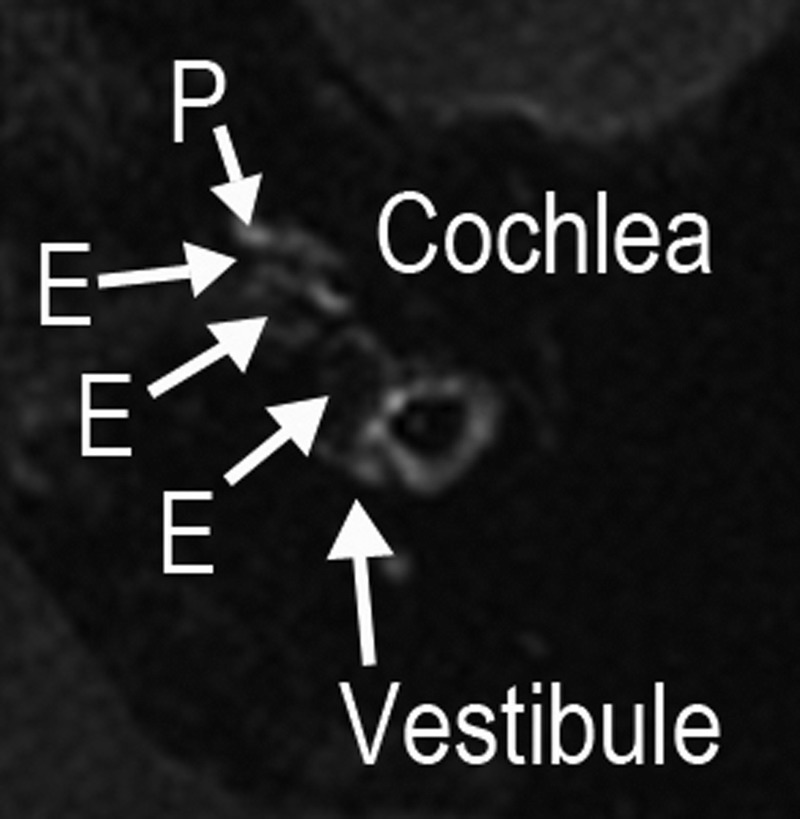
MRIMRI of the inner ear after gadolinium injection: dilation of the endolymphatic space in the cochlea and vestibule, arrows on the distended areas, Menière's disease.
Source : Hornibrook et al., Otology & neurotology, 2015, figure 3 · CC BY-NC-ND
There is no test that "proves" Ménière's disease during the patient's lifetime: it is a clinical diagnosis, made from the history and audiometry, framed by international consensus criteria. The physiotherapist never makes this diagnosis, but must be able to recognise its clinical picture in order to refer, and above all to spot what does not fit.
A clinical triad, an international consensus
Ménière's disease classically combines three elements: attacks of rotational vertigo, with fluctuating sensorineural hearing loss and auditory symptoms (tinnitus, a sensation of fullness or of a blocked ear). In 2015, a classification committee of the Bárány Society, meeting with the AAO-HNS, the EAONO and the Japanese and Korean balance societies, set reference diagnostic criteria that are still used today 1.
The characteristic pathophysiological substrate is endolymphatic hydrops : an excessive accumulation of endolymph in the inner ear, which distends the endolymphatic compartment and damages the ganglion cells 2. This pathological correlate was identified more than 75 years ago, but historically it could only be seen on post-mortem histological examination, which explains the long-standing difficulty in linking hydrops to the symptoms of the living patient 3. Inner-ear MRI after gadolinium injection now makes it possible to visualise it in vivo 4, but the exact relationship between hydrops and symptoms remains incompletely understood 2.
"Definite" Ménière and "probable" Ménière
The 2015 criteria distinguish two categories that structure the whole of diagnostic reasoning 1.
The "definite" (or certain) Ménière's disease rests on purely clinical criteria and requires the full triad:
- at least two episodes of spontaneous vertigo, each lasting from 20 minutes to 12 hours ;
- an audiometrically documented low- to mid-frequency sensorineural hearing loss, on the affected side ;
- one or more fluctuating auditory symptoms (hearing, tinnitus and/or fullness) in the ear concerned.
The "probable" Ménière's disease is a broader concept: episodic vestibular symptoms (vertigo or unsteadiness) combined with fluctuating auditory symptoms, occurring over a period of 20 minutes to 24 hours (the duration window is widened and audiometric documentation of the hearing loss is not required) 1.
This distinction is not an administrative detail: it reflects the degree of certainty. The "definite" form presupposes a hearing loss objectified on the audiogram; the "probable" form covers suggestive but incomplete pictures, where follow-up will decide.
| Criterion | "Definite" Ménière | "Probable" Ménière |
|---|---|---|
| Duration of attacks | 20 min to 12 h | 20 min to 24 h |
| Low-to-mid-frequency sensorineural hearing loss | Documented (audiometry required) | Not required |
| Fluctuating auditory symptoms | Required | Required |
| Nature of the vestibular symptom | Vertigo | Vertigo or unsteadiness |
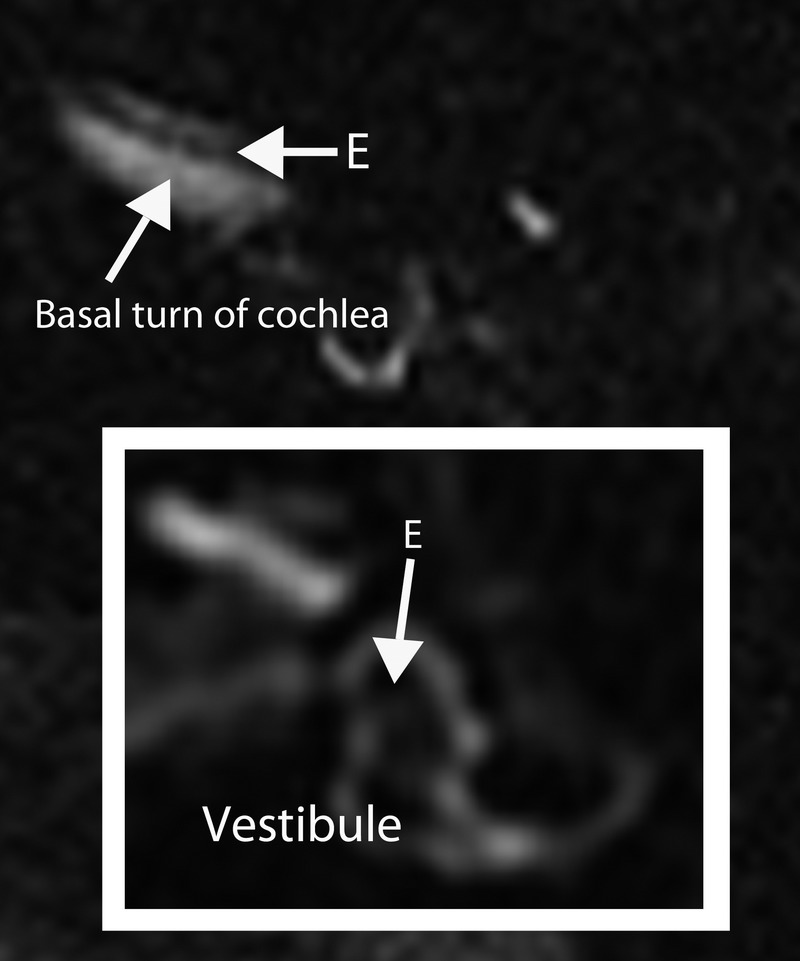
MRIMRI of the inner ear, close-up: isolated dilation of the endolymphatic space in the vestibule without cochlear involvement, arrow on the distended area.
Source : Hornibrook et al., Otology & neurotology, 2015, figure 4 · CC BY-NC-ND
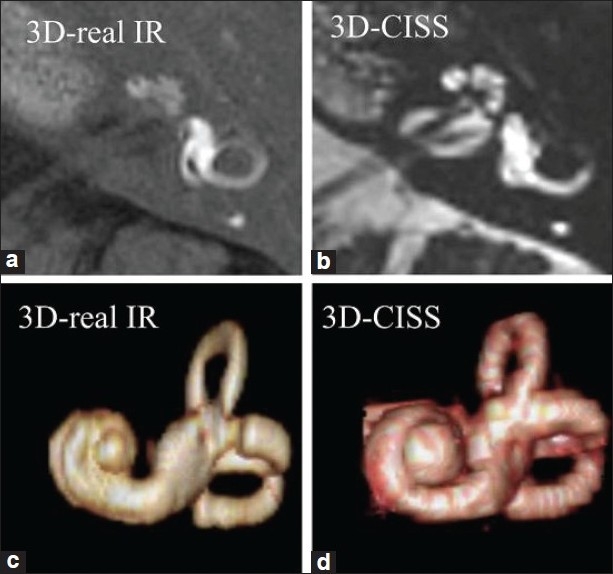
MRIMRI of the labyrinth in a patient with Menière's disease: 3D-real IR and 3D-CISS sequence images (a, b) and their three-dimensional volume-rendered reconstructions (c, d) showing the degree of endolymphatic hydrops.
Source : Vassiliou et al., Annals of Indian Academy of Neurology, 2011, figure 3 · CC BY
Key points
- The diagnosis of Ménière's disease is clinical : it rests on the history and audiometry, not on a single confirmatory test.
- The definite form: attacks of 20 min to 12 h + documented low-to-mid-frequency sensorineural hearing loss + fluctuating auditory symptoms.
- The probable form: window widened to 24 h, with no mandatory audiometry.
- The physiotherapist recognises and refers ; he does not make the diagnosis.
The duration of attacks: a decisive marker
Duration is one of the most discriminating markers in the history. Vertigo lasting 20 minutes to 12 hours points towards Ménière's disease 1. Conversely, vertigo lasting a few seconds and triggered by changes of position suggests benign paroxysmal positional vertigo (BPPV) instead; a single major bout of vertigo lasting several days suggests vestibular neuritis. This simple piece of timing information, which the patient reports spontaneously, already frames the hypothesis.
Audiometry: objectifying the hearing loss
Pure-tone audiometry is the key test that distinguishes the definite form from the probable form. It must demonstrate a sensorineural hearing loss predominating at low and mid frequencies, on the affected side, with a fluctuating character that is particularly suggestive: hearing may deteriorate during flare-ups then recover, at least early in the course 12. This test belongs to the ENT specialist, not to physiotherapy, but the physiotherapist has every interest in knowing that a normal audiogram makes a diagnosis of definite Ménière's disease unlikely.
The real pitfall: vestibular migraine
The main stumbling block in the differential diagnosis is vestibular migraine. Its typical symptoms (headache, vestibular symptoms, cochlear signs such as tinnitus or fullness) mimic those of Ménière's disease, and no sign taken in isolation is specific 1315. The overlap is massive: in a specialist cohort, 59% of patients with Ménière's disease also had migrainous features, and about a quarter were labelled "Ménière + vestibular migraine" 14. One review reports that 51.5% of vestibular migraine patients had first been misdiagnosed as Ménière's disease 13.
How can we find our way? A multicentre study of 268 patients showed that Ménière patients mainly have accompanying auditory symptoms (tinnitus, fullness, hearing loss), whereas migrainous signs (headache, photophobia, phonophobia, visual aura), anxiety and palpitations dominate during vestibular migraine attacks 15. But the authors insist that no symptom is highly specific to one entity; it is the combination of symptoms, and not any single sign, that must guide the reasoning 15. Other diagnoses to rule out include BPPV, vestibular neuritis and vestibular schwannoma 13.
The stakes go beyond semantics: a diagnostic mix-up can lead a migraine patient to receive aggressive treatments designed for Ménière's disease (ablative ones, for example), with a risk of needless damage to the inner ear 13. That is why a medical assessment is required before any rehabilitation management.
Epidemiology: in whom should we think of it?
The prevalence of Ménière's disease is poorly delineated, with estimates widely scattered depending on the criteria used, from 3.5 to 513 per 100,000 5 (most often between 200 and 500 per 100,000) 3. It is a relatively rare condition, with onset in middle adulthood and a female predominance : a large British study finds a mean age at diagnosis of 55.4 years and 65.4% women 7, and frequency rises with age, at least up to the 70-year age band 6. The female/male ratio is estimated at between about 1.9 and 2.2 depending on the cohort 56.
We must also keep in mind the psychological impact, which is part of the picture to be assessed: a 2025 meta-analysis (35 studies, nearly 16,000 patients) estimates the prevalence of depression at 34% and that of anxiety at 23% in these patients 20.
What the physiotherapist actually spots
The physiotherapist does not establish the diagnosis, but occupies a privileged observation post. In practice, he spots:
- the temporal profile of the attacks reported by the patient (vertigo lasting 20 min to a few hours, in flare-ups, rather than positional vertigo lasting a few seconds) ;
- the association with unilateral auditory signs (tinnitus, fullness, fluctuating hearing loss), which signals inner-ear involvement ;
- the warning signs for another diagnosis : headache, photophobia/phonophobia or aura suggesting vestibular migraine ; brief, purely positional vertigo suggesting BPPV ; unexplained asymmetry that should raise the possibility of a schwannoma ;
- the residual between-attack unsteadiness, which is precisely its therapeutic target.
One point deserves to be said honestly: because this diagnosis rests on clinical criteria and because vestibular migraine overlaps so heavily with the picture, uncertainty is common, including for specialists. Faced with an atypical picture (vertigo that is too brief or too long, headache in the foreground, the absence of any auditory sign, an unusual course), the right course of action is not to decide for oneself, but to refer to the ENT specialist or the doctor. The physiotherapist's role lies downstream of the diagnosis: supporting compensation for the chronic vestibular deficit, once the doctor has established the picture.
🎯 Ménière's disease or something else? The differential diagnosis
🎯 Pitfall no. 1: vestibular migraine
Before speaking of Ménière's disease, one must think of vestibular migraine: the two pictures overlap enormously, to the point of often being associated.
Specialist cohort: 59% (45/76) of patients with Ménière's disease had migrainous features. The other differentials: BPPV, vestibular neuritis, schwannoma. Source: Neff et al., 2012 (PMID 22801040).
Vertigo is not a diagnosis, it is a symptom. Before a patient is labelled "Ménière's disease", several conditions with blurred boundaries must be ruled out. This step is not a matter for physiotherapy, since the diagnosis of Ménière's disease rests on purely clinical criteria set by the doctor 1 but the physiotherapist must know these pictures: first, to recognise what does not fit and refer on; second, because several of these differential diagnoses (BPPV, unilateral vestibular deficit) do fall directly within his own remit. In other words, knowing how to tell them apart serves as much to guide as to treat.
Key points
- Definite Ménière's disease combines attacks of vertigo lasting 20 minutes to 12 hours, with fluctuating low- to mid-frequency sensorineural hearing loss and fluctuating auditory symptoms (tinnitus and/or aural fullness) on the affected side 1.
- The great pitfall is vestibular migraine which mimics Ménière's disease, often coexists with it, and no symptom taken in isolation is specific 13.
- The physiotherapist's role is not to settle the diagnosis but to recognise the picture, spot the red flags and refer on whenever anything is atypical 1.
The signature of Ménière's disease: duration, fluctuation, the ear
To place the differentials, the reference must first be kept in mind. The 2015 international consensus (Bárány Society, AAO-HNS, EAONO, Japanese and Korean societies) requires, for "definite" Ménière's disease, an episodic vestibular syndrome associated with a low- to mid-frequency sensorineural hearing loss and with fluctuating auditory symptoms in the affected ear, with attacks lasting between 20 minutes and 12 hours 1. The "probable" form widens the window: episodic vestibular symptoms plus fluctuating aural symptoms over 20 minutes to 24 hours, with no mandatory audiometric documentation 1. The substrate invoked is endolymphatic hydrops, for a long time observable only on post-mortem histology, which explains why there is no confirmatory test: this is a diagnosis made from the history 3. Three markers follow from this. The duration of the attacks, their fluctuating character, and their unilateral auditory anchoring serve as a grid for telling the other causes apart.
Vestibular migraine: the look-alike
This is the number one differential diagnosis, and the most disconcerting. Its typical symptoms, headache, vestibular symptoms and cochlear symptoms (tinnitus, fullness), mimic those of Ménière's disease 13. The overlap is such that, in a specialist cohort, 59% (45/76) of Ménière patients also had migrainous features, and about a quarter were labelled "Ménière + vestibular migraine" 14. In the other direction, one review reports that 51.5% of vestibular migraine patients had first been wrongly diagnosed as Ménière's disease, the two conditions coexisting in about 25% of subjects 13.
How can they be told apart? A prospective multicentre study of 268 patients provides the key nuance: there is no symptom that is highly specific to a single entity, and it is the combination that points the way 15. Ménière patients mainly suffered from accompanying auditory symptoms (tinnitus, fullness, hearing loss), whereas migraine-type headache, photophobia and phonophobia, visual aura, anxiety and palpitations were more frequent during vestibular migraine attacks 15. The stakes are not academic: confusing the two can lead a vestibular migraine patient to be given, in error, an ablative protocol designed for Ménière's disease (intratympanic gentamicin), with needless damage to the inner ear 13.
For the physiotherapist, the practical message is twofold. First, a patient referred for "vestibular rehabilitation of Ménière's disease" who mainly describes throbbing headaches, discomfort in light and noise, or attacks that vary greatly in duration, deserves to be sent back to the doctor: the diagnosis may not be the right one. Second, the frequency of the comorbidity calls for caution in interpreting results: a patient who does not progress as expected may have two mechanisms at once.
BPPV: positional vertigo
Benign paroxysmal positional vertigo is the most frequent differential diagnosis in practice, and often the easiest to settle, provided it is considered. Its semiology contrasts almost point by point with that of Ménière's disease: the vertigo is brief (a few seconds to less than a minute), triggered by a change in the position of the head (lying down, turning over in bed, looking up), and above all with no auditory symptom meaning no fluctuating hearing loss, no new tinnitus and no aural fullness 1. Where Ménière's disease runs in attacks of 20 minutes to several hours marked by the ear, BPPV is a vertigo lasting a few seconds, purely mechanical and positional.
This is also the differential where the therapeutic distinction is clearest. For BPPV, it is the repositioning manoeuvres (Epley type) that are the most effective in the short term, more so than vestibular rehabilitation exercises, even though combining the two favours functional recovery in the longer term 19. Mistaking BPPV for Ménière's disease would therefore mean missing a simple and highly effective procedure. Conversely, a "BPPV" accompanied by hearing loss or tinnitus on the same side must prompt reconsideration of the diagnosis.
Vestibular neuritis: the single, prolonged attack
Vestibular neuritis (acute unilateral peripheral vestibular deficit) is explicitly among the diagnoses to be ruled out 13. What sets it apart from Ménière's disease is its timing since it is typically a major rotational vertigo that is single, intense and prolonged over several days, without the fluctuating hearing or the repeated, ear-driven character of Ménière attacks. Where Ménière's disease is made of episodes that return, each bounded by 20 minutes to 12 hours and signed by the ear, neuritis is an isolated acute event that then gives way to a recovery phase.
This phase of sequelae is precisely the elective ground for physiotherapy. The Cochrane review concludes with a "moderate to strong" level of evidence that vestibular rehabilitation is a safe and effective management of unilateral peripheral vestibular deficit, on the basis of high-quality randomised trials 19 a framework that covers vestibular neuritis in compensation as much as advanced or post-ablative Ménière's disease. The physiotherapist therefore has a direct role here, unlike in Ménière attacks, on which he does not act.
Vestibular schwannoma: the red flag not to be missed
Vestibular schwannoma (acoustic neuroma) is the differential that one really does not want to miss, because it completely changes management 13. This benign tumour of the vestibulocochlear nerve classically causes a progressive unilateral sensorineural hearing loss and tinnitus on the same side, symptoms that may at first suggest early Ménière's disease. The essential distinction lies in the course: Ménière's disease fluctuates (hearing recovers between attacks), whereas a unilateral hearing loss that worsens progressively and without recovery, or a persistent auditory asymmetry, must raise the alarm and prompt referral for investigation (imaging).
None of the sources used here details the imaging or the epidemiology of schwannoma, so we stay with the clinical principle. For the physiotherapist the rule is simple: faced with a progressive, non-fluctuating unilateral hearing loss, one does not reassure, one refers to the doctor.
Orientation table
| Condition | Duration / rhythm of the vertigo | Auditory symptoms | Key clue |
|---|---|---|---|
| Ménière's disease | Repeated attacks of 20 min to 12 h | Fluctuating hearing loss + tinnitus/fullness, unilateral | Auditory fluctuation paced by the attacks 1 |
| Vestibular migraine | Highly variable | Possible (tinnitus, fullness), but headache/photo-phonophobia in the foreground | Migrainous context; it is the combination that points the way 15 |
| BPPV | Seconds, positional | Absent | Triggered by position; responds to manoeuvres 19 |
| Vestibular neuritis | Single attack, several days | Absent | Isolated acute episode, then compensation 1 |
| Vestibular schwannoma | Unsteadiness rather than attacks | Progressive unilateral hearing loss, non-fluctuating | Red flag: worsening without recovery 13 |
Red flags and when to refer on
The diagnosis remains a medical matter, but the physiotherapist is often the clinician who sees the patient most regularly. A few situations call for a return to the doctor rather than continuing rehabilitation: a progressive, non-fluctuating unilateral hearing loss (suggesting a schwannoma rather than Ménière's disease); an atypical picture in which headache, photophobia and aura dominate (prompting reconsideration of vestibular migraine); vertigo that is strictly positional and without auditory signs pointing rather to a BPPV amenable to manoeuvres; or any course that does not match the stated diagnosis. The underlying instruction set out by the consensus is clear: the physiotherapist must know how to recognise the picture in order to refer, without making the diagnosis himself 1.
One last point of honest caution: these boundaries are shifting. The Ménière–vestibular migraine overlap is so great that the same patient may fall under both, and no symptom taken in isolation settles the matter 15. Faced with an uncertain case, the right answer is not to force a box, but to say so and refer on.
💊 Medical treatments: what does the evidence really say?
💊 Betahistine does no better than placebo
The BEMED trial, randomised and double-blind against placebo, found no difference in attack frequency, at any dose.
Attack rate ratios. A ratio of 1.0 means "no difference": here 1.036 (95% CI 0.942–1.140) and 1.012 (0.919–1.114), p = 0.759. Disease-modifying treatments for Ménière's disease rest overall on weak evidence. Source: BEMED trial, Adrion et al., BMJ 2016 (PMID 26797774).
Before turning to the place of physiotherapy, we must be honest about what comes before it: medical treatments for Ménière's disease rest, in the main, on a low level of evidence. The 2023 Cochrane review of systemic pharmacological treatments (betahistine, diuretics, antivirals, corticosteroids) concludes that the data are "very uncertain", with few randomised trials comparing them against placebo and the available data of low to very low certainty 9. In other words, no disease-modifying medical treatment has been solidly demonstrated. This reality changes the conversation with the patient: we do not promise that the attacks will disappear, we aim to reduce their impact and to support compensation.
Salt restriction and lifestyle measures
Salt restriction, often combined with limiting caffeine and alcohol, is one of the measures classically proposed as first-line management. It rests on the pathophysiological hypothesis of endolymphatic hydrops, that excessive accumulation of endolymph in the inner ear regarded as the pathological correlate of the disease for more than 75 years 3 which one would seek to limit by reducing water and sodium retention. But it must be said clearly: this logic remains theoretical, and there is no good-quality randomised trial showing that salt restriction changes the frequency or the intensity of attacks. It is therefore offered as a reasonable and risk-free measure, not as a treatment of proven efficacy. The physiotherapist does not have to prescribe it, but does well to know that it belongs more to common sense than to evidence, so as not to sustain disproportionate expectations in the patient.
Betahistine: the most prescribed treatment, and the most contested
Betahistine is historically the most prescribed disease-modifying drug in Ménière's disease. It was called into question by a landmark trial: BEMED, multicentre, randomised, double-blind against placebo, in 221 patients with definite Ménière's disease, with continuous treatment for 9 months 8. The result was unambiguous: the incidence of attacks did not differ between placebo, low-dose betahistine and high-dose betahistine. Attack rate ratios against placebo were 1.036 (95% CI 0.942–1.140) and 1.012 (0.919–1.114), with no significant difference between the groups (p = 0.759). In plain terms, betahistine did no better than placebo on attack frequency.
This result does not prove that betahistine is useless in every patient, since the absence of a demonstrated effect is not a demonstration of the absence of an effect, but it does require caution and an honest presentation of the uncertainty. Betahistine remains widely prescribed despite this controversy, often because it is well tolerated. This is a useful point for the physiotherapist to know: a patient on betahistine who goes on having attacks is not necessarily "failing treatment"; he illustrates the limits of a treatment whose efficacy is not established.
Diuretics
Diuretics follow the same logic as salt restriction: reducing the fluid overload assumed to underlie the hydrops. They are part of the disease-modifying armamentarium in common use, but their level of evidence is just as fragile: the 2023 Cochrane review places them among the systemic pharmacological treatments whose efficacy rests on data of low to very low certainty 9. Here again, the honest position is to acknowledge that we have no robust evidence of benefit, while accepting that these well-tolerated treatments retain an empirical place in practice.
Intratympanic injections: corticosteroids and gentamicin
When attacks become refractory to disease-modifying treatment, intratympanic injections are used, delivering the drug in contact with the inner ear. Two options coexist, with opposite logics.
The intratympanic corticosteroids are a non-ablative option: they aim to calm the disease without destroying the vestibule. Their level of evidence remains limited, the 2023 Cochrane review concluding that the data are of low to very low certainty for every comparison against placebo or no treatment 11. An interesting benchmark comes from a randomised double-blind trial comparing methylprednisolone and gentamicin in refractory unilateral Ménière's disease: vertigo attacks fell by 90% with the corticosteroid and by 87% with gentamicin, with no significant difference between the two (mean difference −0.9; 95% CI −3.4 to 1.6) 12. The corticosteroid thus appears as a credible and non-destructive alternative.
The intratympanic gentamicin route, by contrast, is an ablative treatment: it deliberately destroys part of the vestibular function on the affected side in order to abolish the attacks. Effective against vertigo, it comes at a cost, since damage to the vestibular organs can leave residual symptoms, in particular unsteadiness 17. Its level of evidence also remains very uncertain: the dedicated 2023 Cochrane review stresses how few randomised trials have been published, all with very small numbers, which prevents any reliable conclusion about benefit 10. We are therefore dealing with a treatment whose mechanism and physiological price are known, but whose real size of benefit remains poorly quantified.
Ablative treatments: where physiotherapy takes over
It is precisely after an ablative procedure (intratympanic gentamicin, more rarely labyrinthectomy) that physiotherapy finds its clearest place. Destruction of the vestibule creates a chronic unilateral peripheral vestibular deficit, and this is exactly the situation in which vestibular rehabilitation has proved itself: the 2015 Cochrane review concludes with a "moderate to strong" level of evidence that it is a safe and effective management of this deficit, on the basis of high-quality randomised trials 19. Gaze stability work, gait rehabilitation and habituation exercises promote central compensation and reduce residual unsteadiness 17. The 2020 AAO-HNS guideline is explicit: offer rehabilitation to patients with chronic imbalance, but do not recommend it for managing acute attacks 18.
| Approach | Aim | Level of evidence |
|---|---|---|
| Salt restriction / diuretics | Reduce the hydrops (disease-modifying) | Low to very low / not demonstrated 9 |
| Betahistine | Space out the attacks (disease-modifying) | No superiority over placebo 8 |
| Intratympanic corticosteroids | Refractory attacks, non-ablative | Low to very low 11 |
| Intratympanic gentamicin | Refractory attacks, ablative | Very uncertain, small numbers 10 |
| Vestibular rehabilitation (chronic deficit / post-ablative) | Compensation, residual unsteadiness | Moderate to strong for unilateral deficit 19 |
Key points
- No disease-modifying medical treatment is solidly demonstrated and the systemic pharmacological data are of low to very low certainty 9.
- Betahistine was no better than placebo on attack frequency in the BEMED trial 8, despite very widespread prescription.
- Salt restriction and diuretics rest on plausible pathophysiological logic but without robust evidence of efficacy, and should be presented as such.
- Injections of corticosteroid (non-ablative) and of gentamicin (ablative) reduce refractory attacks to a comparable degree 12, but on evidence that is overall very uncertain.
- Physiotherapy does not act on the attacks and its real place is compensation for the chronic vestibular deficit, particularly after ablative treatment 1918.
🧭 Where does physiotherapy have its place?
🧭 Where physiotherapy acts, and where it does not
Central message: vestibular rehabilitation treats neither the attacks nor the disease. It helps compensate for the residual chronic deficit.
The 2020 AAO-HNS clinical practice guideline (Basura et al., PMID 32267799) is explicit about this distinction. A 2023 meta-analysis (3 trials, 465 patients) finds a benefit on dizziness-related handicap (DHI, standardised mean difference −0.58) but with a low level of evidence. Source: Rezaeian et al., 2023 (PMID 37341761).
The question deserves to be asked bluntly, because the whole credibility of vestibular rehabilitation in Ménière's disease depends on it: the physiotherapist acts neither on the attacks, nor on the disease itself. His ground, precise and legitimate, is elsewhere, in compensation for the residual chronic vestibular deficit, in the unsteadiness that persists between attacks and, above all, in the aftermath of an ablative treatment. Setting these limits out frankly protects the patient from unrealistic expectations and the physiotherapist from a therapeutic misunderstanding.
Why physiotherapy has no part to play during the attack
A Ménière attack is an episode of rotational vertigo lasting, by definition, from 20 minutes to 12 hours, associated with a fluctuating low- and mid-frequency sensorineural hearing loss and with auditory symptoms, tinnitus and aural fullness 1. It reflects an inner-ear phenomenon, endolymphatic hydrops, that excessive accumulation of endolymph regarded for more than 75 years as the pathological correlate of the disease 32. No rehabilitation exercise drains a hydrops or interrupts a flare-up. Managing the attack is a medical matter: salt restriction, betahistine, diuretics, intratympanic injections of gentamicin or corticosteroids.
The AAO-HNS clinical practice guideline is unambiguous here: clinicians must not recommend vestibular rehabilitation for managing acute vertigo attacks in Ménière's disease 18. This is not a nuance of caution, it is a counter-indication of indication: the attack is not the target.
We should moreover be honest about the rest of the armamentarium: the level of evidence for disease-modifying treatments is low. The BEMED trial, randomised and double-blind against placebo in 221 patients, showed no superiority of betahistine over placebo in spacing out the attacks, at either low or high dose, with attack rate ratios of 1.04 (95% CI 0.94–1.14) and 1.01 (0.92–1.11) and no difference between the groups 8. The 2023 Cochrane review concludes that the evidence for systemic pharmacological treatments is of low to very low certainty 9. In other words, the physiotherapist is not alone in having no control over the attack: medicine itself has few solidly demonstrated levers. This shared humility must be said to the patient.
The real ground: the residual chronic vestibular deficit
It is downstream of the attack that physiotherapy finds its place. When the flare-ups have left a vestibule impoverished on one side, a chronic imbalance persists, a between-attack unsteadiness, difficulty with walking or with head movement. This situation is precisely that of a unilateral peripheral vestibular deficit, the setting for which vestibular rehabilitation has the best level of evidence. The 2015 Cochrane review (39 studies, 2,441 participants) concludes that there is "moderate to strong" evidence that vestibular rehabilitation is a safe and effective management of unilateral peripheral vestibular deficit, with no adverse effect reported 19.
The AAO-HNS guideline completes the picture on the positive side: clinicians should offer vestibular rehabilitation to Ménière patients with chronic imbalance 18. The indication is therefore clear in both directions: yes for chronic unsteadiness, no for the attack.
Key points
- Never during the attack: the AAO-HNS explicitly advises against vestibular rehabilitation for managing acute vertigo attacks 18.
- Yes for chronic imbalance: in the same guideline, rehabilitation should be offered in cases of persistent unsteadiness 18.
- After ablative treatment: intratympanic gentamicin can leave a residual unsteadiness that rehabilitation helps to compensate for 17.
- Real but fragile evidence: a moderate effect on dizziness handicap, but trials at high risk of bias and with no long follow-up 16.
- The physiotherapist refers, he does not diagnose: knowing how to recognise the triad in order to refer to the doctor 1.
After ablative treatment: the best indication
The clearest situation is the one that follows a procedure destroying the vestibule, reserved for refractory forms. After an intratympanic injection of gentamicin, the destruction of the vestibular organs can leave residual symptoms, in particular unsteadiness, and it is exactly this phase that vestibular rehabilitation targets, with gaze stabilisation exercises, gait rehabilitation and habituation, in order to promote central compensation 17. Here we are dealing with a clear-cut and stable unilateral vestibular deficit, the elective ground for rehabilitation.
It must be recalled that these ablative treatments themselves rest on a very low level of evidence: the 2023 Cochrane review judges the evidence for intratympanic gentamicin "very uncertain", for lack of randomised trials of sufficient size 10. In refractory patients, one trial nevertheless showed that intratympanic methylprednisolone (non-ablative) reduced attacks by 90% against 87% for gentamicin, with no significant difference 12 one argument for preferring, where possible, the option that spares the vestibule before having to compensate for its loss.
What the Ménière-specific evidence says, and does not say
Are there data specific to Ménière's disease, rather than extrapolated from vestibular deficit in general? Yes, but they call for caution. A 2023 meta-analysis (3 trials, 465 patients) finds a moderate effect in favour of vestibular rehabilitation on dizziness-related handicap (Dizziness Handicap Inventory, standardised mean difference −0.58; 95% CI −1.12 to −0.05) immediately after treatment 16. This is a real signal, consistent with the physiology of compensation.
But the same meta-analysis immediately sets out its caveats, and it would be dishonest to pass over them: all the included trials were at high risk of bias, and none had long-term follow-up 16. We therefore do not yet know whether the benefit is maintained over time, nor whether it would survive better-conducted trials. The honest reading is this: vestibular rehabilitation probably helps the Ménière patient with a chronic deficit in the short term, but the size and the durability of that benefit remain uncertain.
| Clinical situation | Role of the physiotherapist | Level of evidence |
|---|---|---|
| Acute vertigo attack | None, a medical matter | Contra-indicated 18 |
| Chronic / between-attack unsteadiness | Vestibular rehabilitation recommended | Moderate to strong for unilateral deficit 1918 |
| After gentamicin / ablative procedure | Compensation for the residual deficit | Consistent, but limited trials 17 |
| Improvement in DHI, Ménière's disease | Short-term benefit | Low: high risk of bias, no long follow-up 16 |
A vigilance that remains medical: refer before rehabilitating
Recognising the picture does not mean making the diagnosis. The physiotherapist must be able to identify the triad, episodic vertigo of 20 min to 12 h, fluctuating low- to mid-frequency hearing loss, auditory symptoms in the affected ear, in order to refer to the ENT specialist, without taking his place 1. The major pitfall is vestibular migraine, which mimics Ménière's disease and is frequently associated with it: in a specialist cohort, 59% of Ménière patients also had migrainous features 14, and patients with both conditions account for about 25% of subjects 13. No symptom taken in isolation is specific: it is the combination that points the way 15. An atypical picture or an unusual course must send the patient back to the doctor, all the more so because other diagnoses (BPPV, vestibular neuritis, vestibular schwannoma) are in play.
Finally, management is not limited to balance exercises. The psychological impact of the disease is major: a 2025 meta-analysis (35 studies, 15,890 patients) estimates the prevalence of depression at 34% and that of anxiety at 23% in Ménière patients 20. The physiotherapist, through the frequency of contact and his position of support over time, takes part in that support and in education for self-management, without ever suggesting that he has control over a disease whose core, the hydrops and its attacks, is beyond him.
💬 Impact, falls and long-term support
The vertigo attack draws attention, but most of the burden the patient lives with is played out between the attacks and over time. Ménière's disease is a chronic condition, running in flare-ups that combine vertigo, fluctuating hearing loss, tinnitus and aural fullness, and in which the exact relationship between endolymphatic hydrops and symptoms remains incompletely understood 23. For the physiotherapist, it is precisely in this long timeframe (unpredictability of the attacks, residual unsteadiness, psychological impact) that the space for action lies, not on the disease itself but on its functional consequences.
A psychological impact of the first order
The unpredictability of the attacks, the fear of the next one and the fluctuation in hearing weigh heavily on quality of life. This impact is not anecdotal: a 2025 systematic review with meta-analysis (35 observational studies, 15,890 patients) estimates the prevalence of depression at 34% (95% CI 18–54%) and that of anxiety at 23% (95% CI 16–32%) in patients with Ménière's disease, with scores significantly higher than in healthy controls 20. In other words, about one patient in three has depressive symptoms and nearly one in four anxiety symptoms.
This psychological burden has a direct clinical translation for the physiotherapist. Anxiety sustains bodily hypervigilance and avoidance of situations perceived as destabilising (crowds, heights, head movements), which can hold back vestibular compensation. It also blurs diagnostic reasoning: anxiety and palpitations are more frequent during vestibular migraine attacks than during Ménière attacks 15, yet vestibular migraine is the main differential diagnosis and a frequent comorbidity, patients with both conditions accounting for about 25% of subjects in a 2023 review 13. The physiotherapist does not have to make this diagnosis, but a picture dominated by anxiety deserves to be reported to the doctor rather than attributed straight away to the vestibular deficit alone.
Key points
- About one Ménière patient in three has depression (34%) and nearly one in four anxiety (23%), so psychological support is part of the care given 20.
- Vestibular rehabilitation acts neither on the attacks nor on the disease, but on the residual chronic unsteadiness 18.
- Moderate to strong evidence for rehabilitation in chronic unilateral peripheral vestibular deficit 19, but weak evidence with no long-term perspective in Ménière's disease specifically 16.
- The physiotherapist's real lever is self-management over time: educating, making things safe, maintaining compensation.
Chronic unsteadiness and risk of falling
Between attacks, many patients retain an instability (unsteadiness), particularly marked in advanced forms and after ablative treatment. The AAO-HNS clinical practice guideline (2020) draws a clear boundary here: vestibular rehabilitation should be offered to patients with chronic imbalance, but it must not be recommended for managing acute vertigo attacks 18. This distinction structures practice: one does not rehabilitate an attack, one rehabilitates its aftermath.
The question of falls follows logically from this chronic unsteadiness, all the more so because the disease preferentially affects middle-aged adults and its frequency rises with age, the mean age at diagnosis being 55.4 years in a large British study 7, and both prevalence and incidence rising up to the 70-year age band in a Korean population study 6. A residual unsteadiness in an ageing patient is a factor of functional vulnerability that must be assessed and made safe. We must nevertheless remain honest about the limits of our data: the literature used here provides no precise figure for the fall rate specific to Ménière's disease, and it would not be rigorous to put one forward. The clinical reasoning holds, chronic unsteadiness plus advancing age equals an issue of falls prevention, but the exact quantification remains to be documented, and it is better to say so than to build on an invented figure.
One does not rehabilitate the Ménière attack, one rehabilitates the unsteadiness it leaves behind.
What rehabilitation can, and cannot, do
The soundest evidence base for physiotherapy is not Ménière's disease as such, but chronic unilateral peripheral vestibular deficit, precisely the situation of advanced Ménière's disease or of disease after an ablative procedure (intratympanic gentamicin, labyrinthectomy). On this ground, the 2015 Cochrane review concludes with a "moderate to strong" level of evidence that vestibular rehabilitation is a safe and effective management, with no adverse effect reported, on the basis of high-quality randomised trials 19. In practical terms, after vestibular destruction by gentamicin, residual symptoms, in particular unsteadiness, can persist, and rehabilitation (gaze stabilisation, gait rehabilitation, habituation) aims to promote central compensation 17.
In Ménière's disease specifically, the benefit exists but the evidence is more fragile. A 2023 meta-analysis (3 trials, 465 patients) finds a moderate effect in favour of vestibular rehabilitation on dizziness-related handicap, Dizziness Handicap Inventory, standardised mean difference = −0.58 (95% CI −1.12 to −0.05), and an improvement in quality of life, but immediately after treatment only 16. A crucial caveat, to be stated as such to the patient: all the included trials were at high risk of bias and none had long-term follow-up 16. One can therefore reasonably expect a short-term gain in perceived handicap; one cannot promise that it will last.
| Target | Role of physiotherapy | Level of evidence |
|---|---|---|
| Acute vertigo attack | None, a matter for medical treatment; the AAO-HNS explicitly advises against rehabilitation here | Contra-indicated in this setting 18 |
| Dizziness handicap (DHI), quality of life in Ménière's disease | Short-term improvement after treatment | Low: moderate effect but high bias, no long-term perspective 16 |
| Chronic unilateral vestibular deficit, residual unsteadiness (including post-gentamicin) | Central compensation: gaze stabilisation, gait, habituation | Moderate to strong 1917 |
The physiotherapist, partner in long-term self-management
The weakness of disease-modifying treatments strengthens, by contrast, the value of support. The BEMED trial showed no superiority of betahistine over placebo in spacing out the attacks 8, and the 2023 Cochrane review judges the evidence for systemic pharmacological treatments to be of low to very low certainty, with very little confidence that the reported effects reflect the true effect 9. In this landscape of therapeutic uncertainty, the patient needs someone who helps him live with a chronic and fluctuating disease rather than "cure" it.
The physiotherapist occupies a privileged place in this self-management, on several counts. First through education by explaining the fluctuating, flare-up nature of the disease 2, defusing fear by distinguishing the attack, transient, lasting 20 minutes to 12 hours under the international criteria 1 from the between-attack unsteadiness, on which one can act. Then through making things safe by assessing balance, adapting the environment and maintaining the gains of compensation, particularly in the older patient. Finally through the link by spotting frequent psychological distress 20 or an atypical picture suggesting vestibular migraine 1315 and referring to the doctor, since the diagnosis and the treatment of attacks are never a matter for physiotherapy.
All in all, supporting a patient with Ménière's disease is an exercise in therapeutic humility. The physiotherapist changes neither the hydrops, nor the frequency of the attacks, nor hearing; he acts on what is accessible, the unsteadiness, confidence in movement, quality of life, while owning up before the patient to the uncertainty about how long the benefit lasts. It is a modest role in its scope, but a central one in the daily experience of a disease that lasts.
🗂️ What do concrete case reports teach us?
Nothing anchors principles better than two clinical situations. The cases that follow are published and carry their PubMed identifier. The first two were chosen because they were taken for Ménière's disease and were not. Their purpose is not to propose a protocol, but to show where the physiotherapist's role lies, and where it does not, in the face of Ménière's disease.
Published case no. 1: an endolymphatic sac tumour disguised as Ménière's disease
The case. McHugh and colleagues report a destructive tumour of the endolymphatic sac of the middle ear, causing involvement of the facial, vestibulocochlear and vagus nerves21. The authors stress that these tumours are rare, indolent in their course, and that they initially present with an audio-vestibular dysfunction that is unremarkable, mimicking benign causes21.
What tipped the balance. The acute clinical decline and the aggressive appearances on skull-base imaging led to urgent surgical exploration for histological diagnosis21.
What this changes in the clinic. A Ménière's disease that worsens quickly, or that spills over onto other cranial nerves (facial palsy, swallowing or voice problems), is no longer Ménière's disease. These are warning signals that vestibular rehabilitation must not absorb.
Published case no. 2: an intralabyrinthine schwannoma in the guise of Ménière's disease
The case. Nishimura and colleagues report an intravestibular schwannoma presenting as Ménière's disease, diagnosed on a 3D-FLAIR MRI performed four hours after gadolinium injection, then resected by the translabyrinthine approach and confirmed histologically22. The preoperative audiogram showed a progressive sensorineural hearing loss22.
What this changes. The progressive rather than fluctuating character of the hearing impairment is the element that jars. Ménière's disease fluctuates; hearing that only goes down calls for imaging.
Published case no. 3: otolithic crises, and why they cause falls
The study. Calzada and colleagues examined the otolithic membrane of the utricle intra-operatively in 28 patients undergoing labyrinthectomy, of whom 7 (25%) had a history of otolithic crises with falls, 9 (32%) had Ménière's disease and 6 (21%) delayed endolymphatic hydrops23.
What this brings to the physiotherapist. These sudden falls, with no loss of consciousness and no preceding vertigo, are not a matter of a balance deficit that can be rehabilitated: they arise from documented otolithic damage. The right course is to make the environment safe and to refer, not to intensify postural work.
And the drug side, to place rehabilitation in context. The Cochrane reviews devoted to disease-modifying treatments for Ménière's disease910 recall the level of uncertainty surrounding these options. This is the setting in which vestibular rehabilitation is discussed: it does not compete with a treatment whose effect is established, it occupies ground where little is established.
What the two cases have in common: the support given
Beyond exercise, Mr R. and Mrs L. alike remind us that the impact of Ménière's disease is not only vestibular. Diagnostic uncertainty, the unpredictability of the attacks and the persistence of symptoms carry a substantial psychological cost. A 2025 systematic review (35 studies, 15,890 patients) estimates the prevalence of depression at 34% and that of anxiety at 23% in Ménière patients 20. This support, listening, education, self-management, referral to appropriate help within multidisciplinary management, is part of the physiotherapist's field, without encroaching on that of the doctor or the psychologist.
Key points: the place of rehabilitation and support (case no. 2)
- Physiotherapy treats neither the attacks nor the disease and targets the residual unsteadiness and the chronic vestibular deficit 16.
- The soundest evidence base: unilateral peripheral vestibular deficit, particularly after ablative treatment 19.
- Real but fragile benefit: a short-term effect on dizziness handicap, with no long-term data, to be stated honestly 16.
- Do not forget the frequent psychological impact (depression, anxiety) and the importance of multidisciplinary management 20.
All in all, these published trajectories condense the essentials: in the face of Ménière's disease, the physiotherapist's added value lies less in a spectacular procedure than in a correct positioning, recognising in order to refer, rehabilitating the chronic deficit where the evidence supports it, and supporting a patient whose disease, chronic and unpredictable, goes beyond the vestibular symptom alone.
🧭 How is this applied in practice?
The physiotherapist is never the first link in Ménière's disease: he does not make the diagnosis, does not treat the attacks and does not act on the endolymphatic hydrops 3. His role, precise and legitimate, lies downstream, on compensation for the chronic vestibular deficit and for the residual unsteadiness 1816. It still takes knowing how to recognise the picture, refer sensibly and coordinate with the ENT specialist. This section offers an operational thread to follow.
A decision algorithm in the practice
Faced with a patient referred for "dizziness" or unsteadiness, the reasoning can unfold in simple steps. It does not replace medical assessment: it helps situate one's own action and spot what must go back to the doctor.
- Has the diagnosis been made? Definite Ménière's disease rests on purely clinical criteria 1 namely at least two attacks of spontaneous vertigo lasting 20 minutes to 12 hours, a fluctuating low- to mid-frequency sensorineural hearing loss and fluctuating auditory symptoms (tinnitus and/or fullness) on the affected side. There is no confirmatory test: this is a diagnosis made from the history, and it does not belong to the physiotherapist. Without a clear medical diagnosis, one does not improvise an "anti-Ménière" rehabilitation programme.
- Are we in an attack or between attacks? Cardinal distinction. Vestibular rehabilitation must not be offered for managing acute vertigo attacks 18 which are a matter for medical treatment. The physiotherapist acts on the unsteadiness between the attacks, or on the residual deficit after ablative treatment.
- Is the picture consistent? If the "attacks" last a few seconds and are triggered by changes of position, think of BPPV; if they are accompanied by headache, photophobia or aura, think of vestibular migraine; if a deficit sets in abruptly and lastingly, think of vestibular neuritis or of schwannoma. Any atypical feature sends the patient back for medical assessment 13.
- Objectify and follow up. A self-report handicap questionnaire such as the Dizziness Handicap Inventory (DHI), the tool on which the evidence for the effectiveness of rehabilitation rests 16 serves as a baseline and follow-up measure. It documents the real impact and objectifies progress.
What rehabilitation does, and does not do
The most important message to hold to, for the patient as for the referrer, is one of honesty about the limits. Vestibular rehabilitation does not space out the attacks, does not restore hearing and does not change the course of the disease. It aims at central compensation for chronic unilateral peripheral vestibular deficit, precisely the situation of advanced Ménière's disease or of disease treated with intratympanic gentamicin, whose vestibular destruction leaves a residual unsteadiness 17. It is in this setting that the level of evidence is soundest: the Cochrane review finds a "moderate to strong" level in favour of rehabilitation in unilateral peripheral vestibular deficit 19.
The tools are the classic ones: gaze stabilisation exercises (gaze stability), habituation, and rehabilitation of balance and gait 17. Care must be taken, however, not to confuse the settings: for an associated BPPV, it is the repositioning manoeuvres, and not the exercises, that are effective in the short term 19.
The uncertainty must also be named rather than masked. The Ménière-specific meta-analysis (3 trials, 465 patients) shows a moderate favourable effect on the DHI immediately after treatment, but all the trials were at high risk of bias and none had long-term follow-up 16. In other words: a plausible short-term benefit, a durability that is not demonstrated. Saying so to the patient is part of the care.
Key messages to pass on to the patient
- Rehabilitation does not stop the attacks. It helps the brain compensate better between attacks and reduces the unsteadiness. This clarity avoids disappointed expectations.
- No disease-modifying treatment has solidly demonstrated its efficacy. The BEMED trial showed no superiority of betahistine over placebo in reducing the frequency of attacks 8, and the Cochrane review judges all systemic pharmacological treatments to be of low to very low certainty 9. The physiotherapist therefore has no reason to oversell his own intervention.
- The psychological impact is frequent and legitimate. Depression (≈ 34%) and anxiety (≈ 23%) are far more frequent than in controls 20 and recognising the patient's anxiety, and referring on if needed, is part of the support given.
- Regularity comes first. Compensation is a form of learning: daily self-rehabilitation counts at least as much as the sessions.
When to (re)refer to the ENT specialist or the doctor
The physiotherapist is also a sentinel. Some situations call for sending the patient back to the doctor rather than continuing rehabilitation:
- Diagnosis not established or uncertain. Without the clinical criteria being met 1, referral takes precedence over rehabilitation.
- Signs suggesting another diagnosis. Vestibular migraine is the major pitfall: in a specialist cohort, 59% of Ménière patients also had migrainous features 14, and about a quarter of subjects have both conditions 13. It is the combination of symptoms, not any single sign, that points the way 15. A picture that does not fit must go back to the specialist: inappropriate management can be harmful to the inner ear 13.
- Worsening hearing, new tinnitus, marked fullness, or unusual unilateral vertigo. These features are a matter for the ENT work-up (including ruling out a vestibular schwannoma), not for the physiotherapy practice.
- Uncontrolled attacks. If the patient is still in a phase of frequent attacks, rehabilitation is not indicated in the acute setting 18 and the priority is medical optimisation.
Working as a team with the ENT specialist
Ménière's disease is chronic, fluctuating and multidimensional (hearing, balance, mental health): it calls for coordinated management. The ENT specialist makes the diagnosis, conducts the disease-modifying medical treatment (salt restriction, betahistine, diuretics) and, in refractory forms, the second-line treatments: intratympanic injections of corticosteroids or of gentamicin, whose level of evidence remains low 1011. It is often at this hinge that the physiotherapist comes on the scene.
Coordination is particularly useful after ablative treatment. Gentamicin markedly reduces the attacks but can leave a residual unsteadiness through vestibular destruction 17 and ideally rehabilitation is dovetailed with this procedure to speed up compensation. In practical terms, this means knowing the affected side, the stage of the disease, the current treatments and any ablative procedures, information that comes from the ENT letter, not from deduction. In return, the physiotherapist passes on his objective measures (DHI, balance tests, tolerance), which help the ENT specialist assess residual function. The report circulates in both directions.
Key points
- No diagnosis and no treatment of attacks by the physiotherapist: the diagnosis is clinical and medical 1, and rehabilitation must not target acute attacks 18.
- The real target: compensation for the chronic vestibular deficit and for the residual unsteadiness, particularly after gentamicin 1719.
- Honest evidence: a short-term effect on the DHI, but trials at high risk of bias and with no long-term follow-up 16.
- Differential vigilance: think systematically of vestibular migraine 1314 and refer on whenever anything is atypical.
- Teamwork: take one's bearings from the ENT letter (side, stage, treatments) and send back objective measures; support the frequent psychological impact as well 20.
Bibliography
Every reference verified individually on PubMed (clickable PMID). 20 sources. Click a superscript note marker in the text: the bibliography opens and highlights the source.
- Lopez-Escamez JA, Carey J, Chung WH, et al. (Classification Committee of the Bárány Society) (2015). Journal of Vestibular Research. PMID 25882471. doi:10.3233/VES-150549.
- Nakashima T, Pyykkö I, Arroll MA, et al. (2016). Nature Reviews Disease Primers. PMID 27170253. doi:10.1038/nrdp.2016.28.
- Gürkov R, Pyykö I, Zou J, Kentala E (2016). Journal of Neurology. PMID 27083887. doi:10.1007/s00415-015-7930-1.
- Consensus group on MR imaging of endolymphatic hydrops (first author: Liu Y) (2022). Frontiers in Surgery. PMID 35574547. doi:10.3389/fsurg.2022.874971.
- Alexander TH, Harris JP (2010). Otolaryngologic Clinics of North America. PMID 20713236. doi:10.1016/j.otc.2010.05.001.
- Kim MH, Cheon C et al. (2020). Audiology & Neurotology (Audiol Neurootol). PMID 32289780. doi:10.1159/000506921.
- Bruderer SG, Bodmer D, Stohler NA, Jick SS, Meier CR (2017). Audiology & Neurotology. PMID 28723686. doi:10.1159/000475875.
- Adrion C, Fischer CS, Wagner J, et al. (BEMED Study Group) (2016). BMJ. PMID 26797774. doi:10.1136/bmj.h6816.
- Webster KE, Galbraith K, Harrington-Benton NA, et al. (2023). Cochrane Database of Systematic Reviews. PMID 36827524. doi:10.1002/14651858.CD015171.pub2.
- Webster KE, Galbraith K, Lee A, et al. (Cochrane) (2023). Cochrane Database of Systematic Reviews. PMID 36847592. doi:10.1002/14651858.CD015246.pub2.
- Webster KE, Lee A, Galbraith K, et al. (Cochrane) (2023). Cochrane Database of Systematic Reviews. PMID 36847608. doi:10.1002/14651858.CD015245.pub2.
- Patel M (first author), Agarwal K, Arshad Q, et al. (2016). The Lancet. PMID 27865535. doi:10.1016/S0140-6736(16)31461-1.
- Chen JY, Guo ZQ, Wang J, et al. (2023). Journal of Neurology. PMID 36562849. doi:10.1007/s00415-022-11532-x.
- Neff BA, Staab JP, Eggers SD, et al. (2012). Otology & Neurotology. PMID 22801040. doi:10.1097/MAO.0b013e31825d644a.
- Lopez-Escamez JA, Dlugaiczyk J, Jacobs J, Lempert T, Teggi R, von Brevern M, Bisdorff A (2014). Frontiers in Neurology. PMID 25566172. doi:10.3389/fneur.2014.00265.
- Rezaeian A, Abtahi H, Moradi M, Farajzadegan Z (2023). European Archives of Oto-Rhino-Laryngology. PMID 37341761. doi:10.1007/s00405-023-08066-x.
- Tong Q, Zhang L et al. (2025). BMJ Open. PMID 39987011. doi:10.1136/bmjopen-2024-088722.
- Basura GJ, Adams ME, Monfared A et al. (AAO-HNSF guideline) (2020). Otolaryngology–Head and Neck Surgery. PMID 32267799. doi:10.1177/0194599820909438.
- McDonnell MN (first author), Hillier SL (2015). Cochrane Database of Systematic Reviews. PMID 25581507. doi:10.1002/14651858.CD005397.pub4.
- Yeo BSY, Toh EMS, Lim NE, et al. (2025). European Archives of Oto-Rhino-Laryngology. PMID 40087158. doi:10.1007/s00405-025-09297-w.
- McHugh A, Gendre A, Jones H, Barrett H, Walsh RM (2026). Case report: endolymphatic sac tumor masquerading as Meniere's disease. International Journal of Surgery Case Reports. PMID 41837081.
- Nishimura K, Murofushi T, Hakuba N (2022). Concurrent intravestibular schwannoma mimicking Ménière's disease. Frontiers in Neurology. PMID 36438944. doi:10.3389/fneur.2022.1043452.
- Calzada AP, Lopez IA, Ishiyama G, Ishiyama A (2012). Otolithic membrane damage in patients with endolymphatic hydrops and drop attacks. Otology & Neurotology. PMID 23064391. doi:10.1097/MAO.0b013e318271c48b.
❓ Frequently asked questions
What is Ménière's disease?
It is a chronic inner-ear condition defined by a clinical triad: attacks of rotational vertigo lasting from 20 minutes to 12 hours, fluctuating low- to mid-frequency sensorineural hearing loss and fluctuating auditory symptoms (tinnitus and/or aural fullness) on the affected side. The international consensus criteria distinguish a "definite" form (documented audiometry, attacks of 20 min to 12 h) from a broader "probable" form (episodic vestibular symptoms over 20 min to 24 h) 1.
What causes Ménière's disease?
The characteristic pathophysiological substrate is endolymphatic hydrops: an excessive accumulation of endolymph in the inner ear, regarded for more than 75 years as the pathological correlate of the disease. It can now be visualised in vivo by MRI after gadolinium injection. The exact relationship between hydrops and symptoms nevertheless remains incompletely understood 32.
How long does an attack last, and who is affected?
In the definite form, each vertigo attack lasts from 20 minutes to 12 hours 1. The disease is chronic and relatively rare, with an estimated prevalence of 200-500 per 100,000 3. It typically begins in mid-life, with a mean age at diagnosis of about 55 years in a large British study, and shows a clear female predominance 7.
How can Ménière's disease be told apart from vestibular migraine?
This is the main diagnostic pitfall: the symptoms overlap heavily and no sign is specific. In a multicentre study of 268 patients, Ménière patients mainly had accompanying auditory symptoms (tinnitus, fullness, hearing loss), whereas headache, photophobia/phonophobia, visual aura and anxiety were more frequent during vestibular migraine attacks; it is the combination of symptoms, not any single sign, that points the way 15. The overlap is such that about a quarter of patients carry both diagnoses 13. Other diagnoses to rule out include BPPV, vestibular neuritis and vestibular schwannoma.
Can physiotherapy stop vertigo attacks?
No. Vestibular rehabilitation acts neither on acute attacks nor on the disease itself: the AAO-HNS guideline states that it should be offered to patients with chronic imbalance, but should not be recommended to manage acute attacks 18. Its role is to help compensate for the residual chronic vestibular deficit and for unsteadiness, particularly after ablative treatment. A meta-analysis (3 trials, 465 patients) found a moderate favourable effect on dizziness-related handicap in the short term (SMD −0.58; 95% CI −1.12 to −0.05), but all the trials were at high risk of bias and none had long-term follow-up 16.
Are drugs such as betahistine effective?
The level of evidence is low. The BEMED randomised, double-blind, placebo-controlled trial (221 patients) showed no superiority of betahistine over placebo in reducing attack frequency, at either low or high dose (attack rate ratios of 1.036 and 1.012 versus placebo, with no significant difference) 8. More broadly, the 2023 Cochrane review concludes that the evidence for systemic pharmacological treatments is of low to very low certainty 9. Honesty is therefore called for: no disease-modifying medical treatment has been solidly demonstrated.
Further reading in the review