




In brief
Cervicogenic dizziness (CGD) is a diagnosis of exclusion, defined in the Bárány Society's 2022 position statement as imbalance, unsteadiness or light-headedness associated with neck movements or positions, in the absence of any other identifiable cause. These non-specific vestibular symptoms are correlated in time with neck pain or stiffness, once BPPV, vestibular migraine and vertebrobasilar insufficiency have been ruled out; whiplash is the major risk factor. First-line management combines manual therapy, proprioceptive, oculomotor and deep neck flexor strengthening exercise, plus education. About 43 % of chronic neck pain is accompanied by dizziness.
Clinical synthesis based on the Bárány Society's official 2022 position statement, the De Vestel 2022 and Carrasco-Uribarren 2025 meta-analyses, the Howard 2022 critique of the CFRT, and the 2023 empirical data on JPSE (AlDahas).
Clinical summary
- Cervicogenic dizziness (CGD) is a diagnosis of exclusion under the Bárány Society's official 2022 position statement, resting on the temporal correlation between neck pain and vestibular symptoms, once BPPV, vestibular migraine and VBI have been ruled out.
- Meanwhile, vestibular migraine is the most frequent cause of the neck pain plus dizziness combination, and should be excluded first under the Lempert 2022 criteria.
- The pathophysiology rests on a sensory conflict between altered cervical proprioceptive input, the vestibular system and the visual system.
- Above all, neck trauma (whiplash) is the major risk factor: up to 70 % of chronic WAD report dizziness (Treleaven 2017); 40-43 % of chronic neck pain is accompanied by dizziness (Knapstad 2023, Vural 2021).
- The key clinical tests (CFRT, JPSE, SPNT) are useful for orientation, but their diagnostic properties are probably overestimated according to the Howard 2022 critical review.
- In practice, manual therapy alone significantly reduces the DHI (−10 points) and the dizziness VAS (−23 points), at a moderate level of evidence on GRADE (De Vestel 2022, 13 RCTs, n = 898).
- The combination of manual therapy plus exercise is more effective , but the quality of evidence then falls to very low on GRADE.
- Exercise targets cervical proprioception, sensorimotor control, gaze stability (VOR) and strengthening of the deep neck flexors.
- In the longer run, preventing recurrence rests on self-management (a home programme plus therapeutic education). Reid 2015 shows effects maintained at 12 months.
- Anxiety and catastrophising are documented obstacles to recovery: 30-47 % of vestibular patients have anxiety (Kim 2024, n = 764,403).
- Finally, PPPD (ICD-11 AB32.0) can develop secondarily in 15-20 % of patients after any vestibular episode; screening for it is essential.
- Return to sport must be gradual and criteria-guided (DHI < 30, NDI < 10/50, JPSE < 3°), particularly for contact sports (Marshall 2015, Cheever 2021).
- Red flags (the 5Ds and 3Ns, a focal neurological deficit) call for urgent medical referral; yellow flags (anxiety, kinesiophobia) point towards collaboration with a psychologist.
- The standardised PROMs (DHI, NDI, NRS) are essential for measuring effectiveness; the MCID for the DHI is 18 points (Jacobson 1990), and for the NDI 7.5/50 (Carreon 2010).
Contents
- What are the fundamentals to know about cervicogenic dizziness?
- How do you assess and diagnose cervicogenic dizziness with certainty?
- Which treatment strategies are the most effective?
- How do you secure lasting recovery and prevent recurrence?
- What do real clinical cases teach us about cervicogenic dizziness?
- How do you apply these recommendations concretely in your practice?
What are the fundamentals to know about cervicogenic dizziness?
How is this condition defined, who does it affect and what are the risk factors?
The operational definition adopted by most authors rests on three converging criteria.¹٬²٬³ First, non-specific vestibular symptoms (unsteadiness, a “floating head” feeling, imbalance) rather than true rotational vertigo. Second, a clear temporal correlation with neck pain or stiffness. Third, the documented exclusion of the other causes (BPPV, vestibular migraine, neuronitis, Ménière's, VBI). The verified 2021-2023 epidemiology confirms a high prevalence of dizziness in patients with chronic neck pain. The Norwegian cohort Knapstad 2023 (n = 133) reports 43 % concomitant dizziness in patients with persistent neck pain.⁴ The Turkish multicentre cohort Vural 2021 (n = 2,361) finds a prevalence of 40.1 %.⁵ In patients with whiplash-associated disorders (WAD), up to 70 % report dizziness in the chronic phase, according to Treleaven 2017.⁶ In specialist ENT care, however, CGD accounts for only 5-6 % of consultations for dizziness (Frontiers Neurol 2025 perspective).⁷📊 Distribution of the causes of chronic dizziness in specialist practice
BPPV and vestibular migraine dominate; CGD remains a minority (5-6 %)
Sources: von Brevern 2007 [PMID 17135456] · Paz-Tamayo 2020 [PMID 33110417] · Staab 2017 [PMID 29036855]. The proportions vary with the setting (primarycare vs specialist centres).
- Whiplash-type neck trauma : the best established. The Treleaven 2017 meta-analysis confirms a persistent prevalence of dizziness in the chronic phase (up to 70 %) with marked proprioceptive deficits, oculomotor disturbance and altered sensorimotor control.⁶
- Cervical spondylosis and degenerative conditions of the upper cervical spine, particularly the C1-C3 segments (Devaraja 2018, review in Eur Arch Otorhinolaryngol).⁸
- Chronic suboccipital muscle tension and masticatory or suboccipital trigger points (Sung 2020).⁹
- Sustained postures (screen work, forward head position): the Moustafa 2017 RCT shows that an 8-week postural correction programme significantly reduces dizziness and cervicocephalic kinaesthetic sensitivity at 1-year follow-up.¹⁰
What happens in the body, and how does cervicogenic dizziness evolve naturally?
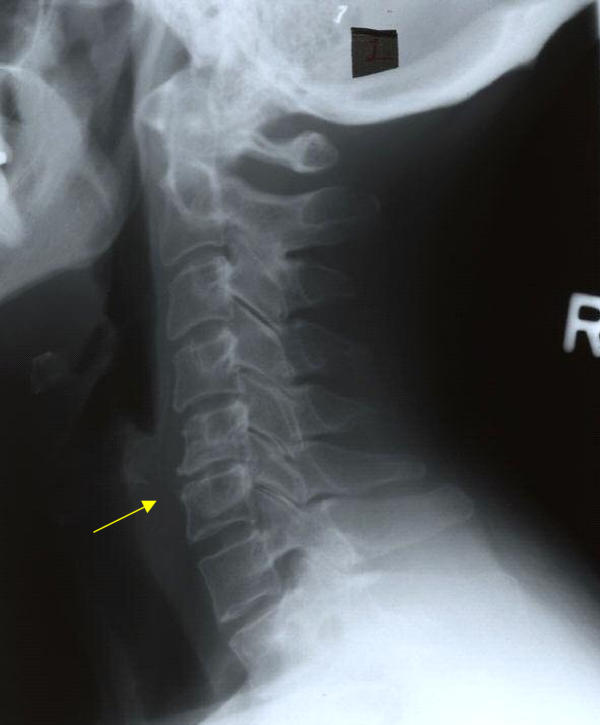
X-rayLateral cervical spine X-ray: disc space narrowing and anterior osteophyte at C5-C6, arrow, a sign of cervical osteoarthritis that can disrupt neck proprioception.
Source : Stupar et al., BMC Musculoskeletal Disorders, 2003, figure 2 · Libre accès BioMed Central
Key points, chapter 1
- CGD is a diagnosis of exclusion under the Bárány Society's official 2022 position statement (Seemungal et al., J Vestib Res).
- The main cause is a sensory conflict between proprioceptive, vestibular and visual input.
- Consolidated epidemiology: 43 % of chronic neck pain (Knapstad 2023), 40.1 % (Vural 2021), and up to 70 % in chronic WAD (Treleaven 2017).
- The vestibular migraine is the most frequent cause of the neck pain plus dizziness combination; exclude it first.
- The prognosis is broadly favourable under treatment (De Vestel 2022, meta-analysis of 13 RCTs, n = 898).
Bibliography
- Seemungal BM, Agrawal Y, Bisdorff A, Bronstein A, Cullen KE, Goadsby PJ, Lempert T, Kothari S, Lim PB, Magnusson M, Marcus HJ, Strupp M, Whitney SL. The Bárány Society Position on Cervical Dizziness. J Vestib Res. 2022;32(6):487-499. PMC9837683 · doi:10.3233/VES-220202.
- Reiley AS, Vickory FM, Funderburg SE, Cesario RA, Clendaniel RA. How to diagnose cervicogenic dizziness. Arch Physiother. 2017;7:12. PMID 29340206.
- De Vestel C, De Hertogh W, Van Rompaey V, Vereeck L. Clinical characteristics and diagnostic aspects of cervicogenic dizziness in patients with chronic dizziness: A cross-sectional study. Musculoskelet Sci Pract. 2022;60:102559. PMID 35364427.
- Knapstad MK, Ask T, Skouen JS, Goplen FK, Nordahl SHG. Prevalence and consequences of concurrent dizziness on disability and quality of life in patients with long-lasting neck pain. Physiother Theory Pract. 2023. PMID 35152809.
- Vural M et al. Prevalence and characteristics of cervicogenic dizziness in patients with chronic neck pain, multicentre cohort. 2021. PMC8790272.
- Treleaven J. Dizziness, Unsteadiness, Visual Disturbances, and Sensorimotor Control in Traumatic Neck Pain. J Orthop Sports Phys Ther. 2017;47(7):492-502. PMID 28622488 · doi:10.2519/jospt.2017.7052.
- Yacovino DA, Hain TC, Zanotti E. Proprioceptive Cervicogenic Dizziness: A Narrative Review of Pathogenesis, Diagnosis, and Treatment. J Clin Med. 2022. PMC9655761.
- Devaraja K. Approach to cervicogenic dizziness: a comprehensive review of its aetiopathology and management. Eur Arch Otorhinolaryngol. 2018;275(10):2421-2433. PMID 30094486.
- Sung YH. Upper cervical spine dysfunction and dizziness. J Exerc Rehabil. 2020;16(5):385-391. PMID 33178639.
- Moustafa IM, Diab AA, Harrison DE. The effect of normalizing the sagittal cervical configuration on dizziness, neck pain, and cervicocephalic kinesthetic sensibility: a 1-year randomized controlled study. Eur J Phys Rehabil Med. 2017;53(1):57-71. PMID 27575013.
- Wrisley DM, Sparto PJ, Whitney SL, Furman JM. Cervicogenic dizziness: a review of diagnosis and treatment. J Orthop Sports Phys Ther. 2000;30(12):755-766. PMID 11153554.
- Peng B. Cervical Vertigo: Historical Reviews and Advances. World Neurosurg. 2018;109:347-350. PMID 29061460.
- Signs and symptoms of vertebrobasilar insufficiency secondary to atherosclerosis: a systematic review. 2025. PMID 40148099.
- De Vestel C, Vereeck L, Reid SA, Van Rompaey V, Lemmens J, De Hertogh W. Systematic review and meta-analysis of the therapeutic management of patients with cervicogenic dizziness. J Man Manip Ther. 2022;30(5):273-283. PMID 35383538.
How do you assess and diagnose cervicogenic dizziness with certainty?
Which questions should you ask to understand the patient and their history?
History-taking aims to establish the plausibility of the cervico-vestibular link.²- Timing : did the dizziness begin at the same time as, or after, the neck pain or a neck injury? This correlation is essential.
- Description of the symptom : unsteadiness, a “floating head” feeling (light-headedness) or imbalance. True rotational vertigo (“the room is spinning”) should raise suspicion of a peripheral or central vestibular cause.
- Triggers : rotation or extension movements of the neck, sustained postures. A purely positional trigger (lying down, getting up) points rather to BPPV.
- Past history : whiplash injury, cervical surgery, known osteoarthritis, previous vestibular comorbidity.
- Associated symptoms : headache, visual disturbance, tinnitus, aural fullness (Ménière's?), nausea, photophobia (vestibular migraine?).
🚩 Red flags: urgent medical referral
- Diplopia, dysarthria, dysphagia, ataxia, a focal sensorimotor deficit → central involvement (“5Ds and 3Ns”).
- Drop attacks (sudden falls without prolonged loss of consciousness) → suspected VBI.
- A sudden “thunderclap” headache → suspected vertebral dissection or subarachnoid haemorrhage.
- Pure vertical spontaneous nystagmus or downbeating → a central sign.
- A “central pattern” on HINTS (skew deviation, direction-changing nystagmus) → vertebrobasilar stroke until proven otherwise.
- Major vascular risk factors + symptoms triggered by extreme rotation → VBI work-up essential.
- Unexplained weight loss, night sweats, fever + neck pain → work-up for malignancy or infection.
⚠️ Source: the international framework Finucane 2020 (JOSPT)¹⁵ and the 2025 VBI atherosclerosis review.¹³
Which clinical tests should you perform, and which other conditions should you rule out?
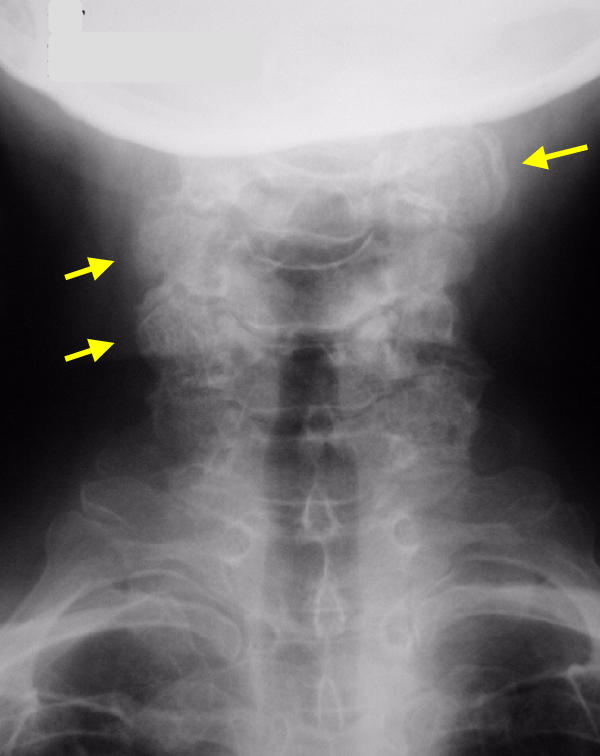
X-rayAnteroposterior cervical spine X-ray: severe facet arthrosis affecting the C3 to C6 levels bilaterally, arrows, a possible source of cervical proprioceptive dysfunction.
Source : Stupar et al., BMC Musculoskeletal Disorders, 2003, figure 3 · Libre accès BioMed Central
Cervical orientation tests
- Cervical Flexion-Rotation Test (CFRT) : normal range about 44° to each side in maximal cervical flexion; positive threshold < 32° or a difference of ≥ 10° between sides.³ Sensitivity 91 %, specificity 90 % in Hall's original 2008 study, but the diagnostic properties are probably overestimated according to the Howard 2022 critical review (imperfect gold standard, inclusion bias).⁴
- Joint Position Sense Error (JPSE) : Revel's historical 1991 threshold was > 4.5°. The recent empirical data of AlDahas 2023 (n = 43) show that healthy subjects average 2-2.5° of error and patients with chronic neck pain 3.5-4.8°: a clinical threshold of 3-4° offers a better sensitivity/specificity trade-off.⁵٬⁶
- Head-Neck Differentiation Test (HNDT) and the Smooth Pursuit Neck Torsion Test (SPNT) : reproducing the symptoms by rotating the trunk under a fixed head, which points towards a cervical origin (L'Heureux-Lebeau 2014).⁷
- Segmental palpation C0-C3, active and passive joint mobility, looking for suboccipital and upper trapezius trigger points.
📐 Key clinical thresholds: CFRT and JPSE in healthy subjects vs chronic neck pain
Mean values and decision thresholds, from AlDahas 2023, Hall 2010, Treleaven 2003
Sources: Hall 2010 [PMID 21886422] · Howard 2022 critique [PMID 36476405] · Treleaven 2003 [PMID 12610847] · AlDahas 2023 [PMC10569517]. ⚠️ These thresholds are of orientation value, not a definitive diagnostic status.
Mandatory differential diagnosis (in order of frequency)
🎯 Because CGD is a diagnosis of exclusion, it is fundamental to test for and rule out the most frequent causes of dizziness:| Condition | Key test / criterion | Distinguishing feature |
|---|---|---|
| BPPV (cause no. 1) | Dix-Hallpike, Supine Roll | Typical nystagmus after a latency, fatigability, episodes < 1 min |
| Vestibular migraine | Lempert 2022 criteria | ≥ 5 episodes of 5 min to 72 h, a history of migraine, photophobia / phonophobia |
| PPPD (ICD-11 AB32.0) | Staab 2017 criteria | Symptoms ≥ 3 months, triggered by upright posture or visual stimuli |
| Ménière's disease | Audiometry, glycerol test | The triad: vertigo + tinnitus + fullness or fluctuating hearing loss |
| Vestibular neuritis | HINTS, vHIT, calorics | Acute rotational vertigo, unilateral peripheral deficit |
| VBI (rare) | Duplex ultrasound, MRI | 5Ds and 3Ns, triggered by extreme rotation, vascular risk factors |
Should patients with cervicogenic dizziness be classified, and what are the benefits?
Classification is still developing but clinically useful. The Bárány Society 2022 consensus distinguishes two levels of diagnostic certainty:- “Probable” cervical dizziness : criteria met with a plausible temporal correlation.
- “Definite” cervical dizziness : retrospective confirmation through the disappearance of symptoms after treatment of the cervical dysfunction.
- The traumatic profile (post-WAD): marked proprioceptive deficits, oculomotor disturbance, altered sensorimotor control. Treatment target: proprioceptive plus oculomotor rehabilitation (Treleaven 2017, Sterling 2004).¹¹٬¹²
- The degenerative profile (cervical spondylosis): C1-C3 joint restriction, mechanical pain. Target: gentle manual therapy plus mobility and endurance.
- The functional profile (muscular / postural): trigger points, forward posture. Target: myofascial release, postural correction, strengthening.
Critique and controversy
The diagnosis of CGD remains a diagnosis of exclusion with no pathognomonic test. The Bárány 2022 position stresses that no single sign or test suffices, and that “proof by treatment” is pragmatic but scientifically weak. Howard's 2022 critical review warns that the CFRT, often presented as a reference test, has diagnostic properties (Se 91 % / Sp 90 %) that are probably overestimated by inclusion bias and by the imperfection of the gold standard used (manual examination). The clinician should therefore treat these tests as orienting elements within a cluster of findings, not as verdicts. Another controversy concerns the real weight of cervical afferents in overall balance : their role is anatomically proven, but the scale of their contribution relative to the vestibular and visual systems remains debated.Key points, chapter 2
- ✅ The diagnosis of CGD is a diagnosis of exclusion.
- ✅ The temporal correlation from neck pain to dizziness is the central criterion.
- ✅ Key tests: CFRT (threshold < 32° or Δ ≥ 10°), JPSE (clinical threshold 3-4°), SPNT and HNDT.
- ⚠️ Howard 2022: the diagnostic properties of the CFRT are probably overestimated (gold standard bias).
- ✅ It is essential to rule out BPPV (Dix-Hallpike), vestibular migraine (Lempert 2022) and PPPD (Staab 2017, ICD-11 AB32.0).
- 📌 Vestibular migraine is more frequent than CGD in the neck pain plus dizziness population (Bárány Society 2022).
Bibliography
- Seemungal BM, Agrawal Y, Bisdorff A, et al. The Bárány Society Position on Cervical Dizziness. J Vestib Res. 2022;32(6):487-499. PMC9837683.
- Reiley AS, Vickory FM, Funderburg SE, Cesario RA, Clendaniel RA. How to diagnose cervicogenic dizziness. Arch Physiother. 2017;7:12. PMID 29340206.
- Hall T, Briffa K, Hopper D, Robinson K. The influence of lower cervical joint pain on range of motion and interpretation of the flexion-rotation test. J Man Manip Ther. 2010;18(3):126-131. PMID 21886422.
- Paquin JP, Dumas JP, Gérard T, Tousignant-Laflamme Y. A perspective on the use of the cervical flexion rotation test in the physical therapy management of cervicogenic headaches. Arch Physiother. 2022;12(1):26. PMID 36476405.
- AlDahas A, Petersen S, Devecchi V, et al. Measurement properties of cervical joint position error in people with and without chronic neck pain. PLoS One. 2023. PMC10569517.
- Treleaven J, Jull G, Sterling M. Dizziness and unsteadiness following whiplash injury: characteristic features and relationship with cervical joint position error. J Rehabil Med. 2003;35(1):36-43. PMID 12610847.
- L'Heureux-Lebeau B, Godbout A, Berbiche D, Saliba I. Evaluation of paraclinical tests in the diagnosis of cervicogenic dizziness. Otol Neurotol. 2014;35(10):1858-1865. PMID 25058834.
- Bhattacharyya N, Gubbels SP, Schwartz SR, et al. Clinical Practice Guideline: Benign Paroxysmal Positional Vertigo (Update). Otolaryngol Head Neck Surg. 2017;156(3_suppl):S1-S47. PMID 28248609.
- Lempert T, Olesen J, Furman J, et al. Vestibular migraine: Diagnostic criteria (Update). J Vestib Res. 2022;32(1):1-6. PMID 34719447.
- Staab JP, Eckhardt-Henn A, Horii A, et al. Diagnostic criteria for persistent postural-perceptual dizziness (PPPD). J Vestib Res. 2017;27(4):191-208. PMID 29036855.
- Treleaven J. Dizziness, Unsteadiness, Visual Disturbances, and Sensorimotor Control in Traumatic Neck Pain. J Orthop Sports Phys Ther. 2017;47(7):492-502. PMID 28622488.
- Sterling M. A proposed new classification system for whiplash associated disorders. Man Ther. 2004;9(2):60-70. PMID 15040964.
- Signs and symptoms of vertebrobasilar insufficiency secondary to atherosclerosis: a systematic review. 2025. PMID 40148099.
- Yacovino DA, Hain TC, Zanotti E. Proprioceptive Cervicogenic Dizziness: A Narrative Review. J Clin Med. 2022. PMC9655761.
- Finucane LM, Downie A, Mercer C, et al. International Framework for Red Flags for Potential Serious Spinal Pathologies. J Orthop Sports Phys Ther. 2020;50(7):350-372. PMID 32438853.
Which treatment strategies are the most effective for cervicogenic dizziness?
Where do you start? What is the recommended hierarchy of interventions?
The De Vestel 2022 meta-analysis remains the most solid reference to date: 13 RCTs included, n = 898 patients.¹ 🩺 The mean effects (mean differences) are as follows:- Dizziness intensity (VAS) : MD = −22.56 [95 % CI −28.11 to −17.01], p < 0.001, I² = 0 %.
- DHI : MD = −10.04 [95 % CI −16.36 to −3.73], p = 0.002, I² = 79 % (high heterogeneity).
- CROM flexion-extension : MD = +7.18° [95 % CI 3.65 to 10.70].
- Neck pain VAS : MD = −14.01 [95 % CI −22.77 to −5.26].
📈 Mean clinical effects of manual therapy on CGD (De Vestel 2022)
13 RCTs, n = 898; pooled mean differences with 95 % CI
Source: De Vestel C et al. J Man Manip Ther. 2022;30(5):273-283 [PMID 35383538] · confirmed by Carrasco-Uribarren 2025 [PMID 40618099].
What is the place of exercise, and is there a superior approach?
Exercise is not optional, but no protocol has shown absolute superiority. Personalisation matters more than the format. 🏋️♂️ Three categories of exercise are validated:- Sensorimotor control and proprioception : joint repositioning with a laser pointer, target tracking, oculomotor exercises coordinated with cervical movement. This is the most direct target of the pathophysiological mechanism (Lystad 2011).³
- Vestibular and oculomotor rehabilitation : gaze fixation exercises during head movement (VOR x1, x2), saccades, habituation. The Piromchai 2023 RCT (n = 68) shows a significant reduction in the DHI at 2 weeks with a home self-exercise programme.⁴
- Strengthening and endurance : deep neck flexors (longus colli) and scapular stabilisers. Moustafa 2017 showed that an 8-week postural correction programme improves alignment and reduces the intensity of dizziness.⁵
Manual therapies, technologies: how effective are they really?
Manual interventions are the most studied and offer the most solid quantitative data in the field. 🤲- Upper cervical mobilisations (Maitland techniques, Mulligan SNAGs): the reference RCT Reid 2014 (n = 86, Phys Ther) shows equivalent efficacy between SNAGs and Maitland on the DHI at 12 weeks.⁶ The long-term follow-up Reid 2015 confirms that the effects persist at 12 months.⁷
- Soft-tissue techniques : suboccipital inhibition, myofascial release. Promising data but small trials (typically n < 50).
- Mechanisms : Bialosky 2018 (JOSPT) proposes an integrated model: peripheral, spinal and supraspinal neurophysiological effects, modulated by the patient's expectations and the therapeutic alliance.⁸
| Modality | Main indication | Level of evidence | Expected effect |
|---|---|---|---|
| Therapeutic education | Every profile | Moderate-high | ↘ anxiety, ↗ self-management, ↘ recurrence |
| Upper cervical manual therapy | Any form | Moderate (De Vestel 2022) | Dizziness VAS −23, DHI −10 (short term) |
| Maitland / Mulligan SNAG mobilisations | C1-C3 restriction | Moderate (Reid 2014, n = 86) | SNAGs ≈ Maitland on the DHI at 12 weeks |
| Proprioceptive / oculomotor exercise | Traumatic profile above all | Low-moderate | ↘ JPSE, ↗ gaze stability |
| Home self-exercise | Maintenance phase | Low (Piromchai 2023, n = 68) | ↘ DHI at 2 weeks |
| Manual therapy combined with exercise | All chronic forms | Very low | A probable additive effect, weak evidence |
| Dry needling, kinesiotaping, laser | Symptomatic adjunct | Very low | Patchy data, RCTs with n < 50 |
| Mechanical traction alone | — | Very low | ⚠️ not recommended as firstline treatment |
🔺 GRADE pyramid of the evidence for CGD interventions (2026)
No intervention currently has “high” level evidence specifically for CGD
Grading inspired by GRADE (Guyatt 2008) applied to the pooled 2022-2025 data. The 2025 Carrasco-Uribarren meta-analysis confirms the “low to very low” stratification across all modalities. ⚠️ No standardised protocol stands out as superior; personalisation comes first.
Beyond the physical: how do you educate the patient and address psychological factors?
Anxiety is a major factor in vestibular disorders. The Kim 2024 meta-analysis (n = 764,403) shows an anxiety prevalence of 30.6 % in BPPV patients, 47.0 % in Ménière's patients and 46.5 % in vestibular migraine.⁹ PPPD (ICD-11 AB32.0) can develop secondarily after any vestibular episode in 15-20 % of patients.¹⁰ 🧠 Therapeutic education has three aims: (1) explaining the mechanism of a reversible sensory conflict (no “danger” to the cord or the brain); (2) reassuring without minimising (the symptoms are real, but the prognosis under treatment is favourable); (3) providing self-management tools (simple home exercises, managing acute episodes, identifying triggers).¹¹ Screening for anxiety and catastrophising (PCS, GAD-7, HADS) is recommended, because these factors predict chronicity and non-response to treatment.¹²Critique and controversy
The CGD field suffers from three persistent methodological weaknesses :- The absence of a diagnostic gold standard : the populations included in the RCTs are heterogeneous, which explains the high I² (up to 79 % for the DHI in De Vestel 2022).
- Placebo effect and therapeutic alliance not separated out : manual therapy involves physical contact and sustained attention. The specific versus non-specific share of the effect remains unknown (Bialosky 2018).
- Long-term follow-up is rare : are the benefits seen at 4-12 weeks maintained at 1 year? Reid 2015 is one of the few trials to give a positive answer.
Key points, chapter 3
- 🎓 The multimodal approach (manual therapy + exercise + education) is the first-line strategy.
- 🤲 Manual therapy alone has a significant effect on the DHI (−10 points) and the dizziness VAS (−23 points), at moderate evidence (De Vestel 2022, 13 RCTs, n = 898).
- 💪 Combining manual therapy with exercise is more effective but on weaker evidence (heterogeneity, bias).
- 🎯 Exercise targets proprioception, the VOR, and deep flexor endurance.
- 🧠 Screening for anxiety and PPPD is essential: 30-47 % of vestibular patients have anxiety (Kim 2024).
Bibliography
- De Vestel C, Vereeck L, Reid SA, Van Rompaey V, Lemmens J, De Hertogh W. Systematic review and meta-analysis of the therapeutic management of patients with cervicogenic dizziness. J Man Manip Ther. 2022;30(5):273-283. PMID 35383538 · doi:10.1080/10669817.2022.2033044.
- Carrasco-Uribarren A et al. Is manual therapy effective for cervical dizziness? A systematic review and meta-analysis of RCTs. BMC Musculoskelet Disord. 2025;26:659. PMID 40618099.
- Lystad RP, Bell G, Bonnevie-Svendsen M, Carter CV. Manual therapy with and without vestibular rehabilitation for cervicogenic dizziness: a systematic review. Chiropr Man Therap. 2011;19(1):21. PMID 21923933.
- Piromchai P, Toumjaidee N, Srirompotong S, Yimtae K. The efficacy of self-exercise in a patient with cervicogenic dizziness: A randomized controlled trial. Front Neurol. 2023;14:1121101. PMID 36864911.
- Moustafa IM, Diab AA, Harrison DE. The effect of normalizing the sagittal cervical configuration on dizziness, neck pain, and cervicocephalic kinesthetic sensibility: a 1-year randomized controlled study. Eur J Phys Rehabil Med. 2017;53(1):57-71. PMID 27575013.
- Reid SA, Rivett DA, Katekar MG, Callister R. Comparison of Mulligan Sustained Natural Apophyseal Glides and Maitland Mobilizations for Treatment of Cervicogenic Dizziness: A Randomized Controlled Trial. Phys Ther. 2014;94(4):466-476. PMID 24336477.
- Reid SA, Callister R, Snodgrass SJ, Katekar MG, Rivett DA. Manual therapy for cervicogenic dizziness: Long-term outcomes of a randomised trial. Man Ther. 2015;20(1):148-156. PMID 25220110.
- Bialosky JE, Beneciuk JM, Bishop MD, Coronado RA, Penza CW, Simon CB, George SZ. Unraveling the Mechanisms of Manual Therapy: Modeling an Approach. J Orthop Sports Phys Ther. 2018;48(1):8-18. PMID 29034802.
- Kim SK, Yeo BSY et al. Anxiety and Depression in Adults With Vestibular Disorders: A Systematic Review and Meta-Analysis. Laryngoscope. 2024. doi:10.1002/lary.70055.
- Staab JP, Eckhardt-Henn A, Horii A, et al. Diagnostic criteria for persistent postural-perceptual dizziness (PPPD). J Vestib Res. 2017;27(4):191-208. PMID 29036855.
- Reiley AS, Vickory FM, Funderburg SE, Cesario RA, Clendaniel RA. How to diagnose cervicogenic dizziness. Arch Physiother. 2017;7:12. PMID 29340206.
- Yaseen K, Hendrick P, Ismail A, Felemban M, Alshehri MA. The effectiveness of manual therapy in treating cervicogenic dizziness: a systematic review. J Phys Ther Sci. 2018;30(1):96-102. PMID 29410575.
How do you secure lasting recovery and prevent recurrence of cervicogenic dizziness?
How do you make the patient an active participant in their recovery through self-management?
Self-management rests on two pillars: therapeutic education and a home exercise programme. 🧠 The essential components validated by Piromchai 2023 (RCT, n = 68):²- Proprioception and motor control : slow active repositioning (10-15 repetitions, twice a day), with visual feedback (a laser on a cap or headband).
- Cervical stabilisation : isometrics of the deep flexors (craniocervical flexion test, 10 s × 10 repetitions, progressing over 4-6 weeks).
- Vestibular and oculomotor rehabilitation : VOR x1 / x2 (10 cycles, gradually increasing speed), horizontal and vertical saccades.
- Self-mobilisation : SNAGs (Mulligan) in cervical rotation, static suboccipital stretches.
When and how should a safe return to sport and to activity be planned?
No standardised protocol exists specifically for CGD. Progression should follow the general principles of return to sport (RTS) after neck pain plus concussion, particularly for contact sports or post-WAD athletes.³٬⁴ 💪 Prerequisites before starting the progression :- No dizziness at rest or during activities of daily living.
- Full, pain-free cervical range of motion.
- Normalised sensorimotor control tests (JPSE < 3°, balance on foam with eyes closed > 30 s).
- NDI < 10/50, DHI < 30/100.
🏃 Progression algorithm: return to sport after CGD
5 graded steps, guided by criteria rather than by a fixed calendar
At every step: monitor symptoms, NDI, DHI, JPSE. Step back if symptoms return. Contact sport: enhanced cervical assessment after Marshall 2015 and Cheever 2021, since a residual cervical deficit increases the risk of future concussion.
Critique and controversy
Uncertainty about the specificity of the interventions remains. The trials show that manual therapy alone improves symptoms in the short term, but that the combination with exercise is needed for durability. That suggests the maintenance of results depends less on the initial manual technique than on the patient's active engagement . The challenge is therefore behavioural more than technical. The prognostic factors for non-response identified by Knapstad 2023 (severe initial neck pain, high NDI, anxiety comorbidity, symptoms lasting > 6 months) should prompt more intensive treatment and early multidisciplinary referral.⁵Key points, chapter 4
- The Preventing recurrence rests on the patient moving to active self-management (Reid 2015, effects maintained at 12 months).
- The four pillars of the home programme: proprioception, cervical stability, VOR/oculomotor work, self-mobilisation (Piromchai 2023, significant fall in the DHI at 2 weeks, n = 68).
- Return to sport is graded and guided by functional criteria (DHI < 30, NDI < 10/50, JPSE < 3°).
- And contact sports require an enhanced cervical assessment (Marshall 2015, Cheever 2021).
- Poor prognostic factors: anxiety, a high initial NDI, symptoms lasting > 6 months.
Bibliography
- Reid SA, Callister R, Snodgrass SJ, Katekar MG, Rivett DA. Manual therapy for cervicogenic dizziness: Long-term outcomes of a randomised trial. Man Ther. 2015;20(1):148-156. PMID 25220110.
- Piromchai P, Toumjaidee N, Srirompotong S, Yimtae K. The efficacy of self-exercise in a patient with cervicogenic dizziness: A randomized controlled trial. Front Neurol. 2023;14:1121101. PMID 36864911.
- Marshall CM, Vernon H, Leddy JJ, Baldwin BA. The role of the cervical spine in post-concussion syndrome. Phys Sportsmed. 2015;43(3):274-284. PMID 26138797.
- Cheever K, McDevitt J, Phillips J, Kawata K. The Role of Cervical Symptoms in Post-concussion Management: A Systematic Review. Sports Med. 2021;51(9):1875-1891. PMID 33891292.
- Knapstad MK, Ask T, Skouen JS, Goplen FK, Nordahl SHG. Prevalence and consequences of concurrent dizziness on disability and quality of life in patients with long-lasting neck pain. Physiother Theory Pract. 2023. PMID 35152809.
- Treleaven J. Dizziness, Unsteadiness, Visual Disturbances, and Sensorimotor Control in Traumatic Neck Pain. J Orthop Sports Phys Ther. 2017;47(7):492-502. PMID 28622488.
- Tiwari D, Goldberg A, Yorke A, Marchetti GF, Alsalaheen B. Characterization of Cervical Spine Impairments in Children and Adolescents Post-Concussion. Int J Sports Phys Ther. 2019;14(2):282-295. PMID 30997280.
What do real clinical cases teach us about cervicogenic dizziness?
A typical case: a 38-year-old woman (Minguez-Zuazo 2016, PMC4934967)
The case series of Minguez-Zuazo and colleagues 2016, published open access in the Journal of Exercise Rehabilitation , describes 7 patients (5 women, 2 men, mean age 38.4 years) with CGD for a mean of 28 months.¹ The initial pain NRS was 6.29/10. Protocol: 8 sessions over 4 weeks (twice weekly) :- Sessions 1-4 : pain education + cervical mobilisations + motor control retraining (craniocervical flexion test).
- Sessions 5-8 : progression to endurance strengthening + oculomotor and gaze stability exercises.
📈 Before and after 8 sessions: Minguez-Zuazo 2016
Change in the 3 objective measures across the case series (n = 7)
Source: Minguez-Zuazo A et al. J Exerc Rehabil. 2016;12(3):216-225 [PMC4934967 / PMID 27419118]. Protocol: 8 sessions over 4 weeks. Level of evidence: case series (Oxford CEBM level 4).
The diagnostic challenge: when CGD mimics Ménière's disease (Chu 2021, PMC8577610)
Chu and colleagues 2021 (Journal of Medical Cases, free full text) report the case of a 40-year-old radio presenter with 12 months of episodic rotational vertigo plus aural fullness, tinnitus and sudden hearing loss in the right ear.² 🤔 The triad suggested Ménière's disease. Initial diagnosis and treatment failure :- ENT diagnosis: Ménière's disease.
- Four months of drug treatment (betahistine + low-salt diet + vestibular rehabilitation): complete failure.
- Vestibular and neurological examinations: normal , which is atypical for active Ménière's disease.
- Restricted ROM: extension 40/70°, rotation 60/90°.
- Dynamic radiographs: a dissociated clivo-axial angle suggesting craniocervical instability.
- Brain MRI: normal.
- Symptom triggers: cervical rotation, closing the eyes, smartphone use.
A complex case: post-concussion (Teare-Ketter 2021, PMC7872469)
Teare-Ketter and colleagues 2021 (Int J Sports Phys Ther, free full text) describe a 21-year-old patient assessed 356 days after a fall from a golf buggy, with impact on the left shoulder and neck.³ Loss of consciousness, post-traumatic amnesia, an unoperated left temporal fracture. No follow-up after the emergency department. Symptoms persisting 12 months later : neck pain, bilateral radicular pain, a drunken feeling, nausea, dizziness, blurred vision, diplopia, photophobia, balance problems, headache triggered by reading and by neck movement. Initial RPQ: 20/64. Clinical assessment : cervical ROM and accessory mobility impaired, abnormal VOR, Fukuda Step Test with 70° of rotation to the left (latent vestibular deficit), abnormal m-CTSIB. Protocol: 8 sessions of 60 minutes over 5 weeks, combining (1) manual therapy (joint mobilisations, soft-tissue techniques, neural glides), (2) vestibular rehabilitation (VOR adaptation, saccades, habituation) and (3) neuromotor retraining with a laser harness (cervical proprioception). Results : cervical ROM normalised (apart from a residual left rotation), m-CTSIB and Fukuda Step Test normalised, RPQ: 20/64 → 2/64 (near-complete resolution), with occasional mild residual headache. Post-traumatic cervical dysfunction can persist for 12 months and more when left untreated. The dual mechanism (concussion + whiplash) justifies a systematic cervical assessment in any prolonged post-concussion syndrome, as Marshall 2015 and the Cheever 2021 systematic review stress.⁴٬⁵Critique and controversy
🧠 Clinical cases carry little evidential weight in the GRADE pyramid (very low / Oxford CEBM level 4). A single case illustrates a possibility, not a generality. No cause-and-effect relationship can be asserted, because placebo effects, regression to the mean and natural history are not controlled. Published cases also tend to report successes (publication bias). They remain valuable for documenting the existence of atypical presentations (mimicking Ménière's), for demonstrating the mechanistic plausibility of cervical management, and for generating testable hypotheses.⭐ Key points, chapter 5
- Minguez-Zuazo 2016 (PMC4934967): a typical multimodal case, DHI ↘ 9.7 pts, NDI ↘ 5.1, PCS ↘ 11.6. Level of evidence: very low (case series).
- Chu 2021 (PMC8577610): CGD mimicking Ménière's disease, a call for systematic cervical reassessment where well-conducted vestibular treatment fails.
- Teare-Ketter 2021 (PMC7872469): a post-concussion case at 356 days, RPQ 20 → 2, justifying systematic cervical assessment in prolonged post-concussion syndrome.
- Clinical cases are illustrative, not demonstrative : always read them in the light of the De Vestel 2022 and Carrasco-Uribarren 2025 meta-analyses (moderate to low level).
- ⚠️ The hierarchy of evidence : where an appealing clinical case diverges from a meta-analysis, the clinical decision should follow the meta-analysis.
Bibliography
- Minguez-Zuazo A, Grande-Alonso M, Moral Saiz B, La Touche R, Lerma Lara S. Therapeutic patient education and exercise therapy in patients with cervicogenic dizziness: a prospective case series clinical study. J Exerc Rehabil. 2016;12(3):216-225. PMC4934967 · PMID 27419118.
- Chu ECP, Al Zoubi F, Yang J. Cervicogenic Dizziness Associated With Craniocervical Instability: A Case Report. J Med Cases. 2021;12(11):451-454. PMC8577610 · PMID 34804305.
- Teare-Ketter A, LaForme Fiss A, Ebert J. The Utility of Neuromotor Retraining to Augment Manual Therapy and Vestibular Rehabilitation in a Patient with Post-Concussion Syndrome: A Case Report. Int J Sports Phys Ther. 2021;16(1):248-258. PMC7872469 · PMID 33604153.
- Marshall CM, Vernon H, Leddy JJ, Baldwin BA. The role of the cervical spine in post-concussion syndrome. Phys Sportsmed. 2015;43(3):274-284. PMID 26138797.
- Cheever K, McDevitt J, Phillips J, Kawata K. The Role of Cervical Symptoms in Post-concussion Management: A Systematic Review. Sports Med. 2021;51(9):1875-1891. PMID 33891292.
- De Vestel C, Vereeck L, Reid SA, et al. Systematic review and meta-analysis of the therapeutic management of patients with cervicogenic dizziness. J Man Manip Ther. 2022;30(5):273-283. PMID 35383538.
- Nissen T, Wynn R. The clinical case report: a review of its merits and limitations. BMC Res Notes. 2014;7:264. PMID 24758689.
How do you apply these recommendations concretely in your practice?
When and to which other health professionals should you refer?
Identifying the red flags (see the box in chapter 2) is the first non-negotiable step. The international framework Finucane 2020 (JOSPT) stresses that many traditional red flags have poor diagnostic accuracy taken in isolation and must be read in the context of a full examination.¹ Beyond emergencies, the presence of yellow flags (catastrophising, kinesiophobia, anxiety, depression) predicts chronicity. The prevalence of anxiety in vestibular patients reaches 30-47 % depending on the condition (Kim 2024 meta-analysis, n = 764,403).² Referral to a clinical psychologist trained in cognitive behavioural therapy is indicated where HADS-A ≥ 11, PCS > 30, TSK ≥ 37, or PHQ-9 > 10.| Clinical profile | Referral | Rationale |
|---|---|---|
| Resistant dizziness + tinnitus / hearing loss | ENT + audiometry | Rule out Ménière's, vestibular neuronitis |
| Associated migraine headache | Neurologist | Lempert 2022 vestibular migraine criteria |
| High anxiety + symptoms > 3 months | Psychologist / psychiatrist | Risk of PPPD (Staab 2017, ICD-11 AB32.0) |
| Suspected craniocervical instability | Dynamic imaging + specialist | The Chu 2021 case: rare, but worth knowing |
| Vascular symptoms (5Ds and 3Ns) | Emergency department / neurologist | Suspected VBI (2025 SR) |
| Athlete with persistent post-concussion symptoms | Sports physician + neuropsychology | Marshall 2015, Cheever 2021 |
How do you measure outcomes and overcome barriers to implementation?
Systematic use of Patient-Reported Outcome Measures (PROMs) is now a quality standard. 📈 For CGD, three tools are essential:Critique and controversy: beyond the guidelines
First, the tension between standardisation and personalisation. Practice guidelines are based on population averages. Every patient is unique. Greenhalgh 2014 (BMJ) warned of an “EBM crisis”: rigid application of protocols can damage the therapeutic alliance, a factor that is nonetheless essential to good outcomes; Ferreira 2013 quantified that effect in chronic low back pain.⁴٬⁵ Second, the focus on PROMs can obscure other aspects of recovery (subjective quality of life, return to valued activities), and data collection must not come at the expense of time spent listening. Third, equity of access to the recommended referrals (psychologist, neurologist, ENT) varies widely between regions. The physiotherapist is often left on the front line managing the complexity, which highlights the structural limits of the health system more than those of individual practice.Key points, chapter 6
- 🚩 Systematically look for the red flags (5Ds and 3Ns, neurological deficit) and refer urgently (Finucane 2020).
- 💛 Screen for the yellow flags (anxiety 30-47 %, catastrophising, kinesiophobia); collaboration with a psychologist is indicated (Kim 2024).
- 📊 Use validated PROMs : DHI (MCID 18), NDI (MCID 7.5), dizziness and neck pain NRS (MCID 2).
- 🤝 Refer to a psychologist, neurologist or ENT specialist according to the specific profile.
- ⚖️ Balance standardisation (the recommendations) against personalisation (the therapeutic alliance, Ferreira 2013).
Bibliography
- Finucane LM, Downie A, Mercer C, et al. International Framework for Red Flags for Potential Serious Spinal Pathologies. J Orthop Sports Phys Ther. 2020;50(7):350-372. PMID 32438853 · doi:10.2519/jospt.2020.9971.
- Kim SK, Yeo BSY et al. Anxiety and Depression in Adults With Vestibular Disorders: A Systematic Review and Meta-Analysis. Laryngoscope. 2024. doi:10.1002/lary.70055.
- Scurlock-Evans L, Upton P, Upton D. Evidence-based practice in physiotherapy: a systematic review of barriers, enablers and interventions. Physiotherapy. 2014;100(3):208-219. PMID 24780633.
- Greenhalgh T, Howick J, Maskrey N. Evidence based medicine: a movement in crisis? BMJ. 2014;348:g3725. PMID 24927763.
- Ferreira PH, Ferreira ML, Maher CG, Refshauge KM, Latimer J, Adams RD. The therapeutic alliance between clinicians and patients predicts outcome in chronic low back pain. Phys Ther. 2013;93(4):470-478. PMID 23139428.
- Carreon LY, Glassman SD, Campbell MJ, Anderson PA. Neck Disability Index, short form-36 physical component summary, and pain scales for neck and arm pain: the minimum clinically important difference and substantial clinical benefit after cervical spine fusion. Spine J. 2010;10(6):469-474. PMID 20359958.
- Young IA, Dunning J, Butts R, Mourad F, Cleland JA. Reliability, construct validity, and responsiveness of the Neck Disability Index and Numeric Pain Rating Scale in patients with mechanical neck pain without upper extremity symptoms. Physiother Theory Pract. 2018. PMID 29856244.
And after this article?
This article is part of a collection of evidence-based clinical syntheses. A question, a comment, a correction to suggest? Contact us directly through the WhatsApp button at the bottom right of the screen.