


In brief
Sport-related concussion (SRC) is a mild traumatic brain injury of biomechanical origin, triggering a transient neurometabolic cascade with no structural lesion visible on imaging; post-concussion syndrome refers to symptoms persisting beyond three months. Diagnosis is exclusively clinical, standardised by the SCAT6 (symptoms, cognition, balance, oculomotor function), with imaging reserved for red flags. First-line management has abandoned strict rest in favour of 24 to 48 hours of relative rest, followed by early subthreshold aerobic exercise, cervicovestibular rehabilitation and a six-stage graded return to sport. Around 90 % of cases resolve within fourteen days in adults.
A clinical synthesis based on the Amsterdam 2022 consensus (Patricios 2023, BJSM), the landmark randomised trials (Leddy 2019, Schneider 2014) and the neurometabolic cascade of Giza & Hovda.
Clinical synthesis
- Sport-related concussion (SRC) is a mild traumatic brain injury of biomechanical origin, triggering a transient neurometabolic cascade but with no structural lesion visible on conventional imaging.
- Diagnosis is exclusively clinical : no routine MRI or CT. Imaging is reserved for red flags (suspected haemorrhage, fracture).
- Around 90 % of cases resolve within ≤ 14 days in adults; recovery is longer in women, adolescents and patients with a history of concussion.
- Standardised diagnosis rests on the SCAT6 (Sport Concussion Assessment Tool, 6th edition, Patricios 2023): symptoms, cognition, balance (BESS), oculomotor function.
- The cervicogenic component is frequently intertwined and must be assessed systematically (neck pain, cervicogenic dizziness, cervicogenic headache).
- Prolonged strict rest is obsolete (Schneider 2017): 24-48 h of relative rest is enough, followed by a gradual return.
- Early subthreshold aerobic exercise (Leddy 2019, JAMA Pediatr) significantly shortens recovery: median 13 days vs 17 days in the control group.
- Cervicovestibular rehabilitation (Schneider 2014, BJSM) multiplies by 3.91 the probability of being medically cleared at 8 weeks (73 % vs 7 % in controls).
- The return-to-sport protocol (Berlin/Amsterdam) has 6 progressive stages, ≥ 24 h per stage, stopping if symptoms return.
- The Return to Learn (RTL) always precedes the Return to Play (RTP): the pupil must be able to manage a full school day before going back to sport.
- Factors predicting prolonged recovery (Iverson 2017): a history of concussion, initial symptom severity, female sex, young age, pre-existing conditions (anxiety, migraine).
- No specific pharmacological treatment is validated: management is symptomatic (painkillers, melatonin for sleep).
- The red flags require immediate referral to the emergency department (thunderclap headache, repeated vomiting, prolonged loss of consciousness, focal neurological deficit, seizures).
- The post-concussion syndrome (PCS) is defined by symptoms persisting beyond 3 months; it benefits from a multimodal approach (cervical + vestibular + aerobic + cognitive-behavioural).
- Measure outcomes with standardised PROMs (RPQ, Rivermead Post-Concussion Questionnaire, PCSI) and work in a multidisciplinary team (sports physician, neuropsychologist, ENT specialist).
Contents
- What are the fundamentals to know about concussion?
- How can concussion be assessed and diagnosed with confidence?
- Which treatment strategies are most effective for concussion?
- How can lasting recovery and return to sport be secured?
- What do real case reports teach us about concussion?
- How can these recommendations be applied in your practice?
What are the fundamentals to know about concussion?
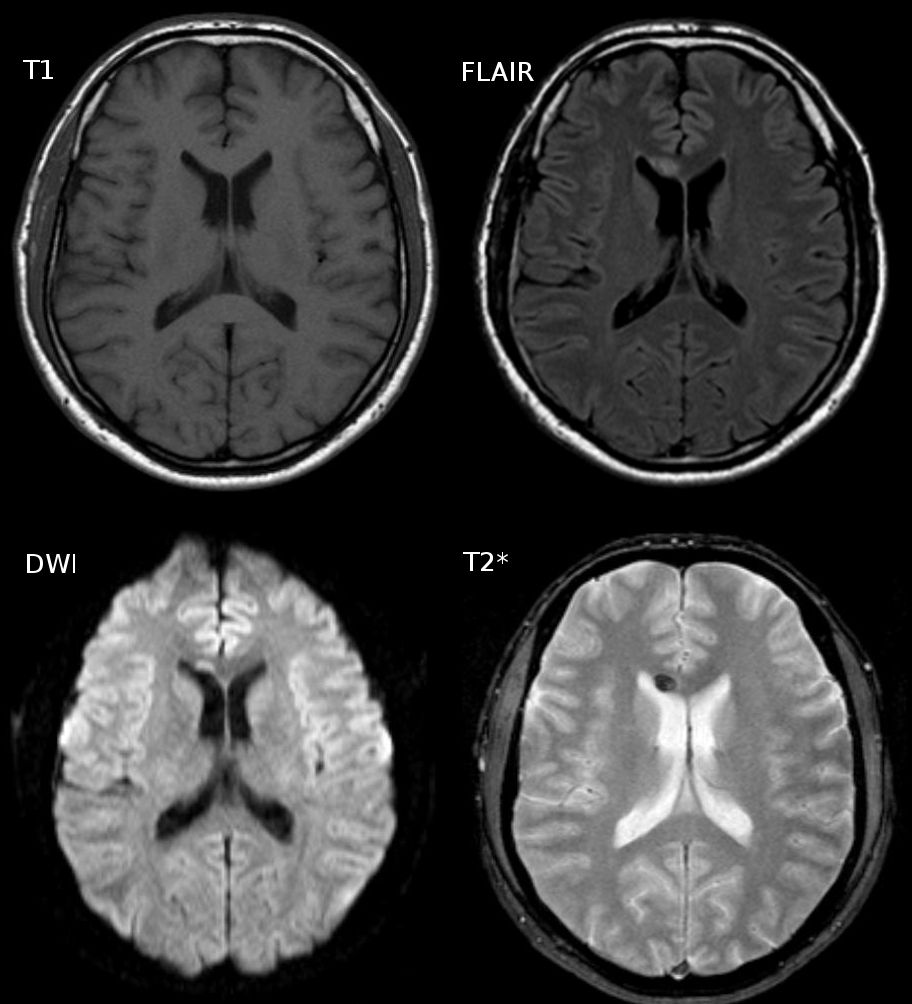
MRIBrain MRI, four sequences compared (T1, FLAIR, DWI, T2 star): paramedian diffuse axonal injury, punctate haemorrhage visible on FLAIR and DWI, best on T2 star, and no longer visible on T1.
Source : Hellerhoff, Wikimedia Commons · CC BY-SA
How is concussion defined and who is most affected?
The sport-related concussion (SRC) is defined by the Amsterdam 2022 consensus as a mild traumatic brain injury induced by biomechanical forces transmitted to the head, neck or trunk. It shows up as the rapid onset of a brief alteration in neurological function, which resolves spontaneously in most cases.¹ SRC is a subset of mild traumatic brain injury (mTBI); the two terms are often used interchangeably, although SRC implies a specific sporting context. From an epidemiological point of view, contact sports (rugby, ice hockey, American football, boxing, MMA) and sports carrying a risk of falling (cycling, equestrian sports, snow sports) account for the bulk of cases. In adults, around 90 % of SRCs resolve within 14 days ; in adolescents, that period frequently extends to 4 weeks.¹ Women show significantly longer recovery times than men at equivalent exposure, a robust phenomenon whose mechanisms (hormonal, cervical biomechanics, symptom reporting) remain debated.¹- SRC = mild traumatic brain injury of biomechanical origin, a clinical diagnosis (no routine imaging).
- 90 % resolution within ≤ 14 days (adults), 4 weeks (adolescents), longer recovery in women.
- A history of concussion = the main risk factor for recurrence and for prolonged recovery.
What happens in the brain? The neurometabolic cascade and natural history
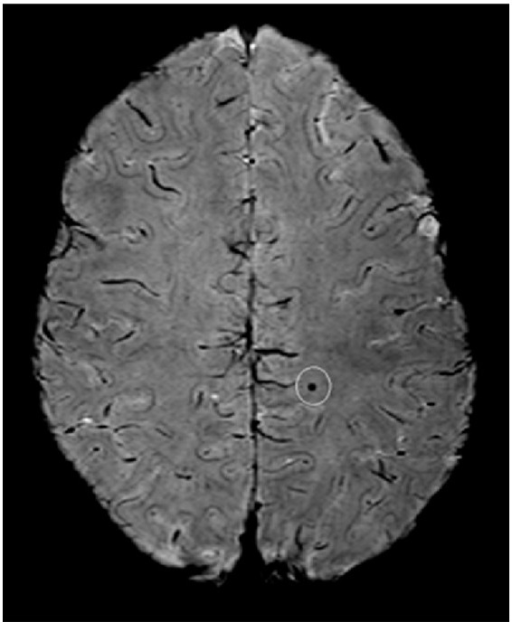
MRIBrain MRI, susceptibility-weighted imaging (SWI) sequence: a small circled deposit of haemosiderin, a sequela of traumatic microhaemorrhage after complicated mild traumatic brain injury.
Source : Iverson et al., Rehabilitation research and practice, 2012, figure 1 · CC BY
Bibliography
- Patricios JS, Schneider KJ, Dvorak J, et al. Consensus statement on concussion in sport: the 6th International Conference on Concussion in Sport-Amsterdam, October 2022. Br J Sports Med. 2023;57(11):695-711. PMID 37316210.
- Giza CC, Hovda DA. The new neurometabolic cascade of concussion. Neurosurgery. 2014;75(Suppl 4):S24-S33. PMID 25232881.
- McCrory P, Meeuwisse W, Dvorak J, et al. Consensus statement on concussion in sport — the 5th international conference on concussion in sport held in Berlin, October 2016. Br J Sports Med. 2017;51(11):838-847. PMID 28446457.
How can concussion be assessed and diagnosed with confidence?
Which tools should be used to assess a concussion? SCAT6, BESS and cervical tests
The SCAT6 (Sport Concussion Assessment Tool, 6th edition), published in the Amsterdam 2022 consensus, is the standard reference tool for the acute and subacute assessment of SRC.¹ It comprises several sections: immediate recognition (with red flags), symptom assessment (22 items scored 0-6), cognitive orientation, immediate and delayed memory, balance and coordination, and neurological tests. For the public and non-medical staff, the CRT6 (Concussion Recognition Tool 6) provides a simplified guide to recognition and referral.¹ Assessment of balance classically rests on the BESS (Balance Error Scoring System): 3 stances (double leg, dominant leg, tandem) on 2 surfaces (firm ground, foam), each for 20 seconds, counting the errors (maximum total 60). The modified BESS (mBESS, 3 stances on firm ground only) is built into the SCAT6.¹ The cervical examination is essential and too often neglected: it includes assessment of active range of motion (flexion/extension, rotations, side flexion), palpation of the suboccipital muscles and trapezius, and the search for reproducible pain suggesting a cervicogenic component. The vestibulo-oculomotor tests (smooth pursuit, horizontal and vertical saccades, vergence, VOR, vestibulo-ocular reflex, gaze stabilisation) complete the assessment and point towards specific rehabilitation where abnormalities are found.¹How can concussion be told apart from associated conditions (cervicogenic, vestibular)?
SRC is frequently accompanied by associated conditions that must be recognised in order to guide treatment:- Cervicogenic component : headache of cervical origin, cervicogenic dizziness (triggered by head movements, with altered cervical proprioception), neck pain reproducible on palpation. A full cervical examination (palpation, range of motion, provocation tests) is essential.¹
- Central or peripheral vestibular dysfunction : rotatory vertigo, unsteadiness, abnormalities of the VOR or of gaze stabilisation. The VOMS (Vestibular/Ocular Motor Screening) test is useful for screening.¹
- Oculomotor dysfunction : difficulty reading, eye strain, abnormalities of vergence or saccades.
- Psycho-affective component : anxiety, depression, sleep disturbance, often underdiagnosed but correlated with prolonged recovery.²
- SCAT6 = the standard assessment tool (symptoms, cognition, balance, oculomotor function).
- BESS for balance, VOMS for vestibulo-ocular function, a systematic cervical examination.
- Identifying the dominant phenotype (cervical, vestibular, oculomotor, cognitive, anxiety/migraine) guides targeted rehabilitation.
Bibliography
- Patricios JS, Schneider KJ, Dvorak J, et al. Consensus statement on concussion in sport: the 6th International Conference on Concussion in Sport-Amsterdam, October 2022. Br J Sports Med. 2023;57(11):695-711. PMID 37316210.
- McCrory P, Meeuwisse W, Dvorak J, et al. Consensus statement on concussion in sport — the 5th international conference on concussion in sport held in Berlin, October 2016. Br J Sports Med. 2017;51(11):838-847. PMID 28446457.
Which treatment strategies are most effective for concussion?
Relative or active rest? What does the research say?
The historical view of prolonged strict rest (« cocooning ») as the reference treatment for concussion is today obsolete. The systematic review by Schneider et al. (2017, BJSM), commissioned for the Berlin consensus, concludes that relative rest of 24 to 48 hours is sufficient in the acute phase, and that a gradual return to activity (cognitive and subthreshold physical) from 48 h improves outcomes compared with prolonged rest.¹ The proposed mechanism: prolonged rest induces physiological deconditioning, avoidance-related anxiety, sleep disturbance and kinesiophobia which paradoxically prolong symptoms. A return to controlled activity, by contrast, stimulates neurometabolic and psychological recovery.¹Subthreshold aerobic exercise: the Leddy revolution
The landmark randomised trial by Leddy et al. (2019, JAMA Pediatrics) transformed management by showing that symptom-limited subthreshold aerobic exercise, prescribed as early as 2-10 days after concussion in adolescent athletes, significantly shortens recovery.² The protocol rests on the Buffalo Concussion Treadmill Test (BCTT) : a graded treadmill exercise test to determine the threshold at which symptoms appear (heart rate threshold, HRt). The patient is then prescribed daily exercise (20 min, 5-6 days a week) at 80-90 % of the HRt, to be increased gradually. Results: the aerobic exercise group recovered in a median of 13 days against 17 days for the cervical stretching group (HR 0.52; 95 % CI 0.33-0.80; p = 0.009), with no increase in adverse effects and no worsening of symptoms.² This protocol is now built into the Amsterdam 2022 consensus as a high-level-evidence intervention for persistent SRC or SRC at risk of becoming prolonged.Cervicovestibular and oculomotor rehabilitation
The pivotal randomised trial by Schneider et al. (2014, BJSM) demonstrated the added value of combined cervicovestibular rehabilitation in patients with persistent symptoms (neck pain, headache or dizziness) after sport-related concussion.³ Method : 31 patients (12-30 years) with symptoms persisting > 10 days randomised into two groups (intervention vs watchful control). The intervention comprised cervical manual therapy (mobilisations, manipulations), cervical exercises (motor control, endurance), vestibular rehabilitation (habituation, VOR exercises, gaze stabilisation) and balance exercises, over 8 weeks. Results : 73 % (11/15) of patients in the intervention group were medically cleared to return to sport at 8 weeks, against 7 % (1/14) in the control group (adjusted RR: 3.91 ; 95 % CI 1.34-11.34; p = 0.002). These results, although in a small sample, remain among the most striking in post-concussion rehabilitation and feature in the Amsterdam 2022 recommendations.³| Intervention | Timing | Level of evidence | Pivotal reference |
|---|---|---|---|
| Patient education (information, reassurance, plan) | From day 0 | High | Patricios 2023 |
| Relative rest 24-48 h then gradual return | Day 0-2 | High | Schneider 2017 |
| Subthreshold aerobic exercise (BCTT-guided) | Day 2-10 | High | Leddy 2019 |
| Cervicovestibular rehabilitation if symptoms persist | ≥ day 10 | Moderate | Schneider 2014 |
| Cognitive behavioural therapy (PCS) | ≥ 4 wks | Moderate | Patricios 2023 |
| Pharmacology (melatonin, painkillers) | Symptomatic | Low (symptomatic) | Patricios 2023 |
| Prolonged strict rest (« cocooning ») | — | Not recommended | Schneider 2017 |
- Strict rest obsolete : 24-48 h max, then a gradual return (Schneider 2017).
- Subthreshold aerobic exercise from day 2-10: median 13 days vs 17 days (Leddy 2019).
- Cervicovestibular rehabilitation if symptoms persist > 10 days: ×3.91 chance of returning to sport (Schneider 2014).
- No specific pharmacological treatment is validated.
Bibliography
- Schneider KJ, Leddy JJ, Guskiewicz KM, et al. Rest and treatment/rehabilitation following sport-related concussion: a systematic review. Br J Sports Med. 2017;51(12):930-934. PMID 28341726.
- Leddy JJ, Haider MN, Ellis MJ, et al. Early Subthreshold Aerobic Exercise for Sport-Related Concussion: A Randomized Clinical Trial. JAMA Pediatr. 2019;173(4):319-325. PMID 30715132.
- Schneider KJ, Meeuwisse WH, Nettel-Aguirre A, et al. Cervicovestibular rehabilitation in sport-related concussion: a randomised controlled trial. Br J Sports Med. 2014;48(17):1294-1298. PMID 24855132.
- Patricios JS, Schneider KJ, Dvorak J, et al. Consensus statement on concussion in sport: the 6th International Conference on Concussion in Sport-Amsterdam, October 2022. Br J Sports Med. 2023;57(11):695-711. PMID 37316210.
How can lasting recovery and return to sport be secured?
The six-stage return-to-sport protocol
The Berlin 2016 consensus (McCrory 2017) and then Amsterdam 2022 (Patricios 2023) set out a graded return-to-sport (RTP) protocol in 6 stages, each separated by a minimum of 24 symptom-free hours. Any return of symptoms requires going back to the previous stage.¹٬²| Stage | Activity | Objective |
|---|---|---|
| 1 | Symptom-free daily activities | Allow a return to daily activities (reading, limited screen time, walking). |
| 2 | Light aerobic exercise (brisk walking, stationary bike) | Raise the heart rate (≤ 70 % max HR), no head movement. |
| 3 | Sport-specific exercise (running, light skating) | Add movement, no impact or contact. |
| 4 | Non-contact training | Technical drills, coordination, increased cognitive load. |
| 5 | Contact training (after medical clearance) | Return to full team training. |
| 6 | Return to competition | Normal return after medical clearance. |
What are the factors predicting prolonged recovery?
The systematic review by Iverson et al. (2017, BJSM) identifies several factors predicting prolonged recovery after SRC, useful for clinical stratification from the initial assessment onwards:³- Initial symptom severity (a high symptom score on the SCAT): the most robust predictor.
- A history of previous concussion(s).
- Female sex : longer recovery at equivalent exposure.
- Young age (adolescents > adults).
- Personal history : migraine, anxiety or depressive disorders, learning difficulties, ADHD.
- Marked initial cognitive or vestibular/oculomotor symptoms.
- The RTP protocol in 6 stages (Berlin/Amsterdam): ≥ 24 h per stage, stop if symptoms appear.
- Return to Learn before Return to Play : school and cognitive activity come before sport.
- Factors predicting prolonged recovery (Iverson 2017): initial severity, a history of concussion, female sex, young age, comorbidities (migraine, anxiety).
Bibliography
- Patricios JS, Schneider KJ, Dvorak J, et al. Consensus statement on concussion in sport: the 6th International Conference on Concussion in Sport-Amsterdam, October 2022. Br J Sports Med. 2023;57(11):695-711. PMID 37316210.
- McCrory P, Meeuwisse W, Dvorak J, et al. Consensus statement on concussion in sport — the 5th international conference on concussion in sport held in Berlin, October 2016. Br J Sports Med. 2017;51(11):838-847. PMID 28446457.
- Iverson GL, Gardner AJ, Terry DP, et al. Predictors of clinical recovery from concussion: a systematic review. Br J Sports Med. 2017;51(12):941-948. PMID 28566342.
What do real case reports teach us about concussion?
Two case reports illustrating multimodal management
Case 1: A 24-year-old athlete with persistent post-concussion symptoms treated with multimodal manual therapies
The case report published in Frontiers in Neurology (2021) documents the management of a 24-year-old athlete with persistent post-concussion symptoms (headaches, dizziness, neck pain) beyond the usual time to resolution. The multimodal approach combined cervical manual therapy (joint mobilisations, soft-tissue techniques), vestibulo-oculomotor rehabilitation (habituation, VOR exercises, gaze stabilisation) and a graded return to activity. The case report describes complete resolution of symptoms and a return to sport, illustrating the clinical value of a multidimensional approach targeted at the dominant phenotypes.¹Case 2: A patient with post-concussion syndrome treated with neuromotor retraining
A second case report (2021) explores the value of neuromotor retraining alongside manual therapy and vestibular rehabilitation in a patient with persistent post-concussion syndrome. The programme included cervical motor control exercises, postural perturbations and dual cognitive-motor tasks, showing progressive improvement in vestibular and cervicogenic symptoms.² These two cases illustrate a consensus principle: managing persistent post-concussion syndrome cannot be one-dimensional. It must simultaneously target the dominant phenotypes identified at assessment (cervical, vestibular, oculomotor, cognitive, anxiety, migraine), with gradual intensification below the symptom threshold.Critical differential diagnoses not to be missed
Any post-traumatic assessment must consider the critical differential diagnoses, some of which are life-threatening emergencies:- Intracranial haemorrhage (subdural or extradural haematoma): progressive headache, vomiting, deteriorating consciousness, focal neurological deficit → urgent imaging.
- Subarachnoid haemorrhage : explosive « thunderclap » headache → urgent imaging (non-contrast CT).
- Cervical arterial dissection (carotid or vertebral): violent unilateral neck pain, headache, Horner’s syndrome, ischaemic stroke → MR or CT angiography.
- Cervical fracture with or without spinal cord involvement: pain, stiffness, neurological deficit → cervical immobilisation and imaging.
- Post-traumatic migraine : throbbing headache with possible aura, a history of migraine.
- BPPV (benign paroxysmal positional vertigo) : brief rotatory vertigo triggered by changes in head position → Epley manoeuvre.
- Post-concussion syndrome (PCS): symptoms persisting > 3 months, with no structural lesion.
Bibliography
- Case report. Manual therapies promote resolution of persistent post-concussion symptoms in a 24-year-old athlete. Front Neurol. 2021. PMC 7829464.
- Case report. The Utility of Neuromotor Retraining to Augment Manual Therapy and Vestibular Rehabilitation in a Patient with Post-Concussion Syndrome. 2021. PMC 7872469.
- Patricios JS, Schneider KJ, Dvorak J, et al. Consensus statement on concussion in sport: the 6th International Conference on Concussion in Sport-Amsterdam, October 2022. Br J Sports Med. 2023;57(11):695-711. PMID 37316210.
How can these recommendations be applied in your practice?
When to refer urgently? Red flags in concussion
Immediate recognition of the red flags is the first non-negotiable skill of anyone involved (clinician, coach, therapist, pitch-side physiotherapist). Their presence requires immediate removal from play and urgent medical referral (emergency services, hospital emergency department).¹🚩 Red flags requiring urgent referral
- Explosive « thunderclap » headache or progressive, intense headache → suspected subarachnoid or intracranial haemorrhage.
- Prolonged loss of consciousness (> 1 minute) or recurrent loss of consciousness.
- Repeated vomiting (≥ 2 episodes).
- Seizures or abnormal movements.
- Focal neurological deficits : hemiplegia, aphasia, unequal pupils, visual disturbance, severe ataxia.
- Progressive deterioration in level of consciousness (falling GCS).
- Suspected cervical spine injury : severe neck pain, limb paraesthesia → strict cervical immobilisation before any movement.
- High-energy mechanism : a fall from height, violent impact, suspected skull base fracture (CSF from the ear or nose, bruising behind the ear or bilateral periorbital bruising).
- Marked behavioural disturbance, persistent confusion or prolonged disorientation.
⚠️ Any red flag → stop immediately, call the emergency services, do not return the player to play, do not move them if spinal injury is suspected. Urgent imaging (brain CT ± cervical spine).
Measuring outcomes and working in a multidisciplinary team
Standardised outcome measurement is essential. The most widely used validated PROMs are:- RPQ (Rivermead Post-Concussion Symptoms Questionnaire): 16 items, score 0-64, for longitudinal follow-up.
- PCSI (Post-Concussion Symptom Inventory): versions adapted by age (child, adolescent, adult).
- SCAT6 symptom severity score: built into the SCAT, 22 items × 6 = score 0-132.
- HIT-6 (Headache Impact Test) where headaches predominate.
- DHI (Dizziness Handicap Inventory) where dizziness predominates.
- Recognising the red flags = a non-negotiable skill (thunderclap headache, repeated vomiting, focal deficit, altered consciousness).
- Measure with validated PROMs: RPQ, PCSI, SCAT6 symptom score.
- Work in a multidisciplinary team : sports physician + neuropsychologist + ENT specialist + physiotherapist.
- The physiotherapist has a central role in coordination, in the cervical and vestibular phenotypes and in the graded return to exertion.
Bibliography
- Patricios JS, Schneider KJ, Dvorak J, et al. Consensus statement on concussion in sport: the 6th International Conference on Concussion in Sport-Amsterdam, October 2022. Br J Sports Med. 2023;57(11):695-711. PMID 37316210.
- McCrory P, Meeuwisse W, Dvorak J, et al. Consensus statement on concussion in sport — the 5th international conference on concussion in sport held in Berlin, October 2016. Br J Sports Med. 2017;51(11):838-847. PMID 28446457.
- Iverson GL, Gardner AJ, Terry DP, et al. Predictors of clinical recovery from concussion: a systematic review. Br J Sports Med. 2017;51(12):941-948. PMID 28566342.
And after this article?
This article is part of a collection of evidence-based clinical syntheses. A question, a comment, a correction to suggest? Contact us directly through the WhatsApp button at the bottom right of the screen.