











In brief
We look at the surgical construct, and we pick the wrong variable. The large trials that varied surgery did not shift mortality ; the time to first standing does shift it. This article deals with hip fracture in the older adult, a traumatic emergency in a frail patient. For the elective total hip replacement, for hip osteoarthritis, in a patient who chose the date of the operation, the dedicated article is rehabilitation after total hip replacement : neither the same population, nor the same urgency, nor the same rehabilitation. For the bone background, see osteoporosis and the prevention of fragility fractures.
Clinical summary based on the Danish hip fracture registry (36,229 patients, 2025), the HIP ATTACK trial in the Lancet (2020) on accelerated surgery, the HEALTH trial in the New England Journal of Medicine (2019), the Cochrane review on exercise and falls prevention (2019) and the meta-analysis on undernutrition and outcome after hip fracture (2024): 62 references checked one by one on PubMed.
Clinical summary
Two results that are rarely quoted together have to be set side by side, because their juxtaposition changes the hierarchy of priorities. HIP ATTACK randomised 2,970 patients in 69 hospitals across 17 countries between accelerated surgery, aiming for theatre within six hours, and usual care. The median delay was indeed 6 hours versus 24. Mortality at 90 days: 9 % versus 10 %, hazard ratio 0.91, interval 0.72 to 1.14. Major complications: 22 % in both arms (PMID 32050090). Bringing theatre forward by eighteen hours shifted nothing.
The Danish registry, covering 36,229 patients aged 65 and over operated on between 2016 and 2021, measures the other variable. The weighted risk of death at 30 days is 9.67 % when the first mobilisation takes place between 24 and 36 hours after entering theatre, versus 8.00 % when it takes place within 24 hours : a risk difference of 1.67 points, a hazard ratio of 1.22, interval 1.07 to 1.38. And the effect does not stop at 24 hours: mobilising between 12 and 24 hours rather than within the first 12 still gives a ratio of 1.25 (PMID 40658456).
These are observational data, therefore weighted and not randomised. But the randomised trial that varied surgery found nothing, whereas the observation that varies mobilisation finds something in every analysis. The hierarchy of priorities follows from that.
The most likely mechanism is infectious, and it has been measured separately. In the same cohort of 36,229 patients, the risk of hospital-treated infection within 30 days is 12.9 % among those mobilised between 24 and 36 hours, versus 10.9 % among those mobilised within 24 hours, with comparable associations for pneumonia and urinary tract infection, but not for sepsis or reoperation (PMID 39838916). What the first mobilisation prevents is not the fracture: it is hypostatic pneumonia and urinary tract infection.
It is not only the delay that counts, it is the extent. A cohort of 701 patients scored what each of them achieved on the first postoperative day with the cumulated ambulation score, which rates from 0 to 6 the transfer out of bed, the sit-to-stand and indoor walking. Mortality at 30 days: 23.7 % among the 97 patients who could do nothing, versus 1.2 % among the 85 who scored 4 to 6 points. Each point gained goes with a reduction of 38 % in the risk of death, after adjustment for age, sex, place of residence, previous mobility, fracture type and anaesthetic score (PMID 38347704).
On the other two levers, the data are less spectacular but just as clear. Undernutrition multiplies by 3.42 the risk of death at one month and by 2.75 the risk of postoperative delirium, and at one year it further multiplies by 3.68 the risk of death and by 2.18 that of moving to a more medicalised place of residence (PMID 38613102). As for the next fracture, it occurs in 9.0 % of patients within the 24 months following a femoral neck fracture, including 4.5 % second hip fractures, at a median delay of nine months. And in these two large international cohorts, only 25.2 % of patients received bone treatment at any point in follow-up, even though the protocols prescribed it (PMID 36017942).
And for late rehabilitation, an honesty that is often missing is called for. The CAP trial randomised 210 patients aged 60 and over, unable to walk in the community, between multicomponent home-based rehabilitation and an active control. The proportion of patients able to cover 300 metres in six minutes at sixteen weeks: 22.9 % versus 17.8 %, a non-significant difference (PMID 31503309). What we know how to do, we do early. What we try to make up at three months is made up badly.
- Operating within six hours rather than twenty-four does not change mortality : the randomised trial of 2,970 patients is unequivocal.
- Mobilising beyond 24 hours goes with a risk of death at 30 days raised by 22 %, and with a risk of infection raised by 2 absolute points.
- A patient who achieves nothing on the first postoperative day has a 30-day mortality of 23.7 %, twenty times that of those who walk.
- The undernourished patient carries a 3.4 times higher risk of death at one month. Undernutrition is screened for in five minutes and rarely scored.
- An ensuing fracture occurs in 9 % of patients within two years, at a median of nine months, and three patients out of four leave without bone treatment.
- Late intensive rehabilitation has not proved its effect on community walking. The time that counts is the first day.
Why is a hip fracture not first of all a fracture?
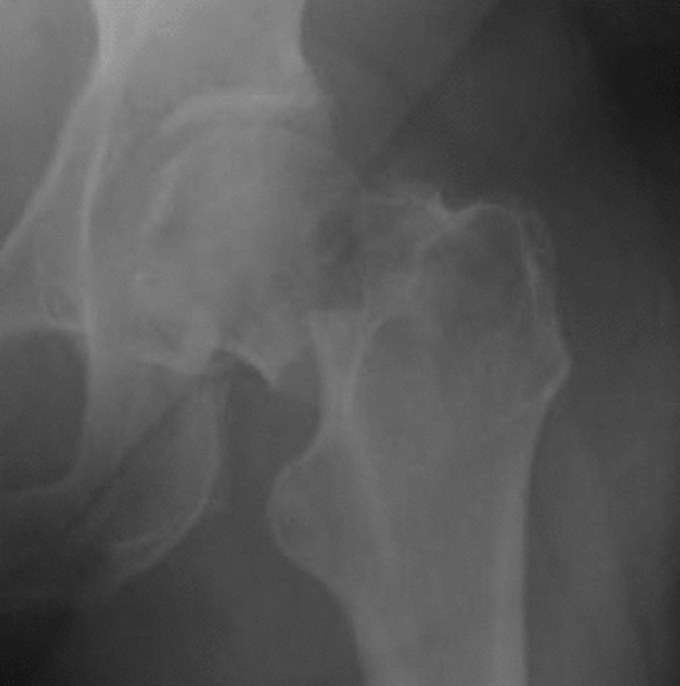
X-rayClose-up hip X-ray in a 75-year-old woman: displaced femoral neck fracture, with the head and neck misaligned relative to the shaft.
Source : Eskildsen et al., Arthroplasty Today, 2016, figure 1 · CC BY-NC-ND
The fracture line almost always heals. What kills is the week that follows, and what disables is the year. This chapter sets out the two anatomical territories, the scale of the phenomenon and the real mortality, which varies twofold depending on the population.
Two very different fractures hide under the same word. The true cervical fracture, intracapsular, sits between the femoral head and the base of the neck ; it interrupts a blood supply that runs up along the neck, which explains head necrosis and non-union, and argues for replacing rather than fixing as soon as displacement is frank. The trochanteric fracture, extracapsular, sits in a richly vascularised cancellous zone ; it heals well, is fixed with a sliding implant, and its problem is not bone biology but bleeding and loss of independence. The ICD-11 classification does separate the two territories cleanly, NC72.2 for the neck, NC72.3 for the trochanteric region.
| Criterion | True cervical fracture | Trochanteric fracture |
|---|---|---|
| Site | Intracapsular | Extracapsular |
| Blood supply | Compromised by displacement | Preserved, cancellous bone |
| Specific risk | Head necrosis, non-union | Bleeding, varus malunion |
| Usual treatment | Arthroplasty if displaced, internal fixation if undisplaced | Internal fixation with a sliding implant or a nail |
| What the rehabilitation professional takes from it | Replacement allows weight-bearing straight away ; fixation means following the surgical instruction | Weight-bearing is almost always allowed ; vigilance is for anaemia and orthostatic hypotension |
A mass phenomenon, and a growing one
The historical projection remains the reference for the order of magnitude: 1.7 million hip fractures worldwide in 1990, 6.3 million expected in 2050 through ageing alone, with an observation that has not aged either, only half of patients regain the mobility and independence they had twelve months before the fracture (PMID 9302894). A 2026 review updates it without contradicting it: worldwide incidence above 1.6 million a year, projected between 4.5 and 6.5 million in 2050, with femoral neck fractures accounting for about half of the total (PMID 41868737).
One-year mortality, and why it varies so much
The figure that gets quoted, « one death in three at one year », is true somewhere and false elsewhere. Published cohorts range from 16.6 % in 728 Italian patients followed prospectively (PMID 31822743) – 32.5 % in a Colombian series of 126 patients operated on in 2019 and 2020 (PMID 35945469). Between the two, a series of 212 North American hemiarthroplasties gives 29 % (PMID 35061652), and the largest database available, 476,469 patients from England and Wales, 30.3 % (PMID 39348896). A general review retains « up to 30 % » (PMID 36521464).
One-year mortality after hip fracture, six cohorts
The same diagnosis, twofold variation depending on country, age and organisation of care
Sources in order: Morri 2020, Sci Rep (PMID 31822743) ; Zrour 2025, Tunis Med (PMID 39748698) ; Gannon 2022, J Orthop Trauma (PMID 35061652) ; Nisar 2024, Bone Joint J (PMID 39348896) ; Duque-Sánchez 2022, Arch Osteoporos (PMID 35945469). The populations, the ages and the follow-up methods differ : this scatter is a fact to know, not a contradiction to settle.
This scatter has an immediate practical consequence. There is no « mortality figure » to announce to a family, and announcing one would be dishonest. What can be said, on the other hand, is which part of that range depends on us: how early the patient is got standing, the nutritional state and the organisation around the patient. The three chapters that follow each deal with one of them.
Two comorbidities that weigh more than the construct
The delirium rate reaches 14.6 % of the 27,888 hip fracture admissions in an Australian database, and delirium comes with a higher one-year mortality rate, independently of dementia status (PMID 28628893). The mode of anaesthesia weighs, but less than we imagine and not in the way we believe. In 107,028 patients from the British registry, spinal anaesthesia without sedation significantly reduces the risk of delirium compared with general anaesthesia, but only slightly, odds ratio 0.95, interval 0.92 to 0.98 ; it also increases the probability of mobilisation on the first day, odds ratio 1.06, and that of returning to the previous home, 1.04. Spinal anaesthesia with sedation, on the other hand, shows none of these advantages, and no difference in mortality appears between the groups (PMID 36154933). In other words : the overall equivalence between spinal and general anaesthesia hides a subgroup that does better, and it is sedation that makes the difference.
A history of stroke, often feared, does not change the prognosis once the fracture has happened. In 548 patients operated on, 77 of them with a history of stroke, one-year mortality and loss of mobility are comparable to those of the others, even though their previous mobility and their anaesthetic score were worse (PMID 24934871). In other words: the hemiplegic patient is not doomed to a worse result, he starts from lower down.
Red flags of the acute phase
- Hip pain and inability to bear weight after a fall, normal radiograph : occult fracture until proven otherwise, cross-sectional imaging or MRI.
- New confusion, reversed sleep-wake rhythm, hallucinations : delirium. Screen for it with the 4AT, look for pain, retention, infection and medication.
- Orthostatic hypotension, tachycardia, pallor on first standing : postoperative anaemia, occult bleeding from the trochanteric site.
- Calf pain, dyspnoea, desaturation : thromboembolic disease, the leading cause of avoidable death in this population.
- Hip pain that increases after a phase of improvement : implant failure, head necrosis, infection.
- Refusal to get up despite controlled pain : fear of falling or kinesiophobia, which are treated and not worked around.
- Two fractures under one word: the cervical, which threatens the blood supply to the head, and the trochanteric, which threatens haemoglobin.
- 1.6 million a year today, 4.5 to 6.5 million expected in 2050.
- Only half of patients regain their previous mobility : disability is the dominant outcome, not death.
- One-year mortality ranges from 16.6–32.5 % depending on the cohort. No single figure is honest.
- The delirium rate runs at one patient in seven and weighs on survival. Anaesthesia does not explain it.
What surgery decides, and what it does not
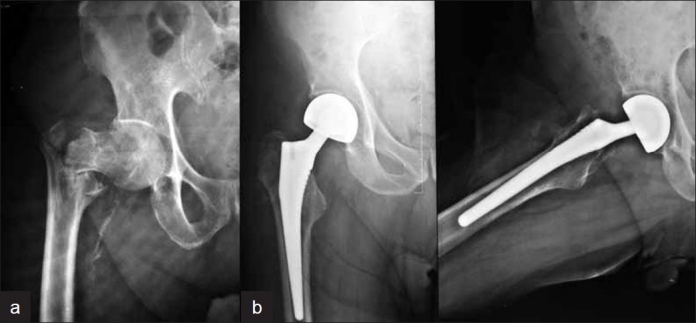
X-rayHip X-rays in a 73-year-old female patient: unstable intertrochanteric fracture before surgery, then cementless hemiarthroplasty after healing.
Source : Marya et al., Indian journal of orthopaedics, 2011, figure 2 · CC BY
Three international trials of more than a thousand patients each varied what the surgeon controls: the time of theatre, the type of implant, the type of prosthesis. None shifted mortality. This chapter summarises them, because it is by knowing what does not move that we identify what does.
The time of theatre: HIP ATTACK
The hypothesis was solid and supported by many observational studies: operating faster ought to save lives. HIP ATTACK tested it in 69 hospitals across 17 countries. Of 27,701 patients screened, 7,780 were eligible and 2,970 were randomised between accelerated surgery, aiming for theatre within six hours of diagnosis, and usual care. The contrast obtained is clear: median delay of 6 hours versus 24.
The two primary outcomes do not move. Mortality at 90 days: 140 deaths out of 1,487 patients, or 9 %, versus 154 out of 1,483, or 10 %, hazard ratio 0.91, interval 0.72 to 1.14, absolute reduction of 1 point with an interval of −1 to 3. Major complications, a composite that groups death, myocardial infarction, stroke, thromboembolic disease, sepsis, pneumonia and haemorrhage: 22 % in both arms (PMID 32050090).
This result does not say that the surgical delay is a matter of indifference. It says that between six and twenty-four hours, the hoped-for gain does not exist. Guidelines that set a limit at 24 or 48 hours keep their meaning, and a Japanese observational study of 175 patients shows that operating within 24 hours goes with a better postoperative cumulated ambulation score, with an adjusted coefficient of 1.36 points, interval 0.24 to 2.48. The caveat is instructive : the gain is clear in cognitively intact patients, 2.66 points, and absent in patients with dementia, 0.43 points with an interval that crosses zero (PMID 30502228). The lesson is more precise: chasing the six-hour mark buys nothing, and the energy spent that way would be better placed elsewhere.
The type of prosthesis: HEALTH
In patients aged 50 and over with a femoral neck fracture that is displaced and who were able to walk unaided before the fracture, 1,495 patients were randomised across 80 centres in 10 countries between total hip replacement and hemiarthroplasty. The primary outcome was reoperation within 24 months.
| Outcome at 24 months | Total hip replacement | Hemiarthroplasty | Reading |
|---|---|---|---|
| Hip reoperation | 57 out of 718, or 7.9 % | 60 out of 723, or 8.3 % | No difference, hazard ratio 0.95 |
| Instability or dislocation | 34, or 4.7 % | 17, or 2.4 % | Hazard ratio 2.00 against total hip replacement |
| Mortality | 14.3 % | 13.1 % | Identical |
| Serious adverse events | 300, or 41.8 % | 265, or 36.7 % | Frequent in both arms |
| Function, total WOMAC score | Modestly in favour of total hip replacement | Clinically negligible difference | |
The meta-analysis pooling 16 trials and 3,084 patients confirms and refines. No difference in reoperation at five years or in function at three years ; a higher quality of life for the total hip replacement, mean difference of 0.05 for a minimal important difference of 0.145, in other words a real advantage that does not reach the patient's threshold of perception ; and an operating time shorter by 22 minutes for hemiarthroplasty (PMID 32732709). For the rehabilitation professional, the consequence is direct: the choice of implant should not change the programme, with one exception, the monitoring for instability, twice as frequent after total hip replacement.
The type of implant: FAITH
In 1,108 patients aged 50 and over operated on for a low-energy hip fracture suitable for fixation, the sliding hip screw with a plate did no better than multiple cancellous screws: 20 % reoperations versus 22 % at 24 months, hazard ratio 0.83, interval 0.63 to 1.09. Avascular necrosis, on the other hand, is more frequent with the sliding hip screw, 9 % versus 5 %, hazard ratio 1.91 (PMID 28262269). The authors reserve a possible benefit of the sliding hip screw for smokers and for displaced or basicervical fractures.
Three trials, more than five thousand patients, three major surgical variables. None shifted mortality. That does not make surgery negligible: it means the room for progress lies elsewhere.
And when surgery is not the right answer
A Dutch multicentre study followed patients aged 70 and over, frail and living in institutions, with a femoral neck or pertrochanteric fracture, comparing surgical management with deliberate non-surgical management. It documents what actually becomes of the patient in each arm, with six months of follow-up in 25 hospitals, and it exists for a reason the authors state bluntly: avoiding surgical overtreatment in a population with a limited life expectancy (PMID 35234817). It is not a plea against surgery, it is a plea for shared decision-making in the situations where it has been skipped.
The classification, and why it is worth less than we think
The Garden classification traditionally decides between fixing and replacing. Its reliability stands up badly to measurement: across 150 images re-read by six surgeons of three levels of experience, the interobserver kappa for Garden ranges from 0.28 to 0.73, for a mean of 0.49 (PMID 35078436). And to judge the quality of a reduction, five scoring systems were compared with the plain global impression of eighteen observers: the best reach an intraclass correlation coefficient of 0.41 to 0.48, and none does better than the global impression, at 0.49 (PMID 19550226). The vocabulary is more precise than the measurement it carries, and that is useful to know when a report reads as categorical.
- HIP ATTACK : operating within 6 hours rather than 24 reduces neither mortality nor major complications.
- HEALTH : total hip replacement and hemiarthroplasty give the same reoperation rate and the same mortality ; the total hip replacement dislocates twice as often.
- FAITH : the sliding hip screw does not reduce reoperations and almost doubles head necrosis.
- The Garden classification has an interobserver agreement averaging 0.49, and no reduction score beats the global impression.
- The surgical construct should not change the rehabilitation programme, except for monitoring for instability after total hip replacement.
Why the first 24 hours weigh more than the construct
That is the thesis of this article, and it rests on a national cohort of 36,229 patients analysed twice, once for mortality and once for infections. This chapter gives the figures, the probable mechanism, and the reasons to be wary of them.
The Danish hip fracture registry included every patient aged 65 and over operated on between 2016 and 2021, that is 36,229 people, 67.3 % women, median age 82.6 years. The exposure measured is the number of hours between the start of the operation and the first mobilisation. The main comparison sets mobilisation between 24 and 36 hours against mobilisation within 24 hours, with inverse probability of treatment weighting to account for differences in patient background.
The weighted risk of death between the second and the thirtieth day is 9.67 % for mobilisation between 24 and 36 hours, versus 8.00 % within 24 hours. Risk difference: 1.67 points, interval 0.54 to 2.80. Hazard ratio: 1.22, interval 1.07 to 1.38. And the gradient does not stop at the 24-hour threshold: comparing mobilisation between 12 and 24 hours with mobilisation within the first 12 still gives a difference of 1.62 points and a ratio of 1.25, interval 1.12 to 1.39. The authors conclude by proposing to aim for 24 hours, or even earlier (PMID 40658456).
30-day mortality by the time of the first mobilisation
Risks weighted by inverse probability of treatment, Danish national registry
Sources: Kristensen 2025, J Gerontol A Biol Sci Med Sci, for mortality (PMID 40658456) ; Hjelholt 2025, Age Ageing, for the distribution in the same cohort (PMID 39838916). Weighted observational data, not randomised : they establish a strong association, not causation.
The most likely mechanism: infection, not the fracture
The same cohort, analysed for infections, gives the missing link. The risk of hospital-treated infection between the second and the thirtieth day is 12.9 % for mobilisation between 24 and 36 hours, versus 10.9 % within 24 hours, a risk difference of 2.0 points, a risk ratio of 1.2. The associations are comparable for pneumonia and urinary tract infection, but absent for sepsis and for reoperation for surgical site infection (PMID 39838916).
This dissociation is instructive. If the effect went through the quality of the surgical act, we would expect surgical site infection to move. It does not move. What moves are the two classic complications of bed rest. Mobilising early is therefore not about treating the hip: it is about stopping the lung and the bladder from paying for immobility. This formulation helps to convince a team, because it moves mobilisation out of the register of rehabilitation and into that of complication prevention.
What the systematic review confirms, and what it admits
A systematic review screened 24,507 articles to retain 20 studies, covering in total 317,173 patients over 60 years of age, including two randomised trials, five prospective studies and thirteen retrospective cohorts. Early mobilisation, defined here as within 48 hours of the operation, is associated with improvement in 29 of the 33 patient-reported outcomes and in 45 of the 51 clinical outcomes, including reduced postoperative complications, length of stay and mortality (PMID 40602785).
The authors also give the weakness of the file, and it has to be quoted: the definition of early mobilisation varies from one study and one health system to the next, and weight-bearing status is often unreported or ambiguously defined, which made any formal meta-analysis impossible. We therefore have a very broad and very consistent body of evidence, but no pooled estimate. That is exactly the kind of nuance a review article has to carry, rather than converting 45 out of 51 into certainty.
A North American figure completes the picture on a cruder but more telling outcome. Across 212 consecutive hemiarthroplasties for femoral neck fracture, all allowed full weight-bearing from day one, 62 % of patients were able to walk before discharge. Those patients have a one-year hazard ratio for death of 0.57, interval 0.34 to 0.94, that is a reduction of 43 % in risk, with no measured effect on readmission at 90 days (PMID 35061652).
The reading trap: these are observational data
- The patient who does not get up is often the one who was already doing badly. Inverse probability of treatment weighting corrects for what is measured (age, comorbidities, previous mobility, place of residence) and does not correct for what is not.
- The direction of causation is not proven. Not getting up may be an early symptom of the complication that will kill, as much as a cause of it.
- But the argument holds all the same, for a reason of method: the randomised trial that varied surgery found nothing, whereas every analysis that varies mobilisation finds something, in the same direction, on different outcomes and in different health systems.
- And the action carries no known risk. No study reports harm attributable to early mobilisation in this population, which makes the decision asymmetry very favourable.
How can what the patient actually did on the first day be measured?
« Mobilised » is an empty word: one can be sitting on the edge of the bed or have walked down the corridor. A three-item score, rated in one minute, separates those two situations and predicts thirty-day mortality better than any other bedside marker.
The cumulated ambulation score rates three basic activities, each from 0 to 2: the transfer out of bed, the sit-to-stand and indoor walking. Zero means unable, one means able with human help, two means independent, with or without a walking aid. The total runs from 0, patient confined to bed, to 6, patient who transfers, stands up and walks indoors unaided.
| Item | 0 points | 1 point | 2 points |
|---|---|---|---|
| Transfer out of bed | Unable | With human help | Alone, walking aid allowed |
| Sit-to-stand | Unable | With human help | Alone, walking aid allowed |
| Indoor walking | Unable | With human help | Alone, walking aid allowed |
In a consecutive series of 701 patients aged 65 and over, of whom 80 % came from their own home and 49 % had a trochanteric fracture, the score was recorded on the first postoperative day. 86 % were mobilised at least to standing or to a chair, that is a score of at least 1. The distribution and the mortality that follows from it are the most useful figures in this chapter.
What the patient achieves on day 1, and what becomes of him at 30 days
701 consecutive patients, cumulated ambulation score recorded on the first postoperative day
Source: Kristensen 2024, Clin Rehabil, 701 consecutive patients (PMID 38347704). The numbers, the two extreme mortality figures and the total of 61 deaths out of 701 are those of the publication ; the value for the middle group, 37 deaths out of 519, is obtained by difference and is not reported as such by the authors.
After adjustment for age, sex, place of residence, the pre-fracture ambulation score, the fracture type and the anaesthetic score, each additional point goes with a 38 % reduction in the risk of death at 30 days, hazard ratio 0.63, interval 0.50 to 0.78. The authors explicitly propose that national registries replace their binary indicator, mobilised or not, with this score, which captures the extent of what was achieved (PMID 38347704).
Two remarks for use. First, this score is not a therapeutic target : aiming for 6 in everyone would make no sense, and pushing a patient beyond what he can do on the day is not what the data support. It is a marker of severity, and its value is to turn an impression into a transmissible piece of data. Second, a score of 0 on the first day is a warning signal, not a fatality: it must trigger a search for a treatable cause, poorly controlled pain, anaemia, delirium, hypotension, urinary retention, before being accepted.
Finally, interventions that explicitly target adherence to guidelines produce a modest but real effect. A meta-analysis of ten studies evaluating clinical pathways, orthogeriatric models, audit and feedback or pay for performance finds an effect of 0.47 in standardised difference on the surgical delay and of 0.33 on early mobilisation, with substantial heterogeneity (PMID 41131507). In other words, the time to first mobilisation is not a fixed feature of a ward: it moves when it is measured and made visible.
- The cumulated ambulation score rates three transfers, from 0 to 6, in less than a minute.
- A score of 0 on the first day goes with a 30-day mortality of 23.7 % ; a score of 4 to 6, of 1.2 %.
- Each point gained is worth 38 % less risk of death, after adjustment.
- It is a marker of severity, not a target to reach : a low score triggers an investigation, not insistence.
- Organisations that measure and display this delay really do shorten it.
Undernutrition, the risk factor nobody scores
It multiplies by three and a half the risk of death at one month, it is screened for in five minutes with a free questionnaire, and it rarely appears in the physiotherapy record. This chapter gives the figures, the tool, and what supplements really contribute, which is more modest than was hoped.
The most complete meta-analysis on this point retained 14 studies linking a validated nutritional score to the outcomes of a hip fracture in older adults. The overall result fits in one sentence: undernutrition increases the risk of every adverse outcome analysed by 70 % at one month, and by up to 250 % at one year (PMID 38613102).
What undernutrition multiplies, after a hip fracture
Odds ratios and 95 % confidence intervals, meta-analysis of 14 studies
Source: Chiavarini 2024, Nutrients, random-effects meta-analysis of 14 studies (PMID 38613102). The nutritional scores pooled are the MNA, the GNRI, the PNI and the CONUT : these are not the same instruments, and the heterogeneity that follows is the main limitation of this synthesis.
Screening fits on one page
The instrument most used in this work is the short form of the Mini Nutritional Assessment, scored out of 14 points: 0 to 7 indicates undernutrition, 8 to 11 a risk, 12 to 14 a satisfactory nutritional state. In 415 consecutive patients of an Italian orthogeriatric unit, mean age 84 years, this three-class stratification predicts postoperative delirium in multivariate analysis: 78 patients were undernourished, 185 at risk and 152 well nourished (PMID 28263371).
A Danish cohort of 2,800 patients operated on consecutively under a single protocol confirms the place of this factor among 19 candidates, insisting on a methodological point that justifies the attention paid to it: research has long concentrated on risk factors that are static, such as age or sex, whereas better outcomes come through those that can be optimised. Undernutrition, defined by a low body mass index or a low serum albumin, is one of them, alongside previous function and comorbidities (PMID 34854063).
Undernutrition, moreover, never comes alone. It overlaps with sarcopenia and with frailty, three entities that share mechanisms and consequences, and that remain poorly recognised by carers even though targeted interventions significantly improve postoperative outcomes (PMID 33291800). The extent of the overlap is spectacular: the prevalence of osteosarcopenia, the association of osteoporosis and sarcopenia, is estimated at between 17.1 and 96.3 % in patients with a hip fracture depending on the criteria used, versus 5 to 37 % in older people living at home (PMID 32202056). A range that wide says above all that the definition is not settled ; it says no less that the patient sitting in front of us is probably affected.
And nutritional supplements? The honest answer is disappointing
The Cochrane review devoted to nutritional supplementation after hip fracture is the best antidote to enthusiasm. Its conclusions, all of them attached to low or very low certainty:
- The oral multinutrient supplements started before or just after surgery may prevent complications in the first twelve months, but have no clear effect on mortality.
- Increasing protein intake has no clear effect on mortality, relative risk 1.42 with an interval of 0.85 to 2.37, and very low and contradictory evidence of a reduction in adverse outcomes, relative risk 0.78, interval 0.65 to 0.95, from two trials only.
- The enteral feeding tube has no demonstrated effect and is poorly tolerated.
- B group vitamins, vitamin D at various doses, iron, ornithine, taurine: no clear effect.
- The only notable favourable signal concerns human help at mealtimes : one trial suggests that a dietetic assistant reduces mortality, 19 deaths out of 145 versus 36 out of 157, relative risk 0.57, interval 0.34 to 0.95 (PMID 27898998).
The only nutritional result that comes close to significance is not about a product, but about someone who sits next to the patient while he eats.
The practical conclusion is therefore not to prescribe supplements and consider the matter closed. It is to identify undernutrition, pass it on and watch actual intake. A physiotherapist is often the professional who spends the most time with the patient during the day : he sees the meal tray come back untouched, and that is clinical information.
- Undernutrition multiplies by 3.42 the risk of death at one month, by 2.75 that of delirium and by 3.68 the risk of death at one year.
- The short-form MNA stratifies into three classes out of 14 points and predicts postoperative delirium.
- It almost always overlaps with sarcopenia : up to 96 % of patients depending on the criteria.
- Oral supplements have a weak and uncertain effect on complications, and none on mortality.
- What carries the clearest signal is human help at mealtimes. Observing and reporting actual intake is part of the job.
Preventing the next fall
This is the only chapter of this article where evidence of high certainty is available, on more than twenty thousand participants, and where the effective intervention is precisely the one we deliver. This chapter gives its size, its form and its dose.
The Cochrane review on exercise and falls prevention in community-dwelling older people included 108 randomised trials and 23,407 participants in 25 countries, of mean age 76 years and female in 77 % of cases. Compared with a control, exercise in all its forms reduces the rate of falls by 23 %, rate ratio 0.77, interval 0.71 to 0.83, across 59 studies and 12,981 participants, at high certainty. Applied to an illustrative risk of 850 falls per 1,000 people followed for a year, that represents 195 falls avoided (PMID 30703272).
What exercise avoids, in community-dwelling older people
Rate ratios and risk ratios, with their 95 % confidence intervals. To the left of the line, exercise protects.
Source: Sherrington 2019, Cochrane Database Syst Rev, 108 trials and 23,407 participants (PMID 30703272). The certainty levels are those assigned by the authors. The review covers older people living at home, not specifically patients operated on for a hip fracture : the transposition is reasonable, it is not demonstrated.
Which exercise, delivered by whom, and at what dose
The abridged version published in the British Journal of Sports Medicine makes clear what the full review allows us to say about form. Three results govern practice. First, not all forms of exercise are equal : it is balance and functional exercises that reduce the rate of falls. Next, the effect is greater when the intervention is delivered by a healthcare professional, most often a physiotherapist. Finally, no difference appears depending on whether the trial selected people at risk of falling or not, on age beyond 75 years, or between group and individual sessions (PMID 31792067).
The update carried out for the World Health Organization guidelines takes the corpus to 116 studies and 25,160 participants and explores the dose-response relationship (PMID 33239019). A secondary analysis of the same corpus looked at what governs the benefit in practice, adherence: across 102 studies and 136 supervised interventions, it links adherence to participant characteristics and to intervention components, and it recalls that the benefit is more marked when adherence is better (PMID 40973057). It is an apparent truism with a concrete consequence: a perfect programme that is abandoned is worth less than a decent programme that is followed.
- Exercise reduces the rate of falls by 23 % at high certainty, and the number of fallers by 15 %.
- On fall-related fractures, the risk ratio is 0.73, at low certainty: the direction is right, the precision limited.
- It is balance and functional exercises that carry the effect, not activity in general.
- The effect is greater when a healthcare professional delivers the intervention. It is one of the rare places where the literature explicitly names our added value.
- Neither advanced age nor the group format reduces the benefit.
Preventing the next fracture
A femoral neck fracture is the best known predictor of the fracture of the months that follow, and it is also the moment when the care system fails most. Three figures are enough to show it.
The pre-specified analysis of 2,520 patients from two prospective trials conducted across 90 sites and five continents gives the cleanest data on this point. Within the 24 months following a femoral neck fracture: 226 patients, or 9.0 %, sustain at least one new fragility fracture, including 113 hip fractures, or 4.5 %. The median interval between the initial fracture and the next is about nine months. And the conclusion the authors put forward: only 25.2 % of patients, that is 634 out of 2,520, report having taken a bone treatment at any point in follow-up, even though the two trial protocols carried an explicit instruction to that effect (PMID 36017942).
After a femoral neck fracture: the next fracture, and the treatment that is missing
Two international prospective trials, 2,520 patients followed for 24 months
Source: Bogoch 2022, J Bone Joint Surg Am, pre-specified analysis of the cohorts of two randomised trials (PMID 36017942). The green square represents the treated proportion : it is a representation, not an individual count.
This is not peculiar to trials. Among 377,561 women aged 65 and over insured by Medicare who sustained a fracture, 10 % sustain another within a year, 18 % within two years and 31 % within five years. The authors conclude that management without delay is justified after all non-traumatic fractures, including those that involve neither the hip nor the spine (PMID 30456571).
What can be set against it, and what works
The HORIZON trial for the prevention of recurrent fractures randomised 2,127 patients, of mean age 74.5 years, between an annual infusion of zoledronic acid 5 mg and a placebo, the first being given within 90 days of the surgical repair of a hip fracture. All received calcium and vitamin D. Over a median follow-up of 1.9 years, the rate of new clinical fracture is 8.6 % versus 13.9 %, that is a relative reduction of 35 %, and the rate of new clinical vertebral fracture 1.7 % versus 3.8 % (PMID 17878149).
Two classic objections have been lifted by secondary analyses of the same trial. The first, the bisphosphonate risks delaying healing : no association was found between the timing of the infusion and delayed healing, including for infusions given in the immediate postoperative period (PMID 21153021). The second, a bone density scan is needed first : antifracture efficacy is independent of the bone mineral density of the neck and of the total hip before treatment, whether it is analysed as a continuous variable or dichotomised at the −2.5 threshold (PMID 33903925). Waiting for the bone density scan before treating is therefore not supported by the data from this trial.
On the organisational side, the recommended response has a name: the fracture liaison service, combined with orthogeriatric care. Setting it up increases the proportion of patients assessed and treated, and real-world cohort studies, in the majority but not all of them, find a lower fracture incidence and longer survival in patients treated with nitrogen-containing bisphosphonates (PMID 31547983).
- 9.0 % new fragility fracture within 24 months, including 4.5 % second hip fracture, at nine months median.
- The risk is highest straight away : that is the concept of imminent risk, and it justifies not deferring.
- Three patients out of four leave without bone treatment, even in trials that prescribed it.
- Zoledronic acid within 90 days brings a reduction of 35 % in new clinical fractures, without delaying healing and without a prior bone density scan being necessary.
- The question « have you seen a doctor about your bones since the fracture? » belongs to the physiotherapy assessment, not only to the doctor's.
Which rehabilitation after the acute phase, and how far?
Progressive strengthening works, and its effect evaporates when it stops. Late intensive rehabilitation, for its part, did not restore community walking in the trial that tested it. This chapter sorts what holds from what does not, and proposes the only coherent conclusion: start early and do not stop.
The largest meta-analysis on exercise after hip fracture pools 15 publications from 12 trials, 1,198 participants of mean age 80 years. Compared with no exercise, exercise has a moderate effect on overall physical function, standardised mean difference of 0.46, interval 0.27 to 0.65. Among the components, the progressive strengthening carries the largest effect, 0.48, interval 0.27 to 0.69, whereas aerobic exercise alone has no effect that is demonstrated, 0.41 with an interval of −0.44 to 1.26 that crosses zero widely. On mobility, the effect is small (PMID 34101525).
The meta-analysis with meta-regression devoted to progressive strengthening alone specifies the parameters and delivers a useful piece of bad news. Across 10 trials and 728 participants, strength increases immediately after the programme, standardised difference of 0.40, interval 0.02 to 0.78 ; so does walking speed, 0.42, interval 0.08 to 0.76. But across the 5 trials that extended follow-up, no difference persists, neither for strength nor for speed. Two features of the programme are associated with better results: programmes carried out in a centre rather than at home, and those whose intensity is prescribed from a repetition maximum rather than estimated some other way (PMID 35514534).
Progressive strengthening produces what is expected of it, and only while it is being done. That is not a failure of the method: it is the definition of training.
How many weeks? The answer is less obvious than it seems
A Danish multicentre trial compared 12 weeks against 6 weeks of outpatient physiotherapy with progressive strengthening, twice a week, in 100 patients over 60 years of age, cognitively intact, included on average 18 days after the operation. The gain on the six-minute walk test is 143.8 metres for the long group and 161.5 metres for the short group, both far above the minimal clinically important difference of 55 metres. The between-group difference is −17.7 metres, interval −50.1 to 14.8: doubling the duration did no better (PMID 34460897).
One secondary result deserves to be remembered, because it lifts a frequent reluctance: pain during training did not exceed a moderate level and did not increase when intensity increased. Heavy strengthening after hip fracture is well tolerated, and the carer's apprehension is often greater than the patient's. The Norwegian trial that built strengthening into every stage of a three-month programme, at 80 % of maximum, in 150 patients who had gone home, had already shown a clear gain on the Berg balance scale, mean difference of 4.7 points (PMID 21247887).
What late rehabilitation failed to do
The CAP trial asked the most ambitious question and got the most disappointing answer. Two hundred and ten patients aged 60 and over, living at home and walking without human help before the fracture, but unable to walk in their daily activities at the time of inclusion, were randomised within the 26 weeks following hospitalisation between a multicomponent home-based programme combining endurance, strength, balance and functional training, and an active control receiving transcutaneous electrical nerve stimulation and active mobilisation. Both groups received two to three weekly visits from a physiotherapist for 16 weeks, nutritional advice and supplementation with vitamin D, calcium and multivitamins.
Primary outcome, the ability to cover 300 metres or more in six minutes at sixteen weeks: 22.9 % of the 96 participants in the training group versus 17.8 % of the 101 in the control group, a difference of 5.1 points whose one-sided interval reaches up to 16.3 and whose one-sided test gives p = 0.19 (PMID 31503309). A later analysis comparing the CAP participants with an observational cohort receiving usual care likewise finds no clear advantage (PMID 37610404), and the single-centre trial of 34 patients that compared the same two interventions on walking and strength did not settle it either (PMID 36087806).
The temptation to compensate with a pharmacological adjuvant has been tested. The STEP-HI trial combined a supervised exercise programme with topical testosterone in women aged 65 and over recently operated on for a femoral fracture and with objective mobility limitation, across eight American centres (PMID 40372752). The very fact that a phase 3 trial was judged necessary says enough that the problem of late recovery is not solved by rehabilitation alone.
Seven decisions from this file, ranked by the strength of the evidence
From high certainty to what has not been demonstrated
Levels taken from the syntheses cited, in their authors' terms where they give them: Sherrington 2019 (PMID 30703272), Lyles 2007 (PMID 17878149), Kristensen 2025 (PMID 40658456), Van Heghe 2022 (PMID 34591127), Ramadi 2022 (PMID 35514534), Avenell 2016 (PMID 27898998) and Magaziner 2019 (PMID 31503309). « Not demonstrated » does not mean « ineffective » : the trial missed its primary outcome, it did not show harm.
- The progressive strengthening component is the one that carries the effect. Aerobic work alone has none.
- The effect is real during the programme and does not persist afterwards. The consequence is not to give it up, it is to prepare what comes next from the very start.
- Doubling the duration doubles nothing : 6 and 12 weeks give the same gain, both above the clinically important threshold.
- The pain during heavy strengthening stays moderate and does not increase with intensity. The apprehension is often the carer's.
- The trial that tried to restore community walking at a distance from the fracture failed on its primary outcome. The moment that counts is the first month, not the third.
Fear of falling, and why it is not a psychological detail
A substantial share of patients do not get up because they are afraid, and that fear predicts functional recovery at one year. It can be spotted, it can be scored, and it has been the subject of a randomised trial.
The most precise cohort study on this point followed 241 cognitively intact patients aged 60 and over for 52 weeks after an operated hip fracture, and measured fear of falling with the short form of the Falls Efficacy Scale International. It describes the prevalence, the course and the relationship with functional recovery at one year, as well as the moderating effect of previous function (PMID 27726939).
A latent class analysis of 263 patients from the same study identifies three distinct trajectories between the fourth and the twelfth week: 72 % with minimal fear, 17 % with high fear that decreases, and 11 % with high fear that increases. It is this last group that is worrying, and the strongest predictor identified in multivariate analysis is neuroticism, that is a personality trait that will not be changed (PMID 31894600). The practical interest is therefore not to treat the trait, but to spot the rising trajectory early.
An intervention was built for that and tested. The FIT-HIP trial, conducted in clusters across 11 Dutch geriatric rehabilitation units in 78 patients with fear of falling after hip fracture, evaluated a multicomponent cognitive-behavioural intervention delivered by physiotherapists and integrated into usual care (PMID 31078486). The fact that such a trial exists, with that sample size, says two things: the problem is recognised, and the level of evidence available remains modest.
Finally, a recent qualitative study of 15 patients interviewed between the second and the seventh postoperative day describes what kinesiophobia covers in practice. Five themes emerge: fear, in its three forms (fear of falling, fear of recovering badly, fear of injuring oneself again) ; the gap between expectations and reality, a source of frustration ; lack of knowledge, in the patient as in the main carer ; emotional loneliness and insufficient support ; and the need for continuity of rehabilitation after discharge (PMID 40705841). Three of those five themes can be worked on at the bedside, from the first day, and without equipment.
- Fear of falling follows three trajectories, and 11 % of patients see theirs increase between the fourth and the twelfth week.
- It is associated with poorer functional recovery at one year.
- It is scored in two minutes with the short Falls Efficacy Scale.
- What patients describe first is not pain, but the lack of information, for themselves and for their carer.
- A patient who refuses to get up while his pain is controlled belongs to this assessment, not to insistence.
What the organisation of care changes, and what it does not
The patient chooses neither his hospital nor his pathway. Three successive meta-analyses nevertheless allow us to say what the organisation really shifts, and the result is more precise than a slogan about coordination.
The most complete synthesis pools 37 studies and 37,294 patients comparing orthogeriatric models with conventional care. The results, on moderate quality evidence: length of stay reduced by 1.55 days, in-hospital mortality reduced by 28 %, one-year mortality reduced by 14 %, risk of delirium reduced by 19 %. And two absences of effect that count just as much: no effect on the surgical delay and no effect on readmission at 30 days, the effect on functional outcome remaining inconsistent. No data allow the best of the three models to be named, geriatric consultation, geriatric unit with orthopaedic advice or integrated care (PMID 34591127).
Two earlier syntheses converge: an odds ratio for mortality of 0.85, interval 0.74 to 0.97, across 18 studies (PMID 29691612), and a review of 18 studies and 9,094 patients that already asked the question of the best model without settling it (PMID 23912859). On quality of life, eight studies and 2,411 patients give an improvement that is small but significant, standardised difference 0.18, interval 0.06 to 0.30 (PMID 40253688).
Finally, an uncomfortable result has to be named, because it touches our practice directly. The analysis of 476,469 patients from England and Wales shows that non-white patients are less often mobilised on the day after the operation, 74.3 % versus 79.0 %, more often delayed in theatre for medical reasons, 14.8 % versus 12.7 %, and that they have a higher in-hospital mortality, 9.2 % versus 8.4 % (PMID 39348896). The gap in first-day mobilisation is an indicator a team can act on directly, as soon as it measures it.
On the resources side, a Paris team evaluated in real-world conditions the use of a bodyweight-supported treadmill in a perioperative geriatric unit, measuring the time to first sitting out of bed, the time to first walking, daily distances, length of stay and safety (PMID 41634597). The very existence of this work illustrates the shift under way: the question is no longer whether to mobilise early, but with what means to achieve it in those who cannot.
- Orthogeriatrics reduces in-hospital mortality by 28 %, one-year mortality by 14 % and delirium by 19 %.
- It does not shorten the surgical delay and does not reduce readmissions.
- None of the three organisational models has proved its superiority over the others.
- Mobilisation on the following day varies with the patients' origin, from 74.3–79.0 % : it is an indicator of equity as much as of quality.
What do concrete clinical cases teach us?
Four published observations, all referenced, each showing a point that the large cohorts smooth over: the fracture that is not seen, the recovery thought to be finished, the cause that was not looked for and the side that was not looked at.
Case 1. The fracture that three examinations did not show
A 79-year-old woman presents after a fall from standing height, unable to bear weight on the right hip. The radiographs are negative. So is the CT. Her comorbidities contraindicate MRI. A CT scan in dual energy, with image processing targeted on bone oedema, identifies the femoral neck fracture, which is stabilised surgically (PMID 34648465).
What this case teaches: the inability to bear weight after a fall in an older person is a clinical sign that overrides normal imaging. The physiotherapist who receives this patient in the community, with a reassuring radiology report and groin pain that forbids weight-bearing, must refer for cross-sectional imaging rather than start rehabilitation.
Case 2. A recovery restarted three months later, at 97
This is the most useful case in the physiotherapy literature on this subject. A woman of 97 years lives in a care home, three months after internal fixation of a pertrochanteric fracture. She has already had two and a half months of conventional physiotherapy and has not regained her previous mobility. She agrees to take part in a programme of high-intensity progressive strengthening over two months, with two weekly resistance sessions using a weighted belt, alternating with endurance and balance work on the other days.
The results measured on the operated limb: isometric strength in hip extension +8 kg, in abduction +3 kg, in knee extension +7 kg. Berg balance scale: from 14 to 45. Nine-item physical performance test: from 8 to 18. Walking speed: from 0.50 to 0.83 m/s (PMID 19856635).
A 97-year-old patient, who had already been given ten weeks of rehabilitation, gains thirty-one balance points in two months of heavy strengthening. One case is not proof, but it forbids saying that it was impossible.
What this case teaches, and its limit. It illustrates exactly what the meta-analysis measured across the corpus: it is progressive and intense strengthening that carries the effect, and age is not a contraindication. But a single case says nothing about how often this result occurs, and the CAP trial is a reminder that at population level, late rehabilitation did not reach its objective. The right reading is this: do not conclude too early that a patient has reached his ceiling, and check that ceiling with a genuinely progressive load before accepting it.
Case 3. The cause that was not looked for
A 68-year-old woman is referred with a year of bilateral hip pain and nine months of inability to bear weight. The diagnosis retained is a bilateral displaced fracture of the femoral neck, secondary to nutritional osteomalacia. Given how long-standing it was and the comorbidities, a two-stage bilateral hemiarthroplasty is performed, with good function at four months (PMID 33708703). The authors conclude that osteomalacia must be suspected in any long-standing bone pain with muscle weakness, whatever the age.
What this case teaches: the fracture is sometimes the symptom of a deficiency, not of a fall. In a patient whose history includes diffuse bone pain and proximal weakness before the fracture, the nutritional question is not an add-on to management, it is the diagnosis.
Case 4. The side that was not looked at
A 65-year-old farmer consults for right hip pain lasting more than a month, with no trauma, after a long history of work in the fields. A right subcapital fracture is diagnosed. The hip CT shows nothing on the left. But the MRI performed for the right side carried an abnormal signal in the left femoral neck, which was not noted. Two months after the right replacement, left-sided pain appears, and a second replacement is needed for a displaced left femoral neck fracture (PMID 37713829).
What this case teaches: faced with a fragility fracture, the contralateral side deserves to be examined and asked about, and new contralateral pain after surgery is never « compensation » by default.
- An inability to bear weight after a fall overrides a normal radiograph.
- A functional plateau after ten weeks of conventional rehabilitation is not necessarily the ceiling of the patient.
- A fragility fracture can be the first sign of a deficiency, not the consequence of a fall.
- New contralateral pain after a hip fracture is documented, it is not put down to compensation.
How is this applied concretely at the bedside and in the practice?
Here is the article reduced to what gets decided, in the chronological order of care, with the mistakes that cost the most and the alert triggers that are not up for discussion.
Seven decisions, in order
- Day 0: getting up, not mobilising. The aim is sitting out in a chair and, if possible, a few steps, within 24 hours of theatre. It is the only modifiable variable whose association with outcome is consistent.
- Score what was done. Cumulated ambulation score out of 6, to be written in the record. A 0 triggers a search for a treatable cause, not a giving up.
- Screen for undernutrition in the first week. Short-form MNA, weight, observed actual intake. Pass it on.
- Name the fear. A patient whose pain is controlled and who refuses to get up is scored on the short Falls Efficacy Scale.
- Strengthen, progressively and heavily. It is the component that carries the effect, in a centre rather than at home when possible, with a prescribed rather than an estimated intensity.
- Ask the bone question. « Have you seen anyone about your bones since the fracture? » Three patients out of four will say no.
- Plan what comes next. The gain from strengthening does not survive its being stopped: leaving the programme is prepared from the start, with a hand-over to balance and functional activity.
Six common mistakes
- Confusing this fracture with an elective hip replacement. Neither the same population, nor the same urgency, nor the same objectives : see rehabilitation after total hip replacement for the other situation.
- Waiting for perfect analgesia before getting the patient up. Pain is treated in order to get the patient up, it is not treated before getting the patient up.
- Believing that weight-bearing depends on the construct. It depends on the surgical instruction, which allows full weight-bearing in the great majority of cases.
- Leaving undernutrition to the doctor. The meal tray coming back untouched is a clinical piece of data observed by the person who spends the most time in the room.
- Taking a zero ambulation score for a characteristic of the patient. It is a signal, and the cause is often treatable.
- Stopping strengthening on return home. That is precisely the moment when the measured effect starts to fade.
The patient with cognitive impairment
He is largely excluded from trials and yet represents a considerable share of the real population. The systematic review devoted to him retained only seven studies out of 4,478 references screened, two of them randomised trials. Its conclusion is cautious and encouraging: it is feasible to run targeted rehabilitation programmes in these patients in post-acute care, and there are elements suggesting that intensive rehabilitation and exercise benefit them, provided that the approaches that engage them are invented (PMID 26612482). In other words: excluding these patients from intensive programmes is not founded on data, it is founded on their absence.
When to alert, and whom
| Situation | To whom | Timeframe |
|---|---|---|
| New confusion, hallucinations, reversed sleep-wake rhythm | Medical team, delirium screening | Immediate |
| Pallor, tachycardia, faintness on first standing | Medical team, haemoglobin | Immediate |
| Calf pain, dyspnoea, desaturation | Emergency department or medical team | Immediate |
| Hip pain that increases after an improvement | Referring surgeon | Within 48 hours |
| Zero ambulation score on the second day, with no identified cause | Medical and geriatric team | The same day |
| No bone treatment prescribed at discharge | General practitioner, fracture liaison service | Before the end of rehabilitation |
| Undernutrition screened, actual intake insufficient | General practitioner, dietitian | Within a week |
Frequently asked questions
Should a hip fracture be operated on as an absolute emergency?
No, not in the six-hour sense. The HIP ATTACK trial randomised 2,970 patients between surgery targeted within six hours and usual care, achieving a median delay of 6 hours versus 24, with no difference in mortality, 9 % versus 10 %, and none in major complications, 22 % in both arms (PMID 32050090). Guidelines that set a limit at 24 or 48 hours keep their meaning, but chasing the six-hour mark buys nothing measurable.
When can a patient operated on for a hip fracture be got out of bed?
As early as possible, and the reasonable target is the same day or the next day. In 36,229 Danish patients, mobilising beyond 24 hours goes with a 22 % higher risk of death at 30 days and a two absolute point higher risk of infection (PMID 40658456, PMID 39838916). These are weighted observational data, not a randomised trial : they establish a strong association, and the action they suggest carries no known risk.
Can full weight be put on the operated leg?
In the great majority of cases, yes, and it is the surgical instruction that decides, not the type of fixation. In the American series where every patient was allowed full weight-bearing from day one, 62 % were able to walk before discharge, and those patients saw their one-year risk of death fall by 43 % (PMID 35061652). If in doubt, the question goes to the surgeon before the first session, not after.
Total hip replacement or hemiarthroplasty : which is better?
In a patient who walked unaided before the fracture, the HEALTH trial finds no difference in reoperation at 24 months, 7.9 % versus 8.3 %, nor in mortality, 14.3 % versus 13.1 %. The total hip replacement dislocates twice as often, 4.7 % versus 2.4 %, and brings a functional gain that does not reach the patient's threshold of perception (PMID 31557429, PMID 32732709). For the rehabilitation professional, the only practical difference is watching for instability.
What is one-year mortality after a femoral neck fracture?
There is no honest single figure. Published cohorts range from 16.6 % in Italy to 32.5 % in Colombia, with 30.3 % across 476,469 British patients (PMID 31822743, PMID 35945469, PMID 39348896). What is constant, on the other hand, is that only half of patients regain their previous mobility and independence.
Are nutritional supplements of any use?
Little, and less than one would hope. The Cochrane review concludes, with low certainty, that oral multinutrient supplements started before or just after surgery may prevent complications in the first twelve months, with no clear effect on mortality. No vitamin tested on its own shows a clear effect. The strongest signal in the file concerns human help at mealtimes, with a relative risk of death of 0.57 in a single trial (PMID 27898998). Screening for undernutrition remains useful : it is the risk factor, not the supplement, that weighs.
Is osteoporosis treatment needed after a hip fracture?
Yes, and without waiting. A new fragility fracture occurs in 9 % of patients within 24 months, at a median of nine months, and only 25.2 % of patients receive bone treatment (PMID 36017942). Zoledronic acid given within 90 days of the repair reduces new clinical fractures by 35 % (PMID 17878149), without delaying healing (PMID 21153021) and independently of baseline bone density (PMID 33903925).
My patient is 90 with cognitive impairment: does intensive rehabilitation make sense?
Nothing allows the opposite to be said, and that is exactly the problem. The systematic review devoted to this population retained only seven studies, two of them randomised trials ; it concludes that running these programmes is feasible and that intensive rehabilitation appears to benefit these patients, while stressing that the means of engaging them still have to be invented (PMID 26612482). The published case of a 97-year-old woman who gains 31 points on the Berg scale in two months of heavy strengthening is a reminder not to decide the ceiling on the patient's behalf (PMID 19856635).
How many weeks of rehabilitation should be planned?
A Danish trial compared 12 weeks with 6 weeks of outpatient physiotherapy with progressive strengthening: the gain on the six-minute walk test is 143.8 metres versus 161.5, both well above the clinically important threshold, and the between-group difference is not significant (PMID 34460897). The useful question is therefore not the length of the programme but what comes after: the effect of strengthening does not persist once it is stopped (PMID 35514534).
References
62 references, resolved one by one through the PubMed E-utilities API on 16 August 2026. For each of them, the abstract was read and the figures quoted in the article checked at source. The metadata below, authors, journal, year, pagination and DOI, are extracted from the PubMed XML by script, and not copied by hand.
Epidemiology, mortality and burden (8)
- Schroeder JD, Turner SP, Buck E. Hip Fractures: Diagnosis and Management. Am Fam Physician. 2022;106(6):675-683. PMID 36521464.
- Pietrzak JRT, Geldenhuys DB, Nicolaou C, et al. Fractured Truths: A Collected Review of Modern Insights on Femoral Neck Fracture Management. Orthop Rev (Pavia). 2026;18:158940. PMID 41868737. DOI 10.52965/001c.158940.
- Johnell O. The socioeconomic burden of fractures: today and in the 21st century. Am J Med. 1997;103(2A):20S-25S; discussion 25S-26S. PMID 9302894.
- Morri M, Ambrosi E, Chiari P, et al. One-year mortality after hip fracture surgery and prognostic factors: a prospective cohort study. Sci Rep. 2020;9(1):18718. PMID 31822743. DOI 10.1038/s41598-019-55196-6.
- Duque-Sánchez JD, Toro LÁ, González-Gómez FI, et al. One-year mortality after hip fracture surgery: urban-rural differences in the Colombian Andes. Arch Osteoporos. 2022;17(1):111. PMID 35945469. DOI 10.1007/s11657-022-01150-5.
- Mitchell R, Harvey L, Brodaty H, et al. One-year mortality after hip fracture in older individuals: the effects of delirium and dementia. Arch Gerontol Geriatr. 2018;72:135-141. PMID 28628893. DOI 10.1016/j.archger.2017.06.006.
- Nisar S, Lamb J, Johansen A, et al. The impact of ethnicity on care and outcome after hip fracture in England and Wales. Bone Joint J. 2024;106-B(10):1182-1189. PMID 39348896. DOI 10.1302/0301-620X.106B10.BJJ-2024-0217.R1.
- Zrour S, Belhaj Salem S, Ben Chekaya N, et al. [Not Available]. Tunis Med. 2025;102(12):1078-1083. PMID 39748698. DOI 10.62438/tunismed.v102i12.5178.
What surgery decides, and what it does not (7)
- HIP ATTACK Investigators. Accelerated surgery versus standard care in hip fracture (HIP ATTACK): an international, randomised, controlled trial. Lancet. 2020;395(10225):698-708. PMID 32050090. DOI 10.1016/S0140-6736(20)30058-1.
- HEALTH Investigators, Bhandari M, Einhorn TA, et al. Total Hip Arthroplasty or Hemiarthroplasty for Hip Fracture. N Engl J Med. 2019;381(23):2199-2208. PMID 31557429. DOI 10.1056/NEJMoa1906190.
- Fixation using Alternative Implants for the Treatment of Hip fractures (FAITH) Investigators. Fracture fixation in the operative management of hip fractures (FAITH): an international, multicentre, randomised controlled trial. Lancet. 2018;389(10078):1519-1527. PMID 28262269. DOI 10.1016/S0140-6736(17)30066-1.
- Ekhtiari S, Gormley J, Axelrod DE, et al. Total Hip Arthroplasty Versus Hemiarthroplasty for Displaced Femoral Neck Fracture: A Systematic Review and Meta-Analysis of Randomized Controlled Trials. J Bone Joint Surg Am. 2021;102(18):1638-1645. PMID 32732709. DOI 10.2106/JBJS.20.00226.
- Loggers SAI, Willems HC, Van Balen R, et al. Evaluation of Quality of Life After Nonoperative or Operative Management of Proximal Femoral Fractures in Frail Institutionalized Patients: The FRAIL-HIP Study. JAMA Surg. 2022;157(5):424-434. PMID 35234817. DOI 10.1001/jamasurg.2022.0089.
- Cazzato G, Oliva MS, Masci G, et al. Femoral neck fracture: the reliability of radiologic classifications. BMC Musculoskelet Disord. 2022;22(Suppl 2):1063. PMID 35078436. DOI 10.1186/s12891-022-05007-3.
- Karanicolas PJ, Bhandari M, Walter SD, et al. Interobserver reliability of classification systems to rate the quality of femoral neck fracture reduction. J Orthop Trauma. 2009;23(6):408-12. PMID 19550226. DOI 10.1097/BOT.0b013e31815ea017.
Resuming walking: the first 24 to 48 hours (8)
- Kristensen MT, Andersen IT, Viberg B, et al. Time to mobilization in hours after surgery for hip fracture and 30-day mortality-a study on 36,229 patients from the Danish Hip Fracture Registry. J Gerontol A Biol Sci Med Sci. 2025;80(8). PMID 40658456. DOI 10.1093/gerona/glaf147.
- Hjelholt TJ, Andersen IT, Kristensen MT, et al. Early mobilisation after hip fracture surgery reduces the risk of infection: an inverse probability of treatment weighted analysis. Age Ageing. 2025;54(1). PMID 39838916. DOI 10.1093/ageing/afaf007.
- Kristensen MT, Turabi R, Sheehan KJ. The relationship between extent of mobilisation within the first postoperative day and 30-day mortality after hip fracture surgery. Clin Rehabil. 2024;38(7):990-997. PMID 38347704. DOI 10.1177/02692155241231225.
- Mazarello Paes V, Ting A, Masters J, et al. A systematic review of evidence regarding the association between time to mobilization following hip fracture surgery and patient outcomes. Bone Jt Open. 2025;6(7):741-747. PMID 40602785. DOI 10.1302/2633-1462.67.BJO-2024-0243.R1.
- Gannon NP, Kampa J, Westberg JR, et al. Does Inpatient Mobilization Predict 1-Year Mortality After Femoral Neck Fracture Treated With Hemiarthroplasty? J Orthop Trauma. 2022;36(2):98-103. PMID 35061652. DOI 10.1097/BOT.0000000000002196.
- Ogawa T, Aoki T, Shirasawa S. Effect of hip fracture surgery within 24 hours on short-term mobility. J Orthop Sci. 2019;24(3):469-473. PMID 30502228. DOI 10.1016/j.jos.2018.11.001.
- Sarkies M, Testa L, Taylor ME, et al. Interventions to improve hip fracture guideline adherence for time to surgery and early mobilization: a systematic review and meta-analysis. BMC Geriatr. 2025;25(1):803. PMID 41131507. DOI 10.1186/s12877-025-06240-w.
- Nicolas M, Genet B, Cohen-Bittan J, et al. Early postoperative walking recovery using a connected bodyweight-supported treadmill after hip fracture surgery in older patients: a retrospective cohort study (STAND-UP). BMC Geriatr. 2026;26(1). PMID 41634597. DOI 10.1186/s12877-026-07099-1.
Rehabilitation: dose, content and the limits of the trials (9)
- Magaziner J, Mangione KK, Orwig D, et al. Effect of a Multicomponent Home-Based Physical Therapy Intervention on Ambulation After Hip Fracture in Older Adults: The CAP Randomized Clinical Trial. JAMA. 2019;322(10):946-956. PMID 31503309. DOI 10.1001/jama.2019.12964.
- Zhang X, Butts WJ, You T. Exercise interventions, physical function, and mobility after hip fracture: a systematic review and meta-analysis. Disabil Rehabil. 2022;44(18):4986-4996. PMID 34101525. DOI 10.1080/09638288.2021.1924299.
- Overgaard JA, Kallemose T, Mangione KK, et al. Six Versus 12 Weeks of Outpatient Physical Therapy Including Progressive Resistance Training in Cognitively Intact Older Adults After Hip Fracture: A Multicenter Randomized Controlled Trial. J Gerontol A Biol Sci Med Sci. 2022;77(7):1455-1462. PMID 34460897. DOI 10.1093/gerona/glab256.
- Sylliaas H, Brovold T, Wyller TB, et al. Progressive strength training in older patients after hip fracture: a randomised controlled trial. Age Ageing. 2011;40(2):221-7. PMID 21247887. DOI 10.1093/ageing/afq167.
- Ramadi A, Ezeugwu VE, Weber S, et al. Progressive Resistance Training Program Characteristics in Rehabilitation Programs Following Hip Fracture: A Meta-Analysis and Meta-Regression. Geriatr Orthop Surg Rehabil. 2022;13:21514593221090799. PMID 35514534. DOI 10.1177/21514593221090799.
- Binder EF, Bartley JM, Berry SD, et al. Combining Exercise Training and Testosterone Therapy in Older Women After Hip Fracture: The STEP-HI Randomized Clinical Trial. JAMA Netw Open. 2025;8(5):e2510512. PMID 40372752. DOI 10.1001/jamanetworkopen.2025.10512.
- Huang MZ, Rogers MW, Pizac D, et al. Effect of Multicomponent Home-Based Training on Gait and Muscle Strength in Older Adults After Hip Fracture Surgery: A Single Site Randomized Trial. Arch Phys Med Rehabil. 2023;104(2):169-178. PMID 36087806. DOI 10.1016/j.apmr.2022.08.974.
- Prasad NK, Bajracharya R, Wijesinha M, et al. Multicomponent Home-based Physical Therapy Versus Usual Care for Recovery After Hip Fracture. Arch Phys Med Rehabil. 2023;104(12):2011-2018. PMID 37610404. DOI 10.1016/j.apmr.2023.05.001.
- Resnick B, Beaupre L, McGilton KS, et al. Rehabilitation Interventions for Older Individuals With Cognitive Impairment Post-Hip Fracture: A Systematic Review. J Am Med Dir Assoc. 2016;17(3):200-5. PMID 26612482. DOI 10.1016/j.jamda.2015.10.004.
The next fall and fear of falling (8)
- Sherrington C, Fairhall NJ, Wallbank GK, et al. Exercise for preventing falls in older people living in the community. Cochrane Database Syst Rev. 2019;1(1):CD012424. PMID 30703272. DOI 10.1002/14651858.CD012424.pub2.
- Sherrington C, Fairhall N, Wallbank G, et al. Exercise for preventing falls in older people living in the community: an abridged Cochrane systematic review. Br J Sports Med. 2020;54(15):885-891. PMID 31792067. DOI 10.1136/bjsports-2019-101512.
- Sherrington C, Fairhall N, Kwok W, et al. Evidence on physical activity and falls prevention for people aged 65+ years: systematic review to inform the WHO guidelines on physical activity and sedentary behaviour. Int J Behav Nutr Phys Act. 2021;17(1):144. PMID 33239019. DOI 10.1186/s12966-020-01041-3.
- Bower ES, Wetherell JL, Petkus AJ, et al. Fear of Falling after Hip Fracture: Prevalence, Course, and Relationship with One-Year Functional Recovery. Am J Geriatr Psychiatry. 2018;24(12):1228-1236. PMID 27726939. DOI 10.1016/j.jagp.2016.08.006.
- Bower ES, Wetherell JL, Petkus AJ, et al. Neuroticism predicts fear of falling after hip fracture. Int J Geriatr Psychiatry. 2020;35(5):498-506. PMID 31894600. DOI 10.1002/gps.5261.
- Scheffers-Barnhoorn MN, van Eijk M, van Haastregt JCM, et al. Effects of the FIT-HIP Intervention for Fear of Falling After Hip Fracture: A Cluster-Randomized Controlled Trial in Geriatric Rehabilitation. J Am Med Dir Assoc. 2020;20(7):857-865.e2. PMID 31078486. DOI 10.1016/j.jamda.2019.03.009.
- Ma Y, Zhang Y, Tang Y, et al. Barriers to early rehabilitation and support needs among elderly hip fracture patients with kinesiophobia: a qualitative study. Disabil Rehabil. 2026;48(1):187-196. PMID 40705841. DOI 10.1080/09638288.2025.2532866.
- Kwok WS, Oliveira JS, Nyman SR, et al. Adherence to Supervised Falls Prevention Exercise in Community-Dwelling Older Adults: Secondary Analysis of a Systematic Review. J Phys Act Health. 2025;22(12):1495-1506. PMID 40973057. DOI 10.1123/jpah.2024-0830.
The next fracture: imminent risk and bone treatment (6)
- Bogoch E, Marcano-Fernández FA, Schemitsch EH, et al. High Rates of Imminent Subsequent Fracture After Femoral Neck Fracture in the Elderly. J Bone Joint Surg Am. 2022;104(22):1984-1992. PMID 36017942. DOI 10.2106/JBJS.22.00088.
- Balasubramanian A, Zhang J, Chen L, et al. Risk of subsequent fracture after prior fracture among older women. Osteoporos Int. 2019;30(1):79-92. PMID 30456571. DOI 10.1007/s00198-018-4732-1.
- Lyles KW, Colón-Emeric CS, Magaziner JS, et al. Zoledronic acid and clinical fractures and mortality after hip fracture. N Engl J Med. 2007;357(18):1799-809. PMID 17878149. DOI 10.1056/NEJMoa074941.
- Geusens P, Bours SPG, Wyers CE, et al. Fracture liaison programs. Best Pract Res Clin Rheumatol. 2020;33(2):278-289. PMID 31547983. DOI 10.1016/j.berh.2019.03.016.
- Lyles KW, Bauer DC, Colon-Emeric CS, et al. Zoledronic acid reduces the rate of clinical fractures after surgical repair of a hip fracture regardless of the Pretreatment bone mineral density. Osteoporos Int. 2021;32(6):1217-1219. PMID 33903925. DOI 10.1007/s00198-021-05923-5.
- Colón-Emeric C, Nordsletten L, Olson S, et al. Association between timing of zoledronic acid infusion and hip fracture healing. Osteoporos Int. 2012;22(8):2329-36. PMID 21153021. DOI 10.1007/s00198-010-1473-1.
Undernutrition, sarcopenia and frailty (6)
- Chiavarini M, Ricciotti GM, Genga A, et al. Malnutrition-Related Health Outcomes in Older Adults with Hip Fractures: A Systematic Review and Meta-Analysis. Nutrients. 2024;16(7). PMID 38613102. DOI 10.3390/nu16071069.
- Avenell A, Smith TO, Curtain JP, et al. Nutritional supplementation for hip fracture aftercare in older people. Cochrane Database Syst Rev. 2016;11(11):CD001880. PMID 27898998.
- Frandsen CF, Glassou EN, Stilling M, et al. Malnutrition, poor function and comorbidities predict mortality up to one year after hip fracture: a cohort study of 2800 patients. Eur Geriatr Med. 2022;13(2):433-443. PMID 34854063. DOI 10.1007/s41999-021-00598-x.
- Mazzola P, Ward L, Zazzetta S, et al. Association Between Preoperative Malnutrition and Postoperative Delirium After Hip Fracture Surgery in Older Adults. J Am Geriatr Soc. 2017;65(6):1222-1228. PMID 28263371. DOI 10.1111/jgs.14764.
- Inoue T, Maeda K, Nagano A, et al. Undernutrition, Sarcopenia, and Frailty in Fragility Hip Fracture: Advanced Strategies for Improving Clinical Outcomes. Nutrients. 2021;12(12). PMID 33291800. DOI 10.3390/nu12123743.
- Kirk B, Zanker J, Duque G. Osteosarcopenia: epidemiology, diagnosis, and treatment-facts and numbers. J Cachexia Sarcopenia Muscle. 2021;11(3):609-618. PMID 32202056. DOI 10.1002/jcsm.12567.
Organisation of care: orthogeriatrics and anaesthesia (5)
- Van Heghe A, Mordant G, Dupont J, et al. Effects of Orthogeriatric Care Models on Outcomes of Hip Fracture Patients: A Systematic Review and Meta-Analysis. Calcif Tissue Int. 2022;110(2):162-184. PMID 34591127. DOI 10.1007/s00223-021-00913-5.
- Moyet J, Deschasse G, Marquant B, et al. Which is the optimal orthogeriatric care model to prevent mortality of elderly subjects post hip fractures? A systematic review and meta-analysis based on current clinical practice. Int Orthop. 2020;43(6):1449-1454. PMID 29691612. DOI 10.1007/s00264-018-3928-5.
- Grigoryan KV, Javedan H, Rudolph JL. Orthogeriatric care models and outcomes in hip fracture patients: a systematic review and meta-analysis. J Orthop Trauma. 2014;28(3):e49-55. PMID 23912859. DOI 10.1097/BOT.0b013e3182a5a045.
- Vleeshouwers K, Beert J, Boonen A, et al. The effects of in-hospital orthogeriatric care on health-related quality of life: a systematic review and meta-analysis. Age Ageing. 2025;54(4). PMID 40253688. DOI 10.1093/ageing/afaf106.
- Matharu GS, Shah A, Hawley S, et al. The influence of mode of anaesthesia on perioperative outcomes in people with hip fracture: a prospective cohort study from the National Hip Fracture Database for England, Wales and Northern Ireland. BMC Med. 2022;20(1):319. PMID 36154933. DOI 10.1186/s12916-022-02517-8.
Published clinical cases (5)
- Rogers NB, Karam WN, Kumaravel M, et al. Dual-Energy CT to Diagnose Occult Femoral Neck Fracture in MRI-Contraindicated Patient: A Case Report. JBJS Case Connect. 2022;11(4). PMID 34648465. DOI 10.2106/JBJS.CC.21.00404.
- Gmitter JP, Mangione KK, Avers D. Case report: an evidence-based approach to examination and intervention following hip fracture. J Geriatr Phys Ther. 2009;32(1):39-45. PMID 19856635.
- Garg S, Singh J, Bahadur R, et al. Nutritional Osteomalacia-induced Bilateral Neck Femur Fracture in an Elderly Patient: A Case Report. J Orthop Case Rep. 2022;10(8):19-22. PMID 33708703. DOI 10.13107/jocr.2020.v10.i08.1840.
- Fang Z, Cao J, Wang X, et al. Bilateral femoral neck stress fractures in elderly individuals: A case report and literature review. Medicine (Baltimore). 2023;102(37):e34681. PMID 37713829. DOI 10.1097/MD.0000000000034681.
- Nho JH, Lee YK, Kim YS, et al. Mobility and one-year mortality of stroke patients after hip-fracture surgery. J Orthop Sci. 2015;19(5):756-61. PMID 24934871. DOI 10.1007/s00776-014-0593-4.
Behind this article
An author who explains, a reviewer who checks.
How we write and check our content

Physiotherapist · co-founder of Physio Learning
Marked for life by his first four-hour lecture without a single image, he took a master’s in instructional design so that it would never happen to anyone again. He hunts down publication bias and unreadable slides with the same intransigence.

Head of scientific content
Physiotherapist specialising in neuro-musculoskeletal practice and holder of a master’s in public health. He checks the methodological rigour of every article: primary sources, levels of evidence, no exceptions.