




A patient sits down and rests their hands on their thighs. One hand trembles. The question that follows decides everything else: does that tremor stop when the hand reaches for the glass, or does it start at that moment? This article deals with the recognition and sorting of parkinsonian syndromes: what separates Parkinson's disease from essential tremor, what should raise the possibility of an atypical syndrome, and what that diagnosis changes for the prognosis and for the rehabilitation plan. For the detail of exercise protocols, walking programmes and falls prevention, the article Parkinson's and physiotherapy takes the question head on.
- Updated 16 August 2026
- Level Clinical summary
- Sources 43 verified references
- ICD-10 G20
Three figures that frame the problem
A common and expanding disease, a fallible clinical diagnosis, and neighbouring syndromes that take years to reveal themselves.
Sources: GBD 2016 Parkinson's Disease Collaborators, Lancet Neurol 2018 (PMID 30287051); Rizzo et al., Neurology 2016 (PMID 26764028); Swallow and Counsell, J Neurol 2023 (PMID 36971841).
In brief
- The parkinsonian tremor rests, the essential tremor works. The first appears at complete rest and fades when the limb goes into action; the second is absent at rest and is triggered precisely when the hand is used for something. It is the only element of the history that, on its own, really points the way.
- Asymmetry is a strong argument. Parkinson's disease begins on one side and stays that way for a long time. A frankly bilateral, symmetrical tremor of both hands, with no associated slowness, is not parkinsonian until proven otherwise.
- The response to levodopa separates, without settling. The motor score improves on average by 41.5 % in Parkinson's disease against 14.7 % in atypical syndromes and 6.3 % in multiple system atrophy 11. But de novo patients, still little affected, respond far less (25.9 %), to the point of overlapping the atypical syndrome range: a weak early response condemns nothing.
- One diagnosis in five is wrong. Set against examination of the brain, the accuracy of the clinical diagnosis peaks at 80.6 % 2. The physiotherapist, who sees the patient walk thirty times a year, is sometimes the first to see the picture deform.
- Early falls, a fixed gaze, urinary trouble from the outset: the picture is not the one you think. These features point towards an atypical syndrome, whose progression is faster, whose response to treatment is poor, and where rehabilitation aims at safety and functional maintenance rather than performance.
- Rehabilitation has a real but measured benefit. Compared with no intervention, physiotherapy improves walking speed by 0.04 m/s and the freezing score by 1.41 points 20. That is neither nothing nor a cure, and saying so honestly is part of the care.
- The European guideline exists and can be cited. The European physiotherapy guideline for Parkinson's disease sets explicit referral criteria and recommends referring early, before the first fall 17.
Parkinson's disease or parkinsonian syndrome: what are we talking about?
The two terms are not interchangeable, and the confusion has direct consequences for what is announced to the patient.
The term parkinsonian syndrome describes a set of signs: slowness of movement with decrement (bradykinesia), together with rigidity, a rest tremor, or both. It is a clinical description, not a disease. Parkinson's disease is the commonest cause of that syndrome, but it is not the only one: the so-called atypical degenerations, certain drugs and vascular lesions produce the same initial picture.
That distinction is the reason this article exists. The physiotherapist does not make the diagnosis, but works with a patient for months, sometimes years, and sees things the twenty-minute consultation does not show: how the patient rises from a low chair, what happens when they go through a doorway, at what time of day they fall.
What Parkinson's disease represents in numbers
Worldwide, 6.1 million people were living with Parkinson's disease in 2016, against 2.5 million in 1990 3. That doubling is not only the effect of ageing populations: age-standardised prevalence, which neutralises exactly that effect, rose by 21.7 % over the same period. Something else is at work, which the study raises without settling: a lengthened disease duration, and environmental factors.
In France, the national study on health insurance databases counted 149,672 prevalent cases and 25,438 incident cases for the single year 2010 4. The disease affects men more, with a ratio of 1.48 for prevalence, but that overall figure masks an instructive variation with age: before 50, incidence is the same in men and women, and the gap only widens afterwards, exceeding 1.6 after 80.
Four epidemiological markers
The French data come from an exhaustive count of reimbursements for antiparkinsonian drugs, not from a sample.
Sources: Moisan et al., J Neurol Neurosurg Psychiatry 2016 (PMID 26701996); GBD 2016 Parkinson's Disease Collaborators, Lancet Neurol 2018 (PMID 30287051).
The four signs, and the one that is often missing
The parkinsonian syndrome is recognised by bradykinesia, which is its obligatory criterion. It is not simply slowness: the Movement Disorder Society criteria require slowness of movement accompanied by a progressive reduction in amplitude or speed during repeated movements 1. It is that decrement which marks the disorder: ask the patient to open and close the hand twenty times in a row, and watch whether the movement runs out.
To that bradykinesia is added at least one of the two other cardinal signs: rigidity (resistance to passive movement, present throughout the range and independent of speed) or the rest tremor. Postural instability, long cited as a fourth cardinal sign, is no longer part of the entry criteria: it appears late in Parkinson's disease, and its early onset points instead towards another diagnosis.
The point that most surprises students: the tremor is not obligatory. A notable proportion of patients have never had one. A patient who is slow, stiff, with a poorly mobile face and a short-stepped gait, with not the slightest tremor, can have full-blown Parkinson's disease.
Key points
The word “parkinsonian” describes a syndrome, not a cause. Faced with a patient who trembles, two questions sort things out in thirty seconds: is the tremor present when the hand is doing nothing and does it disappear on action, and is there a slowness that runs out on repeated movements? Without bradykinesia there is no parkinsonian syndrome, however marked the tremor.
Measuring, so as to be able to compare
Two tools structure follow-up. The Hoehn and Yahr scale, described in 1967, is still used to situate the overall stage: unilateral, bilateral without balance disturbance, bilateral with postural instability, then progressive loss of independent walking 5. The MDS-UPDRS, and particularly its motor part III, serves as the reference measure in all the trials cited in this article: it is the one to have in mind when interpreting effect sizes, whose clinically important difference is estimated at 2.5 points 19.
How do you recognise Parkinson's disease?
![Brain DAT-SPECT scintigraphy ([123I]-FP-CIT): case 1 and case 2 show a moderate to severe deficit of the dopamine transporter in the striatum, with a comma-shaped pattern, versus normal symmetrical uptake in case 3.](/images/articles/figures/la-maladie-de-parkinson-et-les-syndromes-parkinsoniens/01-spect-datscan-deficit-transporteur-dopaminergique.jpg)
Bone scanBrain DAT-SPECT scintigraphy ([123I]-FP-CIT): case 1 and case 2 show a moderate to severe deficit of the dopamine transporter in the striatum, with a comma-shaped pattern, versus normal symmetrical uptake in case 3.
Source : Umeh et al., Tremor and other hyperkinetic movements, 2013, figure 1 · CC BY-NC-ND
The diagnosis remains clinical, it rests on written criteria, and it is wrong one time in five.
There is no test that establishes Parkinson's disease during the patient's lifetime. The diagnosis rests on clinical criteria, whose reference version is the one published by the Movement Disorder Society in 2015 1. Their architecture deserves to be known by the physiotherapist, because it explains what the neurologist is looking for and why they review the patient.
These criteria first establish the parkinsonian syndrome, then weigh up three categories of elements: supportive criteria (a clear response to dopaminergic treatment, a rest tremor, loss of the sense of smell), absolute exclusion criteria which rule the diagnosis out, and red flags which, without ruling it out, must be counterbalanced by supportive criteria. A patient who accumulates red flags with no supportive criterion does not have Parkinson's disease.
What that diagnosis is worth, measured against autopsy
The question is not theoretical. A meta-analysis brought together the studies that compared the clinical diagnosis with neuropathological examination, the only arbiter 2. Across the eleven studies with that verification, overall accuracy is 80.6 % (credible interval 75.2 to 85.3). In other words, one diagnosis in five is wrong.
The detail is more interesting still. Accuracy falls to 73.8 % when the diagnosis is made by non-specialists, and rises to 83.9 % among movement disorder experts, but only after revision over the course of follow-up: at the first consultation, those same experts are at 79.6 %. The diagnosis is therefore not an act, it is a process, and time is its main instrument.
The trap of the inherited diagnosis
A patient arrives with a label attached six years ago. That label has a one in five chance of being wrong, and a little more if it was applied outside a specialist centre and never reassessed. This is not an invitation to challenge the diagnosis in front of the patient, it is a reason to report to the doctor what is observed when the course does not resemble what was announced: too rapid a deterioration, backward falls in the first year, an absence of benefit from treatment.
Rest tremor or action tremor: how do you decide?
This is the question patients ask, and it has a clear clinical answer in most cases.
The international classification of tremors sorts them along two axes: clinical characteristics (age at onset, family history, course, bodily distribution, activation condition, associated signs) and aetiology 6. The activation condition is the practical key: in what situation does the tremor appear?
The two tremors are not seen in the same position
The rest tremor of Parkinson's disease occurs when the segment is completely supported against gravity and no voluntary contraction is under way. It lessens or disappears as soon as movement begins, then may reappear after a few seconds of holding a posture. Its usual frequency is 4 to 6 Hz, it is often asymmetrical, and it is heightened by emotion or mental arithmetic.
The essential tremor is an action tremor: postural when the patient holds the arms outstretched, and kinetic when the hand moves towards a target. It is absent, or minimal, when the hands rest on the thighs. It therefore hampers precisely what the parkinsonian tremor spares: carrying a spoon to the mouth, pouring water, signing a cheque. Its own management is dealt with in the article Essential tremor.
That difference has a lived consequence which few texts underline. Asked about the number of waking hours spent trembling, patients with essential tremor report a median of 10 hours a day, against 3 hours for parkinsonian patients 16. The tremor most visible in the consulting room is not the one that occupies most of the day.
| Criterion | Parkinson's disease | Essential tremor |
|---|---|---|
| Activation condition | At rest, limb supported. Fades at the start of movement. | On action: arms outstretched, and directed movement. Absent at rest. |
| Functional trouble | Little trouble for the movement itself; it is the slowness that disables. | Directly hampers drinking, eating, writing, applying make-up, shaving. |
| Symmetry | Begins on one side, stays asymmetrical for a long time. | Usually bilateral, often with moderate asymmetry. |
| Frequency | 4 to 6 Hz. | Faster, typically 6 to 12 Hz. |
| Associated signs | Bradykinesia with decrement, rigidity, hypomimia, micrographia. | Isolated tremor by definition; sometimes head or voice. |
| Response to alcohol | Absent. | Clear in about 80 % of patients tested objectively. |
| Response to levodopa | Mean motor improvement of 41.5 %. | None. |
| Duration before consulting | A few months to two years. | Often decades, with a frequent family history. |
Sources: Bhatia et al., Mov Disord 2018 (PMID 29193359); Postuma et al., Mov Disord 2015 (PMID 26474316); Kou et al., J Neurol 2025 (PMID 39891751); McGurrin et al., Ann Clin Transl Neurol 2024 (PMID 38087917); Louis, Mov Disord Clin Pract 2016 (PMID 27430000).
Sorting a tremor in the consulting room, in four steps
An orientation procedure, not a diagnostic one. It serves to decide whether the patient should be referred, and with what urgency.
Built from the criteria of Postuma et al., Mov Disord 2015 (PMID 26474316) and the classification of Bhatia et al., Mov Disord 2018 (PMID 29193359). An orientation tool for the physiotherapist, it does not replace neurological examination.
Asymmetry, an underrated argument
Parkinson's disease is an asymmetrical disease, and it stays that way. The side it starts on is not random: in a series of more than six hundred patients, the side affected first corresponded to the dominant hand in a proportion significantly above chance 15. For the clinician, the practical rule is simple: a parkinsonian syndrome that is symmetrical from the outset should prompt a search for another cause, notably drug-induced or atypical.
The response to levodopa: what it proves, and what it does not
A meta-analysis of 58 studies covering 3,641 parkinsonian patients and 711 patients with atypical syndromes quantified the levodopa test 11. The mean improvement in the UPDRS-III motor score reaches 41.5 % in Parkinson's disease, against 14.7 % in atypical syndromes taken together and 6.3 % in multiple system atrophy.
These averages conceal an overlap that has to be known. De novo patients, not yet treated, improve their score by only 25.9 %, against 42.4 % in already treated patients. Yet mildly affected atypical patients improve theirs by 21.2 %: the two distributions overlap. Dose matters too, improvement rising from 17.0 % with 100 mg to 34.3 % with 200 to 250 mg.
Response to the levodopa test by diagnosis
Mean improvement in the UPDRS-III motor score, meta-analysis of 58 studies. The pale bars are a reminder that early forms respond less, and that the ranges overlap.
Source: Kou et al., J Neurol 2025 (PMID 39891751). Acute levodopa test, improvement in the UPDRS-III score.
Key points
The response to levodopa is a strong argument in favour of Parkinson's disease when it is clear-cut, but its absence at the very start rules nothing out: a de novo patient responds on average by 25.9 %, barely more than a mildly affected atypical patient. What the physiotherapist can contribute is observation of the real functional benefit at the treatment hours: a patient who visibly walks better an hour after their dose, and markedly less well before the next, provides information the formal test does not give.
Two traps in the history
The response to alcohol is often cited as the signature of essential tremor, and so it is: a standardised challenge study measured an objective response in 80 % of the patients tested 39. But the same study showed that the response reported by the patient correlates poorly with the measured response. A patient who states that alcohol does not relieve them therefore does not rule the diagnosis out, and a patient who states that it does does not confirm it either.
The second trap concerns handwriting. Parkinsonian micrographia is a progressive shrinking of the letters along the line, on a stroke that stays clean 35. Essential tremor produces the opposite: large, tremulous writing, with irregular letters but preserved size. Asking for a writing sample, and looking at whether the letters shrink or the stroke wavers, takes ten seconds and points usefully.
What should raise the possibility of an atypical parkinsonian syndrome?
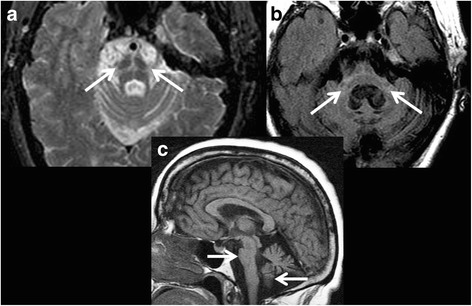
MRIBrain MRI in a patient with multiple system atrophy: axial view showing the hot cross bun sign, cruciform hyperintensity of the pons reflecting pontocerebellar degeneration, with marked atrophy of the brainstem and cerebellum on the sagittal view.
Source : Saeed et al., Translational Neurodegeneration, 2017, figure 1 · CC BY
The prognosis and the content of rehabilitation are not the same, and the physiotherapist sees some of the signs before the neurologist.
Atypical parkinsonian syndromes group four main entities, each with its published diagnostic criteria: progressive supranuclear palsy 7, multiple system atrophy 8, corticobasal degeneration 9 and dementia with Lewy bodies 10.
These four diagnoses are not the physiotherapist's business. What is, is recognising that the course is not following the announced script, and saying so. A German study examined the value of symptoms and red flags in early differential diagnosis, and is a reminder that these signs take on their meaning in the first few years, when the picture is still incomplete 12.
| Syndrome | What should raise concern | What that changes in rehabilitation |
|---|---|---|
| Progressive supranuclear palsy (PSP) | Backward falls in the first year, limitation of downward gaze, predominantly axial rigidity, fixed face with a staring gaze. Four domains structure the criteria: oculomotor, postural instability, akinesia, cognition. | The priority becomes prevention of the backward fall and safety of the environment. Limited downward gaze makes obstacles on the ground invisible: clear them, provide contrast, and abandon visual cues placed on the floor. |
| Multiple system atrophy (MSA) | Early and marked dysautonomia: orthostatic hypotension, urinary trouble (urgency, retention), erectile dysfunction. Associated cerebellar syndrome in the C form, whose rehabilitation follows that described in Cerebellar ataxia. Nocturnal stridor. | Standing up is prepared and supervised: the fall is often syncopal and not related to balance. Measure blood pressure lying and then standing before intensifying. Rapid progression means anticipating assistive equipment. |
| Corticobasal degeneration (CBD) | Very asymmetrical involvement with clumsiness of one limb, dystonia, myoclonus, apraxia, sometimes alien limb. Language disturbance possible. | Apraxia is not a strength deficit: the complex verbal instruction fails where the automatic movement succeeds. Work through concrete tasks and manual guidance rather than through explanation. |
| Dementia with Lewy bodies | Fluctuating alertness, structured visual hallucinations, REM sleep behaviour disorder, parkinsonian syndrome arising with or shortly after cognitive decline. | The session is set around the fluctuations in alertness. Major sensitivity to antipsychotics: any abrupt motor deterioration after a treatment is introduced must be reported without delay. |
Sources: Höglinger et al., Mov Disord 2017 (PMID 28467028); Wenning et al., Mov Disord 2022 (PMID 35445419); Armstrong et al., Neurology 2013 (PMID 23359374); McKeith et al., Neurology 2017 (PMID 28592453).
Red flags in this chapter
In a patient labelled “Parkinson's disease”, the following should lead you to alert the general practitioner or the neurologist:
- Falls in the first year of the illness, especially backwards, when the postural instability of Parkinson's disease is late.
- Faintness on standing, vision that dims on rising, falls with no preceding loss of balance: think of orthostatic hypotension and measure it.
- Rapid progression with loss of independent walking within two to three years.
- Absence of benefit from dopaminergic treatment at an adequate dose, or loss of the effect within a few months.
- Nocturnal stridor or early onset of choking on food.
- Abrupt motor deterioration after an antipsychotic is introduced, including when prescribed for behavioural disturbance.
The diagnostic delay, and why it concerns the physiotherapist
A cohort study followed the diagnostic pathway of patients with PSP and CBD, compared with parkinsonian patients matched for age and sex 14. Parkinson's disease was diagnosed 0.96 years after the first symptom. For PSP and CBD, it took 1.88 years to identify a parkinsonian syndrome, 3.41 years for the diagnosis to be raised, and 4.03 years for it to be settled on.
During those four years, these patients attended emergency care more often (33.3 % against 10.0 %) and were referred to a median of five different specialties, against two. The initial symptom already differed: more tremor in Parkinson's disease, more balance disturbance and falls in PSP and CBD.
The time it takes to put the right name to it
Median delays between the first symptom and the stages of diagnosis, cohort comparing PSP and CBD with parkinsonian patients matched for age and sex.
Source: Swallow and Counsell, J Neurol 2023 (PMID 36971841). During that interval, these patients attended emergency care three times more often (33.3 % against 10.0 %) and were referred to five different specialties in median, against two.
A patient who falls before they tremble probably does not have Parkinson's disease. It is the order in which the signs appear, more than the signs themselves, that points the way.
What the prognosis announces
The natural history of multiple system atrophy has been described in a prospective European cohort of 141 patients 13. Mean age at onset was 56.2, and median survival 9.8 years from the first symptom. Two factors predicted shorter survival: the parkinsonian form and a bladder emptying defect. One fact is of direct interest to rehabilitation: absence of response to levodopa predicted rapid progression of functional scores, with an odds ratio of 3.4.
Over 24 months, the cohort's scores deteriorated by 49 % for activities of daily living and 74 % for the motor examination. These figures are not there to discourage: they justify anticipating assistive equipment and home adaptation rather than offering them after function is lost.
What does the diagnosis change for prognosis and rehabilitation?
The same initial assessment, the same tools, but objectives and a pace that have nothing in common.
The question deserves to be put frankly, because the spontaneous answer (“you do the same thing”) is half wrong. The tools look alike, the objectives diverge.
In Parkinson's disease, the patient has many years ahead of them, a response to treatment that modulates their capacities hour by hour, and a slow progression. A gain can be aimed for there: improving walking speed, increasing aerobic capacity, reducing the number of falls. Intensity is possible and desirable.
In an atypical syndrome, the horizon is shorter, treatment hardly helps, and functional loss advances despite what is done. The objective shifts towards maintaining independence, safety, preventing the complications of immobility and anticipating aids. That does not mean less rehabilitation: it means rehabilitation whose success has been redefined.
The trap of the imported protocol
Almost all the exercise literature cited in this article was produced in patients with idiopathic Parkinson's disease, at a mild to moderate stage, without major cognitive impairment. The benchmark Cochrane review says so for its 156 trials 19. Applying a high-intensity protocol as it stands to a patient with PSP who falls backwards, or to an MSA patient with orthostatic hypotension, amounts to extrapolating outside the domain in which the evidence was built. It is not forbidden, but it must be said and monitored.
The little we know about rehabilitation in atypical syndromes
We have to be clear about the state of the evidence: it is thin. A review devoted to exercise in progressive supranuclear palsy first found that the existing studies described their interventions so poorly that they were not reproducible 32. More recent work opens up targeted avenues, such as expiratory muscle training, evaluated for feasibility in this population 34, and a randomised trial dedicated to physiotherapy and home training in parkinsonian syndromes is under way 33.
Pending its results, the reasonable course is to transpose what is solid in Parkinson's disease, keeping two reservations: monitor tolerance more closely, and accept that the objective is to slow a loss rather than to produce a gain.
What does the European physiotherapy guideline say?
It exists, it is written for physiotherapists, and it says precise things about when to refer.
The European physiotherapy guideline for Parkinson's disease was developed by a consortium bringing together professional associations from nineteen European countries, following on from the Dutch work that had produced the first evidence-based guidance in this field 17. Its summary aimed at neurologists insists on a point that French practice applies poorly: the referral criteria, and the importance of referring correctly and early.
The central message is that you should not wait for a fully formed problem to appear before referring. The recently diagnosed patient, who walks normally and complains of nothing, already warrants care, whose object is education, maintenance of physical activity and prevention of inactivity, and not treatment of a deficit.
Across the Atlantic, the American Physical Therapy Association published a full clinical practice guideline in 2022 for the physiotherapy management of Parkinson's disease 18. The two texts agree on the essentials: exercise of sufficient intensity, training of gait, transfers and balance, and the use of compensatory strategies.
Key points
When a parkinsonian patient comes to the clinic after their first fall, they come late. The logic of the European guideline is to reverse that order: referral to the physiotherapist is part of care from diagnosis onwards, and not only when a problem has declared itself. It is an argument to put to the referring doctor, and it is published.
What rehabilitation brings, in figures
The Cochrane review comparing physiotherapy with no intervention brought together 39 trials and 1,827 participants 20. The benefits are real and modest: walking speed gains 0.04 m/s (95 % CI 0.02 to 0.06), the distance covered on walking tests gains 13.37 m (95 % CI 0.55 to 26.20), and the freezing questionnaire improves by 1.41 points.
A larger meta-analysis, covering 191 trials and nearly 8,000 participants, sets out which modalities act on what: conventional physiotherapy improves motor symptoms, gait and quality of life; strengthening and the treadmill improve gait; dance, Nordic walking and martial arts improve motor symptoms, balance and gait alike 21. One result deserves to be kept as it stands: dual-task training improved none of the outcomes studied in that analysis.
Exercise modalities and effect on motor signs
Mean difference on the UPDRS motor score, a network of 71 trials and 3,196 participants. A negative score means improvement; the clinically important difference is 2.5 points, marked by the vertical line.
Source: Ernst et al., Cochrane Database Syst Rev 2023 (PMID 36602886). Network meta-analysis, 156 trials and 7,939 participants in total.
A word on how to read this chart. Dance is the only modality whose effect is judged to be of high confidence, and its effect is the largest. All the other beneficial modalities are rated as low confidence: their effect is probably real, but its size is uncertain. And flexibility practised alone does nothing, which is useful information when it makes up the bulk of a prescription.
The modalities ranked by what supports them
Dance
What supports it. The only modality in the whole Cochrane network meta-analysis to receive a high confidence rating, with the largest observed effect on motor signs: 10.32 points of mean difference on the UPDRS motor score, for a clinical relevance threshold set at 2.5 19. Confirmed by the meta-analysis of 191 trials on motor signs, balance and gait 21.
Its limit. Adherence depends on access to a suitable local offering, and the trials cover mildly to moderately affected patients.
Aerobic exercise
at sustained intensity
What supports it. Two converging randomised trials. SPARX shows stabilisation of the motor score at 80.2 % of maximum heart rate, against a deterioration of 3.2 points under usual care 22. Park-in-Shape obtains 4.2 points of difference in the OFF period, at home and double blind 23.
Its limit. SPARX is a phase 2 trial designed to test non-futility, not efficacy; its phase 3 successor is under way 24. Both trials recruited recently diagnosed patients.
Rhythmic auditory
cues
What supports them. A gain of 0.09 m/s in walking speed compared with training alone, across ten trials 27, an effect confirmed by a dedicated meta-analysis 26 and an umbrella review 38.
Its limit. Low quality evidence, a confidence interval covering trivial effects, and above all an effect that fades six weeks after training stops 25.
Amplitude
training
What supports it. An improvement of 5.05 points in the motor score at sixteen weeks, on blinded video rating, with a significant difference between groups 30, and a dedicated meta-analysis 31.
Its limit. Small samples, and comparison of intensive individual care with unsupervised exercise: the effect of the method and that of the supervision are not separated.
Balance
and falls prevention
What supports it. A clear reduction in falls in the least affected patients (rate ratio 0.31), and improvement in physical performance, fear of falling and quality of life in all groups 29.
Its limit. No effect across the study population as a whole, and a trend towards increased falls in severely affected patients. The indication depends on the stage.
Dual task
and flexibility alone
What is known. Dual-task training improved none of the outcomes studied in the meta-analysis of 191 trials 21. Flexibility practised alone obtains a trivial or null effect on motor signs, with an estimate that runs in the wrong direction 19.
What to do with it. Do not make it the main content of a prescription. Stretching keeps its place as an adjunct, for comfort and joint range objectives.
Do external cues really change gait and freezing?
Yes, and sometimes spectacularly, but the effect does not survive stopping.
The principle of external cues, or cueing, rests on a long-standing clinical observation: a patient blocked in front of a doorway, unable to initiate a step, steps without difficulty over an obstacle placed on the floor in front of their foot. The automatic movement, which is impaired, is bypassed in favour of a movement guided by an external stimulus.
The benchmark trial, and what it showed at six weeks
The RESCUE trial evaluated cue training, carried out at home, in parkinsonian patients 25. The results are twofold, and they have to be given together. On one side, significant improvements: 4.2 % on the mobility score (p = 0.005), a reduction of 5.5 % in freezing severity in the patients concerned (p = 0.007), gains in walking speed, step length and timed balance tests.
On the other, a conclusion the authors state bluntly: the effects had largely diminished six weeks after the end of the intervention. From that they draw a recommendation that still holds: cues must be permanent, built into the patient's daily life as a device, and not taught then abandoned.
Auditory or visual: the question is not a neutral one
A recent systematic review compares adding cues with gait training alone, across ten trials and 309 participants 27. The cues that are Auditory add 0.09 m/s of walking speed (95 % CI 0.02 to 0.15) compared with walking alone. Visual cues, for their part, improved neither speed nor step length. The level of evidence is rated as low, and the authors stress that the confidence interval covers both trivial and clinically useful effects.
An earlier meta-analysis devoted to rhythmic auditory cues confirms their effect on parkinsonian gait 26, and an umbrella review made the same finding on mobility 38.
That does not condemn visual cues in all their forms. A wearable device projecting a laser line on the floor in front of the foot has been tested in patients with freezing: it reduced the number of blocking episodes by 45.9 % in the OFF period and by 37.7 % in the ON period, and the time spent frozen by 56.5 % in OFF (95 % CI 32.5 to 85.8; p = 0.004) 28. The reduction in the ON period did not reach the significance threshold, and the study covered immediate laboratory measures.
Key points
For continuous walking (cadence, speed), the rhythmic auditory cue has the best evidence. For blocking on initiation or on crossing a threshold, the visual cue placed on the floor keeps all its value, including as a wearable device. These are two different problems, and the choice of cue follows the problem, not the fashion. In every case, the effect depends on the cue being kept up: what is not built into daily life dies out within a few weeks.
Amplitude and intensity: what are LSVT BIG and sustained training worth?
Two strong ideas, two unequal levels of evidence, and a frequent confusion between feasibility and efficacy.
Forced amplitude
The reasoning behind amplitude training starts from the observation that the parkinsonian patient produces movements of too small an amplitude while perceiving them as normal. Recalibration therefore consists of getting them to produce exaggeratedly large movements, until perceived amplitude and actual amplitude come together.
The Berlin trial compared three conditions in 60 patients with a mild to moderate form: individual amplitude training (BIG), group Nordic walking, and unsupervised home exercise 30. At sixteen weeks, the UPDRS motor score improved by 5.05 points on average in the amplitude group, with a significant difference between groups, on a rating made blind from video recordings.
A later meta-analysis brought together the work on this approach 31. Caution remains in order: the samples are small, and the Berlin trial compared intensive individual care with unsupervised exercise, which mixes the effect of the method with that of the supervision.
High intensity
The SPARX trial is cited everywhere, often beyond what it establishes. It is a phase 2 trial, whose stated objective was to test feasibility and non-futility, not to demonstrate a clinical benefit 22. One hundred and twenty-eight de novo patients were allocated between high-intensity treadmill (80.2 % of maximum heart rate), moderate intensity (65.9 %), and usual care.
At six months, the motor score varied by +0.3 points in the high-intensity group against +3.2 points in the usual-care group (p = 0.03): the intensive patients stabilised where the others deteriorated. Only the high-intensity group crossed the predefined non-futility threshold. The authors conclude that an efficacy trial is warranted, which is exactly what SPARX3, a phase 3 trial, has undertaken 24.
The Park-in-Shape trial provides the most solid demonstration of feasibility at home. One hundred and thirty patients were randomised between an aerobic programme on a stationary bike, remotely supervised, and an active stretching programme 23. At six months, the difference in the motor score in the OFF period reached 4.2 points (95 % CI 1.6 to 6.9; p = 0.0020) in favour of aerobic exercise, which is well above the clinical relevance threshold.
The high-intensity treadmill stabilises what usual care lets deteriorate. That is a result worth announcing to the patient, provided it is not turned into a promise of slowing the disease: that point has not been demonstrated.
And falls?
The most instructive result in the literature on falls is a negative one, and it is nuanced. A randomised trial in 231 patients tested a programme of balance, lower limb strengthening and freezing work 29. Overall, the fall rate did not differ between groups (rate ratio 0.73; 95 % CI 0.45 to 1.17; p = 0.18).
But the subgroup analysis, planned in advance, shows a strong interaction with severity (p < 0.001): in the least affected patients, falls fell markedly (rate ratio 0.31; 95 % CI 0.15 to 0.62; p < 0.001); in the most affected, the trend was towards more falls (rate ratio 1.61). In both groups, physical performance, fear of falling and quality of life improved.
The same programme, two opposite effects depending on severity
Fall rate ratio of the exercise group compared with the control group. Below 1, exercise protects; above, it exposes. The horizontal bars show the 95 % confidence interval.
Source: Canning et al., Neurology 2015 (PMID 25552576). Randomised trial, 231 participants, subgroup analysis planned in the protocol, interaction with severity p < 0.001.
The trap of late prevention
This result overturns the usual intuition, which is to intensify balance work when the patient starts to fall. In a patient who is already severely affected, a demanding balance programme can increase exposure to risk by putting them back on their feet in unstable situations. The time to act on falls is when the patient has not yet fallen. Past that stage, the objective shifts towards making the environment safe, assistive equipment, and work done seated or supported.
What do published clinical situations teach us?
Four cases reported in the literature, all in patients with atypical syndromes, where the evidence is most lacking.
Case 1: eight weeks of body-weight-supported treadmill in PSP
A 62-year-old man with progressive supranuclear palsy presents with severely impaired balance and frequent, abrupt falls. The programme combines gait training, balance perturbations and step work on a treadmill with body weight support. Sessions last an hour and a half, three times a week, for eight weeks.
At the end of the programme, the patient reports fewer falls, and both balance and gait have improved. The authors note that this is the first published case reporting a reduction in falls after physiotherapy in a person with PSP.
Suteerawattananon M, MacNeill B, Protas EJ. Phys Ther 2002;82(5):485-495. PMID 11991801
Case 2: two and a half years of locomotor training in a mixed PSP and CBD form
A 72-year-old dentist, diagnosed six years earlier with a mixed form combining features of PSP and corticobasal degeneration, is referred for asymmetrical limb apraxia, markedly impaired balance and frequent falls on changing position. The intervention runs over two and a half years and combines regular participation in an exercise group for parkinsonian patients with locomotor treadmill training, with and without body weight support.
This case is as interesting for its duration as for its content: it documents what long-term support can be in a condition whose authors remind us that wheelchair dependence is the expected outcome. The objective there is not gain, but maintenance and reduction of falls during transfers.
Steffen TM, Boeve BF, Mollinger-Riemann LA, Petersen CM. Phys Ther 2007;87(8):1078-1087. PMID 17578939
Case 3: balance training with feedback in multiple system atrophy
A 61-year-old man with multiple system atrophy undergoes thirty sessions of balance work assisted by a biofeedback device, at thirty minutes a session over six weeks. His static and dynamic balance capacities improve on the Berg balance scale, the trunk impairment scale, the functional independence measure and the functional reach test.
The detail that matters is the one the authors also report: neither walking speed nor muscle strength improved. It is an honest illustration of what a positive result looks like in this population, with a level V of evidence that the authors own.
Lee HJ, Lee KE, Yi TI, Kim HY. PM R 2018;10(5):555-559. PMID 28943458
Case 4: amplitude training transposed outside Parkinson's disease
A 68-year-old man, followed for fourteen months for olivopontocerebellar atrophy, presents with bradykinesia, rigidity and postural instability. He takes part in thirty-four sessions of a programme based on amplitude training, a method validated in idiopathic Parkinson's disease but little studied in the related syndromes.
This case illustrates exactly the approach described above: transposing what is solid in Parkinson's disease, while documenting what is observed, for want of direct evidence in the population concerned.
Babcock R, Viana S, Roach V, et al. Physiother Theory Pract 2024;40(8):1888-1897. PMID 37165996
Key points
These four cases have in common that they are isolated cases, of low evidential level, and that they concern patients for whom no randomised trial existed at the time of publication. They do not prove that a method works. They show that structured care is feasible in these conditions, and they document realistic objectives: fewer falls, preserved balance, independence maintained for longer.
How do you apply this in practice?
What to look for at assessment, what to report, and how to organise the session.
At the first assessment, five questions that point the way
- The tremor, when? Hands resting on the thighs, then arms outstretched, then finger-to-nose. Note in which of the three positions it appears and in which it disappears.
- Does the slowness run out? Twenty openings and closings of the hand, twenty heel taps. Look for the progressive reduction in amplitude, not just for slowness.
- Is one side more affected? Asymmetry is an argument in favour of Parkinson's disease or corticobasal degeneration, and against a drug cause.
- When did the first falls occur? In the first year, that is a red flag. Look for the direction of the fall: backwards points towards PSP.
- What does the treatment do? Ask for the times of doses and get them to describe a good and a bad period. The complete absence of a difference is information to pass on.
Organise the session around the fluctuations
In a treated patient, the motor state varies through the day. Scheduling the session far from a dose amounts to assessing and working with a patient at their worst, then being surprised at how small the progress is. Ask for the dose times, set the session about an hour afterwards, and systematically note the time since the last dose on the assessment sheet: without that item, two successive assessments are not comparable.
Choosing the modality, according to the problem
| Main problem | What the literature supports | Level of evidence |
|---|---|---|
| Overall motor signs | Dance; failing that, gait, balance and functional training, or multi-domain training | High for dance, low for the others |
| Walking speed | Gait training with a rhythmic auditory cue | Low, effect 0.09 m/s |
| Freezing on initiation or on crossing a threshold | Visual cue on the floor, wearable device, attentional strategies | Class III, immediate effects demonstrated |
| Falls, mildly affected patient | Balance programme, lower limb strengthening, freezing work | Significant reduction in subgroup |
| Falls, severely affected patient | Making the environment safe and assistive equipment before intensifying | Signal of increased risk |
| Movement amplitude, hypomimia, micrographia | BIG-type amplitude training | Small trials, significant result |
| Aerobic capacity, recently diagnosed patient | Aerobic exercise at sustained intensity, treadmill or bike, including at home | Phase 2 and a positive randomised trial |
| Handwriting | Specific handwriting exercises; the data remain limited | One randomised trial, a scoping review |
Sources: Ernst et al. 2023 (PMID 36602886); Nascimento et al. 2024 (PMID 38897907); Barthel et al. 2018 (PMID 29263221); Canning et al. 2015 (PMID 25552576); Ebersbach et al. 2010 (PMID 20669294); Schenkman et al. 2018 (PMID 29228079); van der Kolk et al. 2019 (PMID 31521532); Vorasoot et al. 2020 (PMID 31506240); Gardoni et al. 2023 (PMID 36964814).
Three common errors
- Prescribing flexibility alone. It is the only modality for which the network meta-analysis concludes to a trivial or null effect on motor signs. It has its place as an adjunct, not as the main content.
- Teaching cues without installing them. The effect of cue training fades six weeks after it stops. What counts is the device that stays in the patient's life: metronome, app, markers on the floor at home.
- Intensifying balance work after the first fall. That is the moment when the benefit disappears and the risk increases. Preventive work is done beforehand.
Working with others
The physiotherapist is often the professional who sees the patient most often and for longest. That position gives them a precise responsibility: to report what does not fit. Too rapid a progression, early falls, faintness on standing, an absence of treatment effect, a deterioration after a new drug are observations that belong in the medical record and must find their way there. Given the median four-year delay before the diagnosis of an atypical syndrome, passing that on is not an administrative detail.
Frequently asked questions
How do you know whether a tremor is parkinsonian or essential?
The distinction is made on the activation condition. Have the hands rest on the thighs, completely relaxed: a tremor that appears there and fades as soon as the hand moves is a rest tremor, suggestive of Parkinson's disease. Then have the arms stretched out, then a glass carried to the mouth: a tremor that appears in those positions and hampers the movement is an action tremor, suggestive of essential tremor 6. The second decisive element is the presence or absence of bradykinesia with decrement: without it, there is no parkinsonian syndrome 1.
Can a parkinsonian patient do high-intensity exercise safely?
In recently diagnosed patients with no limiting comorbidity, yes. The SPARX trial had de novo patients running at 80.2 % of their maximum heart rate, and the anticipated musculoskeletal adverse events were not severe 22. The Park-in-Shape trial reached the same safety finding at home 23. Caution applies to more advanced patients, to those who fall, and above all to atypical syndromes, in whom this evidence has not been built.
Does exercise slow the progression of the disease?
That is not demonstrated. The available trials show improvement in motor signs and quality of life, and for SPARX a stabilisation of the motor score where the control group deteriorated 22. A symptomatic stabilisation over six months is not a modification of the course of the disease. The distinction may seem subtle; it is not so for a patient who has been led to believe their disease would stop if they pedalled enough.
Should you wait until the patient has difficulties before referring them to physiotherapy?
No, and that is the main message of the European physiotherapy guideline for Parkinson's disease, which insists on explicit referral criteria and on the importance of referring early 17. The recently diagnosed patient warrants care aimed at education and maintenance of activity, and it is also the moment when falls prevention works 29.
Which cue should you choose against freezing?
It depends on when the blocking occurs. For an overall slowing of gait, the rhythmic auditory cue has the best evidence, with a gain of 0.09 m/s added to training alone, whereas visual cues contributed nothing on that outcome 27. For blocking on initiation or on crossing a threshold, the visual cue placed on the floor remains relevant: a device projecting a laser line reduced the number of episodes by 45.9 % in the OFF period 28.
What if I think the diagnosis is not the right one?
Describe, do not conclude. A physiotherapist does not revise a neurological diagnosis, but is entitled to write to the doctor about what they observe: the date of the first falls and their direction, the existence of faintness on standing, the speed of deterioration, the response to treatment as it appears in the session. These are precisely the elements that make the difference between Parkinson's disease and an atypical syndrome 12, and the mean delay before the right diagnosis is made reaches four years 14.
Is rehabilitation useful in an atypical parkinsonian syndrome?
It is warranted, but its objectives change. Direct evidence is limited to case reports and series, and a review showed that exercise studies in progressive supranuclear palsy described their interventions too poorly to be reproduced 32. The published cases report a reduction in falls and preserved balance 41 42, with no gain in speed or strength. A dedicated randomised trial is under way 33.
Can an essential tremor evolve into Parkinson's disease?
The two conditions can coexist, and the international classification recognises intermediate pictures, notably so-called essential tremor “plus”, which combines the tremor with subtle neurological signs 6. In clinical practice, the later appearance of a frank rest tremor, of bradykinesia with decrement or of marked asymmetry in a patient followed for essential tremor warrants a neurological opinion. The subject is developed in the article Essential tremor.
What place is there for dance, tai chi or boxing?
Dance is the best supported modality in the Cochrane network meta-analysis, with a mean difference of 10.32 points on the motor score and a high confidence rating, the only such case in the whole analysis 19. Mind and body approaches, which include tai chi, show a smaller effect of low confidence. The comparative detail of these approaches is dealt with in the article Parkinson's and physiotherapy.
Should dual tasking be trained or avoided?
The data are contradictory, and that has to be said. The meta-analysis of 191 trials concludes that dual-task training improved none of the outcomes it studied 21. That does not mean the patient should be forbidden to talk while walking, but that dual tasking is not, as things stand, a training modality from which a measurable gain can be expected.