



A clinical synthesis on the place of physiotherapy in Parkinson's disease: what the evidence really says about exercise and its intensity, gait and freezing, falls prevention and specific approaches (LSVT BIG, dance, tai chi, boxing). Every reference has been checked individually on PubMed.
📝 In brief: clinical synthesis
- Parkinson's disease is the neurological condition whose burden is growing fastest: the number of people affected worldwide rose from 2.5 million in 1990 to 6.1 million in 2016, driven by the ageing of the population 1.
- The intensity of the effort matters: in recently diagnosed patients, high-intensity treadmill work (80–85 % of maximum heart rate, 4 times a week) stabilised the UPDRS motor score at 6 months (+0.3) whereas it worsened by +3.2 points under usual care; moderate intensity was not enough 10.
- Home aerobic exercise is feasible and effective: a gamified, remotely supervised stationary bike (3 times a week, 6 months) improved the MDS-UPDRS motor score in the OFF phase by 4.2 points compared with stretching, in patients at a mild stage 5.
- Physiotherapy improves gait speed (+0.04 m/s), the UPDRS motor score (−5.01 points) and balance (Berg +3.71 points), but mainly in the short term (< 3 months), which justifies care maintained over time 7.
- Tai chi specifically targets balance: in a trial of 195 patients, it outperformed stretching on maximum excursion of the centre of gravity (+11.98 percentage points) and reduced the incidence of falls, with effects maintained 3 months after it stopped 6.
- Freezing of gait must be actively sought: its pooled prevalence reaches 50.6 % on the specific questionnaire, around double what the items of the clinical scales reveal (23.2 %) 2.
- Across all the trials, exercise probably reduces the rate of falls by around 26 % in patients at a mild to moderate stage (moderate certainty of evidence) 13.
- This article covers what physiotherapy BRINGS once the diagnosis has been made. To make that diagnosis, to tell a rest tremor from an essential tremor and to recognise an atypical parkinsonian syndrome, see Parkinson's disease and the parkinsonian syndromes.
🧠 What are the fundamentals to know about Parkinson's disease?
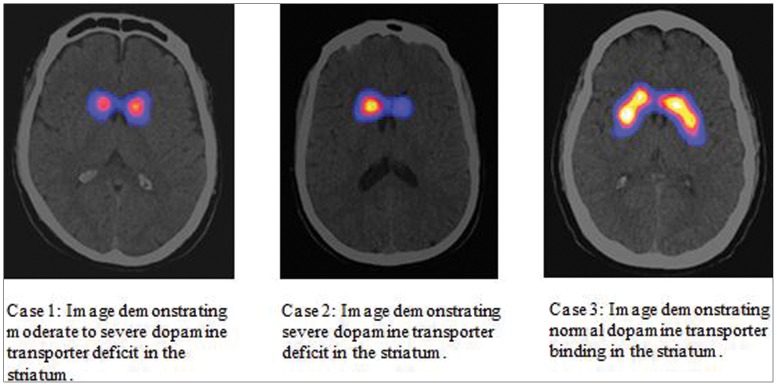
Bone scanBrain scintigraphy (DAT-SPECT): moderate to severe deficit of dopamine transporter uptake in the striatum, compared with normal uptake, a characteristic sign of Parkinson's disease.
Source : Umeh et al., Tremor and other hyperkinetic movements, 2013, figure 1 · CC BY-NC-ND
🌍 The fastest-growing neurological condition
In 26 years, the number of people living with Parkinson's disease worldwide has more than doubled, driven by the ageing of populations.
Age-standardised prevalence up by 21.7 %; 3.2 million disability-adjusted life years and around 211,000 deaths in 2016. Source: GBD 2016 1.
Before building relevant motor rehabilitation, you need a clear picture of the disease: what it affects, how it evolves, and with what tools it is measured. Parkinson's disease is a chronic neurodegenerative condition that progressively impairs the control of movement. For the physiotherapist, three ideas structure the whole of management: the cardinal motor symptoms, the measurement scales that objectify severity, and the motor fluctuations that mean the same patient is not the same at two moments of the day. That is the foundation of this section.
A neurological disease in full expansion
The public health stake is major and growing. According to the Global Burden of Disease 2016 study, the number of people living with Parkinson's disease worldwide rose from 2.5 million in 1990 to 6.1 million in 2016, more than a doubling in 26 years 1. strong evidence
This growth is not simply a mechanical effect of population ageing: the age-standardised prevalence itself rose by 21.7 % over the period, which makes Parkinson's disease the neurological condition whose burden is growing fastest in the world. In 2016 it was responsible for around 3.2 million disability-adjusted life years (DALYs) and nearly 211,000 deaths 1. strong evidence In practice, demand for motor rehabilitation will keep rising, and the physiotherapist occupies a front-line place in this care.
The cardinal motor symptoms
The motor picture rests on a few fundamental signs found, to varying degrees, in most patients:
- Bradykinesia (slowness of movement) and akinesia (difficulty initiating movement): this is the central sign. It reduces the amplitude and the speed of movements, reduces arm swing, makes handwriting smaller and gait more shuffling.
- Rigidity : a muscular stiffness that increases resistance to passive movement and contributes to pain and joint limitation.
- Rest tremor : an oscillation that appears with the limb at rest and lessens on voluntary movement. It is visible but it is not always the most disabling symptom.
- Postural instability : impaired balance reactions, which appear later but weigh heavily on independence and on the risk of falling.
Two functional consequences deserve particular attention from the rehabilitation clinician, because they are frequent and often underestimated.
Freezing of gait, that sensation of feet « stuck to the floor » that abruptly blocks the step, must be actively sought. A meta-analysis of more than 9,000 patients finds a pooled prevalence of 50.6 % when it is assessed with a specific questionnaire (FOG-Q / NFOG-Q), around double what emerges from the simple items of the clinical scales (23.2 %) 2. moderate evidence In other words, if you do not look for it with a dedicated tool, you miss it one time in two. Its frequency rises markedly with the duration of the disease: from 37.9 % at an early stage (≤ 5 years of evolution) to 64.6 % at an advanced stage (≥ 9 years) 2.
Falls are one of the most frequent and most feared problems. A systematic review of prospective studies reports that 60.5 % of patients have at least one fall and that 39 % are recurrent fallers, the latter falling on average nearly 21 times a year 3. moderate evidence A more recent meta-analysis of 46 prospective studies (6,874 patients) confirms the order of magnitude: around one patient in two falls at least once (pooled proportion 0.48) and one in three is a recurrent faller (0.32) 4. moderate evidence Freezing and postural instability are direct contributors to this risk, hence the importance of screening for them and targeting them early.
How the disease is measured: MDS-UPDRS and Hoehn & Yahr
Two instruments come up constantly, in the clinic as much as in the trials we cite in this article. Understanding them makes it possible to read a file and to follow a patient's course.
| Tool | What it measures | How to read it |
|---|---|---|
| MDS-UPDRS (Movement Disorder Society – Unified Parkinson's Disease Rating Scale) |
The reference scale, detailed, whose motor part quantifies the severity of the signs (slowness, rigidity, tremor, gait and so on). It is the « motor score » used as the primary outcome in the large trials. | A higher score = more severe involvement. A fall reflects an improvement. It is this motor score that moves in the exercise studies (SPARX, Park-in-Shape). |
| Hoehn & Yahr | A staging scale that classifies overall progression, from early involvement of one side of the body to the loss of independent walking. | A quick synthetic marker. The early stages (Hoehn & Yahr ≤ 2) correspond to mild disease, where many interventions are at their most effective. |
These scales are not mere administrative formalities: most of the evidence in physiotherapy is expressed in points of the MDS-UPDRS motor score, and study populations are described by their Hoehn & Yahr stage. The Park-in-Shape trial thus included patients at a mild stage (Hoehn & Yahr ≤ 2) and the landmark tai chi trial covered stages 1 to 4 56. Knowing where a patient sits on these scales is knowing which evidence they most resemble.
The ON/OFF fluctuations, and what they change for the session
As the disease and the dopaminergic treatment evolve, many patients no longer show a stable motor state through the day but fluctuations :
- The ON phase : the treatment is working, mobility is better, movements are smoother.
- The OFF phase : the effect of the medication wears off and the motor symptoms return, slowness, stiffness and freezing can reappear, sometimes abruptly.
This distinction is crucial, including for measurement. In the Park-in-Shape trial, the MDS-UPDRS motor score was assessed in a standardised OFF state, with dopaminergic therapy withheld, precisely to capture the patient's « real » motor burden, without the mask of the medication; it is in this state that aerobic exercise showed its 4.2-point benefit 5. strong evidence A performance in a session can therefore look excellent in ON and far more fragile two hours later.
The same patient can walk almost normally in the ON phase and freeze on their own doorstep in the OFF phase. Planning the session means first asking: « at which point in their medication cycle am I going to see them? »
For practice, several reflexes are needed, to be adapted to the objective:
- Ask about the timing of the doses and identify the patient's usual ON and OFF windows.
- Schedule in ON the demanding active work (strengthening, amplitude, endurance, motor learning), when the patient has the best control.
- Do not ignore the OFF state : this is often where freezing and insecurity in walking show themselves. Working on strategies that can be used even when the treatment does not « cover », such as rhythmic cues (cueing), makes sense for the most vulnerable moments of everyday life.
- Document the motor state (ON or OFF) at the time of each assessment, failing which an « improvement » or a « worsening » may be nothing but an artefact of medication timing.
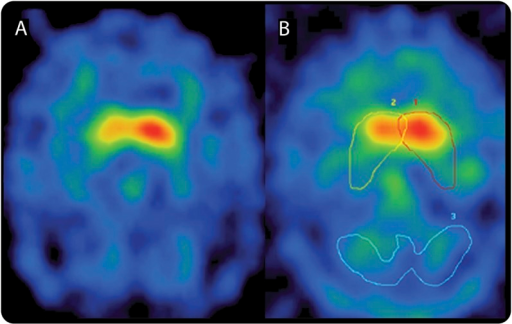
Bone scanBrain scintigraphy (DAT-SPECT), transaxial view: decreased and asymmetric striatal uptake, with more pronounced loss in the putamen, in a patient with Parkinson's disease.
Source : Martikainen et al., Neurology. Genetics, 2015, figure 2 · CC BY-NC-ND
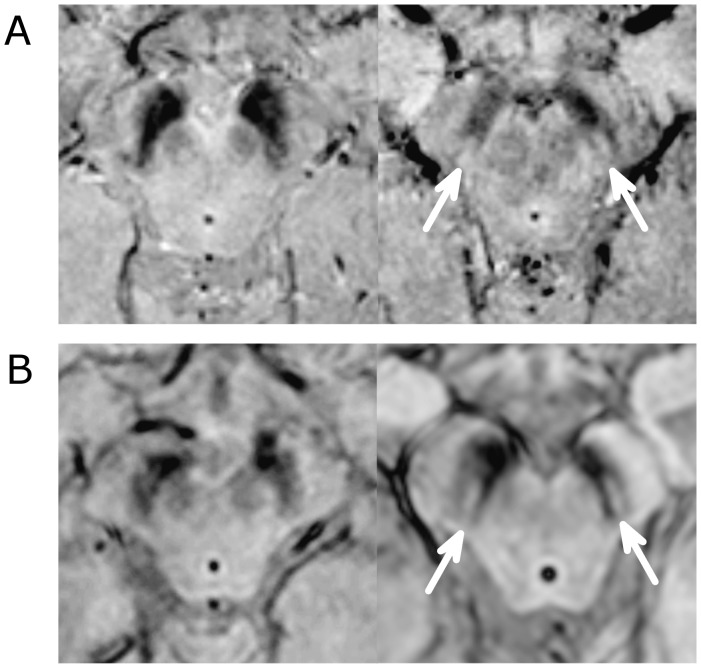
MRIBrain MRI, high-resolution gradient-echo (SWI) sequence, axial view at the level of the midbrain: loss of the swallow tail sign (nigrosome-1) on the left in a patient with Parkinson's disease, present on the right in a healthy control (arrows).
Source : Schwarz et al., PLoS ONE, 2014, figure 3 · CC BY
Key points
- A disease that is exploding in numbers : from 2.5 to 6.1 million people affected between 1990 and 2016, it is the neurological condition whose burden is growing fastest 1.
- Four cardinal motor signs : bradykinesia/akinesia (the heart of the picture), rigidity, rest tremor, postural instability.
- Two complications to screen for actively : freezing of gait 2 and falls 3.
- Two scales to master : the MDS-UPDRS (motor severity, a score that falls as the patient improves) and Hoehn & Yahr (overall stage; ≤ 2 = mild disease).
- Think ON/OFF : the motor state varies through the day with the treatment. Plan the demanding work in ON, prepare strategies for OFF, and always record the state at the assessment.
🏃 What can exercise really do in Parkinson's disease?
🏃 Almost any exercise helps, but not to the same degree
The largest Cochrane synthesis (154 trials, 7,837 participants) compares the modalities against each other on the (MDS-)UPDRS motor score.
Mean differences on the (MDS-)UPDRS motor score versus passive control (a larger value = more improvement). A moderate effect for dance and gait/balance training (moderate level of evidence), a small effect for multi-domain. Few clear differences between modalities. Source: Ernst et al., Cochrane 2024 (PMID 38588457).
Parkinson's disease is the neurological condition whose global burden is growing fastest: the number of people affected rose from 2.5 million in 1990 to 6.1 million in 2016, more than a doubling in 26 years driven by the ageing of the population 1. This growth puts motor rehabilitation at the forefront of need. The question is no longer whether if exercise helps, but what it really does, at what dose, and what it does not do, because overselling a promise of cure or of neuroprotection does patients as much disservice as under-prescribing.
A solid motor benefit, but a modest one in size
Physiotherapy, compared with no intervention, improves gait speed and the motor score: the reference Cochrane review (39 trials, 1,827 participants) finds a gain in gait speed of +0.04 m/s, a UPDRS motor score improved by −5.01 points, a Timed Up & Go shortened by 0.63 s and Berg balance improved by +3.71 points 7. Two qualifications are needed straight away. First, these differences are small, sometimes close to the threshold of clinical relevance, and to be interpreted with caution given the uneven methodological quality of the trials. Second, the benefits are demonstrated mainly in the short term (less than 3 months), which argues for care maintained over time rather than delivered in one-off courses.
Across the literature as a whole, the largest Cochrane network synthesis (156 trials, 7,939 participants) confirms that exercise improves the severity of the motor signs and quality of life, whatever the type of activity, but with a very variable certainty of evidence 8. It is dance that comes out with the highest level of confidence (a moderate effect, −10.32 points on the motor scale). For most of the other modalities, certainty remains low: no single approach clearly stands out as superior.
| Modality | Effect on the motor score (UPDRS/MDS-UPDRS) | Level of evidence |
|---|---|---|
| Dance | −10.18 points (moderate effect) | Moderate |
| Gait / balance / functional training | −7.50 points (moderate effect) | Moderate |
| Multi-domain training | −5.90 points (small effect) | Low |
| Endurance, aquatic, strengthening, mind-body | A small effect possible | Low |
From the Cochrane network meta-analysis 9 : 154 randomised trials, 7,837 participants.
Intensity matters: do not confuse exercise with gentle activity
A key message from the recent data is that intensity is not a detail. In recently diagnosed (de novo) patients not treated with L-dopa, the phase 2 randomised trial SPARX (128 patients) compared a treadmill at high intensity (80-85 % of maximum heart rate, 4 times a week), at moderate intensity (60-65 %), and usual care. At 6 months, the UPDRS motor score had remained almost stable in the high-intensity group (+0.3 points) whereas it worsened by +3.2 points under usual care. Only high intensity crossed the predefined non-futility threshold (P = 0.03); moderate intensity did not reach it 10.
Be careful, however: SPARX is a phase 2 trial, a proof of concept. It shows that sufficiently intense exercise might slow motor worsening in the short term: it is not a definitive demonstration of neuroprotection (see below).
Home exercise is feasible and effective
Rehabilitation is not confined to the practice. The double-blind randomised trial Park-in-Shape (130 patients at a mild stage, Hoehn & Yahr ≤ 2) tested a home stationary bike, gamified and remotely supervised (3 times a week, 30-45 min, 6 months), against stretching. Assessed in the OFF state (dopaminergic therapy withheld, a demanding condition), the MDS-UPDRS motor score was on average 4.2 points better in the cycling group (95 % CI 1.6-6.9; p = 0.0020), a clinically relevant difference 5. Regular aerobic exercise therefore lessens the motor signs measured off treatment, and it can be done at home.
Work on range of movement has also proved itself. In the Berlin LSVT BIG study (60 patients), an intensive protocol centred on large-amplitude movements (16 h over 4 weeks) improved the UPDRS motor score by −5.05 points, whereas Nordic walking and unsupervised home exercises led on the contrary to a slight deterioration (P < 0.001). LSVT BIG was also superior on the Timed Up & Go and on the timed 10 m walk 11. The practical lesson: structure, intensity and supervision make the difference: a « home » programme left to itself is not enough.
Balance and falls: target early, prescribe specific
Falls are one of the most frequent and most feared problems. A meta-analysis of 46 prospective studies (6,874 patients) finds that around one patient in two falls at least once during follow-up (proportion 0.48) and one in three is a recurrent faller (0.32) 4, figures consistent with the earlier reviews 3.
Against this risk,balance training has a demonstrated specific effect. In a randomised trial published in the NEJM (195 patients, stages 1 to 4), tai chi (2 sessions a week, 24 weeks) improved postural stability more than muscle strengthening or stretching: +11.98 points of maximum excursion of the centre of gravity versus stretching (95 % CI 7.21-16.74), together with a reduction in falls compared with stretching, effects maintained 3 months after it stopped 6.
But the timing of the intervention is decisive. The Canning trial (231 patients, a balance and leg strengthening programme, 3 times a week, 6 months) did not show a significant overall fall in the number of falls (rate ratio 0.73; 95 % CI 0.45-1.17). But in the least affected patients (UPDRS motor ≤ 26), exercise reduced falls by 69 % (ratio 0.31; p < 0.001), whereas a trend towards more falls appeared in the most affected: a signal for caution in advanced disease 12. Across all the trials, the dedicated Cochrane review (32 studies, 3,370 participants) concludes that exercise probably reduces the rate of falls by around 26 % (ratio 0.74; moderate certainty) in patients at a mild to moderate stage 13.
Gait, freezing and dual task
The freezing of gait (the sensation of feet « stuck to the floor ») must be systematically sought: a meta-analysis (66 studies, more than 9,000 patients) finds a pooled prevalence of 50.6 % when it is assessed with a specific questionnaire (FOG-Q/NFOG-Q), around double what the simple items of the clinical scales reveal (23.2 %). It climbs from 37.9 % at an early stage (≤ 5 years) to 64.6 % at an advanced stage (≥ 9 years) 2. It is underestimated if it is not actively sought.
The external sensory cues (cueing) are a key strategy. In the RESCUE trial (153 patients, Hoehn & Yahr II-IV), home training with rhythmic cueing (auditory, visual, somatosensory; 3 weeks) improved a composite measure of posture and gait by 4.2 % (p = 0.005) and reduced the severity of freezing by 5.5 % in freezers (p = 0.007), without changing the risk of falling 14. A crucial point: the effect faded markedly at the 6-week follow-up without training, hence the need for regular maintenance and for cues built into everyday life.
Finally, training gait under dual task (walking while performing a cognitive task) is feasible and safe, contrary to a frequent fear. The DUALITY trial (121 patients, Hoehn & Yahr II-III) improved dual-task gait speed by 7.75 % to 13.44 % (p < 0.001), gains maintained at 12 weeks, without increasing the risk of falling (p = 0.84) 15.
What remains uncertain: the progression of the disease
This is the line not to cross. Exercise improves the motor symptoms , gait, balance and quality of life, that is solidly established. Does it slow the underlying progression of the disease? The honest answer is: we do not know yet. The strongest signal comes from SPARX, where high intensity stabilised the motor score where usual care deteriorated 10, but it is a phase 2 trial, over 6 months, with a clinical measure (the UPDRS) that does not on its own prove biological neuroprotection. None of the trials confirmed here demonstrates that exercise durably changes the neurodegenerative trajectory. Editorial caution is called for: promising that « sport slows Parkinson's » goes beyond what the evidence allows.
Key points
- Well established: exercise improves the motor signs, gait speed, balance and quality of life: a real effect but of modest size, demonstrated mainly in the short term 78.
- Intensity matters: aim for genuinely sustained effort (high intensity in the patients who can manage it), not only gentle activity 10.
- Specificity: tai chi and balance work for falls 6 ; LSVT BIG-type amplitude for bradykinesia 11 ; cueing for freezing 14 ; dual task, safe and effective 15.
- Start early: falls prevention through exercise is above all effective in the least affected patients 1213.
- Maintain: the benefits fade once it stops: physiotherapy must be continuous, not occasional.
- Do not oversell: the effect on the progression of the disease remains undemonstrated. Treating the symptoms, yes; promising neuroprotection, no.
🔥 What intensity should you aim for?
🔥 Intensity changes the result: SPARX
In recently diagnosed (de novo, untreated) patients, only genuinely sustained exercise stabilised the motor signs at 6 months.
Mean change in the UPDRS motor score at 6 months: a lower value = less worsening. Only the high-intensity group crossed the predefined non-futility threshold (P = 0.03); moderate intensity (60–65 %) did not reach it. A phase 2 result (proof of concept), and not a demonstration of neuroprotection. Source: SPARX trial, Schenkman et al., JAMA Neurology 2018 (PMID 29228079).
For a long time, rehabilitation in Parkinson's disease settled for maintenance: gentle walking, stretching exercises, mobilisations. The idea that a parkinsonian patient can, and should, get out of breath, sweat and push their heart close to its maximum is recent. It rests on a handful of randomised trials that put the question differently: not « should we move? » (the answer has been yes for a long time), but « at what intensity does effort become genuinely useful? ». This section takes stock of what we know, and of what we do not yet know.
The central argument : the SPARX trial
The reference study is the phase 2 trial SPARX 10, run in 128 patients recently diagnosed and not yet treated with levodopa (so-called « de novo »). Three groups : treadmill at high intensity (80–85 % of maximum heart rate), treadmill at moderate intensity (60–65 %), and usual care. Frequency : four sessions a week.
At six months, the result is clear. The motor score of the UPDRS barely moved in the high-intensity group (mean change of +0.3 points, which reflects near-stability), whereas it had worsened by +3.2 points in the usual care group. The decisive fact : only high intensity crossed the « non-futility » threshold defined in advance (P = 0.03). Moderate intensity did not reach it 10.
That is why modern physiotherapy insists on genuinely sustained intensity rather than on simple gentle activity. The clinical message is powerful : in a patient at an early stage, prescribing effort at 80–85 % of maximum heart rate is not relentlessness, it is probably the dose that counts.
A major caveat : slowing progression is not proven
Here editorial caution is called for. SPARX is a phase 2 trial, that is to say a proof of concept, not a definitive demonstration. The fact that the motor score stays stable under high intensity is encouraging and suggests that sufficiently intense exercise could slow motor worsening. But it does not prove that exercise protects neurons or durably changes the course of the disease.
Key points, what SPARX does (and does not) say
- What is established : at six months, in de novo patients, high intensity (80–85 % HR max, 4×/week) maintains the motor score where usual care lets it deteriorate (+0.3 vs +3.2 points; P = 0.03).
- What remains uncertain : speaking of « neuroprotection » would be overselling the result. There is no solid evidence to date that exercise durably slows the disease or preserves dopaminergic neurons.
- The right stance : aim high, yes, but present intensity as a powerful symptomatic lever, not as a demonstrated disease-modifying treatment.
Telling a patient « exercise will cure your Parkinson's » would be dishonest. Telling them « sustained, regular effort is, to date, one of the best ways to stay functional for longer » is accurate and motivating.
Going hard… at home : the Park-in-Shape trial
Intense effort does not require coming to the practice four times a week. The Park-in-Shape 5 trial showed this rigorously : 130 patients at a mild stage (Hoehn & Yahr ≤ 2), a gamified home exercise bike supervised remotely, three sessions of 30 to 45 minutes a week for six months, compared with a stretching programme. The study was double-blind, which is rare and precious in rehabilitation.
The result, measured in the OFF phase (that is to say with dopaminergic therapy withheld, the situation that best reflects the « raw » motor state) : the MDS-UPDRS motor score was on average 4.2 points better in the cycling group than in the stretching group (95 % CI 1.6–6.9; p = 0.0020), a difference considered clinically relevant 5.
| Trial | Modality & dose | Population | Key motor result |
|---|---|---|---|
| SPARX 10 |
Treadmill, high intensity 80–85 % HR max, 4×/week, 6 months | De novo, untreated | UPDRS motor +0.3 vs +3.2 (usual care) ; non-futility threshold crossed moderate evidence (phase 2) |
| Park-in-Shape 5 |
Home stationary bike, remotely supervised, 3×/week, 30–45 min, 6 months | Mild stage (H&Y ≤ 2) | MDS-UPDRS OFF better by 4.2 pts vs stretching a double-blind trial |
Two practical lessons. First,cardiorespiratory fitness really is the target : in both trials, what sets apart the group that improves is sustained aerobic work, not mobility alone. Second, home is no longer a fallback : properly framed (remote supervision, a playful dimension to keep it going over time), it makes it possible to reach an effective dose. For a physiotherapist, this opens the door to mixed practice + home programmes, with a heart rate monitor to guarantee that the prescribed intensity is actually reached.
What dose should you aim for in practice?
Sticking strictly to the validated protocols :
- Intensity : aim for a high zone. SPARX sets the most ambitious marker : 80–85 % of maximum heart rate. Park-in-Shape confirms that regular aerobic work, even carried out at home, produces a measurable benefit.
- Frequency : 3 to 4 sessions a week in these trials (4 for the SPARX treadmill, 3 for the Park-in-Shape bike).
- Session length : of the order of 30 to 45 minutes for the home bike 5.
- Programme length : the benefits were measured over 6 months in both cases.
Safety and feasibility
The question comes immediately : is it reasonable to push a parkinsonian patient's heart to 80–85 % of its maximum? The trials provide reassuring elements in the populations studied. In SPARX as in Park-in-Shape, the patients were at an early to mild stage, and the SPARX high-intensity protocol was safe enough to be carried through to the end and to reach its efficacy objective 10. The Park-in-Shape home bike, remotely supervised, proved feasible and effective over six months 5.
Two common-sense reservations, consistent with the available data. First, these results concern patients who are not very advanced ; they cannot be transposed as they stand to severe stages, where the risk of falling and comorbidity change the equation. Second, high intensity presupposes a prior cardiovascular assessment and competent supervision : you do not prescribe 85 % of HR max without having made sure that the heart and the locomotor system can follow. The physiotherapist plays a fine-dosing role here, heart rate monitor in hand.
Keeping it going : the real challenge
The weak point of all rehabilitation in Parkinson's disease is not producing a benefit, the trials demonstrate that, but maintaining it. The reference Cochrane review 7 says so bluntly : compared with no intervention, physiotherapy improves gait speed (mean difference +0.04 m/s) and the UPDRS motor score (−5.01 points), but these benefits are demonstrated mainly in the short term (less than 3 months). In other words : as soon as you let go, the benefit fades.
The consequence is structuring for practice. An intensive six-week programme that then stops is an investment half lost. What counts is care maintained over time rather than delivered in one-off courses : that is precisely why the home format of Park-in-Shape (gamified, built into everyday life, remotely supervised) is interesting. It turns exercise into a habit rather than a course of treatment. The physiotherapist's role then shifts towards that of a long-term coach : setting the right intensity, checking that it is reached, readjusting, and above all keeping motivation up over months and years.
Key points: prescribing intensity in practice
- Aim high, not gentle : in the patient at an early stage, genuinely sustained exercise (80–85 % HR max) does what moderate activity does not (SPARX).
- Home works : a remotely supervised stationary bike, 3×/week, improves the OFF motor score by 4.2 points in a double-blind trial (Park-in-Shape).
- Make it safe : prior cardiovascular assessment, supervision, a heart rate monitor ; data valid above all at mild stages, caution in advanced disease.
- Keep it going : the benefits fade when you stop 7 ; favour regular maintenance rather than an isolated course.
- Stay honest : a strong and demonstrated symptomatic effect; an effect on the progression of the disease suggested but not proven, do not promise neuroprotection.
Finally, intensity does not remove the choice of modality. The largest Cochrane synthesis 9 confirms that most forms of exercise improve the motor signs, with particularly clear effects for dance (−10.18 points) and gait/balance training (−7.50 points), and that no single approach clearly dominates the others. Intensity is a major lever, doubtless under-used ; it does not replace a complete programme, it makes it more effective.
🚶 How do you work on gait and freezing?
🚶 Freezing: to be actively sought, because it is often missed
Its frequency climbs with the duration of the disease, and doubles when it is sought by questionnaire rather than through the items of the clinical scales.
Pooled prevalence of freezing of gait measured with a specific questionnaire (FOG-Q / NFOG-Q), around double the 23.2 % detected by the items of the clinical scales alone. A meta-analysis of 66 studies, 9,072 patients. Source: Zhang et al., J Neurol 2021 (PMID 34236501).
Gait is at the heart of the functional complaint in Parkinson's disease: a shortened step, slowing, loss of arm swing, and above all those disconcerting episodes where the feet seem « stuck to the floor ». With the number of people affected having risen from 2.5 million in 1990 to 6.1 million in 2016 worldwide, the fastest growth of any neurological condition 1, gait rehabilitation has become a public health matter. It is moreover part of the European recommendations, which credit physiotherapy with a positive impact on the functional activities of walking, transfers and balance 16.
Freezing of gait: look for it actively
The freezing of gait (FOG) is that sudden, transient inability to move forward, while the intention to walk is present. It is a frequent symptom, and above all a major determinant of falls. Its prevalence is striking: a meta-analysis of 66 studies covering more than 9,000 patients finds a pooled prevalence of 50.6 % when it is assessed with a specific questionnaire (FOG-Q / NFOG-Q), around double what the simple items of the standard clinical scales reveal (23.2 %) 2.
The clinical lesson is direct: freezing is underestimated if it is not actively sought. It must be asked about specifically, because it often appears in situations that escape examination in the practice, on starting, in turns, when going through doorways or narrow spaces, under time pressure, or when attention is caught by something else. Its frequency also rises with the duration of the disease: from 37.9 % at an early stage (≤ 5 years of evolution) to 64.6 % at an advanced stage (≥ 9 years) 2. This link with duration justifies repeated screening over the course of follow-up.
On the precise mechanisms, let us stay honest: freezing remains imperfectly explained and its pathophysiology is still debated. What is solidly established, on the other hand, is that it is responsive to concrete rehabilitation levers (external cues, dual-task management, attentional strategies), which we set out below.
External cues (cueing): getting round the block
The principle of external sensory cues, or cueing, is to give the patient a rhythm or a marker that « stands in » for the failing internal step generator. A distinction is made between:
- Auditory cues : a metronome, rhythmic music, or counting aloud give a tempo on which to set each step.
- Visual cues : lines on the floor (transverse strips, tiles, a laser projected from a stick), which the patient steps over, turn a blocked automatic movement into a succession of voluntary ones.
- Somatosensory cues : a vibration, a rhythmic touch.
The reference randomised controlled trial is RESCUE (153 patients, Hoehn & Yahr stages II to IV). After three weeks of home training with rhythmic cueing, the composite scores of posture and gait improved by 4.2 % (p = 0.005) and, in the patients affected by freezing, the severity of the freezing fell by 5.5 % (p = 0.007), with gains in gait speed and step length 14. Of note: the training did not increase the risk of falling, but nor did it reduce it (OR 1.4; 95 % CI 0.63–3.1; p = 0.4).
Key points on cueing
- Auditory and visual cues genuinely help gait and lessen freezing (RESCUE: +4.2 % posture-gait, −5.5 % freezing severity).
- But the effect runs out without maintenance : in RESCUE, the benefits had largely faded at the 6-week follow-up without training 14.
- Practical consequence: build the cues into everyday life (durable markers at home, a metronome app, strategies learnt and rehearsed) rather than a one-off course with no follow-through.
Cueing is not a « once and for all » treatment: it is a skill to be maintained. The effect melts away as soon as the training stops.
Dual task: train it, do not fear it
Walking while doing something else (talking, carrying an object, calculating) is particularly destabilising in Parkinson's disease, because gait loses its automaticity there and calls on more attentional resources. For a long time the dominant instruction was to avoid dual task. The recent data strongly qualify that caution.
The randomised trial DUALITY (121 patients, Hoehn & Yahr stages II–III) compared two ways of training dual-task walking at home, motor and cognitive tasks worked on together or separately, over six weeks. Both approaches improved dual-task gait speed comparably and durably (up to 12 weeks of follow-up), with gains of +7.75 % – +13.44 % (p < 0.001), without increasing the risk of falling (p = 0.84) 15.
| Received idea | What the data show (DUALITY) |
|---|---|
| « Doing two things while walking is dangerous, it must be avoided. » | Training dual-task walking is feasible and safe : no increase in the risk of falling 15. |
| « The two tasks absolutely must be worked on at the same time. » | Training the tasks together or separately gives equivalent results: it is adapted to the patient's tolerance. |
One common-sense reservation is needed, however: these results concern patients at a mild to moderate stage (H&Y II–III), in a supervised training setting. In a very unstable patient or one with severe freezing, progression is gradual, with the environment made safe.
Attentional strategies and range of movement
Since parkinsonian gait loses its automaticity, a key strategy consists in bringing it back under voluntary, conscious control : actively thinking about taking large steps, about « walking big », about breaking a complex movement (the turn, standing up) into sequenced stages. It is the same principle as cueing, but with an internal cue.
This logic of amplitude has been formalised and validated by the LSVT BIG protocol, centred on very large-amplitude movements. In the Berlin randomised study (60 patients), intensive large-amplitude training (16 hours over 4 weeks) improved the UPDRS motor score by protocol, centred on very large-amplitude movements. In the Berlin randomised study (60 patients), intensive large-amplitude training (16 hours over 4 weeks) improved the UPDRS motor score by, whereas Nordic walking and unsupervised home exercises led on the contrary to a slight deterioration; LSVT BIG was also superior on the Timed Up & Go and on the timed 10 m walk 11. The message for gait: the intention of amplitude, trained intensively, translates into a longer step and better motor performance, on condition that the work is supervised and sustained, not exercises left to themselves.
The treadmill and aerobic exercise: intensity and regularity
The treadmill occupies a particular place: it imposes an external speed and cadence, which makes it at once a tool for retraining gait and a support for measurable aerobic exercise. It is on this last ground that the evidence is strongest, with a central lesson about intensity.
The phase 2 trial SPARX (128 recently diagnosed, untreated patients) compared a treadmill at high intensity (80–85 % of maximum heart rate, 4 times a week), at moderate intensity (60–65 %) and usual care. At 6 months, only high intensity almost stabilised the UPDRS motor score (change +0.3), against a worsening of +3.2 points under usual care; moderate intensity did not reach the predefined non-futility threshold 10.
Caution nonetheless : SPARX is a phase 2 trial, a proof of concept. It suggests that sufficiently intense exercise could slow motor progression, but it does not demonstrate neuroprotection in the strict sense. The solid clinical message is more modest and nonetheless valuable: aim for real intensity, and not simple gentle activity, when the patient's condition allows it and under appropriate supervision.
Good news: this exercise does not necessarily require equipment. The double-blind trial Park-in-Shape (130 patients, mild stage, H&Y ≤ 2) showed that aerobic training on a stationary bike, gamified and remotely supervised at home (3 times a week, 6 months), improved the MDS-UPDRS motor score measured in the OFF phase by 4.2 points versus a stretching group (95 % CI 1.6–6.9; p = 0.0020) 5. Regular home aerobic exercise is therefore feasible and effective.
Gait, freezing and falls: staying the course over time
Working on gait also means preventing falls: a feared problem if ever there was one. According to a meta-analysis of 46 prospective studies (6,874 patients), around one patient in two falls at least once over the follow-up period (pooled proportion 0.48) and one in three is a recurrent faller (0.32) 4. Across all the trials, exercise remains the best-supported strategy: a Cochrane review concludes that it probably reduces the rate of falls by around 26 % (rate ratio 0.74; moderate certainty) in patients at a mild to moderate stage 13.
Two important qualifications frame this optimism. First, the effect depends on severity: in the Canning trial (231 patients), the overall reduction in falls was not significant, but reached −69 % in the least affected patients (UPDRS motor ≤ 26; ratio 0.31; p < 0.001), with on the contrary a trend towards more falls in the most affected 12. Hence the importance of starting early, when rehabilitation is at its most effective, and of staying cautious at an advanced stage.
Second, duration. The reference Cochrane review confirms that physiotherapy improves gait speed (+0.04 m/s), the freezing questionnaire (−1.41 points), the Timed Up & Go (−0.63 s) and balance (Berg +3.71 points), but stresses that these benefits are demonstrated mainly in the short term (< 3 months) and are often small 7. Combined with the fading of the cueing effects seen in RESCUE, this points to one and the same conclusion: gait and freezing are worked on continuously, not in one-off courses.
Practical synthesis: gait and freezing
- Screen for freezing actively (a dedicated questionnaire): otherwise it goes unnoticed one time in two 2.
- Auditory and visual cueing : effective on gait and freezing, to be built durably into everyday life because the effect fades without maintenance 14.
- Dual task : training it is feasible and safe in mild to moderate patients, do not avoid it on principle 15.
- Amplitude (LSVT BIG type): « thinking big » improves the step and motor function, under intensive supervised training 11.
- Sustained aerobic work (treadmill, home bike): aim for real intensity when possible, without overselling an undemonstrated neuroprotection 105.
- Set the care in the long term and start it early 71213.
⚖️ How do you prevent falls?
🛡️ Exercise reduces falls: above all early
The effect is clear in the least affected patients, but it fades, and even reverses, in the advanced forms.
Reduction in the rate of falls. Across all the trials, exercise probably reduces the rate of falls by 26 % (rate ratio 0.74, moderate certainty of evidence). In the least affected, the fall reaches 69 % (ratio 0.31); Canning's overall reduction was not significant (0.73). Message: start balance rehabilitation early. Sources: Allen et al., Cochrane 2022 (PMID 35665915); Canning et al., Neurology 2015 (PMID 25552576).
⚖️ Falls: one patient in two, one in three repeatedly
This is one of the most frequent and most feared complications of the disease.
Pooled proportions from a meta-analysis of 46 prospective studies (6,874 patients). Another review finds 60.5 % of fallers and 39 % of recurrent fallers. Sources: Van Bladel et al., Clinical Rehabilitation 2023 (PMID 36851866); Allen et al., 2013 (PMID 23533953).
The fall is one of the most frequent and most feared events of Parkinson's disease: it often marks a turning point, between loss of confidence, restricted outings and fractures. The good news is that rehabilitation has tools whose effectiveness has been measured. The qualification, to be stated at the outset, is that these tools reduce the risk without removing it, and that they work unevenly depending on the stage of the disease. This section sorts what is solidly demonstrated from what remains uncertain.
One patient in two falls: the problem is massive
The figures converge. A systematic review of prospective studies finds that 60.5 % of parkinsonian patients report at least one fall (a range of 35 to 90 % depending on the populations) and that 39 % are recurrent fallers, the latter falling on average nearly 21 times a year 3. A more recent meta-analysis of 46 prospective studies (6,874 patients) gives a consistent picture: around one patient in two falls at least once over the follow-up period (pooled proportion 0.48) and one in three is a recurrent faller (0.32) 4.
This stake is all the heavier as the disease progresses: worldwide, the number of people affected rose from 2.5 million in 1990 to 6.1 million in 2016, more than a doubling in 26 years, driven by the ageing of the population 1. Falls prevention is therefore not a marginal concern but a growing public health need.
Recognising the risk factors, starting with freezing
Some determinants of falls are specific to Parkinson's disease and must be actively sought in the assessment. The most important is freezing of gait : that abrupt sensation of feet « stuck to the floor », particularly on turning or going through doorways, is a direct source of falls. It is frequent and largely underestimated if it is not sought: a meta-analysis of more than 9,000 patients finds a prevalence of 50.6 % when it is assessed with a specific questionnaire (FOG-Q / NFOG-Q), around double what the simple items of the clinical scales reveal (23.2 %) 2. Its frequency climbs with the duration of the disease: from 37.9 % at an early stage (≤ 5 years) to 64.6 % at an advanced stage (≥ 9 years).
Key points
- Falls affect around one patient in two ; a third are recurrent fallers 4.
- The freezing phenomenon is a major risk factor, present in half of patients when it is sought with a dedicated questionnaire: twice as many as with the clinical scales alone 2. Screening for it is a priority of the assessment.
- Exercise probably reduces the rate of falls by around 26 % at mild to moderate stages 13, but the benefit is more uncertain, or even absent, at advanced stages 12.
Training balance: what is demonstrated
Beyond strengthening and gait, specific work on postural stability has proved itself. The reference is a randomised trial published in the New England Journal of Medicine in 195 patients (Hoehn & Yahr stages 1 to 4): tai chi, at two sessions a week for 24 weeks, improved the limits of stability more than stretching (maximum excursion of the centre of gravity +11.98 percentage points) and more than muscle strengthening, and reduced the incidence of falls compared with stretching 6. The effects were still maintained three months after the programme stopped. It is one of the rare results where a modality shows both a measured gain in balance and an actual fall in the number of falls.
Tai chi improves postural stability and reduces falls compared with stretching: one of the most solid results in the field 6.
Across all the trials, the Cochrane synthesis is encouraging but measured: over 32 studies (3,370 participants), exercise probably reduces the rate of falls by around 26 % (rate ratio 0.74; moderate certainty) and slightly lowers the proportion of people who fall (by around 10 %), in patients at a mild to moderate stage 13. Exercise therefore remains, to date, the best-supported strategy for acting on falls, without being an individual guarantee.
Rhythmic cues (cueing) against freezing and gait blocks
Faced with gait disorders and freezing, the external sensory cues (auditory cueing, a metronome, visual, lines on the floor, or somatosensory) are a key strategy. The RESCUE trial (153 patients, stages II to IV) tested home cueing training over three weeks: it improved a composite score of posture and gait by 4.2 % and reduced the severity of freezing by 5.5 % in the patients concerned 14.
Two limits must be stated honestly. First, in this trial, cueing did not change the risk of falling itself (no significant increase or reduction). Second, and above all, the effect fades markedly from 6 weeks without training : the gains do not hold on their own. The practical consequence is concrete: cueing must be maintained and built into everyday life (durable auditory or visual markers), not prescribed as a one-off.
Dual task: trainable and safe
Many falls occur in a dual-task situation: walking while talking, while carrying an object. A frequent fear was that training this situation would expose the patient. The DUALITY trial (121 patients, stages II-III) removes it: two ways of training dual task at home improved dual-task gait speed by 7.75 %–13.44 %, gains maintained at 12 weeks, without any increase in the risk of falling 15. Training gait under attentionally demanding conditions is therefore feasible and safe in these patients.
The honest limit: severity changes everything
This is the most important point, and the one most often passed over in silence. Falls prevention through exercise does not work the same way at every stage. In a randomised trial of 231 patients (a balance and leg strengthening programme, 3 times a week for 6 months), there was no significant overall reduction in the rate of falls (rate ratio 0.73; 95 % CI 0.45-1.17) 12.
The result appears only when the patients are separated: in the least affected (UPDRS motor score ≤ 26), exercise reduced falls by 69 % (ratio 0.31; p < 0.001); in the most affected, there was on the contrary a trend towards more falls in the exercise group. The clinical message is twofold: start early, when balance rehabilitation is at its most effective, and stay cautious at advanced stages, where a poorly supervised programme can expose the patient.
| Approach | What is demonstrated | Evidence |
|---|---|---|
| Tai chi (balance) | Improves postural stability and reduces falls vs stretching; effect holding at 3 months 6 | High |
| Exercise (overall, mild-moderate stage) | Probably reduces the rate of falls by around 26 % 13 | Moderate |
| Cueing / rhythmic cues | Improves gait and freezing (+4.2 %; −5.5 %), but the effect is not durable and there is no effect of its own on falls 14 | Moderate |
| Dual task | Improves dual-task gait without increasing the risk of falling 15 | Moderate |
| Exercise, advanced stage | Benefit on falls not demonstrated; a signal for caution 12 | Low / uncertain |
What to conclude for practice
Falls prevention in Parkinson's disease rests on a coherent combination: screen for freezing systematically by questionnaire 2, train balance with validated modalities such as tai chi 6, add rhythmic cues for gait and maintain them over time 14, and do not fear supervised dual task work 15. All of this sits within regular physiotherapy, whose benefit on balance (Berg Balance Scale +3.71 points) and mobility (Timed Up & Go −0.63 s) versus no intervention the Cochrane review confirms, while recalling that these gains are modest and demonstrated mainly in the short term 7.
Two honest points must accompany this message to patients and families. First, no approach removes the risk: at best, exercise reduces it by around a quarter at mild to moderate stages 13. Second, the timing counts as much as the content: the earlier balance rehabilitation begins, the more it protects 12. Waiting for the first fall means intervening when the lever is already at its weakest.
🥊 LSVT BIG, dance, tai chi, boxing: what are the specific approaches worth?
🥊 No « miracle » method: comparing without overselling
Lined up side by side on the motor score, the specific approaches give real effects but of the same order.
Improvement in the (MDS-)UPDRS motor score. Note: figures taken from different trials and syntheses, not directly comparable head to head. Tai chi, for its part, acts above all on balance 6, which is not shown here. What often separates the approaches is adherence and enjoyment. Sources: Ernst et al., Cochrane 2024 (PMID 38588457); Ebersbach et al., Movement Disorders 2010 (PMID 20669294); Li et al., NEJM 2012 (PMID 22316445).
Every year, new « Parkinson-branded » programmes spread through practices and patient associations: LSVT BIG and its large-amplitude work, dedicated dance classes, tai chi, non-contact boxing sessions. They share the same promise, being made for the disease, and the same risk: that the marketing outruns the evidence. Faced with a condition whose number of sufferers has more than doubled in 26 years, rising from 2.5 to 6.1 million worldwide between 1990 and 2016 1, the question is not trivial. Here is what the literature really says, method by method, and where what can be asserted stops.
How to read the levels of evidence across approaches
A first warning is needed: comparing these methods with each other is treacherous. Most trials set one approach against a control group (stretching, usual care), rarely two specific approaches head to head. The large syntheses therefore proceed by indirect comparisons (network meta-analyses), more fragile than a head-to-head trial. The reference Cochrane review on types of exercise (156 randomised trials, 7,939 participants) says so bluntly: exercise improves the motor signs and quality of life whatever the modality, but for most of them the certainty of the evidence remains low, and no single approach clearly stands out as superior 8.
In other words: the debate « which method is best? » is partly the wrong question. What is solidly established is that genuinely sustained exercise is better than gentle activity: the SPARX trial shows that a high-intensity treadmill (80-85 % of maximum heart rate) slows motor worsening at 6 months where moderate intensity fails 10. The label of the method counts for less than intensity, regularity and adherence over time.
LSVT BIG: recalibrating amplitude, promising but narrow evidence
LSVT BIG starts from a sound clinical observation: the parkinsonian patient under-scales their movements (hypokinesia) without being aware of it. The protocol recalibrates this perception through deliberately large movements, repeated intensively: typically 16 hours over 4 weeks. The Berlin randomised trial is the most cited: the LSVT BIG group improves its UPDRS motor score by 5.05 points, while Nordic walking and unsupervised home exercises lead on the contrary to a slight deterioration; LSVT BIG also does better on the Timed Up and Go and on the timed 10-metre walk 11.
It is a clear result, but it must be weighed: it rests on a single trial of 60 patients. The difference observed may owe as much to the intensive individual supervision as to the specific « amplitude » element: the weakest control group being unsupervised home exercises. It can be said that large-amplitude work is supported and coherent; it cannot be said that it outclasses any other supervised rehabilitation of comparable intensity. Its heaviness (frequency, cost, certification) also remains a real obstacle to its spread.
Dance: the highest level of confidence in the recent syntheses
This is the most striking result of the latest Cochrane reviews, and it often comes as a surprise: among all the exercise modalities, dance comes out with the highest level of confidence and a moderate effect on the severity of the motor signs: a mean difference of -10.32 points on the motor scale, with a level of evidence judged high 8. In the update of that review, dance (-10.18 points) and gait/balance/functional training (-7.50 points) show a moderate effect, multi-domain training a small effect (-5.90 points) 9.
How is it to be explained? Dance combines, in a single activity, several ingredients each of which has value: external rhythmic cues (the music acts as an auditory cueing ), balance and weight-transfer work, motor learning, dual task, and a strong social and emotional dimension. Caution nonetheless: these trials are often small and heterogeneous (tango, Irish dance, waltz and so on), and the measured effect may be inflated by the difficulty of blinding patients and assessors. Dance is therefore not a superior « medicine »; it is a particularly effective vehicle for delivering the ingredients that work, with a major advantage in attendance.
Tai chi: a targeted and well-demonstrated effect on balance
Tai chi has one of the best bodies of evidence among the specific approaches, but on a precise objective: postural stability. The landmark trial published in the New England Journal of Medicine (195 patients, Hoehn & Yahr stages 1 to 4, 2 sessions a week for 24 weeks) shows a gain of 11.98 percentage points of maximum excursion of the centre of gravity compared with stretching, and better directional control than muscle strengthening; above all, tai chi reduces the incidence of falls compared with stretching, with effects still present 3 months after it stopped 6.
Two important qualifications, so as not to over-interpret. First, tai chi reduces falls compared with stretching, but not compared with muscle strengthening: strength work is therefore not to be neglected. Second, the stake of falls is major 4, but prevention through exercise does not work the same way everywhere: it is markedly more effective at mild stages (up to -69 % of falls in the least affected) and could even be counterproductive at advanced stages 12. Tai chi is an excellent balance tool, to be offered above all early and in a targeted way.
Boxing: plenty of adherence, little evidence: let us say so plainly
Adapted (non-contact) boxing arouses real enthusiasm in patients: intensity, letting off steam, group spirit, the feeling of « fighting » the disease. These are genuine levers of engagement, and engagement is not a detail: Tomlinson's Cochrane review reminds us that the benefits of physiotherapy are demonstrated mainly in the short term (less than 3 months), which makes adherence over time decisive 7.
But let us be honest about the state of the evidence: boxing is not among the modalities for which the large randomised syntheses establish a specific effect. The available data rest mainly on small series, often without a control group or blinding, with a high risk of a « novelty » effect and of selection bias (participants are motivated to begin with). As things stand, adapted boxing can be said to be plausible as a way of delivering intense exercise, balance work and dual task, three supported ingredients, but it cannot be asserted that it has an effectiveness of its own superior to well-conducted training. Its value lies first in the enjoyment and attendance it generates, and that is reason enough to offer it to those who like it, without crediting it with undemonstrated virtues.
| Approach | What is supported | Level of evidence |
|---|---|---|
| LSVT BIG (amplitude) | UPDRS motor gain -5.05 pts, better TUG and 10 m walk 11 | Moderate: a single trial, 60 patients |
| Dance | Moderate effect on the motor signs (-10.32 pts), the best level of confidence in the reviews 8 | High for the motor effect, but heterogeneous trials |
| Tai chi | Postural stability (+11.98 pts of excursion) and fewer falls vs stretching 6 | High, but targeted on balance |
| Adapted boxing | No specific effect established by a randomised trial; indirect levers (intensity, enjoyment, attendance) | Low: small series, no convincing RCT |
What can be promised, and what cannot
One last clarification, because this is where the message most often goes off the rails. That intense exercise stabilises the motor symptoms at 6 months 10 or that home aerobic exercise preserves motor function better than simple stretching 5 is encouraging, but these are phase 2 trials measuring symptoms, not a demonstration of neuroprotection. None of these specific approaches has proved that it slows the underlying degeneration. Promising a patient that dance or boxing « protects their neurons » is an extrapolation the data do not support, and a promise that cannot be kept.
Key points
- No « miracle » method. The large reviews conclude that exercise helps whatever the modality, without any specific approach clearly standing out 8. The label counts for less than intensity, regularity and adherence.
- Dance: the highest level of confidence in the recent syntheses on the motor effect 8, probably because it combines rhythm, balance, dual task and enjoyment.
- Tai chi: solid but targeted evidence on balance and the reduction of falls 6, to be favoured early in the disease.
- LSVT BIG: supported but on a single trial ; effective for recalibrating amplitude, without demonstrated superiority over equivalent supervised rehabilitation 11.
- Boxing: adherence yes, evidence no. No convincing randomised trial; its value lies in enjoyment and attendance, which is enough to offer it, without crediting it with an effectiveness of its own.
- Never promise neuroprotection: these approaches improve symptoms, they have not demonstrated that they slow the disease.
📋 What do concrete clinical cases teach us?
Scientific evidence sets a course; the clinic plays out patient by patient. To show how the data set out above translate into concrete decisions (assessment, choice of exercise, dosing, readjustment as the fluctuations go), we follow two rehabilitation journeys below. These two cases are published and carry their PubMed identifier. They are reported to illustrate a piece of reasoning, never to prescribe a universal course of action.
Published case no. 1: freezing brought on by levodopa, not relieved by it
The case. Nonnekes and Bloem describe a phenotype of freezing of gait not previously reported: a freezing induced by levodopa, on a biphasic profile17. In other words, a freezing that appears not when the treatment is lacking, but at the rising and falling phases of its effect.
What the authors draw from it. This observation supports the idea that freezing would emerge from a mismatch between the cognitive-limbic loops and the motor loops of gait control17. Above all, they conclude that it is decisive to assess the influence of dopaminergic treatment in everyday clinical practice17.
Why this case is more useful than a constructed portrait. It contradicts the rule everyone applies. The physiotherapist's usual reasoning is: the patient blocks, so they are OFF, so we work in ON. This case establishes that freezing can belong to the transition. The practical consequence is to note the time of the dose and the time of the block rather than assume the relationship, which no invented case would have suggested.
Published case no. 2, what to do at stage 5, when the usual catalogue no longer applies
The case. Bhoge and colleagues report a woman of 62 at stage 5 of the disease, complaining of incoordinated movements, weakness and difficulty in everyday activities18.
What was done. Strengthening, stretching, LSVT BIG, work on transfers and bed mobility, gait rehabilitation with auditory cueing and balance work18.
The honest reading. An isolated case does not demonstrate the effectiveness of a protocol, and it does not replace the trials cited earlier in this article. What it documents is feasibility : at the most advanced stage, the question is no longer choosing the best-graded method but maintaining transfers, bed mobility and cued walking. The previous case settles the when, this one the what.
Adapting to the ON/OFF rhythm: the heart of the job
The difficulty specific to Mr R. is fluctuation. The adjustment reasoning is as follows:
| Situation | Rehabilitation choice | Support |
|---|---|---|
| ON phase (treatment working) | Demanding work: amplitude, endurance, motor learning, dual-task walking | DUALITY, LSVT BIG |
| OFF phase (blocks, freezing) | Compensatory strategies: rhythmic cues, visual markers, managing doorways | RESCUE 14 |
| High risk of falling | Supervised balance, making things safe, tai chi | Li 2012; Allen 2022 |
Dual task, long feared, is in fact trainable. It was feared that learning to walk while doing something else would increase falls. The DUALITY trial (121 patients, stages 2-3) shows the opposite: dual-task gait speed improved by 7.75 % to 13.44 %, gains maintained at 12 weeks, without any increase in the risk of falling, and training the tasks together or separately gave equivalent results moderate evidence (randomised trial, 121 patients) 15. In the ON phase, Mr R. can therefore be made to walk while counting backwards or carrying a tray, cautiously and under supervision.
Overall, physiotherapy retains a measurable benefit versus no intervention: gait speed +0.04 m/s, Timed Up & Go −0.63 s, Berg balance +3.71 points, freezing questionnaire −1.41 points, but the Cochrane review recalls that these differences are demonstrated mainly in the short term (< 3 months) and are often small moderate evidence (limited trial quality) 7. This justifies care maintained over time, not an isolated course.
What these two stories teach
Three principles emerge from these two published cases:
- Act early and hard. At a mild stage, aim for real intensity 10 and engage balance when it pays off most 12.
- Adapt to the symptom and to the phase. Freezing calls for external cues 14 ; balance, tai chi 6 ; complex walking is worked on in the ON phase 15.
- Maintain. The gains of cueing and of physiotherapy fade without continuity 147 : Parkinson's rehabilitation is long-term support.
No modality clearly outclasses the others: the Cochrane network review (154 trials, 7,837 participants) puts dance and gait/balance training at the top (a moderate effect, −10.18 and −7.50 points), but with a generally low certainty of evidence and no single winner 9. The right exercise remains, above all, the one the patient will do regularly.
🧭 How is this applied in practice?
Moving from evidence to clinical action assumes a simple thread: assess, refer early, prescribe genuinely dosed exercise, maintain it over time and work as a network. With a number of patients that has more than doubled in 26 years, from 2.5 million in 1990 to 6.1 million in 2016 worldwide, making Parkinson's disease the neurological condition whose burden is growing fastest 1: motor rehabilitation is no longer an optional extra. Here is how to structure care based on the current data.
A decision algorithm in practice
Physiotherapy is an integral part of the European recommendations, with a demonstrated positive impact on gait, transfers and balance 16. In practice, the reasoning can go in stages:
- Identify the stage and the profile. In a recently diagnosed patient with few limitations (Hoehn & Yahr ≤ 2), the priority is sustained aerobic exercise and maintaining the level of activity. At more advanced stages, the targets become balance, gait, freezing and falls prevention.
- Screen systematically for freezing. Freezing is underestimated if it is not actively sought: a meta-analysis finds a prevalence of 50.6 % on the specific questionnaire (FOG-Q/NFOG-Q), around double the 23.2 % picked up by the items of the clinical scales alone 2. It must therefore be asked about and observed, not just ticked off as an item.
- Assess the risk of falling. Around one patient in two falls at least once over the follow-up period and one in three is a recurrent faller 43. This risk shapes the content of the session.
- Choose the modality according to the target (see table), bearing in mind that no single approach clearly stands out as superior on every count.
- Maintain. The benefits of physiotherapy are demonstrated mainly in the short term (< 3 months) 7 : continuous care and a home programme are essential, not a one-off course.
| Clinical objective | Supported modality | What the evidence shows |
|---|---|---|
| Slowing motor worsening at an early stage | High-intensity aerobic work (treadmill, 80-85 % HR max, 4×/week) | Motor score almost stable at 6 months (+0.3) vs +3.2 under usual care; only high intensity crosses the non-futility threshold: phase 2 10 |
| Reducing the motor signs at home | Gamified, remotely supervised stationary bike (3×/week, 6 months) | −4.2 points on the MDS-UPDRS motor score in OFF vs stretching, double-blind 5 |
| Improving balance and reducing falls | Tai chi (2×/week, 24 weeks) | +11.98 pts of maximum excursion vs stretching; fewer falls vs stretching 6 |
| Amplitude and bradykinesia | LSVT BIG (large amplitude, 16 h over 4 weeks) | −5.05 pts on the UPDRS motor score whereas Nordic walking and unsupervised exercises deteriorate 11 |
| Gait and freezing | Auditory/visual rhythmic cues (cueing) at home | +4.2 % posture-gait, −5.5 % freezing severity; an effect that fades at 6 weeks without maintenance 14 |
| Walking in real situations (dual task) | Dual-task training | +7.75 to 13.44 % of dual-task speed, maintained at 12 weeks, without any rise in the risk of falling 15 |
Refer early, do not wait for the fall
The most important message is chronological: the earlier you intervene, the more effective the levers. The clearest example concerns falls prevention. In the Canning trial (231 patients), a balance and strengthening programme did not significantly reduce falls across the group as a whole (rate ratio 0.73; 95 % CI 0.45-1.17), but reduced falls by 69 % in the least affected patients (UPDRS motor ≤ 26: ratio 0.31; p < 0.001), with on the contrary a trend towards more falls in the most severe 12.
Balance rehabilitation is put in place when it is most effective: at the beginning, not when the patient is already falling every week.
Likewise, the strongest argument in favour of sustained exercise from the diagnosis onwards comes from « de novo » patients: it is in them that intensity makes the difference 10. Referral to a physiotherapist (ideally one trained in Parkinson's disease, as the European guideline stresses 16) should therefore closely follow the announcement of the diagnosis, and not wait for complications to appear.
Three key messages to pass on to the patient and their family
- « Exercise, yes, but intense enough. » Gentle activity is not enough to slow motor worsening; it is high intensity that reached the threshold of interest in SPARX, moderate intensity did not 10. To be adapted, of course, to cardiovascular comorbidity.
- « It works at home too. » Home aerobic exercise, remotely supervised and gamified, is feasible and effective 5. This removes a major barrier of access and regularity.
- « It is lifelong training, not a course of treatment. » The gains fade once it stops: the effects of cueing had markedly diminished 6 weeks after the end of the training 14 and the overall benefits of physiotherapy are demonstrated mainly in the short term 7.
Frequent mistakes to avoid
- Under-dosing the effort. Prescribing « gentle walking » where the data support sustained aerobic work means missing the benefit measured at an early stage 10.
- Not looking for freezing. Sticking to passive observation means missing half the cases; a dedicated questionnaire is needed 2.
- Confusing unsupervised exercise with structured exercise. In the Berlin study, Nordic walking and unsupervised home exercises led to a slight motor deterioration, unlike the supervised amplitude protocol 11. Supervision and structure count.
- Avoiding dual task on principle. Contrary to a widespread fear, training it is feasible and safe, without any increase in the risk of falling 15.
- Treating with one-off courses. Without maintenance, the gains are lost 714.
- Overselling « neuroprotection ». See the box below.
Key points on exercise and progression: staying honest
It is tempting to announce that exercise « slows the disease ». Caution is called for. SPARX is a phase 2 trial (a proof of concept), not a definitive demonstration of neuroprotection: it shows that high intensity keeps the motor score almost stable at 6 months (+0.3 vs +3.2), without proving a durable change in the course of the disease 10. Likewise, the Cochrane synthesis confirms a symptomatic benefit on the motor signs and quality of life, but with an often low certainty of evidence and without any modality clearly imposing itself 9. The accurate message is therefore: « exercise improves symptoms and independence, and could slow motor worsening, but we cannot yet speak of demonstrated neuroprotection. »
Working as a team
Rehabilitation is not played out in a vacuum. Several points of coordination recur:
- With the neurologist: line up the assessments and the exercise with the ON/OFF phases. The most robust gains on the motor signs were measured in the OFF state 5, which is a reminder that drug treatment and rehabilitation are complementary, not competing.
- With the GP: confirm fitness for intense effort before prescribing aerobic work at 80-85 % of HR max.
- With the patient and those around them: build the rhythmic cues and the strategies into everyday life, since their effect depends on maintained use 14, and make the home environment safe given the frequency of recurrent falls 4.
- With the other rehabilitation professionals (speech and language therapy for speech and swallowing, occupational therapy for adaptations): the logic of amplitude carried by LSVT BIG 11 sits within a coherent multidisciplinary approach.
50.6 % of patients have freezing on the specific questionnaire, against 23.2 % on the scale items alone: looking for it actively is the first team action 2.
In summary: refer early, dose the exercise, vary the modalities according to the target, maintain over time and coordinate the network. It is this continuity, more than an isolated technique, that turns evidence into real benefit for the patient.
Bibliography
Every reference checked individually on PubMed (clickable PMID). 16 sources. Click a superscript note marker in the text: the bibliography opens and highlights the source.
- GBD 2016 Parkinson's Disease Collaborators (Dorsey ER, Elbaz A, et al.) (2018). The Lancet Neurology. PMID 30287051. doi:10.1016/S1474-4422(18)30295-3.
- Zhang WS, Gao C, Tan YY, Chen SD (2021). Journal of Neurology. PMID 34236501. doi:10.1007/s00415-021-10685-5.
- Allen NE, Schwarzel AK, Canning CG (2013). Parkinson's Disease. PMID 23533953. doi:10.1155/2013/906274.
- Van Bladel A, et al. (2023). Clinical Rehabilitation. PMID 36851866. doi:10.1177/02692155231158565.
- van der Kolk NM, de Vries NM, Kessels RPC, Post B, Bloem BR, et al. (2019). The Lancet Neurology. PMID 31521532. doi:10.1016/S1474-4422(19)30285-6.
- Li F, Harmer P, Fitzgerald K, Eckstrom E, et al. (2012). New England Journal of Medicine. PMID 22316445. doi:10.1056/NEJMoa1107911.
- Tomlinson CL, Patel S, Meek C, Clarke CE, Deane KHO, et al. (2013). Cochrane Database of Systematic Reviews. PMID 24018704. doi:10.1002/14651858.CD002817.pub4.
- GBD n/a — Ernst M, Folkerts AK, Gollan R, et al. (Cochrane) (2023). Cochrane Database of Systematic Reviews. PMID 36602886. doi:10.1002/14651858.CD013856.pub2.
- Ernst M, Folkerts AK, Gollan R, Lieker E, Caro-Valenzuela J, Adams A, et al. (2024). Cochrane Database of Systematic Reviews. PMID 38588457. doi:10.1002/14651858.CD013856.pub2.
- Schenkman M, Moore CG, Kohrt WM, et al. (2018). JAMA Neurology. PMID 29228079. doi:10.1001/jamaneurol.2017.3517.
- Ebersbach G, Ebersbach A, Edler D, Kupsch A, Wissel J, et al. (2010). Movement Disorders. PMID 20669294. doi:10.1002/mds.23212.
- Canning CG, Sherrington C, Lord SR, et al. (2015). Neurology. PMID 25552576. doi:10.1212/WNL.0000000000001155.
- Allen NE, et al. (2022). Cochrane Database of Systematic Reviews. PMID 35665915. doi:10.1002/14651858.CD011574.pub2.
- Nieuwboer A, Kwakkel G, Rochester L, Willems AM, et al. (2007). Journal of Neurology, Neurosurgery, and Psychiatry. PMID 17229744. doi:10.1136/jnnp.2006.097923.
- Strouwen C, Molenaar EALM, Münks L, et al. (2017). Movement Disorders. PMID 28440888. doi:10.1002/mds.27014.
- Domingos J, Keus SHJ, Bloem BR, et al. (2018). Journal of Parkinson's Disease. PMID 30149464. doi:10.3233/JPD-181383.
- Nonnekes J, Bloem BR (2020). Biphasic Levodopa-Induced Freezing of Gait in Parkinson's Disease. Journal of Parkinson's Disease. PMID 32417798. doi:10.3233/JPD-201997.
- Bhoge SS, Harjpal P, Gupta S (2023). Physiotherapy Approach to a Stage V Parkinson's Disease Patient: A Case Report. Cureus. PMID 38022080. doi:10.7759/cureus.47549.
❓ Frequently asked questions
Is physiotherapy really effective in Parkinson's disease?
Yes. The reference Cochrane review shows that physiotherapy, compared with no intervention, improves gait speed (mean difference +0.04 m/s), the UPDRS motor score (−5.01 points), the Timed Up & Go (−0.63 s) and balance on the Berg Balance Scale (+3.71 points). These benefits are demonstrated mainly in the short term (< 3 months), which argues for continuing care rather than one-off courses 7.
Should the exercise be gentle or genuinely intense?
Intensity matters. In the SPARX randomised trial in recently diagnosed patients, high-intensity treadmill work (80–85 % of maximum heart rate, 4 times a week) kept the UPDRS motor score almost stable at 6 months (+0.3 points) whereas it worsened by +3.2 points under usual care. Only high intensity crossed the non-futility threshold; moderate intensity (60–65 %) did not reach it 10.
Can patients train effectively at home?
Yes. In the double-blind Park-in-Shape trial, gamified, remotely supervised aerobic training on a stationary bike (3 times a week for 6 months) reduced motor symptoms in the OFF phase by 4.2 points on the MDS-UPDRS compared with a stretching group, in patients at a mild stage (Hoehn & Yahr ≤ 2). Home exercise is therefore feasible and effective 5.
Which approach improves balance and prevents falls?
Tai chi has a specific effect on balance: in a randomised trial of 195 patients published in the NEJM, it outperformed stretching on maximum excursion of the centre of gravity (+11.98 percentage points) and reduced the incidence of falls, with effects maintained 3 months after it stopped 6. More broadly, the Cochrane review concludes that exercise probably reduces the rate of falls by around 26 % in patients at a mild to moderate stage 13.
What is freezing of gait and why look for it?
Freezing of gait is that sensation of feet « stuck to the floor ». A meta-analysis of more than 9,000 patients finds a pooled prevalence of 50.6 % when it is assessed with a specific questionnaire (FOG-Q / NFOG-Q), around double what the simple items of the clinical scales reveal (23.2 %). It also increases with the duration of the disease, rising from 37.9 % at an early stage to 64.6 % at an advanced stage. It is underestimated if it is not actively sought 2.
Do rhythmic cues (cueing) help gait?
Yes, but the effect must be maintained. In the RESCUE trial, home training with rhythmic cueing (3 weeks) improved a composite measure of posture and gait by 4.2 % and reduced the severity of freezing by 5.5 % in the patients concerned. The effect faded markedly at the 6-week follow-up without training, which underlines the need for regular maintenance and for cues built into everyday life 14.