













A clinical synthesis on the place of physiotherapy and physical activity in multiple sclerosis: exercise is safe, it acts on fatigue, walking and balance, provided you work around fatigue and heat. Every reference has been checked individually on PubMed.
📝 In brief: clinical synthesis
- Multiple sclerosis affects about 2.8 million people worldwide (35.9 per 100,000 population), with a female predominance (women are affected twice as often as men) and a mean age at diagnosis of 32 1.
- Fatigue is the most frequent symptom and often the most disabling: its pooled worldwide prevalence is estimated at 59.1 % of those affected 5, and it is a central target of management 4.
- Therapeutic exercise significantly reduces MS-related fatigue, with an effect in favour of exercise (standardised mean difference -0.53; 95 % CI -0.73 to -0.33), particularly endurance, mixed or yoga-type training 4.
- Exercise is safe: it does not increase the risk of relapse (relative risk 0.95; 95 % CI 0.61-1.48) or of serious adverse events (RR 1.05), and can be prescribed safely in people who are not in relapse 113.
- Physiotherapy modalities and structured multidisciplinary rehabilitation improve mobility, muscle strength and aerobic capacity, reduce fatigue and improve quality of life 12.
- Exercise improves walking: a gain in speed on the 10-metre test (-1.76 s; 95 % CI -2.47 to -1.06) and in endurance on the 6-minute test (+36.46 m; 95 % CI 15.14 to 57.79), and balance training has a moderate effect (effect size 0.46; 95 % CI 0.18 to 0.74). Pearson 2015; Wallin 2024.
- Guidelines recommend at least 30 minutes of moderate-intensity aerobic activity twice a week and strengthening of the major muscle groups twice a week 14, that is at least 150 min a week of exercise and/or everyday physical activity at every level of disability 9.
🧠 What are the fundamentals to know about multiple sclerosis?
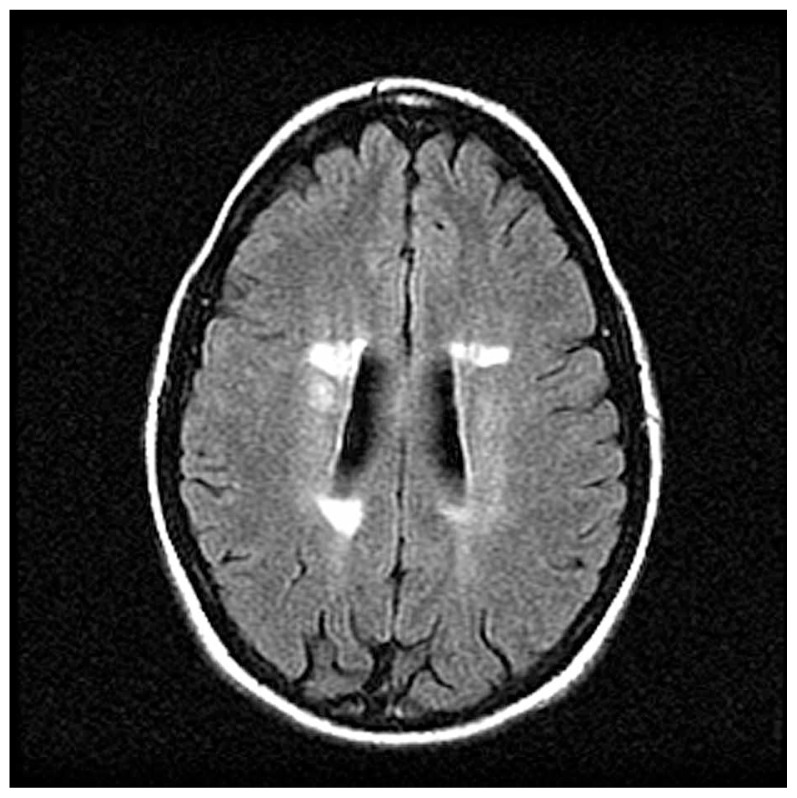
MRIAxial FLAIR brain MRI: hyperintense periventricular lesions typical of demyelination in multiple sclerosis.
Source : Dooley et al., Journal of Ophthalmic & Vision Research, 2010, figure 2 · CC BY
Multiple sclerosis (MS) is a chronic disease of the central nervous system that affects adults who are often young and active. For the physiotherapist, knowing its epidemiological landmarks, its clinical presentations and the tools used to assess disability is not an academic detail: it is what allows management to be finely adapted to a fluctuating, heterogeneous and progressive disease. This section sets out the fundamentals that matter for rehabilitation.
A common disease, female-predominant and diagnosed young
According to the MS Atlas (3rd edition), about 2.8 million people live with multiple sclerosis worldwide, a prevalence of 35.9 per 100,000 population, and that prevalence has risen in every region of the world since 2013 1. The disease has a markedly female face: women are twice as likely as men to live with MS. Finally, the mean age at diagnosis is 32 1 , all of which places the people most often seen in rehabilitation: young adults, mostly women, in the middle of working and family life.
How the diagnosis is made: the 2017 McDonald criteria
The diagnosis rests on the McDonald criteria, revised in 2017 2. These criteria apply above all to a patient presenting with a typical clinically isolated syndrome and define what is needed to demonstrate the dissemination of lesions in space and in time within the central nervous system, while requiring that no other explanation better accounts for the clinical picture. The 2017 revisions aim at an earlier diagnosis: the presence of cerebrospinal fluid-specific oligoclonal bands allows the diagnosis of MS to be made in a patient with a typical clinically isolated syndrome and dissemination in space already demonstrated; cortical lesions can be used to demonstrate dissemination in space 2.
In practice, the physiotherapist therefore increasingly sees people whose diagnosis was made early, sometimes in the aftermath of a first relapse, with functional impact that is still moderate: a useful window in which to establish physical activity habits early.
Relapses and progression: a heterogeneous course
MS does not progress uniformly from one person to another. Clinically, we distinguish phases of relapse (neurological exacerbations) and more stable phases between them; some patients mainly experience an accumulation of disability in a progressive pattern. This distinction has a direct practical consequence for rehabilitation: exercise guidelines are aimed first at people who are not in relapse 3, the period during which training is beneficial and well tolerated.
We must, however, remain honest about the limits of what we know: nothing in the rehabilitation data allows us to claim that physical activity alters the underlying course of the disease or slows the progression of disability. The demonstrated benefits concern symptoms, function and quality of life, which is already considerable, but exercise is not a treatment for the disease itself. That nuance must be set out clearly to the patient to avoid any misunderstanding about what physiotherapy can, and cannot, bring.
Symptoms: fatigue first and foremost
The most frequent and often the most disabling symptom is fatigue 4. Its prevalence is high: a meta-analysis of 69 studies (44,468 patients) finds a pooled overall prevalence of 59.1 % (95 % CI 55.9-62.2 %) 5, and a systematic review of 54 studies reports figures ranging from 36.5 % to 78.0 % depending on the population, with quality of life clearly reduced 6. This fatigue stems from mechanisms directly and indirectly related to the disease as well as from physical inactivity 4 , and that last point is crucial, because it opens a therapeutic door: part of the fatigue is reachable through movement.
Beyond fatigue, there is one phenomenon the physiotherapist must know: heat sensitivity, or Uhthoff's phenomenon. It concerns 60 to 80 % of patients: a rise in core temperature of barely 0.5 °C can be enough to worsen neurological symptoms temporarily 7. This sensitivity can also be induced by effort: exercise-related heat sensitivity is reported in 29 to 80 % of those affected. It justifies precautions, a cool environment, hydration, breaks, but it does not contraindicate exercise 8. A patient who feels worse after a warm session is not necessarily in relapse: it may be Uhthoff's phenomenon, reversible on cooling.
The EDSS: a common language for disability
To situate the level of disability, the reference tool is the EDSS (Expanded Disability Status Scale). The physical activity guidelines explicitly draw on it, since the National MS Society expert consensus covers the whole spectrum of disability, from EDSS 0 to EDSS 9.0 9. Rehabilitation trials in fact recruit across a wide range: balance training, for example, has been studied in patients with an EDSS of 0 to 7.5 10. Keeping the order of magnitude of the scale in mind, from no measurable disability to severe impairment of mobility, helps the physiotherapist interpret a file and calibrate their goals, knowing that documented programmes exist at almost every level.
What the physiotherapist needs to understand in order to adapt management
Three messages structure what we do. First, exercise is safe. An updated systematic review of 40 randomised trials (1,780 participants) shows that physical training increases neither the risk of relapse (relative risk 0.95; 95 % CI 0.61-1.48) nor that of serious adverse events (RR 1.05) 11. The old idea that people with MS should take it easy is contradicted by the data: outside a relapse, exercise can and should be offered.
Second, exercise acts on symptoms and function. A Cochrane overview (15 reviews, 164 trials, 10,396 participants) concludes, on moderate quality evidence, that physiotherapy and multidisciplinary rehabilitation programmes improve mobility, muscle strength and aerobic capacity, reduce fatigue and improve quality of life 12. On fatigue specifically, the landmark Cochrane review finds a significant effect in favour of exercise (standardised mean difference -0.53; 95 % CI -0.73 to -0.33) 4. On walking, a meta-analysis shows an improvement in speed and endurance, even though the T25FW is not significantly changed 13 , a reminder that not every measure moves at the same pace.
Finally, adaptation matters more than standardisation. The disease fluctuates (relapses, variable fatigue, heat sensitivity), disability spreads across the whole EDSS spectrum, and every symptom profile is different. The physiotherapist must therefore individualise: intensity, thermal environment, fatigue management, choice of modalities. Dosing benchmarks exist, at least 30 minutes of moderate aerobic activity twice a week and strengthening of the major muscle groups twice a week for mild to moderate disability 14, and at least 150 min a week of exercise and/or everyday physical activity throughout the disease 9 , but they are a framework to be adjusted, not a rigid protocol.
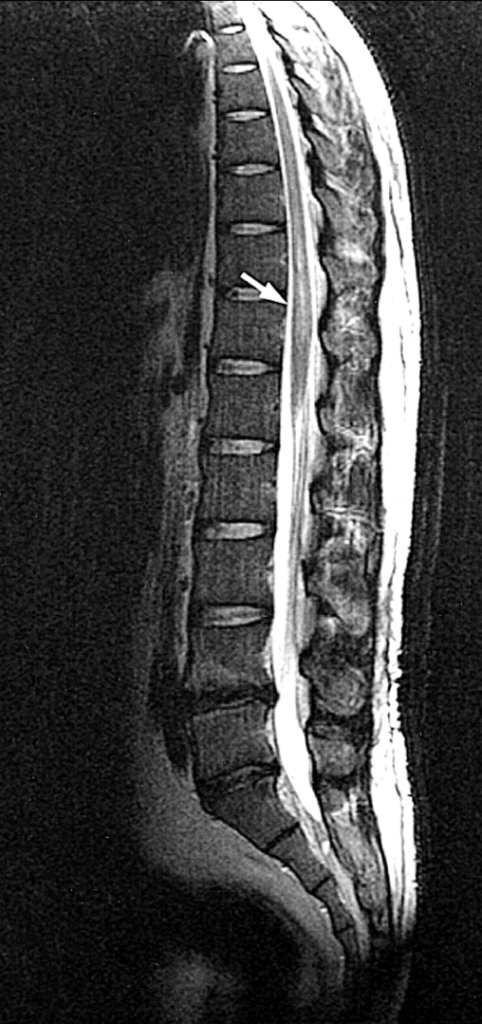
MRISagittal T2 spinal MRI: high-signal lesion of the lower thoracic spinal cord, arrow on the lesion, typical of spinal cord involvement in multiple sclerosis.
Source : Na et al., Yonsei Medical Journal, 2005, figure 3 · CC BY-NC
Key points
- A young, largely female population : 2.8 million people worldwide, women affected twice as often, diagnosis at around 32 1.
- Fatigue dominates the picture 5 and is often the most disabling symptom 4 , but it is reachable through exercise.
- Beware of heat : Uhthoff's phenomenon in 60-80 % of patients, from +0.5 °C 7 ; precautions yes, contraindication no 8.
- Exercise is safe outside a relapse: no excess risk of relapse or of serious adverse events 11.
- Benefits on symptoms and function, not on the course of the disease: do not promise an effect on progression.
✅ Is exercise safe, and what can it really do?
✅ Exercise is SAFE in MS: the overturning of an old fear
Rest was long advised for fear of relapses. Recent data say the opposite: training increases neither relapses nor serious adverse events.
A relative risk close to 1 means no difference. Updated systematic review of 40 randomised trials (1,780 participants): relapses RR 0.95 (95 % CI 0.61-1.48), serious adverse events RR 1.05. Source: Learmonth et al., 2023 (PMID 37880997).
For a long time, people with multiple sclerosis (MS) were advised to take it easy, for fear that effort would worsen the disease or trigger relapses. That excessive caution left its mark: deconditioning, sedentary behaviour and fear of movement themselves feed part of the symptoms. The literature of the past twenty years has reversed the paradigm. Supervised exercise is now considered safe and beneficial at every stage of disability, provided we know what it really changes, and what it does not.
Key points
- Exercise does not increase the risk of relapse in MS (RR 0.95) or of a serious adverse event (RR 1.05): Learmonth 2023.
- It improves strength, aerobic capacity, walking and balance, reduces fatigue and improves quality of life: Amatya 2019, Motl 2012.
- Systematic rest is no longer recommended: aim for at least 150 min a week of activity, at every level of disability (EDSS 0 to 9.0): Kalb 2020.
- Physiotherapy acts on symptoms and function, not on the course of the disease itself.
Breaking with the culture of rest
Fatigue is the most frequent and often the most disabling symptom of MS: its pooled prevalence is estimated at 59.1 % (95 % CI 55.9-62.2 %) across 69 studies gathering 44,468 patients 5, with figures ranging from 36.5 % to 78.0 % depending on the criteria used 6. Yet this fatigue does not stem from the lesion process alone: mechanisms directly and indirectly related to the disease and to physical inactivity contribute to it 4. In other words, part of the fatigue is maintained by deconditioning, and is therefore reachable through movement. Resting as a precaution can worsen the very thing one is trying to protect.
Is exercise safe? What the data say
It is the question that conditions everything else, and the answer today is solid. An updated systematic review of 40 randomised trials (1,780 participants) shows that physical training does not increase the risk of relapse (relative risk 0.95; 95 % CI 0.61-1.48) or of a serious adverse event (RR 1.05; 95 % CI 0.62-1.80) compared with control groups; the authors conclude that it can be promoted as safe and beneficial 11. This result converges with the Cochrane reviews: exercise can be prescribed safely in people with MS 4, and no harmful effect has been documented in patients outside a relapse 3.
An honest methodological reservation: these trials mostly include people with mild to moderate disability, and the exercise in them is supervised and progressive. The safety demonstrated is that of a structured programme, not that of an improvised or maximal effort in a very deconditioned patient. Progressiveness and individualisation remain the rule, and they do not contradict the message: fear of well-conducted exercise is not justified by the evidence.
Uhthoff's phenomenon: understand it, do not fear it
One point deserves particular clinical attention: heat sensitivity, or Uhthoff's phenomenon. It concerns 60 to 80 % of people with MS, and a rise in core temperature of barely 0.5 °C can be enough to worsen temporarily neurological symptoms 7. Since exercise naturally raises body temperature, exercise-induced heat sensitivity is common, reported in 29 to 80 % of patients 8.
Two ideas are essential to pass on. First, this worsening is transient and reversible : it reflects a momentary slowing of nerve conduction in already demyelinated fibres, not a relapse or a new lesion. Second, it does not contraindicate exercise : it justifies precautions, not stopping 8. In practice, the environment and the intensity are adjusted: train in a cool, well-ventilated place, drink plenty, break the effort into intervals, choose the coolest times of day. Aquatic exercise, which limits the rise in temperature, is particularly attractive: a network meta-analysis (27 trials, 1,470 participants) ranks it among the most effective modalities for fatigue 16. Anticipating Uhthoff means allowing the person to stay active without being surprised or discouraged by a worsening they know is temporary.
What exercise really improves
The broadest synthesis available is a Cochrane overview of 15 reviews (164 randomised trials, 10,396 participants): on a moderate level of evidence, physiotherapy (exercise and physical activity) and structured multidisciplinary rehabilitation programmes improve functional outcomes, mobility, muscle strength and aerobic capacity, reduce fatigue and improve quality of life 12. That is the foundation: real benefits, consistent across studies, on what matters day to day.
The detail by domain sharpens the picture:
| Domain | Effect of exercise | Level of evidence |
|---|---|---|
| Self-reported fatigue | Significant reduction (SMD -0.53; 95 % CI -0.73 to -0.33), Heine 2015 | Moderate |
| Muscle strength | Solid evidence against no exercise; progressive resistance training effective, Rietberg 2005, Kjølhede 2012 | High |
| Cardiorespiratory capacity | Moderate gain (effect size 0.47), Platta 2016 | Moderate |
| Walking (speed, endurance) | 10 m: -1.76 s; 6 min: +36.5 m, Pearson 2015 | Moderate |
| Balance | Moderate effect (effect size 0.46), Wallin 2024 | Moderate |
| Quality of life | Improvement, Amatya 2019, Motl 2012 | Moderate |
Two points of honesty. The gain in strength is sometimes small in the overall meta-analyses 18 whereas it is solid for progressive strengthening specifically 17 : the effect depends on the type of training. And the results on walking are not uniform: Pearson 13 finds a gain in speed on the 10-metre test and in endurance on the 6-minute test, but no significant change on the 25-foot walk test (T25FW); likewise, balance training improves the balance score without a clear effect on walking speed 10. The evidence is real but heterogeneous depending on the measure: better to say so than to over-promise.
Physiotherapy acts on symptoms, not on the disease
This is the cardinal distinction, and it must be set out unambiguously with the patient. No data allow us to claim that exercise alters the course of MS, slows demyelination or replaces neurological disease-modifying treatment. What physiotherapy improves are the functional consequences : strength, endurance, walking, balance, fatigue, quality of life 12. It acts on the impact, not on the lesion mechanism. Saying so clearly does not weaken the message, it makes it credible, and it avoids both false hopes and disappointments.
Within that well-defined scope, the guidelines are now clear. For adults with mild to moderate disability: at least 30 minutes of moderate-intensity aerobic activity twice a week, plus strengthening of the major muscle groups twice a week 14. The National MS Society expert consensus widens that framework to the whole spectrum of disability (EDSS 0 to 9.0), encouraging at least 150 min a week of exercise and/or everyday physical activity, and explicitly asking clinicians to promote the benefits and the safety of activity for every person with MS 9. Telerehabilitation is a credible complementary route of access: a meta-analysis of 5 trials (225 participants) shows a significant effect on mobility (SMD 0.41) and balance (SMD 0.64), with feasibility above 90 % 19.
The physiotherapist's role is therefore twofold: to reassure, since exercise is safe, Uhthoff included, and to prescribe an individualised, progressive, realistic programme whose goals bear on function and daily life, not on some hypothetical action against the disease.
🔋 How do you act on fatigue?
🔋 Fatigue and heat: the two realities that frame every session
Fatigue is the most frequent symptom, and heat sensitivity (Uhthoff's phenomenon) affects the majority of patients. All rehabilitation has to work around them.
Fatigue: meta-analysis of 69 studies, 44,468 patients, pooled prevalence 59.1 % 5. Heat: a rise of only 0.5 °C in core temperature can temporarily worsen symptoms 7.
Fatigue is not one symptom among others in multiple sclerosis (MS): it is often the one that those affected name as the most disabling, the one that eats into work, social life and independence long before walking is visibly affected. For the physiotherapist it is both a major therapeutic target and a potential brake on treatment: misunderstood, it discourages activity; well treated, it recedes under the effect of exercise itself. This section takes stock of what is known about its frequency, the place of physical activity and energy management, the real level of evidence and the dose to offer.
An almost universal complaint
MS concerns about 2.8 million people worldwide, a prevalence of 35.9 per 100,000 population, with a mean age at diagnosis of 32 and a marked female predominance, women being twice as likely as men to live with the disease 1. It is therefore an often young, active population, in the middle of working and family life, that fatigue hits head on.
And it hits widely. The landmark Cochrane review recalls that fatigue is the most frequent symptom of MS and the one most often reported as the most disabling 4. A recent meta-analysis of 69 studies gathering 44,468 patients quantifies it: the pooled worldwide prevalence of fatigue reaches 59.1 % (95 % CI 55.9-62.2 %) 5. An earlier systematic review of 54 studies found estimates between 36.5 % and 78.0 % depending on the population and the measurement tool, with quality of life clearly reduced in those affected 6.
Fatigue: between disease and deconditioning
Fatigue in MS has no single cause. Mechanisms directly related to the disease coexist with indirect ones, among them physical inactivity and the deconditioning that follows from it 4. This point is decisive for the physiotherapist: part of the fatigue is maintained by sedentary behaviour, muscle wasting and the fall in aerobic capacity, precisely the targets on which exercise acts. In other words, systematic rest, often adopted spontaneously for fear of exhausting the person, can worsen the vicious circle it claims to relieve.
Exercise, a validated lever against fatigue
This is where the data are strongest. The Cochrane review devoted to fatigue analysed 45 trials (69 interventions, 2,250 people with MS) and concludes that there is a significant effect in favour of exercise compared with a control group, with a standardised mean difference of -0.53 (95 % CI -0.73 to -0.33), a moderate-sized effect on self-reported fatigue 4. The most promising modalities in it are endurance training, mixed training and other approaches such as yoga.
This result is consistent with other syntheses. A meta-analysis of 31 studies (1,434 participants) strongly recommends a regular exercise programme as a component of the rehabilitation programme for these patients 20. A network meta-analysis of 27 trials (1,470 participants) confirms that most exercise modalities outperform no intervention on fatigue, with aquatic exercise coming top of the ranking 16. Finally, the Cochrane overview of 15 reviews (164 randomised trials, 10,396 participants) concludes, on moderate quality evidence, that physiotherapy (exercise and physical activity) and structured multidisciplinary rehabilitation programmes reduce fatigue, improve mobility, muscle strength and aerobic capacity, and raise quality of life 12.
| Benefit sought | What the data show | Level of evidence |
|---|---|---|
| Reduction in fatigue | Moderate effect in favour of exercise, SMD -0.53 4 | Moderate |
| Strength, exercise tolerance, mobility | Solid evidence against no exercise 3 | Solid |
| Cardiorespiratory capacity | Moderate gain, effect size 0.47 18 | Moderate |
| Muscle strength (strengthening alone) | Small gain, effect size 0.27 18 | Low to moderate |
| Safety (no excess relapse risk) | Relapse RR 0.95; serious events RR 1.05 11 | Solid |
Exercise that is safe, fatigue included
The fear that effort will trigger a relapse is common, and reassuring to lift. The Cochrane review concludes that exercise can be prescribed safely in MS 4. An updated systematic review of 40 randomised trials (1,780 participants) confirms it quantitatively: physical training increases neither the risk of relapse (relative risk 0.95; 95 % CI 0.61-1.48) nor that of serious adverse events (RR 1.05), and can therefore be promoted as safe and beneficial 11. Rietberg's review 3, covering 9 trials (260 participants outside relapse), already reported no harmful effect of exercise.
Managing energy: heat, a factor to anticipate
Energy management is not limited to the dose of exercise: it also runs through control of the environment. Heat sensitivity, Uhthoff's phenomenon, concerns 60 to 80 % of patients: a rise in core temperature of barely 0.5 °C can be enough to worsen symptoms temporarily, fatigue among them 7. This exercise-induced sensitivity is reported in 29 to 80 % of those affected, but it does not contraindicate activity: it justifies simple precautions, sessions in a cool environment, hydration, ventilation, even pre-cooling, without giving up exercise 8. In practice, a transient worsening of symptoms during effort is not a sign of danger: it resolves on returning to normal temperature.
What dose is appropriate?
Benchmarks exist and are evidence-based. For adults with MS and mild to moderate disability, the guidelines recommend at least 30 minutes of moderate-intensity aerobic activity twice a week, plus strengthening exercises for the major muscle groups twice a week; meeting those targets can also reduce fatigue and improve mobility and quality of life 14.
The National MS Society international expert consensus widens that framework to the whole spectrum of disability (EDSS 0 to 9.0): clinicians are asked to encourage at least 150 minutes a week of exercise and/or at least 150 minutes a week of lifestyle physical activity, actively promoting its benefits and its safety for every person, while taking comorbidities and symptom fluctuations into account 9. Bringing the two strands together is useful in practice: when a structured session is not possible on a tired day, everyday activity (walking, active household tasks) remains a valid brick in the weekly total.
In practice, the physiotherapist can individualise: favour endurance and mixed formats, break sessions into the least fatiguing hours, plan effort away from temperature peaks, and progress in small steps. Telerehabilitation is a complementary option for maintaining regularity: a meta-analysis of 5 randomised trials (225 participants) shows a significant effect on mobility (SMD 0.41) and balance (SMD 0.64), with feasibility above 90 % 19.
Key points
- Fatigue affects about 6 people in 10 with MS and is among the most disabling symptoms 54.
- Exercise reduces fatigue moderately but significantly (SMD -0.53), particularly endurance, mixed training and yoga 4.
- It is safe: no excess risk of relapse or of serious events 11.
- A workable target: at least 30 min of moderate aerobic activity twice a week plus strengthening twice a week 14, or at least 150 min a week of exercise and/or lifestyle activity 9.
- Anticipate heat sensitivity (Uhthoff, 60-80 %) without giving up exercise 78.
One honest nuance, finally. These benefits bear on symptoms, function and quality of life, not on the course of the disease itself. None of the data above demonstrates that exercise alters the neurological course of MS; moreover, fatigue measurement remains self-reported and heterogeneous from one study to another, which invites caution in interpreting the effect size. The message is not weakened by this: acting on fatigue through physical activity is legitimate, useful and safe, provided it is presented for what it is, a symptomatic and functional treatment, not a disease-modifying one.
🚶 Walking, balance and falls: what rehabilitation?
Walking and balance are among the functions affected earliest and most lastingly in multiple sclerosis (MS). They govern independence, social participation and the risk of falling. The good news: this is also the ground on which training has most clearly proved its worth. A synthesis review finds beneficial effects of exercise on muscle strength, aerobic capacity and walking performance, as well as on fatigue, walking, balance and quality of life 15. What remains is to know what really works, at what dose, and how to measure it.
From walking difficulty to the risk of falling
In a person with MS, walking often deteriorates for several reasons at once: muscle weakness, spasticity, impaired coordination and balance, and above all fatigue. That last is one of the most frequent symptoms of the disease, a meta-analysis of 69 studies (44,468 patients) putting its worldwide prevalence at 59.1 % (95 % CI 55.9-62.2 %) 5 , and it weighs directly on the safety of moving about at the end of the day or after effort. To this is added heat sensitivity (Uhthoff's phenomenon), reported in 60 to 80 % of patients: a rise in core temperature of barely 0.5 °C can temporarily worsen neurological symptoms 7, with a transient impact on walking and stability.
The combination of postural instability, fatigue and heat draws a profile at risk of falling. We must, however, be honest about the state of the evidence: the available data show above all that training improves balance and walking performance, markers associated with the risk of falling, but the demonstration of a direct reduction in the number of falls remains more fragile and less clear-cut. We therefore reason in terms of a functional target (improving balance) rather than a numerical promise of fewer falls.
Key points
- Exercise improves walking speed and endurance, on solid evidence 13.
- Balance training has a moderate and significant effect on balance performance, but its effect on walking speed is not demonstrated 10.
- Exercise is safe: no excess risk of relapse or of serious adverse events 11.
- Fatigue and heat sensitivity are to be built into the programming, not set against activity.
Training balance: what the evidence shows, and what it does not
Specific balance training is now supported by a meta-analysis of 18 randomised trials (902 participants, EDSS 0 to 7.5): it reports an effect size of 0.46 (95 % CI 0.18 to 0.74; p < 0.01) on the composite balance score, a moderate and statistically robust effect 10. That is a strong argument for building postural work systematically into rehabilitation.
Care is needed, however, not to over-interpret: in that same analysis, the effect on walking speed and on stepping tasks (stepping) was not significant 10. In other words, training balance improves balance, but it does not automatically transfer to walking speed. That argues for combined rehabilitation, balance and walking work and strengthening, rather than for a single lever.
Progressive strengthening also contributes to the foundation of stability. A systematic review of 16 studies reports solid evidence of its beneficial effect on muscle strength; on functional capacity, balance and fatigue the effect is less clear but the trend remains broadly positive 17. The gains in fitness are real but measured: a meta-analysis of 20 trials finds a small effect on strength (effect size 0.27) and a moderate one on cardiorespiratory capacity (0.47) 18.
Effects of exercise on walking
It is on walking that the data are most convincing. A meta-analysis of 13 randomised controlled trials shows a significant improvement in speed on the 10-metre test (walking time reduced by -1.76 s; 95 % CI -2.47 to -1.06; p < 0.001) and in endurance on the 6-minute test (+36.46 m; 95 % CI 15.14 to 57.79; p < 0.001) 13.
Here again, honesty is called for: in that same meta-analysis, the timed 25-foot walk test (T25FW) was no significantly changed (-0.59 s; 95 % CI -2.55 to 1.36; p = 0.55) 13. The benefits therefore read better on comfortable speed and on endurance than on very short fast-walking tests, a nuance worth keeping in mind when choosing measurement tools.
These effects sit within a broader picture: the Cochrane synthesis of rehabilitation in MS (15 reviews, 164 trials, 10,396 participants) concludes, on moderate quality evidence, that physiotherapy modalities improve mobility and muscle strength, reduce fatigue and improve quality of life 12. An older Cochrane review already provided solid evidence in favour of exercise for muscle strength, exercise tolerance and mobility-related activities 3.
On walking, the evidence is on the side of exercise; the debate is about how, no longer about whether.
Telerehabilitation, a validated option
When getting to the clinic is difficult (fatigue, distance, reduced mobility), telerehabilitation is a credible alternative. A meta-analysis of 5 randomised trials (225 participants) shows a significant effect on mobility (standardised mean difference 0.41; 95 % CI 0.05-0.77) and on balance (0.64; 95 % CI 0.31-0.97), with feasibility above 90 % 19. It is a useful complement, particularly for maintaining continuity of balance work at home.
Safety: lifting the false contraindications
The fear that effort will wake the disease is unfounded. An updated systematic review of 40 randomised trials (1,780 participants) confirms that physical training does not increase the risk of relapse (relative risk 0.95; 95 % CI 0.61-1.48) or of a serious adverse event (RR 1.05) 11. Exercise can therefore be promoted as safe and beneficial. Let us be clear about what it does not do: nothing in these data allows us to claim that exercise alters the neurological course of the disease. The benefit is functional and symptomatic, which is already considerable.
Heat sensitivity warrants precautions, not abstention: it is common (reported in 29 to 80 % of people depending on the study) but it does not contraindicate exercise 8. In practice: sessions in a cool environment, hydration, breaking the effort into intervals, cooling if needed, and one can carry on.
Measuring and making progress
Choosing the right indicators determines how legible progress will be. Timed walking tests (10 m, 6 minutes) are sensitive to training; the T25FW is less so in this context 13. For balance, a composite score (a standardised clinical scale) captures the gains better than walking speed alone 10.
| Target measured | Tool | Sensitivity to training |
|---|---|---|
| Walking speed | 10-metre test | Good, significant improvement 13 |
| Walking endurance | 6-minute test | Good, +36 m on average 13 |
| Short fast walk | T25FW | Poor, no significant change 13 |
| Balance | Composite balance score | Moderate, effect 0.46 10 |
On dose, we rely on consensus benchmarks. Evidence-based guidelines recommend, for adults with MS and mild to moderate disability, at least 30 minutes of moderate-intensity aerobic activity twice a week and strengthening of the major muscle groups twice a week 14. The National MS Society expert consensus, which covers the whole spectrum of disability (EDSS 0 to 9.0), calls for encouraging at least 150 minutes a week of exercise and/or at least 150 minutes a week of everyday physical activity 9.
In clinical practice, progression combines three complementary strands, balance (for stability), walking (speed and endurance) and strengthening (the foundation of force), since no single lever covers everything. Intensity is personalised to the fatigue of the day, effort is planned around heat peaks, and progress is documented with reproducible tests. It is this structured, graded rehabilitation, rather than isolated exercise, that most reliably improves mobility and quality of life 12.
🎯 Aerobic work, strengthening, dosing: which modalities?
📋 How much exercise? A quantified prescription exists
Evidence-based guidelines give concrete targets, useful to translate into goals with the patient.
The first two rows: physical activity guidelines for MS with mild to moderate disability 14. The third: National MS Society expert consensus covering the whole spectrum of disability, EDSS 0 to 9.0 9.
🎯 What exercise really improves, and by how much
No miracle effect, but real and consistent benefits on the capacities that matter day to day. Effect sizes from meta-analyses.
Standardised mean differences. Benchmark: 0.2 = small effect, 0.5 = medium effect. Fitness and strength: Platta et al., 2016 (PMID 26896750, 20 trials); balance: Wallin et al., 2024 (PMID 39162296, 18 trials, 902 participants). On walking, exercise improves speed on the 10 m test (-1.76 s) and endurance on the 6 min test (+36.5 m). Pearson et al., 2015 (PMID 25712347).
For a long time exercise was viewed with suspicion in multiple sclerosis, for fear of triggering a relapse or worsening fatigue. That time is over. The data accumulated over twenty years converge: physical training is safe and beneficial in people with MS, provided it is dosed and adapted. The physiotherapist's question is no longer whether to get people moving but which modality, at what dose, with what precautions. This section sorts what is solidly supported from what is less so.
Key points
- Exercise does not increase the risk of relapse (RR 0.95) or of a serious adverse event (RR 1.05): it can be prescribed safely 114.
- Aerobic work improves cardiorespiratory capacity and walking above all; progressive strengthening improves muscle strength above all.
- Starting targets: at least 30 min of moderate aerobic activity 2×/week plus strengthening of the major groups 2×/week 14, with a horizon of at least 150 min/week 9.
- No evidence that exercise alters the neurological course of the disease: we treat the consequences (fatigue, walking, strength, quality of life).
Aerobic training: walking, endurance, fatigue
Endurance training is the modality best documented on functional parameters. A meta-analysis of 20 randomised trials finds a moderate gain in cardiorespiratory capacity (effect size 0.47; 95 % CI 0.30-0.65) and a smaller one in strength (0.27): aerobic work acts first where it is expected to, on breathing and endurance 18.
This effect translates concretely into walking. A meta-analysis of 13 trials shows a significant improvement in speed on the 10-metre test (time reduced by 1.76 s; 95 % CI -2.47 to -1.06; p < 0.001) and in endurance on the 6-minute test (+36.5 m; 95 % CI 15.1-57.8; p < 0.001). An honest nuance: in that same body of work, the timed 25-foot walk test (T25FW) was no significantly changed 13. Exercise therefore improves functional walking and endurance, without necessarily transforming every measure.
On fatigue, the most frequent symptom, found in about 59 % of patients 5 and up to 78 % depending on the study 6 , endurance is among the most effective modalities. The landmark Cochrane review concludes that there is a significant effect in favour of exercise (standardised mean difference -0.53; 95 % CI -0.73 to -0.33; p < 0.01), particularly for endurance, mixed or yoga-type training 4. A network meta-analysis (27 trials, 1,470 participants) confirms that most modalities outperform no intervention, with aquatic exercise coming top of the ranking 16.
Strengthening: what progressive resistance brings
Progressive resistance training (PRT) has a target of its own. A systematic review of 16 studies reports solid evidence of its beneficial effect on muscle strength; on functional capacity, balance and fatigue, the evidence is less clear but the trend remains broadly positive 17. That is consistent with Platta's meta-analysis 18 : the gain in strength is real but of smaller magnitude than the aerobic gain in cardiorespiratory fitness.
The clinical message is therefore one of specificity: you do not strengthen a muscle by cycling at moderate intensity, and you do not improve VO₂ by doing sets of leg press. Strengthening is fully justified in patients whose muscle weakness limits mobility, provided you progress the load over time.
Combined work, balance, telerehabilitation
In practice, mixed programmes (aerobic plus strengthening) are widely supported. The historical Cochrane review of 9 trials provides solid evidence in favour of exercise, against no exercise, for muscle strength, exercise tolerance and mobility-related activities, with no documented harmful effect, in patients outside relapse 3. The Cochrane synthesis of 15 reviews (164 trials, 10,396 participants) concludes, on a moderate level of evidence, that physiotherapy and structured multidisciplinary rehabilitation improve mobility, strength and aerobic capacity, reduce fatigue and improve quality of life 12.
The Balance deserves dedicated training: a meta-analysis of 18 trials (902 participants, EDSS 0 to 7.5) shows a moderate and significant effect on the composite balance score (effect size 0.46; 95 % CI 0.18-0.74; p < 0.01), but, again with caution, no effect on walking speed in that body of work 10.
When travel is an obstacle, telerehabilitation is a credible option. A meta-analysis of 5 trials (225 participants) finds a significant effect on mobility (SMD 0.41; 95 % CI 0.05-0.77) and balance (SMD 0.64; 95 % CI 0.31-0.97), with feasibility above 90 % 19. The body of work remains limited, five trials, but the tool is promising for maintaining adherence at a distance.
| Modality | What it improves best | Level of evidence |
|---|---|---|
| Aerobic / endurance | Cardiorespiratory capacity, walking, fatigue | Solid 18134 |
| Progressive resistance | Muscle strength | Solid for strength 17 |
| Combined / structured rehabilitation | Mobility, strength, fatigue, quality of life | Moderate 123 |
| Balance training | Composite balance score | Moderate 10 |
| Telerehabilitation | Mobility, balance at a distance | Emerging, few trials 19 |
Dosing: where to start, how far to go
Two benchmarks command consensus. The evidence-based guidelines of Latimer-Cheung 14, for adults with mild to moderate disability, set a minimum floor : at least 30 minutes of moderate-intensity aerobic activity twice a week, and strengthening exercises for the major muscle groups twice a week, a volume that can also reduce fatigue and improve mobility and quality of life.
The National MS Society expert consensus 9 widens the perspective to the whole spectrum of disability (EDSS 0 to 9.0): encouraging at least 150 min a week of exercise and/or at least 150 min a week of lifestyle physical activity, taking comorbidities and symptom fluctuations into account. In other words, the Latimer-Cheung floor is a starting point, not a ceiling, and everyday activity counts as much as formal training. A meta-analysis of 31 studies (1,434 participants) points the same way: a regular exercise programme is strongly recommended as a component of rehabilitation for these patients 20.
Safety and Uhthoff's phenomenon
The fear of relapse does not hold up against the data. The updated systematic review of 40 trials (1,780 participants) is clear: training increases neither the risk of relapse (RR 0.95; 95 % CI 0.61-1.48) nor that of a serious adverse event (RR 1.05), and can be promoted as safe and beneficial 11. The Cochrane review on fatigue confirms it: exercise can be prescribed safely 4.
One precaution remains in order: heat sensitivity (Uhthoff's phenomenon), which concerns 60 to 80 % of patients, a rise in core temperature of barely 0.5 °C being enough to worsen symptoms temporarily 7. Exercise-induced heat sensitivity is reported in 29 to 80 % of those affected; it justifies simple measures (a cool environment, hydration, light clothing) but does not contraindicate exercise 8.
The right modality is not the most intense one, it is the one the patient tolerates, understands and will keep up over time.
One fundamental reservation, finally, to stay honest about the scope of these benefits: nothing allows us to claim that exercise alters the neurological course of MS. What it improves, and it is already considerable, are its consequences for function: strength, walking, endurance, fatigue, balance and quality of life 1512. It is on that ground, and not on that of the disease itself, that the physiotherapist acts with the greatest certainty.
🗂️ What do concrete case reports teach us?
The evidence presented so far is robust, but it remains group averages. In practice, no two people with multiple sclerosis (MS) are ever quite alike : the level of disability, fatigue, heat sensitivity and life goals change everything about the dose. To show how the guidelines translate into a session, here is one published case, with its PubMed identifier. It does not show how to rehabilitate MS: it shows why one should ask, from time to time, whether it really is MS. These do not illustrate any real patient and do not replace individualised clinical reasoning : they are supports for making the how visible.
Published case: referred for multiple sclerosis, she had a muscular dystrophy
The case. Koshorek and colleagues report a woman referred for assessment of multiple sclerosis because of a progressive deficit21. The diagnosis reached was a LAMA2-related muscular dystrophy, in a new phenotype combining progressive myelopathy and spinal cord abnormalities21.
The authors' reminder. The late-onset form of this genetic disease can present with proximal muscle weakness, joint contractures, neuropathy, epilepsy or cardiorespiratory involvement21.
What that changes for the physiotherapist. They are not going to reopen a diagnosis of MS, and that is not what this case asks for. What it asks is more modest and more useful: to notice, and to say, when the course does not look like what is expected. An MS that never relapses, a strictly proximal weakness, early contractures, unexplained cardiac or respiratory involvement: these are session observations, made by someone who sees the patient every week, and they are worth passing on.
The rest of this article deals with what follows the diagnosis, once it holds: exercise dosing, fatigue management, walking and balance.
What these two cases have in common
Despite opposite profiles, the logic is identical. We start from the real functional level rather than from the diagnostic label ; we choose priority targets (fatigue for Julie, balance and walking for Marc) ; we dose progressively towards a floor of activity 149 ; we manage heat without giving up movement 78 ; and we rely on a reassuring safety profile 113. Finally, an honest clarification is needed : these data show benefits on function, fatigue and quality of life, they do not demonstrate that exercise alters the course of the disease itself. That is already considerable for the daily lives of those affected, and it is on that ground that physiotherapy acts most solidly.
🧭 How is this applied in practice?
Moving from evidence to the session calls for a simple approach: assess the level of disability, set an achievable dose, make the effort safe (fatigue, heat) and know when to refer on. Physiotherapy does not alter the course of the disease, no confirmed data allow that claim, but it improves mobility, strength and aerobic capacity, reduces fatigue and raises quality of life, on a moderate level of evidence 12.
A decision algorithm in practice
The diagnosis belongs to the neurologist and rests on the McDonald criteria revised in 2017, which define dissemination of CNS lesions in time and in space 2. The physiotherapist comes in afterwards, in the stable phase, outside a relapse. The approach can unfold in four steps:
- Locate the disability. The people seen are young (mean age at diagnosis 32), mostly women (twice as many women as men) and heterogeneous 1. Identify the functional level: independent walking, walking aid, or wheelchair. Exercise has been studied and recommended across the whole spectrum of disability, from EDSS 0 to 9.0 9.
- Frame it outside a relapse. The documented benefits and safety concern people who are not in relapse 3. If a relapse is under way, we wait and refer.
- Set the target dose. For mild to moderate disability: at least 30 minutes of moderate-intensity aerobic activity twice a week and strengthening of the major muscle groups twice a week 14. Overall goal: at least 150 min a week of exercise and/or everyday physical activity 9.
- Prioritise according to the complaint. Fatigue dominant → endurance and mixed work; limited walking → aerobic work and endurance; instability → specific balance training.
These targets are starting points to individualise, not rigid thresholds: start low, progress in steps, adjust to the tolerance of the day.
The key messages to pass on
Three simple, evidence-based messages structure the therapeutic alliance:
Moving is safe. It is the most important message. An updated systematic review of 40 randomised trials (1,780 participants) shows that training increases neither the risk of relapse (relative risk 0.95; 95 % CI 0.61-1.48) nor that of serious adverse events (RR 1.05) 11. Exercise can be prescribed safely in MS 4.
Moving acts on what weighs day to day. Training improves muscle strength, exercise tolerance and mobility, on solid evidence 3. In concrete terms, walking improves: a meta-analysis of 13 trials reports increased speed on the 10-metre test and improved endurance on the 6-minute test (+36.5 m), even though the timed 25-foot test was not significantly changed 13. The gains in fitness are real but measured: small for strength (effect size 0.27), moderate for cardiorespiratory capacity (0.47) 18.
Regularity matters more than intensity. Better 150 minutes spread out and sustained over time than one exhausting peak. Everyday physical activity counts as much as structured exercise 9.
Managing fatigue
Fatigue is the most frequent symptom and often the most disabling: its pooled worldwide prevalence reaches 59.1 % (95 % CI 55.9-62.2 %) across 44,468 patients 5 ; other syntheses put it between 36.5 % and 78 % depending on the study 6. It stems from mechanisms related to the disease and to inactivity 4. The intuitive reflex, resting, maintains the deconditioning.
The confirmed lever is counterintuitive: exercise reduces self-reported fatigue. The landmark Cochrane review finds a significant effect in its favour (standardised mean difference -0.53; 95 % CI -0.73 to -0.33), with no increased risk of relapse, endurance, mixed work and yoga-type approaches standing out 4. A network meta-analysis (27 trials, 1,470 participants) confirms that most modalities outperform no intervention, with aquatic exercise coming top 16. A regular programme is strongly recommended as a component of rehabilitation 20.
In practice: break sessions up, plan effort for the hours of best energy, aim for a sustainable moderate intensity, and measure progress on function and on how the person feels rather than on performance alone. It is explained from the outset that fatigue during effort does not signal a worsening of the disease.
Managing heat: Uhthoff's phenomenon
Heat sensitivity concerns 60 to 80 % of those affected: a rise in core temperature of barely 0.5 °C can temporarily worsen symptoms 7. Sensitivity linked to exercise itself (EIHS) is reported in 29 to 80 % of patients, but it justifies precautions, not a contraindication 8. The message must be clear: symptoms that reappear with heat are transient and reversible on cooling, they do not signal a relapse.
Concrete precautions:
- Sessions in the cooler hours; a ventilated or air-conditioned room.
- Hydration before, during and after; cool drinks.
- Pre-cooling and active cooling: a cooling vest or armbands, damp cloths, partial immersion.
- Light clothing, recovery breaks.
- Aquatic exercise, in temperate water, combines coolness with effectiveness against fatigue 16.
Instability and walking: targeting balance
When instability dominates, specific balance training has a moderate and significant effect: a meta-analysis of 18 trials (902 participants, EDSS 0-7.5) reports an effect size of 0.46 (95 % CI 0.18-0.74) on the composite balance score, but with no demonstrated effect on walking speed, which has to be owned honestly 10. Progressive resistance training has solid evidence for strength, more uncertain evidence for balance and fatigue, with a broadly positive trend 17.
Referral: when to redirect
Physiotherapy belongs outside a relapse. Some situations require stopping and referring to the treating neurologist:
- Suspected relapse : a new or clearly worsened neurological symptom, established and persistent (beyond 24 h), distinct from a simple transient increase linked to heat or fatigue.
- Signs not explained by the known MS, or an atypical picture, since the diagnosis requires that there be no better explanation 2.
- Heat-triggered symptoms that do not resolve on cooling.
- Repeated falls, bladder and sphincter problems, pain, poorly controlled spasticity calling for dedicated medical or multidisciplinary management.
Faced with a first suggestive neurological episode that has not yet been investigated, medical referral takes priority: the diagnosis rests on the 2017 McDonald criteria and is not the physiotherapist's remit 2.
Working as a team
The best functional results are seen in structured, multidisciplinary programmes 12. The physiotherapist works alongside the neurologist (diagnosis, disease-modifying treatment, relapse management), the general practitioner, and as needed the occupational therapist, the speech and language therapist, the psychologist and the nurses. Sharing concrete functional goals, holding 30 minutes of walking, climbing a flight of stairs, taking up an activity again, gives coherence to the pathway.
Telerehabilitation widens access and supports adherence: a meta-analysis of 5 trials (225 participants) shows a significant effect on mobility (SMD 0.41) and balance (SMD 0.64), with feasibility above 90 % 19. Useful for maintaining the 150 min a week between sessions, as a complement to and not a replacement for in-person follow-up.
Key points
- Moving is safe, outside a relapse : no excess risk of relapse (RR 0.95) or of serious events (RR 1.05) 11.
- Target dose : at least 30 min of moderate aerobic activity 2×/week plus strengthening 2×/week 14, aiming for at least 150 min a week 9.
- Fatigue 5 : exercise reduces it (SMD -0.53), rest does not 4.
- Heat : 60-80 % are sensitive, from +0.5 °C, reversible; cool, hydrate, do not contraindicate 7.
- Refer on to the neurologist if a relapse is suspected or the picture is atypical 2.
- Honesty : exercise improves function and quality of life 12, but nothing proves that it alters the course of the disease.
Bibliography
Every reference verified individually on PubMed (clickable PMID). 20 sources. Click a superscript note marker in the text: the bibliography opens and highlights the source.
- Walton C, King R, Rechtman L, et al. (Atlas of MS, third edition) (2020). Multiple Sclerosis Journal. PMID 33174475. doi:10.1177/1352458520970841.
- Thompson AJ, Banwell BL, Barkhof F, et al. (2018). The Lancet Neurology. PMID 29275977. doi:10.1016/S1474-4422(17)30470-2.
- Rietberg MB, Brooks D, Uitdehaag BMJ, Kwakkel G (2005). Cochrane Database of Systematic Reviews. PMID 15674920. doi:10.1002/14651858.CD003980.pub2.
- Heine M, van de Port I, Rietberg MB, van Wegen EEH, Kwakkel G (2015). Cochrane Database of Systematic Reviews. PMID 26358158. doi:10.1002/14651858.CD009956.pub2.
- Yi X, et al. (2024). Frontiers in Neurology. PMID 39416662. doi:10.3389/fneur.2024.1457788.
- Oliva Ramirez A, Keenan A, Kalau O, Worthington E, Cohen L, Singh S (2021). BMC Neurology. PMID 34856949. doi:10.1186/s12883-021-02396-1.
- Christogianni A, Bibb R, Davis SL, et al. (2018). Temperature (Austin). PMID 30377640. doi:10.1080/23328940.2018.1475831.
- Šilarová A, Hvid LG, Hradílek P, Dalgas U (Anna Šilarová, first author) (2024). Multiple Sclerosis and Related Disorders. PMID 39213861. doi:10.1016/j.msard.2024.105827.
- Kalb R, Brown TR, Coote S, et al. (2020). Multiple Sclerosis Journal. PMID 32323606. doi:10.1177/1352458520915629.
- Wallin A, et al. (Andreas Wallin, first author) (2024). Neurorehabilitation and Neural Repair. PMID 39162296. doi:10.1177/15459683241273402.
- Learmonth YC, Herring MP, Russell DI, et al. (2023). Multiple Sclerosis Journal. PMID 37880997. doi:10.1177/13524585231204459.
- Amatya B, Khan F, Galea M (2019). Cochrane Database of Systematic Reviews. PMID 30637728. doi:10.1002/14651858.CD012732.pub2.
- Pearson M, Dieberg G, Smart N (Melissa Pearson, first author) (2015). Archives of Physical Medicine and Rehabilitation. PMID 25712347. doi:10.1016/j.apmr.2015.02.011.
- Latimer-Cheung AE, Martin Ginis KA, Hicks AL, et al. (2013). Archives of Physical Medicine and Rehabilitation. PMID 23770262. doi:10.1016/j.apmr.2013.05.015.
- Motl RW, Pilutti LA (2012). Nature Reviews Neurology. PMID 22825702. doi:10.1038/nrneurol.2012.136.
- Chen Y, Xu S, Shen J, Yang H, Xu W, Shao M, Pan F (Yuting Chen, first author) (2021). International Journal of Sports Medicine. PMID 34375988. doi:10.1055/a-1524-1935.
- Kjølhede T, Vissing K, Dalgas U (2012). Multiple Sclerosis Journal. PMID 22760230. doi:10.1177/1352458512437418.
- Platta ME, Ensari I, Motl RW, Pilutti LA (2016). Archives of Physical Medicine and Rehabilitation. PMID 26896750. doi:10.1016/j.apmr.2016.01.023.
- Doherty F, et al. (2024). Journal of the Neurological Sciences. PMID 39270413. doi:10.1016/j.jns.2024.123214.
- Razazian N, Kazeminia M, Moayedi H, et al. (Nazanin Razazian, first author) (2020). BMC Neurology. PMID 32169035. doi:10.1186/s12883-020-01654-y.
- Koshorek J, de Macena Sobreira N, Saidha S (2022). LAMA2-related muscular dystrophy mimicking multiple sclerosis. BMJ Case Reports. PMID 35868801. doi:10.1136/bcr-2022-249061.
❓ Frequently asked questions
How many people have multiple sclerosis, and who is affected?
About 2.8 million people live with multiple sclerosis worldwide, a prevalence of 35.9 per 100,000 population, and prevalence has risen in every region of the world since 2013. Women are affected about twice as often as men, and the mean age at diagnosis is 32 1.
How is multiple sclerosis diagnosed?
The diagnosis rests on the McDonald criteria revised in 2017, which apply above all to a typical clinically isolated syndrome and define dissemination of central nervous system lesions in space and in time, while requiring that no better explanation accounts for the clinical picture. Their revisions (cerebrospinal fluid-specific oligoclonal bands, symptomatic lesions, cortical lesions) aim at an earlier diagnosis 2.
Is fatigue common in MS, and can exercise improve it?
Fatigue is one of the most frequent symptoms and often the most disabling: its pooled worldwide prevalence is estimated at 59.1 % (95 % CI 55.9-62.2 %) in a meta-analysis of 69 studies and 44,468 patients 5. Therapeutic exercise significantly reduces that fatigue, with an effect in favour of exercise (standardised mean difference -0.53; 95 % CI -0.73 to -0.33), particularly endurance, mixed or yoga-type training 4.
Is exercise dangerous, or might it trigger relapses?
No. An updated systematic review of 40 randomised trials (1,780 participants) shows that physical training does not increase the risk of relapse (relative risk 0.95; 95 % CI 0.61-1.48) or of serious adverse events (RR 1.05), and can be promoted as safe and beneficial 11. Therapeutic exercise can be prescribed safely in people who are not in relapse, with no documented harmful effect 3.
What concrete benefits does physiotherapy bring to walking and balance?
Exercise improves walking: a meta-analysis of 13 randomised trials shows an improvement in walking speed on the 10-metre test (time reduced by -1.76 s; 95 % CI -2.47 to -1.06) and in endurance on the 6-minute test (+36.46 m; 95 % CI 15.14 to 57.79) 13. Balance training has a moderate and significant effect on balance performance (effect size 0.46; 95 % CI 0.18 to 0.74) in patients with an EDSS of 0 to 7.5 10. More broadly, structured multidisciplinary rehabilitation and physiotherapy improve mobility, muscle strength, aerobic capacity and quality of life 12.
How much physical activity is recommended for a person with MS?
For adults with mild to moderate disability, evidence-based guidelines recommend at least 30 minutes of moderate-intensity aerobic activity twice a week and strengthening exercises for the major muscle groups twice a week 14. An international expert consensus recommends, at every level of disability (EDSS 0 to 9.0), encouraging at least 150 minutes a week of exercise and/or at least 150 minutes a week of lifestyle physical activity 9.
Further reading in the journal