








Clinical synthesis on stress urinary incontinence (SUI) in women: assessment and pelvic floor rehabilitation, based on the Cochrane review and the guidelines. Every reference has been verified on PubMed.
📝 In brief: clinical synthesis
- Stress urinary incontinence (SUI) is the most common form of incontinence in women: in the nationally representative NHANES 2015-2018 data (5,006 women), 61.8% of adult women reported urinary incontinence, of whom 37.5% had pure SUI against 22.0% urgency incontinence and 31.3% mixed forms 2. The Norwegian population study EPINCONT (27,936 women) finds the same hierarchy, with 50% SUI among incontinent women 3.
- The dominant risk factors are increasing age, overweight or obesity and vaginal delivery; on multivariate analysis, age over 70, BMI over 40 and vaginal delivery show the strongest association 2. The postnatal period is a high-risk window: the weighted prevalence of urinary incontinence between 6 weeks and 1 year after delivery is around 31%, with SUI accounting for 54% of cases 4.
- The pathophysiology is multifactorial and does not come down to a “weak pelvic floor”: bladder neck dilatation, reduced functional urethral length, impaired bladder neck support and lowered maximum urethral closure pressure are the strongest characteristic signs of SUI, with associated involvement of urethral support and of levator ani function 6. The anatomical rationale remains the “hammock hypothesis”: the urethra is compressed and closed against a fascial and vaginal supporting layer stabilised by the arcus tendineus fasciae pelvis and the levator ani 5.
- Pelvic floor muscle training (PFMT) is the first-line conservative treatment, with the highest level of evidence: in women with SUI it makes reported cure eight times more likely: 56% against 6% in the control groups (RR 8.38; 95% CI 3.68-19.07; 4 trials, 165 women; high-quality evidence), and cure or improvement six times more likely (74% against 11%; RR 6.33; 95% CI 3.88-10.33), with a reduction of about one leakage episode per 24 hours (MD -1.23; 95% CI -1.78 to -0.68) 10. The NICE NG123 guideline sets out the parameters: at least 3 months of supervised PFMT, with a minimum of 8 contractions 3 times a day 13.
- Prior testing is not optional: of 139 incontinent women assessed by bidigital palpation using the PERFECT scheme, 15.1% were unable to contract the pelvic floor and 38.1% managed only after additional teaching, that is, 53.2% unable to contract voluntarily without prior instruction 14. After a simple verbal instruction, only 49% of women perform an ideal contraction and 25% adopt an abdominal bearing-down technique liable to promote incontinence, with no factor (age, parity, weight, hormonal status) predicting it 15.
- Equipment adds nothing essential to a well-performed contraction: adding biofeedback to PFMT shows little to no difference in incontinence-related quality of life (SMD -0.07; 95% CI -0.18 to 0.05; 11 studies, 1,169 women; high-certainty evidence) and a negligible gain of 0.29 fewer leakage episodes per 24 hours 22. Electrical stimulation is not superior to active training (7 trials, 411 women; very low certainty) 25, and weighted vaginal cones do no better than PFMT for subjective cure (RR 1.01; 95% CI 0.91-1.13) 26. Individual supervision probably makes little to no difference to quality of life compared with group supervision (5 trials, 544 women) 24.
- PFMT is also preventive, and its limits must be stated honestly: begun during pregnancy in continent women, it reduces the risk of incontinence in late pregnancy by about 62% (RR 0.38; 95% CI 0.20-0.72) and by 29% in the postnatal period beyond 3 to 6 months (RR 0.71; 95% CI 0.54-0.95; high-quality evidence) 9. In moderate to severe forms, by contrast, the 12-year follow-up of the PORTRET trial finds 86.9% crossover from physiotherapy to surgery and markedly less improvement than after a midurethral sling (absolute difference 50.6%; 95% CI 28.2-73.1) 17. A weight loss of 8.0% over 6 months reduces weekly episodes by 47%, with a significant effect on the stress component (p = 0.02) but not on urgency incontinence 7.
💧 What are the fundamentals to know about stress urinary incontinence?
🤰 The postnatal period: the window not to be missed
Incontinence does not disappear on its own with time: after a fall at 3 months, it climbs back at one year to the level of the 3rd trimester of pregnancy.
Systematic review and meta-analysis of 24 studies (35,064 women, Western world). Prevalence is identical in primiparous and multiparous women. Source: Moossdorff-Steinhauser et al., 2021 (PMID 34142179).
💧 Stress incontinence is the most common form
Breakdown of incontinence types among the women affected: stress dominates, alone or combined with urgency.
Share of each type among incontinent women. 61.8% of adult women report urinary incontinence, and 22.1% a moderate to severe form (Sandvik index). NHANES 2015-2018 data (5,006 women, United States). Source: Patel et al., 2022 (PMID 35030139).
Stress urinary incontinence (SUI) is probably the reason for pelvic floor rehabilitation you will meet most often, and yet it is also one of the most poorly understood, both by patients and by some of the professionals who refer them. Before turning to assessment and treatment, solid foundations are essential: what SUI is exactly (and what it is not), how often it occurs, in whom, and through which anatomical and neuromuscular mechanisms continence under effort breaks down.
Key points
- Definition. SUI is any involuntary loss of urine associated with physical activity 1. It is distinct from urgency incontinence, in which leakage is preceded by a compelling urge.
- Frequency. 61.8% of adult American women report urinary incontinence, of whom 37.5% have pure SUI: the leading type of incontinence 2. In EPINCONT, SUI accounts for 50% of cases 3.
- Major risk factors. Increasing age, BMI ≥ 25, vaginal delivery; the strongest associations on multivariate analysis: age > 70, BMI > 40, vaginal delivery 2.
- Postnatal period = high-risk window. Weighted prevalence ≈ 31% between 6 weeks and 1 year, of which 54% SUI 4.
- Multifactorial pathophysiology. Impaired urethral support 5 + bladder neck and urethral incompetence + neuromuscular impairment of the striated sphincter and of the levator ani 6.
Definition: SUI, urgency incontinence, mixed incontinence
The most recent European collaborative review defines SUI as any involuntary loss of urine associated with physical activity 1. It is a symptomatic definition, based on the circumstances of onset: leakage occurs at the moment abdominal pressure rises: coughing, sneezing, laughing, lifting, jumping, running, changing position. In the pure form there is neither a preceding compelling urge nor any sense of urgency.
This distinction is not academic: it governs the whole management strategy. The same authors stress that SUI remains underdiagnosed and undertreated 1: a point to keep in mind during history taking, since a patient referred for some entirely different reason may never spontaneously raise her leakage.
| Criterion | Stress urinary incontinence (SUI) | Urgency incontinence | Mixed incontinence |
|---|---|---|---|
| Circumstances of the leakage | Associated with physical activity 1 | Leakage preceded by a compelling urge | Combination of the two pictures |
| Share among incontinent women (NHANES 2015-2018, n = 5,006) | 37.5 % | 22.0 % | 31.3 % |
| Share among incontinent women (EPINCONT, n = 27,936) | 50 % | 11 % | 36 % |
| Response to weight loss (PRIDE trial, n = 338) | Significant reduction in episodes (p = 0.02) | No significant reduction (p = 0.14) | — |
Note that in NHANES, 9.2% of incontinence remained “unspecified” 2 : symptomatic classification has its grey areas, and pure SUI is not, in the end, an absolute majority of presentations, mixed forms account for nearly a third.
Epidemiology: a majority of women affected
The nationally representative US NHANES 2015-2018 data (5,006 women, weighted analyses) give the order of magnitude: 61.8% of adult women report urinary incontinence, which corresponds to about 78.3 million adult women in the United States 2. Among them, 32.4% of all women reported symptoms at least monthly.
The breakdown by type is instructive for the physiotherapist: among incontinent women, 37.5% had SUI, against 22.0% urgency incontinence, 31.3% mixed forms and 9.2% unspecified incontinence 2. SUI is therefore, by volume, the leading type of incontinence, and if the mixed forms that include a stress component are added, the share of the caseload calling for stress-oriented pelvic floor work becomes very large.
The Norwegian population study EPINCONT (27,936 women, 80% response rate) confirms the message with different figures but an identical hierarchy: 25% of women reported urinary leakage and nearly 7% significant incontinence, defined as moderate to severe and experienced as bothersome. The breakdown by type there was 50% SUI, 11% urgency incontinence and 36% mixed forms 3, which makes SUI the leading reason for pelvic floor rehabilitation.
The gap between the two overall prevalence figures (61.8% vs 25%) comes down to definitions and data-collection methods; what counts clinically is the convergence on two points: incontinence is common, and SUI is its dominant form.
Severity: how many patients are genuinely bothered?
Not all incontinence is equal. In NHANES, the prevalence of moderate to severe incontinence assessed with the Sandvik severity index reached 22.1% of adult women, that is, about 28.5 million women in the United States 2. In other words: while a majority of women report leakage, roughly one woman in five has a form that goes beyond anecdotal bother.
EPINCONT arrives at a consistent reading: nearly 7% of women had significant incontinence, that is, moderate to severe and experienced as bothersome 3. The subjective dimension, the perceived impact, is therefore not superimposable on the quantification of leakage alone. This mismatch justifies using tools that capture both dimensions, such as the ICIQ, whose final version comprises three scored items and one unscored self-diagnostic item, assessing frequency, amount and impact on daily life, with high internal consistency (Cronbach's alpha = 0.95) 8.
Risk factors: age, weight, childbirth
The multivariate analyses of NHANES identify as associated with urinary incontinence (any form and moderate form): increasing age, BMI ≥ 25, a history of vaginal delivery, but also anxiety, depression, functional dependence and non-Hispanic white ethnicity 2.
Among them, three stand out clearly: age over 70, BMI over 40 and vaginal delivery show the strongest association with urinary incontinence in multivariate modelling 2.
| Factor | Strength of association | Source | Physiotherapy lever? |
|---|---|---|---|
| Age > 70 | Strongest association (multivariate) | Patel et al. 2022 | Not modifiable |
| BMI > 40 | Strongest association (multivariate) | Patel et al. 2022 | Modifiable: weight loss effective on SUI 7 |
| Vaginal delivery | Strongest association (multivariate) | Patel et al. 2022 | Not modifiable after the event, but antenatal prevention is documented 9 |
| BMI ≥ 25 (overweight) | Associated with any UI and with moderate UI | Patel et al. 2022 | Modifiable |
| Anxiety, depression, functional dependence | Associated (multivariate) | Patel et al. 2022 | Referral / multidisciplinary management |
The value of this hierarchy is very concrete. Two of the three most strongly associated factors are beyond the reach of retrospective rehabilitation (age, obstetric history). The third, weight, is, by contrast, modifiable, and its effect is specifically documented on the stress component. In a randomised trial of 338 overweight or obese women with at least 10 incontinence episodes a week, a 6-month behavioural weight-loss programme produced a loss of 8.0% of body weight (7.8 kg) against 1.6% (1.5 kg) in the control group, with a reduction in weekly incontinence episodes of 47% against 28% (p = 0.01), and this fall was significant for episodes of stress incontinence (p = 0.02) but not for those of urgency incontinence (p = 0.14) 7.
The postnatal period: a risk window in its own right
The period following childbirth deserves to be set apart, because it concentrates both the risk and the opportunity to intervene. A systematic review with meta-analysis of 24 studies covering more than 35,000 women establishes that the weighted mean prevalence of urinary incontinence between 6 weeks and 1 year after delivery is around 31%, and that SUI is its most common type (54%) 4.
The time course is counter-intuitive and needs to be known: after an initial fall at 3 months, prevalence climbs back at one year to a level close to that of pregnancy (32%) 4. The spontaneous improvement of the third month is therefore not a lasting favourable prognosis: a major point for informing the patient, who might stop her pelvic floor work precisely when symptoms seem to be settling.
Another figure useful in practice: the prevalence of urinary incontinence is identical in primiparous and multiparous women 4. A primiparous woman cannot therefore be reassured on the grounds that this is her first delivery.
“After an initial fall at 3 months, prevalence climbs back at one year to a level close to that of pregnancy.” The lull of the postnatal trimester is not a cure.
This window is also the one in which prevention best demonstrates its worth. In continent women, antenatal pelvic floor muscle training reduces by about 62% the risk of reporting urinary incontinence in late pregnancy (RR 0.38; 95% CI 0.20 to 0.72; 6 trials, 624 women; moderate-quality evidence), and reduces by 29% the risk of incontinence in the mid postnatal period (beyond 3 to 6 months) (RR 0.71; 95% CI 0.54 to 0.95; 5 trials, 673 women): this last result resting on evidence of high quality 9. Pelvic floor work is therefore not only curative: begun early and structured, it has preventive value in the woman who is still continent.
Pathophysiology: urethral support and the hammock hypothesis
The reference anatomical model remains the one described by DeLancey 5, known as the “hammock hypothesis”. It constitutes the direct anatomical rationale for pelvic floor work in physiotherapy.
The principle: the urethra rests on a supporting layer made up of the endopelvic fascia and the anterior vaginal wall. This layer draws its structural stability from its lateral attachments to the arcus tendineus fasciae pelvis and to the levator ani muscle. During a rise in abdominal pressure, the pressure coming from above compresses the urethra against this hammock-shaped supporting layer and closes its lumen 5.
The conceptual consequence is decisive and often poorly conveyed: the increase in urethral closure pressure during a cough probably comes from this compression of the urethra against a hammock-shaped supporting layer, rather than from a genuinely “intra-abdominal” position of the urethra 5. Continence under effort therefore depends on the integrity of a support system, not on a topography. That is exactly what rehabilitation targets: the quality of the support, not repositioning.
The role of the levator ani: “lifting” and “squeezing”
The levator ani muscles (LAM) are regarded as a functional unit delivering a dual action 6 :
- Support of the pelvic organs in the transverse plane: the “lifting”;
- Compression of the urethra against the anterior vaginal wall in the mid-sagittal plane: the “squeezing”.
These two components are not redundant: they describe two distinct mechanical vectors, and an effective pelvic floor contraction mobilises both. Moreover, urethral support depends on its fascial attachments to the arcus tendineus fasciae pelvis and on its connective attachments to the pubis ; impairment of this anatomical support leads to urethral hypermobility, which is thought to hinder transmission to the urethra of the loads induced by descent of the pelvic structures, reducing the extrinsic closure force and resulting in leakage 6.
The causal chain is therefore: loss of support → urethral hypermobility → degraded load transmission → insufficient extrinsic closure force → leakage on effort.
A multifactorial pathophysiology: beyond support alone
It would be reductive to sum SUI up as a defect of support alone. The systematic review with meta-analysis by Falah-Hassani et al. 6 (84 studies retained from 4,629 screened, 24 of them meta-analysed), establishes that the pathophysiology of SUI is multifactorial : it combines deficits in the structure and support of the urethra and of the bladder neck, as well as neuromuscular and mechanical alterations of the striated urethral sphincter (SUS) and of the levator ani muscles.
The meta-analyses identify four strong characteristic signs of SUI 6 :
- the bladder neck dilatation observed;
- the reduction in functional urethral length ;
- the poorer quality of bladder neck support ;
- the fall in maximum urethral closure pressure.
The authors' conclusion is explicit: the strongest evidence points to bladder neck and urethral incompetence. There is also evidence of impaired urethral support and levator function, but standardised measurement approaches are needed to generate higher levels of evidence on these latter dimensions 6.
Why these fundamentals change practice
Understanding the mechanism is not a theoretical exercise: it is what explains why pelvic floor strengthening works, and why it only works if it is correctly performed.
Efficacy is established with a high level of evidence. In the landmark Cochrane review (31 trials, 1,817 women from 14 countries), women with SUI allocated to pelvic floor muscle training (PFMT) groups were eight times more likely to report cure than controls receiving no treatment or an inactive treatment: 56% against 6% (RR 8.38; 95% CI 3.68 to 19.07; 4 trials, 165 women; high-quality evidence) 10. It is the only outcome in the review rated as high-quality evidence under GRADE, which makes it the soundest argument in favour of first-line pelvic floor muscle training.
Beyond complete cure, women with SUI treated with PFMT were six times more likely to report cure or improvement: 74% against 11% (RR 6.33; 95% CI 3.88 to 10.33; 3 trials, 242 women; moderate-quality evidence), with a reduction of about one leakage episode per 24 hours (MD −1.23; 95% CI −1.78 to −0.68; 7 trials, 432 women) and less urine loss on the short pad test (MD −9.71 g; 95% CI −18.92 to −0.50; 4 trials, 185 women) 10. Adverse effects are rare and minor. For all types of urinary incontinence combined, the probability of cure is multiplied by about five (RR 5.34; 95% CI 2.78 to 10.26; 3 trials, 290 women; moderate quality).
This evidence base translates directly into the guidelines. The European Association of Urology guidelines on non-neurogenic female LUTS make a strong recommendation : offer pelvic floor muscle strengthening as first-line treatment to all women with SUI, noting that supervised and higher-intensity regimens bring greater benefit 11. NICE sets out the parameters: a trial of supervised pelvic floor muscle training of at least 3 months as first-line treatment in women with stress or mixed incontinence (rec 1.4.4), with a programme comprising a minimum of 8 contractions performed 3 times a day (rec 1.4.5) 13.
The blind spot: knowing how to contract is not a given
These efficacy figures assume a correct contraction. And that is precisely where the trouble lies: a fundamental to take on board now, before even turning to assessment.
In a cross-sectional study of 139 incontinent women assessed by bidigital palpation using the PERFECT scheme, 21 women (15.1%) were completely unable to contract the pelvic floor, 65 (46.7%) managed at the first instruction and 53 (38.1%) only after additional teaching about perineal anatomy and function, that is, 53.2% of women unable to contract voluntarily without prior instruction. These women had impaired muscle function in strength, endurance and fast contractions (p < 0,001) 14.
Worse: a brief verbal instruction can be counterproductive. Of 47 women assessed by urethral profilometry after a standardised verbal instruction for a Kegel exercise, only 23 (49%) performed an ideal contraction, a significant increase in urethral closure force without notable Valsalva, while 12 (25%) adopted a technique liable to PROMOTE incontinence (abdominal bearing down). Neither age, nor parity, nor weight, nor hormonal status predicted success 15.
This is consistent with what the European review stresses: pelvic floor muscle training stands as the first-line strategy, its effectiveness on symptom improvement being conditional on sound educational instruction and on supervision 1. Supervision by a physiotherapist is not a comfort: it is one of the identified conditions of effectiveness.
What the pathophysiology does not promise
One last fundamental, often passed over in silence: understanding the mechanism does not license promising a lasting cure in every form.
A dedicated systematic review (19 studies, 1,141 women followed for 1 to 15 years) shows that long-term adherence to pelvic floor muscle training ranges between 10% and 70%, that long-term success among initial responders ranges between 41% and 85%, and that subsequent recourse to surgery ranges between 4.9% and 58%. The authors conclude that the short-term result of PFMT can be maintained at long-term follow-up without prompts to carry on training, but stress substantial heterogeneity between studies 16.
In moderate to severe forms, the picture is more severe still. The 12-year follow-up of the randomised PORTRET trial, comparing pelvic floor muscle training with a midurethral sling (184 of the 386 women who responded, that is, 47.7%), finds a crossover rate from physiotherapy to surgery of 86.9%. In post-hoc analysis, the women who had physiotherapy only reported significantly less improvement than those operated on from the outset (absolute difference 50.6%; 95% CI 28.2 to 73.1) or operated on after physiotherapy (49.7%; 95% CI 25.8 to 73.7); the reoperation rate was 4.6% 17. With a caveat: the response rate is only 47.7% and the population is that of moderate to severe SUI: these figures do not extrapolate to mild forms, where PFMT remains first line.
Summary of the fundamentals
- SUI is defined by the circumstance (leakage associated with physical activity), not by volume or by bother, but bother governs the indication.
- It is the leading type of incontinence in women : 37.5% of incontinent women in NHANES, 50% in EPINCONT.
- Three factors dominate : age > 70, BMI > 40, vaginal delivery. Only one is modifiable, and weight loss acts specifically on the stress component (p = 0.02) and not on urgency incontinence (p = 0.14).
- The postnatal period is a critical window : 31% prevalence between 6 weeks and 1 year, 54% SUI, with a climb back to 32% at one year after the lull of the 3rd month. Primiparous and multiparous women are on a par.
- Continence under effort rests on a support system (fascio-vaginal hammock stabilised by the arcus tendineus and the levator ani), not on a urethral position.
- But the pathophysiology is multifactorial : the strongest evidence points to bladder neck and urethral incompetence (bladder neck dilatation, reduced functional urethral length, lowered maximum closure pressure), with involvement of support and of the levators as well.
- Pelvic floor muscle training is first line (a strong EAU recommendation, a minimum of 3 supervised months according to NICE), with 56% reported cure against 6% (high-quality evidence).
- But more than one woman in two cannot contract without teaching, and 25% bear down instead of squeezing on a simple verbal instruction: testing governs everything else.
🔍 How should stress urinary incontinence be assessed?
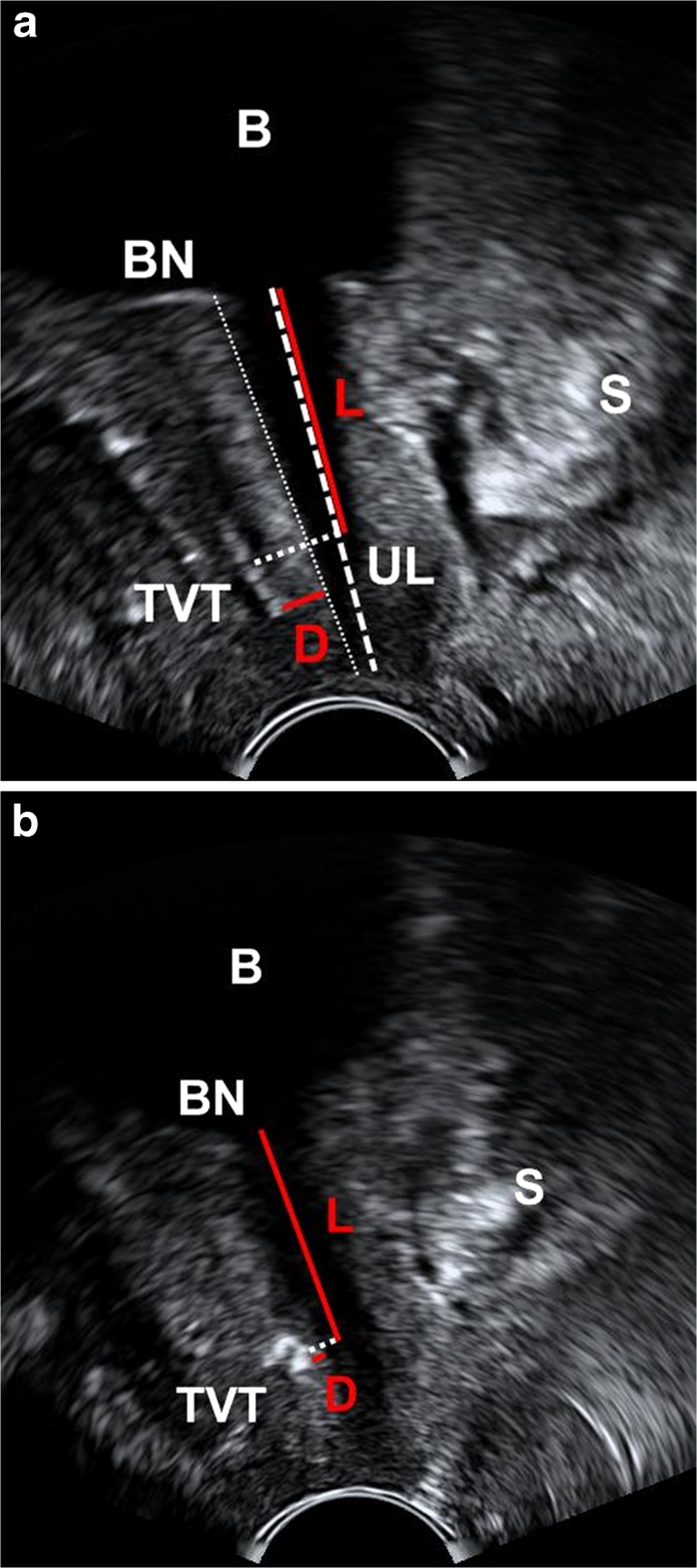
UltrasoundSagittal perineal ultrasound of the bladder neck and urethra, comparing a correctly positioned suburethral sling (a) with a sling too close to the urethra with excessive tension (b).
Source : Viereck et al., International Urogynecology Journal, 2013, figure 3 · CC BY
📋 Urodynamic testing does not change the outcome in uncomplicated SUI
Randomised non-inferiority trial: adding urodynamic testing to clinical assessment before surgery does not change success at 12 months.
VALUE trial (630 women, 11 centres): difference −0.3 points (95% CI −7.5 to 6.9), consistent with non-inferiority, with no difference in severity, quality of life or satisfaction. To be reserved for complex presentations (discordant symptoms, failure of rehabilitation, previous surgery). Source: Nager et al., 2012 (PMID 22551104).
🔍 One woman in two cannot contract her pelvic floor without teaching
This is the strongest argument in favour of testing: verbal instruction alone is not enough, and prescribing exercises without checking the contraction amounts to training on nothing.
Assessment by bidigital palpation (PERFECT scheme) in 139 incontinent women: 53.2% do not contract voluntarily without prior teaching about perineal anatomy and function. Source: Fitz et al., 2020 (PMID 32725368).
Stress urinary incontinence (SUI) is defined as any involuntary loss of urine associated with physical activity 1. This apparently unremarkable definition already carries the whole point of assessment: it is the temporal link between effort and leakage that makes the diagnosis, and it is that link the history must establish precisely. The same European collaborative review recalls a clinical fact that matters for our practice: SUI remains underdiagnosed and undertreated 1. In other words, a large part of the diagnostic work simply consists of asking the question.
Assessment in pelvic floor physiotherapy pursues four distinct aims, which must not be conflated: characterise the type of incontinence (stress, urgency, mixed), measure the impact on daily life, check that the patient is able to contract her pelvic floor correctly, which is far from a given, and identify the situations that warrant specialist medical advice. Each of these aims calls for a different tool.
Key points: the 4 stages of assessment
- History → characterise the leakage (stress / urgency / mixed) and identify modifiable risk factors.
- 3-day bladder diary → objectify actual voiding behaviour Moderate evidence 18.
- ICIQ → quantify symptoms and impact, with a validated tool that is sensitive to change 8.
- Pelvic floor muscle testing → check voluntary contraction BEFORE any prescription of home exercises: 53.2 % of incontinent women cannot contract without prior teaching 14.
1. The history: characterise the leakage above all
The history is not an administrative preliminary: it directs everything that follows. The reason is epidemiological. In the Norwegian population study EPINCONT (27,936 women, 80% response rate), 25% of women reported urinary leakage and nearly 7% significant incontinence: defined as moderate to severe AND experienced as bothersome. The breakdown by type there was 50% SUI, 11% urgency incontinence and 36% mixed forms 3.
The nationally representative US NHANES 2015-2018 data (5,006 women) confirm this hierarchy in another population: 61.8% of adult women reported urinary incontinence, and among them 37.5% pure SUI, 22.0% urgency incontinence and 31.3% a mixed form 2. The prevalence of moderate to severe incontinence, measured by the Sandvik severity index, reached 22.1% of adult women.
About a third of incontinence is mixed, that is the figure that should structure the history. Failing to look actively for the urgency component means risking treating a pure SUI that is nothing of the sort.
The risk factors to document
The multivariate analysis of NHANES identifies as factors associated with incontinence: increasing age, a BMI ≥ 25 and vaginal delivery, as well as anxiety, depression and functional dependence. The strongest associations concerned age over 70, BMI over 40 and vaginal delivery 2.
Two of these factors have a direct clinical translation. First, weight : the randomised PRIDE trial (338 overweight or obese women with at least 10 incontinence episodes a week) showed that a 6-month behavioural weight-loss programme produced a loss of 8.0% of body weight (7.8 kg) against 1.6% (1.5 kg) in the control group, with a reduction in weekly incontinence episodes of 47% against 28% (p = 0.01). A key point for interpretation: the fall was significant for stress episodes (p = 0.02) but not for those of urgency incontinence (p = 0.14) 7. Weight loss acts preferentially on the stress component, so it is a lever to document and discuss from the history onwards, not a generic piece of advice.
Then the postnatal period . A systematic review with meta-analysis (24 studies, more than 35,000 women) finds a weighted mean prevalence of urinary incontinence of around 31% between 6 weeks and 1 year after delivery, of which SUI is the most common form (54%). The time course is worth knowing: after an initial fall at 3 months, prevalence climbs back at one year to a level close to that of pregnancy (32%) 4. The authors also note that prevalence is equivalent in primiparous and multiparous women. In concrete terms: a spontaneous improvement at 3 months says nothing about the outcome at one year, and the absence of multiparity is not reassuring.
2. The bladder diary: objectifying what the history estimates poorly
The 3-day bladder diary is the field tool that turns a retrospective account into data. Its validation in women is solid: a multicentre study conducted in 14 functional urology units (136 women, mean age 55.2) assessed feasibility, reliability and validity. 77.2% of participants completed 80% of the 42 variables in the diary; test-retest reliability gave intraclass correlation coefficients (ICC) of 0.67 to 0.92: the only notable exception being maximum night-time voided volume (ICC 0.54), and inter-observer reliability ICCs of 0.64 to 0.99 18. The authors conclude that the 3-day diary shows good feasibility, reliability and validity for assessing lower urinary tract symptoms in women.
One result of this study is particularly instructive: the diary's correlations were moderate with the questionnaires and weaker with urodynamic testing 18. The bladder diary, the questionnaires and urodynamics do not explore the same thing. They are not substitutes for one another, and disagreement between them is not an anomaly to be resolved: it is information about three distinct dimensions of the problem.
| Tool | What it measures | Psychometric properties | Reference |
|---|---|---|---|
| 3-day bladder diary | Actual voiding behaviour (frequencies, volumes, episodes) | Feasibility 77.2%; test-retest ICC 0.67–0.92; inter-observer ICC 0.64–0.99 | Jimenez-Cidre et al. 2015 |
| ICIQ | Frequency, amount, impact on daily life + self-diagnostic item | Internal consistency α = 0.95; good test-retest stability; sensitivity to change | Avery et al. 2004 |
| PERFECT testing (palpation) | Capacity for voluntary contraction, strength, endurance, fast contractions | Useful for teaching the contraction; Oxford scale not valid as a measure of strength | Fitz et al. 2020 ; Bø & Finckenhagen 2001 |
| Urodynamic testing | Functional assessment of bladder and sphincter | Not inferior to clinical assessment alone in uncomplicated SUI | Nager et al. 2012 (VALUE) |
3. The ICIQ: quantifying the symptom and its impact
The ICIQ questionnaire was developed from a systematic review of the literature and expert opinion, then evaluated across the whole of its psychometric properties: validity, reliability, sensitivity to change. The results are robust: easy completion with few missing data, good discrimination between patient groups, acceptable convergent validity, satisfactory test-retest stability and high internal consistency (Cronbach's alpha = 0.95). The final version comprises three scored items and one unscored self-diagnostic item, assessing frequency, amount and impact on daily life 8. The authors stress its joint usefulness in outcomes research, in epidemiology and in clinical practice.
Its short version, the ICIQ-UI SF, is the outcome measure most used to follow progress. A systematic review with meta-analysis devoted to quality of life finds an improvement of 3.92 points on the ICIQ-UI SF in before/after studies (95% CI 2.97-4.86; p = 0.00001) under pelvic floor muscle training, with benefits identified in the social activities and general health domains; the pooled mean difference in quality of life between experimental and control groups was -3.19 (95% CI -5.99 to -0.40; p = 0.03), the effect concerning mainly patients with SUI 21 Moderate evidence.
An ICIQ score collected on day 0 is only of interest if it is repeated. It is the change that documents the result of rehabilitation, not the initial value.
4. Pelvic floor muscle testing: the step nothing replaces
This is where assessment stops being documentary and becomes decisive. The question is not “how strong is the pelvic floor?” but first “ can this woman contract her pelvic floor? ”. The answer is yes far less often than one imagines.
A majority of women cannot contract on verbal instruction
In a cross-sectional study of 139 incontinent women assessed by bidigital palpation using the PERFECT scheme : 21 (15.1%) were quite simply unable to contract the pelvic floor, 65 (46.7%) managed at the first instruction, and 53 (38.1%) only after additional teaching about perineal anatomy and function. In all, 53.2% of women were not able to contract their pelvic floor voluntarily without prior instruction. The women who needed this teaching had significantly impaired muscle function: strength (p < 0.001), endurance (p < 0.001) and fast contractions (p < 0.001) 14.
53.2 %, that is the proportion of incontinent women unable to contract their pelvic floor voluntarily without prior teaching about perineal anatomy and function 14.
Worse: a brief verbal instruction can be counterproductive
The landmark study by Bump et al. remains without equivalent on this point. Of 47 women assessed by urethral profilometry after a standardised verbal instruction for a Kegel exercise, only 23 (49%) performed an ideal contraction: defined as a significant increase in urethral closure force without appreciable Valsalva effort. And above all: 12 women (25%) adopted a technique liable to PROMOTE incontinence, by bearing down abdominally 15. No clinical factor (neither age, nor parity, nor weight, nor hormonal status), made it possible to predict which patients would succeed.
The practical consequence is clear: home exercises cannot be prescribed on the strength of a verbal instruction. One patient in four risks training herself to do exactly what makes her leakage worse, and no clinical characteristic makes it possible to identify her beforehand. Individual testing is the only filter.
The modified Oxford scale: useful for teaching, invalid for measuring
Here is the methodological nuance most often mishandled in practice. The reproducibility study by Bø & Finckenhagen (20 subjects, 2 experienced physiotherapists, 6-point grading compared with vaginal squeeze pressure) shows inter-rater agreement that is only modest : Spearman's rho 0.70 (p < 0.01), Cohen's kappa 0.37 (SEM 0.16), the two therapists agreeing in only 45% of cases. More damning still: the pressure measurements did not differ between contractions graded weak, moderate, good and strong (p = 0.66) 19.
The authors conclude that the method is neither reproducible, nor sensitive, nor valid for measuring pelvic floor strength for scientific purposes. This does not condemn palpation: it remains useful for teaching the correct contraction, which is precisely the use the data from Fitz and from Bump justify. But an “Oxford 3” recorded at the initial assessment and an “Oxford 4” at reassessment do not constitute proof of progress. Use palpation to guide and correct, and the ICIQ or the bladder diary to document the result.
Key points: pelvic floor muscle testing
- 15.1 % of incontinent women cannot contract at all; 53.2 % cannot do so without prior teaching 14 Moderate evidence.
- After a standardised verbal instruction, 49 % only perform an ideal contraction and 25 % a technique liable to promote incontinence 15.
- No clinical factor (age, parity, weight, hormonal status) predicts success → testing is individual and systematic.
- The Oxford scale: inter-rater agreement 45%, kappa 0.37, no pressure difference between categories (p = 0.66) → a teaching tool, not a measurement tool 19.
5. Understanding what is being assessed: the anatomical rationale
Testing takes on its meaning in the light of the pathophysiology. DeLancey's hammock hypothesis provides the framework: the urethra rests on a supporting layer made up of the endopelvic fascia and the anterior vaginal wall, a layer that draws its structural stability from its lateral attachments to the arcus tendineus fasciae pelvis and the levator ani muscle. Pressure coming from above compresses the urethra against this hammock-like supporting plane and closes its lumen. The increase in urethral closure pressure during a cough therefore probably results from this compression against the hammock, and not from a genuinely “intra-abdominal” position of the urethra 5. That is the direct anatomical rationale for pelvic floor work.
The levator ani muscles act as a functional unit exerting a dual action: support of the pelvic organs in the transverse plane (lifting) and compression of the urethra against the anterior vaginal wall in the mid-sagittal plane (squeezing). Impairment of this anatomical support leads to urethral hypermobility which hinders the transmission of loads to the urethra, reduces the extrinsic closure force and results in leakage 6.
But the most comprehensive systematic review with meta-analysis (84 studies retained from 4,629 screened, 24 meta-analysed) imposes an essential caveat: the pathophysiology of SUI is multifactorial. The meta-analyses identify as strong characteristic signs of SUI: the observed bladder neck dilatation, the reduction in functional urethral length, the poorer quality of bladder neck support and the fall in maximum urethral closure pressure. The authors conclude that the strongest evidence points to bladder neck and urethral incompetence, with evidence of impaired urethral support and levator function as well, but stress that standardised measurement approaches are needed to generate higher levels of evidence 6.
Consequence for assessment: a normal pelvic floor examination does not rule out SUI. The pelvic floor is only one of the components of the system of continence under effort.
6. When to refer: the real place of urodynamics
This is the question that comes up most often, and the answer probably runs counter to intuition.
Urodynamics is not necessary in uncomplicated, demonstrated SUI
The randomised non-inferiority trial VALUE (630 women, 11 centres) compared clinical assessment alone with an assessment supplemented by urodynamic testing before surgery for SUI. Result: treatment success at 12 months was 76.9% in the urodynamics group against 77.2% in the assessment-only group (difference −0.3 percentage points; 95% CI −7.5 to 6.9), a result consistent with non-inferiority, with no difference in severity, quality of life or satisfaction. Urodynamics altered some diagnoses without changing the treatment choice or the outcomes 20 High-level evidence.
The authors conclude that in women with uncomplicated, demonstrated SUI, office clinical assessment alone was not inferior to assessment with urodynamic testing for outcomes at 1 year. Urodynamics is therefore to be reserved for complex presentations : discordant symptoms, failure of rehabilitation, previous surgery, suspected bladder dysfunction.
Knowing when a surgical opinion is worth discussing, on the other hand
The 12-year follow-up of the randomised PORTRET trial, comparing pelvic floor muscle training with a midurethral sling, brings a figure that cannot be withheld from the patient. Of 386 initial participants, 184 (47.7%) answered the questionnaire. The crossover rate from physiotherapy to surgery reached 86.9%. In post-hoc analysis, the women who had physiotherapy only reported significantly less improvement than those operated on from the outset (absolute difference 50.6%; 95% CI 28.2-73.1) or operated on after physiotherapy (49.7%; 95% CI 25.8-73.7). The rate of repeat surgery was low: 4.6% 17.
Essential caveats : no statistically significant difference was found on intention-to-treat analysis; the response rate was only 47.7%; and the population consisted of moderate to severe SUI. These figures do not extrapolate to mild forms, where rehabilitation remains first line. They do, however, justify informing the patient honestly and considering a surgical opinion as 2nd line after rehabilitation that has been well conducted but insufficient.
This limit is part of a broader picture: the systematic review devoted to durability (19 studies, 1,141 women followed for 1 to 15 years) shows long-term adherence to PFMT ranging from 10% to 70%, a long-term success among initial responders of 41% to 85%, and rates of subsequent recourse to surgery of 4.9% to 58%. The authors conclude that the short-term result of PFMT can be maintained in the long term, but stress substantial heterogeneity between studies 16.
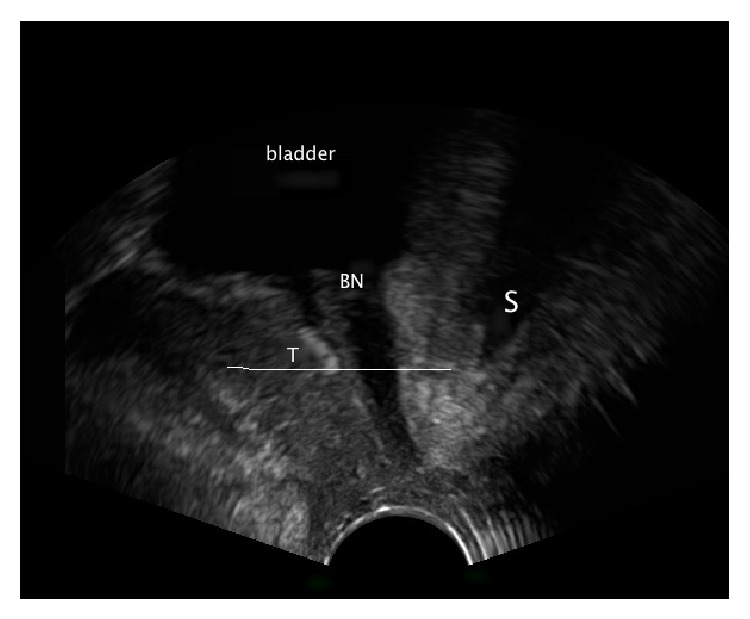
UltrasoundSagittal perineal ultrasound showing the bladder, bladder neck (BN) and suburethral sling (T) above the middle of the urethra, anterior to the pubic symphysis (S).
Source : Kociszewski et al., BioMed Research International, 2015, figure 2 · CC BY
Key points, when to refer
- Uncomplicated, demonstrated SUI → no prior urodynamics needed: clinical assessment alone not inferior at 1 year 20 High-level evidence.
- Refer for urodynamics in the event of a complex presentation: discordant symptoms, failure of rehabilitation, previous surgery, suspected bladder dysfunction.
- A surgical opinion to be discussed for moderate to severe symptoms persisting after well-conducted rehabilitation, without ever short-circuiting the 1st line 17.
- NICE (NG123) sets the threshold for the 1st line: a trial of supervised pelvic floor muscle training of at least 3 months, comprising a minimum of 8 contractions 3 times a day 13. It is this standard that defines what a “failure” of rehabilitation is.
7. What the assessment prepares: a 1st line with a high level of evidence
If the assessment deserves so much care, it is because the treatment it governs is effective. The landmark Cochrane review (31 trials, 1,817 women from 14 countries) shows that, compared with no treatment or an inactive control treatment, women with SUI allocated to pelvic floor muscle training groups were eight times more likely to report cure: 56% against 6% (RR 8.38; 95% CI 3.68-19.07; 4 trials, 165 women), and it is the only outcome in the review rated as HIGH-quality evidence under GRADE 10 High-level evidence.
Beyond complete cure, these women were six times more likely to report cure or improvement: 74% against 11% (RR 6.33; 95% CI 3.88-10.33; 3 trials, 242 women; moderate quality), with a reduction of about one leakage episode per 24 hours (MD −1.23; 95% CI −1.78 to −0.68; 7 trials, 432 women) and less urine loss on the short pad test (MD −9.71 g; 95% CI −18.92 to −0.50; 4 trials, 185 women). Adverse effects are rare and minor 10.
The European Association of Urology makes a strong recommendation : offer pelvic floor muscle strengthening as first-line treatment to all women with SUI, noting that supervised and higher-intensity regimens bring greater benefit 11. The 2025 European review explicitly makes this effectiveness conditional on the quality of the educational instruction and on supervision 1, which loops straight back to testing: without checking the contraction, the condition of effectiveness is not met.
The 25% of women who bear down instead of contracting 15 are not candidates for PFMT failure. They are candidates for testing.
One last point of assessment deserves to be recalled, because it is frequently inverted in practice: it is not the equipment that carries the result. The 2025 Cochrane update (41 studies, 3,483 women) shows that adding biofeedback to PFMT brings little to no difference in incontinence-related quality of life (SMD −0.07; 95% CI −0.18 to 0.05; 11 studies, 1,169 women; HIGH certainty), a reduction of only 0.29 leakage episodes per 24 h that is possibly not clinically important (12 studies, 932 women), and probably little to no difference in reported cure or improvement (OR 1.26; 95% CI 1.00-1.58; 14 studies, 1,383 women) 22 High-level evidence. Biofeedback can help make the contraction perceptible ; it neither replaces nor substantially improves a well-conducted PFMT. The quality of the contraction and adherence, not the equipment, carry the result, and it is the assessment that establishes them.
⚠️ Which factors promote SUI?
⚖️ Weight loss acts specifically on the stress component
A 6-month behavioural programme reduces weekly incontinence episodes, and the effect is significant on stress, not on urgency incontinence.
Randomised trial in 338 overweight or obese women with at least 10 incontinence episodes a week: −47% against −28% (p = 0.01). The fall is significant for stress episodes (p = 0.02) but NOT for urgency incontinence (p = 0.14). Source: Subak et al., 2009 (PMID 19179316).
Stress urinary incontinence does not happen at random. It is built at the intersection of three broad families of determinants: an obstetric event (pregnancy and above all vaginal delivery), a time factor (age), and a load factor (BMI and repeated mechanical stresses). The nationally representative NHANES 2015-2018 data (5,006 women) are unambiguous: on multivariate analysis, increasing age, a BMI ≥ 25 and a history of vaginal delivery are associated with urinary incontinence, with the strongest association for age over 70, BMI over 40 and vaginal delivery 2. Which is to say that the typical profile of our patients in the clinic is not a statistical abstraction: it is the convergence of these three axes.
Pregnancy and childbirth: the major window of vulnerability
This is the weightiest factor, and the best documented. In the NHANES multivariate models, vaginal delivery is among the three variables most strongly associated with urinary incontinence, alongside age > 70 and BMI > 40 2. Moderate evidence
The postnatal period is not a simple parenthesis: it is a high-risk period, and SUI largely dominates within it. A systematic review with meta-analysis of 24 studies covering more than 35,000 women finds a weighted mean prevalence of urinary incontinence of around 31% between 6 weeks and 1 year after delivery, of which 54% is stress urinary incontinence: the most common type 4.
The point most often missed in practice concerns the time course. After an initial fall at 3 months (the one that reassures the patient, and sometimes the clinician), prevalence climbs back at one year to a level close to that of pregnancy (32%) 4. In other words: the spontaneous improvement of the first postnatal trimester is not a cure, it is a trough. An assessment at 3 months concluding “things are better, let's stop” ignores this rebound.
After an initial fall at 3 months, the prevalence of postnatal incontinence climbs back to nearly 32% at one year: the level of pregnancy. The trough at 3 months is not a cure.
A second counter-intuitive caveat: in this same meta-analysis, the prevalence of urinary incontinence is equivalent in primiparous and multiparous women 4. The reasoning “it's her first child, there's no reason to worry” is not supported by the postnatal prevalence data. The first delivery counts.
Age: a continuous gradient that accelerates after 70
Increasing age is associated with urinary incontinence, whether of any type or moderate to severe, on multivariate analysis 2. But the association is not linear in its intensity: it is beyond 70 that one of the strongest associations in the model is found 2. Moderate evidence
Care is needed, however, with the clinical interpretation. Age is a non-modifiable factor, and above all a factor often confounded with other variables in the same model: in NHANES, anxiety, depression and functional dependence are also associated with urinary incontinence of any type and with moderate incontinence 2. Functional dependence in particular is a signal not to be read as age-related fatalism: it is a variable that raises questions about access to the toilet, mobility, and the ability to perform a correct pelvic floor manoeuvre.
The historical epidemiological order of magnitude also bears recalling: in the Norwegian population study EPINCONT (27,936 women, 80% response rate), 25% of women reported urinary leakage and nearly 7% significant incontinence (moderate to severe and experienced as bothersome), with a breakdown of 50% pure SUI, 11% urgency incontinence and 36% mixed forms 3. SUI is therefore, structurally, the leading reason for pelvic floor rehabilitation.
BMI: the most modifiable risk factor, and the most specific to stress
Overweight and obesity are associated with urinary incontinence from a BMI ≥ 25 onwards on multivariate analysis, and a BMI > 40 constitutes one of the three strongest associations in the NHANES model 2. Moderate evidence
Unlike age and obstetric history, BMI is modifiable, and the randomised PRIDE trial brings evidence of intervention here, not merely of association. In 338 overweight or obese women with at least 10 incontinence episodes a week, a 6-month behavioural weight-loss programme produced a loss of 8.0% of body weight (7.8 kg) against 1.6% (1.5 kg) in the control group (p < 0,001). Les épisodes hebdomadaires d'incontinence ont diminué de 47% against 28% (p = 0.01) 7. High-level evidence (randomised trial)
The decisive detail for the physiotherapist lies elsewhere, in the analysis by type of leakage: the reduction was significant for stress incontinence episodes (p = 0.02), but not for urgency incontinence episodes (p = 0.14) 7. Weight loss therefore acts preferentially on the stress component. This is not a generic lifestyle tip slipped in at the end of a session: it is an intervention whose effect is specifically documented on the very mechanism we are rehabilitating.
Activities and efforts: what does “stress” mean?
The reference definition is explicit: SUI is any involuntary loss of urine associated with physical activity 1. The trigger is therefore not a state, it is a loading situation : coughing, sneezing, lifting, impact, abdominal effort.
The pathophysiology explains why certain activities reveal the deficit rather than create it. Under DeLancey's “hammock hypothesis”, the urethra rests on a supporting layer formed by the endopelvic fascia and the anterior vaginal wall, stabilised laterally by the arcus tendineus fasciae pelvis and the levator ani muscle. Abdominal pressure compresses the urethra against this “hammock” and closes its lumen : continence under effort depends on the integrity of this support system, and not on an “intra-abdominal” position of the urethra 5. The increase in urethral closure pressure during a cough comes from this compression against a supporting plane, not from a passive transmission of pressure.
Mechanical corollary: when the support is impaired, the urethra becomes hypermobile, which hinders the transmission to the urethra of the loads induced by descent of the pelvic structures, reduces the extrinsic closure force and results in leakage 6. The levator ani muscles work as a functional unit providing both support of the pelvic organs in the transverse plane (“lifting”) and compression of the urethra against the anterior vaginal wall in the mid-sagittal plane (“squeezing”), urethral support depending on its fascial attachments to the arcus tendineus fasciae pelvis and on its connective attachments to the pubis 6.
This is also why a single-cause model must be avoided. The systematic review with meta-analysis by Falah-Hassani (84 studies retained from 4,629 screened, 24 meta-analysed) concludes that the pathology of SUI is multifactorial, combining deficits in the structure and support of the urethra and of the bladder neck with neuromuscular and mechanical alterations of the striated urethral sphincter and of the levator ani. The meta-analyses identify as strong characteristic signs : bladder neck dilatation, reduced functional urethral length, poorer quality of bladder neck support and a fall in maximum urethral closure pressure; the strongest evidence points to bladder neck and urethral incompetence 6. Moderate evidence
| Factor | What the data say | Modifiable? | Lever in rehabilitation |
|---|---|---|---|
| Vaginal delivery | One of the 3 strongest associations on multivariate analysis 2. SUI = 54% of postnatal incontinence 4. Identical prevalence in primiparous / multiparous women. | No (an event), but it can be anticipated | Antenatal PFMT in the continent woman; follow-up beyond 3 months postnatally (rebound at 1 year) |
| Age > 70 | One of the 3 strongest associations on multivariate analysis 2 ; continuous gradient with increasing age. | No | Active case finding; watch for the associated co-variables (functional dependence, anxiety, depression) |
| BMI ≥ 25, and above all > 40 | Associated on multivariate analysis from 25 onwards; BMI > 40 = strongest association 2. Weight loss of 8% → −47% of episodes, significant effect on SUI (p = 0.02) but not on urgency incontinence 7. | Yes | The only major risk factor with randomised evidence of intervention specific to stress |
| Physical activity / effort | Defining element of SUI: leakage associated with physical activity 1. Reveals the support deficit 56. | Situational | Work on urethral support and on the levator ani; effort is the test context, not merely the culprit |
Primary prevention: acting before the first leak
This is the most underused point in the whole SUI file. Pelvic floor muscle training is not only curative: in the woman who is still continent, antenatal PFMT has demonstrated preventive value.
In the dedicated Cochrane review 9, continent pregnant women performing antenatal PFMT have a risk of reporting urinary incontinence in late pregnancy reduced by about 62% (RR 0.38; 95% CI 0.20 to 0.72; 6 trials, 624 women; moderate-quality evidence). Moderate evidence
And the benefit does not stop at delivery: antenatal PFMT reduces by 29% the risk of urinary incontinence in the mid postnatal period (beyond 3 to 6 months): RR 0.71; 95% CI 0.54 to 0.95; 5 trials, 673 women. This result rests on high-quality evidence (GRADE), the highest level in the review 9. High-level evidence
Two readings are called for, and both must be held. The first: it is a strong argument for incorporating pelvic floor work from pregnancy onwards, and not only as postnatal catch-up: the authors conclude that early, structured PFMT in early pregnancy in the continent woman can prevent the onset of incontinence in late pregnancy and postnatally 9. The second, more honest: the preventive effect is markedly more modest postnatally (29%) than in late pregnancy (62%). Preventing does not cancel the obstetric risk; it reduces it.
Finally, one epidemiological fact governs the whole of prevention: SUI remains underdiagnosed and undertreated 1. If we wait for the patient to raise it spontaneously, a large part of the window for prevention has already passed.
Key points
- Three factors dominate on multivariate analysis : age > 70, BMI > 40 and vaginal delivery are the strongest associations with urinary incontinence 2. SUI is the most common form in the incontinent woman: 37.5% (NHANES) and 50% (EPINCONT).
- The 3-month postnatal trough is a trap. The prevalence of postnatal incontinence is around 31% between 6 weeks and 1 year, SUI accounts for 54% of it, and after a fall at 3 months it climbs back to 32% at one year 4. Do not close the file on the improvement of the 3rd month.
- Primiparous ≠ protected. The prevalence of urinary incontinence is equivalent in primiparous and multiparous women 4.
- BMI is the only major modifiable factor with randomised evidence of intervention, and its effect is specific to stress : −47% of episodes after 8% weight loss, significant on SUI (p = 0.02) but not on urgency incontinence (p = 0.14) 7.
- The mechanism unifies all of this : continence under effort depends on the integrity of the supporting hammock against which abdominal pressure compresses the urethra 5 ; its failure is multifactorial, with strong evidence of bladder neck and urethral incompetence 6.
- Primary prevention works : antenatal PFMT in the continent woman = −62% risk of UI in late pregnancy (RR 0.38; moderate evidence) and −29% in the mid postnatal period (RR 0.71; high-quality evidence) 9.
- Case finding is the weak link : SUI remains underdiagnosed and undertreated 1. It is up to the clinician to ask the question.
💪 Which pelvic floor rehabilitation for SUI?
🎯 Pelvic floor muscle training: the first-line treatment, and by a wide margin
Compared with no treatment, rehabilitation makes cure or improvement of stress incontinence six times more likely.
Landmark Cochrane review: RR 6.33 (95% CI 3.88–10.33; 3 trials, 242 women; moderate quality). The review totals 31 trials and 1,817 women from 14 countries, with rare and minor adverse effects. Source: Dumoulin et al., 2018 (PMID 30288727).
Stress urinary incontinence is the most common form of incontinence in women: in the nationally representative NHANES 2015-2018 data (5,006 women), 61.8% of adult women reported urinary incontinence and, among them, 37.5% pure SUI, against 22.0% urgency incontinence and 31.3% mixed forms 2. The Norwegian population study EPINCONT (27,936 women, 80% response) gave a comparable breakdown: 50% SUI, 11% urgency incontinence, 36% mixed forms 3. It is therefore statistically the leading reason for pelvic floor rehabilitation, and the question of how deserves better than a default protocol.
The good news is that the answer is soundly documented. The most recent European collaborative review defines SUI as any involuntary loss of urine associated with physical activity, recalls that it remains underdiagnosed and undertreated, and positions training of the pelvic floor muscles (PFMT, pelvic floor muscle training) as the first-line strategy, with an explicit condition: sound educational instruction and supervision 1.
PFMT as first line: what Cochrane really says
The landmark Cochrane review (31 trials, 1,817 women from 14 countries) is the bedrock of the reasoning. Compared with no treatment or an inactive control treatment, women with SUI allocated to PFMT groups were eight times more likely to declare themselves cured : 56% against 6% (RR 8.38; 95% CI 3.68-19.07; 4 trials, 165 women) 10.
This GRADE detail deserves emphasis, because it is regularly lost in summaries: the cure perceived by the patient in SUI is the only outcome in the review rated as high-quality evidence 10. It is the soundest argument the physiotherapist has for defending conservative first-line treatment.
Beyond complete cure, the benefits read across the whole set of outcomes:
| Outcome (SUI, end of treatment) | Result | Sample | Level of evidence |
|---|---|---|---|
| Reported cure | 56% vs 6%: RR 8.38 (95% CI 3.68-19.07) | 4 trials, 165 women | High |
| Cure or improvement | 74% vs 11%: RR 6.33 (95% CI 3.88-10.33) | 3 trials, 242 women | Moderate |
| Leakage episodes / 24 h | MD −1.23 (95% CI −1.78 to −0.68), that is, ≈ 1 fewer leak a day | 7 trials, 432 women | Moderate |
| Short pad test | MD −9.71 g (95% CI −18.92 to −0.50) | 4 trials, 185 women | Moderate |
| Cure, all types of UI combined | RR 5.34 (95% CI 2.78-10.26) | 3 trials, 290 women | Moderate |
The adverse effects reported are rare and minor 10. Adding ten new trials to the previous version did not change the essential conclusions: PFMT can be incorporated into first-line conservative management of female urinary incontinence 23. The authors specify, however, that long-term effectiveness and cost-effectiveness remain to be documented: we come back to this below.
The benefit is not confined to counting leaks. A systematic review with meta-analysis devoted to quality of life finds a pooled mean difference of -3.19 between experimental and control groups (95% CI -5.99 to -0.40; p = 0.03) and an improvement of 3.92 points on the ICIQ-UI SF in before/after studies (95% CI 2.97-4.86; p = 0.00001), with gains in the social activities and general health domains: benefits observed mainly in patients with SUI 21.
The anatomical rationale: what exactly are we acting on?
Working the pelvic floor in SUI is not an act of muscular faith. DeLancey's hammock hypothesis gives the mechanism: the urethra rests on a supporting layer formed by the endopelvic fascia and the anterior vaginal wall, stabilised laterally by the arcus tendineus fasciae pelvis and the levator ani muscle. Abdominal pressure compresses the urethra against this “hammock” and closes its lumen. The increase in urethral closure pressure during a cough therefore comes from this compression against a supporting plane, and not from a genuinely “intra-abdominal” position of the urethra 5.
The levator ani muscles act as a functional unit with a dual action: support of the pelvic organs in the transverse plane (lifting) and compression of the urethra against the anterior vaginal wall in the mid-sagittal plane (squeezing). Urethral support depends on its fascial attachments to the arcus tendineus fasciae pelvis and on its connective attachments to the pubis; its impairment leads to urethral hypermobility, which hinders the transmission of loads to the urethra, reduces the extrinsic closure force and results in leakage 6.
A single-cause model must nevertheless be avoided. The systematic review with meta-analysis by Falah-Hassani (84 studies retained from 4,629 screened, 24 meta-analysed) concludes that the pathophysiology of SUI is multifactorial : deficits in the structure and support of the urethra and of the bladder neck, neuromuscular and mechanical alterations of the striated urethral sphincter and of the levator ani. The meta-analyses identify as strong characteristic signs bladder neck dilatation, reduced functional urethral length, poorer quality of bladder neck support and a fall in maximum urethral closure pressure. The strongest evidence points to bladder neck and urethral incompetence; urethral support and levator function are also affected, but standardised measurement approaches are still lacking 6.
The pelvic floor is a major lever, not the only determinant. That is also what explains why some patients do not recover despite well-conducted rehabilitation.
Before prescribing: testing is not a luxury
The most underestimated point of first-line treatment lies upstream of the exercise. In a cross-sectional study of 139 incontinent women assessed by bidigital palpation using the PERFECT scheme, 21 (15.1%) were unable to contract the pelvic floor, 65 (46.7%) managed at the first instruction and 53 (38.1%) only after additional teaching about perineal anatomy and function. That is, 53.2% of women unable to contract voluntarily without prior instruction. These women had impaired muscle function in strength, in endurance and in fast contractions (p < 0.001) 14.
Worse: a brief verbal instruction can be counterproductive. Of 47 women assessed by urethral profilometry after a standardised verbal instruction for a Kegel exercise, only 23 (49%) performed an ideal contraction, a significant increase in urethral closure force without notable Valsalva, while 12 (25%) adopted a technique liable to promote incontinence (abdominal bearing down). Neither age, nor parity, nor weight, nor hormonal status predicted success 15.
Direct practical consequence: home exercises prescribed without individual testing expose one patient in four to training herself to bear down. No clinical profile allows this check to be dispensed with.
Palpation nevertheless retains its limits as a measurement. In the reproducibility study by Bø & Finckenhagen (20 subjects, 2 experienced physiotherapists, 6-point grading compared with vaginal squeeze pressure), inter-rater agreement was only modest: Spearman's rho 0.70, Cohen's kappa 0.37 (SEM 0.16), the two therapists agreeing in only 45% of cases; the pressures measured did not differ between contractions graded weak, moderate, good and strong (p = 0.66). The authors conclude that the method is neither reproducible, sensitive nor valid for measuring strength for scientific purposes 19. Low certainty for metrological use: the modified Oxford scale serves to teach the correct contraction, not to produce a strength figure.
To objectify progress, validated tools are the better basis:
- ICIQ-UI SF : a brief questionnaire, developed from a systematic review and expert opinion, evaluated for validity, reliability and sensitivity to change. Easy completion with few missing data, good discrimination between groups, acceptable convergent validity, satisfactory test-retest stability, high internal consistency (Cronbach's alpha = 0.95). Final version: three scored items and one unscored self-diagnostic item (frequency, amount, impact on daily life) 8.
- 3-day bladder diary : in a multicentre study (14 functional urology units, 136 women, mean age 55.2), 77.2% of participants completed 80% of the 42 variables; test-retest reliability ICC 0.67-0.92 (except maximum night-time voided volume, 0.54); inter-observer reliability ICC 0.64-0.99. Moderate correlations with the questionnaires and weaker ones with urodynamics: the two examinations do not explore the same thing 18.
As for urodynamic testing, it is not necessary in uncomplicated, demonstrated SUI. The randomised non-inferiority trial VALUE (630 women, 11 centres) compared clinical assessment alone with an assessment supplemented by urodynamics before surgery for SUI: treatment success at 12 months of 76.9% against 77.2% (difference −0.3 points; 95% CI −7.5 to 6.9), consistent with non-inferiority, with no difference in severity, quality of life or satisfaction. Urodynamics altered some diagnoses without changing the treatment choice or the outcomes 20. To be reserved for complex presentations: discordant symptoms, failure of rehabilitation, previous surgery, suspected bladder dysfunction.
Parameters: dose, duration, supervision
The guidelines converge on a minimum framework that is workable in the clinic.
NICE (guideline NG123) sets out two operational points:
- Rec 1.4.4: offer a trial of supervised pelvic floor muscle training of at least 3 months as first-line treatment to women with stress or mixed urinary incontinence.
- Rec 1.4.5: programmes should comprise a minimum of 8 contractions performed 3 times a day 13.
The European Association of Urology guidelines on non-neurogenic female LUTS make a strong recommendation : offer pelvic floor muscle strengthening as first-line treatment to all women with SUI. Supervised and higher-intensity regimens bring greater benefit, and the EAU takes up the NICE recommendation of three months of supervised PFMT as first-line treatment 11.
Does that mean it has to be strictly one-to-one? Not necessarily. The Cochrane review devoted to delivery modes (63 trials, 4,920 women) shows that individual supervision probably makes little to no difference to quality of life compared with group supervision (5 trials, 544 women) moderate certainty 24. Clinical translation: once the correct contraction has been confirmed one-to-one, a non-negotiable step given the data from Fitz 2020 and Bump 1991, the rest of the programme can be run individually or in a group depending on the setting and the patient's preference.
The through-line remains that of the European review: the effectiveness of PFMT is explicitly conditional on the quality of the educational instruction and on supervision 1. Supervision is not a comfort of care, it is an identified condition of effectiveness.
Biofeedback: useful for teaching, not for improving the result
This is where the updated data unsettle habits. The 2025 Cochrane update (41 studies, 3,483 women) concludes that adding biofeedback to PFMT brings no clinically relevant benefit :
| PFMT + biofeedback vs PFMT alone | Result | Sample | Certainty |
|---|---|---|---|
| Incontinence-related quality of life | SMD −0.07 (95% CI −0.18 to 0.05): little to no difference | 11 studies, 1,169 women | High |
| Leakage episodes / 24 h | MD −0.29 (95% CI −0.42 to −0.16): small difference, possibly not clinically important | 12 studies, 932 women | Moderate |
| Reported cure or improvement | OR 1.26 (95% CI 1.00-1.58): probably little to no difference | 14 studies, 1,383 women | Moderate |
| Satisfaction | OR 2.41: possibly superior | — | Low |
The remarkable point is that the absence of difference in quality of life rests on evidence of high certainty 22 : this is not a “we do not know”, it is a “we know there is no clinically significant gain”. In the analysis covering 33 studies and 3,031 women, the conclusion is identical 22.
It is not the equipment that carries the result, it is the quality of the contraction and adherence to the programme.
Biofeedback keeps a logical place: helping a patient to perceive her contraction, notably in the 53.2% of women who cannot contract spontaneously 14. But it does not replace a well-conducted PFMT and does not substantially improve it. Management that rests on the device rather than on motor learning and adherence is investing in the wrong place.
Electrical stimulation and vaginal cones: adjunct options
Electrical stimulation. A recent systematic review (7 randomised trials, 411 women) concludes that electrical stimulation is not superior to active PFMT for reducing urinary leakage or improving quality of life in women with SUI, with very low certainty of evidence and a severe risk of methodological bias 25. In other words: neither an argument for substituting it for active work, nor a sufficient evidence base to settle the matter finely.
Weighted vaginal cones. The dedicated Cochrane review (23 trials, 1,806 women) shows that they do better than no active treatment (RR of failure to cure 0.84; 95% CI 0.76-0.94), but that there is little to suggest a difference compared with PFMT for subjective cure (RR 1.01; 95% CI 0.91-1.13) 26. They constitute an adjunct option, useful in a patient whom the format motivates, and not a substitute superior to conventional rehabilitation.
The hierarchy is therefore legible: supervised active work is the treatment; the rest is adjunctive, to be chosen according to what it adds in learning or in adherence, not for an added effectiveness that has not been demonstrated.
Lifestyle: a lever specific to “stress”
The risk factors for female incontinence are dominated by increasing age, overweight/obesity (BMI ≥ 25) and vaginal delivery; on multivariate analysis, age over 70, BMI over 40 and vaginal delivery show the strongest association. The prevalence of moderate to severe incontinence (Sandvik severity index) reaches 22.1% of adult women 2.
Weight is not only an epidemiological risk factor: it is a therapeutic target. In the randomised PRIDE trial (338 overweight or obese women with at least 10 incontinence episodes a week), a 6-month behavioural weight-loss programme produced a loss of 8.0% of body weight (7.8 kg) against 1.6% (1.5 kg) in the control group (p < 0.001). Weekly incontinence episodes fell by 47% against 28% (p = 0.01). A key point for the physiotherapist: the fall was significant for episodes of stress incontinence (p = 0.02) but not for those of urgency incontinence (p = 0.14) 7.
In an overweight patient with SUI, supporting weight loss is therefore not a polite peripheral piece of advice: it is an intervention whose effect is demonstrated on the very mechanism being treated.
Not forgetting prevention: antenatal PFMT
The postnatal period is a high-risk window. A systematic review with meta-analysis of 24 studies covering more than 35,000 women finds a weighted mean prevalence of urinary incontinence of around 31 % between 6 weeks and 1 year after delivery, SUI being its most common type (54 %). After an initial fall at 3 months, prevalence climbs back at one year to a level close to that of pregnancy (32%), and prevalence is equivalent in primiparous and multiparous women 4.
Yet PFMT is not only curative. In continent women, antenatal pelvic floor muscle training reduces by about 62 % the risk of reporting urinary incontinence in late pregnancy (RR 0.38; 95% CI 0.20-0.72; 6 trials, 624 women) moderate quality 9. The benefit persists after delivery: antenatal PFMT reduces by 29 % the risk of incontinence in the mid postnatal period (beyond 3 to 6 months) (RR 0.71; 95% CI 0.54-0.95; 5 trials, 673 women), on evidence of HIGH quality, the highest level in this review 9. The effect is more modest later on (29%) than in late pregnancy (62%), but the argument is strong for incorporating pelvic floor work from pregnancy onwards, and not only as postnatal catch-up.
Durability, adherence, and knowing when to refer
Intellectual honesty requires naming the weak point: adherence over time. The dedicated systematic review (19 studies, 1,141 women followed for 1 to 15 years) shows highly variable compliance: long-term adherence to PFMT varies between 10% and 70%, long-term success among the responders of the initial trial between 41% and 85%, and subsequent recourse to surgery between 4.9% and 58%. The authors conclude that the short-term result of PFMT can be maintained at long-term follow-up, including without prompts to carry on training, but stress substantial heterogeneity between studies 16.
In moderate to severe forms, the limit is clearer. The 12-year follow-up of the randomised PORTRET trial (pelvic floor muscle training versus midurethral sling; 184 of the 386 women who responded, that is, 47.7%) finds a crossover rate from physiotherapy to surgery of 86.9 % (73/84). No statistically significant difference appeared on intention-to-treat analysis; on post-hoc analysis, the women who had physiotherapy only reported significantly less improvement than those operated on from the outset (absolute difference 50.6%; 95% CI 28.2-73.1) or operated on after physiotherapy (49.7%; 95% CI 25.8-73.7). The rate of repeat surgery was 4.6% 17.
These figures call for two rigorous caveats. First, the response rate is only 47.7%. Second, the population is that of moderate to severe SUI: they do not extrapolate to mild forms, where PFMT unquestionably remains first line. They do, however, justify informing the patient honestly about realistic prospects and discussing a surgical opinion in the event of moderate to severe symptoms persisting after well-conducted rehabilitation. The European review, moreover, explicitly places surgery, midurethral slings and mini-slings, as a second-line option, after PFMT 1.
Key points
- PFMT = first line, strong recommendation. 56% cure against 6% without treatment (RR 8.38; 95% CI 3.68-19.07): the only outcome rated as high quality evidence in the Cochrane review 10. The EAU strongly recommends offering it to all women with SUI 11.
- Minimum documented dose: a supervised trial of at least 3 months, a programme of at least 8 contractions × 3 times a day (NICE NG123, recs 1.4.4 and 1.4.5).
- Test before prescribing. 53.2% of incontinent women cannot contract without teaching 14 and 25% adopt, after a verbal instruction, a technique liable to promote incontinence 15. No profile (age, parity, weight, hormonal status) predicts success.
- Palpation teaches, it does not measure. Modest inter-rater agreement on the modified Oxford scale (kappa 0.37; agreement in 45% of cases; no pressure difference between categories, p = 0.66) 19. Objectify via the ICIQ-UI SF 8 and the 3-day bladder diary 18.
- Biofeedback: no clinically relevant gain. Little to no difference in quality of life (SMD −0.07; high certainty), −0.29 leaks/24 h possibly not clinically important, OR 1.26 on cure/improvement 22. Useful for making the contraction perceptible, not for improving the result.
- Electrical stimulation: not superior to active PFMT (7 trials, 411 women; very low certainty, severe bias) 25. Cones: better than nothing (RR 0.84) but no different from PFMT (RR 1.01): an adjunct, not a substitute 26.
- Individual vs group supervision: probably little to no difference in quality of life (5 trials, 544 women; moderate certainty) 24, once the correct contraction has been confirmed.
- Weight loss: −8% of body weight → −47% of episodes a week, with a significant effect on stress (p = 0.02) but not on urgency incontinence (p = 0.14) 7.
- Antenatal prevention: −62% of UI in late pregnancy (RR 0.38) and −29% in the mid postnatal period (RR 0.71; high quality) in continent women 9.
- Urodynamics: unnecessary in uncomplicated, demonstrated SUI 20. To be reserved for complex presentations.
- Knowing when to refer: in moderate to severe forms, 86.9% crossover to surgery at 12 years and markedly less improvement under physiotherapy alone 17. Surgery = second line after well-conducted rehabilitation 1.
🔄 Lasting results: how are the gains maintained?
⏳ In moderate to severe forms, rehabilitation alone runs out of steam
The 12-year follow-up of a randomised trial shows that the great majority of the women in the physiotherapy group ended up resorting to surgery.
PORTRET trial, 12-year follow-up (184 of the 386 women who responded, that is, 47.7%): the midurethral sling, from the outset or after physiotherapy, significantly improved subjective outcomes compared with physiotherapy alone in the long term. This does not disqualify first-line rehabilitation: it makes it imperative to state the prognosis and to know when to refer on. Source: van Oorschot et al., 2025 (PMID 39931871).
🛡️ Starting during pregnancy: PFMT is preventive too
In women who are still continent, antenatal pelvic floor muscle training reduces the risk of becoming incontinent.
Cochrane review: −62% in late pregnancy (95% CI 0.20–0.72; 6 trials, 624 women; moderate quality) and −29% in the mid postnatal period (95% CI 0.54–0.95; 5 trials, 673 women): this last result resting on HIGH-quality evidence (GRADE). Source: Woodley et al., 2020 (PMID 32378735).
The question every patient asks at the end of a pelvic floor rehabilitation programme is not “does it work?”, the literature has settled that point, but “will it last?”. These two questions do not have the same answer, and this is probably the most poorly explained point in the management of stress urinary incontinence (SUI). The short-term effectiveness of pelvic floor muscle training (PFMT) rests on the highest level of evidence available in pelvic floor rehabilitation: 56% reported cure against 6% in the control groups, that is, eight times more chance of declaring oneself cured (RR 8.38; 95% CI 3.68-19.07; 4 trials, 165 women; high-quality evidence) high-level evidence 10. Durability, for its part, depends on other variables: adherence, initial severity, and the clarity with which the patient was informed from the very first session.
This section takes stock of what is really known about maintaining the gains: what “cure” means in the trials, what becomes of the results at 1, 5 and 15 years, why adherence is the real limiting factor, and at what point a surgical opinion or a pessary stops being an admission of failure and becomes a reasoned clinical decision.
Cure or improvement: what exactly are we talking about?
The word “cure” covers, in the trials, a precise reality that is more modest than what the patient spontaneously hears. It is a cure reported by the patient: a subjective outcome, but precisely the one that counts for her. The landmark Cochrane review (31 trials, 1,817 women from 14 countries) carefully distinguishes two levels of result, and the clinician does well to make the same distinction in consultation 10.
First level, complete cure. In women with SUI, PFMT compared with no treatment or an inactive control treatment makes declaring oneself cured eight times more likely: 56% against 6% (RR 8.38; 95% CI 3.68-19.07; 4 trials, 165 women) high-level evidence. It is the only outcome in the review rated as high-quality evidence under GRADE, which makes it the soundest argument in favour of first-line pelvic floor muscle training 10. The sample nevertheless remains modest, 165 women across 4 trials, and the confidence interval wide, which calls for announcing an order of magnitude rather than a figure to the decimal place.
Second level, cure or improvement. In practice this is the more relevant outcome, because the majority of women are not seeking the absolute disappearance of all leakage but the disappearance of the bother. On this outcome, PFMT makes a favourable result six times more likely: 74% against 11% in the control groups (RR 6.33; 95% CI 3.88-10.33; 3 trials, 242 women) moderate evidence 10. For all types of incontinence combined, the probability of cure is multiplied by about five (RR 5.34; 95% CI 2.78-10.26; 3 trials, 290 women; moderate quality): the effect is therefore clearer in pure SUI than in mixed presentations.
These relative figures impress, but they have to be translated into units the patient can check for herself in her daily life. PFMT reduces the number of episodes by about one leak per 24 hours (mean difference -1.23; 95% CI -1.78 to -0.68; 7 trials, 432 women) and reduces urine loss on the short pad test by about 9.7 g (MD -9.71 g; 95% CI -18.92 to -0.50; 4 trials, 185 women) 10. One fewer leak a day sounds like little put that way, and it is considerable for a woman who had two.
“Cure” in the trials means: the patient declares herself cured. It is a subjective outcome, and it is precisely the right one, because nobody consults for a pad test.
The impact on quality of life goes the same way, with an honest magnitude. A dedicated systematic review with meta-analysis finds a pooled mean difference in quality of life of -3.19 (95% CI -5.99 to -0.40; p = 0.03) between experimental and control groups, and an improvement of 3.92 points on the ICIQ-UI SF questionnaire in before/after studies (95% CI 2.97-4.86; p = 0.00001), the benefits concerning in particular the social activities and general health domains, and mainly in cases of stress urinary incontinence 21. The ICIQ is, moreover, the follow-up tool best suited to this time frame: brief, psychometrically robust, with high internal consistency (Cronbach's alpha = 0.95), good discrimination between patient groups and satisfactory test-retest stability 8. Measuring it on entry and then at the end of the programme gives an objectifiable trace of the gain, and a useful point of comparison if symptoms reappear three years later.
One last framing point, which governs all the rest: the adverse effects of PFMT are rare and minor in the Cochrane review 10. The benefit-risk balance of first-line treatment is therefore, strictly speaking, without competition, which justifies the strong recommendation of the European Association of Urology to offer pelvic floor strengthening as first-line treatment to all women with SUI 11.
Long-term maintenance: what becomes of the gains after 1 to 15 years
Here the literature becomes markedly less comfortable, and a good deal more interesting. The Cochrane review itself explicitly acknowledges it: PFMT should feature in first-line conservative management programmes, but long-term effectiveness remains to be documented 10. This is not a formula of academic caution: it is the exact description of the state of the data.
The systematic review devoted to this question (19 studies, 1,141 women followed for between 1 and 15 years) gives the most complete picture available, and it comes down to three very wide ranges 16 :
| Long-term parameter (1 to 15 years) | Range observed | Clinical reading |
|---|---|---|
| Adherence to pelvic floor muscle training | 10% to 70% | The most variable factor and the one most dependent on initial management |
| Long-term success (among initial responders) | 41% to 85% | The initial benefit can be maintained, but nothing guarantees it |
| Subsequent recourse to surgery | 4.9% to 58% | A massive spread, largely explained by the severity of the populations included |
The authors' conclusion deserves to be quoted with its caveat: the short-term result of PFMT can be maintained at long-term follow-up, and this in the initial responders without prompts to carry on training, but with substantial heterogeneity between studies 16. Two pieces of information therefore coexist in the same paragraph, and it would be dishonest to retain only one. The first is optimistic: a gain obtained is not necessarily a gain to be paid for indefinitely by daily lifelong training. The second is sober: a success range of 41% to 85% means that we cannot predict, for a given patient, which side she will fall on.
Adherence 10-70%, long-term success 41-85%, subsequent surgery 4.9-58%: when the ranges are that wide, the average means nothing: it is the patient's profile that decides.
The factor that structures these gaps is initial severity. And on this point, a recent trial has considerably clarified the picture. The 12-year follow-up of the randomised PORTRET trial, which compared pelvic floor muscle training with a midurethral sling in women with moderate to severe SUI, finds a crossover rate from physiotherapy to surgery of 86.9 %, that is, 73 of the 84 women initially randomised to rehabilitation 17. On post-hoc analysis, the women who had physiotherapy only reported significantly less improvement than those operated on from the outset (absolute difference 50.6%; 95% CI 28.2-73.1) or operated on after physiotherapy (49.7%; 95% CI 25.8-73.7). The rate of repeat surgery, for its part, remained low (4.6%).
This figure of 86.9% is striking, and it is frequently over-interpreted. Two methodological reservations are called for, which the authors set out themselves moderate evidence :
- The response rate is only 47.7% (184 of the 386 women): fewer than one participant in two answered at 12 years, which exposes the result to a selection bias whose direction is not known.
- The population is that of moderate to severe SUI. These figures do not extrapolate to mild forms, where rehabilitation remains first line 17.
What PORTRET establishes is therefore not “physiotherapy does not hold up”, but something more precise and more useful: in moderate to severe forms, the durability of PFMT alone is limited, and this information must be given honestly to the patient from the outset, at the same time as rehabilitation is offered. The authors draw from it a conclusion that is not a disavowal of first-line treatment: it justifies informing the patient honestly and considering surgery as second line after failure of well-conducted rehabilitation 17. The order of the words matters: after well-conducted rehabilitation.
This crossover rate also needs putting back into its epidemiological context. Across all severities, the prevalence of moderate to severe incontinence (Sandvik severity index) reaches 22.1% of adult women in the nationally representative NHANES 2015-2018 data 2, and the Norwegian population study EPINCONT (27,936 women, 80% response rate) finds 25% of women reporting leakage but only nearly 7% significant incontinence: moderate to severe and experienced as bothersome 3. In other words, the PORTRET population corresponds to a minority of the women who consult: the majority fall into forms where rehabilitation keeps its full place, and SUI alone accounts for half of incontinence cases (50%, against 11% urgency incontinence and 36% mixed forms in EPINCONT), which makes it the leading reason for pelvic floor rehabilitation 3.
Adherence: the real limiting factor, and the one the physiotherapist can act on
If only one figure were to be retained from the literature on durability, it would be the adherence range: 10% to 70% 16. A sevenfold gap. No other variable in management shows such an amplitude, and it is precisely the one over which the clinician has the most leverage.
Faced with a problem of adherence, the temptation is to add a device. The literature says fairly clearly that this is not the right answer.
Biofeedback is not the solution. The 2025 Cochrane update (41 studies, 3,483 women) is unambiguous on this point: adding biofeedback to PFMT does not change, or barely changes, incontinence-related quality of life (SMD -0.07; 95% CI -0.18 to 0.05; 11 studies, 1,169 women), and this on evidence of high certainty high-level evidence. The gain on leakage is negligible: -0.29 episodes per 24 h (12 studies, 932 women), judged possibly not clinically important. On reported cure or improvement, there is probably little to no difference (OR 1.26; 95% CI 1.00-1.58; 14 studies, 1,383 women) moderate evidence. Only satisfaction might be slightly higher (OR 2.41), but on low-certainty evidence 22. The clinical message is clear: biofeedback can help make the contraction perceptible , but it does not replace and does not substantially improve a well-conducted PFMT. It is the quality of the contraction and adherence, not the equipment, that carry the result.
Nor does electrical stimulation. It is not superior to active pelvic floor muscle training for reducing leakage or improving quality of life in women with SUI (7 randomised trials, 411 women), with, however, very low certainty of evidence and a severe risk of methodological bias, which forbids drawing a strong conclusion either way 25 very low evidence.
Weighted vaginal cones do better than no active treatment (RR of failure to cure 0.84; 95% CI 0.76-0.94) but show no difference from PFMT for subjective cure (RR 1.01; 95% CI 0.91-1.13; 23 trials, 1,806 women). They constitute an adjunct option, not a substitute superior to conventional rehabilitation 26.
No device has beaten a well-learned contraction. The lever is not in the equipment: it is in the initial testing, in supervision and in the duration of the programme.
The real levers are elsewhere, and there are three of them.
1. Initial testing, non-negotiable. A large proportion of incontinent women cannot contract their pelvic floor correctly on a simple verbal instruction. In a cross-sectional study of 139 incontinent women assessed by bidigital palpation using the PERFECT scheme, 21 (15.1%) were unable to contract the pelvic floor, 65 (46.7%) managed at the first instruction and 53 (38.1%) only after additional teaching about perineal anatomy and function, that is, 53.2% unable to contract voluntarily without prior instruction. These women had impaired muscle function in strength, endurance and fast contractions (p < 0.001) 14. More worrying still: of 47 women assessed by urethral profilometry after a standardised verbal instruction for a Kegel exercise, only 23 (49%) performed an ideal contraction, while 12 (25%) adopted a technique liable to promote incontinence: abdominal bearing down. Neither age, nor parity, nor weight, nor hormonal status predicted success 15. Home exercises prescribed without testing are therefore not neutral: in one woman in four, they train the opposite of what they aim at. Note that palpation remains a tool of teaching more than of measurement: the modified Oxford scale shows only modest inter-rater agreement (Cohen's kappa 0.37; Spearman's rho 0.70; agreement in only 45% of cases), and the pressures measured did not differ between contractions graded weak, moderate, good and strong (p = 0.66) 19.
2. Supervision, which is a condition of effectiveness and not a comfort. The most recent European collaborative review makes explicitly the effectiveness of pelvic floor rehabilitation conditional on the quality of the educational instruction and on supervision 1. Supervised and higher-intensity regimens bring greater benefit 11. Once the correct contraction has been confirmed, on the other hand, the format matters little: individual supervision probably makes little to no difference to quality of life compared with group supervision (5 trials, 544 women; 63 trials and 4,920 women in total in the review) moderate evidence 24. This is valuable organisational information: the group is a legitimate option, not a fallback: provided the individual testing has been done beforehand.
3. An explicit dose and duration. NICE (guideline NG123) recommends as first-line treatment a trial of supervised pelvic floor muscle training of at least 3 months in women with stress or mixed urinary incontinence (recommendation 1.4.4), with a programme comprising a minimum of 8 contractions performed 3 times a day (recommendation 1.4.5) 13. This is not a detail: a dated, quantified programme is verifiable, and therefore renegotiable: unlike a “do your exercises regularly”, which allows neither adherence to be established nor failure to be concluded.
The forgotten lever: lifestyle. It has a measurable effect and, notably, one specific to the stress component. In a randomised trial of 338 overweight or obese women with at least 10 incontinence episodes a week, a 6-month behavioural weight-loss programme produced a loss of 8.0% of body weight (7.8 kg) against 1.6% (1.5 kg) in the control group, with a fall in weekly incontinence episodes of 47% against 28% (p = 0.01). A key point for the physiotherapist: the fall was significant for episodes of stress incontinence (p = 0.02) but not for those of urgency incontinence (p = 0.14) 7. Weight loss therefore acts preferentially on the very component we treat. This is not a generic end-of-session tip: it is a co-treatment whose rationale is consistent with the epidemiology, overweight/obesity (BMI ≥ 25) being among the main risk factors along with increasing age and vaginal delivery: a BMI over 40, an age over 70 and vaginal delivery showing the strongest association on multivariate analysis 2.
And prevention, which is the most cost-effective form of “maintenance”. The best gain to maintain is the one that was never lost. Antenatal pelvic floor muscle training in continent women reduces by about 62 % the risk of reporting urinary incontinence in late pregnancy (RR 0.38; 95% CI 0.20-0.72; 6 trials, 624 women) moderate evidence, and the benefit persists after delivery with a reduction of 29 % in the risk of incontinence in the mid postnatal period, beyond 3 to 6 months (RR 0.71; 95% CI 0.54-0.95; 5 trials, 673 women), on evidence of high quality, the highest level in the review 9 high-level evidence. The effect is more modest postnatally (29%) than in late pregnancy (62%), but it is more soundly established. This justifies incorporating pelvic floor work from pregnancy onwards, and not only as postnatal catch-up: all the more so as the postnatal period is a high-risk one: according to a systematic review with meta-analysis of 24 studies covering more than 35,000 women, the weighted mean prevalence of urinary incontinence between 6 weeks and 1 year after delivery is around 31 %, SUI being its most common type (54%). And above all: after an initial fall at 3 months, prevalence climbs back to a level close to that of pregnancy (32%) at one year 4. This rise at 12 months is a major clinical argument: the spontaneous improvement of the third month is not a cure, and the message must be conveyed as such.
When rehabilitation is not enough: the place of second-line treatment
Referring on is not failing. Quite the opposite: knowing when rehabilitation reaches its limits is an integral part of the pelvic floor physiotherapist's competence, and one of the criticisms made of current SUI management is precisely that it remains underdiagnosed and undertreated 1. A patient who quietly gives up after six months of partial results, never having known that a second line existed, is no better served than a patient who is referred on.
The positioning is clear and ranked. The European collaborative review places pelvic floor muscle training as the first-line strategy, with surgery, midurethral slings and mini-slings, constituting a second line option 1. The EAU makes a strong recommendation to offer PFMT as first-line treatment to all women with SUI 11, and NICE sets the duration of this trial at at least 3 months of supervised rehabilitation 13. The order is therefore not open to debate; it is the transition that calls for clinical judgement.
| Situation | What the data say | Course of action |
|---|---|---|
| Mild SUI, patient never treated with rehabilitation | PFMT: 56% cure vs 6% high-level evidence 10 | Supervised rehabilitation ≥ 3 months, 8 contractions × 3/day 13 |
| Incorrect or absent contraction on testing | 53.2% do not contract without teaching; 25% bear down 1415 | Teaching of the contraction before any programme; no blind home exercises |
| Associated overweight/obesity | -47% of episodes vs -28%; significant effect on stress, not on urgency incontinence 7 | Behavioural weight-loss co-treatment |
| Moderate to severe SUI persisting after well-conducted rehabilitation | Crossover to surgery 86.9% at 12 years; less improvement under physiotherapy alone (absolute difference 50.6%) moderate evidence 17 | Surgical opinion to be discussed; repeat surgery rare (4.6%) |
| Uncomplicated, demonstrated SUI, before a decision | VALUE: success at 12 months 76.9% with urodynamics vs 77.2% without (difference -0.3; 95% CI -7.5 to 6.9) 20 | Urodynamic testing not necessary |
| Complex presentation (discordant symptoms, failure of rehabilitation, previous surgery, suspected bladder dysfunction) | Urodynamics alters some diagnoses without changing the outcomes in a simple situation 20 | Urodynamics to be reserved for these situations |
On urodynamic testing, the randomised non-inferiority trial VALUE (630 women, 11 centres) is worth the physiotherapist knowing, if only to answer patients who worry about it. Comparing clinical assessment alone with an assessment supplemented by urodynamic testing before surgery for SUI, it finds treatment success at 12 months of 76.9% in the urodynamics group against 77.2% in the assessment-only group (difference -0.3 points; 95% CI -7.5 to 6.9), consistent with non-inferiority, with no difference in severity, quality of life or satisfaction. Urodynamics altered some diagnoses without changing the treatment choice or the outcomes 20. In uncomplicated, demonstrated SUI it is therefore not a prerequisite, which avoids a further delay for women who have often already waited years.
The follow-up tools, for their part, remain ours. The 3-day bladder diary is feasible, reliable and valid in women: in a multicentre study (14 functional urology units, 136 women, mean age 55.2), 77.2% of participants completed 80% of the 42 variables, with test-retest reliability of 0.67 to 0.92 (ICC; except maximum night-time voided volume, 0.54) and inter-observer reliability of 0.64 to 0.99. Correlations were moderate with the questionnaires and weaker with urodynamic testing: the diary and urodynamics do not explore the same thing 18. Combined with the ICIQ 8, it provides an objectifiable basis for deciding, at 3 months, whether the programme has produced what it could produce.
Finally, this hierarchy keeps its meaning because the anatomical rationale for rehabilitation is sound. The pathophysiology of SUI is multifactorial: the meta-analyses identify bladder neck dilatation, reduced functional urethral length, impaired bladder neck support and a fall in maximum urethral closure pressure as strong characteristic signs, urethral support and levator ani function also being affected 6. The levator ani muscles constitute a functional unit with a dual action, support of the pelvic organs in the transverse plane (“lifting”) and compression of the urethra against the anterior vaginal wall in the mid-sagittal plane (“squeezing”), and impairment of the anatomical support leads to urethral hypermobility, which hinders the transmission of loads to the urethra 6. This is the “hammock hypothesis”: the urethra rests on a supporting layer formed by the endopelvic fascia and the anterior vaginal wall, stabilised laterally by the arcus tendineus fasciae pelvis and the levator ani muscle; abdominal pressure compresses the urethra against this hammock and closes its lumen 5. Part of this system is muscular, and therefore trainable, and part of it is not. That says both why rehabilitation works and why, in some women, it will not be enough.
Key points
- Cure is real and well documented in the short term : 56% vs 6% reported cure (RR 8.38; 95% CI 3.68-19.07), and 74% vs 11% cure or improvement (RR 6.33) high-level evidence on cure 10.
- The long term is uncertain, not negative : across 19 studies and 1,141 women followed for 1 to 15 years, adherence varies from 10 to 70%, success in responders from 41 to 85%, recourse to surgery from 4.9 to 58%; the initial benefit can be maintained without prompts to carry on 16.
- Initial severity changes everything : in moderate to severe SUI, 86.9% crossover to surgery at 12 years 17: figures that do not extrapolate to mild forms, and a response rate of only 47.7%.
- No device compensates for a poor contraction : biofeedback with no clinically relevant benefit 22, electrical stimulation not superior 25, cones equivalent to PFMT 26.
- Test before prescribing : 53.2% of incontinent women do not contract without prior teaching 14 and 25% bear down after a simple verbal instruction 15. The modified Oxford scale teaches, it does not measure 19.
- Set the dose and the date : ≥ 3 months of supervised rehabilitation, a minimum of 8 contractions × 3 a day 13 ; individual supervision ≈ group once the contraction has been acquired 24 ; supervision is a condition of effectiveness 1.
- Add the weight lever : -47% of episodes vs -28%, with a significant effect on stress incontinence (p = 0.02) but not on urgency incontinence 7.
- Prevent rather than catch up : antenatal PFMT, -62% of UI in late pregnancy and -29% in the mid postnatal period high-level evidence 9 ; postnatal prevalence climbs back to 32% at one year after the fall of the 3rd month 4.
- Referring on is part of care : surgery is a 2nd line after well-conducted rehabilitation 1 ; urodynamics is not necessary in uncomplicated SUI 20 ; SUI remains underdiagnosed and undertreated 1.
📋 What do concrete case studies teach us?
The two situations that follow are entirely fictional. They describe no real patient and report no observed data: they are illustrative vignettes, constructed from scratch to make legible, within the flow of a consultation, what the studies cited in this article say. Every decision and every figure given to the patient refers to a referenced piece of work (Author Year). What these vignettes provide is therefore not additional evidence, they are not evidence, but a staging of the reasoning: at what moment testing changes the prescription, and at what moment rehabilitation alone stops being a sufficient answer.
The two profiles deliberately frame the extremes of the decision-making spectrum in SUI. The first (postnatal, recent symptoms), corresponds to the situation where the literature is most favourable: first-line pelvic floor muscle training, high level of evidence 10. The second (long-standing, moderate to severe SUI) is the one where the same literature imposes a more uncomfortable honesty: rehabilitation remains first line 1, but its long-term result in moderate to severe forms is markedly less guaranteed 17.
Fictional case no. 1: Léa, 32, six months after a first delivery
Reminder: Léa is a fictional character. No element of this case comes from a real record.
The reason for consulting
Léa consults six months after a vaginal delivery, her first. She describes urine leakage occurring on coughing, on sneezing, and above all when she takes up running again, never at night, never without a triggering effort, never preceded by a compelling urge. She waited at first, convinced that “it would sort itself out”, and is now worried to find that the situation has stopped improving over the past two months. She spaced out her runs, then stopped them.
This picture, involuntary leakage strictly associated with physical activity, matches the definition adopted by the most recent European collaborative review, which defines SUI as any involuntary loss of urine associated with physical activity 1. The first contribution of the vignette lies there: the diagnosis of SUI is first of all clinical and based on the history, and the absence of associated urgency points to a pure stress form rather than a mixed one.
What the epidemiological context says to Léa
Léa spontaneously expresses the feeling of being an exception, “the only one in her group of friends”. The literature says the opposite, and saying so is not a consolation of circumstance: it is a clinical act, because SUI is described as underdiagnosed and undertreated 1, precisely because women do not talk about it.
This meta-analysis of 24 studies and more than 35,000 women brings a second element directly useful in Léa's case: after an initial fall at 3 months, prevalence climbs back at one year to a level close to that observed during pregnancy (32%) 4. In other words, the idea that time mechanically settles the problem is not supported by the prevalence data: the trough at 3 months is not a durable recovery trajectory at population level. The plateau Léa has been describing for two months is therefore in no way aberrant, and a wait-and-see approach is not founded on the available literature.
Her profile also carries one of the risk factors identified on multivariate analysis in the nationally representative NHANES 2015-2018 data (5,006 women): vaginal delivery, alongside increasing age and overweight/obesity (BMI ≥ 25) 2. Léa is young and of normal build: of the three major factors, only one applies to her. This observation is not merely explanatory: it structures the rest of the reasoning, since here there is no weight lever to pull, unlike in the second case.
The examination: the moment the vignette turns
Léa arrives announcing that she is “already doing her exercises”: a friend explained Kegel contractions to her, she practises them “when she thinks of it”, in her car. She expects the physiotherapist to validate them and, at best, to step them up.
This is exactly the point at which the literature makes it imperative not to settle for a verbal instruction. In a cross-sectional study of 139 incontinent women assessed by bidigital palpation using the PERFECT scheme, 21 women (15.1%) were unable to contract the pelvic floor, 65 (46.7%) managed at the first instruction, and 53 (38.1%) only after additional teaching about perineal anatomy and function, that is, 53.2% unable to contract voluntarily without prior instruction ; these women also had impaired muscle function in strength, endurance and fast contractions (p < 0.001) 14.
The risk is not only ineffectiveness. Of 47 women assessed by urethral profilometry after a standardised verbal instruction for a Kegel exercise, only 23 (49%) performed an ideal contraction, a significant increase in urethral closure force without notable Valsalva, while 12 (25%) adopted a technique liable to promote incontinence, by bearing down abdominally 15. And the decisive point for the vignette: neither age, nor parity, nor weight, nor hormonal status predicted success 15. Nothing in Léa's profile (young, sporty, motivated), therefore allows us to presume that she contracts correctly. Only individual testing tells us.
What this moment illustrates
- A woman who says “I do my exercises” is not saying “I contract correctly”: a brief verbal instruction leaves 25% of women bearing down abdominally, a technique liable to promote incontinence 15.
- More than half of incontinent women do not contract their pelvic floor voluntarily without prior teaching about perineal anatomy and function 14.
- No simple clinical characteristic (age, parity, weight, hormonal status) predicts a successful contraction 15 : individual testing precedes any prescription of home exercises.
Grading, yes, but knowing what the grade is worth
Léa's physiotherapist palpates, corrects and grades. He notes a perceptible but weak contraction, with a tendency to bear down at the end of the effort. Should this be made a reference figure, to be re-measured in three months to prove progress?
Caution is called for. In the reproducibility study by Bø & Finckenhagen (20 subjects, 2 experienced physiotherapists, 6-point grading compared with vaginal squeeze pressure), inter-rater agreement was only modest: Spearman's rho 0.70, Cohen's kappa 0.37 (SEM 0.16), the two therapists agreeing in only 45% of cases ; above all, the pressure measurements did not differ between contractions graded weak, moderate, good and strong (p = 0.66) 19. The authors' conclusion transposes directly: palpation remains useful for teaching the correct contraction, but is not a valid measure of strength for scientific purposes 19.
In the vignette, palpation therefore keeps its full place, it is what revealed the abdominal bearing down and made it possible to correct it, but it does not serve as an outcome measure. Léa's follow-up will rest on tools whose psychometric properties are documented.
| Tool | What the data support | Use adopted with Léa |
|---|---|---|
| Palpation / modified Oxford | Kappa 0.37, agreement in 45% of cases; no pressure difference between grades (p = 0.66) 19 | Teach the contraction, detect bearing down, not measure strength |
| PERFECT testing | Identifies the women unable to contract (15.1%) and those needing teaching (38.1%) 14 | Decide whether home exercises can be prescribed as things stand |
| ICIQ-UI SF | Few missing data, good discrimination between groups, acceptable convergent validity, satisfactory test-retest, Cronbach's alpha 0.95 8 | Follow frequency, amount and impact on daily life |
| 3-day bladder diary | 77.2% of women complete 80% of the 42 variables; test-retest ICC 0.67-0.92; inter-observer ICC 0.64-0.99 18 | Objectify the voiding profile: it does not explore the same thing as urodynamics |
| Urodynamic testing | Non-inferiority of clinical assessment alone before surgery for SUI: 77.2% vs 76.9% success at 12 months (difference −0.3 points; 95% CI −7.5 to 6.9) 20 | Not indicated here : uncomplicated SUI, reserved for complex presentations |
This last point defuses a frequent request. Léa has read that a “full work-up” would be more serious. The randomised non-inferiority trial VALUE (630 women, 11 centres) shows that urodynamics altered some diagnoses without changing the treatment choice or the outcomes, and with no difference in severity, quality of life or satisfaction; its indication lies in complex presentations: discordant symptoms, failure of rehabilitation, previous surgery, suspected bladder dysfunction 20. None is present in Léa.
Why the pelvic floor: the anatomical rationale
Léa asks how contracting a muscle can close a duct. The answer comes down to a precise mechanism, and explaining it is part of the teaching that Fitz 2020 shows to be necessary.
The pathophysiology of SUI rests in part on failure of urethral support, formalised by the “hammock hypothesis”: the urethra rests on a supporting layer formed by the endopelvic fascia and the anterior vaginal wall, stabilised laterally by the arcus tendineus fasciae pelvis and the levator ani muscle; abdominal pressure compresses the urethra against this “hammock” and closes its lumen. Continence under effort therefore depends on the integrity of this system, and not on an “intra-abdominal” position of the urethra 5. It is, as this work puts it, the direct anatomical rationale for pelvic floor work in physiotherapy.
The mechanism has been detailed since: the levator ani muscles constitute a functional unit with a dual action: support of the pelvic organs in the transverse plane (“lifting”) and compression of the urethra against the anterior vaginal wall in the mid-sagittal plane (“squeezing”); urethral support depends on the fascial attachments to the arcus tendineus fasciae pelvis and on the connective attachments to the pubis, and its impairment leads to urethral hypermobility, which hinders load transmission, reduces the extrinsic closure force and results in leakage 6.
This explanation must remain honest about its scope. The pathophysiology of SUI is multifactorial : deficits in the structure and support of the urethra and of the bladder neck, neuromuscular and mechanical alterations of the striated urethral sphincter and of the levators. The systematic review with meta-analysis (84 studies retained from 4,629 screened, 24 meta-analysed) concludes that the strongest evidence points to bladder neck and urethral incompetence (bladder neck dilatation, reduced functional urethral length, poorer quality of bladder neck support and a fall in maximum urethral closure pressure being the strong characteristic signs of SUI), with evidence of impaired urethral support and levator function as well 6. The pelvic floor is therefore a major and accessible lever, not the only determinant.
The prescription and the figures we give
The programme adopted follows the recommended parameters: NICE (guideline NG123) recommends as first-line treatment a trial of pelvic floor muscle training supervised, of at least 3 months in women with stress or mixed urinary incontinence (recommendation 1.4.4), with a programme comprising a minimum of 8 contractions performed 3 times a day (recommendation 1.4.5) 13. The European Association of Urology guidelines on non-neurogenic female LUTS, for their part, make a strong recommendation: offer pelvic floor muscle strengthening as first-line treatment to all women with SUI, supervised and higher-intensity regimens bringing greater benefit 11.
That leaves the question Léa is really asking: does it work?
This result is the only outcome in the review rated as high-quality evidence under GRADE, which makes it the soundest argument in favour of first-line pelvic floor muscle training 10. And beyond complete cure, women with SUI treated with PFMT were six times more likely to report cure or improvement: 74% against 11% (RR 6.33; 95% CI 3.88-10.33; 3 trials, 242 women; moderate-quality evidence), with a reduction of about one leakage episode per 24 hours (MD −1.23; 95% CI −1.78 to −0.68; 7 trials, 432 women) and less urine loss on the short pad test (MD −9.71 g; 95% CI −18.92 to −0.50; 4 trials, 185 women) 10. Adding ten new trials to the previous version did not change these essential conclusions 23, and the adverse effects reported are rare and minor 10.
On what Léa is really aiming at (taking up running again, no longer organising her outings around toilets), a systematic review with meta-analysis finds an improvement in quality of life mainly in cases of SUI: pooled mean difference of −3.19 (95% CI −5.99 to −0.40; p = 0.03) between experimental and control groups, and an improvement of 3.92 points on the ICIQ-UI SF in before/after studies (95% CI 2.97-4.86; p = 0.00001), with benefits in the social activities and general health domains 21.
What Léa asks for in addition, and what we answer
Léa has come across biofeedback probes and vaginal cones, and wonders whether “paying for the equipment” would speed things up.
The 2025 Cochrane update (41 studies, 3,483 women) shows that adding biofeedback to PFMT brings no clinically relevant benefit: little to no difference in incontinence-related quality of life (SMD −0.07; 95% CI −0.18 to 0.05; 11 studies, 1,169 women) with high-certainty evidence ; a reduction of only 0.29 leakage episodes per 24 h, probably not clinically important (12 studies, 932 women); and probably little to no difference in reported cure or improvement (OR 1.26; 95% CI 1.00-1.58; 14 studies, 1,383 women) 22. Only satisfaction might be slightly higher (OR 2.41), on low-certainty evidence 22. The message for the physiotherapist is nuanced, not negative: biofeedback can help make the contraction perceptible , but it does not replace and does not substantially improve a well-conducted PFMT 22. It is therefore the quality of the contraction and adherence, not the equipment, that carry the result.
The same logic for cones: across 23 trials and 1,806 women, weighted vaginal cones do better than no active treatment (RR of failure to cure 0.84; 95% CI 0.76 to 0.94) but show no difference compared with PFMT for subjective cure (RR 1.01; 95% CI 0.91 to 1.13): an adjunct option, not a substitute superior to conventional rehabilitation 26. As for electrical stimulation, it is not superior to active training for reducing leakage or improving quality of life in women with SUI (7 trials, 411 women), with very low certainty of evidence and a severe risk of methodological bias 25.
Léa finally asks whether she should come one-to-one. Individual supervision of PFMT probably makes little to no difference to quality of life compared with group supervision (5 trials, 544 women; moderate certainty), once the correct contraction has been confirmed, rehabilitation can be delivered individually or in a group 24. The reservation lies in the subordinate clause: once the correct contraction has been confirmed. In Léa's case, it had not been at the first appointment.
And if Léa had consulted during her pregnancy?
The vignette allows a useful counterfactual, because it changes the prevention message given to subsequent patients. In primary prevention, antenatal pelvic floor muscle training in continent women reduces by about 62% the risk of reporting urinary incontinence in late pregnancy (RR 0.38; 95% CI 0.20 to 0.72; 6 trials, 624 women; moderate-quality evidence) 9. The benefit persists after delivery: antenatal PFMT reduces the risk of urinary incontinence in the mid postnatal period (beyond 3 to 6 months) by 29% (RR 0.71; 95% CI 0.54 to 0.95; 5 trials, 673 women), on HIGH-quality evidence: the highest level in the review 9. The effect is more modest postnatally (29%) than in late pregnancy (62%), and this caveat deserves to be stated as such 9. PFMT is therefore not only curative: begun early and structured, it has preventive value in the woman who is still continent 9.
Fictional case no. 2: Martine, 58, with SUI established for twelve years
Reminder: Martine is likewise a fictional character, constructed to illustrate a different decision-making profile. No element comes from a real record.
The reason for consulting
Martine describes stress leakage that appeared “after the second child”, some twenty years ago, long tolerated, then worse in recent years. She wears pads every day, changes them three or four times a day, and has given up hiking. Two vaginal deliveries. BMI of 31. She had “some pelvic floor sessions” about ten years ago, of which she retains only a vague memory, and has continued nothing since. She comes because her doctor mentioned an operation and she would like to “avoid that”.
The contrast with Léa is deliberate. Martine carries three of the risk factors identified on multivariate analysis in NHANES 2015-2018: increasing age, obesity and vaginal delivery 2. Her form is long-standing, and its impact places her in the moderate to severe range, which, in this same population study, is no singularity: the prevalence of moderate to severe incontinence (Sandvik severity index) reaches 22.1% of adult women 2.
What Martine is not: an exception
Two sets of population data converge. In the United States, across 5,006 women in the nationally representative NHANES 2015-2018 data, 61.8% of adult women reported urinary incontinence, and among them 37.5% had SUI, against 22.0% urgency incontinence and 31.3% mixed forms 2. In Norway, the population study EPINCONT (27,936 women, 80% response rate) found 25% of women reporting urinary leakage and nearly 7% significant incontinence, moderate to severe and experienced as bothersome, with SUI alone accounting for half the cases (50%), against 11% urgency incontinence and 36% mixed forms 3. The proportions differ between the two sources, but the ranking does not move: SUI is the most common form, which makes it the leading reason for pelvic floor rehabilitation 3.
That Martine waited twelve years is likewise not an individual anomaly: the European collaborative review explicitly stresses that SUI remains underdiagnosed and undertreated 1.
The lever Léa did not have: weight
In Martine's case, a modifiable determinant is present, and the data on it are unusually precise. In a randomised trial of 338 overweight or obese women with at least 10 incontinence episodes a week, a 6-month behavioural weight-loss programme produced a loss of 8.0% of body weight (7.8 kg) against 1.6% (1.5 kg) in the control group; weekly incontinence episodes fell by 47% against 28% (p = 0.01) 7.
In other words, Martine's profile is precisely the one in which this lever has been studied and in which it works. This is not a generic lifestyle tip slipped in at the end of a session: it is an intervention whose effect is documented on her form of incontinence.
First line remains first line
Martine hopes to avoid surgery; her physiotherapist does not have to decide for her, but he does have to set the framework. That framework is the same as for Léa: the EAU makes a strong recommendation to offer pelvic floor muscle strengthening as first-line treatment to all women with SUI 11, NICE recommends a supervised trial of at least 3 months, a minimum of 8 contractions 3 times a day 13, and the European review positions rehabilitation as the first-line strategy while explicitly making its effectiveness conditional on the quality of the educational instruction and on supervision, with surgery, midurethral slings and mini-slings, constituting a second-line option 1.
This condition is not cosmetic. Supervision by a physiotherapist is not a mere comfort: it is one of the identified conditions of effectiveness 1, and supervised, higher-intensity regimens bring greater benefit 11. What Martine describes of her sessions ten years ago (a vague memory, nothing continued), does not allow us to conclude that well-conducted rehabilitation failed in her case. The testing is redone, for exactly the reasons established above 1415.
What we tell her about what comes next, without rounding off
This is where the vignette diverges sharply from the first. Two bodies of data must be set out for Martine.
The first is encouraging and concerns adherence. In a systematic review of 19 studies covering 1,141 women followed for between 1 and 15 years, long-term adherence to PFMT varied from 10% to 70%, long-term success among the initial responders from 41% to 85%, and subsequent recourse to surgery from 4.9% to 58% 16. The authors conclude that the short-term result of PFMT can be maintained at long-term follow-up, including without prompts to carry on training, while stressing substantial heterogeneity between studies 16. The initial benefit is therefore not doomed to evaporate; but adherence is the main weak point of rehabilitation 16.
The second is harsher and bears directly on Martine's profile. The 12-year follow-up of the randomised PORTRET trial (184/386 women responding, 47.7%), comparing pelvic floor muscle training with a midurethral sling, finds a crossover rate from physiotherapy to surgery of 86.9 % (73/84); on post-hoc analysis, the women who had physiotherapy only reported significantly less improvement than those operated on from the outset (absolute difference 50.6%; 95% CI 28.2-73.1) or operated on after physiotherapy (49.7%; 95% CI 25.8-73.7), the rate of repeat surgery being 4.6% 17.
These figures call for two caveats that the authors set out themselves, and that it would be dishonest to withhold in either direction: the response rate is only 47.7%, and the population is that of moderate to severe SUI: these figures do not extrapolate to mild forms, where PFMT remains first line 17. They do, however, justify informing the patient honestly and considering surgery as second line after failure of well-conducted rehabilitation 17.
| Criterion | Léa (fictional): postnatal, 6 months | Martine (fictional): long-standing SUI, moderate to severe |
|---|---|---|
| Risk factors present 2 | Vaginal delivery | Increasing age + obesity (BMI 31) + 2 vaginal deliveries |
| Epidemiological backdrop | ≈31% UI postnatally, of which 54% SUI; rise back to 32% at 1 year 4 | SUI = the most common form 23 ; moderate to severe UI in 22.1% of women 2 |
| First line and prior testing | Identical in both cases: supervised PFMT ≥ 3 months, ≥ 8 contractions × 3 a day 13, after the contraction has been checked 1415 | |
| Lifestyle lever | Not applicable (normal build) | Weight loss: −47% vs −28% of episodes a week, significant on stress (p = 0.02), not on urgency incontinence (p = 0.14) 7 |
| Prognosis given | 56% cure vs 6%; 74% vs 11% cure/improvement 10 | Same first-line data, tempered by: 86.9% crossover to surgery at 12 years in moderate to severe forms 17 |
| Urodynamics | Not indicated (uncomplicated SUI) 20 | To be reconsidered only if rehabilitation fails or the presentation is complex 20 |
| Open question | Prevention: antenatal PFMT would have reduced the risk by 62% in late pregnancy and by 29% in the mid postnatal period 9 | Referral: surgical opinion to be discussed if moderate to severe symptoms persist after well-conducted rehabilitation 171 |
Three lessons, none of which follows from the others. Long-standing, severe SUI does not disqualify rehabilitation: the first-line recommendation is addressed to all women with SUI, with no severity proviso 11, and long-term success among initial responders rises as high as 85% in some series 16. The prognosis given cannot for all that be limited to the 56% cure of Dumoulin 2018: in the moderate to severe range, the long-term follow-up data point the other way 17. Finally, weight loss is no side issue in this patient 7.
Key points, what these two fictional vignettes illustrate
These cases are fictional and illustrative: they do not constitute evidence. The statements below rest solely on the works cited.
- The diagnosis is clinical. SUI is defined as an involuntary loss of urine associated with physical activity 1, and urodynamics is not necessary in uncomplicated forms: 77.2% vs 76.9% success at 12 months, non-inferiority of clinical assessment alone 20.
- Testing governs the prescription. 53.2% of incontinent women do not contract voluntarily without prior teaching 14 and 25% adopt, after a verbal instruction, a technique liable to promote incontinence 15, with no simple clinical factor predicting it 15.
- But palpation does not measure strength. Inter-rater agreement in 45% of cases, kappa 0.37, no pressure difference between grades (p = 0.66): useful for teaching, not valid as a scientific measure 19. Follow up instead with the ICIQ 8 and the 3-day bladder diary 18.
- PFMT is first line, with the best level of evidence in the review. 56% cure vs 6% (RR 8.38; 95% CI 3.68-19.07), the only outcome rated high quality under GRADE 10 ; 74% vs 11% cure or improvement 10 ; conclusions unchanged after ten trials were added 23.
- The parameters are specified: ≥ 3 months of supervised PFMT, ≥ 8 contractions 3 times a day 13, a strong recommendation for all women with SUI, supervised and intensive regimens superior 11 ; supervision is a condition of effectiveness, not a comfort 1. Individually or in a group once the contraction has been confirmed: little to no difference 24.
- It is not the equipment that makes the result. Biofeedback: little to no difference in quality of life, high certainty 22. Cones: no difference vs PFMT on subjective cure 26. Electrical stimulation: not superior, very low certainty 25.
- Weight is a lever specific to stress. −47% vs −28% of weekly episodes after a 6-month behavioural programme, significant on SUI (p = 0.02) but not on urgency incontinence (p = 0.14) 7.
- Prevention starts before birth. Antenatal PFMT in the continent woman: −62% risk in late pregnancy 9 and −29% in the mid postnatal period, on high-quality evidence 9.
- Knowing how to state the limits. Long-term adherence of 10% to 70% 16, but success maintained in 41% to 85% of initial responders 16. In moderate to severe forms, 86.9% crossover to surgery at 12 years and less improvement under physiotherapy alone (absolute difference 50.6%; 95% CI 28.2-73.1) 17: figures that do not extrapolate to mild forms, but that justify a surgical opinion as 2nd line after failure of well-conducted rehabilitation 171.
- And recalling the scale of the need: 61.8% of adult women report urinary incontinence, SUI being its most common form 23: a condition that remains underdiagnosed and undertreated 1.
🧭 How is this applied concretely in practice?
Stress urinary incontinence (SUI) is the leading reason for pelvic floor rehabilitation: in the nationally representative NHANES 2015-2018 data (5,006 women), 61.8% of adult women reported urinary incontinence, and among them 37.5% pure SUI against 22.0% urgency incontinence and 31.3% mixed forms 2. The Norwegian population study EPINCONT (27,936 women) found the same hierarchy: 50% SUI, 36% mixed forms, 11% urgency incontinence 3. In other words, a majority of the women you will see for leakage have, wholly or partly, a stress mechanism, and therefore fall within your first-line field.
The difficulty is not knowing whether pelvic floor muscle training works: that is settled with a high level of evidence. It is knowing how to deliver it, which assessment before prescribing, what dose, what supervision, which adjuncts (and which are useless), and at what point to hand over. The most recent European collaborative review puts it bluntly: pelvic floor muscle training stands as the first-line treatment, its effectiveness being conditional on sound educational instruction and on supervision, and SUI remains underdiagnosed and undertreated 1. This section translates those conditions into concrete actions.
Management algorithm, step by step
Step 1: Characterise the symptom before treating
SUI is defined as any involuntary loss of urine associated with physical activity 1. The first stage is therefore not muscular, it is semiological: linking the leakage to circumstances of effort, and quantifying the impact.
- ICIQ-UI SF questionnaire. Short, psychometrically robust: sound construct validity, good discrimination between groups, satisfactory test-retest stability and high internal consistency (Cronbach's alpha = 0.95). The final version comprises three scored items (frequency, amount, impact on daily life) and one unscored self-diagnostic item 8. It is also your outcome measure: PFMT improves the ICIQ-UI SF by 3.92 points in before/after studies (95% CI 2.97-4.86; p = 0.00001) 21. High-level evidence (psychometrics)
- 3-day bladder diary. Feasible and reliable in women: in a multicentre study of 136 women (14 functional urology units), 77.2% completed 80% of the 42 variables; test-retest reliability ICC 0.67 to 0.92 (except maximum night-time voided volume, 0.54) and inter-observer reliability ICC 0.64 to 0.99 18. An important point: the correlations were moderate with the questionnaires and weaker with urodynamic testing: the diary and urodynamics do not explore the same thing, and the former neither replaces nor predicts the latter.
- Risk factors to document, because they guide advice as much as prognosis: increasing age, BMI ≥ 25 and vaginal delivery are the main ones; on multivariate analysis, age > 70, BMI > 40 and vaginal delivery have the strongest association. The prevalence of moderate to severe incontinence (Sandvik severity index) reaches 22.1% of adult women 2.
Step 2: Testing the contraction: the step that gets skipped and costs the most
This is the tipping point of the whole of management. A verbal instruction, however clear, is not enough to obtain a correct contraction in a majority of patients.
53.2 % of incontinent women are not able to contract their pelvic floor voluntarily without prior teaching about perineal anatomy and function 14.
In this cross-sectional study of 139 incontinent women assessed by bidigital palpation using the PERFECT scheme: 21 (15.1%) were unable to contract the pelvic floor, 65 (46.7%) managed at the first instruction, and 53 (38.1%) only after additional teaching. The women in the impaired group had significantly poorer muscle function in strength, endurance and fast contractions (p < 0.001) 14.
Worse: a brief instruction can be counterproductive. Of 47 women assessed by urethral profilometry after a standardised verbal instruction for a Kegel exercise, only 23 (49%) performed an ideal contraction, a significant increase in urethral closure force without notable Valsalva, while 12 (25%) adopted a technique liable to PROMOTE incontinence, by bearing down abdominally. Neither age, nor parity, nor weight, nor hormonal status predicted success 15.
One woman in four who is simply told “squeeze as though holding on” leaves bearing down. Prescribing home exercises without individual testing is tossing a coin, and the studies show that no demographic data allow the outcome to be guessed.
A methodological caveat to take on board: palpation remains indispensable for teaching the contraction, but it is not a valid measure of strength. In the reproducibility study by Bø & Finckenhagen (20 subjects, 2 experienced physiotherapists, 6-point modified Oxford scale compared with vaginal squeeze pressure), inter-rater agreement was only modest: Spearman's rho 0.70, Cohen's kappa 0.37 (SEM 0.16), the two therapists agreeing in only 45% of cases ; the pressure measurements did not differ between contractions graded weak, moderate, good and strong (p = 0.66) 19. Low reproducibility Practical conclusion: palpate to teach and correct, but do not build your outcome follow-up on an Oxford figure.
Step 3: Prescribe PFMT as first line, at the right dose
The guidelines are concordant and firm. The EAU makes a strong recommendation: offer pelvic floor muscle strengthening as first-line treatment to all women with SUI, specifying that supervised and higher-intensity regimens bring greater benefit 11. NICE (NG123) puts figures on the parameters:
- Rec 1.4.4: offer a trial of pelvic floor muscle training supervised, of at least 3 months as first-line treatment to women with stress or mixed urinary incontinence.
- Rec 1.4.5: the programme should comprise a minimum of 8 contractions performed 3 times a day 13.
The expected benefit, to be stated honestly, rests on the landmark Cochrane review (31 trials, 1,817 women from 14 countries):
| Outcome (women with SUI) | PFMT | Control | Effect | Level of evidence |
|---|---|---|---|---|
| Cure reported by the patient | 56 % | 6 % | RR 8.38 (95% CI 3.68-19.07); 4 trials, 165 women | High |
| Cure or improvement | 74 % | 11 % | RR 6.33 (95% CI 3.88-10.33); 3 trials, 242 women | Moderate |
| Leakage episodes / 24 h | ≈ 1 fewer leak a day | MD −1.23 (95% CI −1.78 to −0.68); 7 trials, 432 women | Moderate | |
| Short pad test (urine loss) | −9.71 g | MD −9.71 g (95% CI −18.92 to −0.50); 4 trials, 185 women | Moderate | |
| Adverse effects | Rare and minor | — | — | |
Source: Dumoulin 2018; Cacciari 2019 update (adding ten new trials did not change the essential conclusions). “Cure perceived by the patient in SUI” is the only outcome in the review rated as evidence of high quality under GRADE: it is your soundest argument in consultation 10.
On quality of life, a systematic review with meta-analysis finds a pooled mean difference of −3.19 between experimental and control groups (95% CI −5.99 to −0.40; p = 0.03), with benefits in the social activities and general health domains, mainly in patients with SUI 21.
Step 4: Choosing the parameters: individual or group, adjuncts or not
Once the correct contraction has been confirmed by testing, the question of format arises. The Cochrane review on delivery modes (63 trials, 4,920 women) shows that individual supervision probably makes little to no difference to quality of life compared with group supervision (5 trials, 544 women) moderate certainty 24. Physiotherapist time is therefore better invested in step 2 (learning the contraction) than in an exclusively one-to-one approach over the long haul.
| Adjunct | What the data say | Course of action |
|---|---|---|
| Biofeedback + PFMT vs PFMT alone |
Little to no difference in incontinence-related quality of life (SMD −0.07; 95% CI −0.18 to 0.05; 11 studies, 1,169 women) high certainty. Small and probably not clinically important difference in leaks/24 h (MD −0.29; 95% CI −0.42 to −0.16; 12 studies, 932 women) moderate. Little to no difference in reported cure/improvement (OR 1.26; 95% CI 1.00-1.58; 14 studies, 1,383 women) moderate. Satisfaction possibly a little higher (OR 2.41) low. Review: 41 studies, 3,483 women 22. | A teaching tool for making the contraction perceptible , not a factor of effectiveness. Do not sell it as an added result. |
| Electrical stimulation vs active PFMT |
Not superior to PFMT for reducing leakage or improving quality of life (7 randomised trials, 411 women), with very low certainty of evidence and a severe risk of methodological bias very low 25. | No substitution for active work; the methodological uncertainty forbids any strong conclusion either way. |
| Weighted vaginal cones | Better than no active treatment (RR of failure to cure 0.84; 95% CI 0.76-0.94), but no demonstrated difference from PFMT for subjective cure (RR 1.01; 95% CI 0.91-1.13): 23 trials, 1,806 women 26. | An adjunct option, never a substitute superior to conventional rehabilitation. |
What carries the result is the quality of the contraction and adherence, not the equipment.
Step 5: Acting on the non-muscular levers
Weight loss has an effect specific to the stress component, which is rarely known. In a randomised trial of 338 overweight or obese women with at least 10 incontinence episodes a week, a 6-month behavioural weight-loss programme produced a loss of 8.0% of body weight (7.8 kg) against 1.6% (1.5 kg) in the control group (p < 0.001). Weekly incontinence episodes fell by 47% against 28% (p = 0.01), and the fall was significant for episodes of stress incontinence (p = 0.02) but not for those of urgency incontinence (p = 0.14) 7. In a patient with a BMI ≥ 25 and SUI, weight support is therefore not a generic public health tip: it is a treatment aimed at the target.
Step 6: The perinatal period: treat, but above all prevent
The postnatal period is a high-risk one. A systematic review with meta-analysis of 24 studies (> 35,000 women) finds a weighted mean prevalence of urinary incontinence of around 31 % between 6 weeks and 1 year after delivery, of which SUI is the most common type (54%). After an initial fall at 3 months, prevalence climbs back to a level close to that of pregnancy (32%) at one year, and prevalence is equivalent in primiparous and multiparous women 4. The “it will sort itself out” is contradicted by the trajectory at 12 months.
Upstream, antenatal PFMT in continent women has demonstrated preventive value:
- Risk of reporting urinary incontinence in late pregnancy reduced by about 62% (RR 0.38; 95% CI 0.20-0.72; 6 trials, 624 women) moderate quality ;
- Risk of urinary incontinence in the mid postnatal period (beyond 3 to 6 months) reduced by 29% (RR 0.71; 95% CI 0.54-0.95; 5 trials, 673 women): HIGH-quality evidence, the highest level in this review 9.
The preventive effect is more modest postnatally (29%) than in late pregnancy (62%), but it rests on the best level of evidence available: starting early and in a structured way is better than catching up.
The key messages to convey to the patient
- “You are not an isolated case, and this is not an inevitability of age.” 61.8% of adult women report urinary incontinence 2 ; the problem remains underdiagnosed and undertreated 1.
- “There is a mechanical explanation, not a moral weakness.” The pathophysiology of SUI is multifactorial: deficits in the structure and support of the urethra and of the bladder neck, neuromuscular and mechanical alterations of the striated urethral sphincter and of the levator ani. The meta-analyses point to bladder neck dilatation, reduced functional urethral length, poorer quality of bladder neck support and a fall in maximum urethral closure pressure as strong characteristic signs 6.
- “Here is why we work that particular muscle.” Under the hammock hypothesis 5, the urethra rests on a supporting layer formed by the endopelvic fascia and the anterior vaginal wall, stabilised laterally by the arcus tendineus fasciae pelvis and the levator ani muscle; abdominal pressure compresses the urethra against this hammock and closes its lumen. Continence under effort depends on the integrity of this system, and not on an “intra-abdominal” position of the urethra. The levators act as a functional unit: support of the organs in the transverse plane (lifting) and compression of the urethra against the anterior vaginal wall in the mid-sagittal plane (squeezing); impairment of this support leads to urethral hypermobility, which hinders the transmission of loads to the urethra, reduces the extrinsic closure force and results in leakage 6.
- “The odds are on your side, and they have been quantified.” 56% reported cure against 6% without treatment; 74% cure or improvement against 11% 10. Adverse effects rare and minor.
- “It is your contractions that treat this, not the machine.” Biofeedback does not change, or barely changes, incontinence-related quality of life (high certainty) 22.
- “The minimum is 8 contractions, 3 times a day, for at least 3 months, with follow-up.” 13
- “If you are overweight, losing weight acts precisely on your stress leakage.” −47% of weekly episodes, with a significant effect on the stress component and not on urgency incontinence 7.
- “And if that is not enough, it will not be a failure: there is a second line.” Surgery (midurethral slings, mini-slings) is the second-line option 1.
Common mistakes, and how to avoid them
Mistake no. 1: prescribing exercises without having tested the contraction
This is the costliest mistake. 15.1% of incontinent women cannot contract at all, and 53.2% cannot manage it without teaching about perineal anatomy and function 14 ; after a simple verbal instruction, 25% adopt a technique liable to promote incontinence 15. No demographic criterion makes it possible to identify in advance who will manage it 15 : individual testing is non-negotiable.
Mistake no. 2: believing that biofeedback or electrical stimulation “boost” the result
High certainty for the absence of difference in quality of life with biofeedback 22 ; non-superiority of electrical stimulation over active PFMT, on very low-certainty evidence 25. Invest clinical time in learning the contraction and in adherence, not in equipment.
Mistake no. 3: grading strength on the Oxford scale and making it an indicator of progress
Modest inter-rater agreement (kappa 0.37; agreement in 45% of cases), and no pressure difference between contractions graded weak, moderate, good and strong (p = 0.66): the method is neither reproducible, nor sensitive, nor valid for measuring strength for scientific purposes 19. Prefer the ICIQ-UI SF 8 and the 3-day bladder diary 18 as follow-up measures.
Mistake no. 4: requesting urodynamic testing “to be sure” in uncomplicated SUI
The randomised non-inferiority trial VALUE (630 women, 11 centres) compared clinical assessment alone with an assessment supplemented by urodynamic testing before surgery for SUI: treatment success at 12 months of 76.9% (urodynamics) against 77.2% (assessment alone), difference −0.3 points (95% CI −7.5 to 6.9), consistent with non-inferiority, with no difference in severity, quality of life or satisfaction. Urodynamics altered some diagnoses without changing the treatment choice or the outcomes 20. To be reserved for complex presentations: discordant symptoms, failure of rehabilitation, previous surgery, suspected bladder dysfunction.
Mistake no. 5: underdosing or undersupervising
NICE sets a floor (8 contractions × 3/day, ≥ 3 supervised months) 13 ; the EAU specifies that supervised and higher-intensity regimens confer greater benefit 11 ; the European review explicitly makes effectiveness conditional on the quality of the instruction and on supervision 1. Individual and group supervision, on the other hand, probably differ little or not at all in quality of life 24: the format matters less than the existence of supervision.
Mistake no. 6: ignoring weight
A BMI ≥ 25 is a major risk factor, a BMI > 40 being among the three strongest associations with incontinence 2 ; and weight loss specifically reduces stress episodes 7. Not raising the subject leaves a documented lever on the table.
Mistake no. 7: promising a definitive cure with nothing to follow
Long-term adherence to PFMT varies between 10% and 70% (19 studies, 1,141 women followed for 1 to 15 years) 16. The honest message is one of maintenance, not of a one-off.
Mistake no. 8: staying in rehabilitation indefinitely in a moderate to severe form
See below: the 12-year follow-up of the PORTRET trial shows a crossover rate to surgery of 86.9% in the group initially randomised to physiotherapy 17.
When to refer on?
Referring on is not an admission of failure: it is a step in the algorithm. The long-term data make it imperative to set this out explicitly to the patient from the start.
What the longitudinal data say
The benefit can hold. In the dedicated systematic review (19 studies, 1,141 women followed for 1 to 15 years), long-term success among the responders of the initial trial varied from 41% to 85%, and the authors conclude that the short-term result of PFMT can be maintained at long-term follow-up, without prompts to carry on training. But the heterogeneity between studies is substantial: adherence 10-70%, subsequent recourse to surgery 4.9% to 58% 16.
In moderate to severe forms, rehabilitation alone shows its limits. The 12-year follow-up of the randomised PORTRET trial (pelvic floor muscle training versus midurethral sling; 184/386 women responding, that is, 47.7%) finds an 86.9% crossover from physiotherapy to surgery. On post-hoc analysis, the women who had physiotherapy only reported significantly less improvement than those operated on from the outset (absolute difference 50.6%; 95% CI 28.2-73.1) or operated on after physiotherapy (49.7%; 95% CI 25.8-73.7). The rate of repeat surgery was 4.6% 17.
To be qualified rigorously : a response rate of only 47.7%, no significant difference on intention-to-treat analysis, a population of moderate to severe SUI. These figures do not extrapolate to mild forms, where PFMT remains first line. They do, however, justify two things: informing the patient honestly, and not delaying a surgical opinion when moderate to severe symptoms persist after well-conducted rehabilitation.
Practical criteria for referral
| Situation | To whom / what | Support |
|---|---|---|
| Moderate to severe symptoms persisting after a trial of PFMT supervised, well conducted, of at least 3 months | Surgical opinion (midurethral sling / mini-sling) as 2nd line | NICE NG123 (2019); Moris 2025; van Oorschot 2025 |
| A complex presentation: symptoms discordant with the examination, failure of rehabilitation, previous surgery, suspected bladder dysfunction | Urodynamic testing (and not routinely in uncomplicated, demonstrated SUI) | Nager 2012 (VALUE) |
| Persistent inability to contract the pelvic floor despite anatomical teaching | Resume the educational step before any escalation; 38.1% of women manage it only after additional teaching | Fitz 2020 |
| Predominant urgency component or marked mixed form | Do not expect weight loss to have an effect on urgency incontinence (p = 0.14); characterise the type before promising a result | Subak 2009; Patel 2022 |
| High BMI, notably > 40 | Coordinated weight support, alongside PFMT | Patel 2022; Subak 2009 |
Key points
- SUI is the most common form of female incontinence : 37.5% of incontinent women 2, 50% in EPINCONT 3. It is the core of your pelvic floor caseload.
- Test before prescribing. 15.1% of incontinent women cannot contract their pelvic floor, 53.2% cannot manage it without teaching 14, and 25% bear down after a simple verbal instruction 15. No demographic criterion makes it possible to guess.
- PFMT is first line, with the best level of evidence in the field : 56% reported cure against 6% (RR 8.38; 95% CI 3.68-19.07) high-level evidence ; 74% cure or improvement against 11% (RR 6.33) moderate ; adverse effects rare and minor 1023. A strong EAU recommendation for all women with SUI 11.
- The minimum dose has been quantified : at least 8 contractions, 3 times a day, over a supervised trial of at least 3 months 13. Supervision is a condition of effectiveness, not a comfort 1, but it can be individual or group-based 24.
- Equipment adds no result. Biofeedback: little to no difference in quality of life, high certainty 22. Electrical stimulation: not superior to active PFMT, very low certainty 25. Cones: better than nothing, no better than PFMT 26. It is the quality of the contraction and adherence that carry the result.
- Weight is a lever specific to stress : −47% of weekly episodes after a 6-month weight-loss programme, with a significant effect on stress leakage (p = 0.02) but not on urgency incontinence (p = 0.14) 7.
- The antenatal period prevents : −62% risk of incontinence in late pregnancy (RR 0.38) and −29% in the mid postnatal period (RR 0.71) high-level evidence in continent women 9. The postnatal period is high risk: ~31% incontinence between 6 weeks and 1 year, of which 54% SUI, with a rebound to 32% at one year 4.
- No routine urodynamics in uncomplicated, demonstrated SUI: 76.9% vs 77.2% success at 12 months, non-inferiority of clinical assessment alone 20.
- Know when to hand over. Long-term adherence 10-70%, recourse to surgery 4.9-58% 16 ; in moderate to severe forms, 86.9% crossover to surgery at 12 years and markedly less improvement under physiotherapy alone 17. Rehabilitation remains first line: surgery is second, not a failure 1.
Bibliography
24 of the 26 sources are indexed on PubMed and verified individually (clickable PMID); the others are official guidelines. Click a superscript reference marker in the text: the bibliography opens and highlights the source.
- Moris L, Heesakkers J, Nitti V, O'Connell HE, Peyronnet B, Serati M, Omar MI, Harding C (2025). European Urology 2025;87(3):292-301. PMID 39848866. doi:10.1016/j.eururo.2024.12.017.
- Patel UJ, Godecker AL, Giles DL, Brown HW (2022). Female Pelvic Medicine & Reconstructive Surgery. PMID 35030139. doi:10.1097/SPV.0000000000001127.
- Hannestad YS, Rortveit G, Sandvik H, Hunskaar S (2000). Journal of Clinical Epidemiology. PMID 11106889.
- Moossdorff-Steinhauser HFA, Berghmans BCM, Spaanderman MEA, Bols EMJ (2021). International Urogynecology Journal. PMID 34142179. doi:10.1007/s00192-021-04877-w.
- DeLancey JO (1994). American Journal of Obstetrics and Gynecology. PMID 8203431.
- Falah-Hassani K, Reeves J, Shiri R, Hickling D, McLean L (2021). International Urogynecology Journal. PMID 33416968. doi:10.1007/s00192-020-04622-9.
- Subak LL, Wing R, West DS, Franklin F, Vittinghoff E, Creasman JM, Richter HE, Myers D, Burgio KL, Gorin AA, Macer J, Kusek JW, Grady D; PRIDE Investigators (2009). New England Journal of Medicine 2009 Jan 29;360(5):481-490. PMID 19179316. doi:10.1056/NEJMoa0806375.
- Avery K, Donovan J, Peters TJ, Shaw C, Gotoh M, Abrams P (2004). Neurourology and Urodynamics. PMID 15227649.
- Woodley SJ, Lawrenson P, Boyle R, Cody JD, Mørkved S, Kernohan A, Hay-Smith EJC (2020). Cochrane Database of Systematic Reviews 2020 May 6;5(5):CD007471. PMID 32378735. doi:10.1002/14651858.CD007471.pub4.
- Dumoulin C, Cacciari LP, Hay-Smith EJC (2018). Cochrane Database of Systematic Reviews. PMID 30288727. doi:10.1002/14651858.CD005654.pub4.
- EAU Guidelines Office (Nambiar AK, Arlandis S, Bø K, et al.) (2026). EAU Guidelines on Non-neurogenic Female LUTS — Disease Management chapter (uroweb.org).
- National Institute for Health and Care Excellence (NICE) (2019). NICE guideline NG123 — Urinary incontinence and pelvic organ prolapse in women: management (published 2 April 2019, updated 24 June 2019).
- National Institute for Health and Care Excellence (NICE), guideline NG123 (full reprint in BJU International) (2019). BJU International 2019;123(5):777-803. PMID 31008559. doi:10.1111/bju.14763.
- Fitz FF, Paladini LM, Ferreira LA, Gimenez MM, Bortolini MAT, Castro RA (2020). International Urogynecology Journal. PMID 32725368.
- Bump RC, Hurt WG, Fantl JA, Wyman JF (1991). American Journal of Obstetrics and Gynecology. PMID 1872333.
- Bø K, Hilde G (2013). Neurourology and Urodynamics 2013;32(3):215-223. PMID 22847318. doi:10.1002/nau.22292.
- van Oorschot HFC, Tijsseling D, Labrie J, van der Vaart CH (2025). BJOG: An International Journal of Obstetrics and Gynaecology. PMID 39931871.
- Jimenez-Cidre MA, Lopez-Fando L, Esteban-Fuertes M, et al. (2015). Neurourology and Urodynamics. PMID 24264859.
- Bø K, Finckenhagen HB (2001). Acta Obstetricia et Gynecologica Scandinavica. PMID 11580731.
- Nager CW, Brubaker L, Litman HJ, et al. (Urinary Incontinence Treatment Network) (2012). New England Journal of Medicine. PMID 22551104.
- Curillo-Aguirre CA, Gea-Izquierdo E (2023). Medicina (Kaunas). PMID 37374208. doi:10.3390/medicina59061004.
- Fernandes ACNL, Jorge CH, Weatherall M, Ribeiro IV, Wallace SA, Hay-Smith EJC (2025). Cochrane Database of Systematic Reviews. PMID 40066950. doi:10.1002/14651858.CD009252.pub2.
- Cacciari LP, Dumoulin C, Hay-Smith EJ (2019). Brazilian Journal of Physical Therapy 2019;23(2):93-107. PMID 30704907. doi:10.1016/j.bjpt.2019.01.002.
- Hay-Smith EJC, Starzec-Proserpio M, Moller B, Aldabe D, Cacciari L, Pitangui ACR, Vesentini G, Woodley SJ, Dumoulin C, Frawley HC, Jorge CH, Morin M, Wallace SA, Weatherall M (2024). Cochrane Database of Systematic Reviews. PMID 39704322. doi:10.1002/14651858.CD009508.pub2.
- Lunardi AC, Foltran GC, Carro DF, Silveira LTY, Haddad JM, Ferreira EAG (2025). Disability and Rehabilitation. PMID 39467254. doi:10.1080/09638288.2024.2419424.
- Herbison GP, Dean N (2013). Cochrane Database of Systematic Reviews 2013;(7):CD002114. PMID 23836411. doi:10.1002/14651858.CD002114.pub2.
❓ Frequently asked questions
How effective is pelvic floor muscle training really in stress urinary incontinence?
Pelvic floor muscle training (PFMT) is effective with the highest level of evidence available. In the landmark Cochrane review (31 trials, 1,817 women from 14 countries), women with stress urinary incontinence allocated to PFMT were eight times more likely to report cure than controls receiving no treatment or an inactive treatment: 56% against 6% (RR 8.38; 95% CI 3.68-19.07; 4 trials, 165 women; high-quality evidence). They were also six times more likely to report cure or improvement (74% against 11%; RR 6.33; 95% CI 3.88-10.33; 3 trials, 242 women), with a reduction of about one leakage episode per 24 hours (MD -1.23; 95% CI -1.78 to -0.68) and less urine loss on the short pad test (MD -9.71 g) 10. Adverse effects are rare and minor 10.
How long and at what dose should rehabilitation run before drawing a conclusion?
The British NICE NG123 guideline sets out the first-line parameters: offer a trial of supervised pelvic floor muscle training of at least 3 months to women with stress or mixed urinary incontinence (recommendation 1.4.4), the programme comprising a minimum of 8 contractions performed 3 times a day (recommendation 1.4.5) 13. The European EAU guidelines make a strong recommendation to offer pelvic floor muscle strengthening as first-line treatment to all women with stress urinary incontinence, supervised and higher-intensity regimens bringing greater benefit 11. The European collaborative review explicitly makes effectiveness conditional on the quality of the educational instruction and on supervision 1.
Should the pelvic floor be tested before prescribing exercises?
Yes, individual testing is essential before any prescription of home exercises. In a cross-sectional study of 139 incontinent women assessed by bidigital palpation using the PERFECT scheme, 15.1% were unable to contract the pelvic floor, 46.7% managed at the first instruction and 38.1% only after additional teaching about perineal anatomy and function: in all, 53.2% were unable to contract voluntarily without prior instruction 14. A brief verbal instruction is insufficient and can be counterproductive: of 47 women assessed by urethral profilometry after a standardised verbal instruction, only 49% performed an ideal contraction while 25% adopted abdominal bearing down liable to promote incontinence, with no factor (age, parity, weight, hormonal status) predicting success 15. Care is needed, however, with the interpretation of the modified Oxford scale as a measure of strength: inter-rater agreement is only modest (kappa 0.37; agreement in only 45% of cases) and the pressures measured do not differ between contractions graded weak, moderate, good and strong (p = 0.66) 19.
Do biofeedback, electrical stimulation or vaginal cones bring any additional benefit?
No, none of these adjuncts brings a clinically relevant benefit compared with a well-conducted PFMT. The 2025 Cochrane update (41 studies, 3,483 women) shows that adding biofeedback to PFMT gives little to no difference in incontinence-related quality of life (SMD -0.07; 95% CI -0.18 to 0.05; 11 studies, 1,169 women; high-certainty evidence), a reduction of only 0.29 leakage episodes per 24 hours judged possibly not clinically important, and probably little to no difference in reported cure or improvement (OR 1.26; 95% CI 1.00-1.58) 22. Electrical stimulation is not superior to active pelvic floor muscle training for reducing leakage or improving quality of life (7 randomised trials, 411 women), with very low certainty of evidence 25. Weighted vaginal cones do better than no active treatment (RR of failure to cure 0.84; 95% CI 0.76-0.94) but are no different from PFMT for subjective cure (RR 1.01; 95% CI 0.91-1.13; 23 trials, 1,806 women) 26. It is therefore the quality of the contraction and adherence, not the equipment, that carry the result 22.
Is urodynamic testing necessary before treating stress urinary incontinence?
No, not in uncomplicated, demonstrated stress urinary incontinence. The randomised non-inferiority trial VALUE (630 women, 11 centres) compared clinical assessment alone with an assessment supplemented by urodynamic testing before surgery for stress incontinence: treatment success at 12 months was 76.9% with urodynamics against 77.2% with assessment alone (difference -0.3 points; 95% CI -7.5 to 6.9), with no difference in severity, quality of life or satisfaction; urodynamics altered some diagnoses without changing the treatment choice or the outcomes 20. It remains to be reserved for complex presentations: discordant symptoms, failure of rehabilitation, previous surgery, suspected bladder dysfunction 20. The 3-day bladder diary, for its part, is feasible, reliable and valid (77.2% of women complete 80% of the 42 variables; test-retest ICC 0.67 to 0.92), and explores a different dimension from urodynamics, with which its correlations are weak 18. The ICIQ questionnaire completes the assessment with high internal consistency (Cronbach's alpha = 0.95) 8.
Does the benefit of rehabilitation last, and when should a patient be referred to a surgeon?
The initial benefit can be maintained, but adherence is the weak point and severe forms often escape rehabilitation alone. In a systematic review of 19 studies covering 1,141 women followed for 1 to 15 years, long-term adherence varied from 10% to 70%, long-term success among initial responders from 41% to 85%, and subsequent recourse to surgery from 4.9% to 58%; the authors conclude that the short-term result can be maintained in the long term, with substantial heterogeneity between studies 16. In moderate to severe forms, the 12-year follow-up of the randomised PORTRET trial (184 of the 386 women who responded, 47.7%) finds a crossover rate from physiotherapy to surgery of 86.9%, and the women who had physiotherapy only reported significantly less improvement than those operated on from the outset (absolute difference 50.6%; 95% CI 28.2-73.1) or operated on after physiotherapy (49.7%; 95% CI 25.8-73.7), the rate of repeat surgery remaining low (4.6%) 17. These figures do not extrapolate to mild forms, where rehabilitation remains first line; surgery (midurethral slings and mini-slings) is a second-line option after failure of well-conducted rehabilitation 1. Upstream, prevention is effective: antenatal pelvic floor muscle training in continent women reduces by about 62% the risk of incontinence in late pregnancy (RR 0.38; 95% CI 0.20-0.72) and by 29% postnatally beyond 3 to 6 months (RR 0.71; 95% CI 0.54-0.95; high-quality evidence) 9, and a weight loss of 8.0% over 6 months reduces weekly incontinence episodes by 47%, with a significant effect on the stress component (p = 0.02) but not on urgency incontinence (p = 0.14) 7.
Also worth reading in the review