





In brief
A stress fracture (bone stress injury) is a continuum of injury running from an oedematous reaction to a cortical fracture, caused by an imbalance between microdamage and bone repair under excessive cyclic loading in the athlete. The pain is insidious and localised, at first only on exercise; the tibia and the metatarsals dominate the distribution. The main modifiable cause is training error, the major systemic cause is REDs (relative energy deficiency). MRI is the reference investigation. Management rests on pain-guided load modification and cross-training, not on absolute rest. These injuries account for 15 to 20 % of musculoskeletal injuries in runners.
Clinical synthesis based on the most recent international consensus statements: the 2025 BSI Delphi, IOC REDs 2023, Nature Reviews 2022, and the 2021-2024 JOSPT and BJSM meta-analyses.
Clinical summary
- The bone stress injury (BSI) is a continuum of injury running from an oedematous reaction to a cortical fracture, caused by an imbalance between microdamage and the bone's capacity to repair.
- It accounts for 15-20 % of musculoskeletal injuries in runners, with a 2-4× higher risk in women. The tibia and the metatarsals dominate the anatomical distribution.
- The main modifiable cause is training error (volume or intensity increased too quickly); the major systemic cause is REDs (Relative Energy Deficiency in Sport).
- Female athletes have a 2- to 4-fold higher risk of BSI; amenorrhoea alone multiplies the risk by 4.7. REDs affects men too (LEA prevalence around 49 %).
- MRI is the reference investigation (Se ~100 %, Sp 86 %). The initial radiograph is falsely reassuring in 70-90 % of early cases.
- Stratification into high risk vs low risk (femoral neck, navicular, anterior tibia, 5th MT vs posteromedial tibia, fibula) governs the whole of management.
- The Fredericson MRI grade is predictive of the time to return to sport (42 days for grade 1 to 98 days for grade 4, Hoenig 2022 meta-analysis).
- Treatment rests on pain-guided load modification and cross-training, not on absolute rest. Return to sport is criteria-based, not calendar-based.
- The acute-to-chronic workload ratio (ACWR) should stay in the 0.8-1.3 sweet spot; a ratio ≥ 1.5 multiplies injury risk by 2-4.
- Shockwave therapy (ESWT) has moderate efficacy for delayed union; LIPUS and manual therapy have very limited evidence in acute BSI.
- Preventing recurrence (20-30 % in runners) means correcting the systemic causes: load, REDs, biomechanics, vitamin D, calcium.
- The IOC's 2023 CAT2 stratifies REDs into 4 traffic lights (green/yellow/amber/red) with an associated course of action.
- BSIs can mimic other conditions: sciatica (sacral BSI), psoas tendinopathy (femoral neck BSI), medial tibial stress syndrome.
- Multiple or bilateral BSIs call for a systematic REDs work-up : menstrual cycles, DEXA, vitamin D, ferritin, endocrine panel.
- Referral to the sports physician or the orthopaedic surgeon is urgent for high-risk sites (risk of non-union, necrosis, displacement).
Contents
- What are the fundamentals to know about stress fracture in the athlete?
- Why do female athletes and REDs call for particular vigilance?
- How do you diagnose a stress fracture with certainty?
- What is the most effective treatment strategy?
- How do you prevent recurrence and plan the return to sport?
- What do the published clinical cases teach us?
- How do you apply these recommendations in practice?
What are the fundamentals to know about stress fracture in the athlete?
Definition, epidemiology and risk factors
A BSI results from an accumulation of bone microdamage when cyclic mechanical stress exceeds the capacity of bone tissue to adapt and repair. The spectrum runs from isolated marrow oedema (visible only on MRI) to a complete displaced cortical fracture.¹ Epidemiologically, BSIs account for 15 to 20 % of musculoskeletal injuries in runners, with up to 13 % of female athletes reporting a previous episode in some cohorts.² The sports most at risk are distance running, triathlon, classical ballet, basketball, and military recruits in basic training.¹- Extrinsic factors (modifiable): training error remains the dominant trigger, with a rapid increase in volume, intensity or frequency, a change of surface (road → track), or unsuitable equipment.⁴
- Intrinsic factors: female sex, a personal history of BSI (×3 risk of recurrence), low BMD, altered running biomechanics, vitamin D and calcium deficiency.¹⁰
📊 Anatomical distribution of stress fractures in the athlete
Synthesis of the literature (Matheson 1987, Hoenig 2022, Pegrum 2012)
Sources: Hoenig 2022 (Nat Rev Dis Primers), Pegrum 2012 (BMJ).¹٬¹⁶
Pathophysiology and natural course of BSI
Bone is a living tissue in constant remodelling, through the coupling of osteoclasts (resorption) and osteoblasts (formation).¹⁵ Under normal cyclic loading, this remodelling adapts bone tissue to the stresses placed on it (Wolff's law). Under excessive cyclic loading with insufficient recovery between bouts, osteoclastic resorption transiently outpaces formation, creating resorption cavities that locally weaken the cortex and increase porosity.¹ If loading continues without allowing consolidation, the microdamage coalesces into a cortical fracture line, and ultimately a complete fracture.Key points
- The BSI is a continuum, a term to prefer to “fatigue fracture”.
- Training error (volume or intensity increased too quickly) remains the number one modifiable trigger.
- The REDs is the major systemic factor, affecting both sexes.
- The tibia and the metatarsals dominate the distribution; femoral neck and navicular are high risk.
- The pathophysiology rests on an imbalance between bone resorption and formation under excessive load.
Bibliography
- Hoenig T, Ackerman KE, Beck BR, Bouxsein ML, Burr DB, Hollander K, et al. Bone stress injuries. Nat Rev Dis Primers. 2022;8(1):26. PMID 35484131.
- Warden SJ, Davis IS, Fredericson M. Management and prevention of bone stress injuries in long-distance runners. J Orthop Sports Phys Ther. 2014;44(10):749-65. PMID 25103133.
- Wright AA, Taylor JB, Ford KR, Siska L, Smoliga JM. Risk factors associated with lower extremity stress fractures in runners: a systematic review with meta-analysis. Br J Sports Med. 2015;49(23):1517-23. PMID 26582192.
- Warden SJ, Edwards WB, Willy RW. Preventing bone stress injuries in runners with optimal workload. Curr Osteoporos Rep. 2021;19(3):298-307. PMID 33635519.
- Mountjoy M, Ackerman KE, Bailey DM, Burke LM, Constantini N, Hackney AC, et al. 2023 IOC consensus statement on Relative Energy Deficiency in Sport (REDs). Br J Sports Med. 2023;57(17):1073-1097. PMID 37752011.
- Hoenig T, Tenforde AS, Strahl A, Rolvien T, Hollander K. Does MRI Grading Correlate With Return to Sports After Bone Stress Injuries? A Systematic Review and Meta-analysis. Am J Sports Med. 2022;50(3):834-844. PMID 33720786.
- McInnis KC, Ramey LN. High-Risk Stress Fractures: Diagnosis and Management. PM R. 2016;8(3 Suppl):S113-S124. PMID 26972260.
- Hoenig T, Eissele J, Strahl A, Popp KL, Hollander K, Warden SJ, et al. Return to sport following low-risk and high-risk bone stress injuries: a systematic review and meta-analysis. Br J Sports Med. 2023;57(7):427-432. DOI 10.1136/bjsports-2022-106328.
- Patel DS, Roth M, Kapil N. Stress fractures: diagnosis, treatment, and prevention. Am Fam Physician. 2011;83(1):39-46. PMID 21888126.
- Tenforde AS, Ackerman KE, Bouxsein ML, et al. Factors Associated With High-Risk and Low-Risk Bone Stress Injury in Female Runners. Orthop J Sports Med. 2024;12(5):23259671241246227. PMID 38779133.
- Hoenig T, Hollander K, Ackerman KE, et al. International Delphi consensus on bone stress injuries in athletes. Br J Sports Med. 2025;59(2):85-94. PMID 39638438.
- Sale C, Elliott-Sale KJ. Nutrition and Athlete Bone Health. Sports Med. 2019;49(Suppl 2):139-151. PMID 31696454.
- Tenforde AS, Kraus E, Fredericson M. Bone Stress Injuries in Runners. Phys Med Rehabil Clin N Am. 2016;27(1):139-149. PMID 26616181.
- Nattiv A, Kennedy G, Barrack MT, et al. Correlation of MRI Grading of Bone Stress Injuries With Clinical Risk Factors and Return to Play. Am J Sports Med. 2013;41(8):1930-1941. PMID 23825184.
- Robling AG, Castillo AB, Turner CH. Biomechanical and molecular regulation of bone remodeling. Annu Rev Biomed Eng. 2006;8:455-98. PMID 16834564.
- Pegrum J, Crisp T, Padhiar N. Diagnosis and management of bone stress injuries of the lower limb in athletes. BMJ. 2012;344:e2511. PMID 22532009.
Why do female athletes and REDs call for particular vigilance?
Physiological specifics and the ×2-4 risk
Several mechanisms converge to explain female bone vulnerability in sport:- A lower peak bone mass reached earlier (around 18-20 years in women vs 20-25 in men).¹
- Hormonal dependence of bone formation: oestradiol is protective, and any disturbance of the hypothalamic-pituitary-gonadal axis directly affects BMD.²
- Bone geometry: female femoral and tibial shafts are on average narrower, with a lower section modulus.³
- Sociocultural pressures that are specific (appearance, weight, dietary restriction) and more frequent in certain at-risk disciplines (dance, gymnastics, distance running).⁴
📊 Relative risk of BSI by factor: synthesis of cohorts
Cumulative BSI risk factors in the female athlete (Tenforde 2017, 2024; Barrack 2014)
Sources: Tenforde 2017 AJSM, Tenforde 2024 OJSM, Barrack 2014, Mountjoy 2023.⁵٬⁶٬⁷
The REDs syndrome: definition, screening, CAT2
The concept of REDs is defined as the whole set of harmful consequences of low energy availability (LEA) for health and sporting performance. It was redefined in 2023 by the IOC as a multisystem syndrome affecting both sexes, and no longer as a “female triad”.⁴ Energy availability (EA) is calculated as follows:EA = (energy intake − exercise energy expenditure) / fat-free mass (kg FFM)
⚡ The spectrum of energy availability (EA)
Severe LEA < 30 kcal/kg FFM/day disrupts the hypothalamic-pituitary-gonadal axis within 4-5 days
Adapted from Loucks 2011 (J Sports Sci) and IOC 2023 (Mountjoy).⁴٬⁸
| Level | Clinical indicators | Course of action |
|---|---|---|
| 🟢 GREEN | No or few REDs indicators | Full participation in sport |
| 🟡 YELLOW | Early indicators (moderate LEA, slightly irregular cycles) | Continuous monitoring, nutritional advice |
| 🟠 AMBER | Several clinical indicators (amenorrhoea, low BMD, recent BSI) | Intensive medical intervention, partial restrictions |
| 🔴 RED | Major indicators (BMD < -2, multiple fractures, endocrine dysfunction) | Temporary withdrawal from sport, full medical management |
Triad Cumulative Risk Assessment and clinical stratification
For the clinician on the ground, the most widely used tool remains the Triad Cumulative Risk Assessment Score (Tenforde 2017), which aggregates 6 indicators into a score from 0 to 12 points.⁵| Indicator | 0 points | 1 point | 2 points |
|---|---|---|---|
| Energy availability | No restriction | Restriction without an eating disorder | Current or past eating disorder |
| BMI (kg/m²) | ≥ 18.5 | 17.5-18.5 | < 17.5 |
| Age at menarche | < 15 years | 15-16 years | ≥ 16 years |
| Menstrual cycles per year | ≥ 9 | 6-9 | < 6 or amenorrhoea |
| BMD Z-score | ≥ -1.0 | -1.0 - -2.0 | ≤ -2.0 |
| History of BSI / fracture | None | 1 previous episode | ≥ 2 or trabecular |
🚩 REDs warning signs to screen for systematically
- Women: amenorrhoea > 3 months, irregular cycles, delayed menarche, loss of cycles after stopping the pill
- Men: reduced libido, erectile dysfunction, chronic fatigue, performance plateauing or declining
- Everyone: multiple or recurrent BSIs, delayed healing, repeated upper respiratory infections, falling BMI, dietary restriction
- Adolescents: growth delay, delayed puberty, fractures from low-energy trauma
Key points
- BSI risk is 2 to 4× higher in women, linked to the hormonal, nutritional and bone triad.
- Amenorrhoea multiplies the risk by 4.7 (95 % CI 1.5-15).
- The REDs affects men too (LEA prevalence around 49 %); the exclusively “female triad” concept should be abandoned.
- The IOC's 2023 CAT2 (traffic lights ⊕ amber) structures the decision to return to training.
- Any multiple or bilateral BSI → a systematic REDs work-up (cycles, DEXA, vitamin D, ferritin, endocrine panel).
Bibliography
- Sale C, Elliott-Sale KJ. Nutrition and Athlete Bone Health. Sports Med. 2019;49(Suppl 2):139-151. PMID 31696454.
- Goolsby MA, Boniquit N. Bone Health in Athletes. Sports Health. 2017;9(2):108-117. PMID 27821574.
- Tenforde AS, Ackerman KE, Bouxsein ML, et al. Factors Associated With High-Risk and Low-Risk Bone Stress Injury in Female Runners. Orthop J Sports Med. 2024;12(5):23259671241246227. PMID 38779133.
- Mountjoy M, Ackerman KE, Bailey DM, et al. 2023 IOC consensus statement on Relative Energy Deficiency in Sport (REDs). Br J Sports Med. 2023;57(17):1073-1097. PMID 37752011.
- Tenforde AS, Carlson JL, Chang A, et al. Association of the Female Athlete Triad Risk Assessment Stratification to the Development of Bone Stress Injuries in Collegiate Athletes. Am J Sports Med. 2017;45(2):302-310. PMID 28038316.
- Barrack MT, Gibbs JC, De Souza MJ, et al. Higher incidence of bone stress injuries with increasing Female Athlete Triad-related risk factors. Am J Sports Med. 2014;42(4):949-958. DOI 10.1177/0363546513520295.
- Ackerman KE, Holtzman B, Cooper KM, et al. Low energy availability surrogates correlate with health and performance consequences of REDs. Br J Sports Med. 2019;53(10):628-633. PMID 29860237.
- Loucks AB, Kiens B, Wright HH. Energy availability in athletes. J Sports Sci. 2011;29 Suppl 1:S7-15. PMID 21793767.
- Stellingwerff T, Mountjoy M, McCluskey WT, et al. Review of the scientific rationale, development and validation of the IOC REDs Clinical Assessment Tool V.2 (CAT2). Br J Sports Med. 2023;57(17):1109-1118. PMID 37752002.
- Hoenig T, Ackerman KE, Beck BR, et al. Bone stress injuries. Nat Rev Dis Primers. 2022;8(1):26. PMID 35484131.
- Gallant TL, Ong LF, Wong L, et al. Low Energy Availability and Relative Energy Deficiency in Sport: A Systematic Review and Meta-analysis. Sports Med. 2025;55(2):325-339. PMID 39485653.
- Kraus E, Tenforde AS, Nattiv A, et al. Bone stress injuries in male distance runners: higher modified Female Athlete Triad Cumulative Risk Assessment scores predict increased rates of injury. Br J Sports Med. 2019;53(4):237-242. PMID 30580252.
How do you diagnose a stress fracture with certainty?
Targeted history-taking and red flags
Systematic questioning looks for a cluster of highly suggestive findings:- Insidious, localised pain, at first on exercise then coming on ever earlier, and at rest if it progresses.¹
- A recent change (2-6 weeks) in training load: volume, intensity, frequency, terrain, footwear.²
- Systemic intrinsic factors: amenorrhoea or oligomenorrhoea, a history of eating disorder, low BMI, a personal or family history of BSI or fragility fracture.³
- Vitamin D and calcium status: to be checked systematically, because it is correctable.⁴
🚩 Red flags: immediate medical referral
- Groin or buttock pain in a runner, especially on single-leg loading → suspected femoral neck fracture
- Anterior tibial pain (the hard side) that persists → a high-risk site (the “dreaded black line”)
- Pain on the dorsum of the foot centred on the N spot of the navicular → poor blood supply, risk of non-union
- Multiple or bilateral fractures → systematic search for REDs and an endocrine work-up
- Night pain, weight loss, fever → rule out tumour or infection
- Recent corticosteroid therapy or an endocrine disorder → systematic bone densitometry
Clinical examination and differential diagnosis
The clinical examination aims to locate the painful area precisely and to reproduce the symptoms.- Focal bone palpation: exquisite tenderness over a precise bony point, the most reliable sign for accessible sites (tibia, metatarsals, fibula).⁵
- Single-leg hop test: positive if the athlete cannot perform several hops without pain. Useful for lower-limb BSI.¹
- Fulcrum test for the femur, percussion at a distance and the tuning fork for the tibia: variable sensitivity, low specificity.⁵
- The medial tibial stress syndrome (diffuse pain over > 5 cm along the posteromedial border).
- The tendinopathies (pain on loading the tendon, not on bone impact).
- The chronic exertional compartment syndrome (cramping that eases at rest).
- The radiculopathies or nerve compression (particularly for sacral BSIs, which mimic sciatica).⁶
Imaging: why and how to classify?
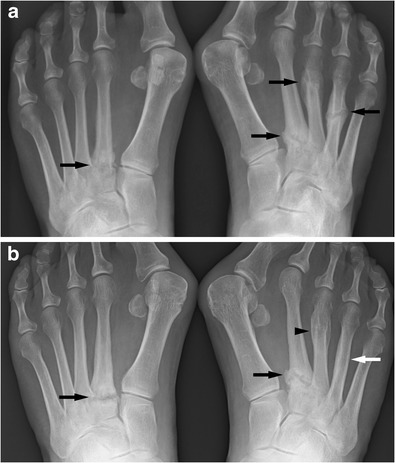
X-rayAnteroposterior X-rays of both feet: bilateral, symmetrical stress fractures at the base of the second metatarsals, at different stages of healing (arrows).
Source : Tins et al., Insights into Imaging, 2015, figure 1 · CC BY
🔬 Comparative diagnostic performance of the imaging tests
MRI is the gold standard for early marrow oedema
Sources: Hoenig 2022 AJSM (meta-analysis), Tenforde 2016, Pegrum 2012.⁷٬⁸
| Category | Sites | Course of action |
|---|---|---|
| High risk | Femoral neck (tension side), navicular, anterior tibia, medial malleolus, base of the 5th MT, sesamoids, patella | Complete offloading, surgical opinion, imaging follow-up; risk of non-union and necrosis |
| Low risk | Posteromedial tibia, fibula, MT 2-3-4, pubis, sacrum (usually) | Pain-guided load modification, cross-training, gradual resumption |
📈 Time to return to sport by Fredericson MRI grade
Hoenig 2022 meta-analysis, pooling 16 studies and 560 BSIs
Hoenig T, Tenforde AS, Strahl A, et al. Am J Sports Med. 2022;50(3):834-844.⁷
Diagnostic decision algorithm
To bring clinical suspicion, imaging and risk stratification together into one coherent decision, here is the recommended summary algorithm.🧭 Decision algorithm: from suspicion to treatment plan
A synthesis of Hoenig Delphi 2025 + IOC REDs 2023 + Warden JOSPT 2021
An algorithm bringing together the Hoenig Delphi 2025 + IOC REDs 2023 + Warden JOSPT 2021 recommendations.¹²٬¹³٬¹⁴
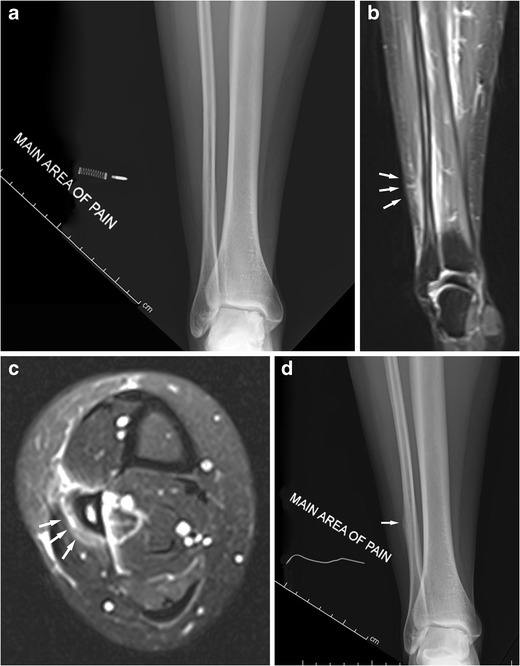
MRICoronal and axial MRI in a female runner: periosteal reaction and soft tissue oedema around the fibula, typical of a stress fracture not visible on the initial X-ray.
Source : Tins et al., Insights into Imaging, 2015, figure 11 · CC BY
Key points
- Adopt the term BSI and think in terms of a continuum.
- MRI is the reference investigation . The initial radiograph is falsely reassuring in 70-90 % of early cases.
- Stratify systematically into high risk vs low risk before any treatment decision.
- The Fredericson MRI grade is predictive of the time to RTS (42 to 98 days).
- Every decision must include correcting the systemic causes (REDs, load, biomechanics).
Bibliography
- Warden SJ, Davis IS, Fredericson M. Management and prevention of bone stress injuries in long-distance runners. J Orthop Sports Phys Ther. 2014;44(10):749-65. PMID 25103133.
- Warden SJ, Edwards WB, Willy RW. Preventing bone stress injuries in runners with optimal workload. Curr Osteoporos Rep. 2021;19(3):298-307. PMID 33635519.
- Mountjoy M, Ackerman KE, Bailey DM, et al. 2023 IOC consensus statement on REDs. Br J Sports Med. 2023;57(17):1073-1097. PMID 37752011.
- Sale C, Elliott-Sale KJ. Nutrition and Athlete Bone Health. Sports Med. 2019;49(Suppl 2):139-151. PMID 31696454.
- Pegrum J, Crisp T, Padhiar N. Diagnosis and management of bone stress injuries of the lower limb in athletes. BMJ. 2012;344:e2511. PMID 22532009.
- Ferreira GS, Almeida RN, Pinto JFP. Sacral stress fracture in a young-adult, long-distance runner: an underestimated cause of low back pain. BMJ Case Rep. 2023;16(9):e255959. PMC10481734.
- Hoenig T, Tenforde AS, Strahl A, et al. Does MRI Grading Correlate With Return to Sports After Bone Stress Injuries? A Systematic Review and Meta-analysis. Am J Sports Med. 2022;50(3):834-844. PMID 33720786.
- Tenforde AS, Kraus E, Fredericson M. Bone Stress Injuries in Runners. Phys Med Rehabil Clin N Am. 2016;27(1):139-149. PMID 26616181.
- McInnis KC, Ramey LN. High-Risk Stress Fractures: Diagnosis and Management. PM R. 2016;8(3 Suppl):S113-S124. PMID 26972260.
- Hoenig T, Eissele J, Strahl A, et al. Return to sport following low-risk and high-risk bone stress injuries: a systematic review and meta-analysis. Br J Sports Med. 2023;57(7):427-432. DOI 10.1136/bjsports-2022-106328.
- Fredericson M, Jennings F, Beaulieu C, Matheson GO. Stress fractures in athletes. Top Magn Reson Imaging. 2006;17(5):309-325. PMID 17414993.
- Hoenig T, Hollander K, Ackerman KE, et al. International Delphi consensus on bone stress injuries in athletes. Br J Sports Med. 2025;59(2):85-94. PMID 39638438.
- Warden SJ, Edwards WB, Willy RW. Optimal Load for Managing Low-Risk Tibial and Metatarsal Bone Stress Injuries in Runners. J Orthop Sports Phys Ther. 2021;51(7):322-330. PMID 33962529.
- Nattiv A, Kennedy G, Barrack MT, et al. Correlation of MRI Grading of Bone Stress Injuries With Clinical Risk Factors and Return to Play. Am J Sports Med. 2013;41(8):1930-1941. PMID 23825184.
What is the most effective treatment strategy?
Hierarchy of recommended interventions
- Stopping the activity that provokes the pain: immediate and non-negotiable. The key idea is relative rest, not absolute rest.³
- Offloading: complete and protected with crutches for high-risk BSIs; partial, or simply activity modification, for low-risk BSIs.⁴
- Identifying and correcting the causal factors: training errors, biomechanics, equipment, and above all a systemic assessment (REDs, vitamin D, calcium, energy balance).⁵
- Nutritional optimisation: aim for 1000-1300 mg/day of calcium and a serum 25(OH)D > 75 nmol/L (> 30 ng/mL), ideally > 100 nmol/L.⁶
Progressive load and the acute-to-chronic ratio
Rehabilitation is built around optimal loading, defined by Warden et al. as “the load that produces no symptoms during, after, or the day following the activity”.² 🏃🔄 Resumption algorithm for low-risk BSI (Warden 2021)
Cross-training → walk-run → continuous running → sport-specific
Adapted from Warden, Edwards, Willy. JOSPT 2021.²
📈 Acute-to-chronic ratio (ACWR) and injury risk
Risk zones by ratio (Gabbett 2016, Maupin 2020)
Adapted from Gabbett 2016 (BJSM) and Maupin 2020 (Open Access J Sports Med).⁷٬⁸ ⚠ A critical note: the “sweet spot” has attracted methodological criticism (coupling bias). Use it as a guide, not as an absolute rule.
Adjunctive modalities and GRADE level of evidence
| Modality | Indication | Level of evidence | Comment |
|---|---|---|---|
| Load management | All BSIs | GRADE high | The cornerstone; the benefit is not in doubt |
| Cross-training without impact | Maintaining fitness | GRADE high | Avoids deconditioning, a universal recommendation |
| Muscle strengthening | Correcting deficits | GRADE moderate | Indirect benefit (biomechanics, bone quality) |
| Ca / vitamin D supplements | If deficiency is proven | GRADE moderate | Calcium 2000 mg + vitamin D 800 IU lowered incidence in recruits |
| ESWT (shockwave) | Delayed union, non-union | GRADE low | 62-72 % union in non-unions; no solid RCT in acute BSI |
| LIPUS (pulsed ultrasound) | Accelerating healing | GRADE very low | Limited and heterogeneous data in BSI |
| Manual therapy | Associated tightness or stiffness | GRADE very low | Does not accelerate bone healing; an adjunctive role |
| Bisphosphonates | Refractory BSI ± severe REDs | GRADE very low | An exceptional indication, specialist opinion required |
Key points
- Both Load modification and cross-training are the only elements graded GRADE high.
- Rehabilitation is symptom-guided, not calendar-guided.
- The acute-to-chronic ratio (ACWR) should stay in the 0.8-1.3 sweet spot.
- ESWT is of moderate value only in delayed union.
- No modality replaces correcting the causes (load, REDs, biomechanics).
Bibliography
- Hoenig T, Hollander K, Ackerman KE, et al. International Delphi consensus on bone stress injuries in athletes. Br J Sports Med. 2025;59(2):85-94. PMID 39638438.
- Warden SJ, Edwards WB, Willy RW. Optimal Load for Managing Low-Risk Tibial and Metatarsal Bone Stress Injuries in Runners. J Orthop Sports Phys Ther. 2021;51(7):322-330. PMID 33962529.
- Warden SJ, Davis IS, Fredericson M. Management and prevention of bone stress injuries in long-distance runners. J Orthop Sports Phys Ther. 2014;44(10):749-65. PMID 25103133.
- McInnis KC, Ramey LN. High-Risk Stress Fractures: Diagnosis and Management. PM R. 2016;8(3 Suppl):S113-S124. PMID 26972260.
- Mountjoy M, Ackerman KE, Bailey DM, et al. 2023 IOC consensus statement on REDs. Br J Sports Med. 2023;57(17):1073-1097. PMID 37752011.
- Sale C, Elliott-Sale KJ. Nutrition and Athlete Bone Health. Sports Med. 2019;49(Suppl 2):139-151. PMID 31696454.
- Gabbett TJ. The training-injury prevention paradox: should athletes be training smarter and harder? Br J Sports Med. 2016;50(5):273-280. PMID 26758673.
- Maupin D, Schram B, Canetti E, Orr R. The Relationship Between Acute: Chronic Workload Ratios and Injury Risk in Sports: A Systematic Review. Open Access J Sports Med. 2020;11:51-75. PMID 32158285.
- Soligard T, Schwellnus M, Alonso JM, et al. How much is too much? (Part 1) IOC consensus statement on load in sport and risk of injury. Br J Sports Med. 2016;50(17):1030-1041. PMID 27535989.
- McDaniel M, Eltman NR, Pan J, Swanson RL. Evaluation of Low-Intensity Pulsed Ultrasound on Stress Fractures. Cureus. 2023;15(10):e47896. PMID 38024090.
- Putukian M. The psychological response to injury in student athletes. Br J Sports Med. 2016;50(3):145-148. PMID 26719498.
How do you prevent recurrence and plan the return to sport?
Self-management and therapeutic education
Therapeutic education is the best protective factor. Three priority lines:- Understanding the concept of cumulative overload: the athlete must know that the trigger is not an acute event but an accumulation of small loads. Volume progression remains the number one modifiable factor.³٬⁴
- Detecting REDs: screening with the REDs Clinical Assessment Tool v2 (CAT2) from the IOC 2023, with questions on menstrual cycles, BMI, eating behaviour, performance and chronic fatigue.⁵ 🧠
- Keeping a training diary: loads, pain, sleep, rating of perceived exertion (RPE), mood, to pick up the warning signals early. 📝
Performance-based return-to-sport criteria
Return to sport is not an event but a criteria-based process. The decision brings together:- Clinical criteria: no pain on palpation, on the hop test, or on 30 minutes of continuous running, and no symptoms the following day.⁶
- Functional criteria: strength balance, neuromuscular control, quality of the running pattern (video analysis recommended for runners with recurrent injury).⁶
- Psychological criteria: assessing kinesiophobia (TSK-11 scale) and confidence in the ability to resume, both often overlooked.⁷
- Contextual criteria: correction of the causal factors (REDs, load, equipment); without this, recurrence is predictable.⁵
Key points
- Preventing recurrence rests on education and on correcting the causes.
- RTS is criteria-based, not date-based.
- Both REDs and kinesiophobia are the most underestimated factors.
- Follow-up imaging is useful for high-risk sites and dispensable for asymptomatic low-risk BSIs.
Bibliography
- Wright AA, Taylor JB, Ford KR, Siska L, Smoliga JM. Risk factors associated with lower extremity stress fractures in runners. Br J Sports Med. 2015;49(23):1517-23. PMID 26582192.
- Tenforde AS, Ackerman KE, Bouxsein ML, et al. Factors Associated With High-Risk and Low-Risk Bone Stress Injury in Female Runners. Orthop J Sports Med. 2024;12(5):23259671241246227. PMID 38779133.
- Warden SJ, Edwards WB, Willy RW. Preventing bone stress injuries in runners with optimal workload. Curr Osteoporos Rep. 2021;19(3):298-307. PMID 33635519.
- Soligard T, Schwellnus M, Alonso JM, et al. IOC consensus statement on load in sport and risk of injury. Br J Sports Med. 2016;50(17):1030-1041. PMID 27535989.
- Mountjoy M, Ackerman KE, Bailey DM, et al. 2023 IOC consensus statement on REDs. Br J Sports Med. 2023;57(17):1073-1097. PMID 37752011.
- Warden SJ, Edwards WB, Willy RW. Optimal Load for Managing Low-Risk Tibial and Metatarsal BSI in Runners. J Orthop Sports Phys Ther. 2021;51(7):322-330. PMID 33962529.
- Putukian M. The psychological response to injury in student athletes. Br J Sports Med. 2016;50(3):145-148. PMID 26719498.
- Hoenig T, Tenforde AS, Strahl A, et al. Does MRI Grading Correlate With Return to Sports After BSI? Am J Sports Med. 2022;50(3):834-844. PMID 33720786.
- Hoenig T, Eissele J, Strahl A, et al. Return to sport following low-risk and high-risk BSI: a SR/MA. Br J Sports Med. 2023;57(7):427-432. DOI 10.1136/bjsports-2022-106328.
- McInnis KC, Ramey LN. High-Risk Stress Fractures: Diagnosis and Management. PM R. 2016;8(3 Suppl):S113-S124. PMID 26972260.
What do the published clinical cases teach us?
Case 1: female runner, buttock pain simulating sciatica
A distance runner presenting with right buttock and low back pain radiating down the back of the thigh, which began after a marathon. Neurological tests negative (straight leg raise, slump test). Given the persistence,MRI reveals extensive marrow oedema of the right sacral ala, consistent with a sacral BSI. Management: gradual offloading, nutritional treatment, resumption at 8 weeks. Key lesson: any “sciatica” in a runner that does not respond to standard treatment calls for a targeted MRI of the sacrum. Source: Ferreira et al. BMJ Case Reports 2023: PMC10481734.¹Case 2: elite female runner, bilateral femoral neck stress fractures
A high-performance runner presenting with chronic bilateral groin pain, dismissed as “psoas tendinopathy”.MRI reveals bilateral femoral neck BSIs on the compression side. Investigation uncovers secondary amenorrhoea (> 1 year), a low BMI and insufficient energy intake, a picture of REDs. Multidisciplinary management: orthopaedic (prophylactic screw fixation), nutritional, psychological and endocrine. Key lesson: any bilateral or multiple BSI calls for systematic REDs screening and a full endocrine work-up. Source: Jasqui-Remba et al. BMJ Case Rep 2019: PMID 31451476.²Case 3: a series of 62 navicular fractures in a sporting cohort
A prospective series of 59 patients (62 fractures) over 11 years (impact sports and running). The key finding: a mean diagnostic delay of 4 months before correct management (pain centred on the dorsal N spot ), with bone scan or MRI frequently needed (radiographs normal in most cases). Mean time to return to activity 4-6 months. The risk of recurrence was significantly associated with poor adherence to the initial offloading. Key lesson: navicular BSI is under-diagnosed and carries a high risk of non-union. Dorsal foot pain at the N spot calls for MRI even when the radiograph is normal. Source: Saxena et al. J Foot Ankle Surg 2017: PMID 28842101.³- BSI is a great imitator : demand a systematic diagnostic rethink if pain persists.
- Any multifocal or bilateral BSI calls for systematic REDs screening.
- Sites with a precarious blood supply (navicular, femoral neck, anterior tibia) demand great caution and early specialist referral.
Key points
- The diagnosis is above all clinical : focal bone pain in an athlete after a change in load.
- Early MRI is the investigation of choice where doubt persists.
- Think of the imitators and the red flags : sciatica → sacrum, psoas tendinopathy → femoral neck.
- Bilateral or multiple fractures call for a search for a systemic cause (REDs).
Bibliography
- Ferreira GS, Almeida RN, Pinto JFP. Sacral stress fracture in a young-adult, long-distance runner: an underestimated cause of low back pain. BMJ Case Rep. 2023;16(9):e255959. PMC10481734.
- Jasqui-Remba S, Jasqui-Bucay A, Jasqui-Bucay A, Fernández-De-Lara-Barrera Y. Bilateral femoral neck stress fractures in a high-performance young female runner. BMJ Case Rep. 2019;12(8). PMID 31451476.
- Saxena A, Behan SA, Valerio DL, Frosch DL. Navicular Stress Fracture Outcomes in Athletes: Analysis of 62 Injuries. J Foot Ankle Surg. 2017;56(5):943-948. PMID 28842101.
- Talbot JC, Cox G, Townend M, Langham M, Parker PJ. Femoral neck stress fractures in military personnel--a case series. J R Army Med Corps. 2008;154(1):47-50. PMID 19090388.
- Hayes M, Smith TR, Bracken P, et al. Development of a new guideline to facilitate diagnosis and management of rib stress injuries in rowers. BMJ Open Sport Exerc Med. 2015;1(1):e000018. PMC4535300.
How do you apply these recommendations in practice?
When and to which professionals should you refer?
Every high-risk BSI must be referred without delay to a sports physician or an orthopaedic surgeon. A nutrition or endocrinology opinion is essential in multiple BSIs, a history of REDs or low BMD. And psychological support may be warranted where kinesiophobia is marked or contributing psychosocial factors are present (perfectionism, poor social support).¹٬²🚩 Red flags calling for referral
- A high-risk site (femoral neck, navicular, anterior tibia, base of the 5th MT) → urgent surgical opinion
- Multiple / bilateral / recurrent BSIs → systematic REDs work-up (endocrinology, nutrition)
- Night pain, weight loss, fever → rule out tumour or infection
- Failure of conservative treatment after 6 weeks → repeat imaging plus specialist opinion
- High kinesiophobia (TSK-11 > 37) → psychological referral
Measuring outcomes and overcoming barriers to implementation
Building in Patient-Reported Outcome Measures (PROMs), the VISA-A score modified for BSI, a numerical pain scale, a return-to-sport scale, should go hand in hand with performance tests (hop test, 30 minutes of continuous running). Beyond statistical significance, aim for the Minimal Clinically Important Difference (MCID).³ Red flags in practice: apply Verhagen's 2016 grid systematically to exclude serious conditions in any persistent bone pain.⁴ Shared decision-making: adherence to the treatment plan is better when the athlete takes part in the choices (modality, timetable for resumption, level of risk accepted). The Cochrane review by Légaré 2018 confirms the clinical value of this approach.² Barriers to implementation: the most frequently reported obstacles are lack of time, lack of skills in critical appraisal of the literature, and insufficient organisational support. The facilitators include strong leadership, access to resources and continuing education.Key points
- Every high-risk BSI calls for immediate referral to a sports physician or surgeon.
- Multiple BSIs → systematic REDs work-up (cycles, DEXA, vitamin D, ferritin, endocrinology).
- Measure outcomes with standardised PROMs and functional tests, aiming for the MCID.
- A Shared decision-making improves adherence and outcomes.
- Overcoming organisational barriers requires a multifaceted approach (training, leadership, audit and feedback).
Bibliography
- Putukian M. The psychological response to injury in student athletes: a narrative review. Br J Sports Med. 2016;50(3):145-148. PMID 26719498.
- Légaré F, Adekpedjou R, Stacey D, et al. Interventions for increasing the use of shared decision making by healthcare professionals. Cochrane Database Syst Rev. 2018;7(7):CD006732. PMID 30025154.
- Robertson GAJ, Wood AM. Lower limb stress fractures in sport: optimising their management and outcome. World J Orthop. 2017;8(3):242-255. PMID 28361017.
- Verhagen AP, Downie A, Popal N, Maher C, Koes BW. Red flags presented in current low back pain guidelines: a review. Eur Spine J. 2016;25(9):2788-2802. PMID 27376890.
- Hoenig T, Hollander K, Ackerman KE, et al. International Delphi consensus on bone stress injuries in athletes. Br J Sports Med. 2025;59(2):85-94. PMID 39638438.
And after this article?
This article is part of a collection of evidence-based clinical syntheses. A question, a comment, a correction to suggest? Contact us directly through the WhatsApp button at the bottom right of the screen.