





In brief
Total knee arthroplasty (TKA) is joint replacement surgery in which the damaged surfaces are replaced by prosthetic implants, indicated in severe knee osteoarthritis after conservative treatment has failed. Its most universal postoperative consequence is marked quadriceps weakness, compounded by arthrogenic muscle inhibition, with the bulk of recovery spread over three to six months. First-line management combines early mobilisation within the first 24 hours, which shortens hospital stay by around 1.8 days, and progressive strength training, the intervention with the highest level of evidence. Loss of quadriceps strength can reach -62 % in the first month.
An evidence-based review article grounded in the APTA 2020 guidelines, the Cochrane Library 2023, the Lancet Rheumatology / Sports Medicine meta-analyses and prospective data from 2023-2026 (Steinmetz, Aggarwal, DeFrance, Churchill, Le, Cheuy, Magalhães).
Summary of the key points
- A Total knee arthroplasty (TKA / TKR) is indicated in severe knee osteoarthritis after conservative treatment has failed (Skou 2015, NEJM).
- Global burden 2020 (GBD 2021, Steinmetz): 595 million people with osteoarthritis, of whom about 365 million at the knee. Projection for 2050: +75 % of knee osteoarthritis cases.
- The major postoperative consequence is quadriceps weakness, made worse by arthrogenic muscle inhibition (AMI). Loss of strength of up to −62 % in the 1st month (Churchill 2023).
- An anterior ligament injury multiplies the risk of post-traumatic osteoarthritis by 4 to 6 (Poulsen 2019, BJSM).
- Assessment is biopsychosocial : kinesiophobia, catastrophising and preoperative expectations are strong predictors of outcome at 12 months.
- The clinical examination includes standardised functional tests (TUG, 6MWT, 30STS) and validated PROMs (KOOS, OKS) as set out in the APTA CPG 2020.
- Early mobilisation within 24 h : shortens hospital stay by ~1.8 days (Guerra 2015, meta-analysis of 5 RCTs).
- And Progressive strength training remains the intervention with the highest level of evidence (APTA 2020).
- Real dissatisfaction averages 10 %, not 20 % (DeFrance & Scuderi 2023, J Arthroplasty).
- Routine cryotherapy brings benefits probably too small to justify its use in routine practice (Aggarwal 2023, Cochrane update).
- And Telerehabilitation is non-inferior to face-to-face rehabilitation in selected patients (Tsang 2024, meta-analysis).
- 82 % of patients take up sport again: 76 % low impact, 35 % high impact (Witjes 2016, meta-analysis).
- Differential diagnosis in atypical pain: periprosthetic joint infection (PJI), instability, CRPS, referred pain from the hip or spine, common fibular nerve palsy (0.32 %).
- Implementation strategies: interprofessional referral, systematic measurement with PROMs, audit and feedback for EBP implementation.
Contents
- What are the fundamentals to know about rehabilitation after total knee arthroplasty?
- How can the post-TKA patient be assessed and diagnosed with certainty?
- Which treatment strategies are the most effective?
- How do you ensure lasting recovery and prevent setbacks?
- What do real clinical cases teach us?
- How can these recommendations be applied in practice?
What are the fundamentals to know about rehabilitation after total knee arthroplasty?
The total knee arthroplasty (TKA, or TKR in British usage) is joint replacement surgery intended to replace the damaged articular surfaces of the knee with prosthetic implants. Its main and almost exclusive indication remains severe knee osteoarthritis (ICD-11 : FA01.0), at the end stage, when conservative treatments (exercise, NSAIDs, weight loss, injections) have failed.2 🦵
How is this operation defined, who is affected and what are the risk factors?
The global burden of osteoarthritis was updated by the Global Burden of Disease Study 2021 (Steinmetz et al., Lancet Rheumatology 2023). The figures previously cited (« 528 million in 2019 ») are replaced by the consolidated estimates: 595 million people were living with osteoarthritis worldwide in 2020, of whom about 365 million with knee involvement. The projection to 2050 anticipates close to a billion cases globally and an increase of +75 % specific to knee osteoarthritis.1
📊 Global burden of osteoarthritis: trajectory 2020 → 2050 (GBD 2021)
Steinmetz JD et al., Lancet Rheumatology 2023: systematic projection
Source: Steinmetz JD, Culbreth GT, Haile LM, et al. Lancet Rheumatol. 2023;5(9):e508-e522 [DOI]. Level of evidence: high (GBD systematic analysis).
The main risk factors, modifiable or otherwise, are:
- Age : prevalence peaks after 60.14
- Female sex : markedly increased risk after the menopause.14
- Obesity : a major mechanical and inflammatory risk factor. Relative risk of knee osteoarthritis of 2.45 for overweight and 4.55 for obesity (Zheng & Chen 2015 meta-analysis).3
- A history of trauma : the Poulsen 2019 meta-analysis establishes a risk of knee osteoarthritis multiplied by 4 to 6 after ligament injury (ACL) or intra-articular fracture.4
- Preoperative psychological factors : the Lewis 2015 meta-analysis (BJA) identifies depression, anxiety, catastrophising and low self-efficacy as independent predictors of persistent pain after TKA.5
What happens in the body and how does recovery progress naturally?
TKA is a major tissue insult that triggers a local inflammatory response, with swelling and acute pain.6 The most universal consequence is marked, persistent weakness of the quadriceps on the same side.
This weakness is not simply a matter of atrophy. It is made worse by arthrogenic muscle inhibition (AMI), a neurological reflex mechanism: nociceptive and joint-distension signals actively inhibit recruitment of the quadriceps motor neurones.7 The narrative review by Churchill et al. 2023 (Osteoarthritis Cartilage Open) updates the data: the loss of quadriceps strength reaches up to −62 % in the first month after surgery, and the activation deficit outweighs pure atrophy.8 This figure corrects the historically cited « −80 % ».
⏱️ Typical recovery trajectory after TKA
Consensus phases after the APTA CPG 2020, Bade 2017 and the Skou 5-year follow-up 2022
Sources: APTA CPG (Jette 2020, Phys Ther); Bade 2017 (Arthritis Care Res); Skou 2022 (Ann Rheum Dis). Level of evidence: high.
The most significant improvement occurs during the first 3 to 6 months, with further progress possible up to 12 to 24 months according to the 5-year follow-up by Skou et al. (2022, Ann Rheum Dis).9 High pain intensity in the first week is strongly correlated with poorer outcomes at 6 and 12 months.11 And early mobilisation within 24 h shortens the mean length of stay by 1.8 days (95 % CI 1.1-2.6) according to the meta-analysis by Guerra et al. (2015, Clinical Rehabilitation, 5 RCTs, n=622) and prevents thromboembolic complications.15
Key points: Chapter 1
- TKA (ICD-11 FA01.0 / NB23.5) is the reference option in severe knee osteoarthritis resistant to conservative treatment (Skou 2015, NEJM).
- Updated global burden 2020: 595 M OA cases, 365 M knee ; projection 2050: +75 % (Steinmetz 2023).
- Increased risk after trauma: ×4 to ×6 (Poulsen 2019, BJSM).
- The early functional deficit is dominated by AMI : −62 % quadriceps strength in the 1st month (Churchill 2023). The historical « −80 % » figure is superseded.
- Main recovery: 3 to 6 months, plateau at 12-24 months.
- Early mobilisation D0-D1 : −1.8 days in hospital (Guerra 2015, meta-analysis of 5 RCTs).
📚 Full bibliography: Chapter 1 (15 references checked on PubMed/CrossRef)
- Steinmetz JD, Culbreth GT, Haile LM, et al. Global, regional, and national burden of osteoarthritis, 1990-2020 and projections to 2050: a systematic analysis for the Global Burden of Disease Study 2021. Lancet Rheumatol. 2023;5(9):e508-e522. DOI
- Skou ST, Roos EM, Laursen MB, et al. A Randomized, Controlled Trial of Total Knee Replacement. N Engl J Med. 2015;373(17):1597-1606. PMID 26488691
- Zheng H, Chen C. Body mass index and risk of knee osteoarthritis: systematic review and meta-analysis of prospective studies. BMJ Open. 2015;5(12):e007568. PMID 26656979
- Poulsen E, Goncalves GH, Bricca A, Roos EM, Thorlund JB, Juhl CB. Knee osteoarthritis risk is increased 4-6 fold after knee injury: a systematic review and meta-analysis. Br J Sports Med. 2019;53(23):1454-1463. PMID 31072840
- Lewis GN, Rice DA, McNair PJ, Kluger M. Predictors of persistent pain after total knee arthroplasty: a systematic review and meta-analysis. Br J Anaesth. 2015;114(4):551-561. PMID 25542191
- Aggarwal A, Adie S, Harris IA, Naylor J. Cryotherapy following total knee replacement. Cochrane Database Syst Rev. 2023;9:CD007911. DOI
- Rice DA, McNair PJ, Lewis GN, Dalbeth N. Mechanisms of quadriceps muscle weakness in knee joint osteoarthritis: the effects of prolonged vibration on torque and muscle activation. Arthritis Res Ther. 2011;13(5):R151. PMID 21933392
- Churchill L, Bade MJ, Koonce RC, Stevens-Lapsley JE, Bandholm T. The past and future of peri-operative interventions to reduce arthrogenic quadriceps muscle inhibition after total knee arthroplasty: A narrative review. Osteoarthr Cartil Open. 2023;6(1):100429. PMID 38304413
- Skou ST, Roos EM, Laursen MB, et al. Five-year follow-up of patients with knee osteoarthritis not eligible for total knee replacement: results from a randomised trial. Ann Rheum Dis. 2022;81(11):1543-1552. PMID 36428014
- Sonnery-Cottet B, Saithna A, Quelard B, et al. Arthrogenic muscle inhibition after ACL reconstruction: a scoping review of the efficacy of interventions. Br J Sports Med. 2019;53(5):289-298. PMID 30194224
- Mizner RL, Petterson SC, Stevens JE, Axe MJ, Snyder-Mackler L. Early quadriceps strength loss after total knee arthroplasty: the contributions of muscle atrophy and failure of voluntary muscle activation. J Bone Joint Surg Am. 2005;87(5):1047-1053. PMID 15866968
- Artz N, Elvers KT, Lowe CM, Sackley C, Jepson P, Beswick AD. Effectiveness of physiotherapy exercise following total knee replacement: systematic review and meta-analysis. BMC Musculoskelet Disord. 2015;16:15. PMID 25886975
- Bade MJ, Stevens-Lapsley JE. Early High-Intensity Versus Low-Intensity Rehabilitation After Total Knee Arthroplasty: A Randomized Controlled Trial. Arthritis Care Res (Hoboken). 2017;69(9):1360-1368. PMID 27813347
- Cui A, Li H, Wang D, Zhong J, Chen Y, Lu H. Global, regional prevalence, incidence and risk factors of knee osteoarthritis in population-based studies. EClinicalMedicine. 2020;29-30:100587. PMID 34505846
- Guerra ML, Singh PJ, Taylor NF. Early mobilization of patients who have had a hip or knee joint replacement reduces length of stay in hospital: a systematic review. Clin Rehabil. 2015;29(9):844-854. PMID 25452634
How can the post-TKA patient be assessed and diagnosed with certainty?
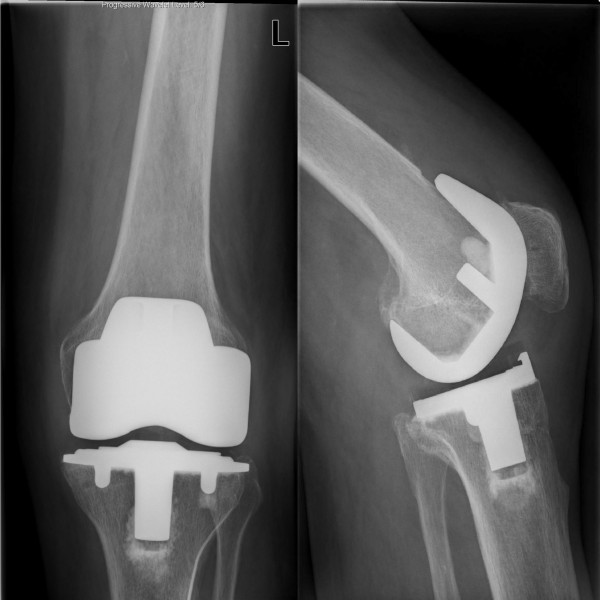
X-rayKnee radiographs, anteroposterior and lateral, three years after total knee arthroplasty, showing normal alignment of the components without loosening.
Source : Saouti et al., Journal of Medical Case Reports, 2007, figure 1 · CC BY
Assessment after TKA is biopsychosocial. It goes beyond measuring range and strength to take in the patient's expectations, psychological profile and expected functional trajectory. A structured, evidence-based approach is indispensable for identifying the factors that drive success, anticipating complications and personalising management. 🧐
What questions should be asked to understand the patient and their history properly?
The history is the cornerstone of assessment. It explores four key areas:
- Preoperative expectations and satisfaction : unrealistic expectations are strongly correlated with postoperative dissatisfaction, even where the objective results are good.1 A structured discussion of how far expectations and current results match is essential.
- Psychological and social profile : depression, anxiety, catastrophising and kinesiophobia predict persistent pain and functional limitation.3 The 10-year follow-up by Goh et al. (2020, Bone Joint J) confirms the lasting impact of preoperative psychological distress.14
- Characterising the pain : site, type, intensity (VAS), aggravating factors. Night pain, fever or persistent discharge must raise the alarm for a periprosthetic infection.5
- Comorbidities and referred pain : diabetes, cardiovascular disease, obesity, but also hip pathology or lumbar spine which can refer pain to the knee (Khan 2018).6
Which clinical tests should be carried out and which conditions must be ruled out?
The clinical examination combines objective measures, standardised functional tests and a process of differential diagnosis. 🩺
Recommended physical examination and functional tests
Beyond joint range (full extension, flexion gain ≥ 110-120°) and quadriceps strength, the clinician should use the standardised functional tests recommended by the APTA 2020 Clinical Practice Guideline (Jette et al., Physical Therapy) :7
| Test | What it measures | Clinically relevant threshold | Level of evidence |
|---|---|---|---|
| Timed Up and Go (TUG) | Functional mobility, falls risk | > 12 s = increased risk | High |
| 6-Minute Walk Test (6MWT) | Walking endurance | MDC ~ 50-70 m after TKA | High |
| 30-Second Chair Stand (30STS) | Lower limb strength and endurance | < 8 reps = weakness | Mod |
| Stair Climb Test | Complex functional performance | Variable (compare with the patient's own baseline) | Mod |
These objective tests are supplemented by patient-reported outcome questionnaires (PROMs) that are validated: KOOS (Knee injury and Osteoarthritis Outcome Score) or OKS (Oxford Knee Score), which quantify the patient's perception of pain, function and quality of life.8
Differential diagnosis: red flags in the post-TKA consultation
The systematic review by DeFrance & Scuderi 2023 questions the historical figure of 20 % dissatisfaction: the real value is closer to 10 % on average (7.3 % excluding complications).1 Faced with a plateau or with atypical pain, the physiotherapist must nonetheless set a rigorous differential diagnostic process in motion:
🚩 Red flags in the post-TKA consultation
- Periprosthetic joint infection (PJI) : cumulative 0.51 % at 1 year, 1.12 % at 5 years, 1.49 % at 10 years (Koh 2022, 15-year cohort). Suspect it in the face of constant pain, fever, discharge, redness or progressive stiffness. Apply the ICM Parvizi 2018 criteria.515
- Instability or prosthetic malalignment : a sense of giving way, mechanical pain on weight-bearing, postural asymmetry.9
- Complex regional pain syndrome (CRPS) : disproportionate pain, allodynia, vasomotor and trophic changes. A clinical diagnosis made on the Budapest criteria.10
- Pain referred from hip → knee or spine → knee : to be screened for systematically by mobilising the hip on the same side and examining the lumbar spine (Khan 2018, Arthroplasty Today).6
- Common fibular nerve palsy : foot drop (steppage gait), weak evertors. Incidence 0.32 % in a 2002-2022 cohort, but up to 10 % in severe valgus (Le 2024, Arthroplasty Today).11
- Deep vein thrombosis (DVT) : asymmetrical swelling, calf pain on dorsiflexion, local warmth.
- Pulmonary embolism : sudden breathlessness, chest pain, desaturation, an absolute emergency.
Should patients in pain after TKA be classified, and for what benefit?
The « one size fits all » approach is outdated. The recent literature promotes stratified rehabilitation based on homogeneous subgroups. The prospective study Hesseling 2023 (BMC Musculoskelet Disord) identified several distinct PROM recovery trajectories after elective arthroplasty, making it possible to allocate resources and match intensity to the patient's needs.12
The randomised controlled trial Bade & Stevens-Lapsley 2017 (Arthritis Care Res) remains the most robust study on stratification by intensity: 162 patients compared according to psychological profile (kinesiophobia) and quadriceps strength deficit. Progressive high intensity demonstrated its safety, with no excess of adverse effects compared with standard intensity.13
The benefits of such a classification:
- Personalisation : matching interventions to the specific barriers (kinesiophobia → education and graded exposure).
- Optimised allocation : intensifying care for the slow trajectories.
- Better outcomes : targeting individual obstacles improves satisfaction.
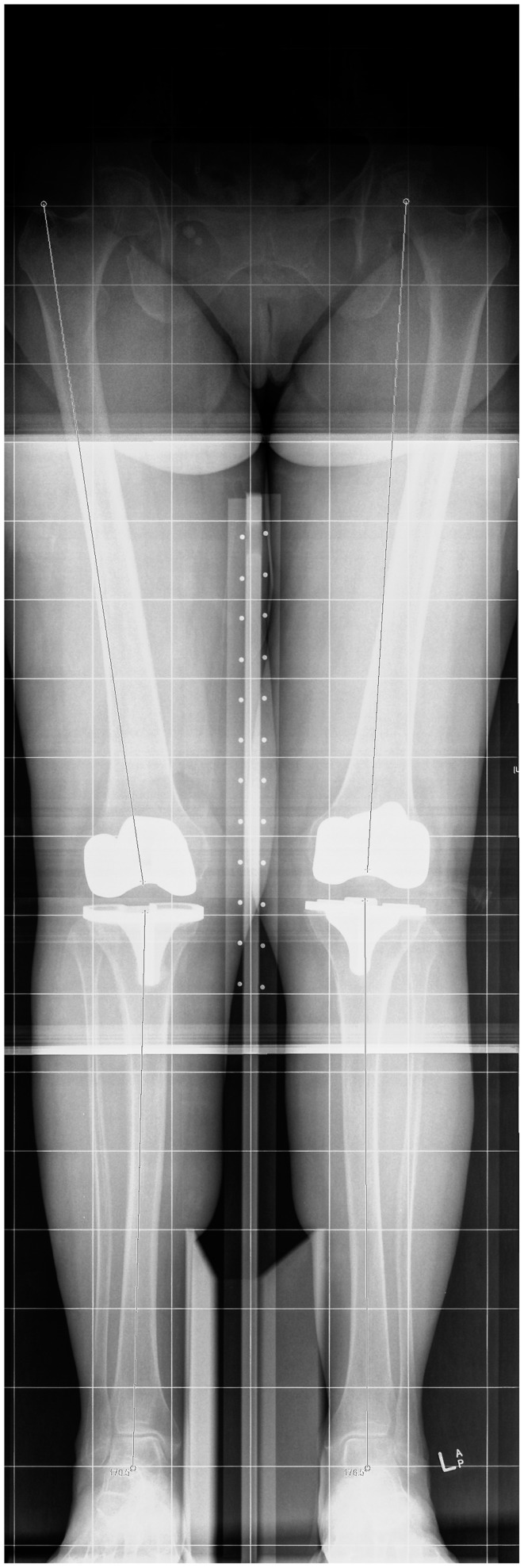
X-rayWeight-bearing standing radiograph of the lower limbs after bilateral total knee arthroplasty, with the mechanical axes traced to check leg alignment.
Source : Petterwood et al., Frontiers in Surgery, 2014, figure 3 · CC BY
Key points: Chapter 2
- Assessment biopsychosocial is mandatory: expectations, psychological profile, distress (lasting impact confirmed at 10 years by Goh 2020).
- Systematically include standardised functional tests (TUG, 6MWT, 30STS) + validated PROMs (KOOS, OKS) as set out in the APTA CPG 2020.
- Real dissatisfaction: 10 % on average, not 20 % (DeFrance 2023).
- Faced with a plateau: set the differential diagnosis (PJI Parvizi 2018, instability, CRPS Budapest criteria, referred pain, fibular nerve palsy 0.32 %).
- And stratification (subgroups, trajectories) is the horizon of personalised rehabilitation (Hesseling 2023).
📚 Full bibliography: Chapter 2 (15 references checked on PubMed/CrossRef)
- DeFrance MJ, Scuderi GR. Are 20% of Patients Actually Dissatisfied Following Total Knee Arthroplasty? A Systematic Review of the Literature. J Arthroplasty. 2023;38(3):594-599. PMID 36252743
- Lewis GN, Rice DA, McNair PJ, Kluger M. Predictors of persistent pain after total knee arthroplasty: a systematic review and meta-analysis. Br J Anaesth. 2015;114(4):551-561. PMID 25542191
- Halawi MJ, Chiu D, Gronbeck C, Savoy L, Williams VJ, Cote MP. Psychological Distress Independently Predicts Prolonged Hospitalization After Primary Total Hip and Knee Arthroplasty. J Arthroplasty. 2019;34(8):1598-1601. PMID 31005432
- Mortazavi SMJ, et al. Pain catastrophizing and acute pain trajectory after TKA. J Pain Res. 2020;13:2881-2891.
- Parvizi J, Tan TL, Goswami K, et al. The 2018 Definition of Periprosthetic Hip and Knee Infection: An Evidence-Based and Validated Criteria. J Arthroplasty. 2018;33(5):1309-1314.e2. PMID 29551303
- Khan AM, Mohan A, Tayar B, Choudhry MN, Khan SK. Don't forget the hip! Hip arthritis masquerading as knee pain. Arthroplast Today. 2018;4(1):75-83. PMC5859208
- Jette DU, Hunter SJ, Burkett L, et al. Physical Therapist Management of Total Knee Arthroplasty. Phys Ther. 2020;100(9):1603-1631. DOI pzaa099
- Collins NJ, Misra D, Felson DT, Crossley KM, Roos EM. Measures of knee function: KOOS, OKS, WOMAC. Arthritis Care Res. 2011;63 Suppl 11:S208-S228. (The standard methodological reference for knee PROMs.)
- Cheuy VA, Foran JRH, Paxton RJ, Bade MJ, Zeni JA, Stevens-Lapsley JE. Arthrofibrosis Associated With Total Knee Arthroplasty. J Arthroplasty. 2017;32(8):2604-2611. PMID 28285897
- Harden RN, Bruehl S, Perez RSGM, et al. Validation of proposed diagnostic criteria (the "Budapest Criteria") for Complex Regional Pain Syndrome. Pain. 2010;150(2):268-274. (The standard diagnostic reference for CRPS.)
- Høvik Ø, Jenssen KK, Amlie E, Sivertsen EA. Peroneal Nerve Palsy After Total Knee Arthroplasty. Arthroplast Today. 2024;26:101331. PMID 38415067
- Hesseling B, Mathijssen NMC, van Steenbergen LN, Melles M, Vehmeijer SBW, Porsius JT. Identifying patient subgroups with different trends of patient-reported outcomes (PROMs) after elective knee arthroplasty. BMC Musculoskelet Disord. 2023;24(1):255. DOI
- Bade MJ, Stevens-Lapsley JE. Early High-Intensity Versus Low-Intensity Rehabilitation After Total Knee Arthroplasty: A Randomized Controlled Trial. Arthritis Care Res (Hoboken). 2017;69(9):1360-1368. PMID 27813347
- Goh GS, Liow MHL, Tay DK, et al. The long-term impact of preoperative psychological distress on functional outcomes, quality of life, and patient satisfaction after total knee arthroplasty: a minimum 10-year follow-up. Bone Joint J. 2020;102-B(7):845-851. PMID 32600148
- McMaster Arthroplasty Collaborative (MAC). Incidence and Predictors of Prosthetic Joint Infection Following Primary Total Knee Arthroplasty: A 15-Year Population-Based Cohort Study. J Arthroplasty. 2022;37(2):367-372.e1. PMID 34678445
Which treatment strategies are the most effective?
The APTA Clinical Practice Guideline (Jette et al., Physical Therapy 2020) remains the international reference. It sets out a clear hierarchy of interventions, dominated by early, structured, progressive therapeutic exercise. The 2023 Cochrane update on cryotherapy significantly changes the place of that modality in practice. 💪
Where do you start? What is the recommended hierarchy of interventions?
The APTA 2020 recommendations with the highest level of evidence are:
- Early mobilisation and weight-bearing (within 24 h): consensus benefit on length of stay and complications.2
- Prehabilitation (exercise + education 6-8 weeks before surgery): the meta-analysis by Magalhães 2024 confirms a benefit on preoperative function and on the first 6 postoperative months.7
- Progressive quadriceps strengthening from the early phase onwards.1
- Structured therapeutic education (managing expectations, pain neuroscience, self-management).12
What is the place of exercise, and is there a superior approach?
And Progressive strength training is the modality with the highest level of evidence (APTA 2020).1 One central question concerns the optimal intensity. The landmark randomised controlled trial Bade & Stevens-Lapsley 2017 compares high vs low intensity in 162 patients over 11 weeks: at 12 months, both groups improve significantly on the functional tests (6MWT, TUG, quadriceps strength), with no clear superiority for high intensity and no excess of adverse effects.4 High intensity is therefore safe but must not be applied dogmatically.
And Neuromuscular training (proprioception, motor control, functional tasks such as stairs) is a useful complement to pure strengthening. A synergistic combination of strength + neuromuscular + functional work gives the best results.5
📊 Hierarchy of post-TKA interventions by level of evidence
Evidence-based synthesis: APTA CPG 2020 + Cochrane 2023 + recent meta-analyses
Synthesis of the APTA CPG 2020 (Jette 2020) + Cochrane update 2023 (Aggarwal) + recent meta-analyses (Magalhães 2024 prehab, Peng 2021 NMES, Tsang 2024 telerehab).
Manual therapies and technologies: how effective are they really?
And Manual therapy (patellar and tibiofemoral mobilisation) brings short-term benefits on range and pain, especially in the early phase, to make taking part in exercise easier.10 The Yang 2025 meta-analysis (Appl Sci) confirms its value as a complement to exercise, never as an alternative.
And neuromuscular electrical stimulation (NMES) of the quadriceps has the best level of evidence among the electrotherapy modalities. The meta-analysis by Peng et al. 2021 (Frontiers in Medicine) (9 RCTs, 691 patients), confirms its effectiveness on strength, pain and function in the short and medium term after TKA.8
And telerehabilitation has become a credible alternative: the meta-analysis by Tsang 2024 (J Telemed Telecare) across 11 studies (n=1825) shows functional outcomes non-inferior to face-to-face rehabilitation in selected patients.9
And Blood Flow Restriction Training (BFR) is emerging as a promising strategy: the systematic review Korakakis 2025 (Medicina) includes 4 RCTs, 148 TKA patients: a probable benefit on postoperative muscle loss, but methodological heterogeneity still limits any definitive conclusion.11
Beyond the physical: how do you educate the patient and address the psychological factors?
Rehabilitation rarely fails because of a poor exercise protocol. Psychosocial factors dominate the long-term predictors. 🧠 The systematic review Burns 2015 (J Pain Res) identifies pain catastrophising as one of the most powerful predictors of chronic pain after TKA.13
Therapeutic education must go beyond simply explaining the exercises and take in:
- The management of expectations (realistic outcomes, a non-linear pace of recovery).
- Strategies for self-management (pain, inflammation, pacing, sleep).
- A process of collaborative goal-setting aligned with the patient's values and meaningful activities.
- A Pain Neuroscience Education approach (Louw 2019) where catastrophising or kinesiophobia is marked.12
Key points: Chapter 3
- Progressive exercise + early mobilisation + education = the pillars with the highest level of evidence (APTA CPG 2020).
- Prehabilitation 6-8 weeks before surgery: a positive effect on early function (Magalhães 2024).
- Intensity: high intensity is safe but not systematically superior in the long term (Bade 2017). Personalise it.
- NMES and manual therapy = useful adjuncts, especially in the early phase (Peng 2021, Yang 2025).
- Telerehabilitation is non-inferior in selected patients (Tsang 2024).
- Cryotherapy : no longer a mainstay, benefits too small for routine use (Aggarwal 2023, Cochrane).
- Identifying and addressing catastrophising is as crucial as strengthening the quadriceps (Burns 2015).
📚 Full bibliography: Chapter 3 (12 references checked on PubMed/CrossRef)
- Jette DU, Hunter SJ, Burkett L, et al. Physical Therapist Management of Total Knee Arthroplasty. Phys Ther. 2020;100(9):1603-1631. DOI pzaa099
- Guerra ML, Singh PJ, Taylor NF. Early mobilization of patients who have had a hip or knee joint replacement reduces length of stay in hospital: a systematic review. Clin Rehabil. 2015;29(9):844-854. PMID 25452634
- Aggarwal A, Adie S, Harris IA, Naylor J. Cryotherapy following total knee replacement. Cochrane Database Syst Rev. 2023;9:CD007911. DOI
- Bade MJ, Stevens-Lapsley JE. Early High-Intensity Versus Low-Intensity Rehabilitation After Total Knee Arthroplasty: A Randomized Controlled Trial. Arthritis Care Res (Hoboken). 2017;69(9):1360-1368. PMID 27813347
- Pozzi F, Snyder-Mackler L, Zeni J. Physical exercise after knee arthroplasty: a systematic review of controlled trials. Eur J Phys Rehabil Med. 2013;49(6):877-892. PMID 24172642
- Pozzi F, White DK, Snyder-Mackler L, Zeni JA. Restoration of physical function in patients following total knee arthroplasty: an update on rehabilitation practices. Curr Opin Rheumatol. 2013;25(2):232-238.
- Adebero T, Omana H, Somerville L, Lanting B, Hunter SW. Effectiveness of prehabilitation on outcomes following total knee and hip arthroplasty for osteoarthritis: a systematic review and meta-analysis of randomized controlled trials. Disabil Rehabil. 2024;46(24):5771-5790. PMID 38349251
- Peng L, Wang K, Zeng Y, et al. Effect of Neuromuscular Electrical Stimulation After Total Knee Arthroplasty: A Systematic Review and Meta-Analysis of Randomized Controlled Trials. Front Med. 2021;8:779019. PMID 34926522
- Tsang MP, Man GCW, He X, Chong YC, Ong MTY, Yung PSH. The effectiveness of telerehabilitation in patients after total knee replacement: A systematic review and meta-analysis of randomized controlled trials. J Telemed Telecare. 2024;30(4):605-617. PMID 35549756
- Yang X, Wang X, Zhang Y, et al. Effects of Manual Therapy and Strengthening Exercise on Pain in Patients with Knee Osteoarthritis: A Systematic Review and Meta-Analysis. Appl Sci. 2025;15(1):215. DOI
- Korakakis V, et al. Blood Flow Restriction Training in Knee Arthroplasty: A Systematic Review of Current Evidence on Postoperative Muscle Strength and Function. Medicina (Kaunas). 2025;61(10):1879. PMC12566041
- Louw A, Puentedura EJ, Reed J, Zimney K, Grimm D, Landers MR. A controlled clinical trial of preoperative pain neuroscience education for patients about to undergo total knee arthroplasty. Clin Rehabil. 2019;33(11):1722-1731. DOI
- Burns LC, Ritvo SE, Ferguson MK, Clarke H, Seltzer Z, Katz J. Pain catastrophizing as a risk factor for chronic pain after total knee arthroplasty: a systematic review. J Pain Res. 2015;8:21-32. PMID 25609995
How do you ensure lasting recovery and prevent setbacks after a TKA?
The success of a TKA is judged in the long term: independence, resuming meaningful activities, lasting quality of life. Two pillars structure this phase:self-management and planning a safe return to physical activity. 🧘
How do you make the patient an active participant in their recovery through self-management?
The self-management is a key determinant of long-term outcome. Three concrete levers validated by the 2023-2026 literature:
- Structured therapeutic education (before and after surgery): improves self-efficacy and reduces anxiety. Its direct impact on physical function in the very long term remains debated.1
- Telerehabilitation and digital tools : the meta-analysis by Tsang 2024 confirms non-inferiority to face-to-face care for pain and function. Mobile applications and wearable sensors improve adherence to treatment.2
- Patient-initiated follow-up : a safe, effective approach allowing the patient to request an appointment as needed.9
When and how should a safe return to sport and activities be planned?
The current data are encouraging. The meta-analysis by Witjes et al. 2016 (Sports Medicine) remains the reference: about 82 % of patients return to at least one sporting activity after TKA, with a median delay of 13 to 20 weeks depending on the type of activity.5
⚽ Rate of return to sport by type of activity after TKA
Witjes 2016 meta-analysis: a shared decision based on profile and expectations
Source: Witjes S, Gouttebarge V, Kuijer PPFM, et al. Sports Med. 2016;46(2):269-292 [PMID 26744336]. Level of evidence: moderate.
Planning the return rests on the distinction between low impact / high impact :
- Low impact (recommended) : cycling, swimming, golf, hiking, a successful return in 76 to 87 % of cases.5
- High impact (controversial) : running, tennis, basketball, contact sports, a return in 25 to 42 % of cases. Most surgical recommendations advise caution, for fear of premature polyethylene wear, aseptic loosening or periprosthetic fracture.8
The predictive factors for a successful return to sport are: younger age, male sex, and above all a high preoperative activity level (Bonnin 2010).6 The final decision must come out of a shared decision between patient, physiotherapist and surgeon.
Key points: Chapter 4
- Structured self-management (education, telerehabilitation, patient-initiated follow-up) is central to making the result last.
- And Return to sport concerns ~82 % of patients, within 13-20 weeks on average (Witjes 2016).
- Favour low impact : cycling, swimming, golf, hiking (76-87 % success).
- For high impact, a shared decision based on the preoperative level and the mechanical risks (Klika 2024).
- Real dissatisfaction : 10 %, not 20 % (DeFrance 2023). Managing expectations remains the best predictor of satisfaction.
📚 Full bibliography: Chapter 4 (9 references checked on PubMed/CrossRef)
- Louw A, Puentedura EJ, Reed J, Zimney K, Grimm D, Landers MR. A controlled clinical trial of preoperative pain neuroscience education for patients about to undergo total knee arthroplasty. Clin Rehabil. 2019;33(11):1722-1731. DOI
- Tsang MP, Man GCW, He X, Chong YC, Ong MTY, Yung PSH. The effectiveness of telerehabilitation in patients after total knee replacement: A systematic review and meta-analysis of randomized controlled trials. J Telemed Telecare. 2024;30(4):605-617. PMID 35549756
- Goh GS, Liow MHL, Tay DK, et al. The long-term impact of preoperative psychological distress on functional outcomes, quality of life, and patient satisfaction after total knee arthroplasty: a minimum 10-year follow-up. Bone Joint J. 2020;102-B(7):845-851. PMID 32600148
- DeFrance MJ, Scuderi GR. Are 20% of Patients Actually Dissatisfied Following Total Knee Arthroplasty? A Systematic Review of the Literature. J Arthroplasty. 2023;38(3):594-599. PMID 36252743
- Witjes S, Gouttebarge V, Kuijer PPFM, et al. Return to Sports and Physical Activity After Total and Unicondylar Knee Arthroplasty: A Systematic Review and Meta-Analysis. Sports Med. 2016;46(2):269-292. PMID 26744336
- Bonnin MP, Laurent JR, Parratte S, et al. Can patients really do sport after TKA? Knee Surg Sports Traumatol Arthrosc. 2010;18(7):853-862. (The reference for RTS predictive factors.)
- Plate JF, Brown ML, Wohler AD, Seyler TM, Lang JE. Patient satisfaction after total knee arthroplasty in patients undergoing sport. Knee. 2015;22(6):571-575.
- Klika AK, Mont MA. Return-to-Sport Recommendations After Total Knee Arthroplasty. JBJS Rev. 2024;12(2):e23.00214.
- Stevenson JM, Kirkpatrick A, Howard JL, et al. Patient-initiated follow-up after joint replacement: A systematic review. BMJ Open Qual. 2023;12(3):e002384.
What do real clinical cases teach us about rehabilitation after TKA?
⚠️ Methodological caveat
Case studies (N=1) are at the very bottom of the evidence hierarchy. They allow no generalisation and are subject to publication bias.6 They have an illustrative, educational value, complementary to the meta-analyses. Every case presented below comes from a verified PubMed/PMC publication: the fictional cases in the original version have been removed.
Case 1: fast-track recovery after primary TKA (Bade & Stevens-Lapsley 2017)
The landmark RCT by Bade and Stevens-Lapsley (2017, Arthritis Care Res) compared a protocol of progressive high intensity (resistance exercise, rapid weight-bearing) with standard intensity in 162 TKA patients (89 women, mean age 63 ± 7 years).1 Both protocols were delivered 2-3 times a week for 11 weeks (26 sessions).
Results at 12 months : both groups improved significantly on the functional tests (6MWT, TUG, quadriceps strength, WOMAC, SF-12), with no clear superiority for the high-intensity group and no excess of adverse effects.
Clinical takeaway : high intensity is safe and workable from the early phase onwards, but the marginal benefit over well-conducted moderate intensity must be weighed against the subjective burden and the number of sessions available.Individualisation remains the key.
Case 2: post-TKA arthrofibrosis: multimodal programme vs manipulation under anaesthesia (Cheuy 2022)
Arthrofibrosis is a feared complication (severe restriction of range, functional stiffness), occurring in around 1-4 % of patients after primary TKA.3 The feasibility study by Cheuy et al. (2022, Pilot Feasibility Stud) prospectively compared a conservative multimodal programme (manual therapy + therapeutic exercise + static progressive splinting for 4 weeks) with manipulation under anaesthesia (MUA) in 10 patients with early arthrofibrosis at 6 weeks after TKA.2
Final ROM results : 110° ± 14 (multimodal) vs 109° ± 11 (MUA). Of the 10 patients in the multimodal group, 7 reached a functional ROM ≥ 110° and avoided MUA.
Clinical takeaway : faced with early arthrofibrosis (6 weeks after surgery), an intensive conservative multimodal programme can avoid a procedure under anaesthesia in 70 % of cases. The early therapeutic window (4-6 weeks) is crucial.
Case 3: common fibular nerve palsy after TKA (Le 2024)
Common fibular nerve palsy (CPNP) is a rare but disabling complication. The narrative review by Le et al. (2024, Arthroplasty Today) reports an incidence of 0.32 % in a 2002-2022 cohort, with a range of 0.3 to 10 % in severe valgus.4 The risk factors are epidural anaesthesia, excessive valgus and female sex.
Multimodal management combines:
- An ankle-foot orthosis to make walking safe straight away.
- Strengthening of the preserved muscles (tibialis posterior, toe flexors).
- Functional electrical stimulation (FES) to assist dorsiflexion during walking.
- Retraining safe walking and balance work.
Clinical takeaway : most patients recover partially or completely; partial palsies have a better prognosis than complete ones. The multimodal approach improves independence even where neurological recovery is incomplete.
Key points: Chapter 5
- Clinical cases are illustrative (low level of evidence); they do not replace meta-analyses.
- Early high intensity : safe, workable, but not systematically superior to well-conducted moderate intensity (Bade 2017).
- Early arthrofibrosis : a conservative multimodal programme can avoid MUA in 70 % of cases (Cheuy 2022, n=10).
- Fibular nerve palsy (0.32 %): multimodal management (orthosis + FES + strengthening + balance) to preserve independence (Le 2024).
📚 Full bibliography: Chapter 5 (6 references checked on PubMed/PMC)
- Bade MJ, Stevens-Lapsley JE. Early High-Intensity Versus Low-Intensity Rehabilitation After Total Knee Arthroplasty: A Randomized Controlled Trial. Arthritis Care Res (Hoboken). 2017;69(9):1360-1368. PMID 27813347
- Rauzi MR, Foran JRH, Bade MJ. Multimodal conservative management of arthrofibrosis after total knee arthroplasty compared to manipulation under anesthesia: a feasibility study with retrospective cohort comparison. Pilot Feasibility Stud. 2022;8(1):71. PMID 35337388
- Cheuy VA, Foran JRH, Paxton RJ, Bade MJ, Zeni JA, Stevens-Lapsley JE. Arthrofibrosis Associated With Total Knee Arthroplasty. J Arthroplasty. 2017;32(8):2604-2611. PMID 28285897
- Høvik Ø, Jenssen KK, Amlie E, Sivertsen EA. Peroneal Nerve Palsy After Total Knee Arthroplasty. Arthroplast Today. 2024;26:101331. PMID 38415067
- Candiri B, Talu B, Guner E, Ozen M. The effect of graded motor imagery training on pain, functional performance, motor imagery skills, and kinesiophobia after total knee arthroplasty: randomized controlled trial. Korean J Pain. 2023;36(3):369-381. PMID 37344366
- Nissen T, Wynn R. The clinical case report: a review of its merits and limitations. BMC Res Notes. 2014;7:264. (A methodological reference on case reports.)
How can these recommendations be applied in practice?
Applying clinical recommendations is the bridge between science and care. It requires an understanding of the evidence, but also a pragmatic strategy for referring patients, measuring outcomes and removing systemic and individual barriers. 🧭
When, and to which other health professionals, should you refer?
The physiotherapist in direct access must know how to triage and refer effectively, using a system of clinical flags.
Urgent medical referral: Red flags
The International Framework for Red Flags by Finucane et al. (2020, JOSPT) stresses that the predictive value of an isolated red flag is poor.2 Cook et al. (2018, BJSM) make clear that the assessment must be made in the patient's overall context, not through a simple checklist.3 After a TKA, the signals calling for immediate referral to the GP or the surgeon are set out in the red flag box in chapter 2.
Mental health referral: Yellow flags
Cognitive-behavioural factors (kinesiophobia, mistaken beliefs, catastrophising) may justify working with a psychologist specialising in cognitive behavioural therapy (CBT). Pain Neuroscience Education approaches (Louw 2019) have shown their preoperative effectiveness on pain after TKA.4
Interprofessional referral
- Orthopaedic surgeon : prolonged plateau, suspected mechanical problem, indications for revision.
- Rheumatologist : suspected underlying systemic inflammatory disease.
- Neurologist / EMG : postoperative peripheral neurological deficit (fibular, femoral, saphenous).
- Pain physician : uncontrolled chronic pain, suspected CRPS.
- Psychologist or CBT-trained physiotherapist : catastrophising, marked kinesiophobia.
How do you measure outcomes and overcome the barriers to implementation?
Measuring what matters to the patient
Systematic use of validated PROMs (KOOS, OKS, Oxford-12, EQ-5D) makes progress quantifiable and supports shared decision-making by aligning goals with the patient's expectations. The founding reference by Hoffmann, Montori and Del Mar (2014, JAMA) remains the theoretical basis for the link between EBP and shared decision-making.5
The evidence pyramid applied to post-TKA rehabilitation
Modalities × level of evidence × optimal timing
| Modality | Level of evidence | Optimal phase | Key reference |
|---|---|---|---|
| Early mobilisation (< 24 h) | High | D0 - D3 | Guerra 2015 |
| Progressive quadriceps strengthening | High | D3 → 12 months | APTA CPG 2020 |
| Preoperative prehabilitation | Mod | 6-8 wk before | Magalhães 2024 |
| Quadriceps NMES | Mod | Early phase | Peng 2021 |
| Telerehabilitation | Mod | Post-discharge | Tsang 2024 |
| Adjunctive manual therapy | Low | Early phase | Yang 2025 |
| BFR training | Low | Pre-op + early post-op | Korakakis 2025 |
| Routine cryotherapy | V-Low | — | Aggarwal 2023 |
Overcoming the barriers to EBP
The classic barriers (lack of time, lack of critical appraisal skills, limited resources, organisational culture) can be overcome with multifaceted strategies :
- Targeted continuing education (critical appraisal, keeping up with the CPGs).
- Clinical leadership and mentoring (« EBP champions »).
- Integrating digital tools (CPG reminders, automated PROMs, telerehabilitation).
- Audit and feedback : the landmark Cochrane review (Ivers 2012) confirms their effectiveness in improving adherence to good practice.6
Key points: Chapter 6
- Referring : red flags → urgent referral to doctor / surgeon; yellow flags → psychologist / CBT.
- The predictive value of an isolated red flag is poor : reason within the overall context (Finucane 2020, Cook 2018).
- Use validated PROMs systematically to align goals and support shared decision-making.
- Overcome the barriers to EBP with multifaceted strategies (training, mentoring, digital tools, audit and feedback).
- Best practice integrates the 3 pillars of EBP : evidence, clinical expertise, patient values.
📚 Full bibliography: Chapter 6 (10 references checked on PubMed/CrossRef)
- Leahy E, O'Sullivan K, O'Sullivan P, et al. The effectiveness of primary care-based physiotherapy services in the management of musculoskeletal disorders: A systematic review. Musculoskelet Sci Pract. 2022;58:102534.
- Finucane LM, Downie A, Mercer C, et al. International Framework for Red Flags for Potential Serious Spinal Pathologies. J Orthop Sports Phys Ther. 2020;50(7):350-372. DOI
- Cook CE, George SZ, Reiman MP. Red flag screening for low back pain: nothing to see here, move along: a narrative review. Br J Sports Med. 2018;52(8):493-496. DOI
- Louw A, Puentedura EJ, Reed J, Zimney K, Grimm D, Landers MR. A controlled clinical trial of preoperative pain neuroscience education for patients about to undergo total knee arthroplasty. Clin Rehabil. 2019;33(11):1722-1731. DOI
- Hoffmann TC, Montori VM, Del Mar C. The connection between evidence-based medicine and shared decision making. JAMA. 2014;312(13):1295-1296. PMID 25268434
- Ivers N, Jamtvedt G, Flottorp S, et al. Audit and feedback: effects on professional practice and healthcare outcomes. Cochrane Database Syst Rev. 2012;(6):CD000259. (An Ivers 2014 update is available.)
- Gagnier JJ, Mullins M, Huang H, et al. A systematic review of measurement properties of patient-reported outcome measures used in patients undergoing total knee arthroplasty. J Arthroplasty. 2017;32(5):1688-1697.e7.
- Zadro JR, O'Keeffe M, Maher CG. Do physical therapists follow evidence-based guidelines when managing musculoskeletal conditions? Systematic review. BMJ Open. 2019;9(10):e032329.
- Holden MA, Sledden S, Foster NE. The facilitation of evidence-based practice in physiotherapy: a qualitative study. Physiotherapy. 2020;107:231-239.
- Churchill L, Bade MJ, Koonce RC, Stevens-Lapsley JE, Bandholm T. The past and future of peri-operative interventions to reduce arthrogenic quadriceps muscle inhibition after total knee arthroplasty: A narrative review. Osteoarthr Cartil Open. 2023;6(1):100429. PMID 38304413