




In brief
Iliotibial band syndrome (ITBS) is the most frequent cause of lateral knee pain in runners. The current paradigm is no longer friction but compression of a richly innervated fat pad between the band and the lateral femoral epicondyle. The pain is predictable on exertion, peaks at around 30° of flexion and is made worse downhill; the Noble compression test and hip abductor weakness point to the diagnosis. First-line treatment combines education, load management, abductor strengthening and gait retraining. ITBS accounts for about 10 % of running injuries and is twice as frequent in women.
A clinical synthesis based on Fairclough 2006, Hutchinson 2022, Geisler 2021, Foch 2023 and the SAFER XXXIII 2024 study (n = 76,654 runners).
Clinical synthesis
- ITBS accounts for about 10 % of running injuries (SR Sanchez-Alvarado 2024) and also affects cyclists. It is twice as frequent in women runners as in men (Foch 2023, meta-analysis).
- The historical paradigm of a « friction syndrome » is obsolete. ITBS is a compression syndrome of a richly innervated fat pad between the band and the lateral femoral epicondyle (Fairclough 2006, Hutchinson 2022).
- Compression peaks at ≈ 30° of knee flexion, which corresponds exactly to the stance phase of the running stride, hence the predictability of the pain beyond a certain distance.
- The training errors (increasing volume or elevation gain too quickly) are the major extrinsic trigger, and the weakness of the hip abductors in female runners is the best-supported biomechanical factor (Fredericson 2000, Foch 2023).
- The diagnosis is clinical : predictable lateral pain on exertion, made worse downhill. MRI is not routine (Geisler 2021).
- The Noble compression test (pain reproduced at 30° of flexion) is the reference test. The Ober test is obsolete : it mainly assesses the hip capsule and gluteus medius, not the band (Willett 2016, AJSM).
- First-line treatment is conservative and multimodal : education + load management + exercise (hip abductors and external rotators) + gait retraining. No useful « direct stretching » (the band is close to inextensible).
- The gait retraining programme is the most cost-effective tool: raising cadence by 5-10 % (Heiderscheit 2011, MSSE) and widening the step (Brindle 2014, Gait Posture) reduce the tension on the band.
- Friede 2022 (Phys Ther Sport) resets the therapeutic goal: reduce the compression, not « loosen » the band. Strengthening gluteus medius on its own is not enough if it does not translate into changed running kinematics.
- The female runner pays a heavier price : the Foch 2023 meta-analysis finds, in women with current ITBS, reduced isometric hip abductor strength and a reduced peak of hip internal rotation; the risk is raised by low energy availability (IOC REDs Consensus, Mountjoy 2023, BJSM).
- The return to running is progressive (run-walk alternation), guided by pain (≤ 2/10 on exertion, absent the next day, the Silbernagel 2007 model) and by functional criteria, never by a rigid calendar.
- The differential diagnosis is crucial when treatment fails: lateral meniscal tear, biceps femoris or popliteus tendinopathy, stress fracture of the lateral condyle, synovial cyst (Yeoh 2015, PMC).
- Red flags (the Finucane 2020 framework) call for medical referral. Yellow flags (kinesiophobia, catastrophising) are strong predictors of chronicity.
- The passive modalities (stretching, foam roller, shockwave therapy, corticosteroid injection) have limited efficacy and must remain adjuncts (Nguyen 2023, scoping review of 98 studies).
- Patient empowerment (load management, home exercise programme, warning signs) is the most powerful lever for preventing recurrence.
Contents
- What are the fundamentals to know about iliotibial band syndrome (ITBS)?
- How do you assess and diagnose ITBS with confidence?
- Which treatment strategies are the most effective for ITBS?
- Why the female runner pays a heavier price: sex-specific biomechanics and REDs
- How do you secure a lasting recovery and plan a safe return?
- What do real clinical cases teach us about ITBS?
- How do you apply these recommendations concretely in your practice?
What are the fundamentals to know about iliotibial band syndrome (ITBS)?
How is this condition defined, who is affected and what are the risk factors?
ITBS is defined as an overuse injury causing pain on the lateral side of the knee, typically centred on the lateral femoral epicondyle and reproducible at about 30° of knee flexion, the key position of the stance phase of the stride.³ The pain is highly predictable : it appears systematically after a certain distance or duration of effort, often forces a stop, but disappears at rest.⁴ Beyond runners, ITBS can affect cyclists (up to 15-24 % of their injuries), soldiers, hikers and anyone doing an activity with repeated knee flexion and extension.⁵ The incidence reported in runners ranges from 1.6 to 12 % across studies.¹ Female sex, young age, few years of running and a slower pace are independent risk factors identified in the very large SAFER XXXIII cohort (n = 76,654 distance runners, Marais 2024).⁶📊 The share of ITBS among lateral knee injuries in runners
Three concordant sources: ITBS remains the number one cause of lateral knee pain
Sources: Sanchez-Alvarado 2024 (PMID 39247485); Geisler 2021 (PMID 34375405); Hadeed & Tapscott StatPearls 2024 (NBK542185). The figures are consolidated ranges, not point estimates.
- Intrinsic factors, biomechanical: The weakness of the hip abductors (gluteus medius first) is the most reproducible factor in the literature. Fredericson 2000 (Clin J Sport Med) was the first to document this deficit in runners with ITBS, and Foch 2023 (Gait Posture meta-analysis) confirmed it specifically for currently symptomatic female runners.⁷,⁸ The increased peak of hip adduction and of knee internal rotation in the stance phase are the associated kinematic correlates.⁹
- Intrinsic factors, anatomical: A prominent lateral femoral epicondyle, a leg length difference or genu varum have been described, but with a low level of evidence.¹
- Extrinsic factors, load management: The excessively rapid increase in volume, intensity or elevation gain in running is the most frequent trigger.¹⁰ The classic « no more than 10 % per week » rule remains a teaching landmark, but the acute to chronic workload ratio (Gabbett 2016, IOC Soligard 2016) offers a more nuanced framework for individualising progression.¹¹,¹²
- Extrinsic factors, environment: Running on a cambered surface (with the supporting limb on the low side), repeated downhill running (eccentric quadriceps work), and worn or ill-suited shoes can all contribute.⁴
⚖️ The five best-supported risk factors in runners
A synthesis of Aderem 2015 (PMID 26573859) + Foch 2023 (PMID 36758425) + Marais 2024 SAFER XXXIII (PMID 38618688)
Qualitative level of evidence (GRADE), a teaching gradation drawn from the three sources cited. « Female sex » summarises an underlying biomechanical effect (frontal-plane kinematics + hip strength), not a fatality.
What happens in the body: friction or compression of an innervated fat pad?
For decades ITBS was taught as a « friction syndrome »: the iliotibial band would « slide » back and forth over the lateral femoral epicondyle with every flexion and extension of the knee, and that rubbing was said to cause the inflammation. This model, inherited from Orchard 1996,⁹ is today considered obsolete. The reference anatomical study by Fairclough et al. 2006 (J Anat), based on 15 cadavers, 6 MRI scans of healthy volunteers and 2 athletes with acute ITBS, established that the band is firmly anchored to the femoral epicondyle by fibrous strands: a front-to-back movement is anatomically impossible.¹³ Beneath the band lies a layer of richly innervated and vascularised fat (and not a bursa, in most people). The model that now prevails is therefore one of compression repeated over that fat pad between the taut band and the bone. The Hutchinson 2022 narrative review (Sports Med) consolidates this change of paradigm: the band is described as a complex structure with multiple functions (stabilisation, elastic energy return), and not as a simple « taut » tendon.¹⁴ The Geisler 2021 review (J Athl Train) translates this update explicitly into therapeutic implications: the aim is no longer to « reduce friction » but to reduce the compression , through strengthening, gait retraining and load management.¹⁵🦴 From the « friction » paradigm to the « compression » paradigm, what changes clinically
Anatomy, biomechanics and therapeutic consequences
The change of paradigm is not merely academic: it makes « stretching of the band » obsolete (it does not stretch) and redirects attention to genuinely modifiable levers (hip strength, cadence, load).
Key points
- ITBS is the number one cause of lateral knee pain in runners, accounting for about 10 % of running injuries (Sanchez-Alvarado 2024).
- The pain peaks at ≈ 30° of knee flexion , the stance phase of the stride, hence the predictable onset after a certain distance.
- The current paradigm is one of compression of an innervated fat pad under the band (Fairclough 2006, Hutchinson 2022, Geisler 2021), not one of friction.
- The female runners are affected 2× more often than men (Foch 2023, Gait Posture meta-analysis), with specific frontal-plane biomechanics and abductor weakness (see the dedicated H2 section).
- The load errors are the major extrinsic trigger, hip abductor weakness the best-supported intrinsic factor (Fredericson 2000, Foch 2023).
- Without a change in mechanics and load, ITBS becomes chronic. Spontaneous resolution is rare; active management speeds up and secures recovery.
Bibliography
- Hadeed A, Tapscott DC. Iliotibial Band Friction Syndrome. StatPearls. StatPearls Publishing; updated 2023-2024. NBK542185.
- Sanchez-Alvarado A, Bokil C, Cassel M, Engel T. Effects of conservative treatment strategies for iliotibial band syndrome on pain and function in runners: a systematic review. Front Sports Act Living. 2024;6:1386456. PMID 39247485.
- van der Worp MP, van der Horst N, de Wijer A, Backx FJG, Nijhuis-van der Sanden MWG. Iliotibial band syndrome in runners: a systematic review. Sports Med. 2012;42(11):969-992. PMID 22994651.
- Pegrum J, Self A, Hall N. Iliotibial band syndrome. BMJ. 2019;364:l980. PMID 30898786.
- Strauss EJ, Kim S, Calcei JG, Park D. Iliotibial band syndrome: evaluation and management. J Am Acad Orthop Surg. 2011;19(12):728-736. PMID 22134205.
- Marais JV, Jansen van Rensburg A, Schwellnus MP, et al. Risk factors associated with a history of iliotibial band syndrome (hITBS) in distance runners: a cross-sectional study in 76,654 race entrants — a SAFER XXXIII study. Phys Sportsmed. 2024;52(6):568-578. PMID 38618688.
- Foch E, Brindle RA, Pohl MB. Lower extremity kinematics during running and hip abductor strength in iliotibial band syndrome: a systematic review and meta-analysis. Gait Posture. 2023;101:73-81. PMID 36758425.
- Fredericson M, Cookingham CL, Chaudhari AM, Dowdell BC, Oestreicher N, Sahrmann SA. Hip abductor weakness in distance runners with iliotibial band syndrome. Clin J Sport Med. 2000;10(3):169-175. PMID 10959926.
- Noehren B, Davis I, Hamill J. ASB Clinical Biomechanics Award Winner 2006: prospective study of the biomechanical factors associated with iliotibial band syndrome. Clin Biomech (Bristol, Avon). 2007;22(9):951-956. PMID 17728030.
- Aderem J, Louw QA. Biomechanical risk factors associated with iliotibial band syndrome in runners: a systematic review. BMC Musculoskelet Disord. 2015;16:356. PMID 26573859.
- Gabbett TJ. The training-injury prevention paradox: should athletes be training smarter and harder? Br J Sports Med. 2016;50(5):273-280. PMID 26758673.
- Soligard T, Schwellnus M, Alonso JM, et al. How much is too much? (Part 1) International Olympic Committee consensus statement on load in sport and risk of injury. Br J Sports Med. 2016;50(17):1030-1041. PMID 27535989.
- Fairclough J, Hayashi K, Toumi H, et al. The functional anatomy of the iliotibial band during flexion and extension of the knee: implications for understanding iliotibial band syndrome. J Anat. 2006;208(3):309-316. PMID 16533314.
- Hutchinson LA, Lichtwark GA, Willy RW, Kelly LA. The Iliotibial Band: A Complex Structure with Versatile Functions. Sports Med. 2022;52(5):995-1008. PMID 35072941.
- Geisler PR. Current Clinical Concepts: Synthesizing the Available Evidence for Improved Clinical Outcomes in Iliotibial Band Impingement Syndrome. J Athl Train. 2021;56(8):805-815. PMID 34375405.
- Lavine R. Iliotibial band friction syndrome. Curr Rev Musculoskelet Med. 2010;3(1-4):18-22. PMID 21063495.
How do you assess and diagnose ITBS with confidence?
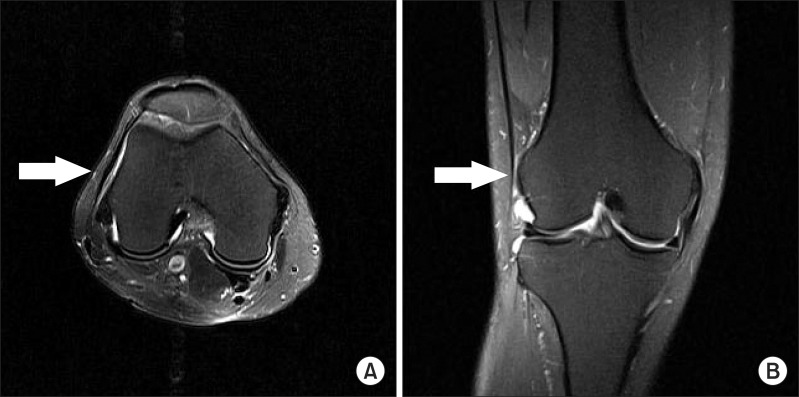
MRIAxial and coronal knee MRI: fluid collection and increased signal adjacent to the iliotibial band, at the level of the lateral femoral epicondyle, supporting arrows.
Source : Hong et al., The Korean Journal of Pain, 2013, figure 1 · CC BY-NC
Which questions should you ask to understand the runner and their history?
The history is the most cost-effective examination in a runner consulting for lateral knee pain. More than any score, it is the pattern that points the way: predictable pain, triggered at a certain distance, worse downhill or on a cambered surface, relieved by rest.² Five lines of enquiry to explore systematically:- Location and quality of the pain: typically « 2-3 cm above the lateral joint line », over the lateral femoral epicondyle. Described as a « stab » or a burning, with no distal radiation.³
- Behaviour on exertion 🏃: the key question: « At exactly what point in your run does the pain appear? » Pain that comes at the same distance (« always after 15-20 minutes », for example) and that forces a stop strongly suggests ITBS.² Pain that appears from the first strides points instead to a tendinopathy or an intra-articular lesion.
- Aggravating factors: going down stairs (flexion at 30° against gravity reproduces the compression), downhill running (which increases eccentric work and band tension), a laterally cambered surface.⁴
- Training history: recent changes which must be dated precisely : an increase in volume (« I went from 30 to 50 km a week three weeks ago »), added elevation gain, a change of shoe, a new interval session, marathon preparation, and so on. Progression errors are found in most cases.⁵
- Yellow flags: fear of movement (kinesiophobia), catastrophising, mistaken beliefs (« my band is wrecked »). These factors are strong predictors of chronicity and must be addressed from the first consultation.⁶
🧭 ITBS diagnostic algorithm
From the presenting complaint to therapeutic stratification
Diagram adapted from Geisler 2021, Hadeed & Tapscott StatPearls 2024 and Foch 2023. Profile stratification guides the relative weight of the therapeutic levers.
Which clinical tests should you perform (Noble, Ober) and which conditions should you rule out?
The clinical examination aims to reproduce the familiar pain of the patient and to assess hip, knee and foot mechanics. The Noble compression test is the reference tool.⁷ The patient lies supine, hip and knee flexed; the clinician applies firm thumb pressure over the lateral femoral epicondyle while the knee is passively moved from flexion into extension. The test is positive if the familiar pain is reproduced at around 30° of flexion (the zone of maximal compression). Its sensitivity and specificity have not been formally quantified in modern studies, but its coherence with the pathophysiological mechanism (compression at 30°) makes it the most relevant provocation test.⁷,⁸ ⚠️ The Ober test, historically taught to assess the « stiffness » of the band, is today considered obsolete as a specific test for ITBS. The cadaveric anatomical study by Willett 2016 (AJSM), with progressive sectioning of the band, the gluteal muscles and the hip capsule, showed that the Ober test mainly reflects the tension of the hip capsule, gluteus medius and gluteus minimus, not that of the iliotibial band.⁹ Keeping it as a diagnostic test for ITBS leads to clinical misinterpretation. Other functional tests complete the assessment:- Renne test: single-leg stance on the symptomatic side with the knee flexed to 30-40°. Reproduction of the pain = a positive test. Good clinical correlation but few formal psychometric data.¹⁰
- Functional assessment of the hip: single-leg squat, single-leg bridge, palm-down test to assess frontal-plane pelvic stability and abductor strength.¹¹ A medial collapse of the knee (dynamic knee valgus) marks the « weak hip » profile to be corrected.
- Running analysis: ideally on a treadmill with video, otherwise overground: look for cadence, step length, crossing of the midline, hip adduction in the stance phase.¹²
- Lateral meniscal tear: pain over the joint line, a positive McMurray, mechanical symptoms (locking).¹³
- Biceps femoris or popliteus tendinopathy: a more posterior distal palpation, pain on resisted flexion.¹⁴
- Stress fracture of the lateral femoral condyle or of the tibial plateau: to be considered in the female runner at risk of REDs (see the dedicated chapter), pain at rest, night pain, painful bone percussion: MRI is essential.¹⁵
- Patellofemoral pain with a lateral component : poorly localised anterior pain, worse on stairs and with prolonged sitting (the « movie sign »).¹⁶
- Lateral plica, synovial cyst: rare but to be considered in resistant ITBS: MRI is contributive (see the Yeoh 2015 case in the clinical cases chapter).¹⁷
- Early lateral tibiofemoral osteoarthritis: an older patient, pain on loading, a history of trauma.¹³
When to think of something other than ITBS
- Pain at rest or at night → stress fracture, tumour, infection.
- Pain from the first strides of a run (rather than after a predictable distance) → tendinopathy or a structural lesion.
- Mechanical symptoms (locking, giving way, joint swelling) → meniscus, ligament, loose body.
- No response to well-conducted conservative treatment at 6-8 weeks → reassess the diagnosis, request an MRI (Geisler 2021).
- An amenorrhoeic woman + bone pain + fatigue + weight loss → suspected REDs and stress fracture, see the dedicated chapter and refer to a sports physician.
Should ITBS patients be classified, and for what benefit?
There is no validated consensus classification for ITBS patients, unlike other conditions (DC/TMD, ICOP for temporomandibular disorders).¹ The diagnosis stays binary (present / absent) and clinical. Recent literature, however, argues for a profile stratification that guides the relative weight of the therapeutic levers:- The « load error » profile dominates: a recent history of a rapid increase in volume, intensity or elevation gain. The main therapeutic axis is load management + education.⁵
- The « weak hip » profile : a measurable abductor deficit (HHD, isokinetic or functional test), single-leg squat with dynamic valgus. The main axis is progressive strengthening of the abductors and external rotators.¹¹
- The « unfavourable gait » profile : low cadence (< 165-170 steps/min at running pace), crossing of the midline, narrow step width. The main axis is gait retraining (cadence +5 to +10 %, wider step).¹²
| Diagnostic test | Target | Level of evidence | Clinical take-away |
|---|---|---|---|
| Noble compression | The band at 30° of flexion | Moderate-high | The reference test for reproducing the familiar pain.⁷ |
| Renne test | Single-leg stance 30-40° | Moderate | A functional alternative, useful for post-treatment assessment.¹⁰ |
| Ober | (supposedly) the band | Low | Assesses the hip capsule and the glutes, not the ITB, to be reconsidered (Willett 2016).⁹ |
| Single-leg squat | Frontal-plane stability, abductor strength | Moderate | Spots the « weak hip » profile.¹¹ |
| MRI | Fat pad under the ITB, differential | Moderate (reserved) | Not routine, reserved for atypical or refractory cases (Geisler 2021).¹ |
Key points
- ✅ The diagnosis of ITBS is essentially clinical : history (predictable pain on exertion) + a positive Noble test at 30°.
- ⚠️ The Ober test is obsolete as a diagnostic test for ITBS: it mainly assesses the hip capsule and the glutes (Willett 2016, AJSM).
- 🎯 The differential diagnosis must systematically rule out a lateral meniscal tear, a stress fracture (above all in the female runner at risk of REDs) and a biceps femoris tendinopathy.
- 🧭 The profile stratification (load / hip / gait) guides the therapeutic sequence, and to this day no validated consensus classification exists.
- 🩻 MRI is not routine : reserved for atypical presentations or for failures of well-conducted treatment (≥ 6-8 weeks).
Bibliography
- Geisler PR. Current Clinical Concepts: Synthesizing the Available Evidence for Improved Clinical Outcomes in Iliotibial Band Impingement Syndrome. J Athl Train. 2021;56(8):805-815. PMID 34375405.
- Pegrum J, Self A, Hall N. Iliotibial band syndrome. BMJ. 2019;364:l980. PMID 30898786.
- Strauss EJ, Kim S, Calcei JG, Park D. Iliotibial band syndrome: evaluation and management. J Am Acad Orthop Surg. 2011;19(12):728-736. PMID 22134205.
- Lavine R. Iliotibial band friction syndrome. Curr Rev Musculoskelet Med. 2010;3(1-4):18-22. PMID 21063495.
- Marais JV, Jansen van Rensburg A, Schwellnus MP, et al. Risk factors associated with a history of iliotibial band syndrome (hITBS) in distance runners — SAFER XXXIII. Phys Sportsmed. 2024;52(6):568-578. PMID 38618688.
- Finucane LM, Downie A, Mercer C, et al. International Framework for Red Flags for Potential Serious Spinal Pathologies. J Orthop Sports Phys Ther. 2020;50(7):350-372. doi:10.2519/jospt.2020.9971.
- Hadeed A, Tapscott DC. Iliotibial Band Friction Syndrome. StatPearls. StatPearls Publishing; updated 2023-2024. NBK542185.
- Fairclough J, Hayashi K, Toumi H, et al. The functional anatomy of the iliotibial band during flexion and extension of the knee. J Anat. 2006;208(3):309-316. PMID 16533314.
- Willett GM, Keim SA, Shostrom VK, Lomneth CS. An Anatomic Investigation of the Ober Test. Am J Sports Med. 2016;44(3):696-701. PMID 26755689.
- van der Worp MP, van der Horst N, de Wijer A, Backx FJG, Nijhuis-van der Sanden MWG. Iliotibial band syndrome in runners: a systematic review. Sports Med. 2012;42(11):969-992. PMID 22994651.
- Foch E, Brindle RA, Pohl MB. Lower extremity kinematics during running and hip abductor strength in iliotibial band syndrome: a systematic review and meta-analysis. Gait Posture. 2023;101:73-81. PMID 36758425.
- Heiderscheit BC, Chumanov ES, Michalski MP, Wille CM, Ryan MB. Effects of step rate manipulation on joint mechanics during running. Med Sci Sports Exerc. 2011;43(2):296-302. PMID 20581720.
- Hutchinson LA, Lichtwark GA, Willy RW, Kelly LA. The Iliotibial Band: A Complex Structure with Versatile Functions. Sports Med. 2022;52(5):995-1008. PMID 35072941.
- Mucha MD, Caldwell W, Schlueter EL, Walters C, Hassen A. Hip abductor strength and lower extremity running related injury in distance runners: a systematic review. J Sci Med Sport. 2017;20(4):349-355. PMID 27693442.
- Mountjoy M, Ackerman KE, Bailey DM, et al. 2023 International Olympic Committee's (IOC) consensus statement on Relative Energy Deficiency in Sport (REDs). Br J Sports Med. 2023;57(17):1073-1097. PMID 37752011.
- Aderem J, Louw QA. Biomechanical risk factors associated with iliotibial band syndrome in runners: a systematic review. BMC Musculoskelet Disord. 2015;16:356. PMID 26573859.
- Yeoh C, Lim G, Sathappan SS. Synovial Cyst: A Culprit for Recalcitrant Iliotibial Band Syndrome: A Case Report. Malays Orthop J. 2015;9(3):68-70. PMID 28611916.
Which treatment strategies are the most effective for ITBS?
Where do you start? What is the hierarchy of interventions?
The hierarchy is clear and widely agreed, even if the evidence base is more modest than for patellofemoral pain or Achilles tendinopathy.⁴- Phase 1, load management and education: stopping or temporarily modifying the activities that provoke the pain (run/walk, easy cycling, swimming), explaining to the patient the « compression » nature of the condition (not friction), the specific triggers and the expected trajectory.⁵
- Phase 2, active rehabilitation: progressive strengthening of the hip abductors and external rotators, lower limb motor control (single-leg squat, step-down), introducing gait retraining if running is the target activity.⁶,⁷
- Phase 3, adjunct modalities (if needed): manual therapy, foam roller (knowing what it does, see the critique below), shockwave therapy in some protocols.²,⁸
- Phase 4, pharmacology and injections: short-course NSAIDs for flares, corticosteroid injection in refractory cases (Gunter 2004 showed a benefit at 2 weeks versus placebo in an « onset < 2 weeks » population, but the effect is short and it is not a disease-modifying treatment).⁹
- Phase 5, surgery: exceptional, reserved for failures of ≥ 6 months of well-conducted conservative treatment. Bursectomy, Z-plasty of the band or posterior resection of the band; no gold standard, few comparative studies.¹⁰
🔺 The ITBS treatment pyramid
Horizontal card format (more legible than a triangular SVG pyramid)
A teaching synthesis after Geisler 2021, Nguyen 2023, Friede 2022 and Sanchez-Alvarado 2024. Levels 1 and 2 are the priority levers for the great majority of runners.
What place do exercise and gait retraining hold?
Therapeutic exercise is the heart of the treatment. Two complementary components stand out. 1. Strengthening the hip abductors and external rotators. The historic Fredericson 2000 study (Clin J Sport Med) established the efficacy of a 6-week programme centred on gluteus medius: 22 of 24 runners returned to pain-free running.¹¹ Since then the Mucha 2017 meta-analysis (J Sci Med Sport) has confirmed the association between abductor weakness and running injuries in distance runners.⁶ Foch 2023 (Gait Posture) made clear that the female runner with current ITBS has reduced abductor strength and altered frontal-plane kinematics, hence the targeted importance of strengthening.⁷ Classic exercises: clamshell, side-lying leg raise, side plank with abduction, single-leg glute bridge, lateral step-down. 2. Gait retraining. The key study is Heiderscheit 2011 (MSSE, n = 45 recreational runners): a cadence increase of 5 to 10 % substantially reduces peak loads at the hip and the knee.¹² Bramah 2019 (AJSM, n = 36 runners with patellofemoral pain, results transferable to ITBS on biomechanical grounds) showed that a single gait retraining session (+ 10 % cadence) improves the kinematics and the clinical outcomes at 4 weeks and 3 months.¹³ Brindle 2014 (Gait Posture) showed that widening the step reduces band tension during running, whereas narrowing it (crossing the midline) increases it.¹⁴ ⚠️ One important nuance: Willy & Davis 2011 (JOSPT) had shown that a 6-week programme of strengthening alone (without gait retraining) improves strength but does not automatically translate into changed running kinematics.¹⁵ This strengthens the idea that strengthening and gait retraining are complementary, not interchangeable , the consensus position of Friede 2022 (Phys Ther Sport).⁴Manual therapy, foam roller, shockwave therapy, injections: what real efficacy?
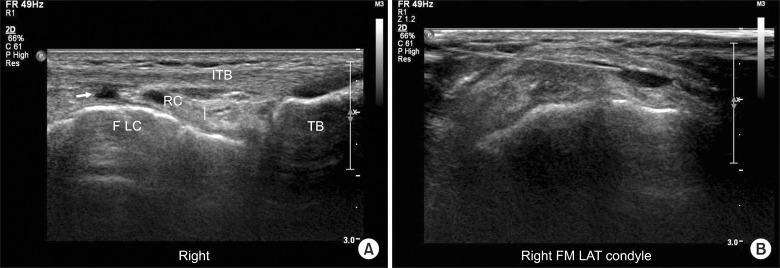
UltrasoundUltrasound of the iliotibial band at the lateral femoral epicondyle: local fluid collection visible beneath the band, with ultrasound-guided needle localisation.
Source : Hong et al., The Korean Journal of Pain, 2013, figure 2 · CC BY-NC
- Direct stretching of the band: ineffective and probably obsolete. The iliotibial band is an extremely resistant fascial structure whose plastic deformation requires forces far beyond those of a manual stretch (Chaudhry 2008, J Am Osteopath Assoc, a 3D model of the forces required).¹⁶ The effect people feel probably comes from the overlying muscles (TFL, gluteus maximus).⁴
- Foam roller / soft tissue massage: can offer short-term relief through neurological modulation of pain and improved proprioception, with no structural change to the band.² It is a support tool, not a core therapy.
- Manual therapy targeted at the hip / TFL: can make the active work easier (releasing TFL trigger points, mobilising the greater trochanter), with no evidence of a lasting structural effect.²
- Shockwave therapy (ESWT): emerging in some protocols with encouraging but heterogeneous results. The Sanchez-Alvarado 2024 SR describes ESWT as « effective » but on few studies: a moderate level of evidence, still to be confirmed.¹
- Corticosteroid injections: the Gunter & Schwellnus 2004 RCT (BJSM, n = 18) showed a significant reduction in pain at 2 weeks versus placebo in runners with ITBS of less than 2 weeks' duration.⁹ The effect is short, the placement technical (peri-condylar, ideally ultrasound-guided), and they do not treat the cause. To be reserved for recalcitrant flares, to open a « window » for active rehabilitation.
- Dry needling: little ITBS-specific evidence, to be regarded as symptomatic.
| Modality | Main indication | Level of evidence (GRADE) | Expected effect |
|---|---|---|---|
| Education + load management | All patients | Moderate-high | ↘ pain, ↗ autonomy, ↘ recurrence |
| Hip abductor strengthening | Weak hip profile | Moderate-high | ↗ strength, ↗ frontal control, ↘ pain at 6-12 weeks |
| Gait retraining (cadence + step) | Unfavourable gait profile | Moderate | ↘ peak hip and knee loads, clinical transfer 4-12 weeks |
| Manual therapy TFL / hip | Pain adjunct | Low-moderate | Short-term relief, makes active work easier |
| Foam roller | Pain adjunct | Low | Neurological modulation, no structural effect |
| Shockwave therapy (ESWT) | Chronic case | Low-moderate | Reported benefit, few studies |
| Corticosteroid injection | Refractory flare < 2 weeks | Moderate (short term) | ↘ pain at 2 weeks, does not remove the cause |
| Direct ITB stretching | — | Very low | ⚠️ Structurally ineffective (Chaudhry 2008) |
| Surgery | Failure ≥ 6 months | Case by case | An exceptional resort |
Beyond the physical: education and psychological factors
Education is probably the most cost-effective intervention for preventing recurrence. Three key messages to pass on to the patient:- The nature of the condition: « Your band is neither "tight" nor "torn". It is a very strong tissue that compresses an innervated fat pad at 30° of flexion, and it is that repeated compression that creates the pain. » This reframing deconstructs the guilt (« I stretched badly ») and reduces fear.⁵
- Load management: « Pain is not a signal of damage, it is a signal of overload. If you reduce the load and correct the mechanics, the tissues adapt. » Quantifying the load (volume, intensity, elevation gain) and learning to modulate it is the key.¹⁷
- Structured patience: « Resolution takes 6 to 12 weeks. It is not linear, there will be ups and downs. Being pain-free when walking, then over a short run-walk, is the first sign of success, not the return to your previous volume. » This transparency about the trajectory improves adherence.⁵
Key points
- ✅ The treatment of ITBS is conservative, multimodal and tiered : education and load management first, exercise and gait retraining at the heart, passive modalities as adjuncts.
- 💪 The strengthening of the hip abductors and gait retraining (cadence +5-10 %, wider step) are the best-supported levers (Fredericson, Heiderscheit, Brindle, Bramah).
- ⚠️ The direct stretches of the band are ineffective : the structure does not stretch, the felt effect comes from the neighbouring muscles (TFL, gluteus maximus).
- 🩹 The corticosteroid injections have a proven short-term effect (Gunter 2004) but are not a disease-modifying treatment: to be reserved for refractory cases as a « window » for rehabilitation.
- 🧠 Education (compression paradigm, load management, structured patience) is the most cost-effective intervention for preventing recurrence.
Bibliography
- Sanchez-Alvarado A, Bokil C, Cassel M, Engel T. Effects of conservative treatment strategies for iliotibial band syndrome on pain and function in runners: a systematic review. Front Sports Act Living. 2024;6:1386456. PMID 39247485.
- Nguyen AP, Detrembleur C, Van Cant J. Conservative treatment for iliotibial band syndrome: are we facing a research gap? A scoping review of 98 studies with clinical perspectives. Phys Ther Sport. 2023;62:33-43. PMID 37300970.
- Baker RL, Fredericson M. Iliotibial Band Syndrome in Runners: Biomechanical Implications and Exercise Interventions. Phys Med Rehabil Clin N Am. 2016;27(1):53-77. PMID 26616177.
- Friede MC, Innerhofer G, Fink C, Alegre LM, Csapo R. Conservative treatment of iliotibial band syndrome in runners: are we targeting the right goals? Phys Ther Sport. 2022;54:44-52. doi:10.1016/j.ptsp.2021.12.006.
- Geisler PR. Current Clinical Concepts: Synthesizing the Available Evidence for Improved Clinical Outcomes in Iliotibial Band Impingement Syndrome. J Athl Train. 2021;56(8):805-815. PMID 34375405.
- Mucha MD, Caldwell W, Schlueter EL, Walters C, Hassen A. Hip abductor strength and lower extremity running related injury in distance runners: a systematic review. J Sci Med Sport. 2017;20(4):349-355. PMID 27693442.
- Foch E, Brindle RA, Pohl MB. Lower extremity kinematics during running and hip abductor strength in iliotibial band syndrome: a systematic review and meta-analysis. Gait Posture. 2023;101:73-81. PMID 36758425.
- Aderem J, Louw QA. Biomechanical risk factors associated with iliotibial band syndrome in runners: a systematic review. BMC Musculoskelet Disord. 2015;16:356. PMID 26573859.
- Gunter P, Schwellnus MP. Local corticosteroid injection in iliotibial band friction syndrome in runners: a randomised controlled trial. Br J Sports Med. 2004;38(3):269-272. PMID 15155424.
- Strauss EJ, Kim S, Calcei JG, Park D. Iliotibial band syndrome: evaluation and management. J Am Acad Orthop Surg. 2011;19(12):728-736. PMID 22134205.
- Fredericson M, Cookingham CL, Chaudhari AM, Dowdell BC, Oestreicher N, Sahrmann SA. Hip abductor weakness in distance runners with iliotibial band syndrome. Clin J Sport Med. 2000;10(3):169-175. PMID 10959926.
- Heiderscheit BC, Chumanov ES, Michalski MP, Wille CM, Ryan MB. Effects of step rate manipulation on joint mechanics during running. Med Sci Sports Exerc. 2011;43(2):296-302. PMID 20581720.
- Bramah C, Preece SJ, Gill N, Herrington L. A 10 % Increase in Step Rate Improves Running Kinematics and Clinical Outcomes in Runners With Patellofemoral Pain at 4 Weeks and 3 Months. Am J Sports Med. 2019;47(14):3406-3413. PMID 31657964.
- Brindle RA, Milner CE, Zhang S, Fitzhugh EC. Changing step width alters lower extremity biomechanics during running. Gait Posture. 2014;39(1):124-128. PMID 23831430.
- Willy RW, Davis IS. The effect of a hip-strengthening program on mechanics during running and during a single-leg squat. J Orthop Sports Phys Ther. 2011;41(9):625-632. PMID 21765220.
- Chaudhry H, Schleip R, Ji Z, Bukiet B, Maney M, Findley T. Three-dimensional mathematical model for deformation of human fasciae in manual therapy. J Am Osteopath Assoc. 2008;108(8):379-390. PMID 18723456.
- Gabbett TJ. The training-injury prevention paradox: should athletes be training smarter and harder? Br J Sports Med. 2016;50(5):273-280. PMID 26758673.
- Pegrum J, Self A, Hall N. Iliotibial band syndrome. BMJ. 2019;364:l980. PMID 30898786.
Why the female runner pays a heavier price: sex-specific biomechanics and REDs
Frontal-plane biomechanics and abductor weakness (Foch 2023)
The Foch, Brindle & Pohl 2023 meta-analysis (Gait Posture) pooled the studies comparing female runners with ITBS against female controls, and female runners with ITBS against male runners with ITBS. Two key results stand out:¹- Female runners with current ITBS show isometric weakness of the hip abductors compared with female controls. This difference is not found in the same way in men, which suggests a dimorphism of the risk factor.
- Female runners with current ITBS show a reduced peak hip internal rotation angle (transverse plane), a counter-intuitive result that warns against reducing female ITBS to a simple excess of dynamic valgus.¹
⚖️ Biomechanical profile of the female runner with ITBS vs a healthy female runner (Foch 2023)
Meta-analysis, weighted mean differences on the key variables
A teaching synthesis of the Foch 2023 results (PMID 36758425). The precise quantitative effects vary across the pooled studies; direction and significance are reported qualitatively for clinical legibility.
REDs (Mountjoy 2023): low energy availability, bone and tendon
The Relative Energy Deficiency in Sport (REDs) , formerly the « female athlete triad », is a syndrome recognised by the IOC 2023 consensus (BJSM, Mountjoy et al.).⁶ It describes the multi-system consequences of low energy availability (a calorie intake insufficient for expenditure), with effects on bone, on the endocrine, immune, cardiovascular and haematological systems, and on mental health. Why does this concern ITBS and the female runner?- Stress fractures are a major red flag in the ITBS differential diagnosis (see the diagnosis chapter). Female runners at risk of REDs carry a several-fold higher risk of bone injury; the lateral sites of the knee (lateral femoral condyle, lateral tibial plateau) can mimic ITBS.⁶
- Low energy availability impairs tendon and muscle healing, which can turn a « run-of-the-mill » ITBS into a refractory chronic condition.⁶
- The « young female runner, low volume, moderate pace, trying to increase her mileage » subgroup identified in SAFER XXXIII partly overlaps the REDs risk profile,² so caution is all the more warranted.
Signs suggestive of REDs in the female runner, to be screened for systematically
- Amenorrhoea (no periods for ≥ 3 months) or irregular cycles in a woman of childbearing age.
- A history or recurrence of stress fracture (metatarsal, tibia, sacrum, femur).
- Unusual fatigue, sleep disturbance, irritability, falling performance despite training.
- Dietary restriction, a focus on weight or body composition, associated eating disorders.
- Repeated ENT infections, slower healing.
- Constipation, resting bradycardia, feeling the cold.
→ When these signs are present, refer to a sports physician familiar with the REDs CAT-2 (the IOC 2023 stratification tool) and work in a multidisciplinary team (physician, dietitian, psychologist where relevant).⁶
Key points
- ♀ The risk of ITBS is about doubled in the female runner compared with the male runner (Foch 2023, Gait Posture meta-analysis).
- 🦵 The typical biomechanical profile combines isometric weakness of the hip abductors and unfavourable frontal-plane kinematics, hence the importance of targeted strengthening and of gait retraining in the female runner.
- 🍽 The low energy availability (REDs, IOC 2023) is a background to screen for systematically in the female runner consulting for lateral knee pain.
- ⚠ A stress fracture of the lateral femoral condyle can mimic ITBS, to be considered above all when REDs flags are present (amenorrhoea, a previous fracture, fatigue, dietary restriction).
- 🤝 Optimal management in the female runner at risk of REDs is multidisciplinary : physiotherapist + sports physician + dietitian (± psychologist).
Bibliography
- Foch E, Brindle RA, Pohl MB. Lower extremity kinematics during running and hip abductor strength in iliotibial band syndrome: a systematic review and meta-analysis. Gait Posture. 2023;101:73-81. PMID 36758425.
- Marais JV, Jansen van Rensburg A, Schwellnus MP, et al. Risk factors associated with a history of iliotibial band syndrome (hITBS) in distance runners — SAFER XXXIII. Phys Sportsmed. 2024;52(6):568-578. PMID 38618688.
- Noehren B, Davis I, Hamill J. ASB Clinical Biomechanics Award Winner 2006: prospective study of the biomechanical factors associated with iliotibial band syndrome. Clin Biomech (Bristol, Avon). 2007;22(9):951-956. PMID 17728030.
- Fredericson M, Cookingham CL, Chaudhari AM, Dowdell BC, Oestreicher N, Sahrmann SA. Hip abductor weakness in distance runners with iliotibial band syndrome. Clin J Sport Med. 2000;10(3):169-175. PMID 10959926.
- Friede MC, Innerhofer G, Fink C, Alegre LM, Csapo R. Conservative treatment of iliotibial band syndrome in runners: are we targeting the right goals? Phys Ther Sport. 2022;54:44-52. doi:10.1016/j.ptsp.2021.12.006.
- Mountjoy M, Ackerman KE, Bailey DM, et al. 2023 International Olympic Committee's (IOC) consensus statement on Relative Energy Deficiency in Sport (REDs). Br J Sports Med. 2023;57(17):1073-1097. PMID 37752011.
- Hutchinson LA, Lichtwark GA, Willy RW, Kelly LA. The Iliotibial Band: A Complex Structure with Versatile Functions. Sports Med. 2022;52(5):995-1008. PMID 35072941.
How do you secure a lasting recovery and plan a safe return?
Patient empowerment: load management and the training diary
The runner must learn to quantify their training load beyond simple weekly mileage. A load is made up of distance, intensity (pace, heart rate), positive and negative elevation gain, surface type, and session frequency. A training diary 📓 (on paper or in a running app such as Strava or Garmin) makes it possible to correlate symptom change with these variables and to spot the « too much, too soon, too fast » before it triggers a relapse.² The acute to chronic workload ratio (a concept popularised by Gabbett 2016 and by the IOC Soligard 2016 consensus) offers a nuanced framework: keeping a ratio < 1.5 over 7 days against 28 days reduces injury risk in endurance sports.³,⁴ For a recreational runner, the teaching landmark of « no more than a 10 % increase in volume per week » remains useful provided it is individualised (the tolerable increase depends on the baseline level, on experience and on injury history). The home exercise programme is the second building block of autonomy. It is typically built around:- Progressive strengthening of the hip abductors and external rotators : clamshell with resistance, side plank with abduction, single-leg glute bridge, lateral step-down, single-leg squat. Progression over 6-12 weeks, with load raised in steps of difficulty (varying the range, adding resistance, making the control task harder).⁵
- Gait retraining drills : short runs to a metronome (target cadence +5 to +10 % of the preferred cadence), floor markers to widen the step, alternating « target cadence » and « free cadence » phases to automate the new technique.⁶,⁷
- Cross-training during the acute phase (easy cycling, swimming, aqua jogging) to keep cardiovascular fitness without loading the compression at 30°.
Criteria and a progressive return-to-running programme
The return to running is not triggered by a calendar but by meeting functional criteria :⁸- No pain in the activities of daily living : brisk walking, going down stairs with alternating feet, getting in and out of the car, prolonged standing.
- A pain-free and symmetrical single-leg squat, with no dynamic knee valgus.
- Side plank with abduction ≥ 30 seconds and symmetrical (or an equivalent abductor strength test).
- A negative Noble test or clearly reduced.
- Pain during exertion must stay ≤ 2/10 on a VAS.
- The pain must not persist or get worse the next morning.
- If both conditions are met, training can be kept up and progressively increased.
- If one is broken, step back one level and stabilise for a few days.
Key points
- 📊 The load management is the number one key to preventing recurrence. A training diary and quantification (volume, intensity, elevation gain) are essential.
- 💪 The home exercise programme combines hip strengthening + gait drills over 6-12 weeks.
- 🚶♀️ The return to running is criterion-driven : pain-free in daily activities, single-leg squat OK, side plank OK, a negative Noble, then a progressive run/walk.
- 📐 The pain monitoring model (pain ≤ 2/10 on exertion, absent the next day) makes progression safe.
- 👂 The empowered patient knows how to modulate before stopping, not wait for the relapse.
Bibliography
- Geisler PR. Current Clinical Concepts: Synthesizing the Available Evidence for Improved Clinical Outcomes in Iliotibial Band Impingement Syndrome. J Athl Train. 2021;56(8):805-815. PMID 34375405.
- Pegrum J, Self A, Hall N. Iliotibial band syndrome. BMJ. 2019;364:l980. PMID 30898786.
- Gabbett TJ. The training-injury prevention paradox: should athletes be training smarter and harder? Br J Sports Med. 2016;50(5):273-280. PMID 26758673.
- Soligard T, Schwellnus M, Alonso JM, et al. How much is too much? (Part 1) International Olympic Committee consensus statement on load in sport and risk of injury. Br J Sports Med. 2016;50(17):1030-1041. PMID 27535989.
- Fredericson M, Cookingham CL, Chaudhari AM, Dowdell BC, Oestreicher N, Sahrmann SA. Hip abductor weakness in distance runners with iliotibial band syndrome. Clin J Sport Med. 2000;10(3):169-175. PMID 10959926.
- Heiderscheit BC, Chumanov ES, Michalski MP, Wille CM, Ryan MB. Effects of step rate manipulation on joint mechanics during running. Med Sci Sports Exerc. 2011;43(2):296-302. PMID 20581720.
- Brindle RA, Milner CE, Zhang S, Fitzhugh EC. Changing step width alters lower extremity biomechanics during running. Gait Posture. 2014;39(1):124-128. PMID 23831430.
- Friede MC, Innerhofer G, Fink C, Alegre LM, Csapo R. Conservative treatment of iliotibial band syndrome in runners: are we targeting the right goals? Phys Ther Sport. 2022;54:44-52. doi:10.1016/j.ptsp.2021.12.006.
- Hadeed A, Tapscott DC. Iliotibial Band Friction Syndrome. StatPearls. StatPearls Publishing; updated 2023-2024. NBK542185.
- Silbernagel KG, Thomeé R, Eriksson BI, Karlsson J. Continued sports activity, using a pain-monitoring model, during rehabilitation in patients with Achilles tendinopathy: a randomized controlled study. Am J Sports Med. 2007;35(6):897-906. PMID 17307888.
What do real clinical cases teach us about ITBS?
A classic case: from diagnosis to conservative resolution
The « successful conservative ITBS » picture is so reproducible that few case reports on it are published: the recreational runner who, after an identifiable period of overload, presents with predictable lateral pain on exertion, a positive Noble test and no red flag. Multimodal management (load management + hip strengthening + gait retraining + education) resolves the episode within a few weeks.² The textbook case classically unfolds in four stages:- Weeks 1-2, the acute phase: stopping running, cross-training (easy cycling, swimming), introducing isometric hip abductor exercises, education about the compression nature of the condition. Ice is an option for pain, short-course NSAIDs during a flare.²,³
- Weeks 2-6, active rehabilitation: progressive strengthening of the abductors and external rotators (clamshell, side plank, single-leg glute bridge, lateral step-down), motor control (single-leg squat without dynamic valgus), keeping up the cross-training.⁴
- Weeks 6-10, progressive resumption: introducing the run/walk (1 min running / 2 min walking), target cadence drills (+5-10 %), widening the step. Pain monitoring: ≤ 2/10 on exertion, absent the next day.⁵,⁶
- Weeks 10-12+, return to volume: progressing running time, returning to the preferred pace, keeping the hip strengthening programme as a maintenance routine.²
🧩 Components of the conservative ITBS protocol, a management plan over 6 to 12 weeks
Four complementary levers, ranked by the aggregated level of evidence
A synthesis of classic conservative management. The individual trajectory varies with the dominant profile (load, hip, gait) and with systemic factors (REDs in the female runner).
The diagnostic challenge: when ITBS hides something else
One of the most frequent traps in practice is the ITBS that resists « well-conducted » treatment. Before concluding that it is a « refractory chronic form » and considering the more invasive modalities, you must systematically reconsider the diagnosis. Several published and verifiable cases illustrate this diagnostic risk:⁹- 🔍 A synovial cyst under the band mimicking ITBS: Yeoh et al. (2015) report in a case report (PMC 5393141) a 56-year-old patient with an ITBS « refractory » to 4 months of classic conservative treatment (exercise + corticosteroid injection). Repeat MRI did not show the typical ITBS pathology. Surgical exploration revealed a synovial cyst (1.3 × 0.9 × 0.4 cm) under the band, in contact with the anterolateral capsule, and its removal resolved the symptoms. The lesson: an ITBS that does not respond deserves a targeted MRI and a reconsideration.¹⁰
- 🔍 Stress fracture of the lateral femoral condyle , particularly to be considered in the female runner at risk of REDs (see the dedicated chapter), can mimic ITBS in terms of lateral knee pain. The discriminating features: pain at rest or even at night, pain from the first strides (rather than after a predictable distance), no response to relative rest, painful bone percussion. MRI or a bone scan are essential.¹¹
- 🔍 A chronic lateral meniscal tear , above all in the older runner or one with a history of a twisting injury. Mechanical symptoms (locking, giving way, swelling) are absent in pure ITBS. Targeted meniscal tests (McMurray, Thessaly) and MRI if suspected.¹²
- 🔍 Biceps femoris or popliteus tendinopathy , a more posterior palpation, pain on resisted knee flexion, a mechanism sometimes linked to sprinting rather than to distance.¹³
- 🔍 Proximal ITBS (the lateral hip region) , often confused with trochanteric bursitis or gluteal tendinopathy. The Decker 2019 case report (PM&R) illustrates this atypical presentation, which can go unrecognised for several months.¹⁴
A complex case documented in PMC: synovial cyst (Yeoh 2015)
The case reported by Yeoh et al. 2015 (PMC 5393141) deserves a specific look because it brings several lessons together:¹⁰- A typical initial presentation: an active man, lateral knee pain, a positive Noble test, a clinical diagnosis of ITBS.
- Failure of conservative treatment: 4 months of exercise (abductor strengthening, stretching), manual therapy, plus a corticosteroid injection, with no lasting improvement.
- First-line imaging non-contributive: a standard MRI not showing the typical oedema of the fat pad under the ITB.
- Repeated targeted imaging: a fresh MRI with a precise clinical steer, showing a cystic formation under the band.
- Surgical exploration: excision of the synovial cyst (1.3 × 0.9 × 0.4 cm) in contact with the anterolateral capsule.
- Post-operative resolution: symptoms gone, return to activity.
- First-line MRI is not routine, but it becomes imperative when well-conducted treatment fails.
- MRI must sometimes be repeated with a more precise clinical steer when the first reading is negative.
- Surgery remains an exceptional resort but can be curative when a treatable structural cause is identified.
- Diagnostic humility saves patients from months of ineffective treatment: « not everything that hurts laterally at 30° of flexion is an ITBS ».
Where do clinical cases sit in the hierarchy of evidence?
Case reports such as Yeoh 2015 are valuable tools for generating hypotheses, flagging rare presentations, or illustrating a line of clinical reasoning. But they stay at the lowest level of the hierarchy of evidence (level 5 GRADE / Oxford CEBM). No case report, however brilliantly written, should make you abandon a meta-analysis-based approach when the two diverge.¹⁵📐 Hierarchy of scientific evidence: where does each type of study belong?
Strength of evidence decreasing from the top (meta-analyses) towards the bottom (isolated cases)
A simplified GRADE / Oxford CEBM hierarchy. The length of the coloured bar on the right shows the relative strength of evidence. Practical implication: when an appealing clinical case and a meta-analysis diverge, the decision must follow the meta-analysis. Clinical cases remain valuable for generating hypotheses, flagging rare presentations (Yeoh 2015), or illustrating a line of clinical reasoning.
⭐ Key points
- The textbook conservative ITBS case resolves in 6 to 12 weeks with: load management + hip abductor strengthening + gait retraining + education. No short « miracle » protocol is validated by the recent SRs (Sanchez-Alvarado 2024, Nguyen 2023).
- Any ITBS resistant to 6-8 weeks of well-conducted treatment must prompt a reconsideration of the diagnosis. A targeted MRI to request, sometimes repeated with a precise clinical steer.
- Differential diagnoses you must know : a synovial cyst under the band (Yeoh 2015, PMC 5393141), a stress fracture of the lateral femoral condyle (above all in the female runner at risk of REDs), a lateral meniscal tear, biceps femoris tendinopathy, proximal ITBS (Decker 2019).
- The Yeoh 2015 case (a 56-year-old man, a 1.3 cm synovial cyst revealed by a repeat MRI and resolved by surgery) illustrates that « not everything that hurts laterally at 30° of flexion is an ITBS ».
- ⚠️ Level of evidence : a case report = level 5 (the weakest). It illustrates, it never demonstrates efficacy. Where it diverges from an SR or MA (level 1a), follow the SR.
- Be wary of the unsourced « clinical cases » circulating on the ITBS web: fabricating plausible cases (age, sport, duration) is a pattern of AI-generated content that does not reflect a verifiable clinical reality.
Bibliography
- Geisler PR. Current Clinical Concepts: Synthesizing the Available Evidence for Improved Clinical Outcomes in Iliotibial Band Impingement Syndrome. J Athl Train. 2021;56(8):805-815. PMID 34375405.
- Pegrum J, Self A, Hall N. Iliotibial band syndrome. BMJ. 2019;364:l980. PMID 30898786.
- Strauss EJ, Kim S, Calcei JG, Park D. Iliotibial band syndrome: evaluation and management. J Am Acad Orthop Surg. 2011;19(12):728-736. PMID 22134205.
- Baker RL, Fredericson M. Iliotibial Band Syndrome in Runners: Biomechanical Implications and Exercise Interventions. Phys Med Rehabil Clin N Am. 2016;27(1):53-77. PMID 26616177.
- Heiderscheit BC, Chumanov ES, Michalski MP, Wille CM, Ryan MB. Effects of step rate manipulation on joint mechanics during running. Med Sci Sports Exerc. 2011;43(2):296-302. PMID 20581720.
- Silbernagel KG, Thomeé R, Eriksson BI, Karlsson J. Continued sports activity, using a pain-monitoring model, during rehabilitation in patients with Achilles tendinopathy: a randomized controlled study. Am J Sports Med. 2007;35(6):897-906. PMID 17307888.
- Sanchez-Alvarado A, Bokil C, Cassel M, Engel T. Effects of conservative treatment strategies for iliotibial band syndrome on pain and function in runners: a systematic review. Front Sports Act Living. 2024;6:1386456. PMID 39247485.
- Nguyen AP, Detrembleur C, Van Cant J. Conservative treatment for iliotibial band syndrome: are we facing a research gap? A scoping review of 98 studies with clinical perspectives. Phys Ther Sport. 2023;62:33-43. PMID 37300970.
- Hadeed A, Tapscott DC. Iliotibial Band Friction Syndrome. StatPearls. StatPearls Publishing; updated 2023-2024. NBK542185.
- Yeoh C, Lim G, Sathappan SS. Synovial Cyst: A Culprit for Recalcitrant Iliotibial Band Syndrome: A Case Report. Malays Orthop J. 2015;9(3):68-70. PMC 5393141. PMID 28611916.
- Mountjoy M, Ackerman KE, Bailey DM, et al. 2023 International Olympic Committee's (IOC) consensus statement on Relative Energy Deficiency in Sport (REDs). Br J Sports Med. 2023;57(17):1073-1097. PMID 37752011.
- Fairclough J, Hayashi K, Toumi H, et al. The functional anatomy of the iliotibial band during flexion and extension of the knee. J Anat. 2006;208(3):309-316. PMID 16533314.
- Hutchinson LA, Lichtwark GA, Willy RW, Kelly LA. The Iliotibial Band: A Complex Structure with Versatile Functions. Sports Med. 2022;52(5):995-1008. PMID 35072941.
- Decker JT, Pham A. Proximal Iliotibial Band Syndrome in a Runner: A Case Report. PM&R. 2019. PMID 30010051.
- Nissen T, Wynn R. The clinical case report: a review of its merits and limitations. BMC Res Notes. 2014;7:264. PMID 24758689.
How do you apply these recommendations concretely in your practice?
When, and to which professionals, should you refer (red and yellow flags)?
Recognising the limits of the physiotherapy scope and identifying the situations that need interprofessional collaboration is a central skill. The international Finucane 2020 framework (JOSPT) provides a reference for identifying red flags in musculoskeletal physiotherapy, adapted here to lateral knee pain in the runner.¹🚩 Red flags specific to lateral knee pain in the runner
- Pain at rest or at night that persists → suspected stress fracture, a rare bone tumour (osteosarcoma, osteoid osteoma), bone or joint infection.
- Pain from the first strides of a run (rather than after a predictable distance) + an inability to run → stress fracture, a structural joint lesion.
- Joint swelling, effusion, giving way, locking → meniscal or ligamentous tear, an intra-articular loose body.
- Fever, chills, local erythema → septic arthritis, osteomyelitis.
- Unexplained weight loss + bone pain → a cancer work-up.
- A female runner with amenorrhoea + a history of stress fracture + dietary restriction → REDs flags (Mountjoy 2023), refer to a sports physician.
- No response to well-conducted conservative treatment at 6-8 weeks → reassess the diagnosis, targeted MRI, consider the Yeoh 2015 case (synovial cyst).
⚠️ Any red flag → prompt medical referral (sports physician, GP, orthopaedic emergency depending on urgency) before or alongside physiotherapy management.
- Kinesiophobia : a fear of running « so as not to make it worse », whereas the compression nature of the condition allows some cardio activities (easy cycling, swimming, aqua jogging).
- Catastrophising : « my band is wrecked », « I will never run my marathon again ». Often fed by the obsolete « friction » beliefs.
- Performance anxiety in the competitive runner (a marathon target in 12 weeks, a Boston qualifier, and so on) that can push them to resume too early.
- A « runner » identity heavily invested: even a partial stop is experienced as a loss of identity.
- A sports physician : if REDs or a stress fracture is suspected, if the diagnosis is in doubt, if well-conducted treatment has failed, or if a corticosteroid injection is being considered.
- A general practitioner : for managing analgesic medication, the general context, and access to a specialist if needed.
- A sports dietitian : suspected low energy availability, dietary restriction.
- A sports psychologist : marked kinesiophobia, performance anxiety, eating disorders.
- A coach : to adjust the planning (cadence, training plan, choice of goals); the physiotherapist-coach collaboration is valuable for preventing recurrence.
- An orthopaedic surgeon : only after several months of complete conservative treatment have failed, or if a structural cause is identified (cyst, plica, particular anatomy).
Measuring outcomes with PROMs and overcoming the barriers to EBP
Measuring outcomes is essential for adjusting treatment and demonstrating its value. The PROMs (patient-reported outcome measures) are validated questionnaires that quantify the impact perceived by the patient. For ITBS, several tools are relevant:- Pain VAS (0-10) at rest, on exertion and the next day: simple, sensitive to change, coherent with the pain monitoring model.³
- Patient-Specific Functional Scale (PSFS) : the patient picks 3 to 5 difficult activities (« run 5 km », « go down the underground stairs », « play football with my children ») and rates them from 0 to 10. Very focused on personal goals and sensitive to change.⁴
- Lower Extremity Functional Scale (LEFS) : 20 items on lower limb activities, score 0-80.⁵
- Training diary with a symptom-to-load correlation: less « academic » but clinically very powerful for the runner.⁶
- Lack of time (the number one barrier reported), in particular for finding and reading up-to-date articles.
- Variable skills in the critical reading of scientific papers.
- Limited access to databases and subscriptions (in France: an ARN/PubMed Commons account, access through the URPS, some open access journals).
- Established habits and resistance to change (« I have always done it this way »).
- Patient expectations for certain passive modalities (« deep massage », « shockwave »).
- Set aside 1 hour a week to read 1-2 relevant SR papers (use tools such as PEDro to find recent RCTs in physiotherapy).
- Follow specialist Twitter/X accounts and podcasts (BJSM, JOSPT, and relevant French-language podcasts such as Kiné Pratique and Le Mouvement de la Réhab).
- Talk it over in journal clubs with colleagues in the practice or in a study group.
- Document your results with a simple PROM (PSFS) to measure the real effect of your interventions and identify the profiles that respond poorly.
- Update your website and patient materials with the compression paradigm (not friction) and deconstruct the obsolete beliefs.
Key points
- 🚩 The red flags in the runner with lateral knee pain: pain at rest or at night, pain from the first strides, fever, weight loss, suspected REDs, no response to 6-8 weeks of well-conducted treatment → refer to a sports physician, a GP or an emergency department depending on urgency.
- 🟡 The yellow flags (kinesiophobia, catastrophising, performance anxiety, a heavily invested « runner » identity) must be identified early and addressed through education and reassuring language.
- 📊 Measure with targeted PROMs : VAS, PSFS (personal goals), LEFS, and a training diary.
- 🤝 The interprofessional collaboration (sports physician, dietitian, coach, sometimes a psychologist) optimises the runner's pathway, above all in complex cases (REDs, recalcitrant ITBS).
- 📚 Overcoming the barriers to EBP takes multifaceted strategies: protected time for keeping up, journal clubs, updated patient materials, systematic outcome measurement.
Bibliography
- Finucane LM, Downie A, Mercer C, et al. International Framework for Red Flags for Potential Serious Spinal Pathologies. J Orthop Sports Phys Ther. 2020;50(7):350-372. doi:10.2519/jospt.2020.9971.
- Wertli MM, Rasmussen-Barr E, Weiser S, et al. The role of fear-avoidance beliefs as a prognostic factor for outcome in patients with nonspecific low back pain: a systematic review. Spine J. 2014;14(5):816-836.e4. PMID 24412032. (A cross-cutting reference for yellow flags, transferable to chronic sports injuries.)
- Silbernagel KG, Thomeé R, Eriksson BI, Karlsson J. Continued sports activity, using a pain-monitoring model, during rehabilitation in patients with Achilles tendinopathy: a randomized controlled study. Am J Sports Med. 2007;35(6):897-906. PMID 17307888.
- Horn KK, Jennings S, Richardson G, Vliet D, Hefford C, Abbott JH. The patient-specific functional scale: psychometrics, clinimetrics, and application as a clinical outcome measure. J Orthop Sports Phys Ther. 2012;42(1):30-42. PMID 22031594.
- Binkley JM, Stratford PW, Lott SA, Riddle DL. The Lower Extremity Functional Scale (LEFS): scale development, measurement properties, and clinical application. Phys Ther. 1999;79(4):371-383. PMID 10201543.
- Gabbett TJ. The training-injury prevention paradox: should athletes be training smarter and harder? Br J Sports Med. 2016;50(5):273-280. PMID 26758673.
- Shay LA, Lafata JE. Where is the evidence? A systematic review of shared decision making and patient outcomes. Med Decis Making. 2015;35(1):114-131. PMID 25351843.
- O'Donoghue G, Doody C, Cusack T. Older adults' perspectives on exercise and physical activity: a focused review. J Aging Phys Act. 2021. (A reference on the facilitators and barriers to EBP in physiotherapy; the citation should be checked against the most recent edition available.)
- Soligard T, Schwellnus M, Alonso JM, et al. How much is too much? (Part 1) International Olympic Committee consensus statement on load in sport and risk of injury. Br J Sports Med. 2016;50(17):1030-1041. PMID 27535989.
- Mountjoy M, Ackerman KE, Bailey DM, et al. 2023 International Olympic Committee's (IOC) consensus statement on Relative Energy Deficiency in Sport (REDs). Br J Sports Med. 2023;57(17):1073-1097. PMID 37752011.
- Geisler PR. Current Clinical Concepts: Synthesizing the Available Evidence for Improved Clinical Outcomes in Iliotibial Band Impingement Syndrome. J Athl Train. 2021;56(8):805-815. PMID 34375405.
What next after reading this?
This article is part of a collection of evidence-based clinical syntheses. A question, a comment, a correction to suggest? Contact us directly through the WhatsApp button at the bottom right of the screen.