




In brief
Lateral epicondylalgia, or “tennis elbow”, is a degenerative, non-inflammatory tendinopathy affecting mainly the insertion of the extensor carpi radialis brevis (ECRB) on the lateral epicondyle. It causes lateral elbow pain, made worse by gripping and by resisted wrist extension. Diagnosis is clinical (Cozen, Maudsley and Mill tests, grip-strength test), with no first-line imaging, and rules out the differential diagnoses (radial tunnel syndrome). First-line treatment is active: education, load management and progressive exercise. Incidence is 3.4 per 1000 person-years, peaking between 40 and 49 years, and only 5 to 10 % of cases are linked to tennis.
Clinical synthesis based on the Clinical Practice Guidelines JOSPT 2022 (Lucado et al.), the Karanasios 2021 and Coombes 2010/2013 meta-analyses and the Sanders 2015 population cohort.
Clinical summary
- Lateral epicondylalgia (lateral elbow tendinopathy, LET) is a degenerative, non-inflammatory tendinopathy affecting mainly the insertion of the extensor carpi radialis brevis (ECRB) on the lateral epicondyle¹².
- Age- and sex-adjusted incidence is 3.4/1000 person-years (Olmsted County cohort 2000-2012, Sanders 2015), peaking between 40 and 49 years, with a near-balanced sex ratio⁴.
- Playing tennis accounts for only 5–10 % of cases; the vast majority is linked to repetitive occupational or leisure loading (Bretschneider/Descatha 2022, GRADE high for the strain index)¹⁵.
- Diagnosis is essentially clinical : history, palpation of the epicondyle, provocation tests (Cozen, Maudsley, Mill, grip-strength test). Imaging is not required as a first-line investigation (Lucado 2022, level B)¹.
- The differential diagnosis is crucial: 40.7 % of patients diagnosed with epicondylitis in fact have another condition or a co-existing one: radial tunnel syndrome (PIN) 18.8 %, humeroradial synovial plica, posterolateral instability¹⁶.
- The natural history is favourable : most patients improve within 6 to 12 months, but 5 to 10 % progress to a chronic form with marked functional and occupational impact²³.
- First-line treatment is active : education plus load management plus progressive exercise (Lucado 2022 level A, Karanasios 2021 meta-analysis of 30 RCTs, n=2123)⁷⁸.
- No one type of exercise has shown clear superiority: isometric, eccentric, graded concentric or heavy-slow resistance (HSR) are equivalent, the key being suitable progression⁹¹⁰.
- The corticosteroid injections improve pain at 6 weeks (78 % success vs 27 % wait-and-see) but cause a recurrence rate of 72 % (47/65 patients) and poorer outcomes at 1 year (Bisset 2006 BMJ, Coombes 2013 JAMA)¹¹¹².
- Manual therapy (mobilisation with movement, cervicothoracic manipulation) brings short-term relief that makes it easier to engage with exercise (Vicenzino 2007, Lucado 2022 level B)¹³.
- The shockwave therapy (ESWT) is a validated option for chronic, recalcitrant cases (Yao 2020 MA)¹⁴.
- The Silbernagel pain-monitoring rule (pain tolerated at < 5/10 during exercise, back to baseline at 24 h) allows safe, continuous self-management⁵.
- The return to work and to sport must be based on functional criteria (grip strength at 90-95 % of the healthy side, no pain on exertion) rather than on the calendar⁶.
- Yellow flags (kinesiophobia, catastrophising, depression) are robust predictors of chronicity: Mallows 2017 (n=1391, pooled OR 1.3-2.9)¹⁷.
- The reference outcome measure is the PRTEE (Patient-Rated Tennis Elbow Evaluation, MacDermid 2007), 15 items, MCID 11-37 points depending on initial severity.
Contents
- What are the fundamentals to know about lateral epicondylalgia (“tennis elbow”)?
- How do you assess and confidently diagnose lateral epicondylalgia (“tennis elbow”)?
- Which treatment strategies are most effective for lateral epicondylalgia (“tennis elbow”)?
- How do you secure a lasting recovery and prevent recurrence of lateral epicondylalgia (“tennis elbow”)?
- What do real clinical cases teach us about lateral epicondylalgia (“tennis elbow”)?
- How do you apply these recommendations concretely in your practice?
What are the fundamentals to know about lateral epicondylalgia (“tennis elbow”)?
How is this condition defined, who is affected and what are the risk factors?
Lateral epicondylalgia, or lateral elbow tendinopathy (LET) in the international ICON 2019 consensus terminology⁹, is one of the most common musculoskeletal conditions of the upper limb. Contrary to what the historical term “epicondyl-itis” suggests, it is not an inflammatory condition but a degenerative tendinopathy²: the histological studies of Kraushaar & Nirschl (1999, n=43 surgical samples) showed a near-absence of inflammatory cells and the presence of angiofibroblastic hyperplasia with disorganisation of the collagen fibres³. The tendon most often involved is that of the extensor carpi radialis brevis (ECRB), at its insertion on the lateral epicondyle¹. The pain, usually felt over the lateral aspect of the elbow and sometimes radiating along the forearm, is made worse by gripping and by resisted wrist extension movements¹. The term “lateral epicondylalgia” (pain at the lateral epicondyle) is now preferred in the scientific literature because it is more descriptive and makes fewer assumptions about the underlying pathology⁹.📊 Incidence of lateral epicondylalgia by age band (Sanders 2015, Olmsted County cohort 2000-2012)
Incidence per 1000 person-years, by age and sex (n=5236 patients identified over 12 years)
Source: Sanders TL, Maradit Kremers H, Bryan AJ, et al. Am J Sports Med. 2015;43(5):1066-1071. PMID 25656546.
📈 Risk factors for lateral epicondylalgia (Bretschneider/Descatha 2022, GRADE)
Level of evidence from a synthesis of prospective studies (2010-2021), rated with GRADE
Source: Bretschneider SF, Los FS, Eygendaal D, Kuijer PPFM, van der Molen HF. Am J Ind Med. 2022;65(1):41-50. PMID 34674287.
What happens inside the body, and how does it evolve if left alone?
The pathophysiology follows the Cook & Purdam 2009 continuum⁶, which distinguishes three stages:- Reactive tendinopathy : an adaptive response to acute overload, with a thickened but structurally intact tendon. Treatment: reduce the load, isometric exercises for their pain-relieving effect.
- Tendon dysrepair : an attempt at healing with matrix disorganisation and neovascularisation. Management is more gradual.
- Degenerative tendinopathy : advanced structural change with areas of cell death. The target of strengthening protocols (eccentric, HSR) intended to stimulate remodelling.
- Lateral epicondylalgia is a degenerative tendinopathy of the ECRB, not an inflammatory tendinitis (Kraushaar 1999, ICON 2019).
- Incidence 3.4/1000/year, peaking between 40 and 49 years, with a near-balanced sex ratio (Olmsted cohort, Sanders 2015).
- Tennis accounts for only 5-10 % of cases; most are linked to manual work (GRADE high evidence for the strain index, Bretschneider 2022).
- The course is favourable : about 80 % resolve by 12 months even without treatment, but 5-10 % become chronic.
- The Cook & Purdam (2009) continuum guides the choice of exercise: isometric in the reactive phase, progressive loading in the degenerative phase.
References
- Lucado AM, Day JM, Vincent JI, MacDermid JC, Fedorczyk J, Grewal R, Martin RL. Lateral Elbow Pain and Muscle Function Impairments: Clinical Practice Guidelines Linked to the ICF. J Orthop Sports Phys Ther. 2022;52(12):CPG1-CPG111. PMID 36453071.
- Ahmad Z, Siddiqui N, Malik SS, Abdus-Samee M, Tytherleigh-Strong G, Rushton N. Lateral epicondylitis: a review of pathology and management. Bone Joint J. 2013;95-B(9):1158-1164. PMID 23997125.
- Kraushaar BS, Nirschl RP. Tendinosis of the elbow (tennis elbow). Clinical features and findings of histological, immunohistochemical, and electron microscopy studies. J Bone Joint Surg Am. 1999;81(2):259-278. PMID 10073590.
- Sanders TL Jr, Maradit Kremers H, Bryan AJ, Ransom JE, Smith J, Morrey BF. The epidemiology and health care burden of tennis elbow: a population-based study. Am J Sports Med. 2015;43(5):1066-1071. PMID 25656546.
- Shiri R, Viikari-Juntura E, Varonen H, Heliövaara M. Prevalence and determinants of lateral and medial epicondylitis: a population study. Am J Epidemiol. 2006;164(11):1065-1074. PMID 16968862.
- Cook JL, Purdam CR. Is tendon pathology a continuum? A pathology model to explain the clinical presentation of load-induced tendinopathy. Br J Sports Med. 2009;43(6):409-416. PMID 18812414.
- Coombes BK, Bisset L, Vicenzino B. A new integrative model of lateral epicondylalgia. Br J Sports Med. 2009;43(4):252-258. PMID 19050004.
- Cook JL, Rio E, Purdam CR, Docking SI. Revisiting the continuum model of tendon pathology: what is its merit in clinical practice and research? Br J Sports Med. 2016;50(19):1187-1191. PMID 27127294.
- Scott A, Squier K, Alfredson H, et al. ICON 2019: International Scientific Tendinopathy Symposium Consensus: Clinical Terminology. Br J Sports Med. 2020;54(5):260-262. PMID 31399426.
- Vaquero-Picado A, Barco R, Antuña SA. Lateral epicondylitis of the elbow. EFORT Open Rev. 2017;1(11):391-397. PMC 5367546.
- Smidt N, van der Windt DA, Assendelft WJ, Devillé WL, Korthals-de Bos IB, Bouter LM. Corticosteroid injections, physiotherapy, or a wait-and-see policy for lateral epicondylitis: a randomised controlled trial. Lancet. 2002;359(9307):657-662. PMID 11879861.
- Bisset L, Beller E, Jull G, Brooks P, Darnell R, Vicenzino B. Mobilisation with movement and exercise, corticosteroid injection, or wait and see for tennis elbow: randomised trial. BMJ. 2006;333(7575):939. PMID 17012266.
- Titchener AG, Fakis A, Tambe AA, Smith CJ, Hubbard RB, Clark DI. Risk factors in lateral epicondylitis (tennis elbow): a case-control study. J Hand Surg Eur Vol. 2013;38(2):159-164. PMID 22490998.
- Abate M, Vanni D, Pantalone A, Salini V. The clinical role of obesity and diabetes in tendinopathy. Muscles Ligaments Tendons J. 2014;4(1):29-33. PMC 4017838.
- Bretschneider SF, Los FS, Eygendaal D, Kuijer PPFM, van der Molen HF. Work-relatedness of lateral epicondylitis: Systematic review including meta-analysis and GRADE. Am J Ind Med. 2022;65(1):41-50. PMID 34674287.
- Blonna D, Hoxha N, Greco V, Rivoira C, Bonasia DE, Rossi R. When Lateral Epicondylitis Is Not Lateral Epicondylitis: Analysis of the Risk Factors for the Misdiagnosis of Lateral Elbow Pain. Am J Sports Med. 2025;53(5):1195-1201. doi:10.1177/03635465251319545.
- Mallows A, Debenham J, Walker T, Littlewood C. Association of psychological variables and outcome in tendinopathy: a systematic review. Br J Sports Med. 2017;51(9):743-748. PMID 27852585.
How do you assess and confidently diagnose lateral epicondylalgia (“tennis elbow”)?
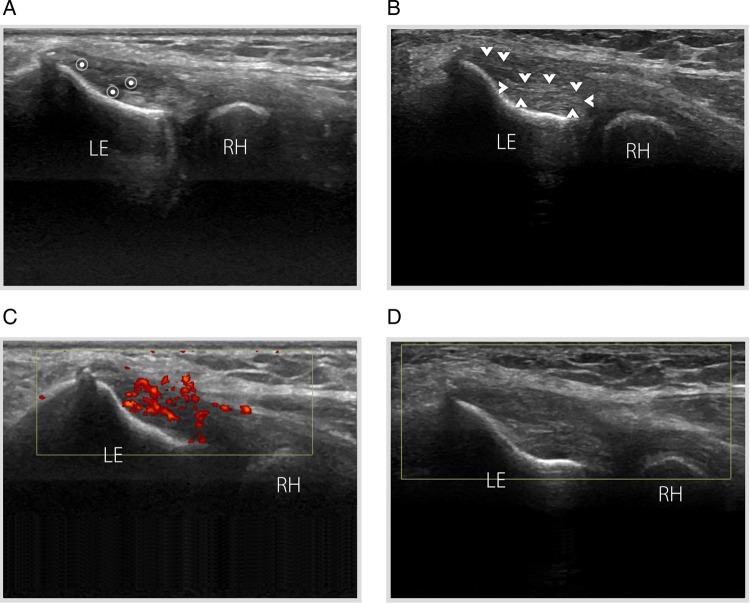
UltrasoundLongitudinal elbow ultrasound: irregular structure and hypoechoic focus of the extensor carpi radialis tendon, with hypervascularity on power Doppler.
Source : Valera-Garrido et al., Acupuncture in medicine, 2014, figure 4 · CC BY-NC
Which questions should you ask to understand the patient and their history?
The history is the cornerstone of diagnosis. According to the Clinical Practice Guidelines of Lucado et al. (JOSPT 2022)¹, several domains must be explored systematically:- Location and description : the pain must be precisely localised to the lateral epicondyle. Diffuse pain that sits more distally (4-5 cm below the epicondyle, over the supinator muscle) should raise the suspicion of radial tunnel syndrome (RTS)².
- Triggering mechanism : an insidious onset over several weeks is typical. A sudden onset after trauma points to another cause³.
- Aggravating factors : specifically look for movements involving gripping (shaking hands, carrying a bag),resisted wrist extension (screwing, hammering) and loaded supination¹.
- Occupational and leisure history : a recent change of job, an increase in activity volume, racquet sports, playing a stringed instrument: the strain index is the main risk factor⁴.
- Neurological symptoms : paraesthesia, reduced sensation or motor weakness must redirect you towards a neurological diagnosis (RTS, C6 radiculopathy, thoracic outlet syndrome)².
Which clinical tests should you perform, and which other conditions must be ruled out?
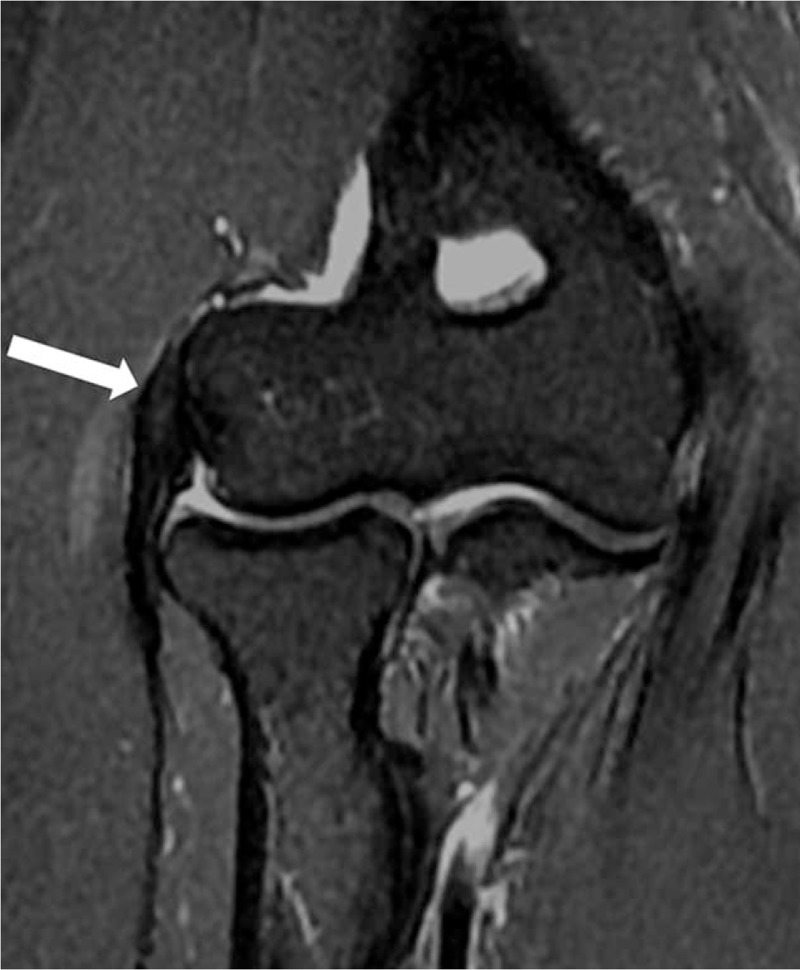
MRICoronal T2 fat-suppressed elbow MRI: early focal hyperintensity of the common extensor tendon at its insertion on the lateral epicondyle, arrow.
Source : Qi et al., Medicine, 2016, figure 1 · CC BY
🧪 Clinical provocation tests: diagnostic properties (Saroja 2014)
Sensitivity and specificity of the 3 classic tests in n=30, with ultrasonography as the reference standard
Source: Saroja G, Leo PJM, Linu V. Diagnostic accuracy of provocative tests in lateral epicondylitis. Int J Physiother Res. 2014;2(6):815-823. Caveat : a very low-powered study (n=30), with the specificity of Cozen and Maudsley at 0 %, most likely reflecting a biased sample. To be read with caution. The Lucado 2022 CPG recommend the combined battery of tests rather than any single test.
- Cozen test : resisted wrist extension with the elbow flexed. Positive = pain reproduced at the epicondyle. The pivotal test of the classic examination¹.
- Maudsley test (3rd finger) : resisted extension of the middle finger. Particularly specific to the ECRB⁶.
- Mill test : passive stretch of the extensors (wrist flexion, pronation, elbow extension). High specificity but lower sensitivity⁶.
- Grip-strength test (Jamar dynamometer) : pain on gripping and loss of strength on the affected side (typically 20-40 % against the healthy side). A sensitive functional test, useful for follow-up⁵.
🚩 Red flags for the lateral elbow
- Unexplained mechanical night pain, fever, night sweats → suspected tumour or infection
- Firm, progressive swelling, a palpable mass → work-up for malignancy (sarcoma, bone tumour)
- Progressive motor deficit (wrist/fingers), wasting of brachioradialis or of the extensors → established nerve compression (PIN, brachial plexus)
- Dermatomal sensory loss (dorsum of the hand, 1st web space) → C6-C7 radiculopathy
- Vascular symptoms (pallor, cyanosis on exertion, claudication) → thoracic outlet syndrome
- Complete failure after 3 months of well-conducted treatment → reconsider the diagnosis, MRI (Blonna 2025: 40.7 % misdiagnosis)⁷
⚠️ Any red flag or diagnostic doubt → medical referral and advanced imaging (MRI > ultrasound for PIN/plica/LCL).
- Young age (< 35 years)
- A history of trauma to the elbow
- Restricted range of joint movement
- Swelling / effusion
- Cozen test negative
- A history of multiple corticosteroid injections without lasting benefit
- Radial tunnel syndrome (RTS / PIN compression) : 18.8 %. Pain typically 4-5 cm more distal, made worse by resisted supination, with tenderness on palpation of the supinator².
- Humeroradial synovial plica : 8-10 %. Pain with catching or clicking, relieved by repeated flexion-extension, MRI = the reference investigation⁹.
- Posterolateral rotatory instability (PLRI) : 5-8 %. Often post-traumatic or following repeated injections, with a positive lateral pivot shift test¹⁰.
- C6-C7 cervical radiculopathy : 3-5 %. Wainner cluster (Spurling + distraction + ULTT1 + rotation < 60°): 3 of 4 positive gives LR+ ~6.1¹¹.
- Radiohumeral osteoarthritis, osteochondritis dissecans: rarer, in specific populations¹².
Should epicondylalgia be classified, and what is gained by doing so?
The most clinically useful classification is the Cook & Purdam continuum (2009, revised 2016)¹³, which guides the choice of exercise:- Reactive phase (acute, recent overuse): isometric work for pain relief first.
- Dysrepair phase : a gradual transition to isotonic work with pain monitoring.
- Degenerative phase (chronic, > 3 months): eccentric or heavy-slow resistance (HSR) for tendon remodelling¹⁴.
- Diagnosis is clinical : history + a battery of tests (Cozen + Maudsley + grip strength), with no first-line imaging (Lucado 2022 level B).
- The differential diagnosis must be systematic : 40.7 % of patients labelled “epicondylitis” in fact have another condition (Blonna 2025).
- The main mimics: radial tunnel (PIN), humeroradial plica, posterolateral instability, C6 radiculopathy.
- Red flags (night pain, a mass, motor deficit, failure > 3 months) → medical referral + MRI.
- Classification by the Cook & Purdam continuum guides the choice of exercise (isometric when acute / progressive loading when chronic).
References
- Lucado AM, Day JM, Vincent JI, MacDermid JC, Fedorczyk J, Grewal R, Martin RL. Lateral Elbow Pain and Muscle Function Impairments: Clinical Practice Guidelines (CPG). J Orthop Sports Phys Ther. 2022;52(12):CPG1-CPG111. PMID 36453071.
- Naam NH, Nemani S. Radial tunnel syndrome. Orthop Clin North Am. 2012;43(4):529-536. PMID 23026469.
- Ahmad Z, Siddiqui N, Malik SS, Abdus-Samee M, Tytherleigh-Strong G, Rushton N. Lateral epicondylitis: a review of pathology and management. Bone Joint J. 2013;95-B(9):1158-1164. PMID 23997125.
- Bretschneider SF, Los FS, Eygendaal D, Kuijer PPFM, van der Molen HF. Work-relatedness of lateral epicondylitis: Systematic review including meta-analysis and GRADE. Am J Ind Med. 2022;65(1):41-50. PMID 34674287.
- Bisset LM, Vicenzino B. Physiotherapy management of lateral epicondylalgia. J Physiother. 2015;61(4):174-181. PMID 26361816.
- Saroja G, Leo PJM, Linu V. Diagnostic accuracy of provocative tests in lateral epicondylitis. Int J Physiother Res. 2014;2(6):815-823. (Caveat: n=30, low power).
- Blonna D, Hoxha N, Greco V, Rivoira C, Bonasia DE, Rossi R. When Lateral Epicondylitis Is Not Lateral Epicondylitis: Analysis of the Risk Factors for the Misdiagnosis of Lateral Elbow Pain. Am J Sports Med. 2025;53(5):1195-1201. doi:10.1177/03635465251319545.
- Bonczar M, Ostrowski P, Dziedzic M, et al. Evaluation of lateral epicondylopathy, posterior interosseous nerve compression, and plica syndrome as co-existing causes of chronic tennis elbow. Int Orthop. 2023;47(7):1787-1795. PMID 37071147.
- Lee HI, Koh KH, Kim JP, et al. Prominent synovial plicae in radiocapitellar joints as a potential cause of lateral elbow pain: clinico-radiologic correlation. J Shoulder Elbow Surg. 2018;27(8):1349-1356. PMID 30016689.
- Camp CL, Smith J, O'Driscoll SW. Posterolateral rotatory instability of the elbow: part I, mechanism of injury and the posterolateral rotatory drawer test. Arthrosc Tech. 2017;6(2):e401-e405. PMID 28580260.
- Wainner RS, Fritz JM, Irrgang JJ, Boninger ML, Delitto A, Allison S. Reliability and diagnostic accuracy of the clinical examination and patient self-report measures for cervical radiculopathy. Spine. 2003;28(1):52-62. PMID 12544957.
- Vaquero-Picado A, Barco R, Antuña SA. Lateral epicondylitis of the elbow. EFORT Open Rev. 2017;1(11):391-397. PMC 5367546.
- Cook JL, Purdam CR. Is tendon pathology a continuum? Br J Sports Med. 2009;43(6):409-416. PMID 18812414.
- Beyer R, Kongsgaard M, Hougs Kjær B, et al. Heavy Slow Resistance Versus Eccentric Training as Treatment for Achilles Tendinopathy: A Randomized Controlled Trial. Am J Sports Med. 2015;43(7):1704-1711. PMID 26018970.
- Coombes BK, Bisset L, Vicenzino B. A new integrative model of lateral epicondylalgia. Br J Sports Med. 2009;43(4):252-258. PMID 19050004.
Which treatment strategies are most effective for lateral epicondylalgia (“tennis elbow”)?
Where do you start? What is the recommended hierarchy of interventions?
The Clinical Practice Guidelines JOSPT 2022 (Lucado et al.)¹ recommend a stepped approach, with education and progressive exercise in the front line. 🎾| Modality | Level of evidence (2022 CPG) | Expected effect | Optimal timing |
|---|---|---|---|
| Education + load management | A: high | Autonomy + adherence + less kinesiophobia | Any phase (1st line) |
| Exercise (iso/ecc/HSR) | A: high | ↓ pain, ↑ strength, ↑ tendon capacity | From the acute phase (iso), then progressive |
| Manual therapy (MWM, mobilisations) | B: moderate | Short-term relief, makes exercise easier | Adjunct, above all in the painful phase |
| Shockwave therapy (ESWT) | B: moderate | Pain relief in chronic cases > 3 months | 2nd line if exercise fails after 3 months |
| Counterforce braces | B: moderate | Immediate pain relief during activities | Functional adjunct, short term |
| Dry needling / acupuncture | C: low | Variable short-term effect | Adjunct if other modalities fall short |
| Therapeutic ultrasound | C: low | No benefit shown vs placebo | Not recommended routinely |
| Corticosteroid injection | C: high risk | Relief at 6 weeks but 72 % recurrence | Very specific cases, with patient information |
| PRP, autologous blood | C: low | No robust superiority vs placebo | To be discussed case by case |
| Wait-and-see | B: moderate | ~80 % success at 52 weeks (Smidt 2002) | An option if symptoms are minor |
What is the place of exercise, and is any one approach superior?
The meta-analysis Karanasios et al. 2021 (BJSM, 30 RCTs, n=2123)² is the reference: exercise interventions produce a greater effect than passive interventions on pain and function, although the effect size remains moderate. The key conclusion: no one type of contraction has shown robust superiority over the others.- Isometric : rapid pain relief, ideal in the irritable phase. 5 × 45 sec at 70 % of maximal voluntary contraction (Coombes 2015)³.
- Eccentric : the historical “gold standard”. Peterson 2014 (Clin Rehab, n=120 randomised)⁴ showed eccentric work to be superior to concentric at 3 months (about 10 % more responders for pain reduction).
- Heavy-Slow Resistance (HSR) : 3 sets of 6-15 repetitions, tempo 3 sec concentric / 3 sec eccentric, with increasing load. Validated on the Achilles tendon (Beyer 2015 AJSM)⁵ and extended to epicondylalgia with encouraging results¹.
- Kinetic chain strengthening : bringing in the shoulder, the scapula and the trunk. Lucado 2022 recommends systematically assessing the rotator cuff and the scapular stabilisers¹.
💪 Typical progressive exercise programme (based on Lucado 2022 + Stasinopoulos 2005)
A 12-week progression with transition criteria
Practical synthesis based on Lucado AM et al. JOSPT 2022; Karanasios S et al. BJSM 2021; Stasinopoulos D et al. BJSM 2005; Beyer R et al. AJSM 2015. Caveat : the durations are indicative and should be adapted to individual tolerance.
Manual therapies and technologies: how effective are they really?
- Manual therapy (Mulligan MWM, joint mobilisations) : the review by Vicenzino, Cleland & Bisset (2007)⁶ established an immediate pain-relieving effect and an increase in pain-free grip strength. The effect is limited in time (short term), which makes it ideal as an adjunct to make engagement with exercise easier¹.
- Shockwave therapy (ESWT) : the meta-analysis Yao 2020 (BioMed Res Int)⁷ confirms efficacy on pain and on the PRTEE in chronic forms (> 3 months); a validated option if exercise alone proves insufficient after 12 weeks.
- Counterforce braces (epicondyle band) : an immediate functional pain-relieving effect (during provocative activities), with moderate evidence in the long term¹.
- Therapeutic ultrasound : weak to conflicting evidence; not recommended routinely¹.
- Corticosteroid injections : Bisset 2006 (BMJ, n=198)⁸ showed superiority at 6 weeks (78 % success vs 27 % wait-and-see), but a recurrence rate of 72 % (47/65 patients) and poorer outcomes at 52 weeks. Coombes 2013 JAMA⁹ confirmed this: worse outcomes at 1 year with injection ± physiotherapy versus placebo ± physiotherapy. Not advised as routine.
- PRP injections (platelet-rich plasma) : no robust superiority shown vs placebo or physiotherapy; high cost¹⁰.
Beyond the physical: how do you educate the patient and address psychological factors?
The meta-analysis Mallows et al. 2017 (BJSM, n=1391, 13 studies)¹¹ showed that kinesiophobia, catastrophising and depressive symptoms are robust predictors of chronicity in tendinopathy (pooled OR 1.3-2.9). The 2022 CPG recommend (level C, expert opinion)¹:- Assess fear of movement (the TSK scale or targeted questions).
- Assess catastrophising (PCS) if symptoms persist beyond 6 weeks.
- Build in explicit education: “pain does not mean damage”, “the tendon needs progressive loading in order to heal”.
- Refer to a cognitive-behavioural psychologist if yellow flags are severe.
- 🥇 First line : education + load management + progressive exercise (Lucado 2022 level A, Karanasios 2021 meta-analysis of 30 RCTs).
- 💪 No one type of exercise is superior : isometric, eccentric and HSR are equivalent, individualised progression is the key.
- 🤝 Manual therapy (MWM, mobilisations) : useful as a short-term pain-relieving adjunct to make engagement with exercise easier.
- 📈 ESWT : a validated option for chronic cases > 3 months (Yao 2020 MA).
- ❌ Corticosteroids : 78 % success at 6 weeks but 72 % recurrence and poorer outcomes at 1 year (Bisset 2006 BMJ, Coombes 2013 JAMA).
- 🧠 Psychosocial factors : kinesiophobia and catastrophising predict chronicity (Mallows 2017, OR 1.3-2.9). Identify them and address them.
References
- Lucado AM, Day JM, Vincent JI, MacDermid JC, Fedorczyk J, Grewal R, Martin RL. Lateral Elbow Pain and Muscle Function Impairments: CPG. J Orthop Sports Phys Ther. 2022;52(12):CPG1-CPG111. PMID 36453071.
- Karanasios S, Korakakis V, Whiteley R, et al. Exercise interventions in lateral elbow tendinopathy have better outcomes than passive interventions, but the effects are small: a systematic review and meta-analysis of 2123 subjects in 30 trials. Br J Sports Med. 2021;55(9):477-485. PMID 33148599.
- Coombes BK, Bisset L, Vicenzino B. A new integrative model of lateral epicondylalgia. Br J Sports Med. 2009;43(4):252-258. PMID 19050004.
- Peterson M, Butler S, Eriksson M, Svärdsudd K. A randomized controlled trial of eccentric vs. concentric graded exercise in chronic tennis elbow (lateral elbow tendinopathy). Clin Rehabil. 2014;28(9):862-872. PMID 24634444.
- Beyer R, Kongsgaard M, Hougs Kjær B, et al. Heavy Slow Resistance Versus Eccentric Training as Treatment for Achilles Tendinopathy: A Randomized Controlled Trial. Am J Sports Med. 2015;43(7):1704-1711. PMID 26018970.
- Vicenzino B, Cleland JA, Bisset L. Joint manipulation in the management of lateral epicondylalgia: a clinical commentary. J Man Manip Ther. 2007;15(1):50-56. PMID 19066643.
- Yao G, Chen J, Duan Y, Chen X. Efficacy of Extracorporeal Shock Wave Therapy for Lateral Epicondylitis: A Systematic Review and Meta-Analysis. Biomed Res Int. 2020;2020:2064781. PMC 7106907.
- Bisset L, Beller E, Jull G, Brooks P, Darnell R, Vicenzino B. Mobilisation with movement and exercise, corticosteroid injection, or wait and see for tennis elbow: randomised trial. BMJ. 2006;333(7575):939. PMID 17012266.
- Coombes BK, Bisset L, Brooks P, Khan A, Vicenzino B. Effect of corticosteroid injection, physiotherapy, or both on clinical outcomes in patients with unilateral lateral epicondylalgia: a randomized controlled trial. JAMA. 2013;309(5):461-469. PMID 23385272.
- Coombes BK, Bisset L, Vicenzino B. Efficacy and safety of corticosteroid injections and other injections for management of tendinopathy: a systematic review of randomised controlled trials. Lancet. 2010;376(9754):1751-1767. PMID 20970844.
- Mallows A, Debenham J, Walker T, Littlewood C. Association of psychological variables and outcome in tendinopathy: a systematic review. Br J Sports Med. 2017;51(9):743-748. PMID 27852585.
- Cullinane FL, Boocock MG, Trevelyan FC. Is eccentric exercise an effective treatment for lateral epicondylitis? A systematic review. Clin Rehabil. 2014;28(1):3-19. PMID 23881334.
- Stasinopoulos D, Stasinopoulou K, Johnson MI. An exercise programme for the management of lateral elbow tendinopathy. Br J Sports Med. 2005;39(12):944-947. PMID 16306504.
How do you secure a lasting recovery and prevent recurrence of lateral epicondylalgia (“tennis elbow”)?
How do you make the patient an active partner in their own recovery through self-management?
Managing your own condition (self-management) rests on three complementary pillars:- Therapeutic education : pain does not mean tissue damage, it means the load capacity of the tendon has temporarily been exceeded³. Reframing it this way dismantles kinesiophobia⁴ and supports adherence.
- Pain monitoring : the Silbernagel rule (2007 AJSM)⁵, first validated on the Achilles tendon and then extended to upper limb tendinopathy, allows pain during exercise as long as it stays < 5/10 on the NRS and returns to its baseline value the next morning.
- Home exercise programme : lasting benefit depends on regularity: a month after the programme stops, tendon capacity declines quickly⁶.
📐 The Silbernagel pain-monitoring rule (2007) applied to epicondylalgia
A decision algorithm that lets the patient adjust their own exercise
Adapted from: Silbernagel KG, Thomeé R, Eriksson BI, Karlsson J. Continued sports activity, using a pain-monitoring model, during rehabilitation in patients with Achilles tendinopathy. Am J Sports Med. 2007;35(6):897-906. PMID 17307888. Applied to epicondylalgia following Lucado 2022 JOSPT.
When and how do you plan a safe return to sport and to everyday activities?
The return to sport (RTS) or to demanding work activities must be based on functional criteria, not on a calendar (Bern consensus, Ardern 2016)⁷. 🎯- Pain control : ≤ 2/10 on the NRS during functional activities and high-level exercises.
- Grip strength : ≥ 90-95 % of the unaffected contralateral side (Jamar dynamometer, 3 trials, standardised position).
- Wrist extensor strength : ≥ 90 % of the healthy side, pain-free.
- Specific functional tests : for a tennis player, forehand and backhand strokes at increasing intensity without pain; for a manual worker, handling tools under real conditions⁸.
- Psychological stability : a TSK score < 17/52 (low kinesiophobia), with confidence regained in using the limb⁹.
- ✅ Self-management is the cornerstone of the long term: education, monitoring, continued exercise.
- 📐 Silbernagel rule : pain tolerated at < 5/10 during exercise, back to baseline at 24 h.
- 🏋️ Strengthening must carry on after the symptoms have gone to maintain tendon capacity.
- 📊 A return to activities based on criteria : strength ≥ 90 %, pain ≤ 2/10, function restored (Ardern 2016).
- ⚖️ ACWR load management ≤ 1.3 to avoid damaging spikes (Gabbett 2016).
References
- Lucado AM, Day JM, Vincent JI, MacDermid JC, Fedorczyk J, Grewal R, Martin RL. Lateral Elbow Pain and Muscle Function Impairments: CPG. J Orthop Sports Phys Ther. 2022;52(12):CPG1-CPG111. PMID 36453071.
- Mallows A, Debenham J, Walker T, Littlewood C. Association of psychological variables and outcome in tendinopathy: a systematic review. Br J Sports Med. 2017;51(9):743-748. PMID 27852585.
- Cook JL, Purdam CR. Is tendon pathology a continuum? Br J Sports Med. 2009;43(6):409-416. PMID 18812414.
- Coombes BK, Bisset L, Vicenzino B. A new integrative model of lateral epicondylalgia. Br J Sports Med. 2009;43(4):252-258. PMID 19050004.
- Silbernagel KG, Thomeé R, Eriksson BI, Karlsson J. Continued sports activity, using a pain-monitoring model, during rehabilitation in patients with Achilles tendinopathy: a randomized controlled study. Am J Sports Med. 2007;35(6):897-906. PMID 17307888.
- Karanasios S, Korakakis V, Whiteley R, et al. Exercise interventions in lateral elbow tendinopathy have better outcomes than passive interventions, but the effects are small: a systematic review and meta-analysis of 2123 subjects in 30 trials. Br J Sports Med. 2021;55(9):477-485. PMID 33148599.
- Ardern CL, Glasgow P, Schneiders A, et al. 2016 Consensus statement on return to sport from the First World Congress in Sports Physical Therapy, Bern. Br J Sports Med. 2016;50(14):853-864. PMID 27226389.
- Bisset LM, Vicenzino B. Physiotherapy management of lateral epicondylalgia. J Physiother. 2015;61(4):174-181. PMID 26361816.
- Chester R, Jerosch-Herold C, Lewis J, Shepstone L. Psychological factors are associated with the outcome of physiotherapy for people with shoulder pain: a multicentre longitudinal cohort study. Br J Sports Med. 2018;52(4):269-275. PMID 27445360.
- Gabbett TJ. The training-injury prevention paradox: should athletes be training smarter and harder? Br J Sports Med. 2016;50(5):273-280. PMID 26758673.
- Smidt N, van der Windt DA, Assendelft WJ, et al. Corticosteroid injections, physiotherapy, or a wait-and-see policy for lateral epicondylitis: a randomised controlled trial. Lancet. 2002;359(9307):657-662. PMID 11879861.
- Bisset L, Beller E, Jull G, et al. Mobilisation with movement and exercise, corticosteroid injection, or wait and see for tennis elbow: randomised trial. BMJ. 2006;333(7575):939. PMID 17012266.
- Coombes BK, Bisset L, Brooks P, Khan A, Vicenzino B. Effect of corticosteroid injection, physiotherapy, or both on clinical outcomes in patients with unilateral lateral epicondylalgia: a randomized controlled trial. JAMA. 2013;309(5):461-469. PMID 23385272.
What do real clinical cases teach us about lateral epicondylalgia (“tennis elbow”)?
A classic case analysed: from assessment to resolution
The typical case of epicondylalgia follows a reproducible course. The original programme validated by Stasinopoulos, Stasinopoulou & Johnson (BJSM 2005, RCT n=75)¹ illustrates that journey: a 45-year-old manual or office worker with pain building up over 6 to 8 weeks, made worse by gripping, a positive Cozen test, and grip strength at 60 % of the healthy side. Typical management over 12 weeks :- W0-W2 : education (Lucado 2022), stopping the identified provocative activities, isometric wrist extension exercises (5×45 sec, 3-4 times a day). Pain relief expected within 3 to 7 days³.
- S3-S6 : transition to eccentric exercises (the Stasinopoulos programme)¹: 3 sets of 15 repetitions, load 1-3 kg, twice a day. Gradual reintroduction of activities. Add MWM if pain relief plateaus⁴.
- W7-W10 : transition to HSR (Beyer 2015)⁵: 3 sets of 10-15 repetitions, tempo 3 sec concentric / 3 sec eccentric, increasing load, 2-3 times a week. Rotator cuff + scapular strengthening.
- W11-W12 : functional exercises specific to the work or sports task. Validated RTS criteria (strength ≥ 90 %, pain ≤ 2/10).
The diagnostic challenge: when epicondylalgia mimics another condition
The large prospective study by Blonna et al. 2025 (Am J Sports Med, n=294 patients referred with suspected chronic epicondylitis)⁶ is the contemporary reference on diagnostic error. ⚠️🧩 The real diagnoses in 294 patients labelled “chronic epicondylitis” (Blonna 2025)
Nearly 41 % misdiagnosis or co-existence: the predictive factors can be identified clinically
Source: Blonna D, Hoxha N, Greco V, et al. Am J Sports Med. 2025;53(5):1195-1201. doi:10.1177/03635465251319545. A prospective study of 294 patients referred for surgery for chronic epicondylitis, with systematic assessment including imaging.
- Any patient with ≥ 1 risk factor for a wrong diagnosis (Blonna 2025) must be reassessed in depth.
- MRI is the reference investigation whenever there is doubt (more sensitive than ultrasound for the PIN, the plica and the LCL).
- A surgical referral is legitimate after 6 months of failure of well-conducted, structured conservative treatment.
A complex case study: chronic and sensitised
Chronic cases (> 6 months) frequently carry several complicating factors⁸:- Cold thermal hyperalgesia : Coombes et al. showed (Coombes 2012, n=120 patients with unilateral epicondylalgia)⁹ that cold hyperalgesia singles out patients with severe symptoms and is a marker of poor prognosis at 1 year. It suggests bilateral central sensitisation and points towards a multimodal approach that includes pain education.
- Catastrophising + kinesiophobia : Mallows 2017 (BJSM, n=1391)¹⁰ confirms their negative impact on outcome. A cognitive-behavioural referral may be needed.
- Failure of multiple injections : Coombes 2013 (JAMA, n=165)¹¹: repeating injections significantly worsens the 1-year prognosis, with tendon deterioration visible on ultrasound.
📐 The GRADE / Oxford CEBM pyramid: where does the evidence on lateral epicondylalgia sit?
Strength of evidence decreasing from the top (meta-analyses) to the bottom (case reports)
GRADE / Oxford CEBM hierarchy. The length of the coloured bar on the right illustrates the relative strength of evidence. Practical implication: when an appealing clinical case and a meta-analysis diverge, the decision must follow the meta-analysis. Clinical cases generate hypotheses, flag rare presentations or illustrate reasoning; they never demonstrate efficacy.
- The typical case (Stasinopoulos 2005, n=75): a 45-year-old manual or office worker, pain building over 6-8 weeks, a 12-week exercise programme progressing isometric → eccentric → HSR → functional.
- 40.7 % of patients diagnosed with “chronic epicondylitis” in fact have another condition or a co-existing one (Blonna 2025).
- Main alternative diagnoses: radial tunnel syndrome (PIN) 18.8 %, humeroradial plica, posterolateral instability (LCL), radiohumeral osteoarthritis.
- Any failure at 3 to 6 months of well-conducted treatment calls for a diagnostic reassessment + MRI.
- Chronic, sensitised cases (cold hyperalgesia, kinesiophobia, catastrophising) call for a biopsychosocial approach that includes pain education.
- ⚠️ A case report = level 5. It illustrates, it never demonstrates . Clinical decisions follow the meta-analyses (level 1a).
References
- Stasinopoulos D, Stasinopoulou K, Johnson MI. An exercise programme for the management of lateral elbow tendinopathy. Br J Sports Med. 2005;39(12):944-947. PMID 16306504.
- Lucado AM, Day JM, Vincent JI, et al. Lateral Elbow Pain and Muscle Function Impairments: CPG. J Orthop Sports Phys Ther. 2022;52(12):CPG1-CPG111. PMID 36453071.
- Coombes BK, Bisset L, Vicenzino B. A new integrative model of lateral epicondylalgia. Br J Sports Med. 2009;43(4):252-258. PMID 19050004.
- Vicenzino B, Cleland JA, Bisset L. Joint manipulation in the management of lateral epicondylalgia: a clinical commentary. J Man Manip Ther. 2007;15(1):50-56. PMID 19066643.
- Beyer R, Kongsgaard M, Hougs Kjær B, et al. Heavy Slow Resistance Versus Eccentric Training as Treatment for Achilles Tendinopathy: A Randomized Controlled Trial. Am J Sports Med. 2015;43(7):1704-1711. PMID 26018970.
- Blonna D, Hoxha N, Greco V, Rivoira C, Bonasia DE, Rossi R. When Lateral Epicondylitis Is Not Lateral Epicondylitis: Analysis of the Risk Factors for the Misdiagnosis of Lateral Elbow Pain. Am J Sports Med. 2025;53(5):1195-1201. doi:10.1177/03635465251319545.
- Bonczar M, Ostrowski P, Dziedzic M, et al. Evaluation of lateral epicondylopathy, posterior interosseous nerve compression, and plica syndrome as co-existing causes of chronic tennis elbow. Int Orthop. 2023;47(7):1787-1795. PMID 37071147.
- Cook JL, Purdam CR. Is tendon pathology a continuum? A pathology model to explain the clinical presentation of load-induced tendinopathy. Br J Sports Med. 2009;43(6):409-416. PMID 18812414.
- Coombes BK, Bisset L, Vicenzino B. Thermal hyperalgesia distinguishes those with severe pain and disability in unilateral lateral epicondylalgia. Clin J Pain. 2012;28(7):595-601. PMID 22699135.
- Mallows A, Debenham J, Walker T, Littlewood C. Association of psychological variables and outcome in tendinopathy: a systematic review. Br J Sports Med. 2017;51(9):743-748. PMID 27852585.
- Coombes BK, Bisset L, Brooks P, Khan A, Vicenzino B. Effect of corticosteroid injection, physiotherapy, or both on clinical outcomes in patients with unilateral lateral epicondylalgia: a randomized controlled trial. JAMA. 2013;309(5):461-469. PMID 23385272.
- Karanasios S, Korakakis V, Whiteley R, et al. Exercise interventions in lateral elbow tendinopathy have better outcomes than passive interventions, but the effects are small: a systematic review and meta-analysis of 2123 subjects in 30 trials. Br J Sports Med. 2021;55(9):477-485. PMID 33148599.
- Kraushaar BS, Nirschl RP. Tendinosis of the elbow (tennis elbow). J Bone Joint Surg Am. 1999;81(2):259-278. PMID 10073590.
How do you apply these recommendations concretely in your practice?
When should you refer on, and to which other health professionals?
The role of the physiotherapist in advanced practice has widened, which brings greater responsibility for triaging patients¹. Identifying the “red flags” is the first, non-negotiable step: these indicators may signal serious disease requiring prompt medical referral, according to the international IFOMPT framework (Finucane et al. 2020, JOSPT)².🚩 Red flags specific to the lateral elbow
- Unexplained mechanical night pain, night sweats, persistent fever → suspected deep infection or neoplasia
- Firm, progressive swelling, a palpable mass, local warmth → oncology work-up (soft tissue sarcoma, bone tumour)
- Progressive motor deficit : marked weakness of the wrist or finger extensors, visible muscle wasting → suspected established nerve compression (severe PIN/RTS, radiculopathy)
- Dermatomal sensory loss dorsum of the hand, 1st web space → C6-C7 radiculopathy: the Wainner cluster is indicated
- History of cancer + persistent localised pain → MRI as a matter of course to rule out bone metastasis
- Unexplained weight loss > 5 % in 6 months + persistent pain → systemic work-up
- Recent history of trauma with disproportionate pain + instability → occult fracture, posterolateral instability (PLRI)
- Complete failure after 3 to 6 months of well-conducted, structured conservative treatment → 40.7 % misdiagnosis (Blonna 2025); MRI is essential
⚠️ Any red flag → prompt medical referral (GP, orthopaedic or hand surgeon, rheumatologist, even oncologist depending on the context).
- Occupational physician / ergonomist : workstation analysis, adjustments (tools, postures), collective secondary prevention.
- Psychologist (CBT) or chronic pain therapist : if yellow flags persist (severe kinesiophobia, catastrophising, depression).
- Hand surgeon / orthopaedic surgeon : failure at 6 months, suspicion of an alternative condition (PIN, plica, PLRI), discussion of the options (ECRB release, denervation, arthroscopy).
- Sports physician : optimising the return to activity, movement analysis, bringing in the ACWR.
How do you measure outcomes and overcome the barriers to implementation?
Standardised outcome measurement is essential to make management objective and to support shared decision-making. 📈 Lucado 2022 systematically recommends (level A for the PRTEE)⁵:- PRTEE (Patient-Rated Tennis Elbow Evaluation) : a 15-item questionnaire (5 pain + 10 function), score 0-100, MCID 11-37 points depending on initial severity. It is the international reference tool⁶.
- Numerical Rating Scale (NRS) for pain at rest, on activity and at night.
- Grip strength with the Jamar dynamometer (3 trials, standardised position), compared with the healthy side and with baseline.
- Patient-Specific Functional Scale (PSFS) : to personalise goals and track progress on the activities that matter to the patient.
- Psychosocial scales where indicated : TSK (kinesiophobia), PCS (catastrophising), HADS (anxiety/depression).
- 🚩 Red flags (the IFOMPT framework, Finucane 2020): prompt medical referral for unexplained night pain, a mass, a progressive motor deficit, or complete failure at 6 months.
- 🟡 Yellow flags (kinesiophobia, catastrophising) predict chronicity (Mallows 2017): to be assessed and addressed systematically.
- 📋 PRTEE is the reference PROM (15 items, MCID 11-37 points): level A in the Lucado 2022 CPG.
- 🤝 Interprofessional collaboration : occupational physician, hand surgeon, CBT psychologist depending on the profile.
- 📊 Objective outcome measurement (PRTEE, strength, NRS) is what makes informed shared decision-making possible.
References
- Lucado AM, Day JM, Vincent JI, MacDermid JC, Fedorczyk J, Grewal R, Martin RL. Lateral Elbow Pain and Muscle Function Impairments: CPG. J Orthop Sports Phys Ther. 2022;52(12):CPG1-CPG111. PMID 36453071.
- Finucane LM, Downie A, Mercer C, et al. International Framework for Red Flags for Potential Serious Spinal Pathologies. J Orthop Sports Phys Ther. 2020;50(7):350-372. PMID 32438853.
- Mallows A, Debenham J, Walker T, Littlewood C. Association of psychological variables and outcome in tendinopathy: a systematic review. Br J Sports Med. 2017;51(9):743-748. PMID 27852585.
- Chester R, Jerosch-Herold C, Lewis J, Shepstone L. Psychological factors are associated with the outcome of physiotherapy for people with shoulder pain: a multicentre longitudinal cohort study. Br J Sports Med. 2018;52(4):269-275. PMID 27445360.
- Newcomer KL, Martinez-Silvestrini JA, Schaefer MP, et al. Sensitivity of the Patient-rated Forearm Evaluation Questionnaire in lateral epicondylitis. J Hand Ther. 2005;18(4):400-406. PMID 16271686.
- MacDermid J. Update: the patient-rated forearm evaluation questionnaire is now the patient-rated tennis elbow evaluation. J Hand Ther. 2005;18(4):407-410. PMID 16271690.
- Da Silva GS, Sarquis LMM, Cabral DLV, et al. Evidence-based practice: a survey regarding behavior, knowledge, skills, resources, opinions and perceived barriers of Brazilian physical therapists from São Paulo state. Braz J Phys Ther. 2015;19(4):294-303. PMID 26443977.
- Bisset LM, Vicenzino B. Physiotherapy management of lateral epicondylalgia. J Physiother. 2015;61(4):174-181. PMID 26361816.
- Coombes BK, Bisset L, Vicenzino B. Thermal hyperalgesia distinguishes those with severe pain and disability in unilateral lateral epicondylalgia. Clin J Pain. 2012;28(7):595-601. PMID 22699135.
- Coombes BK, Bisset L, Vicenzino B. Efficacy and safety of corticosteroid injections and other injections for management of tendinopathy: a systematic review of randomised controlled trials. Lancet. 2010;376(9754):1751-1767. PMID 20970844.
- Karanasios S, Korakakis V, Whiteley R, et al. Exercise interventions in lateral elbow tendinopathy have better outcomes than passive interventions, but the effects are small: a systematic review and meta-analysis of 2123 subjects in 30 trials. Br J Sports Med. 2021;55(9):477-485. PMID 33148599.
- Ardern CL, Glasgow P, Schneiders A, et al. 2016 Consensus statement on return to sport from the First World Congress in Sports Physical Therapy, Bern. Br J Sports Med. 2016;50(14):853-864. PMID 27226389.
And after this read?
This article is part of a collection of evidence-based clinical syntheses. A question, some feedback, a correction to suggest? Contact us directly through the WhatsApp button at the bottom right of the screen.