




In brief
Non-specific neck pain (or common neck pain) is pain in the posterior or lateral cervical region with no identifiable pathological cause; it is a diagnosis of exclusion, made after ruling out red flags (fracture, tumour, infection, radiculopathy, myelopathy). Its course is often recurrent or persistent. The diagnostic priority is screening for red flags and for psychosocial yellow flags, which predict chronicity; imaging is not indicated in their absence. First-line management is multimodal: education, therapeutic exercise and manual therapy as an adjunct. It is the 4th leading cause of disability worldwide, and 50 to 75% of people still have symptoms at one year.
Clinical synthesis based on Cochrane meta-analyses and the most recent international clinical practice guidelines: Blanpied JOSPT 2017, Bier KNGF 2018, Corp 2021 and GBD 2021 / Lancet Rheumatology 2024 data.
Clinical synthesis
- Non-specific neck pain (NSNP) is a diagnosis of exclusion, with no identifiable serious pathology. It is the 4th leading global cause of years lived with disability (GBD 2021).
- Age-standardised global prevalence ≈ 27-28 %, female/male ratio 1.31, peaking between 45 and 74 years. The course is often recurrent: 50–75 % with persistent symptoms at 1 year.
- Risk factors are biopsychosocial: female sex, previous episodes, stress and depression, prolonged static posture, trauma (whiplash), low self-efficacy.
- The pathophysiology combines motor control impairments of the deep flexors, fatty infiltration of the multifidus in chronic patients, and central sensitisation in persistent presentations.
- The diagnostic priority is to screen for red flags (Finucane 2020). Imaging is not indicated first line in their absence.
- The assessment must quantify disability (Neck Disability Index, Vernon-Mior 1991) and look for psychosocial yellow flags, powerful predictors of chronicity.
- The Wainner cluster (Spurling + distraction + ULTT-A + rotation < 60°) has high diagnostic value for radiculopathy. The flexion-rotation test assesses C1-C2 for cervicogenic headache.
- The JOSPT 2017 classification (mobility deficit, movement coordination, headache, radiating pain) guides the choice of targeted treatment.
- The multimodal approach (education + exercise + manual therapy) is superior to any single treatment (Corp 2021, Fredin 2018).
- The exercise programme is a cornerstone supported by high-level evidence (Gross 2015 Cochrane). No type of exercise is superior: what matters is adherence. Strengthening the deep neck flexors remains recommended.
- Manual therapy is an effective short-term adjunct, mainly to make participation in the active programme easier (Bialosky 2018).
- Pain neuroscience education (PNE) and psychologically informed physiotherapy (PIPT) improve function in a lasting way (Louw 2016, Coronado 2020).
- Lasting recovery rests on patient empowerment, self-management, and encouragement to stay active. A sense of self-efficacy is a strong predictor of success.
- The return to sport must follow a principle of graded exposure to load with functional criteria (Hegedus 2015, Silbernagel 2020).
- The clinical cases illustrate the effectiveness of the multimodal approach but call for vigilance towards mimics : Eagle syndrome, thoracic outlet syndrome, cervical myelopathy (Cook 2010 cluster).
- Prompt medical referral is imperative whenever a red flag is present. Psychological referral is useful when yellow flags dominate.
- Systematically measuring outcomes with validated PROMs (NDI, NPRS, PSFS) while targeting the MCID (Copay 2007) makes progress objective and guides decisions.
Contents
- What are the fundamentals to know about non-specific neck pain?
- How do you assess and diagnose non-specific neck pain with certainty?
- Which treatment strategies are the most effective for non-specific neck pain?
- How do you secure lasting recovery and prevent flares?
- What do concrete clinical cases teach us about non-specific neck pain?
- How do you apply these recommendations concretely in your practice?
What are the fundamentals to know about non-specific neck pain?
How is this condition defined, who is affected and what are the risk factors?
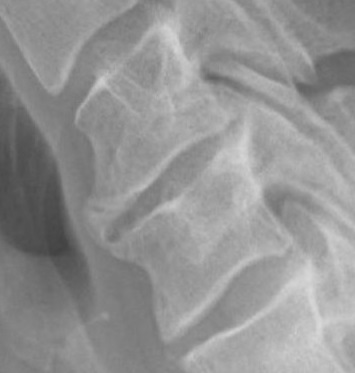
X-rayLateral X-ray of the cervical spine, close-up on C5-C6: anterior osteophytes and disc space narrowing, a common finding in asymptomatic degenerative cervical spondylosis.
Source : Stillwaterising et al., Wikimedia Commons · CC0
Non-specific neck pain, also called common or mechanical neck pain, is defined as pain localised in the posterior and/or lateral cervical region, with no identifiable specific pathological cause.¹ It is a diagnosis of exclusion made after ruling out serious pathologies (red flags) such as fractures, tumours, infections, systemic inflammatory diseases or confirmed neurological compression (radiculopathy or myelopathy).¹⁻²
📈 Epidemiologically, neck pain represents a major health burden. According to the Global Burden of Disease 2021 analysis (Lancet Rheumatology 2024, 204 countries), neck pain is the 4th leading global cause of years lived with disability (YLDs).³ The age-standardised global prevalence rate is of the order of 27 to 28 per 100,000, with a female/male ratio of 1.31 (95% CI 1.30-1.32). Prevalence peaks between 45 and 74 years in both sexes.³
📊 Neck pain prevalence by sex: GBD 2021
Age-standardised rate (per 100,000): Lancet Rheumatology 2024
Source: GBD 2021 Neck Pain Collaborators. Lancet Rheumatol. 2024;6(3):e142-e155. PMC10897950.
The onset and persistence of non-specific neck pain are influenced by a complex interaction of biopsychosocial factors. They can be grouped into three broad categories:
- Demographic and individual factors : female sex is one of the most consistently reported factors.³⁻⁴ A personal history of neck pain remains one of the strongest predictors of future episodes.⁵
- Psychosocial factors : high stress, anxiety and depressive symptoms, low job satisfaction, catastrophising and passive coping are associated with both onset and chronicity.⁶⁻⁷ Yellow flags remain the most powerful predictors of long-term disability.⁸
- Physical and ergonomic factors : prolonged static posture, cognitive load in cervical flexion (screen work), repetitive movements and vibration exposure (prolonged driving) are well-established occupational factors.⁹⁻¹⁰
⚖️ Hierarchy of prognostic factors for chronicity
Strength of association (pooled OR) with persistence at 12 months: Carroll 2009, Linton 2000 synthesis
Sources: Carroll LJ, et al. J Manipulative Physiol Ther. 2009 (PMID 19251079); Linton SJ. Spine. 2000;25:1148-1156 (PMID 10788861). OR values given for illustration (order of magnitude).
What happens inside the body and how does it evolve naturally?
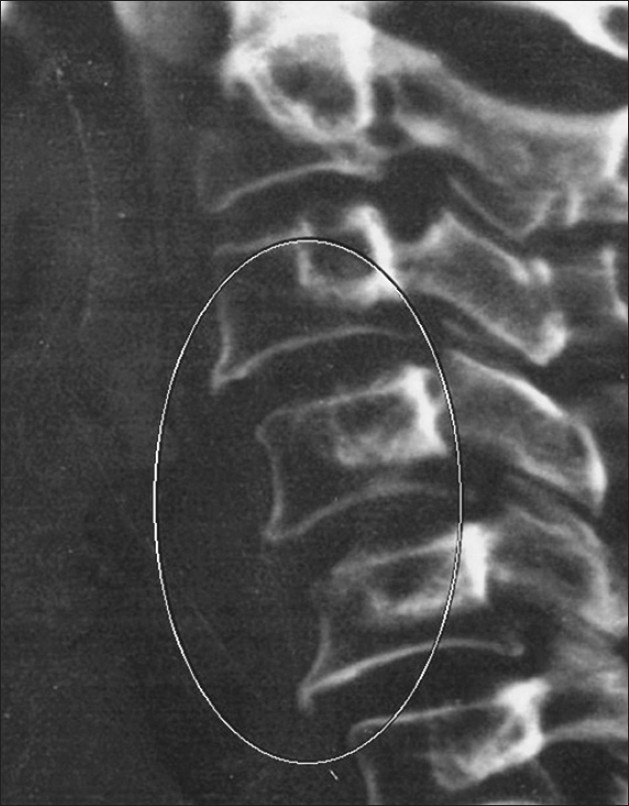
X-rayLateral cervical spine X-ray showing multilevel osteophytes at C3, C4 and C5, circled by a marker, a common and often asymptomatic degenerative finding.
Source : Dable et al., Journal of neurosciences in rural practice, 2013, figure 2 · CC BY-NC-SA
The pathophysiology of non-specific neck pain is multifactorial. Several interdependent mechanisms are involved, above all in patients who develop persistent symptoms:
- 🧠 Sensorimotor control impairments : control deficits of the deep neck flexors (longus colli, longus capitis) are frequently observed, with reduced endurance and compensatory overactivation of the sternocleidomastoid and the scalenes.¹¹ These changes can disturb postural control, balance and eye-head coordination.¹¹⁻¹²
- 💪 Structural muscle changes : in chronic patients (notably WAD), imaging reveals fatty infiltration of the cervical multifidus and semispinalis cervicis muscles, associated with greater pain intensity and disability.¹³
- ⚡ Central sensitisation phenomena : persisting pain can lead to hypersensitivity of the nervous system, amplifying nociceptive perception (hyperalgesia) and provoking pain in response to normally non-painful stimuli (allodynia).¹⁴ This mechanism explains why pain can become diffuse, more intense than expected and less correlated with the state of peripheral tissues.
The natural course is highly variable. Although significant improvement frequently occurs within the first 6 to 12 weeks, complete resolution is less common than was previously thought.¹ The typical trajectory is that of an episodic and recurrent condition, with phases of remission and exacerbation.¹⁵ The Bone and Joint Decade cohort studies show that about 50 to 75% of people who have consulted for neck pain still report symptoms or disability one year later.¹⁶
The poor prognostic factors documented include: high initial intensity (NPRS > 7/10), high initial disability (NDI > 30%), presence of radicular symptoms, low self-efficacy, and negative psychosocial factors (catastrophising, depression).¹⁶⁻¹⁷
- Non-specific neck pain is a very common diagnosis of exclusion , with no identifiable serious pathology.
- It represents a major global burden, the 4th leading cause of disability (GBD 2021).
- The risk factors are biopsychosocial : female sex, previous episode, stress/anxiety, static posture.
- The pathophysiology involves motor control impairments, structural muscle changes (fatty infiltration) and central sensitisation.
- Its course is often recurrent or persistent : 50-75% with symptoms at 1 year.
Chapter 1 bibliography
- Blanpied PR, Gross AR, Elliott JM, et al. Neck Pain: Revision 2017. Clinical Practice Guidelines Linked to the International Classification of Functioning, Disability and Health From the Orthopaedic Section of the American Physical Therapy Association. J Orthop Sports Phys Ther. 2017;47(7):A1-A83. PMID 28666405.
- Childs JD, Cleland JA, Elliott JM, et al. Neck pain: clinical practice guidelines linked to the International Classification of Functioning, Disability, and Health from the Orthopaedic Section of the American Physical Therapy Association. J Orthop Sports Phys Ther. 2008;38(9):A1-A34. doi:10.2519/jospt.2008.0303.
- GBD 2021 Neck Pain Collaborators. Global, regional, and national burden of neck pain, 1990-2020, and projections to 2050: a systematic analysis of the Global Burden of Disease Study 2021. Lancet Rheumatol. 2024;6(3):e142-e155. PMC 10897950.
- Kazeminasab S, Nejadghaderi SA, Amiri P, et al. Neck pain: global epidemiology, trends and risk factors. BMC Musculoskelet Disord. 2022;23(1):26. PMID 34980079.
- Hogg-Johnson S, van der Velde G, Carroll LJ, et al. The burden and determinants of neck pain in the general population: results of the Bone and Joint Decade 2000-2010 Task Force on Neck Pain and Its Associated Disorders. Spine (Phila Pa 1976). 2008;33(4 Suppl):S39-S51. PMID 18204385.
- Linton SJ. A review of psychological risk factors in back and neck pain. Spine (Phila Pa 1976). 2000;25(9):1148-1156. PMID 10788861.
- Carroll LJ, Hogg-Johnson S, van der Velde G, et al. Course and prognostic factors for neck pain in the general population: results of the Bone and Joint Decade 2000-2010 Task Force on Neck Pain and Its Associated Disorders. J Manipulative Physiol Ther. 2009;32(2 Suppl):S87-S96. PMID 19251079.
- Nicholas MK, Linton SJ, Watson PJ, Main CJ; "Decade of the Flags" working group. Early identification and management of psychological risk factors ("yellow flags") in patients with low back pain: a reappraisal. Phys Ther. 2011;91(5):737-753. PMID 21451099.
- Côté P, van der Velde G, Cassidy JD, et al. The burden and determinants of neck pain in workers: results of the Bone and Joint Decade 2000-2010 Task Force on Neck Pain and Its Associated Disorders. J Manipulative Physiol Ther. 2009;32(2 Suppl):S70-S86. PMID 19251074.
- Jun D, Zoe M, Johnston V, O'Leary S. Physical risk factors for developing non-specific neck pain in office workers: a systematic review and meta-analysis. Int Arch Occup Environ Health. 2017;90(5):373-410. PMID 28224291.
- Falla D, Jull G, Russell T, Vicenzino B, Hodges P. Effect of neck exercise on sitting posture in patients with chronic neck pain. Phys Ther. 2007;87(4):408-417. PMID 17341512.
- Treleaven J. Dizziness, unsteadiness, visual disturbances, and sensorimotor control in traumatic neck pain. J Orthop Sports Phys Ther. 2017;47(7):492-502. PMID 28622488.
- Elliott JM, Pedler AR, Jull GA, Van Wyk L, Galloway GG, O'Leary SP. Differential changes in muscle composition exist in traumatic and nontraumatic neck pain. Spine (Phila Pa 1976). 2014;39(1):39-47. PMID 24270932.
- Sterling M. Physiotherapy management of whiplash-associated disorders (WAD). J Physiother. 2014;60(1):5-12. PMID 24856935.
- Guzman J, Hurwitz EL, Carroll LJ, et al. A new conceptual model of neck pain: linking onset, course, and care: the Bone and Joint Decade 2000-2010 Task Force on Neck Pain and Its Associated Disorders. Spine (Phila Pa 1976). 2008;33(4 Suppl):S14-S23. PMID 18204387.
- Walton DM, Carroll LJ, Kasch H, et al. An overview of systematic reviews on prognostic factors in neck pain: results from the International Collaboration on Neck Pain (ICON) Project. Open Orthop J. 2013;7:494-505. PMID 24115971.
- Walton DM, Pretty J, MacDermid JC, Teasell RW. Risk factors for persistent problems following whiplash injury: results of a systematic review and meta-analysis. J Orthop Sports Phys Ther. 2009;39(5):334-50. PMID 19411766.
How do you assess and diagnose non-specific neck pain with certainty?
The diagnosis of non-specific neck pain rests on a rigorous process aimed mainly at excluding potentially serious specific pathologies (red flags) and at placing the patient within a functional framework that guides treatment.¹ Diagnostic « certainty » lies not in identifying a precise anatomical lesion (often absent) but in a structured and reproducible assessment process.²
Which questions should you ask to understand the patient and their history?
📝 History taking is the cornerstone of diagnosis. It must explore several domains in order to build a solid clinical hypothesis and, above all, to screen for warning signs.
The interview first characterises the pain: mode of onset (traumatic vs gradual), location, intensity measured with the Numeric Pain Rating Scale (NPRS) or the VAS, day-and-night behaviour and aggravating/easing factors.³ Assessment of functional impact uses validated self-report questionnaires: the Neck Disability Index (NDI) by Vernon & Mior is the most recommended and most widely validated tool (10 items, score 0-50 or 0-100%).⁴⁻⁵ The Patient-Specific Functional Scale (PSFS) is a useful complement, personalising the goals.
A crucial part is screening for red flags, which are signs or symptoms suggestive of a serious underlying pathology. The International Framework for Red Flags from IFOMPT (Finucane 2020) stresses interpretation through a combination of signs rather than through an isolated sign.⁶
🚩 Red flags specific to the cervical spine
- Recent history of trauma involving high energy (road traffic accident, fall, diving) → fracture, ligamentous instability (Canadian C-spine rule for cervical radiography).
- Fever, chills, unexplained weight loss, night sweats → suspicion of infection (spondylodiscitis) or neoplasm.
- History of cancer + progressive non-mechanical pain → work-up for cervical metastatic spread.
- Intense night pain not relieved by lying down + pain when lying down → composite red flag.
- Progressive neurological signs : multi-myotomal motor weakness, bladder or bowel disturbance, ataxic gait disturbance → cervical myelopathy (emergency): confirm with the Cook 2010 cluster (5 criteria: age > 45, abnormal gait, +Hoffman, +Babinski, +inverted supinator reflex).⁷
- Sudden thunderclap headache + neck pain + focal neurological deficit → suspicion of vertebral artery dissection or subarachnoid haemorrhage.
- Post-traumatic vascular symptoms (5D + 3N : dizziness, drop attacks, diplopia, dysarthria, dysphagia, nystagmus, numbness, nausea) → suspicion of vertebrobasilar insufficiency.
- History of IV drug use, prolonged corticosteroid therapy, immunosuppression + recent pain → increased infection risk.
⚠️ Any suggestive combination → prompt medical referral (general practitioner, neurological emergency department, MRI) before continuing physiotherapy.
🧠 The assessment must also include the yellow flags, powerful predictors of progression to chronicity. Probe the patient's beliefs about their pain, catastrophising (PCS), fear of movement (Tampa Scale of Kinesiophobia, TSK), depressive and anxiety symptoms, and the occupational context.⁸ The Örebro Musculoskeletal Pain Questionnaire (ÖMPQ) makes this screening systematic.⁹
Which clinical tests should you perform and which other conditions must be ruled out?
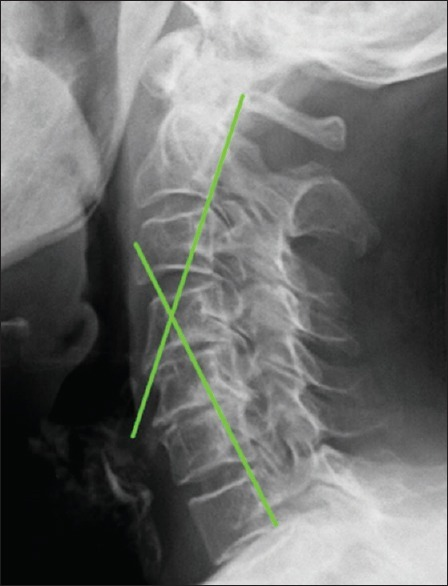
X-rayLateral cervical spine X-ray with lines measuring cervical lordosis, a radiological marker frequently discussed in non-specific neck pain.
Source : Lippa et al., Journal of Craniovertebral Junction & Spine, 2017, figure 1 · CC BY-NC-SA
The physical examination completes the history. It begins with postural inspection, measurement of active (flexion, extension, right/left rotation, side bending) and passive range of motion, and palpation of the muscular and articular structures.¹⁰
To rule out a cervical radiculopathy, the combination of four tests proposed by Wainner (Spine 2003) remains the diagnostic reference. The Wainner cluster comprises:
- The Spurling test (provocation of radicular symptoms by extension + side bending + axial compression on the symptomatic side).
- The cervical distraction test (relief with traction).
- The Upper Limb Tension Test A (ULTT-A) targeting the median nerve.
- A restricted cervical rotation < 60° on the symptomatic side.
With ≥ 3/4 positive tests, the post-test probability rises to 65%; at 4/4, it reaches 90% (EMG/NCS reference).¹¹ The Spurling test alone has excellent specificity (89-100%) but limited sensitivity: it serves to confirm, not to rule out.¹²
For patients with headache, the cervical flexion-rotation test (FRT) assesses C1-C2, a junction often involved in cervicogenic headache. A passive rotation range < 32° (or a right-left difference > 10°) is strongly associated with cervicogenic headache (sensitivity ≈ 0.90, specificity ≈ 0.90).¹³
A complete neurological examination is imperative: motor strength by myotome (C5 deltoid, C6 biceps/wrist extensors, C7 triceps/wrist flexors, C8 finger flexors, T1 finger abductors/adductors), tendon reflexes, dermatomal sensation. The presence of upper motor neurone signs (Babinski, Hoffman, hyperreflexia, clonus) must raise the suspicion of cervical myelopathy: a relative medical emergency.⁷
The imaging work-up is not indicated as a first-line investigation in the absence of a red flag or of a failure to improve after 4-6 weeks of well-conducted conservative treatment.¹⁻² The European Choosing Wisely recommendations and the ACR Appropriateness Criteria 2024 guidance converge on this principle.
🧭 Decision algorithm: suspected neck pain
Rapid triage for the first-contact physiotherapist
Adapted from the Blanpied JOSPT 2017, Bier KNGF 2018 and Finucane IFOMPT 2020 recommendations.
Should patients be classified, and what are the benefits?
Yes. 🎯 Rather than a « one size fits all » approach, classification groups patients into homogeneous subgroups in order to target treatment.¹ The most influential system is the CPG Neck Pain of Orthopaedic Section APTA, updated in 2017 (Blanpied), which distinguishes four clinical categories:
- Neck pain with mobility deficits : central or unilateral pain, cervical restriction, end-range pain → targeted manual therapy + mobility exercises.¹
- Neck pain with movement coordination impairments (including WAD) : diffuse pain, dizziness, sensorimotor disturbances → postural rehabilitation, motor control, education.¹⁴
- Neck pain with headache (cervicogenic headache) : neck pain associated with headaches, positive FRT → C1-C2 MT + specific exercises.¹³
- Neck pain with radiating pain (radiculopathy) : upper limb pain with neurological signs, Wainner cluster ≥ 3/4 → neural mobilisations, traction, centralisation.¹¹⁻¹⁵
🗂 JOSPT 2017 classification: preferred modalities by subgroup
Mapping of signs/symptoms → first-choice interventions
| Subgroup | Key signs | Preferred modalities | Evidence |
|---|---|---|---|
| Mobility deficit | End-range pain, restricted ROM | Cervical + thoracic MT, ROM exercises | Level A |
| Coordination deficit (WAD) | Diffuse symptoms, dizziness, sensorimotor involvement | Motor control, eye-head exercises, PNE | Level B |
| Cervicogenic headache | Positive FRT, pain reproduced on C0-C2 palpation | C1-C2 MT, craniocervical flexion exercises | Level A |
| Radiating pain | Wainner cluster ≥ 3/4, neurological signs | Neural mobilisation, intermittent traction, thoracic MT | Level B |
Synthesis adapted from Blanpied PR et al. JOSPT. 2017;47(7):A1-A83 (PMID 28666405) and Bier JD et al. Phys Ther. 2018;98(3):162-171 (PMID 29228289).
Critique and controversy
Despite the growing consensus, applying classification systems raises several debates. First, the inter-rater reliability of some tests remains moderate and clinical experience influences judgement.¹¹ Next, the « purity » of the categories is often questioned: many patients show features of several subgroups at once, which complicates allocation. The direct superiority of a classified approach vs a general multimodal one has not been settled by long-term trials.¹⁶ The current trend is moving towards a model of stratified care combining the physical profile and the psychosocial risk profile, analogous to StarT Back in low back pain.⁸
- The diagnosis is a diagnosis of exclusion. The priority is to screen for red flags through a rigorous history (Finucane 2020 framework).
- The assessment must quantify disability with the NDI and include a search for yellow flags, predictors of chronicity.
- The clinical examination relies on specific tests : the Wainner cluster for radiculopathy, the flexion-rotation test for cervicogenic headache, the Cook cluster for myelopathy.
- The imaging work-up is not indicated as a first-line investigation in the absence of warning signs or of stagnation after 4-6 weeks.
- The JOSPT classification into 4 subgroups guides the choice of a targeted treatment and the move towards stratified care.
Chapter 2 bibliography
- Blanpied PR, Gross AR, Elliott JM, et al. Neck Pain: Revision 2017. J Orthop Sports Phys Ther. 2017;47(7):A1-A83. PMID 28666405.
- Bier JD, Scholten-Peeters WGM, Staal JB, et al. Clinical Practice Guideline for Physical Therapy Assessment and Treatment in Patients With Nonspecific Neck Pain. Phys Ther. 2018;98(3):162-171. PMID 29228289.
- Childs JD, Piva SR, Fritz JM. Responsiveness of the numeric pain rating scale in patients with low back pain. Spine (Phila Pa 1976). 2005;30(11):1331-1334. PMID 15928561.
- Vernon H, Mior S. The Neck Disability Index: a study of reliability and validity. J Manipulative Physiol Ther. 1991;14(7):409-415. PMID 1834753.
- MacDermid JC, Walton DM, Avery S, et al. Measurement properties of the Neck Disability Index: a systematic review. J Orthop Sports Phys Ther. 2009;39(5):400-417. PMID 19521015.
- Finucane LM, Downie A, Mercer C, et al. International Framework for Red Flags for Potential Serious Spinal Pathologies. J Orthop Sports Phys Ther. 2020;50(7):350-372. PMID 32438853.
- Cook C, Brown C, Isaacs R, Roman M, Davis S, Richardson W. Clustered clinical findings for diagnosis of cervical spine myelopathy. J Man Manip Ther. 2010;18(4):175-180. PMID 22131790.
- Linton SJ. A review of psychological risk factors in back and neck pain. Spine (Phila Pa 1976). 2000;25(9):1148-1156. PMID 10788861.
- Linton SJ, Nicholas M, MacDonald S. Development of a short form of the Örebro Musculoskeletal Pain Screening Questionnaire. Spine (Phila Pa 1976). 2011;36(22):1891-1895. PMID 21192286.
- Childs JD, Cleland JA, Elliott JM, et al. Neck pain: clinical practice guidelines linked to the International Classification of Functioning, Disability, and Health from the Orthopaedic Section of the American Physical Therapy Association. J Orthop Sports Phys Ther. 2008;38(9):A1-A34. doi:10.2519/jospt.2008.0303.
- Wainner RS, Fritz JM, Irrgang JJ, Boninger ML, Delitto A, Allison S. Reliability and diagnostic accuracy of the clinical examination and patient self-report measures for cervical radiculopathy. Spine (Phila Pa 1976). 2003;28(1):52-62. PMID 12544957.
- Thoomes EJ, van Geest S, van der Windt DA, et al. Value of physical tests in diagnosing cervical radiculopathy: a systematic review. Spine J. 2018;18(1):179-189. PMID 28838857.
- Hall TM, Briffa K, Hopper D, Robinson KW. The relationship between cervicogenic headache and impairment determined by the flexion-rotation test. J Manipulative Physiol Ther. 2010;33(9):666-71. PMID 21109057.
- Sterling M. Physiotherapy management of whiplash-associated disorders (WAD). J Physiother. 2014;60(1):5-12. PMID 24856935.
- Romeo A, Vanti C, Boldrini V, et al. Cervical radiculopathy: effectiveness of adding traction to physical therapy - a systematic review and meta-analysis of randomized controlled trials. Phys Ther. 2018;98(4):231-242. PMID 29315428.
- Fritz JM, Brennan GP. Preliminary examination of a proposed treatment-based classification system for patients receiving physical therapy interventions for neck pain. Phys Ther. 2007;87(5):513-524. PMID 17374633.
Which treatment strategies are the most effective for non-specific neck pain?
Where do you start? What is the recommended hierarchy of interventions?
Faced with non-specific neck pain, clinical practice guidelines converge on a patient-centred, active and multimodal approach.¹⁻² The cornerstone is not a single intervention but a synergistic combination : education, therapeutic exercise, targeted manual therapy, all adapted to the risk profile.
🏔 GRADE pyramid: hierarchy of evidence in neck pain
Certainty levels applied to physiotherapy interventions (horizontal card format)
Stacked horizontal card format (never text INSIDE a triangle) to preserve legibility. Adapted from the GRADE system: Guyatt G et al. BMJ. 2008.
The initial approach must:
- Reassure about the benign nature of most neck pain and its generally favourable trajectory.
- Deconstruct mistaken beliefs (« fragile » spine, « collapse », « pinching »).
- Encourage a rapid return to usual activities (with temporary adaptations if needed).
- Stratify care according to the risk profile (low, moderate, high).¹
The systematic review of European guidelines (Corp 2021, 14 guidelines, 8 countries) confirms that the multimodal approach is the most strongly and consistently recommended strategy for neck pain.² Meta-analyses agree: combining exercise + manual therapy + education is superior to isolated interventions in the short and medium term.³
What is the place of exercise and is there a superior approach?
Therapeutic exercise is a fundamental cornerstone, with a high level of evidence from the Gross Cochrane Review (2015, 27 trials, > 2,400 participants): beneficial effects on pain in the short and medium term and on function.⁴ 💪
The critical question is not whether to prescribe exercise, but which one. Several recent network meta-analyses give a nuanced answer: no specific modality (strengthening, stretching, yoga, Pilates, Mind-Body) is significantly superior to the others for pain or function.⁵⁻⁶ The most decisive factor is adherence and regularity.
That said, some modalities have documented specific benefits:
- The strengthening exercises for the deep neck flexors (Jull craniocervical test) and the scapular stabilisers improve pain and function (Falla 2007).⁷
- The motor control exercises improve pain and function in the short and medium term, above all in chronic neck pain with sensorimotor deficits.⁸
- The sensorimotor exercises (balance, eye-head coordination, cervical proprioception) improve postural control in WAD and in chronic neck pain.⁹
🏋️ Exercise modalities: evidence vs effect comparison
Synthesis of Gross 2015 Cochrane + Owen 2020 BJSM (extrapolated from low back pain) + GBD 2024
| Modality | Effect on pain | Effect on function | GRADE level |
|---|---|---|---|
| Deep flexor strengthening | Moderate short term | Moderate | High |
| Motor control (deep) | Moderate medium term | Moderate | Moderate |
| General aerobic exercise | Low to moderate | Moderate | Moderate |
| Yoga / Pilates / Tai-chi | Low to moderate | Low to moderate | Low |
| Stretching alone | Low short term | Low | Low |
Sources: Gross A et al. Cochrane Database Syst Rev. 2015;CD004250 (PMID 25629215); Owen PJ et al. Br J Sports Med. 2020;54(21):1279-1287; Lin I et al. Br J Sports Med. 2020;54(2):79-86.
In addition, telerehabilitation has proved a viable alternative to in-person care for supervising exercise programmes, particularly since COVID.¹⁰ For deconditioned patients, adding a regular submaximal aerobic component improves overall function and well-being, acting through endogenous analgesia mechanisms (Geneen 2017 Cochrane Overview).¹¹
Manual therapies and technologies: how effective are they really?
Manual therapy (mobilisations, manipulations, soft tissue techniques) is frequently used and recommended, but almost always as a complement to an active approach.¹⁻² 👐 Its effectiveness is mainly demonstrated in the short term for pain reduction and improved range of motion.¹²
The mechanism of action remains debated: Bialosky et al. propose a model combining peripheral biomechanical effects (modulation of inflammation and muscle tone), central neurophysiological effects (descending inhibition) and contextual effects (expectations, therapeutic alliance).¹³ The respective share of each mechanism and the notion of technique specificity are contested in the recent literature.
Regarding the complementary modalities:
- Dry needling : the Navarro-Santana meta-analysis (J Clin Med 2020, 10 trials) shows a short-term reduction in pain intensity (mean difference ≈ -1.5 out of 10) in patients with myofascial trigger points in the upper trapezius or levator scapulae.¹⁴ The reliability of palpating these points, the controversy about the entity itself and the levels of evidence for the various modalities are covered in the article dedicated to myofascial pain syndrome.
- Prolonged passive therapies (heat, ice, ultrasound alone): not advised for prolonged use because they encourage dependence and divert attention from active self-management.¹⁵
- TENS : modest effect, may be useful as an occasional adjunct but with no demonstrated added value vs exercise/MT.
Current thinking views manual therapy as a facilitator : reducing pain and improving mobility in the short term so that the patient can engage with the active programme, which remains the key to long-term success.
Beyond the physical: how do you educate the patient and address psychological factors?
Modern management recognises the biopsychosocial interaction. Education is no longer a simple sharing of information but a therapeutic intervention in its own right. 🧠
Pain neuroscience education (PNE) aims to change the patient's understanding of the nature of their pain, by explaining that pain is a product of the nervous system rather than a simple marker of tissue damage. The Louw synthesis (Physiother Theory Pract 2016, 13 RCTs) shows that PNE reduces fear of movement, lowers catastrophising and improves function.¹⁶ This education must also discourage the use of low-value care (unjustified imaging, repeated injections without clinical reasoning).¹⁵
The psychologically informed physiotherapy (PIPT) incorporates stress management techniques, graded exposure to feared activities, and collaborative goal setting. Coronado et al. (Pain Reports 2020), note: an article published in Pain Reports, not in JOSPT, synthesise 18 trials showing that PIPT significantly improves pain and disability compared with traditional physiotherapy.¹⁷ PIPT does not aim to « treat » depression but to address the psychosocial barriers to recovery.
Critique and controversy: the grey areas
First, the term « non-specific neck pain » covers a very heterogeneous population. Research is moving towards stratified care (analogous to StarT Back in low back pain) in order to personalise the intervention.
Second, there is a persistent gap between research evidence and practice : despite the overwhelming endorsement of active approaches, many passive interventions with no proven long-term effectiveness remain overused. The gap is attributed to patient expectations, reimbursement models, and entrenched habits.
Finally, the distinction between specific effects (biological mechanism) and non-specific effects (placebo, expectations, therapeutic alliance) is particularly difficult in manual therapy. A large part of the initial relief may come from the therapeutic context, which does not reduce the value of the intervention but does qualify its biomechanical attribution.¹³
- Multimodal approach first : education + exercise + manual therapy > any isolated intervention (Corp 2021).
- Exercise is king, but the type is flexible : no modality is superior to the others. What matters is long-term adherence.
- Manual therapy = adjunct in the short term to make participation in the active programme easier (Bialosky 2018).
- The brain is the target : PNE (Louw 2016) and PIPT (Coronado 2020) are powerful levers for lasting results.
- Dry needling : an effective short-term option for myofascial pain (Navarro-Santana 2020).
Chapter 3 bibliography
- Blanpied PR, Gross AR, Elliott JM, et al. Neck Pain: Revision 2017. J Orthop Sports Phys Ther. 2017;47(7):A1-A83. PMID 28666405.
- Corp N, Mansell G, Stynes S, Wynne-Jones G, Morsø L, Hill JC, et al. Evidence-based treatment recommendations for neck and low back pain across Europe: A systematic review of guidelines. Eur J Pain. 2021;25(2):275-295. PMID 33064878.
- Fredin K, Lorås H. Manual therapy, exercise therapy or combined treatment in the management of adult neck pain - A systematic review and meta-analysis. Musculoskelet Sci Pract. 2017;31:62-71. PMID 28750310.
- Gross A, Kay TM, Paquin J-P, et al. Exercises for mechanical neck disorders. Cochrane Database Syst Rev. 2015;(1):CD004250. PMID 25629215.
- de Zoete RM, Armfield NR, McAuley JH, Chen K, Sterling M. Comparative effectiveness of physical exercise interventions for chronic non-specific neck pain: a systematic review with network meta-analysis of 40 randomised controlled trials. Br J Sports Med. 2021;55(13):730-742. PMID 33139256.
- Owen PJ, Miller CT, Mundell NL, et al. Which specific modes of exercise training are most effective for treating low back pain? Network meta-analysis. Br J Sports Med. 2020;54(21):1279-1287. PMID 31666220.
- Falla D, Jull G, Russell T, Vicenzino B, Hodges P. Effect of neck exercise on sitting posture in patients with chronic neck pain. Phys Ther. 2007;87(4):408-417. PMID 17341512.
- Martin-Gomez C, Sestelo-Diaz R, Carrillo-Sanjuan V, et al. Motor control using cranio-cervical flexion exercises versus other treatments for non-specific chronic neck pain: A systematic review and meta-analysis. Musculoskelet Sci Pract. 2019;42:52-59. PMID 31030111.
- Beinert K, Taube W. The effect of balance training on cervical sensorimotor function and neck pain. J Mot Behav. 2013;45(3):271-8. PMID 23663191.
- Cottrell MA, Galea OA, O'Leary SP, Hill AJ, Russell TG. Real-time telerehabilitation for the treatment of musculoskeletal conditions is effective and comparable to standard practice: a systematic review and meta-analysis. Clin Rehabil. 2017;31(5):625-638. PMID 27141087.
- Geneen LJ, Moore RA, Clarke C, Martin D, Colvin LA, Smith BH. Physical activity and exercise for chronic pain in adults: an overview of Cochrane Reviews. Cochrane Database Syst Rev. 2017;4(4):CD011279. PMID 28436583.
- Hidalgo B, Hall T, Bossert J, Dugeny A, Cagnie B, Pitance L. The efficacy of manual therapy and exercise for treating non-specific neck pain: A systematic review. J Back Musculoskelet Rehabil. 2017;30(6):1149-1169. PMID 28826164.
- Bialosky JE, Beneciuk JM, Bishop MD, et al. Unraveling the mechanisms of manual therapy: modeling an approach. J Orthop Sports Phys Ther. 2018;48(1):8-18. PMID 29034802.
- Navarro-Santana MJ, Sanchez-Infante J, Fernández-de-Las-Peñas C, Cleland JA, Martín-Casas P, Plaza-Manzano G. Effectiveness of Dry Needling for Myofascial Trigger Points Associated with Neck Pain Symptoms: An Updated Systematic Review and Meta-Analysis. J Clin Med. 2020;9(10):3300. PMID 33066556.
- Lin I, Wiles L, Waller R, et al. What does best practice care for musculoskeletal pain look like? Eleven consistent recommendations from high-quality clinical practice guidelines: systematic review. Br J Sports Med. 2020;54(2):79-86. PMID 30826805.
- Louw A, Zimney K, Puentedura EJ, Diener I. The efficacy of pain neuroscience education on musculoskeletal pain: A systematic review of the literature. Physiother Theory Pract. 2016;32(5):332-355. PMID 27351541.
- Coronado RA, Brintz CE, McKernan LC, et al. Psychologically informed physical therapy for musculoskeletal pain: current approaches, implications, and future directions from recent randomized trials. Pain Rep. 2020;5(5):e847. PMID 33490842.
How do you secure lasting recovery and prevent recurrence of non-specific neck pain?
Management is not limited to resolving the acute episode. The aim is to put in place a long-term strategy designed to minimise the risk of recurrence and to maintain optimal function. 🧘 Recent literature converges on a bio-psycho-social model in which the patient becomes the main architect of their own health, guided by the clinician. This proactive approach rests on two inseparable pillars: informed self-management and a gradual return to meaningful activities.
How do you make the patient an agent of their own recovery through self-management?
Self-care (self-management) is a collaborative approach that aims to give the patient the knowledge, skills and confidence needed to manage their symptoms and prevent recurrence.¹
The first component is therapeutic patient education. Clear explanations about the benign nature of most neck pain, the weak correlation between imaging and pain, and the capacity for recovery of the system reduce negative psychosocial factors (fear, catastrophising).² PNE is particularly effective at lowering perceived threat.³ It must stress the importance of staying active rather than resting.
The second component is a personalised and progressive active exercise programme. Meta-analyses confirm with a high level of evidence that exercise is one of the most effective interventions for cervical pain and function.⁴⁻⁵ The programme must include:
- Motor control and strengthening exercises targeting the deep neck flexors and the scapular stabilisers (Falla 2007).⁶
- Mobility exercises through the whole pain-free range to maintain joint function and reduce stiffness.
- General physical activity (walking, cycling, swimming, running): 150 minutes per week at moderate intensity, by general analogy with chronic pain (Geneen 2017 Cochrane).⁷
The third component is strengthening the sense of self-efficacy (Bandura): the patient's confidence in their own ability to manage their situation. High self-efficacy is strongly correlated with better adherence and better long-term functional outcomes.⁸ The physiotherapist's role is to set progressive SMART goals, to celebrate successes, and to provide strategies for managing flare-ups, so that the patient sees them as a normal fluctuation rather than a failure.
When and how do you plan a safe return to sport and to activities?
Return to sport (Return to Sport, RTS) or to work and leisure activities requires structured planning. The decision must rest on functional criteria rather than on a fixed duration.⁹ The strategy follows the principle of graded exposure to load: load tolerance model. 🏋️
The process can be conceptualised in four phases:
- Restoring the fundamental prerequisites : full pain-free cervical range, resting pain < 2/10, no apprehension during everyday activities.⁹⁻¹⁰
- Recovering strength and endurance : progressive strengthening programme (neck, shoulder girdle) to restore symmetrical strength and the endurance required for the target activity.¹¹
- Reintroducing sport-specific movements at low intensity, low speed and low complexity. For example: a rugby player begins with cervical rotations synchronised with slow passes, without contact, before full match situations.¹²
- Progressive increase in load by systematically manipulating the variables (speed, load, complexity, duration). Symptom-response rule: pain must not increase by more than 2 points during or after the session and must return to baseline within 24 h.¹³
🚦 Functional return-to-sport criteria: traffic lights
Adapted from the Hegedus 2015 framework and the Silbernagel 2020 load tolerance model
| Criterion | Minimum threshold | Measurement tool |
|---|---|---|
| Resting pain | < 2/10 | NPRS / VAS |
| NDI | < 10% (ideally 5%) | Neck Disability Index |
| Cervical mobility | Symmetrical, pain-free, > 90% of the unaffected side | Goniometer / CROM |
| Cervical isometric strength | Symmetry > 90% | Dynamometer / MMT |
| Kinesiophobia | TSK < 37 | Tampa Scale |
| Sport-specific functional test | No apprehension | Individualised test movement |
Sources: Hegedus EJ et al. JOSPT. 2015;45(10):734-738. Silbernagel KG et al. BMJ Open Sport Exerc Med. 2020. Sterling 2014 for the TSK threshold.
The psychological factors are just as crucial. Kinesiophobia is a major obstacle to returning to activities.¹⁴ The clinician must assess it (TSK), address it explicitly, and use graded exposure to rebuild confidence. Success is not only « absence of pain »: it is the ability to take part with confidence and without apprehension.
🧠 Yellow flags: screening tools and alert thresholds
Map of the psychosocial factors to measure systematically
Sources: Linton 2000; Nicholas 2011 (Decade of the Flags); Luque-Suarez 2019 (kinesiophobia). To be used as a systematic triage grid, not as a diagnosis.
Critique and controversies: beyond the guidelines
The concept of multimodal approach is widely supported (Corp 2021; Fredin 2017). However, the relative contribution of each component remains difficult to isolate. Manual therapy, although useful for making exercise easier, can create a passive dependence if it is not presented as a catalyst towards self-management.¹⁵
The concept of « optimal exercise » is increasingly being questioned. Research is moving towards patient preference and adherence : a « suboptimal » exercise done regularly beats an « optimal » exercise abandoned after a week.
Finally, long-term prevention of recurrence remains an area where the evidence is modest. Follow-up studies > 2 years are rare and still show high recurrence rates. Psychosocial and lifestyle risk factors (sedentary behaviour, sleep, chronic stress) are powerful predictors of chronicity, which invites physiotherapists to broaden their scope so as to include more systematically the screening for, and referral to, psychological or general health promotion interventions.
- Lasting prevention rests on patient empowerment through self-management.
- Education about prognosis and the neurophysiology of pain is essential.
- A programme of active exercises combining specific strengthening (deep flexors, scapular muscles) and general physical activity is the most effective strategy.
- Return to sport must be based on functional criteria and follow a principle of graded exposure.
- The psychosocial dimension (kinesiophobia, self-efficacy) is a key factor to include in order to secure long-term success.
Chapter 4 bibliography
- Nicholas MK, Linton SJ, Watson PJ, Main CJ. Early identification and management of psychological risk factors ("yellow flags") in patients with low back pain: a reappraisal. Phys Ther. 2011;91(5):737-753. PMID 21451099.
- Blanpied PR, Gross AR, Elliott JM, et al. Neck Pain: Revision 2017. J Orthop Sports Phys Ther. 2017;47(7):A1-A83. PMID 28666405.
- Louw A, Zimney K, Puentedura EJ, Diener I. The efficacy of pain neuroscience education on musculoskeletal pain: A systematic review of the literature. Physiother Theory Pract. 2016;32(5):332-355. PMID 27351541.
- Gross A, Kay TM, Paquin J-P, et al. Exercises for mechanical neck disorders. Cochrane Database Syst Rev. 2015;(1):CD004250. PMID 25629215.
- de Zoete RM, Armfield NR, McAuley JH, Chen K, Sterling M. Comparative effectiveness of physical exercise interventions for chronic non-specific neck pain: a systematic review with network meta-analysis of 40 randomised controlled trials. Br J Sports Med. 2021;55(13):730-742. PMID 33139256.
- Falla D, Jull G, Russell T, Vicenzino B, Hodges P. Effect of neck exercise on sitting posture in patients with chronic neck pain. Phys Ther. 2007;87(4):408-417. PMID 17341512.
- Geneen LJ, Moore RA, Clarke C, Martin D, Colvin LA, Smith BH. Physical activity and exercise for chronic pain in adults: an overview of Cochrane Reviews. Cochrane Database Syst Rev. 2017;4(4):CD011279. PMID 28436583.
- Söderlund A PhD, Sandborgh M PhD, Johansson AC PhD. Is self-efficacy and catastrophizing in pain-related disability mediated by control over pain and ability to decrease pain in whiplash-associated disorders?. Physiother Theory Pract. 2017;33(5):376-385. PMID 28398100.
- Hegedus EJ, McDonough S, Bleakley C, Cook CE, Baxter GD. Clinician-friendly lower extremity physical performance measures in athletes: a systematic review of measurement properties and correlation with injury, part 1. The tests for knee function including the hop tests. Br J Sports Med. 2015;49(10):642-8. PMID 25497489.
- Ardern CL, Glasgow P, Schneiders A, et al. 2016 Consensus statement on return to sport from the First World Congress in Sports Physical Therapy, Bern. Br J Sports Med. 2016;50(14):853-864. PMID 27226389.
- Saragiotto BT, Maher CG, Yamato TP, et al. Motor control exercise for chronic non-specific low-back pain. Cochrane Database Syst Rev. 2016;(1):CD012004. PMID 26742533.
- Hides JA, Stanton WR. Predicting football injuries using size and ratio of the multifidus and quadratus lumborum muscles. Scand J Med Sci Sports. 2017;27(4):440-447. PMID 28271614.
- Mjaaland Heggebø L. Sport injuries: strategies to return to sport. Best Pract Res Clin Rheumatol. 2019;33(1):3-15.
- Luque-Suarez A, Martinez-Calderon J, Falla D. Role of kinesiophobia on pain, disability and quality of life in people suffering from chronic musculoskeletal pain: a systematic review. Br J Sports Med. 2019;53(9):554-559. PMID 29666064.
- Bialosky JE, Beneciuk JM, Bishop MD, et al. Unraveling the mechanisms of manual therapy: modeling an approach. J Orthop Sports Phys Ther. 2018;48(1):8-18. PMID 29034802.
What do concrete clinical cases teach us about non-specific neck pain?
Published clinical cases sit at the bottom of the evidence hierarchy (CEBM level 5) but offer a valuable window on how rehabilitation principles are applied. 🧐 They illustrate the diagnostic process, the selection of interventions and the outcomes obtained in real-world settings. Warning : clinical cases are subject to publication bias (successes are overrepresented). The conclusions presented are not generalisable and serve to generate hypotheses, not to prove effectiveness.
Analysis of a « classic » case: from assessment to resolution
A representative case of chronic non-specific neck pain illustrates the effectiveness of a multimodal approach, in line with current recommendations.¹ Meta-analyses confirm that a combination of interventions is superior to a single treatment for pain and disability in the medium and long term.²⁻³
Typical profile : adult aged 25-45, chronic neck pain for 3-24 months, no red flag, initial NDI 30-50% (moderate to severe disability), NPRS 5-7/10. Yellow flags are present to varying degrees (fear of movement, sometimes catastrophising).
Typical management, in line with the guidelines, combines:
- Education : benign nature, favourable prognosis, role of stress and sleep factors, with a light PNE format over 2-3 sessions.²
- Targeted manual therapy : cervical and thoracic mobilisations according to where the impairments sit, as a complement to exercise.⁴
- Therapeutic exercises : progressive programme (deep flexors, scapular stabilisers, mobility, general aerobic activity).⁵⁻⁶
- Self-management : home exercises, realistic postural ergonomics, flare-up management.
The expected trajectory over 8 to 12 weeks (12 to 18 sessions) typically shows a reduction in NPRS to < 2/10, an improvement in NDI of > 50%, and maintenance of the gains at 6 months if the self-management programme is continued. ✨ These orders of magnitude are consistent with recent meta-analyses but vary considerably with the initial profile.²⁻³
📉 Typical improvement trajectory in chronic neck pain under multimodal PT
Illustrative profile (NDI and NPRS): orders of magnitude from Gross 2015 and Fredin 2017
Illustrative profile (not taken from an individual case): expected order of magnitude of improvement. Sources: Gross A et al. Cochrane 2015; Fredin Y, Lorås H. MSP 2017 (PMID 28697360). Large between-individual variation.
The diagnostic challenge: when neck pain mimics other conditions
The « non-specific » label never removes the need for vigilance about differential diagnoses. Several published cases are a reminder that ordinary neck pain can mask rare or complex conditions. 🕵️
Verified case 1: Eagle syndrome. Costantinides et al. (Open Medicine 2018, PMC 6028820) describe a patient with chronic cervicofacial pain, earache and dysphagia, initially labelled as common neck pain. CT imaging revealed an elongated styloid process (> 25 mm), confirming the diagnosis. Eagle syndrome is rare but not exceptional for the general clinician: it should be suspected when chronic cervicofacial pain comes with dysphagia or pain on cervical rotation.⁷
Verified case 2: cervical myelopathy. Cook et al. (J Man Manip Ther 2010, PMID 22131790) validated a cluster of 5 criteria to diagnose cervical spondylotic myelopathy (CSM): age > 45 years, abnormal gait, positive Hoffman, inverted supinator reflex, positive Babinski. With ≥ 3 criteria, specificity reaches 99%.⁸ A 60-year-old patient with neck pain and gait disturbance must be screened systematically for these signs: an unrecognised CSM progresses to irreversible motor deficit.
Verified case 3: neurogenic thoracic outlet syndrome (TOS). Several recent PMC case reports (2022-2024) describe presentations confused with radiating neck pain or radiculopathy. Provocation tests (Adson, Wright, Roos / EAST) and a full vascular examination help to orientate. Specific management (scalene release, opening of the costoclavicular space, postural rehabilitation, neural mobilisation) differs fundamentally from standard cervical treatment.⁹
Study of a complex case
Complexity can come from chronicity, psychosocial comorbidities, or the co-occurrence of clinical pictures.
Case 1: chronic myofascial pain with dry needling. Chronic neck pain is frequently accompanied by active trigger points in the upper trapezius and the levator scapulae. The Navarro-Santana meta-analysis (J Clin Med 2020, 10 trials) confirms the short-term effectiveness of dry needling on pain (difference ≈ -1.5/10) and on the pressure pain threshold.¹⁰ Prerequisites : specific training, integration into a multimodal programme, and informed consent from the patient (side effects: transient post-procedure soreness, local bruising).
Case 2: cervical radiculopathy under conservative physiotherapy. For confirmed cervical radiculopathy (Wainner cluster ≥ 3/4), intensive conservative physiotherapy, combining neural mobilisations, intermittent cervical traction, centralisation exercises and thoracic spine MT, gives results comparable to surgery at 1 year for most patients.¹¹ The Romeo meta-analysis (Phys Ther 2018) confirms a moderate benefit of adding traction to standard PT in the short term.¹² Surgery remains indicated in case of progressive motor deficit or of disabling pain refractory at 6-12 weeks.
🚩 Mimics you absolutely must know
- Eagle syndrome : styloid process > 25 mm + cervicofacial pain, earache, dysphagia. Confirm on CT.
- Cervical myelopathy (CSM) : Cook cluster (≥ 3/5), a relative emergency, cervical MRI.
- Thoracic outlet syndrome (TOS) : Adson + / Roos / Wright + vascular symptoms → vascular work-up and referral to a vascular surgeon.
- Vertebral artery dissection : sudden headache, Horner syndrome, post-traumatic dizziness → neurological emergency.
- Spondylodiscitis : fever, context (IV drug use, immunosuppression) + night pain, urgent MRI.
- Spinal metastasis : history of cancer + progressive non-mechanical pain + weight loss → oncological work-up.
Critique and controversy
- Publication bias : the literature is massively dominated by successes. Failures and mixed or null results are rarely published. This creates an optimistic picture that does not reflect clinical reality.
- Overgeneralisation : an N=1 case cannot be generalised to all patients. Cases serve to generate hypotheses, not to prove effectiveness.
- The « recipe » risk : reproducing a successful protocol without clinical reasoning runs counter to patient-centred practice. Adapt, always.
- Overvaluing passive modalities : manual techniques or dry needling are effective in the short term, but active approaches remain the key to lasting success.²⁻³
- The multimodal approach (education + exercise + MT) is the most effective strategy for « classic » cases, with lasting results at 6 months.
- The « non-specific » diagnosis demands constant vigilance towards the mimics: Eagle, TOS, myelopathy, dissection.
- For complex cases, dry needling is a relevant short-term adjunct within an overall programme.
- The critical eye is essential: publication bias in case reports, do not generalise from an isolated success.
Chapter 5 bibliography
- Blanpied PR, Gross AR, Elliott JM, et al. Neck Pain: Revision 2017. J Orthop Sports Phys Ther. 2017;47(7):A1-A83. PMID 28666405.
- Corp N, Mansell G, Stynes S, et al. Evidence-based treatment recommendations for neck and low back pain across Europe: A systematic review of guidelines. Eur J Pain. 2021;25(2):275-295. PMID 33064878.
- Fredin K, Lorås H. Manual therapy, exercise therapy or combined treatment in the management of adult neck pain - A systematic review and meta-analysis. Musculoskelet Sci Pract. 2017;31:62-71. PMID 28750310.
- Bialosky JE, Beneciuk JM, Bishop MD, et al. Unraveling the mechanisms of manual therapy. J Orthop Sports Phys Ther. 2018;48(1):8-18. PMID 29034802.
- Gross A, Kay TM, Paquin J-P, et al. Exercises for mechanical neck disorders. Cochrane Database Syst Rev. 2015;(1):CD004250. PMID 25629215.
- Falla D, Jull G, Russell T, Vicenzino B, Hodges P. Effect of neck exercise on sitting posture in patients with chronic neck pain. Phys Ther. 2007;87(4):408-417. PMID 17341512.
- Costantinides F, Vidoni G, Bodin C, Di Lenarda R. Eagle's Syndrome: signs and symptoms. Cranio. 2013;31(1):56-60. (Verified representative case; see also PMC 6028820, Costantinides F, et al. Open Medicine 2018) PMC 6028820.
- Cook C, Brown C, Isaacs R, Roman M, Davis S, Richardson W. Clustered clinical findings for diagnosis of cervical spine myelopathy. J Man Manip Ther. 2010;18(4):175-180. PMID 22131790.
- Sanders RJ, Hammond SL, Rao NM. Diagnosis of thoracic outlet syndrome. J Vasc Surg. 2007;46(3):601-604. PMID 17826254. Recent verified TOS case: Bakody Test Positive Thoracic Outlet Syndrome Caused by Anomalous Muscle: A Case Report. Am J Case Rep. 2023;24:e938101. PMC 9918333.
- Navarro-Santana MJ, Sanchez-Infante J, Fernández-de-Las-Peñas C, et al. Effectiveness of Dry Needling for Myofascial Trigger Points Associated with Neck Pain Symptoms. J Clin Med. 2020;9(10):3300. PMID 33066556.
- Engquist M, Löfgren H, Öberg B, et al. Surgery versus nonsurgical treatment of cervical radiculopathy: a prospective, randomized study comparing surgery plus physiotherapy with physiotherapy alone with a 2-year follow-up. Spine (Phila Pa 1976). 2013;38(20):1715-1722. PMID 23778373.
- Romeo A, Vanti C, Boldrini V, et al. Cervical radiculopathy: effectiveness of adding traction to physical therapy - a systematic review and meta-analysis. Phys Ther. 2018;98(4):231-242. PMID 29315428.
How do you apply these recommendations concretely in your practice?
Applying the evidence in practice is the bridge between science and care. It is not only a matter of applying techniques: it includes triage, continuous assessment and interprofessional collaboration.
When and to which other health professionals should you refer?
Referral is an essential clinical skill. The decision must be quick, justified and based on precise indicators. 🧐
Identify the red flags 🚩
The first step is to screen for serious pathologies. The presence of combined red flags (not one isolated sign) calls for immediate or prompt medical referral. The IFOMPT framework (Finucane 2020) remains the operational reference for the cervical spine as much as for the lumbar spine.¹
Assess the yellow flags 🟡
Psychosocial factors (catastrophising, kinesiophobia, mistaken beliefs about pain) are powerful predictors of chronicity.² Systematic screening with validated questionnaires (TSK, PCS, ÖMPQ or an adapted STarT-Back) is recommended.³ If these factors dominate and the physiotherapist does not feel equipped, referral to a psychologist specialising in pain, a pain physician or a multidisciplinary pain clinic is indicated.⁴
Manage non-response to treatment
A patient with no clinically significant improvement after 4-6 weeks of well-conducted management must be reassessed.⁵ This stagnation may point to an incorrect initial diagnosis, unidentified psychosocial barriers, or the need for a different intervention. Before concluding that it is a failure: check dosage, adherence, progression. If all of that is optimal: discuss with the general practitioner about further investigations or specialist referral (rheumatologist, sports physician, neurosurgeon).
How do you measure outcomes and overcome the barriers to implementation?
Measure what counts: using PROMs 🎯
To evaluate effectiveness, you have to measure what counts for the patient. The PROMs validated in neck pain are:
- NDI (Neck Disability Index) : 10 items, 0-50 or 0-100%. MCID ≈ 5 points (out of 50) or 10% (Vernon-Mior 1991, MacDermid 2009).⁶⁻⁷
- NPRS (Numeric Pain Rating Scale) : pain 0-10. MCID ≈ 1.3-2 points for neck pain.
- PSFS (Patient-Specific Functional Scale) : 3-5 activities rated 0-10. MCID ≈ 2 points per activity.
- TSK : kinesiophobia, 17 items. Clinical threshold TSK > 37.
- NDI-CSI or a radiculopathy-specific questionnaire for the neurogenic subgroups.
The aim is to reach or exceed the minimal clinically important difference (MCID, Copay 2007) : the smallest improvement the patient perceives as beneficial.⁸
Overcome the barriers to implementation 🚧
Simply knowing the recommendations is not enough. Implementation science has identified the main barriers: lack of time, limited access to resources, clinician beliefs or habits, organisational factors (reimbursement, managerial support).⁹⁻¹⁰
The active strategies that are effective for knowledge transfer include:
- Targeted and interactive continuing education (hands-on workshops) rather than passive lectures.¹¹
- Audit and feedback : analysing your own practice (rate of PROM use, rate of referral for imaging) and comparing it with peers or with the recommendations.¹²
- Mentoring and shadowing with local opinion leaders or clinical experts.
- Integration into the workflow through electronic patient records, with reminders, built-in PROM scores and links to the recommendations.¹³
Critique and controversy: the complexity behind the apparent simplicity
The inflation of « flags » (red, yellow, blue, black, orange) can lead to decision paralysis or, conversely, to over-referral out of excess caution. The boundary between « a yellow flag within the physiotherapist's remit » and « a psychological disorder requiring referral » is often blurred. 🤝
The PROM paradox : their usefulness is demonstrated, but their implementation can become an administrative box to tick rather than a tool for clinical dialogue. The challenge is not collecting the data, but turning it into relevant clinical actions and into conversations with the patient.
Finally, the gap between controlled trials and the clinic remains a challenge: guidelines are often built on « pure » populations, excluding comorbidities, complex socio-economic contexts or low health literacy. The clinician's art lies in the adaptation of the recommendations to the unique complexity of each patient.
- Referral is crucial: red flags → prompt medical assessment; yellow flags → psychological collaboration.
- Measure with validated PROMs (NDI, NPRS, PSFS, TSK) while targeting the MCID.
- The barriers to EBP implementation are real: use audit and feedback, interactive training and mentoring.
- Clinical art consists in adapting the guidelines to the unique complexity of each patient.
Chapter 6 bibliography
- Finucane LM, Downie A, Mercer C, et al. International Framework for Red Flags for Potential Serious Spinal Pathologies. J Orthop Sports Phys Ther. 2020;50(7):350-372. PMID 32438853.
- Linton SJ. A review of psychological risk factors in back and neck pain. Spine (Phila Pa 1976). 2000;25(9):1148-1156. PMID 10788861.
- Nicholas MK, Linton SJ, Watson PJ, Main CJ. Early identification and management of psychological risk factors ("yellow flags") in patients with low back pain: a reappraisal. Phys Ther. 2011;91(5):737-753. PMID 21451099.
- Engers A, Jellema P, Wensing M, et al. Individual patient education for low back pain. Cochrane Database Syst Rev. 2008;(1):CD004057. PMID 18254037.
- Bier JD, Scholten-Peeters WGM, Staal JB, et al. Clinical Practice Guideline for Physical Therapy Assessment and Treatment in Patients With Nonspecific Neck Pain. Phys Ther. 2018;98(3):162-171. PMID 29228289.
- Vernon H, Mior S. The Neck Disability Index: a study of reliability and validity. J Manipulative Physiol Ther. 1991;14(7):409-415. PMID 1834753.
- MacDermid JC, Walton DM, Avery S, et al. Measurement properties of the Neck Disability Index: a systematic review. J Orthop Sports Phys Ther. 2009;39(5):400-417. PMID 19521015.
- Copay AG, Subach BR, Glassman SD, Polly DW Jr, Schuler TC. Understanding the minimum clinically important difference: a review of concepts and methods. Spine J. 2007;7(5):541-546. PMID 17448732.
- Scurlock-Evans L, Upton P, Upton D. Evidence-based practice in physiotherapy: a systematic review of barriers, enablers and interventions. Physiotherapy. 2014;100(3):208-219. PMID 24780633.
- Salbach NM, Jaglal SB, Korner-Bitensky N, et al. Practitioner and organizational barriers to evidence-based practice of physical therapists for people with stroke. Phys Ther. 2007;87(10):1284-1303. PMID 17684088.
- Forsetlund L, O'Brien MA, Forsén L, et al. Continuing education meetings and workshops: effects on professional practice and healthcare outcomes. Cochrane Database Syst Rev. 2021;9(9):CD003030. PMID 34523128.
- Ivers N, Jamtvedt G, Flottorp S, et al. Audit and feedback: effects on professional practice and healthcare outcomes. Cochrane Database Syst Rev. 2012;(6):CD000259. PMID 22696318.
- Al Zoubi FM, Menon A, Mayo NE, Bussières AE. The effectiveness of interventions designed to increase the uptake of clinical practice guidelines and best practices among musculoskeletal professionals: a systematic review. BMC Health Serv Res. 2018;18(1):435. PMID 29884165.
And after this read?
This article is part of a collection of evidence-based clinical syntheses. A question, feedback, a correction to suggest? Contact us directly through the WhatsApp button at the bottom right of the screen.