









In brief
Two physiotherapists looking for the same trigger point on the same patient agree to the extent of a kappa of 0.45: "moderate" agreement on the usual scale, and the historic weak point of the concept. As for the pathophysiological hypothesis of Travell and Simons, it remains a hypothesis: a review published in Rheumatology even concludes that it "has been refuted". This article does not conclude that there is nothing there: the patient's pain is real, palpation does reproduce something, and several interventions relieve it in the short term. It covers what is demonstrated, what is not, and how to act despite a fragile evidence base. For diffuse pain and generalised sensitisation, the dedicated article is fibromyalgia.
A clinical review based on the meta-analysis by Rathbone (Clin J Pain 2017) on the inter-rater agreement of palpation, the critical review by Quintner (Rheumatology 2015) and the viewpoint by Cook (JOSPT 2025) on the controversy, the meta-analyses by Gattie (JOSPT 2017), Sánchez-Infante (Phys Ther 2021) and Braithwaite (PeerJ 2018) on dry needling, and the network meta-analysis by Yao (BMJ 2023) on 8,713 patients: 48 references checked one by one on PubMed.
Clinical review
We have to start with the figure that governs everything else. The meta-analysis by Rathbone gathered the six studies that measured inter-rater agreement on the palpation of a trigger point, that is 363 patients, and finds a pooled kappa of 0.452 (95 % CI 0.364 to 0.540) (PMID 28098584). On the Landis and Koch scale, that is "moderate" agreement (PMID 843571). The authors themselves write in plain terms that the use of manual palpation to identify trigger points "is not reliable".
The detail is more instructive than the pooled figure, and it can be used from tomorrow. In the same meta-analysis, the two criteria that hold up are the most subjective ones: the localised tenderness (κ = 0.676) and the recognition of the usual pain by the patient (κ = 0.575). Those that collapse are precisely the ones claiming to objectify a tissue lesion. Lucas, who had reviewed nine studies eight years earlier, reports kappas of −0.08 to 0.75 for the taut band and of −0.05 to 0.57 for the local twitch response (PMID 19158550). A negative kappa means agreement below chance.
The entity itself is contested, and not marginally. Quintner, Bove and Cohen published in Rheumatology a critical review whose conclusion leaves no ambiguity: the contracted nodule and the vicious circle supposed to sustain it are, they write, "inventions with no scientific basis", and the theory of myofascial pain syndrome caused by trigger points "has been refuted" (PMID 25477053). The next sentence of their abstract is just as important and far less often quoted: they do not deny the existence of the clinical phenomena themselves, for which sound neurophysiological explanations exist. It is the theory that falls, not the patient.
The opposing camp never produced the validation that was missing; it produced a consensus. The Delphi study conducted by Fernández-de-las-Peñas and Dommerholt among 60 experts from 12 countries retained three essential criteria: a taut band, a hypersensitive spot, referred pain (PMID 29025044). An expert consensus is not an external validation: it fixes a definition, it does not demonstrate that the definition corresponds to anything. Ten years earlier, Shah was already acknowledging that the terminology and criteria of the field were "inconsistent, incomplete or controversial" (PMID 25724849).
The treatments do have data, and those data are fragile for a precise reason. Braithwaite did what nobody had done: separate dry needling trials according to the quality of their blinding. Out of 24 trials, only 5 were properly blinded. In the poorly blinded trials, the effect is significant in favour of needling; in the well blinded trials, there is no difference at all between the active needle and the sham needle (PMID 30083458). The authors remain cautious (few trials, small samples), but the signal points in only one direction.
What this finding does not say: that nothing works. It says that the non-specific share of the effect is large, which is true of almost all musculoskeletal physiotherapy. The meta-analysis by Ezzatvar, covering 54 placebo-controlled trials and 3,793 participants, puts that share at 88 % for mobilisation, 81 % for manipulation, 46 % for exercise (PMID 38602164). The authors draw the useful conclusion rather than the nihilistic one: these factors can be cultivated deliberately, and that is an ethical opportunity.
The most solid piece of evidence in the file is not about the needle. The network meta-analysis by Yao, published in the BMJ on 153 trials and 8,713 participants with chronic temporomandibular pain, places trigger point manual therapy at a 32 % risk difference (95 % CI 29 to 34) for achieving the minimal clinically important improvement, with moderate to high certainty (PMID 38101924). It is outperformed by cognitive behavioural therapy combined with biofeedback (36 %) and by assisted mobilisation (36 %). The authors' conclusion deserves quoting as it stands: restricted to moderate or high certainty evidence, it is the interventions that encourage adaptation, movement and activity that best reduce pain.
The costliest diagnostic pitfall is fibromyalgia, in both directions. A Japanese study from 2026 reviewed the files of 29 patients referred to a university hospital for confirmed or suspected fibromyalgia, 28 were retained for analysis, and after review, 25 out of 29 (86.2 %) in fact had myofascial pain syndrome (PMID 42164247). The sample is small and recruitment is biased by the referral pathway, as the authors say, but the direction of the misunderstanding is instructive: these patients had upper back pain and diffuse pain, two features spontaneously associated with fibromyalgia.
Finally, an administrative fact that says a great deal. The official ICD-11 table published by the WHO contains no entry for "myofascial". Myofascial pain syndrome has no code of its own: the closest fit is MG30.02, chronic primary musculoskeletal pain, the one used when pain persists beyond three months and is not better explained by anything else (PMID 30586068). This is precisely the distinction that ICD-11 introduced between pain that is the symptom of a disease and pain that is the disease (PMID 30586067). An entity that the international classification does not name is an entity to be discussed with caution.
- Palpating a trigger point is an act of orientation, not a diagnostic act. Its inter-rater agreement peaks at κ = 0.45.
- What holds up in this examination is the patient's recognition of their usual pain (κ = 0.575), not the examiner's perception of a nodule or a band.
- Dry needling trials that are properly blinded show no difference from placebo. There are five of them out of twenty-four.
- What has the best certainty is not the passive technique but the combination of movement, activity, adaptation (BMJ 2023, 8,713 patients).
- A patient referred for fibromyalgia deserves a regional examination first: the misunderstanding runs massively in that direction.
- Never promise what is not demonstrated. Promising short-term relief is what the data allow; promising that a nodule will disappear is not.
What is a trigger point, and what does the concept rest on?
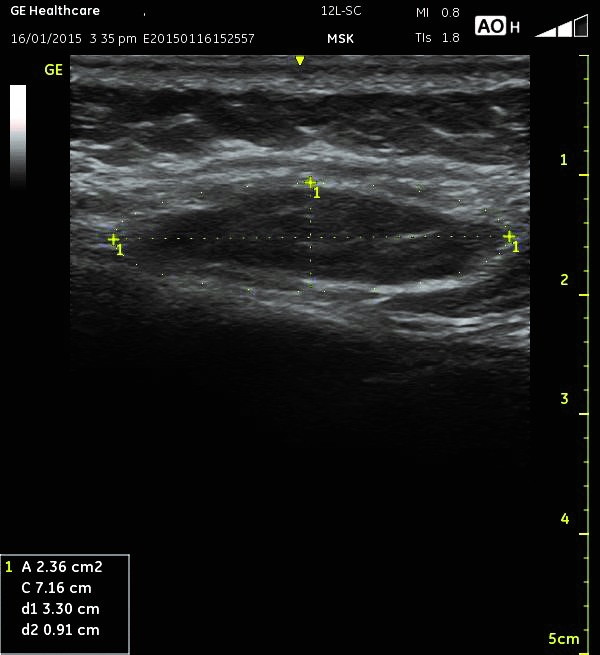
UltrasoundMuscle ultrasound with measurements: oval hypoechoic nodule corresponding to a trigger point, outline and area traced with the probe.
Source : Cojocaru et al., Journal of Medicine and Life, 2015, figure 1 · CC BY
Three signs define the trigger point by international consensus, and a fourth element, the hypothesis that would explain them, rests on two studies of nine subjects each. This chapter separates the clinical description, which is old and stable, from the pathophysiological explanation, which is not.
The myofascial trigger point is described as a hypersensitive spot located in a taut band of skeletal muscle, whose compression reproduces the patient's pain and refers pain at a distance. This description comes from Janet Travell and David Simons, whose manual structured the field for half a century and whose referred pain maps still hang in most clinics. The historical review by Shah, published in PM&R in 2015, retraces its genealogy and asks the question that opens its own abstract: according to Travell and Simons, the trigger point is central to the syndrome, "but is it necessary?" (PMID 25724849).
The three criteria of the 2018 consensus
For want of external validation, the field gave itself a definition by consensus. Fernández-de-las-Peñas and Dommerholt conducted a three-round Delphi study among 60 experts from 12 countries, and derived from it a set of three criteria judged essential to the diagnosis (PMID 29025044) :
- a palpable taut band within the muscle;
- a tender hypersensitive spot within that band;
- the referred pain elicited by pressure on that spot.
Two clarifications from the same panel are often forgotten and change practice. First, 80 % of the experts agree that the referred sensation is not necessarily pain: it may be tingling, burning, heaviness, a dull ache. Second, 84 % hold that the only substantive difference between a so-called active point and a so-called latent one lies in the patient's recognition of their own pain. The panel adds that no precise location should be expected, neither for the point nor for its referral zone, which strips the famous Travell and Simons maps of their status as topographical references.
It is worth knowing what a Delphi consensus is. It is a procedure that makes a definition explicit, reproducible and teachable. It is not a validation: it establishes neither that the object described exists, nor that clinicians will be able to find it again. The next chapter shows precisely that they do not manage it very well.
What the pathophysiological hypothesis rests on, in four figures
The two studies that underpin the "biochemical milieu" and the "visible nodule" are studies of nine subjects. Level of evidence: exploratory research, not transferable to individual diagnostic reasoning.
Ultrasound does distinguish tissue bearing a trigger point from tissue that bears none. It does not distinguish a painful point from a silent one: the size of the nodule is identical in both cases.
The integrated hypothesis, and what actually supports it
The most widespread explanation is that of motor endplate dysfunction: an excessive release of acetylcholine would sustain a localised contracture of a few sarcomeres, which would compress the microcirculation, create local ischaemia and therefore an "energy crisis" preventing relaxation, a circle that closes on itself. It is coherent, it is teachable, and it explains everything, which should already arouse suspicion.
Two bodies of work are regularly cited in its support, and they deserve to be read for what they are.
The first is Shah's in vivo microdialysis study. In nine volunteers, a microprobe placed in the upper trapezius measures the local biochemical milieu. Subjects carrying an active trigger point show higher concentrations of bradykinin, substance P, CGRP, TNF-α, interleukins 1β, 6 and 8, serotonin and noradrenaline, and a lower pH, than those carrying a latent point or unaffected subjects (PMID 18164325). Yet the most interesting result of this study is the one that is never quoted: the same abnormalities are found in the gastrocnemius, an unaffected and distant muscle, in those same subjects. That is not what one expects from a local lesion; it is what one expects from a systemic or central phenomenon.
The second is Sikdar's ultrasound imaging study, also in nine subjects. The trigger point appears as a focal hypoechoic zone, stiffer on vibration elastography, with a mean area of 0.16 ± 0.11 cm², and high-resistance arteriolar flow near the active points (PMID 19887205). Imaging therefore does separate tissue bearing a point from normal tissue. But it does not separate what matters clinically: the authors write that there is no significant difference in size between active and latent points. In other words, what ultrasound sees is not what hurts.
Nine years after that work, Steen's review in Muscle Nerve sums up the situation bluntly: the pathogenesis, diagnostic criteria and classification of myofascial pain syndrome "are still under investigation, which complicates the development of standardised treatment protocols" (PMID 40110636). Thirty-five years after the first edition of the Travell and Simons manual, that is an admission.
How many patients are affected?
The honest answer is: we do not know, and the published figures mostly measure the population in which they were sought.
The most quoted figure comes from a 1989 study. Skootsky examined 172 consecutive patients in a university internal medicine practice; among the 54 whose presenting complaint involved pain, 16, that is 30 %, met the clinical criteria for myofascial pain syndrome (PMID 2788962). The study notes two things that have not aged: the intensity of these pains was comparable to, or even greater than, that of the other causes, and physicians rarely recognised the picture.
At the other end of the spectrum, the prospective multicentre MyCar study assessed 101 patients with incurable cancer entering specialist palliative care: 39 (38.6 %) had myofascial lesions, across 83 sites. The only significant risk factor on multivariate analysis is a poor performance status (OR 3.26; 95 % CI 1.18 to 9.02; p = 0.023), that is to say immobility (PMID 34940848).
Finally, the only prevalence meta-analysis in spinal disorders concludes that the evidence is of low quality, resting on twelve small studies of poor methodology. Chiarotto warns that these estimates "must be considered with caution", because larger studies would probably change them substantially. One result of this review deserves separate mention: latent points are not consistently more frequent in patients with spinal pain than in healthy controls (PMID 26475933). Finding a latent point in someone with back pain therefore teaches nothing about their back pain.
Prevalence figures measure the population, not the disease
Four settings, four figures that do not compare. None gives a general-population prevalence: that datum does not exist.
The figure of 86.2 per cent does not say that myofascial pain syndrome is common: it says that a referral pathway for fibromyalgia selects patients who do not have it. Sample of 29 files, single-centre recruitment.
- The diagnosis rests on three consensus criteria: taut band, hypersensitive spot, referred pain. A consensus is not a validation.
- Active versus latent: the only difference retained by the experts is that the patient recognises their pain. Neither size nor ultrasound appearance separates them.
- The most quoted microdialysis study finds the same abnormalities in a distant, unaffected muscle. That is an argument against the local mechanism, not for it.
- The best established risk factor is not a posture: it is immobility (OR 3.26 for a poor performance status).
- No general-population prevalence is available. The published figures describe care pathways.
What is palpation of trigger points really worth?
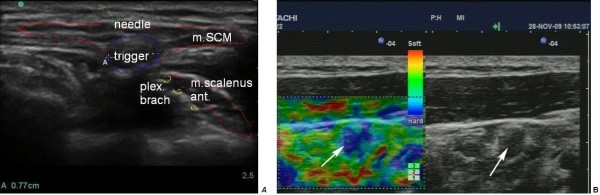
UltrasoundUltrasound of the neck with elastography: the anterior scalene trigger point appears in blue on the stiffness map, arrow, an imaging demonstration of what palpation alone cannot prove.
Source : Bubnov, The EPMA Journal, 2012, figure 1 · CC BY
This is where the concept is most attacked, and this is where the data are clearest. Three systematic reviews, published over nine years by three independent teams, reach the same verdict. All three also say which signs hold up, and that detail can be used directly.
A test that does not reproduce between two examiners cannot be a diagnostic test: if two competent clinicians do not find the same point on the same patient, "the point" is not what they are measuring. That is why inter-rater reliability logically precedes any question of validity, and why this chapter comes before the one on treatments.
The reference meta-analysis
Rathbone, Grosman-Rimon and Kumbhare published in 2017 the only meta-analysis available on the subject. Out of 18 potentially relevant articles, only six met the inclusion criteria (reporting Cohen's kappa, or the data allowing it to be calculated), for a total of 363 patients. The result is a kappa of 0.452 (95 % CI 0.364 to 0.540) (PMID 28098584).
One has to know how to read that number. The Landis and Koch scale, published in Biometrics in 1977 and since become the convention of the field, ranks agreement in six bands: poor below 0, slight from 0 to 0.20, fair from 0.21 to 0.40, moderate from 0.41 to 0.60, substantial from 0.61 to 0.80, almost perfect beyond (PMID 843571). A kappa of 0.452 therefore falls just above the "moderate" line, and the confidence interval reaches down to 0.364, that is to say into the "fair" band.
The authors' conclusion leaves no room for interpretation: "the use of manual palpation for the identification of trigger points is not reliable, and future research should move towards integration with more reliable techniques". They add that only one study allowed intra-rater reliability to be examined: we do not even know whether a practitioner finds their own point again from one session to the next.
The use of manual palpation for the identification of trigger points is not reliable, and future research should move towards integration with more reliable techniques.
Rathbone ATL, Grosman-Rimon L, Kumbhare DA. Clin J Pain 2017;33(8):715-729 : PMID 28098584
The detail sign by sign, which is the useful part
A pooled kappa hides the essential. Rathbone gives the detail, and Lucas had given it eight years earlier on a partly overlapping body of studies. Both say the same thing, and it is counter-intuitive: it is the subjective signs that hold up, and the supposedly objective ones that collapse.
Inter-rater agreement, sign by sign
Cohen's kappa. The shaded bands reproduce the Landis and Koch bands (1977). Lucas's values are ranges across studies, Rathbone's are pooled estimates.
A range that crosses zero means that at least one study measured agreement below chance : two examiners would have done better tossing a coin.
Let us take these four lines one by one, because each has a practical translation.
The localised tenderness obtains the best agreement (κ = 0.676, "substantial"). It is the simplest sign: is this spot painful on pressure? Two examiners agree reasonably well on that.
The recognition of the usual pain follows (κ = 0.575). It is not the examiner who judges: it is the patient who says "yes, that is it, that is my pain". The most reliable sign in the whole file is therefore the one where the clinician merely asks the question.
The taut band collapses: from −0.08 to 0.75 depending on the study and the muscle. Myburgh, who had carried out a critical review in 2008, finds a comparable picture: only three sites prove reproducible, local tenderness of the trapezius (κ 0.15 to 0.62), referred pain of the gluteus medius (0.298 to 0.487) and that of the quadratus lumborum (0.36 to 0.501) (PMID 18503816). His conclusion invites clinicians to "turn to simpler and more global assessments of the patient's condition".
The local twitch response is the worst (−0.05 to 0.57). It is also the one presented as the signature of the trigger point, and the one clinicians try to elicit with the needle to validate the technique. The chapter on safety will show that it has a cost, which makes its status as a target all the more problematic.
Does training change the picture?
That is the first objection, and it is legitimate. Gerwin answered it as early as 1997, in a study published in Pain whose honesty commands respect: it reports a first trial that failed to establish acceptable reliability, then a second, conducted by the same examiners after a period of joint training, which succeeded (PMID 9060014). The study specifies that reliability varies by sign, the local twitch response being "the most difficult", and by muscle.
The right conclusion has to be drawn, and it is neither "so it is reliable" nor "so nothing works". Training a pair of examiners to calibrate on each other improves their agreement: that is expected and it is demonstrated. It says nothing about the agreement between two practitioners trained separately, in two different clinics, which is the real-world situation. And above all: agreement obtained by mutual calibration measures the convergence of the observers, not the existence of the object observed. Two astronomers trained together would have agreed very well on the position of the canals of Mars.
These three reviews are old (2008, 2009, 2017) and the objection "the criteria have changed since" comes up often. Lucas had anticipated it by writing that no study, at that date, had measured reliability against the criteria then proposed. Since the 2018 Delphi consensus, the situation has not changed: no meta-analysis has measured the reliability of the three retained criteria. The viewpoint published by Cook in JOSPT in 2025 calls precisely for tightening the diagnostic criteria for that reason (PMID 40042392).
What this chapter changes in the examination
- Stop trying to objectify the nodule. What the hand believes it feels is not reproducible between two practitioners.
- Put the diagnostic weight on the patient's recognition of the pain. "Is that pain there yours?" is the most reliable question in the whole examination.
- Do not turn the local twitch response into a treatment goal. It is the least reliable sign, and the most costly in soreness.
- Write down what was observed, not what is inferred from it. "Pressure on the upper trapezius reproduces the headache described" is a fact; "active trigger point of the upper trapezius" is an interpretation.
- Be wary of your own reproducibility. Only one study has measured intra-rater reliability: we do not know whether we find our own point again from one session to the next.
Does the trigger point exist? What the two camps say
This chapter gives both positions in their own terms, without arbitrating on their behalf. They coexist in the indexed literature, each has its journals and its authors, and a clinician who had read only one of them would believe themselves informed.
The controversy is not a specialists' disagreement over a detail. It bears on whether the object described (a contracted nodule, sustained by a local vicious circle) exists. It has been published in leading journals, it gave rise to an exchange of letters, and it is not closed.
The two positions, as published
Each box gives its camp's position and its point of agreement with the other. The two camps agree on one point: the patient's pain is real.
The line to remember is in the two white boxes: the critical camp does not deny the pain, and the favourable camp does not defend a settled terminology.
The critical case, in the text
The review by Quintner, Bove and Cohen opens on a methodological observation: the theory of myofascial pain syndrome seeks to explain muscle pain and tenderness in the absence of evidence of local nociception. The authors find that it lacks external validity, and that many practitioners have nevertheless accepted it uncritically, along with the treatment system that follows from it. They then examine two objects separately: the trigger point as a presumed pathological entity, and the vicious circles supposed to sustain it. Their verdict is that these two objects are "inventions that have no scientific basis", whether they are interrogated by the experimental approach, studying the suspect tissue, or by the empirical approach, evaluating the outcomes of treatments based on the presumed pathology. Hence the conclusion: the theory "has been refuted" (PMID 25477053).
The same abstract adds a caveat that a useful article cannot omit:
This is not to deny the existence of the clinical phenomena themselves, for which scientifically sound and logically plausible explanations, based on known neurophysiological phenomena, can be advanced.
Quintner JL, Bove GM, Cohen ML. Rheumatology 2015;54(3):392-399 : doi:10.1093/rheumatology/keu471
That sentence is the heart of the matter. It separates two things that are constantly confused: the clinical fact, this patient has a painful muscle area whose compression wakes up their complaint, and the theoretical explanation, this area is a contracted nodule sustained by an energy crisis. The first is observable every day. The second is, according to these authors, refuted. A physiotherapist can perfectly well work on the first without subscribing to the second; that is in fact what this chapter recommends.
The article was followed by an exchange of letters in the same journal: a reply from Rathbone, Henry and Kumbhare (Rheumatology 2015;54(6):1126-1127, PMID 25832612), and a counter-reply from Quintner, Bove and Cohen opposite (54(6):1127-1128, PMID 25832608). The fact that this exchange exists, and that it led to no shared position, is in itself information about the state of the evidence.
The favourable case, in the text
The camp that defends the concept does not claim that everything is demonstrated. Shah, in his PM&R review, writes that the scientific literature of the field "often appears disjointed and confusing", and that "much of the terminology, theories, concepts and diagnostic criteria are inconsistent, incomplete or controversial". His thesis is that the imaging, biochemistry and brain neuroimaging work carried out since the 2000s brings objective elements: the peri-nodular tissue milieu, neurogenic inflammation, sensitisation and a dysfunction of the limbic system would play a role in the onset, amplification and maintenance of the syndrome (PMID 25724849).
It is a defensible position, and it is worth noting what it concedes: it shifts the explanation from the local nodule towards a set of mechanisms, several of which are central. Yet if the explanation becomes central, the justification for the local technique weakens accordingly. The favourable camp and the critical camp converge more than they say: both end up invoking known neurophysiological mechanisms rather than a specific muscle pathology.
A 2026 systematic review on the neurophysiological effects of dry needling gives an idea of what this shift produces as results. Across fourteen studies, four of them in animals, it records variations in numerous biomarkers (β-endorphin, substance P, CGRP, acetylcholine, interleukins), but a small effect on conditioned pain modulation (SMD 0.36; 95 % CI 0.05 to 0.67) and none on temporal summation (SMD −0.08; 95 % CI −0.44 to 0.27) (PMID 40921318). Plenty of molecules move; the two functional measures of central pain processing, hardly at all.
The viewpoint that arbitrates, and that is the most useful
In February 2025, the JOSPT published a viewpoint signed by Cook, Degenhardt, Fernández-de-las-Peñas and others, that is to say, notably, by authors from both sides. It does not settle the question of existence; it names three flaws and proposes three remedies (PMID 40042392).
First flaw: the diagnosis lacks consistent criteria and is exposed to two named biases. The verification bias arises when only patients already suspected undergo the reference test: the negatives are never verified, and the test appears to perform better than it does. The incorporation bias is more radical: it arises when the test under study is part of the reference standard used to judge it. That is exactly the situation of the trigger point. Lucas wrote it in his very first line: "there is no accepted reference standard for the diagnosis of trigger points" (PMID 19158550). Palpation is both the test and the yardstick. No validity result can come out of such a set-up.
Second flaw: the mechanisms are poorly understood and the symptoms overlap other pictures. The proposed remedy is standardised recording in national registries, including psychological stress and systemic factors, in order to identify distinct phenotypes. That amounts to acknowledging that today "myofascial pain syndrome" probably designates several things.
Third flaw: we do not know how the treatments work, including myofascial release and acupuncture, which are named explicitly. The authors argue for mechanistic trials. The chapter on the evidence shows how heavily this gap weighs.
What a clinician can do with this from tomorrow
- The disagreement bears on the explanation, not on the observation. Nobody disputes that pressure on a muscle can reproduce a familiar pain.
- The diagnosis of a "trigger point" is circular by construction: the test is its own yardstick. That is not a flaw in execution, it is a flaw in the set-up.
- A central explanation makes the local technique less justifiable as an end, which does not prevent using it as a means.
- Telling the patient about a "knotted muscle" or a "stuck fibre" amounts to selling them the refuted theory. Describing a tender area whose compression wakes up their pain is accurate, and commits to nothing.
How can myofascial pain syndrome be distinguished from fibromyalgia?
This is the classic differential diagnosis, and it is more slippery than it looks: fibromyalgia has published and validated criteria, myofascial pain syndrome has none. The comparison is therefore not symmetrical, and the most frequent error does not run in the direction people expect.
The two pictures resemble each other on the surface: chronic muscle pain, tenderness to pressure, effects on sleep and mood. The distinction taught since the 1990s rests on a simple opposition: fibromyalgia is diffuse and gives tender points without referred pain; myofascial pain syndrome is regional and gives trigger points with referred pain. That opposition remains a useful starting point, but it is dated on both sides.
What has changed on the fibromyalgia side
Tender points are no longer used for diagnosis. The revised 2016 criteria, published by Wolfe and colleagues, rest on a widespread pain index and a symptom severity scale, with no palpation at all (PMID 27916278). Comparing "tender points" and "trigger points" therefore amounts to setting an abandoned sign against an unvalidated one.
The conceptual framework has changed too. Fibromyalgia is today the textbook example of nociplastic pain, for which Kosek, Clauw, Nijs and colleagues published the clinical criteria and grading system in 2021 in Pain (PMID 33974577). The site covers this mechanism in detail in the article devoted to fibromyalgia; the present article confines itself to what separates the two pictures in consultation.
The real direction of the misunderstanding
We are taught that myofascial pain syndrome is over-diagnosed in fibromyalgia patients. A Japanese study published in 2026 suggests that the error runs massively the other way, at least in referral settings. Hadano and colleagues reviewed the files of patients referred to a university hospital between 2018 and 2022 with a diagnosis of confirmed or suspected fibromyalgia: out of 29 files, 25 (86.2 %) were reclassified as myofascial pain syndrome after review, on the basis of regional pain, trigger points and taut bands (PMID 42164247).
Three limitations must accompany this figure wherever it is quoted, and the authors state them themselves: the sample is 29 files, the study is retrospective and single-centre, and the review was carried out by a single author, using, precisely, an examination that the previous chapter showed to be unreliable between observers. This result is not a prevalence; it is an alert.
What it does contribute solidly lies in the compared clinical features. The group reclassified as myofascial pain syndrome was older, responded better to local treatments and reported less fatigue. But, and this is the point that explains the confusion, a substantial proportion of these patients had upper back pain and diffuse pain, two features spontaneously attributed to fibromyalgia.
| Criterion | Myofascial pain syndrome | Fibromyalgia | Discriminant value |
|---|---|---|---|
| Nosological status | No ICD-11 code of its own; attached to MG30.02, chronic primary musculoskeletal pain | Coded MG30.01, chronic widespread pain; revised 2016 ACR criteria | high One is defined, the other is not |
| Distribution | Regional, one or a few muscles, with referral at a distance | Diffuse, at least 4 regions out of 5 under the 2016 criteria | moderate Hadano 2026 finds diffuse pain in the myofascial group |
| Palpation | Trigger point: κ = 0.45 between examiners | Tender points abandoned by the 2016 criteria | low An unvalidated sign against a withdrawn one |
| Fatigue and sleep | Less marked (Hadano 2026) | Constitutive of the severity score | moderate Useful in practice, never sufficient |
| Response to local treatment | Better (Hadano 2026) | Poor; graded exercise and education come first | moderate A criterion ex post, not an entry criterion |
| Age | Higher in the reclassified series | Younger in the same series | low 29 files, single-centre |
The two pictures can coexist
The debate over the boundary hides a more mundane possibility: that there is not always one. Fernández-de-las-Peñas and Arendt-Nielsen argued in Pain Management for "two different but overlapping disorders": preliminary data suggest that the overall spontaneous pain of fibromyalgia patients is partly reproduced by the referred pain of active trigger points, and that treating those points would modulate the central nervous system. The authors themselves call these data preliminary and the results contradictory (PMID 27296946). Bourgaize and colleagues reach a similar conclusion in 2018: the distinction rests largely on identifying tender points or trigger points, there is no standardised diagnostic protocol for myofascial pain syndrome, and the result is inconsistency between practitioners (PMID 30270926).
The practical approach that follows is less spectacular than the debate, and safer. One does not choose between two labels: one describes what is observed (the extent of the pain, the presence or absence of recognised referral, fatigue, sleep, the response to treatments already tried) and adapts the active workload accordingly. A patient whose pain is widespread, whose fatigue is major and whose sleep is destroyed will get little out of a session of deep compression, whatever name is given to their picture.
- The tender points have no longer been used to diagnose fibromyalgia since 2016. The tender points versus trigger points opposition is obsolete.
- In referral settings, the misunderstanding runs rather from fibromyalgia towards myofascial pain syndrome (86.2 % of reclassifications across 29 files).
- The features that really help: extent of the pain, fatigue, sleep, response to local treatments. None is decisive on its own.
- The two pictures coexist in some patients. The useful question is not "which of the two" but "how much load does this patient tolerate today".
What red flags hide behind "myofascial pain"?
The "myofascial" label has a dangerous property: it is available for any muscle pain, it requires no further investigation, and it explains treatment failure by chronicity rather than by error. That is the typical profile of a diagnosis that delays the others.
A diagnosis of exclusion with no entry criterion becomes a diagnosis by default. Since palpation does not reproduce between examiners, since no test disproves it, and since the picture is by definition "chronic and regional", a persistent muscle pain can stay labelled "myofascial" for months without anyone having a reason to reopen the file. That is precisely what makes the list below non-negotiable.
Red flags in pain attributed to trigger points
- A palpable mass, even soft, even painless, that does not behave like a contracture → imaging before any continuation of manual treatment. An 8 × 4 cm desmoid tumour of the rhomboids was treated as myofascial pain syndrome until an examination found the mass (PMID 37799261).
- Constant night pain, unchanged by position, with deterioration in general condition, fever or a history of cancer → pain that depends neither on posture nor on load is not mechanical, whatever the tenderness on palpation.
- Objective neurological deficit, dermatomal distribution, absent reflex → the referred pain of a trigger point does not follow a dermatome and is not accompanied by a deficit. A radiculopathy deserves its own examination: see cervicobrachial neuralgia.
- Recent-onset chest or scapular pain in a patient at cardiovascular risk → referred pain of visceral origin can mimic a muscular picture of the shoulder girdle. It is the context, not palpation, that decides.
- Progressive worsening despite well conducted treatment, or unexplained weight loss → reassess the diagnosis, not the technique. Myofascial management that fails three months running is not management to be intensified.
- Persistent post-operative pain with muscle wasting and mechanical allodynia → a delayed myofascial picture after surgery does exist and is documented (PMID 41069897), but it first requires an established nerve lesion to be ruled out.
- Restricted mouth opening, clicking, preauricular pain → the temporomandibular side calls for a dedicated examination: see temporomandibular joint syndrome.
The first of these points deserves detail, because it illustrates the mechanism of error better than any general principle. The case reported by Chu and Sabourdy in Cureus concerns a 30-year-old woman consulting for persistent right-sided neck pain, diagnosed as myofascial pain syndrome, and unimproved after several treatments. It was the physical examination (looking for a mass, not for a point) that found a swelling of the upper trapezius and rhomboid region; MRI showed an 8 × 4 cm intramuscular lesion, and biopsy a sporadic desmoid tumour, which was surgically excised (PMID 37799261).
What allowed the catch-up was not a sophisticated test: it was treating the absence of response as information rather than as an inevitability. The practical rule that follows fits in one sentence: myofascial treatment that achieves nothing in four to six sessions should reopen the diagnosis, not increase the dose.
Which modalities have evidence, and of what level?
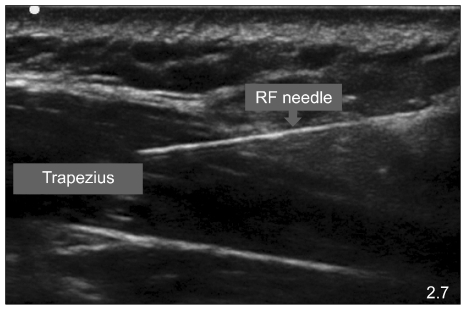
UltrasoundUltrasound of the trapezius: ultrasound-guided radiofrequency needle targeting the trigger point, muscle and needle labelled directly on the image.
Source : Park et al., The Korean Journal of Pain, 2012, figure 1 · CC BY-NC
This chapter replaces the list of techniques with a table of certainty. The question is not "which techniques are available", they are countless, but "what is demonstrated, over what horizon, and with what degree of confidence". The GRADE levels reported here are those the reviews themselves publish, never an added appraisal.
A reading warning is needed from the outset. Almost everything that follows is measured in the short term, on modest samples, against often weak comparators. That is not a flaw in this table: it is the state of the field, and the table makes it visible rather than smoothing it over.
What is demonstrated, by degree of certainty
Stacked cards, from the most certain to the least certain. Each line carries the GRADE wording as the source review publishes it.
The best established line in the file is not a passive technique: it is a set of interventions that encourage movement and adaptation, measured on 8,713 patients.
The full table, modality by modality
| Modality | Comparator and time point | Measured effect | Certainty | Source |
|---|---|---|---|---|
| Trigger point manual therapy | Placebo, chronic temporomandibular pain | RD 32 % (95 % CI 29 to 34) of achieving the minimal important improvement | moderate to high | Yao 2023 PMID 38101924 |
| Supervised exercise, stretching, posture | Placebo, same population | RD 23 to 30 %, including for "usual care" | moderate | Yao 2023 PMID 38101924 |
| Dry needling | Sham, nothing or another treatment, 1 to 3 weeks | SMD −0.69 (95 % CI −1.02 to −0.35) | moderate | Sánchez-Infante 2021 PMID 33609356 |
| Dry needling | Same comparators, 72 h / 4-12 wks / 13-24 wks | SMD −0.81 / −0.85 / −0.81, wide intervals | low heterogeneity | Sánchez-Infante 2021 PMID 33609356 |
| Dry needling by a physiotherapist | Sham or another treatment, immediate to 12 weeks | Pain ↓ and pressure threshold ↑ | very low to moderate | Gattie 2017 PMID 28158962 |
| Dry needling, 6 to 12 months | Sham or another treatment | Not significant. "Long-term benefit is currently lacking" | no conclusive data | Gattie 2017 PMID 28158962 |
| Dry needling, neck pain | Sham / waiting list, immediate then short term | MD −1.53 then −2.31; nothing in the medium term | low to moderate | Navarro-Santana 2020 PMID 33066556 |
| Dry needling versus manual therapy | Direct comparison, short to medium term | No difference on pain, pressure threshold or neck disability | low 6 trials, 241 patients | Lew 2021 PMID 32962567 |
| Dry needling added to stretching | Stretching alone | ES −1.73 (95 % CI −3.06 to −0.40) | low 4 trials out of 5 at unclear risk | Guzmán-Pavón 2024 PMID 39593416 |
| Injection versus dry needling | Cervical muscles, short term | MD −2.13 in favour of injection; nothing on disability or mobility | low very low for the rest | Navarro-Santana 2022 PMID 34114639 |
| Ischaemic compression | Inactive control, pressure threshold | SMD 0.67 (95 % CI 0.35 to 0.98): tolerance to pressure | not graded 11 studies, 427 subjects | Lu 2022 PMID 36050701 |
| Ischaemic compression | Inactive control, self-reported pain | SMD −0.22, not significant (95 % CI −0.53 to 0.09) | not graded 7 studies, 251 subjects | Lu 2022 PMID 36050701 |
| Ischaemic compression, neck pain | Sham or nothing, immediate and short term | Significant differences on pain, threshold and range of motion, at odds with Lu 2022 | not graded 15 trials, 725 patients | Xu 2023 PMID 36872769 |
| Extracorporeal shockwave therapy | Sham or ultrasound, trapezius | Pain reduction; no difference against needling, injection or laser | not graded 10 trials, 477 patients | Zhang 2020 PMID 32234411 |
| Low-level laser | Placebo or active control, myofascial neck pain | Pain MD −1.29; disability not improved (MD −7.83, p = 1.34) | not graded 13 trials, 556 patients | Tehrani 2022 PMID 35962884 |
| Manual therapy, laser, shockwave, ultrasound | No treatment, network meta-analysis | Pain MD −1.60 / −1.15 / −1.61 / −1.54 | not graded 40 trials | Liu 2024 PMID 37939115 |
| Botulinum toxin A | Saline, neck and shoulder | WMD −10.22 out of 100: statistically significant, below the clinical threshold | moderate certainty of an absence of useful effect | Saltychev 2025 PMID 40237694 |
| NSAIDs, diclofenac, TENS | All populations | Evidence insufficient | insufficient | Steen 2025 PMID 40110636 |
| Muscle relaxants, antidepressants, gabapentin, opioids, topical lidocaine, kinesio taping | All populations | Inconclusive | inconclusive | Steen 2025 PMID 40110636 |
One 2023 review stands out in this landscape for its markedly more affirmative conclusion: reviewing the trials and meta-analyses published between 2000 and 2023 on dry needling for low back myofascial pain, Dach and Ferreira conclude that it is "an effective procedure" in both acute and chronic low back pain (PMID 38157883). It is worth looking at what that conclusion is made of: out of 509 references screened, it rests on four randomised trials and two meta-analyses, with variable outcome measures and follow-up durations, and the authors themselves call for better quality work to establish the long-term outcome. It is a positive conclusion backed by six studies: it does not contradict the more cautious reviews, it covers less material.
Three readings of this table
The disagreement over ischaemic compression is real and instructive. Lu concludes in 2022 that compression "only increased pressure tolerance" and that "there is no evidence of a benefit on self-reported pain". Xu concludes in 2023 that compression can be recommended for immediate and short-term relief. Both reviews are indexed, methodologically comparable, published a year apart. They differ in their population, all sites versus neck pain, and in the comparators retained. An article quoting only one of the two would mislead its reader, and that is common in both directions.
The pressure threshold is not the pain. The ischaemic compression file shows this within one and the same meta-analysis: pressure tolerance rises clearly, the pain the patient reports does not move. These are two distinct measures, and it is the second that interests the patient. Many trials in the field favour the first, more sensitive and easier to shift: that is a general reading warning.
What wins is not what was expected. In the only leading network meta-analysis in the file (the one in the BMJ, 153 trials, 8,713 participants), trigger point manual therapy achieves a 32 % risk difference, which is excellent. But it is outperformed by cognitive behavioural therapy combined with biofeedback (36 %) and by therapist-assisted mandibular mobilisation (36 %), and the authors conclude that, restricted to moderate or high certainty evidence, it is the interventions "that promote adaptation and encourage movement and activity" that best reduce pain (PMID 38101924). Work on the trigger point has its place in that list; it is not the top of it.
Once restricted to moderate or high certainty evidence, the interventions that promote adaptation and encourage movement and activity proved the most effective in reducing chronic temporomandibular pain.
Yao L et al. BMJ 2023;383:e076226 (153 trials, 8,713 participants), PMID 38101924
- The dry needling has short-term data, of low to moderate certainty, and none at 6-12 months.
- Needling and trigger point manual therapy are on a par in direct comparison. The choice therefore rests on patient preference and available competence, not on the evidence.
- Ischaemic compression increases pressure tolerance; its effect on reported pain is the subject of disagreement between two meta-analyses.
- Botulinum toxin is the only case where certainty is moderate for an absence of useful effect. That is positive information: it allows us not to refer patients for it.
- What has the best certainty, in the largest meta-analysis available, are the interventions that get people moving again.
Does dry needling do better than its placebo?
The question deserves a chapter of its own, because it has received a precise methodological answer, rarely quoted, and because it applies to all musculoskeletal physiotherapy, not only to the needle.
A trial comparing an active needle with a sham needle runs into a practical difficulty: it is hard to make a patient believe a needle is being inserted when it is not, and harder still to hide from the therapist what their hands are doing. That difficulty is not anecdotal: large meta-epidemiological studies have long shown that absent or insufficient blinding leads to overestimating effects.
What Braithwaite measured
Braithwaite and colleagues searched twelve databases from inception to February 2016 for trials comparing active dry needling with a sham simulating needling. Twenty-four trials were eligible. The methodological sorting sets the scene: in nineteen of them the risk of bias was high or unclear; only five were properly blinded; and blinding had been assessed and reported usably in only ten (PMID 30083458).
The result fits in one sentence: for pain in both the short and long term, the pooled effects of the insufficiently blinded trials were statistically significant in favour of active needling, whereas no difference between the active group and the sham group appeared in the properly blinded trials.
What becomes of the effect of dry needling when blinding holds
24 trials comparing active with sham needling, sorted by quality of blinding. The result changes direction with the sorting.
The sorting does not change the size of the effect, it changes its statistical direction. That is the signature of an effect largely carried by expectations rather than by the needle.
The authors are explicitly cautious, and that caution is part of the result: the small number of trials and their small size make the demonstration insufficient for a definitive conclusion. They nevertheless write that, subject to those reservations, "the available data suggest that inadequate blinding procedures could lead to exaggerated intervention effects in dry needling trials".
What this result does not mean
It does not mean that the patient is not better. It means that what relieves them is probably not the insertion of the needle as such.
That is a crucial nuance, and it is not aimed at the needle in particular. Ezzatvar and colleagues quantified in 2024, in the JOSPT, the share of the effect of physiotherapy interventions that is not attributable to their specific mechanism. Across 54 placebo-controlled trials and 3,793 participants, that share reaches 88 % for mobilisation (PCE 0.88; 95 % CI 0.57 to 1.20) on immediate pain, 81 % for manipulation in the short term, 86 % for mobilisation in the long term, 64 % for taping on disability, and 46 % for exercise (PMID 38602164).
The outcomes of physiotherapy interventions in musculoskeletal pain are significantly influenced by factors not attributable to the specific effects of those interventions. Consciously enhancing them to improve therapeutic outcomes represents an ethical opportunity from which patients can benefit.
Ezzatvar Y et al. J Orthop Sports Phys Ther 2024;54(6):391-399 : PMID 38602164
Two lessons follow, and they point the same way.
First, exercise is the modality whose specific share is the largest of those the review quantifies: 54 % of its effect belongs to it in its own right, against 12 % for mobilisation. When it comes to choosing where to invest session time, that is an argument with figures behind it.
Second, the non-specific share is not a fraud to be hidden: it is a lever to be worked on explicitly, clear explanation, realistic expectations, therapeutic alliance, contact, environment. The difference between using that lever and deceiving the patient lies in what we tell them. Promising "I am going to unknot this muscle" is false; saying "this technique often gives relief for a few days to a few weeks, and it opens a window for us to put movement back in place" is true, and produces the same non-specific benefit.
What to remember about the placebo effect
- In dry needling trials that are properly blinded, the active needle and the sham needle give the same result. There are five of them out of twenty-four.
- This finding is not specific to the needle: 88 % of the effect of mobilisation is not attributable to its specific mechanism.
- Exercise is the modality that keeps the largest specific share (54 %). That is an argument about how session time is allocated.
- Using the contextual effect is not deceiving: what we tell the patient is what makes the difference.
What are the real risks, and how should they be announced?
Two large prospective surveys quantify the adverse events of dry needling. They do not give the same figure, and the gap between the two is itself information about what can be promised.
Safety is the only area of this file where prospective data on tens of thousands of procedures are available. It therefore deserves to be announced precisely, all the more so since informed consent requires it.
Adverse events of dry needling: two prospective surveys
The same procedure, two countries, two data-collection protocols. The gap on minor events is twofold.
The honest figure to give the patient is not the more flattering of the two: roughly one procedure in three is followed by a minor inconvenience, and serious events are rare but not nil.
Brady and colleagues followed 39 Irish physiotherapists over ten months: 1,463 mild adverse events for 7,629 treatments (19.18 %), and no serious event, which gives an estimated upper risk of 0.04 % (PMID 25125935). The most frequent are bruising (7.55 %), bleeding (4.65 %), pain during (3.01 %) and after (2.19 %) the procedure. Then come symptom aggravation (0.88 %), drowsiness (0.26 %), headache (0.14 %) and nausea (0.13 %).
Boyce and colleagues surveyed 420 American physiotherapists over six weeks, covering 20,464 sessions : 7,531 minor events, that is 36.7 % of sessions, dominated by bleeding (16 %), bruising (7.7 %) and pain during the procedure (5.9 %). Twenty major events were reported, that is under 0.1 %, roughly one per one thousand and twenty-four sessions. No association was found between the frequency of events and the practitioner's age, experience or level of training (PMID 32089962).
This last point deserves emphasis, because it contradicts a convenient intuition: it is not experience that protects. Both surveys conclude that dry needling is a safe procedure, and the safety figure holds. But the twofold gap on minor events is a reminder that neither of these surveys is an exhaustive registry: they are voluntary reports from trained practitioners, over short periods.
Faced with a needle: what the two surveys classify as a major event
- Pneumothorax → this is the first of the three categories Boyce collected under the heading "major adverse event", along with excessive bleeding and prolonged aggravation (PMID 32089962). Twenty such events over 20,464 sessions, that is roughly one per thousand.
- Excessive bleeding → to be distinguished from ordinary bleeding, which affects 4.7 to 16 % of sessions depending on the survey and is not a major event.
- Prolonged aggravation → not to be confused with post-needling soreness, expected in most patients and proportional to the number of insertions (PMID 29857165).
- Neither age, nor experience, nor the practitioner's level of training was associated with the frequency of events. Seniority therefore does not exempt anyone from site precautions.
- Unsourced caution, flagged as such: neither survey reports any patient selection protocol. Bleeding disorders, anticoagulant treatment, local skin infection and patient refusal are matters for clinical reasoning and the legal scope of practice, not for these data.
Post-needling soreness is not an adverse event: it is a dose-related consequence
Martín-Pintado-Zugasti and colleagues randomised 120 patients with an active trigger point of the upper trapezius into four groups, according to the number of local twitch responses elicited: none, four, six, or until exhaustion. Post-needling soreness appeared in most subjects, and the groups in whom twitches were elicited had more of it. The number of insertions was associated with the intensity of the soreness, whereas psychological factors were not (PMID 29857165).
Let us relate this to the chapter on reliability. The local twitch response is the sign with the worst inter-rater agreement (κ from −0.05 to 0.57), and it is the one clinicians target and multiply, at the price of proportional soreness. Seeking the maximum number of twitches therefore amounts to maximising a measured inconvenience in pursuit of an unreliable sign, without any data establishing that the clinical outcome improves as a result. This is the kind of reasoning that training in levels of evidence can defuse, and that the site sets out on the page evidence-based practice.
- Roughly one procedure in three is followed by a minor inconvenience: bleeding, bruising, pain. That is the figure to announce, not the lower of the two.
- Serious events are rare but not nil: between 0 per 7,629 procedures and 1 per 1,024.
- Neither age, nor experience, nor level of training was associated with the frequency of events.
- Multiplying local twitches increases soreness with no established clinical benefit. One informed insertion is worth more than a series for the sake of demonstration.
What do published case reports teach us?
Four indexed cases, chosen because they teach four different things: what the label hides, what it sometimes genuinely explains, what a complete treatment contains, and what a series of three patients does not demonstrate.
The case to keep in mind: the tumour mistaken for myofascial pain syndrome
A 30-year-old woman consults in a clinic for severe, persistent pain in the upper right side of the neck. The diagnosis made is myofascial pain syndrome, and several treatments follow one another without significant improvement. It is the physical examination, carried out once more, that finds a soft-tissue mass of the right upper trapezius and rhomboid region. MRI shows an intramuscular lesion of 8 × 4 cm in the rhomboids; biopsy concludes a sporadic desmoid tumour. After surgical excision, a twelve-week rehabilitation programme restores range, strength and comfort (Chu and Sabourdy, Cureus 2023, PMID 37799261).
Three elements of this case deserve to be singled out. The first is the atypical location: the authors stress that the rhomboid is an uncommon site for a desmoid tumour. The second is that nothing in the initial presentation departed from the usual picture: severe unilateral neck pain is the most ordinary presenting complaint there is. The third is the real warning sign: the absence of response to successive treatments. That is not a clinical sign, it is a follow-up fact, and it only appears if someone keeps count of the sessions and their outcome.
The case where the label really explains something
A 48-year-old man develops persistent right anterior chest pain a year after a total aortic arch replacement. Chronic post-surgical pain is usually attributed to neuropathic, genetic or psychosocial causes; musculoskeletal causes are often overlooked. Examination finds postural asymmetry, wasting of the right pectoralis major, mechanical allodynia and trigger points near the cannulation site and the scapula. Ultrasound shows disorganised architecture of the pectoralis major and adjacent connective tissue. Five fortnightly sessions combining pregabalin, ultrasound-guided injections and pectoral nerve blocks achieve significant relief, resolution of the allodynia and improved posture (Watanabe et al., Cureus 2025, PMID 41069897).
This case is the exact mirror of the previous one. Here the myofascial hypothesis did not delay the diagnosis: it moved it forward, because it was made after a nerve lesion had been considered, and because it rested on an identified lesional mechanism, local muscle trauma at the cannulation site. A myofascial hypothesis that names its cause is worth more than a myofascial hypothesis that names none.
The case that shows what a treatment that works contains
A 15-year-old girl consults for restricted mouth opening of one year's duration, with severe bilateral preauricular pain and clicking. The pain, at first dull, became spontaneous, sharp and radiating, resistant to the usual analgesics. A psychosocial stressor is identified as the trigger. Examination finds marked tenderness of several craniofacial and cervical muscles, consistent with myofascial pain syndrome. Management combines drug treatment, TENS, moist heat, cervical manipulation, psychological support and a periodically adjusted occlusal splint. Over fifteen sessions the pain goes from 8/10 to 5/10, then disappears completely, with mouth opening back to 45 mm within six weeks (Ghafoor and Naved, J Pak Med Assoc 2025, PMID 40751624).
What this case illustrates is none of the techniques taken in isolation: it is that they were applied together, over a year of evolution, with a named and managed triggering factor. That matches exactly what the BMJ network meta-analysis finds in this same population: it is the interventions that promote adaptation that achieve the best results of moderate to high certainty (PMID 38101924). The temporomandibular side is covered in its own right in the article devoted to the temporomandibular joint.
The series that must be read for what it is worth
Fusco and colleagues report three patients (aged 45, 55 and 65) with piriformis syndrome and buttock pain radiating into the sciatic distribution, all having failed drug treatment. Ultrasound-guided dry needling of the piriformis and the three gluteal muscles, with continuous monitoring of the needle tip, was carried out over ten days; the symptoms had disappeared at six-month follow-up, with no adverse event (J Chiropr Med 2018, PMID 30228811).
This result is encouraging and demonstrates nothing. Three patients, no control group, spontaneous recovery impossible to rule out: that is the definition of a case series, and the lowest level of evidence in the hierarchy. Its value lies elsewhere: it documents a technique, a landmark-based approach and an absence of complications. Piriformis syndrome is, moreover, an example of the overlaps that Cook calls for untangling: the site devotes a dedicated article.
- to it the absence of response to successive treatments. But someone has to keep count of it.
- A myofascial hypothesis that names its cause (local trauma, immobility, an identified stressor) is worth more than a hypothesis by default.
- The cases that succeed combine several levers, including work on the context: rarely a technique on its own.
- A series of three patients with no control does not demonstrate efficacy, even with six months of follow-up.
How can we act despite a fragile evidence base?
Everything above could lead to doing nothing. That would be a misreading: the patient is in pain, palpation reproduces something recognisable, and several interventions relieve it, in the short term, with a large contextual share, which is still relief. This chapter draws a course of action from it.
The principle that organises everything: never promise more than what is demonstrated
The fragility of the evidence does not forbid treating. It forbids promising. Three common formulations and what can be substituted for them:
| Common formulation | Why it is a problem | Defensible formulation |
|---|---|---|
| "You have a knot in this muscle, I am going to undo it." | Sells a theory described as an invention with no scientific basis by a review in Rheumatology, and promises an unmeasurable structural result. | "This area is tender and pressing on it wakes up your pain. Let us see whether working on it relieves you enough to put movement back in." |
| "The needle will release the contracture." | Properly blinded trials do not distinguish the active needle from the sham needle. | "This technique often gives relief for a few days to a few weeks. What it buys us is time for the active work." |
| "If we do not treat it, it will settle in." | No natural-history data support this threat. | "What most aggravates persistent muscle pain is immobility: it is the best established risk factor." |
A five-step approach
Approach to persistent regional muscle pain
The order of the questions, not the order of the techniques. Each step can stop the process or redirect it.
No step of this approach depends on the examiner perceiving a nodule: that is deliberate, since it is the least reproducible sign of the examination.
What this framework changes concretely in the session
The choice of technique ceases to be an issue. Dry needling and trigger point manual therapy cannot be separated in direct comparison: neither on pain, nor on the pressure threshold, nor on neck disability (PMID 32962567). We can therefore choose according to the patient's preference, their relationship with needles, the competence available and the legal framework: four criteria that are not makeshift but the only ones left when the evidence does not decide.
Session time is reallocated. If the passive technique only opens a window, it does not have to fill the whole session. Devoting ten minutes to local work and the rest to movement, load and explanation is consistent with what the specific share of exercise shows, and with the conclusion of the BMJ on interventions that encourage activity.
Follow-up becomes a diagnostic tool. Keeping count of the sessions and their outcome is not paperwork: it is what turns a failure into information. A patient-centred functional scale serves that follow-up better than a pain score out of ten, because it measures what the patient wants to get back: the site offers the patient-specific functional scale in an interactive version.
The risk factors to work on are not the ones people think. The only significant factor on multivariate analysis in the largest prospective study is a poor performance status, that is to say immobility (OR 3.26; 95 % CI 1.18 to 9.02, PMID 34940848). Not a working posture, not a theoretical muscle imbalance: the fact of no longer moving. That is an accessible target.
Neighbouring pictures must stay open. Persistent neck pain with trigger points falls first under the approach to non-specific neck pain; low back pain under that of non-specific low back pain; a headache under that of cervicogenic tension-type headache. The trigger point is not a diagnosis that replaces these approaches, it is an examination finding that fits into them. The clinical practice guideline of the JOSPT on neck pain, revised in 2017, proceeds in exactly this way: it reasons by categories of patients and by interventions, not by a myofascial entity (PMID 28666405).
The approach on one page
- Ask about the red flags before palpating. None of them is found by palpation.
- Have the patient recognise the pain rather than trying to feel a nodule. It is the most reliable sign of the examination.
- Choose the technique with the patient: manual and needle are on a par, so preference becomes a legitimate criterion.
- Ten minutes of local work, the rest active. It is exercise that keeps the largest specific share.
- Reassess at four to six sessions. A failure is information about the diagnosis, not about the dose.
- Promise only short-term relief: that is what the data allow, and it is already a great deal for the patient.
Frequently asked questions
Do trigger points really exist?
The answer depends on what is meant by "exist". The clinical phenomenon, a muscle area whose compression reproduces a familiar pain and refers it at a distance, is observed daily and nobody disputes it, not even the most critical authors (PMID 25477053). The anatomical object described by the theory, a contracted nodule sustained by a local energy crisis, is contested down to its founding principle. Two examiners agree only moderately on its location (κ = 0.452), and ultrasound does not distinguish a painful point from a silent one. One can therefore work on the phenomenon without subscribing to the explanation.
Should we stop palpating?
No. We should stop expecting palpation to make a diagnosis. What retains value is what the patient answers: recognition of their usual pain achieves the best agreement after simple local tenderness (κ = 0.575 against 0.676). Myburgh was already advising in 2008 that clinicians turn to "simpler and more global" assessments of the patient's condition (PMID 18503816).
Is dry needling more effective than manual therapy?
No, according to the only meta-analysis comparing them directly. Across six randomised trials and 241 participants with myofascial pain syndrome of the neck and upper back, the difference between dry needling and trigger point manual therapy is significant neither on the visual analogue scale, nor on the pressure pain threshold, nor on the neck disability index. Both improve pain and function in the short and medium term, "neither is superior to the other" (PMID 32962567).
How many sessions before concluding failure?
No data set this threshold: four to six sessions is a convention of caution, not a study result, and this article flags it as such. What is documented, however, is the cost of not asking the question: in the desmoid tumour case published in 2023, it was the absence of improvement after "several treatments" that eventually reopened the file (PMID 37799261). The useful rule is less a number than a habit: decide in advance when you will reassess.
Can we tell a patient they have a "knot" in the muscle?
It is a convenient image and it is false. It conveys exactly the theory that the critical review in Rheumatology calls an invention with no scientific basis, and it installs in the patient the idea of a mechanical fault to be corrected, and therefore a dependence on the technique that would correct it. Describing what is actually observed is just as simple and commits to nothing: "this area is tender, and pressing on it wakes up your pain".
Do trigger points cause tension-type headache?
It is a proposed model, not an established fact. Fernández-de-las-Peñas and colleagues put forward in 2007, in Cephalalgia, an updated pain model for chronic tension-type headache in which the trigger points of the cervical, cranial and shoulder muscles would constitute the primary hyperalgesic zones driving central sensitisation (PMID 17359516). A model is a structured hypothesis: it guides research, it does not conclude. The clinical approach to a headache remains the one described in the dedicated article.
Should we try to elicit the local twitch response?
Two findings suggest refraining from making it a goal. It is the sign with the worst inter-rater agreement, from −0.05 to 0.57 depending on the study, that is to say sometimes worse than chance (PMID 19158550). And it is the one whose pursuit costs the patient most: in a randomised trial of 120 patients, the groups in whom twitches were elicited showed significantly more post-needling soreness, in proportion to the number of insertions (PMID 29857165). No data establish that increasing their number improves the clinical outcome.
Can myofascial pain syndrome turn into fibromyalgia?
No longitudinal study documents such a transformation, and asserting it would turn a hypothesis into a threat. What is described is an overlap: some patients present both pictures, and preliminary work suggests that part of the spontaneous pain of fibromyalgia patients is reproduced by the referred pain of active trigger points; the authors themselves call these data preliminary and contradictory (PMID 27296946). In consultation, the useful question is not what the picture will turn into, but how much load the patient tolerates today.
Does myofascial pain syndrome have a code?
Not one of its own. The official ICD-11 table published by the WHO contains no "myofascial" entry: the most accurate coding is MG30.02, chronic primary musculoskeletal pain, a category created for pain persisting beyond three months, associated with significant distress or disability, and not better explained by another condition (PMID 30586068). This absence is not an oversight: it reflects the state of the evidence described throughout this article.
Does a patient who feels better after a session prove that the technique works?
It proves that the patient is better, which is what matters to them and is not what matters for clinical decision-making. The share of the effect not attributable to the specific mechanism reaches 88 % for mobilisation and 81 % for manipulation in the short term (PMID 38602164), and spontaneous recovery is never ruled out by an isolated case. The right conclusion is not "it works" but "the window is open, let us put movement into it".
References
Fifty references, resolved one by one through the PubMed E-utilities API. For each, the abstract was read and the figures quoted in the article checked at source. The two meta-analyses that disagree on ischaemic compression are both cited, as is the exchange of letters that followed the 2015 critical review.
Reliability of the examination and interpretation of agreement measures (5)
- Rathbone ATL, Grosman-Rimon L, Kumbhare DA. Interrater Agreement of Manual Palpation for Identification of Myofascial Trigger Points: A Systematic Review and Meta-Analysis. Clin J Pain. 2017;33(8):715-729. PMID 28098584.
- Lucas N, Macaskill P, Irwig L, Moran R, Bogduk N. Reliability of physical examination for diagnosis of myofascial trigger points: a systematic review of the literature. Clin J Pain. 2009;25(1):80-9. PMID 19158550.
- Myburgh C, Larsen AH, Hartvigsen J. A systematic, critical review of manual palpation for identifying myofascial trigger points: evidence and clinical significance. Arch Phys Med Rehabil. 2008;89(6):1169-76. PMID 18503816.
- Gerwin RD, Shannon S, Hong CZ, Hubbard D, Gevirtz R. Interrater reliability in myofascial trigger point examination. Pain. 1997;69(1-2):65-73. PMID 9060014.
- Landis JR, Koch GG. The measurement of observer agreement for categorical data. Biometrics. 1977;33(1):159-74. PMID 843571.
Existence of the entity: the controversy and its exchanges (6)
- Quintner JL, Bove GM, Cohen ML. A critical evaluation of the trigger point phenomenon. Rheumatology (Oxford). 2015;54(3):392-9. PMID 25477053.
- Rathbone A, Henry J, Kumbhare D. Comment on: A critical evaluation of the trigger point phenomenon. Rheumatology (Oxford). 2015;54(6):1126-7. PMID 25832612.
- Quintner J, Bove G, Cohen M. Comment on: A critical evaluation of the trigger point phenomenon: reply. Rheumatology (Oxford). 2015;54(6):1127-8. PMID 25832608.
- Shah JP, Thaker N, Heimur J, Aredo JV, Sikdar S, Gerber L. Myofascial Trigger Points Then and Now: A Historical and Scientific Perspective. PM R. 2015;7(7):746-761. PMID 25724849.
- Cook CE, Degenhardt B, Aspinall S, Nim C, Malik S, Keter D. Myofascial Pain Syndromes: Controversies and Suggestions for Improving Diagnosis and Treatment. J Orthop Sports Phys Ther. 2025;55(4):231-234. PMID 40042392.
- Fernández-de-Las-Peñas C, Dommerholt J. International Consensus on Diagnostic Criteria and Clinical Considerations of Myofascial Trigger Points: A Delphi Study. Pain Med. 2018;19(1):142-150. PMID 29025044.
Pathophysiology: what imaging and biochemistry show (4)
- Shah JP, Danoff JV, Desai MJ, et al.. Biochemicals associated with pain and inflammation are elevated in sites near to and remote from active myofascial trigger points. Arch Phys Med Rehabil. 2008;89(1):16-23. PMID 18164325.
- Sikdar S, Shah JP, Gebreab T, et al.. Novel applications of ultrasound technology to visualize and characterize myofascial trigger points and surrounding soft tissue. Arch Phys Med Rehabil. 2009;90(11):1829-38. PMID 19887205.
- Rabanal-Rodríguez G, Navarro-Santana MJ, Valera-Calero JA, et al.. Neurophysiological Effects of Dry Needling: A Systematic Review and Meta-analysis. Arch Phys Med Rehabil. 2026;107(2):299-314. PMID 40921318.
- Steen JP, Jaiswal KS, Kumbhare D. Myofascial Pain Syndrome: An Update on Clinical Characteristics, Etiopathogenesis, Diagnosis, and Treatment. Muscle Nerve. 2025;71(5):889-910. PMID 40110636.
Epidemiology and populations (3)
- Skootsky SA, Jaeger B, Oye RK. Prevalence of myofascial pain in general internal medicine practice. West J Med. 1989;151(2):157-60. PMID 2788962.
- Chiarotto A, Clijsen R, Fernandez-de-Las-Penas C, Barbero M. Prevalence of Myofascial Trigger Points in Spinal Disorders: A Systematic Review and Meta-Analysis. Arch Phys Med Rehabil. 2016;97(2):316-37. PMID 26475933.
- Ishiki H, Hasuo H, Matsuda Y, et al.. Prevalence of Myofascial Pain Syndrome and Efficacy of Trigger Point Injection in Patients with Incurable Cancer: A Multicenter, Prospective Observational Study (MyCar Study). Pain Med. 2022;23(7):1259-1265. PMID 34940848.
Fibromyalgia, nociplastic pain and classification (7)
- Wolfe F, Clauw DJ, Fitzcharles MA, et al.. 2016 Revisions to the 2010/2011 fibromyalgia diagnostic criteria. Semin Arthritis Rheum. 2016;46(3):319-329. PMID 27916278.
- Fernández-de-Las-Peñas C, Arendt-Nielsen L. Myofascial pain and fibromyalgia: two different but overlapping disorders. Pain Manag. 2016;6(4):401-8. PMID 27296946.
- Bourgaize S, Newton G, Kumbhare D, Srbely J. A comparison of the clinical manifestation and pathophysiology of myofascial pain syndrome and fibromyalgia: implications for differential diagnosis and management. J Can Chiropr Assoc. 2018;62(1):26-41. PMID 30270926.
- Hadano T, Sugiyama Y, Yoshida H. Proportion of Myofascial Pain Syndrome Among Patients with Diagnosed or Suspected Fibromyalgia: A Pilot Cross-Sectional Study. J Pain Res. 2026;19:604512. PMID 42164247.
- Kosek E, Clauw D, Nijs J, et al.. Chronic nociplastic pain affecting the musculoskeletal system: clinical criteria and grading system. Pain. 2021;162(11):2629-2634. PMID 33974577.
- Nicholas M, Vlaeyen JWS, Rief W, et al.. The IASP classification of chronic pain for ICD-11: chronic primary pain. Pain. 2019;160(1):28-37. PMID 30586068.
- Treede RD, Rief W, Barke A, et al.. Chronic pain as a symptom or a disease: the IASP Classification of Chronic Pain for the International Classification of Diseases (ICD-11). Pain. 2019;160(1):19-27. PMID 30586067.
Dry needling: efficacy, comparisons and blinding (8)
- Gattie E, Cleland JA, Snodgrass S. The Effectiveness of Trigger Point Dry Needling for Musculoskeletal Conditions by Physical Therapists: A Systematic Review and Meta-analysis. J Orthop Sports Phys Ther. 2017;47(3):133-149. PMID 28158962.
- Sánchez-Infante J, Navarro-Santana MJ, Bravo-Sánchez A, Jiménez-Diaz F, Abián-Vicén J. Is Dry Needling Applied by Physical Therapists Effective for Pain in Musculoskeletal Conditions? A Systematic Review and Meta-Analysis. Phys Ther. 2021;101(3). PMID 33609356.
- Navarro-Santana MJ, Sanchez-Infante J, Fernández-de-Las-Peñas C, Cleland JA, Martín-Casas P, Plaza-Manzano G. Effectiveness of Dry Needling for Myofascial Trigger Points Associated with Neck Pain Symptoms: An Updated Systematic Review and Meta-Analysis. J Clin Med. 2020;9(10). PMID 33066556.
- Braithwaite FA, Walters JL, Li LSK, Moseley GL, Williams MT, McEvoy MP. Effectiveness and adequacy of blinding in the moderation of pain outcomes: Systematic review and meta-analyses of dry needling trials. PeerJ. 2018;6:e5318. PMID 30083458.
- Lew J, Kim J, Nair P. Comparison of dry needling and trigger point manual therapy in patients with neck and upper back myofascial pain syndrome: a systematic review and meta-analysis. J Man Manip Ther. 2021;29(3):136-146. PMID 32962567.
- Navarro-Santana MJ, Sanchez-Infante J, Gómez-Chiguano GF, et al.. Dry Needling Versus Trigger Point Injection for Neck Pain Symptoms Associated with Myofascial Trigger Points: A Systematic Review and Meta-Analysis. Pain Med. 2022;23(3):515-525. PMID 34114639.
- Guzmán-Pavón MJ, Torres-Costoso AI, Cavero-Redondo I, Reina-Gutiérrez S, Lorenzo-García P, Álvarez-Bueno C. Effectiveness of deep dry needling combined with stretching for the treatment of pain in patients with myofascial trigger points: A systematic review and meta-analysis. J Bodyw Mov Ther. 2024;40:1086-1092. PMID 39593416.
- Dach F, Ferreira KS. Treating myofascial pain with dry needling: a systematic review for the best evidence-based practices in low back pain. Arq Neuropsiquiatr. 2023;81(12):1169-1178. PMID 38157883.
Other modalities: manual therapy, compression, shockwave, laser, toxin (7)
- Lu W, Li J, Tian Y, Lu X. Effect of ischemic compression on myofascial pain syndrome: a systematic review and meta-analysis. Chiropr Man Therap. 2022;30(1):34. PMID 36050701.
- Xu A, Huang Q, Rong J, Wu X, Deng M, Ji L. Effectiveness of ischemic compression on myofascial trigger points in relieving neck pain: A systematic review and meta-analysis. J Back Musculoskelet Rehabil. 2023;36(4):783-798. PMID 36872769.
- Liu C, Wang Y, Yu W, Xiang J, Ding G, Liu W. Comparative effectiveness of noninvasive therapeutic interventions for myofascial pain syndrome: a network meta-analysis of randomized controlled trials. Int J Surg. 2024;110(2):1099-1112. PMID 37939115.
- Zhang Q, Fu C, Huang L, et al.. Efficacy of Extracorporeal Shockwave Therapy on Pain and Function in Myofascial Pain Syndrome of the Trapezius: A Systematic Review and Meta-Analysis. Arch Phys Med Rehabil. 2020;101(8):1437-1446. PMID 32234411.
- Tehrani MR, Nazary-Moghadam S, Zeinalzadeh A, Moradi A, Mehrad-Majd H, Sahebalam M. Efficacy of low-level laser therapy on pain, disability, pressure pain threshold, and range of motion in patients with myofascial neck pain syndrome: a systematic review and meta-analysis of randomized controlled trials. Lasers Med Sci. 2022;37(9):3333-3341. PMID 35962884.
- Saltychev M, Miikkulainen A, Juhola J. Efficacy of botulinum toxin in myofascial pain in neck and shoulder-systematic review and meta-analysis. Int J Rehabil Res. 2025;48(2):83-89. PMID 40237694.
- Yao L, Sadeghirad B, Li M, et al.. Management of chronic pain secondary to temporomandibular disorders: a systematic review and network meta-analysis of randomised trials. BMJ. 2023;383:e076226. PMID 38101924.
Contextual effect and non-specific share (1)
- Ezzatvar Y, Dueñas L, Balasch-Bernat M, Lluch-Girbés E, Rossettini G. Which Portion of Physiotherapy Treatments' Effect Is Not Attributable to the Specific Effects in People With Musculoskeletal Pain? A Meta-Analysis of Randomized Placebo-Controlled Trials. J Orthop Sports Phys Ther. 2024;54(6):391-399. PMID 38602164.
Safety and adverse events (3)
- Brady S, McEvoy J, Dommerholt J, Doody C. Adverse events following trigger point dry needling: a prospective survey of chartered physiotherapists. J Man Manip Ther. 2014;22(3):134-40. PMID 25125935.
- Boyce D, Wempe H, Campbell C, et al.. ADVERSE EVENTS ASSOCIATED WITH THERAPEUTIC DRY NEEDLING. Int J Sports Phys Ther. 2020;15(1):103-113. PMID 32089962.
- Martín-Pintado-Zugasti A, Fernández-Carnero J, León-Hernández JV, et al.. Postneedling Soreness and Tenderness After Different Dosages of Dry Needling of an Active Myofascial Trigger Point in Patients With Neck Pain: A Randomized Controlled Trial. PM R. 2018;10(12):1311-1320. PMID 29857165.
Published case reports (4)
- Chu EC, Sabourdy E. Sporadic Desmoid Tumor Mimicking Myofascial Pain Syndrome in a Chiropractic Clinic. Cureus. 2023;15(9):e44653. PMID 37799261.
- Watanabe I, Moriwaki K, Hachisuka R, Nakamura R, Tsutsumi YM. Delayed-Onset Postsurgical Myofascial Pain Following Axillary Artery Cannulation: A Case Report. Cureus. 2025;17(9):e91853. PMID 41069897.
- Ghafoor R, Naved N. Myofascial pain syndrome: A diagnostic challenge for dental practitioners. J Pak Med Assoc. 2025;75(7):1118-1121. PMID 40751624.
- Fusco P, Di Carlo S, Scimia P, Degan G, Petrucci E, Marinangeli F. Ultrasound-guided Dry Needling Treatment of Myofascial Trigger Points for Piriformis Syndrome Management: A Case Series. J Chiropr Med. 2018;17(3):198-200. PMID 30228811.
Neighbouring clinical context (2)
- Blanpied PR, Gross AR, Elliott JM, et al.. Neck Pain: Revision 2017. J Orthop Sports Phys Ther. 2017;47(7):A1-A83. PMID 28666405.
- Fernández-de-las-Peñas C, Cuadrado ML, Arendt-Nielsen L, Simons DG, Pareja JA. Myofascial trigger points and sensitization: an updated pain model for tension-type headache. Cephalalgia. 2007;27(5):383-93. PMID 17359516.
Reasoning about pain, not just treating it
Knowing what a clinical sign does not prove is half the work. The other half consists in conducting treatment when the evidence is fragile, and saying so to the patient without selling them a theory.