




In brief
Adductor-related groin pain is the most frequent form of groin pain in athletes, an overload tendinopathy of adductor longus; the 2015 Doha agreement made the term “pubalgia” obsolete. Clinical diagnosis rests on a triad: tenderness on palpation of the proximal insertion of adductor longus, pain on resisted adduction, and a positive squeeze test. First-line management combines education, load management and progressive exercise (the Hölmich protocol, Copenhagen Adduction), with complete rest being harmful. In Hölmich's pivotal trial, 79 % of the active group returned to sport pain-free against 14 % on passive treatment.
Clinical synthesis based on the 2015 Doha agreement (Weir BJSM, PMID 26031643), the pivotal RCT by Hölmich on active training (Lancet 1999, PMID 9989714), the evidence-based framework of Thorborg (JOSPT 2018, PMID 29510653) and the preventive cluster-RCT by Haroy on the Copenhagen Adduction Exercise (BJSM 2019, PMID 29891614).
Clinical summary
- The term pubalgia is obsolete and imprecise. The 2015 Doha agreement (Weir et al. BJSM, PMID 26031643) imposes a clinical classification into 5 entities: pain related to the adductors (the most frequent), to iliopsoas, to the pubis, to the inguinal region, and to the hip.
- Adductor-related groin pain (Adductor-Related Groin Pain, ARGP) accounts for the great majority of cases. Clinical diagnosis by a triad: tenderness on palpation of the proximal insertion of adductor longus on the pubis + pain on resisted adduction + a positive squeeze test (Thorborg 2018 JOSPT, PMID 29510653).
- Incidence in men's professional football: 1.2 groin injuries per 1000 h of match play. The adductors are the most frequent cause.
- Major risk factors: a previous groin injury (OR 2-7), adductor weakness (eccentric in particular), an adductor-to-abductor strength ratio < 80 %, and reduced hip rotation range (Whittaker 2015 BJSM, Ryan 2014 BJSM, Mosler 2015 BJSM).
- Pathophysiology: an overload tendinopathy on the Cook-Purdam continuum model (BJSM 2009, PMID 18812414): a failure of healing, not inflammation.
- Without active management, a chronic course is frequent, with time out of sport (natural longitudinal data). Chronicity is a marker of poor prognosis.
- First-line management: education + load management + progressive exercise. Complete rest is harmful.
- The Hölmich protocol (Lancet 1999, PMID 9989714) is the historic pivotal RCT: 79 % returned to sport pain-free in the active group against 14 % in the passive group. The sequence: isometric -> progressive concentric/eccentric -> sport-specific functional work.
- The Copenhagen Adduction Exercise (Ishoi 2016 SJMSS, PMID 26589483) is the best-supported exercise for increasing eccentric adductor strength (+9 to +36 % in 8 weeks).
- In prevention : the Adductor Strengthening Programme (Haroy 2019 BJSM, PMID 29891614) reduces the risk of groin injury by 41 % in amateur football.
- Adjunctive therapies (manual therapy, shockwave): useful in the short term but no substitute for progressive active exercise.
- The return to sport is dictated by objective functional criteria : adductor strength symmetry > 90 %, an adductor-to-abductor ratio > 80 %, a pain-free squeeze test, and tolerance of sport-specific movements.
- Monitoring by the 24 h rule: pain tolerable at ≤ 4/10 during the exercise and no worse the next day.
- Measure progress with the HAGOS (Copenhagen Hip and Groin Outcome Score, Thorborg 2011 BJSM, PMID 21478502), a validated questionnaire in 6 subscales.
- Red flags (severe trauma, fever, weight loss, a history of cancer, progressive night pain) call for imaging or prompt medical referral.
Contents
- What are the fundamentals to know about groin pain and adductor tendinopathy?
- How do you assess and diagnose adductor tendinopathy with certainty?
- Which treatment strategies are the most effective for adductor tendinopathy?
- How do you secure lasting recovery and prevent recurrence?
- What do real clinical cases teach us about groin pain?
- How do you apply these recommendations concretely in your practice?
What are the fundamentals to know about groin pain and adductor tendinopathy?
Groin pain in the athlete (groin pain in athletes) covers a set of clinical pictures long conflated under the generic term “pubalgia”. That terminological imprecision has held back research, disrupted communication between clinicians and led to poorly targeted treatment.¹ The 2015 Doha agreement, led by 24 international experts from 14 countries, redefined this nosology into five distinct clinical entities, based on the clinical examination: pain related to the adductors, a iliopsoas, the pubis, the inguinal region, and the hip.¹ Adductor-related pain (Adductor-Related Groin Pain, ARGP) is the most frequent presentation.²
How is this condition defined, who does it affect and what are the risk factors?
ARGP is defined by the simultaneous presence of three criteria on clinical examination: (1) pain on palpation of the insertion of the adductor longus tendon on the pubic tubercle, (2) pain on resisted hip adduction, and (3) reproduction of the familiar pain on the hip compression (squeeze) test in supine.¹,² This operational definition is now the standard for research and for clinical practice.³
ARGP mainly affects a young, male sporting population, in disciplines that combine rapid changes of direction, accelerations, decelerations and kicking. Men's football is the most studied sport: groin injuries account for 4 - 19 % of all reported injuries in the UEFA Elite Club Injury Study cohorts.⁴ Adductor muscle injuries are the most frequent cause, with an incidence of about 1.2 injuries per 1000 hours of match play.⁴ Ice hockey, rugby, Australian rules football and sprinting also carry a high exposure.⁵
The risk factors have been robustly identified by the systematic reviews of Whittaker et al. (BJSM 2015, PMID 25833903), Ryan et al. (BJSM 2014, PMID 24795341) and Mosler et al. (BJSM 2015, PMID 26031646). Three stand out with a high level of evidence:⁵,⁶,⁷
- A previous groin injury : the most powerful risk factor, with odds ratios reported between 2 and 7 depending on the cohort. That underlines the importance of complete rehabilitation and of preventive programmes after a first injury.⁵
- Adductor weakness, particularly eccentric strength. Athletes whose eccentric strength is below the median for their cohort have roughly a fourfold higher risk of groin injury.⁷
- An adductor-to-abductor strength imbalance. A ratio below 80 % is identified as the threshold that raises the risk. It is the most widely used strength criterion for shaping rehabilitation and for judging readiness to return.⁷
Other contributing factors include: a higher competitive level, reduced hip internal rotation range, between-limb asymmetry, and cumulative exposure (an acute:chronic workload ratio above 1.5).⁵,⁸
What happens in the tendon, and how does ARGP evolve naturally?
The pathophysiology of ARGP sits within the continuum model of tendon pathology of Cook and Purdam (BJSM 2009, PMID 18812414), which explicitly moves away from the idea of a purely inflammatory “tendinitis”.¹³ The model describes three sequential but not strictly irreversible stages:¹³
- Reactive tendinopathy : a non-inflammatory proliferative response to acute overload. The tendon thickens to increase its cross-section and reduce stress per unit area. A reversible stage with adequate load management.
- Tendon disrepair (tendon disrepair): the overload persists, and there is disorganisation of the collagen fibres, an increase in proteoglycans and the beginning of neovascularisation. A stage that is partly reversible.
- Degenerative tendinopathy : structural changes with areas of cell death, matrix loss and focal acellularity. A stage considered largely irreversible, although the tendon can still function if the remaining healthy areas take the load.
The ICON 2019 consensus (Scott et al. 2020 BJSM, PMID 31399426) recommends the term tendinopathy rather than tendinitis or tendinosis, in the absence of reliable clinical markers that would distinguish these entities non-invasively.¹⁴
“Tendon pain is not necessarily the sign of active structural damage: it is the signature of a tendon whose capacity is temporarily exceeded by the load applied.”
natural history of untreated ARGP is that of a persistent, limiting condition. The pain, initially after exertion, progresses to appear from the start of activity, then continuously during exertion, and finally during activities of daily living (getting out of a car, turning over in bed).¹⁵ Chronicity (pain > 2 months) is a strong marker of poor prognosis and can lead to giving up sport without structured active intervention.¹⁶ Early, targeted intervention significantly changes the trajectory of the condition.
Red flags, urgent medical referral:
- Severe trauma with extensive bruising and loss of function: suspect an avulsion or a pubic avulsion fracture.
- Severe night pain, weight loss, fever : suspect neoplasia or infection (pubic osteomyelitis).
- A history of cancer with recent, progressive pain: pubic metastasis is possible.
- Neurological signs (paraesthesia, motor deficit): think of obturator, ilioinguinal or genitofemoral nerve involvement.
- A palpable hernia or a bulge on examination: surgical opinion (a true inguinal hernia or a sportsman's hernia).
Key points, chapter 1
- The term “pubalgia” is obsolete: use the Doha agreement classification (5 clinical entities) to target treatment.
- ARGP (adductor-related pain) is the most frequent entity, diagnosed by palpation + resisted adduction + squeeze test.
- Robust risk factors: a previous injury (OR 2-7), eccentric adductor weakness, an add/abd ratio < 80 %.
- Pathophysiology: an overload tendinopathy (the Cook-Purdam continuum), not pure inflammation. Chronicity carries a poor prognosis.
Bibliography, chapter 1
- Weir A, Brukner P, Delahunt E, et al. Doha agreement meeting on terminology and definitions in groin pain in athletes. Br J Sports Med. 2015;49(12):768-774. PMID 26031643
- Thorborg K, Reiman MP, Weir A, Kemp JL, Serner A, Mosler AB, Hölmich P. Clinical Examination, Diagnostic Imaging, and Testing of Athletes With Groin Pain: An Evidence-Based Approach to Effective Management. J Orthop Sports Phys Ther. 2018;48(4):239-249. PMID 29510653
- Hölmich P, Hölmich LR, Bjerg AM. Clinical examination of athletes with groin pain: an intraobserver and interobserver reliability study. Br J Sports Med. 2004;38(4):446-451. PMID 15273182
- Werner J, Hägglund M, Waldén M, Ekstrand J. UEFA injury study: a prospective study of hip and groin injuries in professional football over seven consecutive seasons. Br J Sports Med. 2009;43(13):1036-40. PMID 19945984.
- Whittaker JL, Small C, Maffey L, Emery CA. Risk factors for groin injury in sport: an updated systematic review. Br J Sports Med. 2015;49(12):803-809. PMID 25833903
- Ryan J, DeBurca N, Mc Creesh K. Risk factors for groin/hip injuries in field-based sports: a systematic review. Br J Sports Med. 2014;48(14):1089-1096. PMID 24795341
- Mosler AB, Agricola R, Weir A, Hölmich P, Crossley KM. Which factors differentiate athletes with hip/groin pain from those without? A systematic review with meta-analysis. Br J Sports Med. 2015;49(12):810-816. PMID 26031646
- Gabbett TJ. The training-injury prevention paradox: should athletes be training smarter and harder? Br J Sports Med. 2016;50(5):273-280. PMID 26758673
- Cook JL, Purdam CR. Is tendon pathology a continuum? A pathology model to explain the clinical presentation of load-induced tendinopathy. Br J Sports Med. 2009;43(6):409-416. PMID 18812414
- Scott A, Squier K, Alfredson H, et al. ICON 2019: International Scientific Tendinopathy Symposium Consensus: Clinical Terminology. Br J Sports Med. 2020;54(5):260-262. PMID 31399426
- Serner A, Tol JL, Jomaah N, et al. Diagnosis of Acute Groin Injuries: A Prospective Study of 110 Athletes. Am J Sports Med. 2015;43(8):1857-64. PMID 25977522.
- Esteve E, Rathleff MS, Bagur-Calafat C, Urrutia G, Thorborg K. Prevention of groin injuries in sports: a systematic review with meta-analysis of randomised controlled trials. Br J Sports Med. 2015;49(12):785-791. PMID 25730819
How do you assess and diagnose adductor tendinopathy with certainty?
Which questions should you ask to understand the patient and their history?
The history is the cornerstone of the clinical diagnosis of ARGP.¹,² The clinician should characterise several dimensions precisely:
- Precise location : ask the patient to point to the painful area with a single finger. Typical ARGP pain projects onto the proximal insertion of adductor longus on the pubic tubercle, sometimes radiating down the inner thigh.³
- Mode of onset : sudden (during a sprint, a kick, a change of direction) or insidious (gradual onset with accumulating load). The insidious forms, more frequent in chronic tendinopathy, are the most likely to respond to progressive active treatment.³
- Triggering and aggravating activities : sprints, changes of direction, kicking, running up and down hills, getting out of a car, turning over in bed. Identifying the provocative movements guides the load modification.⁴
- Injury history : previous groin, knee, back or hip injuries that could influence current biomechanics.⁵
- Recent training load : an abrupt increase in volume, intensity or frequency, or a change of surface. An ACWR (Acute:Chronic Workload Ratio) above 1.5 is an established risk factor.⁶
- Functional impact : use the HAGOS (Copenhagen Hip and Groin Outcome Score) as a standardised PROM: 37 items, 6 subscales (pain, symptoms, ADLs, sport/recreation, participation, quality of life). Validated in French.⁷
“The patient who points to their pain with a single finger over the insertion of adductor longus, and whose pain is worst getting out of the car in the morning, is probably your leading diagnosis of ARGP before you even examine them.”
Which clinical tests should you perform, and which other conditions should you rule out?
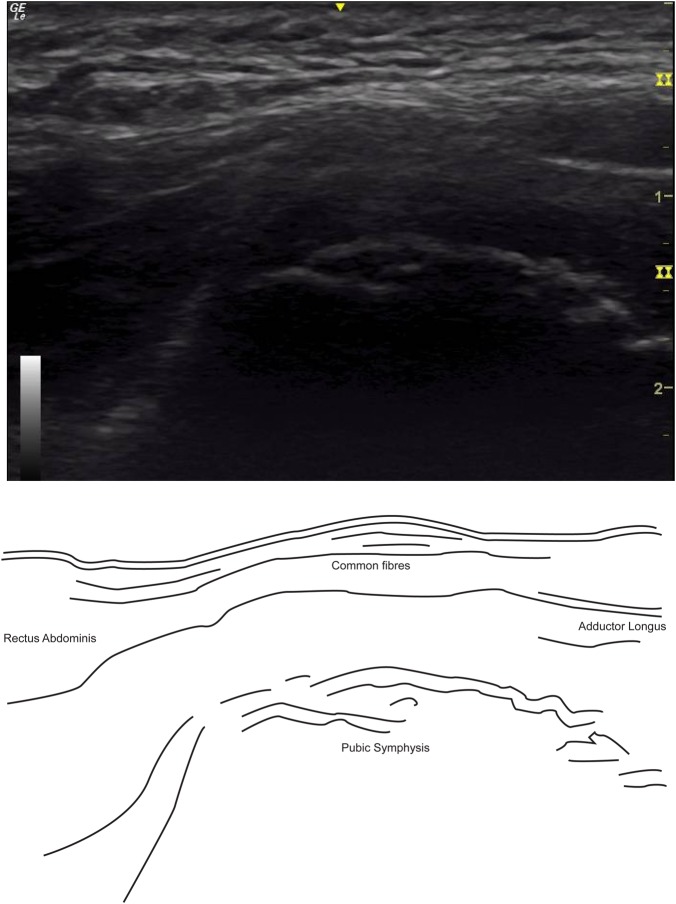
UltrasoundLongitudinal ultrasound of the pubic symphysis with orientation diagram: cortical irregularity at the junction of the common fibres of rectus abdominis and adductor longus, a region typical of athletic pubalgia.
Source : Sailly et al., British journal of sports medicine, 2015, figure 3 · CC BY-NC
The clinical diagnosis of ARGP rests on an objective triad recommended by the Doha agreement and by the evidence-based framework of Thorborg et al. (JOSPT 2018, PMID 29510653):¹,²
- Palpation reproducing the familiar pain : deep, progressive palpation of the insertion of the adductor longus tendon on the pubic tubercle. This is the most consistent and most localising sign.¹ Excellent sensitivity, more limited specificity (pubic pain also occurs in osteitis pubis).
- Pain on resisted hip adduction : test in supine at different angles of hip flexion (0°, 45°, 90°) to load different portions of the adductor group. The Hölmich test at 0° with manual resistance above the medial malleoli is the most widely used.⁷
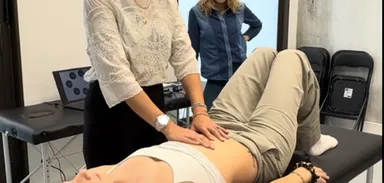
- Squeeze test (hip compression test) : supine, hips at 45° or 90° of flexion, asking the patient to squeeze the examiner's fist between their knees. Reproduction of the familiar pain = a positive test.⁸ Good intra- and inter-examiner reliability when standardised.⁷
Imaging is not required first line if the clinical picture is clear.² It becomes indispensable for ruling out other diagnoses in cases of doubt, severe trauma, red flags, or failure of conservative treatment.⁹,¹⁰ Caution: MRI detects abnormalities (pubic bone marrow oedema, adductor longus changes) in a high proportion of asymptomatic athletes, up to 71 % in some cohorts (Branci 2015 BJSM, PMID 25512059). A positive image therefore does not necessarily mean a symptomatic cause: imaging must be precisely correlated with the clinical examination.¹¹
| Diagnosis | Suggestive features | Key test | Level of evidence |
|---|---|---|---|
| ARGP (adductors) | Tender palpation of adductor longus, familiar pain on resisted adduction | Squeeze test + | High |
| Iliopsoas-related | Anterior groin pain, possible hip snapping | Resisted hip flexion at 90° +, Thomas test | Moderate |
| Pubic-related (osteitis pubis) | Exquisite tenderness over the symphysis, bone pain | Symphysis compression +, MRI bone marrow oedema | Moderate |
| Inguinal-related (sportsman's hernia) | Inguinal bulge on coughing, pain on Valsalva | Examination of the inguinal wall + dynamic ultrasound | Moderate |
| Hip-related (FAI / labrum) | Pain in a C-sign distribution, stiffness in hip internal rotation | FADIR +, FABER +, MR arthrography | High |
| Pubic stress fracture | Cumulative trauma, bone pain at night, possible REDs | MRI, bone scan | High |
| L1-L2 radiculopathy | Paraesthesia, motor weakness, referred pain | Full neurological examination, SLR | Moderate |
| Urogenital condition | Dysuria, testicular pain, fever | Specific examination + urine testing | Moderate |
Should patients be classified by the Doha agreement entities?
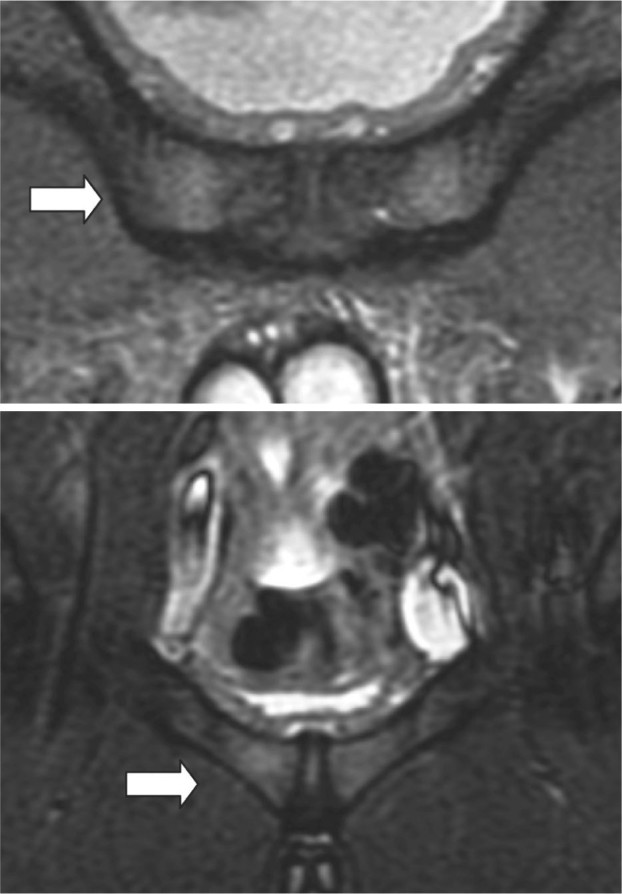
MRIMRI of the pubis in a professional footballer, two slices: marrow oedema overlying the pubic symphysis, arrows, suggestive of osteitis pubis associated with athletic pubalgia.
Source : Branco et al., Revista brasileira de ortopedia, 2010, figure 2 · CC BY-NC-ND
Yes, systematically. The Doha classification is considered a fundamental element of effective management and of clear communication between clinicians and researchers.¹ It replaces the vague, catch-all term “pubalgia” with a precise diagnosis based on the anatomical and clinical entity responsible for the symptoms.¹²
The Doha 2015 system defines five clinical entities for groin pain:¹
- Adductor-related : tender palpation of adductor longus + familiar pain on resisted adduction.
- Iliopsoas-related : palpation of iliopsoas (the anterior groin region, laterally) + pain on resisted hip flexion + pain on stretch (modified Thomas).
- Pubic-related : tenderness on direct palpation of the pubic symphysis or the adjacent pubic ramus, with no criteria met for the adductor or iliopsoas entities.
- Inguinal-related : pain reproduced on palpation of the inguinal canal, worsened by Valsalva or coughing. No palpable hernia.
- Hip-related : groin pain of suspected intra-articular origin, with positive FADIR or FABER tests.
In practice, mixed clinical presentations are frequent (a patient can have adductor-related AND pubic-related pain at once).¹,¹³ The optimal treatment strategy for these cases remains less clearly defined than for the pure entities, but the generally recommended approach is to treat the dominant entity while taking the other components into account.¹²
“Without a precise classification, the best treatment programme can be applied to the wrong condition. Without a rigorous clinical examination and triage by entity, efficacy falls away sharply.”
Key points, chapter 2
- Diagnosis is essentially clinical : the triad of adductor longus palpation + resisted adduction + squeeze test. Reproducing the patient's familiar pain = the key criterion.
- Use the Doha classification into 5 clinical entities systematically, to steer treatment.
- Imaging is not indicated first line : reserve it for red flags, diagnostic doubt, or failure at 3-6 months.
- Beware MRI abnormalities in asymptomatic athletes (up to 71 %). Always correlate clinical findings with imaging.
- Critical differential diagnoses: FAI, osteitis pubis, stress fracture, sportsman's hernia, radiculopathy.
Bibliography, chapter 2
- Weir A, Brukner P, Delahunt E, et al. Doha agreement meeting on terminology and definitions in groin pain in athletes. Br J Sports Med. 2015;49(12):768-774. PMID 26031643
- Thorborg K, Reiman MP, Weir A, et al. Clinical Examination, Diagnostic Imaging, and Testing of Athletes With Groin Pain: An Evidence-Based Approach to Effective Management. J Orthop Sports Phys Ther. 2018;48(4):239-249. PMID 29510653
- Serner A, Tol JL, Jomaah N, et al. Diagnosis of Acute Groin Injuries: A Prospective Study of 110 Athletes. Am J Sports Med. 2015;43(8):1857-64. PMID 25977522.
- Whittaker JL, Small C, Maffey L, Emery CA. Risk factors for groin injury in sport: an updated systematic review. Br J Sports Med. 2015;49(12):803-809. PMID 25833903
- Mosler AB, Agricola R, Weir A, Hölmich P, Crossley KM. Which factors differentiate athletes with hip/groin pain from those without? A systematic review with meta-analysis. Br J Sports Med. 2015;49(12):810-816. PMID 26031646
- Gabbett TJ. The training-injury prevention paradox. Br J Sports Med. 2016;50(5):273-280. PMID 26758673
- Thorborg K, Hölmich P, Christensen R, Petersen J, Roos EM. The Copenhagen Hip and Groin Outcome Score (HAGOS): development and validation according to the COSMIN checklist. Br J Sports Med. 2011;45(6):478-491. PMID 21478502
- Hölmich P, Hölmich LR, Bjerg AM. Clinical examination of athletes with groin pain: an intraobserver and interobserver reliability study. Br J Sports Med. 2004;38(4):446-451. PMID 15273182
- Verrall GM, Slavotinek JP, Barnes PG, et al. Clinical risk factors for hamstring muscle strain injury: a prospective study with correlation of injury by magnetic resonance imaging. Br J Sports Med. 2001;35(6):435-439. PMID 11726483
- Robinson P, Salehi F, Grainger A, et al. Cadaveric and MRI study of the musculotendinous contributions to the capsule of the symphysis pubis. AJR Am J Roentgenol. 2007;188(5):W440-5. PMID 17449740.
- Branci S, Thorborg K, Bech BH, Boesen M, Nielsen MB, Hölmich P. MRI findings in soccer players with long-standing adductor-related groin pain and asymptomatic controls. Br J Sports Med. 2015;49(10):681-691. PMID 25512059
- Hölmich P. Long-standing groin pain in sportspeople falls into three primary patterns, a “clinical entity” approach: a prospective study of 207 patients. Br J Sports Med. 2007;41(4):247-252. PMID 17261557
- Falvey ÉC, King E, Kinsella S, Franklyn-Miller A. Athletic groin pain (part 1): a prospective anatomical diagnosis of 382 patients--clinical findings, MRI findings and patient-reported outcome measures at baseline. Br J Sports Med. 2016;50(7):423-30. PMID 26626272.
Which treatment strategies are the most effective for adductor tendinopathy?
Where do you start? What is the hierarchy of interventions?
Conservative management is universally recognised as the first-line treatment for ARGP.¹ The hierarchy places the active approach at the top of the treatment pyramid. The starting point is not complete rest (which delays the return and encourages deconditioning) but a targeted modification of load to reduce the provocative stresses on the adductor tendon junction.²
The initial intervention combines:
- Patient education : explaining the nature of the injury (an overload, non-inflammatory tendinopathy), the continuum model, the meaning of pain in a tendon context (a sign of irritability rather than of active structural damage), and the step-by-step treatment plan.³
- Load management : identifying the aggravating activities (sprints, changes of direction, kicking) and modifying or temporarily removing them. Maintaining general pain-free physical activity (cycling, swimming, pool running).²
- Early introduction of therapeutic exercise : starting with low to moderate intensity isometric contractions (an analgesic effect), then progressing to concentric and eccentric strengthening.⁴
What is the place of progressive exercise and of the Copenhagen Adduction?
Therapeutic exercise is the cornerstone of ARGP treatment, with a high level of evidence supporting its efficacy.¹,⁵ The historic reference programme is the Hölmich protocol, whose pivotal RCT published in the Lancet in 1999 (PMID 9989714) remains the pillar of the literature:⁶
“79 % of the athletes in the active training group returned to sport pain-free, against only 14 % in the passive treatment group (physical modalities and therapeutic advice alone).”
The Hölmich protocol is structured in two progressive modules (8-12 weeks):⁶
- Module 1 (weeks 1-2) : adductor isometrics (a ball between the knees), static abdominal work, balance, gentle stretching.
- Module 2 (weeks 3-8+) : adding concentric and eccentric loaded strengthening (ski slide-board, cable adduction, dynamic balance exercises), with progression of functional difficulty.
Modern approaches apply the same principles while personalising the progression to the patient and their sport. The general four-phase scheme recommended today is:
- Phase 1: Isometrics (weeks 0-2): static adductor contractions at different hip angles, for analgesia and early muscle activation. Loads 60-70 % MVC, 5 sets of 30-45 s, 3 times a week.⁷
- Phase 2: Progressive isotonic strengthening (weeks 2-6): concentric and eccentric exercise with progressive load. Copenhagen Adduction Exercise +++, side-lying hip adduction with a band or weight, lumbopelvic stability exercises.
- Phase 3: Plyometrics and functional work (weeks 6-10): lateral lunges, cutting drills, single-leg hops, controlled rotation exercises that simulate sport-specific demands.
- Phase 4: Sport-specific reintroduction (weeks 8-12+): a gradual return to running, progressive changes of direction, accelerations and decelerations, and kicking for the sports concerned.
Manual therapies, shockwave, injections: how effective are they really?
Although exercise is central, some adjunctive therapies have a place in a multimodal plan, mainly to modulate symptoms in the short term and make participation in the active programme easier.
🛡️ Manual therapies : soft-tissue massage, hip joint mobilisations, myofascial release and techniques on the lumbopelvic chain can reduce pain in the short term and improve range of motion. However, the evidence for long-term efficacy as a stand-alone treatment is limited.⁸ The recommended position: a temporary adjunct to create a window of opportunity allowing better tolerance of the exercises, never the main treatment.
⚡ Extracorporeal shockwave therapy (ESWT) : systematic reviews show a moderate positive effect in chronic cases that do not respond to rehabilitation alone (the data are mainly on insertional overload tendinopathy in general).⁹ It must be built into a progressive exercise programme.
💊 Injections : corticosteroids can give short-term relief but are controversial because of the risk of tendon weakening and the loss of effect in the medium to long term. PRP (Platelet-Rich Plasma) has given mixed results in recent meta-analyses, with no consistent superiority over placebo in tendinopathies generally.¹⁰ Injections should remain a last conservative resort, before surgery is discussed for selected cases.
| Intervention | Mechanism | Expected effect | Level of evidence |
|---|---|---|---|
| The Hölmich programme (active) | Progressive adductor strengthening + stability | Return to sport ~80 % at 8-12 weeks | High (pivotal RCT) |
| Copenhagen Adduction Exercise | Eccentric adductor strengthening | +9 to +36 % eccentric strength in 8 weeks | High (multiple RCTs) |
| Patient education | Understanding, alliance, adherence | Adherence up, kinesiophobia down | Moderate |
| Manual therapy (adjunct) | Pain modulation, mobility | A short-term effect only | Low on its own |
| Shockwave (ESWT) | Tissue stimulation, neoangiogenesis | A chronic-case adjunct only | Moderate in chronic cases |
| Corticosteroid injection | Local anti-inflammatory | Short-term relief, with risks | Low (controversial) |
| PRP | Release of growth factors | Mixed results vs placebo | Very low |
| Surgery (tenotomy / hernia) | Release / structural repair | Good results in a selected case | Moderate (selected cases) |
Beyond the physical: how do you educate the patient and address psychological factors?
A purely biomedical approach is often insufficient for chronic pain.Therapeutic education and attention to psychosocial factors are essential components of successful management.³
🧠 Therapeutic education : explain to the patient that pain in a tendinopathy does not necessarily mean continuing tissue damage, but rather a sensitivity to load. That reduces fear of movement (kinesiophobia) and encourages adherence to the programme. It is essential to set realistic expectations : the mean time to return to sport after a groin injury is about 12-16 weeks, with wide individual variation.¹¹
🧘♂️ Psychological factors : actively screen for kinesiophobia (TSK-11), pain catastrophising (PCS) and anxiety about returning to sport. Reassuring communication, progressive goals and highlighting intermediate successes all strengthen self-efficacy. Graded exposure to the “feared” movements is an effective strategy for overcoming kinesiophobia.¹²
Key points, chapter 3
- Exercise is king : a progressive active programme plus the Copenhagen Adduction Exercise. Hölmich's pivotal RCT (Lancet 1999) shows 79 % returning to sport pain-free against 14 % with passive treatment.
- The sequence: isometrics (analgesia) -> concentric/eccentric -> plyometrics -> sport-specific functional work.
- Both manual therapies and shockwave are useful short-term adjuncts but no substitute for active exercise.
- The injection options (corticosteroid, PRP) are to be reserved for selected cases: limited evidence, and tendon risks with corticosteroids.
- Patient education and attention to the psychosocial dimensions are indispensable in chronic presentations.
Bibliography, chapter 3
- Thorborg K, Reiman MP, Weir A, et al. Clinical Examination, Diagnostic Imaging, and Testing of Athletes With Groin Pain: An Evidence-Based Approach to Effective Management. J Orthop Sports Phys Ther. 2018;48(4):239-249. PMID 29510653
- Weir A, Brukner P, Delahunt E, et al. Doha agreement meeting on terminology and definitions in groin pain in athletes. Br J Sports Med. 2015;49(12):768-774. PMID 26031643
- Moseley GL, Butler DS. Fifteen Years of Explaining Pain: The Past, Present, and Future. J Pain. 2015;16(9):807-813. PMID 26051220
- Rio E, Kidgell D, Purdam C, et al. Isometric exercise induces analgesia and reduces inhibition in patellar tendinopathy. Br J Sports Med. 2015;49(19):1277-1283. PMID 25979840
- Esteve E, Rathleff MS, Bagur-Calafat C, Urrutia G, Thorborg K. Prevention of groin injuries in sports: a systematic review with meta-analysis of randomised controlled trials. Br J Sports Med. 2015;49(12):785-791. PMID 25730819
- Hölmich P, Uhrskou P, Ulnits L, et al. Effectiveness of active physical training as treatment for long-standing adductor-related groin pain in athletes: randomised trial. Lancet. 1999;353(9151):439-43. PMID 9989713.
- Yousefzadeh A, Shadmehr A, Olyaei GR, Naseri N, Khazaeipour Z. The Effect of Therapeutic Exercise on Long-Standing Adductor-Related Groin Pain in Athletes: Modified Hölmich Protocol. Rehabil Res Pract. 2018;2018:8146819. PMID 29721339
- Ishoi L, Sorensen CN, Kaae NM, Jorgensen LB, Hölmich P, Serner A. Large eccentric strength increase using the Copenhagen Adduction exercise in football: A randomized controlled trial. Scand J Med Sci Sports. 2016;26(11):1334-1342. PMID 26589483
- Korakakis V, Whiteley R, Tzavara A, Malliaropoulos N. The effectiveness of extracorporeal shockwave therapy in common lower limb conditions: a systematic review including quantification of patient-rated pain reduction. Br J Sports Med. 2018;52(6):387-407. PMID 28954794
- Filardo G, Di Matteo B, Kon E, Merli G, Marcacci M. Platelet-rich plasma in tendon-related disorders: results and indications. Knee Surg Sports Traumatol Arthrosc. 2018;26(7):1984-1999. PMID 27665095.
- Serner A, Weir A, Tol JL, et al. Return to Sport After Criteria-Based Rehabilitation of Acute Adductor Injuries in Male Athletes: A Prospective Cohort Study. Orthop J Sports Med. 2020;8(1):2325967119897247. PMID 32064292
How do you secure lasting recovery and prevent recurrence?
How do you make the patient an active participant in their recovery through self-management?
Actively involving the patient is a decisive factor in long-term success. The aim is to give the patient the tools they need to understand their condition, interpret their symptoms and modulate their activities independently.¹
🎯 The pillar of self-management is monitoring and managing pain and load. The patient learns to use the VAS (Visual Analogue Scale) to guide their progression by the 24 h rule :²
- Acceptable pain during the exercise: ≤ 4/10 on the VAS.
- No worsening the next day (the following morning).
- No prolonged joint stiffness.
- The ability to repeat the exercise at the next session with pain stable or decreasing.
This method avoids the “overload -> reaction -> rest” cycle that prolongs rehabilitation. It lets the patient adjust volume and intensity day by day, favouring progressive tissue adaptation rather than recurrent irritation.³
“The patient who understands that their tendon pain is not damage but the signature of an exceeded load moves from a defensive stance to a proactive one: they become the pilot of their own return.”
When and how should a safe return to sport be planned?
The return to sport (Return To Sport, RTS) must never be dictated by the time elapsed since the injury but by meeting a series of objective functional criteria.⁴ A successful return is defined not only by resuming competition but by sustaining it over time (at least 2 months) with no significant recurrence.⁵
Planning proceeds in several stages, each of which must be cleared before the next:
- Pain control and restoring the basics : the patient must be symptom-free in ADLs and in the basic exercises. A pain-free squeeze test. Symmetrical strength on manual isometric testing.⁷
- Restoring strength and neuromuscular control : specific strength criteria. An adductor-to-abductor strength ratio > 80 % is a key indicator drawn from the risk-factor literature.⁸ Adductor strength should be ≥ 90 % of the healthy side.⁵
- Progressive sport-specific reintroduction : linear running → curves → changes of direction → accelerations and decelerations → kicking and tackling. Each step is cleared by the absence of pain (≤ 4/10 on the VAS during and after).²
- Psychological readiness : assess with a validated scale such as the I-PRRS (Injury-Psychological Readiness to Return to Sport). Fear of recurrence can impair performance and increase the risk of a new injury.⁹
In practice, preventing long-term recurrence means building specific programmes into the athlete's routine. The Adductor Strengthening Programme (ASP) of Haroy et al. (BJSM 2019, PMID 29891614), built on 3 progressive sets of the Copenhagen Adduction Exercise once a week in pre-season then once a week in season, demonstrated a 41 % reduction in the risk of groin injury in a cluster-RCT of 652 Norwegian amateur footballers.¹⁰ This simple programme, quick to run (5 minutes) and cheap (a partner is enough to stabilise the ankles), is now the recommended preventive standard for men's football and other at-risk sports.
Signals of a poor prognosis or imminent recurrence:
- Returning to sport without meeting the objective strength criteria.
- A squeeze test that remains painful, even mildly.
- An adductor-to-abductor ratio < 80 % at the time of RTS.
- A recent groin injury on the same or the opposite side.
- High kinesiophobia (TSK-11 > 37) with no psychological support.
- No preventive programme built in after RTS.
Key points, chapter 4
- Self-management: education in the 24 h rule (pain ≤ 4/10 on the VAS, no worsening the next day) gives the patient responsibility.
- RTS = criteria > calendar : strength symmetry ≥ 90 %, an add/abd ratio > 80 %, a pain-free squeeze test, tolerance of sport-specific work.
- Psychological readiness : assess kinesiophobia and the I-PRRS before the final return.
- Preventing recurrence : build the Adductor Strengthening Programme (Copenhagen Adduction Exercise) into the routine, a demonstrated 41 % risk reduction (Haroy 2019 BJSM).
Bibliography, chapter 4
- Caneiro JP, Roos EM, Barton CJ, et al. It is time to move beyond 'body region silos' to manage musculoskeletal pain: five actions to change clinical practice. Br J Sports Med. 2020;54(8):438-439. PMID 31604698.
- Silbernagel KG, Thomeé R, Eriksson BI, Karlsson J. Continued sports activity, using a pain-monitoring model, during rehabilitation in patients with Achilles tendinopathy: a randomized controlled study. Am J Sports Med. 2007;35(6):897-906. PMID 17307888.
- Ardern CL, Glasgow P, Schneiders A, et al. 2016 Consensus statement on return to sport from the First World Congress in Sports Physical Therapy, Bern. Br J Sports Med. 2016;50(14):853-864. PMID 27226389
- Serner A, Weir A, Tol JL, et al. Return to Sport After Criteria-Based Rehabilitation of Acute Adductor Injuries in Male Athletes: A Prospective Cohort Study. Orthop J Sports Med. 2020;8(1):2325967119897247. PMID 32064292
- Mosler AB, Agricola R, Weir A, Hölmich P, Crossley KM. Which factors differentiate athletes with hip/groin pain from those without? A systematic review with meta-analysis. Br J Sports Med. 2015;49(12):810-816. PMID 26031646
- Thorborg K, Reiman MP, Weir A, et al. Clinical Examination, Diagnostic Imaging, and Testing of Athletes With Groin Pain. J Orthop Sports Phys Ther. 2018;48(4):239-249. PMID 29510653
- Thorborg K, Hölmich P, Christensen R, Petersen J, Roos EM. The Copenhagen Hip and Groin Outcome Score (HAGOS): development and validation according to the COSMIN checklist. Br J Sports Med. 2011;45(6):478-491. PMID 21478502
- Webster KE, Feller JA, Lambros C. Development and preliminary validation of a scale to measure the psychological impact of returning to sport following anterior cruciate ligament reconstruction surgery. Phys Ther Sport. 2008;9(1):9-15. PMID 19083699
- Haroy J, Clarsen B, Wiger EG, et al. The Adductor Strengthening Programme prevents groin problems among male football players: a cluster-randomised controlled trial. Br J Sports Med. 2019;53(3):150-157. PMID 29891614
What do real clinical cases teach us about groin pain?
Analysis of a “classic” case in an amateur footballer.
The “classic” ARGP case is a male footballer or ice hockey player with gradual-onset pain at the adductor insertion on the pubis, worsened by accelerations, changes of direction and kicking.
🎯 The verified case report of Yousefzadeh et al. (2018, PMC IJSPT, PMID 29721339) illustrates multimodal management in 37 athletes (amateur footballers) with long-standing ARGP (duration > 2 months). The intervention combined:¹
- Patient education : explaining the condition, load management, and the importance of adhering to the programme.
- Manual therapy : used in the short term to modulate pain and improve hip and pelvic mobility.
- A modified Hölmich progressive exercise programme : the pillar of treatment, starting with pain-free isometrics then progressing to concentric and eccentric work, including functional exercises.
The results showed a significant improvement in pain (VAS down 2.5 points on average), in adductor strength and in HAGOS scores after 8 weeks of the programme, with most participants returning to football pain-free.¹ That timescale (8-12 weeks) is consistent with the literature for well-conducted active management in the amateur footballer.²
📍 Key lessons :
- Do not confuse “long-standing” with “incurable”: even after more than 2 months, a properly conducted active approach gives good results.
- The programme should be progressive and tolerable (the 24 h rule) rather than maximal from the outset.
- Education and adherence matter as much as the technical content of the exercises.
The diagnostic challenge: when ARGP mimics or accompanies other conditions.
🕵️♂️ The groin is an anatomically complex crossroads. Pain can arise from multiple structures and diagnostic confusion is frequent.
Several common mimics or comorbidities are documented:
- Hip pathology (FAI, labral involvement) : femoroacetabular impingement can cause pain referred to the groin, often with a typical C-sign (the patient cups their hip between thumb and index finger). The FADIR and FABER tests are key. The prospective cohort study of Falvey et al. (2016 BJSM, PMID 26644112) in 382 athletes showed that 17 % of those presenting with groin pain in fact had intra-articular hip pathology.³
- Iliopsoas-related pain : anterior or medial groin pain, reproduced by resisted hip flexion at 90° and by the modified Thomas test. Often confused with ARGP.
- Osteitis pubis : a band of pubic pain, exquisitely tender on direct palpation of the symphysis, often seen in footballers. It can coexist with ARGP.
- Sportsman's hernia (“sportsman's groin”): pain worsened by coughing and Valsalva, sometimes with an inguinal bulge. Diagnosis is difficult, often confirmed by dynamic ultrasound and a surgical opinion.
- Pubic stress fracture : above all in long-distance runners, in a context of REDs (Relative Energy Deficiency in Sport). Bone pain at night, bone marrow oedema on MRI.
The case report of Bisciotti et al. (2015 Muscles Ligaments Tendons J, PMID 26261782) describes a professional footballer with persistent groin pain initially read as simple ARGP, in whom imaging finally revealed osteitis pubis requiring a different treatment approach (prolonged offloading plus isometric work before resuming).⁴
Complex case studies: associations with FAI, sports hernia, multidisciplinary care.
🧩 In the elite athlete, groin pain frequently stems from several associated conditions :
1. ARGP + FAI : the study of Schilders et al. (KSSTA 2017, PMID 27475186) showed in a cohort of 41 patients that combined surgical treatment of the FAI (hip arthroscopy) and of the adductor tendinopathy (selective tenotomy) gave favourable results in chronic cases resistant to conservative treatment.⁵ That suggests FAI can be an underlying mechanical factor creating excessive stress on the adductors, and that ignoring the hip pathology can lead to failure when the tendinopathy is treated in isolation.
2. ARGP + sportsman's hernia : a classic but difficult association to manage. Rehabilitation alone can be insufficient. Paajanen et al. (Br J Sports Med 2011, PMID 20542963) published a case series showing that combined surgical repair of the inguinal wall plus treatment of the adductor tendon allows a satisfactory return to play.⁶
3. ARGP resistant to rehabilitation : may be considered for percutaneous adductor tenotomy. Older case studies (Akermark & Johansson, AJSM 1992 PMID 1416982) reported good results with this procedure in elite athletes at a therapeutic impasse.⁷ The surgical option nonetheless remains a last resort after a well-conducted active programme has failed over at least 3-6 months.
“Imaging plays a key role in identifying the athletes unlikely to respond to conservative treatment. Yet the high prevalence of MRI abnormalities in asymptomatic athletes urges us never to treat an image, but a clinical patient.”
Key points, chapter 5
- The diagnosis is clinical above all: adductor longus palpation + resisted adduction + squeeze test. Typical cases respond well to an active programme at 8-12 weeks.
- Always consider the differential diagnoses : FAI (17 % of the Falvey 2016 cohort), iliopsoas, osteitis pubis, sportsman's hernia, stress fracture.
- The complex cases often combine several conditions (FAI + adductor, hernia + adductor). A multidisciplinary approach (surgeon, radiologist, sports physician, physiotherapist) is essential.
- Any surgery must be a last resort after a well-conducted active programme has failed over at least 3-6 months.
Bibliography, chapter 5
- Yousefzadeh A, Shadmehr A, Olyaei GR, Naseri N, Khazaeipour Z. The Effect of Therapeutic Exercise on Long-Standing Adductor-Related Groin Pain in Athletes: Modified Hölmich Protocol. Rehabil Res Pract. 2018;2018:8146819. PMID 29721339
- Hölmich P, Uhrskou P, Ulnits L, et al. Effectiveness of active physical training as treatment for long-standing adductor-related groin pain in athletes: randomised trial. Lancet. 1999;353(9151):439-43. PMID 9989713.
- Falvey ÉC, King E, Kinsella S, Franklyn-Miller A. Athletic groin pain (part 1): a prospective anatomical diagnosis of 382 patients--clinical findings, MRI findings and patient-reported outcome measures at baseline. Br J Sports Med. 2016;50(7):423-30. PMID 26626272.
- Bisciotti GN, Volpi P, Alberti G, et al. Italian consensus statement (2020) on return to play after lower limb muscle injury in football (soccer). BMJ Open Sport Exerc Med. 2019;5(1):e000505. PMID 31673400.
- Schilders E, Dimitrakopoulou A, Cooke M, Bismil Q, Cooke C. Effectiveness of a selective partial adductor release for chronic adductor-related groin pain in professional athletes. Am J Sports Med. 2013;41(3):603-7. PMID 23408590.
- Paajanen H, Brinck T, Hermunen H, Airo I. Laparoscopic surgery for chronic groin pain in athletes is more effective than nonoperative treatment: a randomized clinical trial with magnetic resonance imaging of 60 patients with sportsman's hernia. Surgery. 2011;150(1):99-107. PMID 21549403
- Akermark C, Johansson C. Tenotomy of the adductor longus tendon in the treatment of chronic groin pain in athletes. Am J Sports Med. 1992;20(6):640-3. PMID 1456357.
- Branci S, Thorborg K, Bech BH, Boesen M, Nielsen MB, Hölmich P. MRI findings in soccer players with long-standing adductor-related groin pain and asymptomatic controls. Br J Sports Med. 2015;49(10):681-691. PMID 25512059
How do you apply these recommendations concretely in your practice?
When and to which other professionals should you refer?
One of the physiotherapist's fundamental skills in direct access is recognising the situations that go beyond their scope and call for referral. That process, known as triage, rests on identifying clinical flags.¹
🚩 Red flags : taken in isolation, their diagnostic accuracy is poor (high sensitivity, limited specificity).² Their strength lies in the combination and in overall clinical reasoning. A suspicious cluster or an atypical course should prompt prompt referral to a general practitioner or specialist for further assessment.³
🟨 Yellow, blue and black flags : psychosocial factors, work- and sport-related perceptions, systemic obstacles. Crucial for identifying patients at risk of chronic pain or prolonged disability.⁴
A significant presence of these factors should encourage interprofessional collaboration (IPC). Research shows that IPC in primary care improves patient outcomes, professional satisfaction and system efficiency.⁵ Referral can be to:
- A sports physician or orthopaedic surgeon : suspected FAI, a sportsman's hernia with a bulge, failure of an active programme at 3-6 months, doubt about a surgical indication (tenotomy, inguinal wall repair).
- A radiologist : for targeted imaging (MRI with pubic sequences, dynamic ultrasound for hernia).
- A psychologist or pain therapist : high kinesiophobia (TSK-11 > 37), catastrophising (PCS > 30), associated depression, anxiety about returning to sport.⁶
- A dietitian : suspected REDs in the endurance athlete, pubic bone abnormalities, associated stress fractures.
- An occupational physician or ergonomist : where obstacles to returning to work predominate in the non-sporting patient.
How do you measure outcomes and overcome barriers to implementation?
🎯 To make sure the interventions are effective and to make progress objective, using PROMs (Patient-Reported Outcome Measures) is the standard of patient-centred practice.⁷ For ARGP, the reference tool is the HAGOS (Copenhagen Hip and Groin Outcome Score, Thorborg 2011 BJSM, PMID 21478502), a questionnaire validated in French with 6 subscales:⁸
- Pain, Symptoms, Activities of Daily Living, Sport and Recreation, Participation in physical activity, Hip/groin-related quality of life.
- A score from 0 (extreme) to 100 (no problem) on each subscale.
- MCID (Minimal Clinically Important Difference): it varies by subscale, but an improvement of 10-15 points is generally considered clinically significant.
Other complementary measures:
- NPRS (Numerical Pain Rating Scale) 0-10 at each session and for the 24 h monitoring.
- Isometric strength tests at 0/45/90° of hip flexion with a handheld dynamometer. Calculating the adductor-to-abductor ratio and side-to-side symmetry.
- A graded squeeze test (force measured with a sphygmomanometer or dynamometer): it allows objective measurement and follow-up.
- Functional tests : single-leg hop, agility T-test, COD speed test, according to the sport.
- Psychological scales : TSK-11 (kinesiophobia), PCS (catastrophising), I-PRRS (readiness).
🚧 Barriers to implementation : systematic reviews identify the main ones:¹⁰
- Lack of time : the most frequent obstacle. Strategies: automate pre-filling of PROMs (online forms before the consultation), a targeted rather than exhaustive test battery.
- Limited access to resources : databases, journal subscriptions. Strategies: use PubMed (open access), French-language resources (HAS), professional networks.
- The inertia of habit : “I have always done it this way”. Strategies: targeted continuing education, communities of practice, mentoring.
- Resistance from the patient or the sporting staff : pressure for a fast return, unrealistic expectations. Strategies: shared education, transparent communication about the criteria.
“The risk that PROMs become a mere data-collection exercise rather than a tool for clinical dialogue is real. If the results are not actively used to adjust the plan, their implementation loses its point.”
Key points, chapter 6
- Clinical triage is a key skill: red flags (the combination matters more than any single item), yellow flags (kinesiophobia, catastrophising).
- Structured interprofessional collaboration is essential in complex cases: sports physician, surgeon, psychologist, dietitian.
- The HAGOS is the reference PROM for ARGP (6 subscales, validated in French).
- The isometric strength tests (the add/abd ratio, symmetry) are indispensable for objectifying the return to sport.
- Overcoming the barriers to implementation (time, resources, inertia) means continuing education, communities of practice and technological integration.
Physio Learning: an evidence-based clinical synthesis
This physiotherapy dossier is a checked synthesis on adductor tendinopathy / groin pain, based on the 2015 Doha agreement, Hölmich's pivotal RCT (Lancet 1999) and updated data from the Copenhagen Adduction programme (Ishoi 2016 SJMSS, Haroy 2019 BJSM). To cite this article or receive our next syntheses, find us at articles-pl.fr.
Discover the other syntheses →Bibliography, chapter 6
- Finucane LM, Downie A, Mercer C, et al. International Framework for Red Flags for Potential Serious Spinal Pathologies. J Orthop Sports Phys Ther. 2020;50(7):350-372. PMID 32438853
- Verhagen AP, Downie A, Popal N, Maher C, Koes BW. Red flags presented in current low back pain guidelines: a review. Eur Spine J. 2016;25(9):2788-2802. PMID 27376890
- Premkumar A, Godfrey W, Gottschalk MB, Boden SD. Red Flags for Low Back Pain Are Not Always Really Red: A Prospective Evaluation of the Clinical Utility of Commonly Used Screening Questions for Low Back Pain. J Bone Joint Surg Am. 2018;100(5):368-374. PMID 29509613
- Nicholas MK, Linton SJ, Watson PJ, Main CJ. Early identification and management of psychological risk factors (yellow flags) in patients with low back pain: a reappraisal. Phys Ther. 2011;91(5):737-753. PMID 21451099
- Reeves S, Pelone F, Harrison R, Goldman J, Zwarenstein M. Interprofessional collaboration to improve professional practice and healthcare outcomes. Cochrane Database Syst Rev. 2017;6(6):CD000072. PMID 28639262
- Santana MJ, Manalili K, Jolley RJ, Zelinsky S, Quan H, Lu M. How to practice person-centred care: A conceptual framework. Health Expect. 2018;21(2):429-440. PMID 29151269
- Thorborg K, Hölmich P, Christensen R, Petersen J, Roos EM. The Copenhagen Hip and Groin Outcome Score (HAGOS): development and validation according to the COSMIN checklist. Br J Sports Med. 2011;45(6):478-491. PMID 21478502
- Esteve E, Rathleff MS, Bagur-Calafat C, Urrutia G, Thorborg K. Prevention of groin injuries in sports: a systematic review with meta-analysis of randomised controlled trials. Br J Sports Med. 2015;49(12):785-791. PMID 25730819
- Alshehri MA, Alalawi A, Alhasan H, Stokes E. Physiotherapists' behaviour, attitudes, awareness, knowledge and barriers in relation to evidence-based practice implementation in Saudi Arabia: a cross-sectional study. Int J Evid Based Healthc. 2017;15(3):127-141. PMID 28399014.